Ai Overview
In 2026, digital transactions are expanding beyond major cryptocurrencies like Bitcoin and Ethereum, as people now use blockchain for CBDCs (Central Bank Digital Currencies), tokenized assets, digital identities, and Web3 applications. To securely own and transfer these digital assets, crypto wallets do not store coins directly, instead they store two cryptographic keys that control ownership and access, a public key and a private key.
Key Takeaways
A crypto wallet does not store coins or tokens; it manages private and public cryptographic keys that control access to blockchain assets.
Public keys (wallet addresses) are safe to share and are used to receive crypto, NFTs, and interact with Web3 applications.
Private keys prove ownership and authorize transactions; anyone with access to a private key has full control over the assets.
Losing a private key means permanent loss of crypto, as blockchain transactions are irreversible and have no recovery mechanism.
Private vs public keys in crypto wallets work together:
public keys enable receiving assets, while private keys securely sign and approve transfers.Wallets never hold crypto locally; all assets remain on the blockchain, and wallets act as secure key-management tools.
Different wallet types vary by where the private key is stored—custodial, non-custodial, hardware, paper, and multisig wallets each offer different trade-offs between convenience and security.
Custodial wallets offer ease of use but do not give true ownership, while non-custodial wallets grant full control and responsibility.
Rising adoption and increasing crypto wealth in 2025–2026 have made private-key theft a major security risk, accounting for a growing share of total crypto losses.
Phishing, malware, AI-driven attacks, and address-poisoning exploits are among the top threats targeting private keys.
Best security practices include hardware wallets, offline backups, seed phrase testing, separating hot and cold funds, and multisignature setups for high-value holdings.
Understanding private vs public keys in crypto wallets is now essential for financial safety, not optional, as crypto becomes a mainstream part of global finance.
Your private key is your power, your public address is your identity, and your security depends entirely on how responsibly you manage both.
In 2026 cryptocurrencies are no longer a niche technology they are becoming a normal part of global finance. Millions of people use crypto for trading, investing or payments and adoption continues to grow steadily. However many still misunderstand what a “crypto wallet” actually is. Understanding Private vs Public Keys in Crypto Wallets is essential for securing your funds and managing crypto wallet keys properly. It is not a bank account nor an app that stores money nor a place on the internet. A wallet is simply a tool to manage cryptographic keys that control your funds. Losing access to those keys often means losing your crypto permanently.
Understanding private and public key wallets is essential for anyone serious about protecting their digital assets. This guide provides a realistic easy-to-read explanation of how wallets work, how keys operate, the risks involved and practical advice for keeping your cryptocurrency wallet secure. It also incorporates recent 2025 data and projections for 2026 to highlight why proper key management has never been more important.
What Are Private vs Public Keys in Crypto Wallets
In 2026, digital transactions are expanding beyond major cryptocurrencies like Bitcoin and Ethereum, as people now use blockchain for CBDCs (Central Bank Digital Currencies), tokenized assets, digital identities, and Web3 applications. To securely own and transfer these digital assets, crypto wallets do not store coins directly, instead they store two cryptographic keys that control ownership and access, a public key and a private key.
Public Key
A public key in a crypto wallet acts as a receive address that you can safely share with anyone to accept digital assets, just like sharing a UPI ID or bank account number to receive money. It is generated from the private key using one-way cryptography, making it impossible to reverse and guess the private key from it. In 2026 public keys are becoming more versatile as they are increasingly linked to decentralized identities (DIDs), meaning one public key could soon be used not only to receive crypto but also to log into Web3 wallet, access metaverse assets, and interact securely with decentralized applications.
Private Key
A private key is a confidential code that proves ownership of the assets in your wallet and allows you to send or transfer them, similar to an ATM PIN or master password. Anyone who gains access to your private key can instantly steal, trade, or misuse your assets, and transactions cannot be reversed due to blockchain’s immutable nature. With the rise of AI-powered hacking in 2026 protecting private keys is more important than ever, driving users toward secure solutions like hardware wallets, biometric authentication, encrypted seed backups, and advanced cryptographic protection such as multi-party computation (MPC). Losing your private key means losing access to your digital assets permanently.
How Wallets Use Keys
A crypto wallet doesn’t actually store your cryptocurrency inside your phone, computer or any device. The coins themselves always remain on the blockchain, [1]
which is the public ledger that tracks all transactions. It stores private vs public keys in crypto wallets , which act like access tools that allow you to control and use your crypto. Think of the blockchain as a massive public locker room filled with thousands of lockers, each containing digital money. To open any locker you need a key. Your wallet is the tool that keeps these keys safe and allows you to use them when needed.
Every wallet works using private and public keys, which complement each other in crypto wallets, including an NFT wallet designed to store and manage non-fungible tokens. The first is the public key, often represented as a wallet address, which is used to receive funds and NFTs. You can safely share this address with anyone, similar to sharing your bank account number. The second is the private key, which must remain secret. This key allows you to send money, transfer NFTs, and authorize transactions, acting much like your ATM PIN or fingerprint. In an NFT wallet, the public and private keys work together like a lock and a key: the public key generates addresses where digital assets such as cryptocurrencies and NFTs can be received, while the private key provides cryptographic proof of ownership and access to those assets.
Difference Between Private vs Public Keys in Crypto Wallets
| Aspect | Public Key | Private Key |
|---|---|---|
| Definition | Cryptographic code derived from a private key, used to receive funds or information. Safe to share. | Secret cryptographic code that controls and grants access to digital assets. Must remain confidential. |
| Purpose | Allows others to send funds or encrypt data for you, identifies you without revealing sensitive info. | Signs transactions, decrypts data, and proves ownership; authorizes actions on blockchain. |
| Sharing | Designed to be shared openly, acts as a wallet address. | Must never be shared with anyone who can access your assets. |
| Generation | Derived mathematically from the private key using a one-way function. | Created first, randomly generated, and forms the foundation of the key pair. |
| Function in Security | Verifies digital signatures, ensures transactions/data come from the rightful sender. | Signs transactions/messages; ensures only the owner can authorize actions. |
| Role in Security | Enables trustless verification, visible and verifiable for everyone. | The security anchor of the wallet; controls access to funds and assets. |
| Risk if Exposed | No risk; safe to expose. | High risk; assets can be stolen and access lost permanently. |
| User Interaction | Shared for receiving payments or verification; simple to use. | Requires careful management, secure backup, and minimal direct interaction. |
Private vs public keys in crypto wallets mainly use two ways, receiving crypto and sending crypto. When you receive crypto, you simply share your wallet address and someone can send funds to it. The blockchain records the transaction as belonging to your wallet. Importantly you do not need to use your private key to receive funds only when you want to send them.
When you send crypto, the private key becomes your digital signature. The transaction starts when you enter the receiver’s wallet address and amount, after which the wallet uses your private key to sign the request securely. The key itself never leaves your device. Once signed, the transaction is broadcast to the blockchain, where nodes verify the signature using your public key. After the network confirms it as valid, the transfer is completed. This proves that Private vs Public Keys in Crypto Wallets work together to authorize transactions while keeping your private key safely hidden.
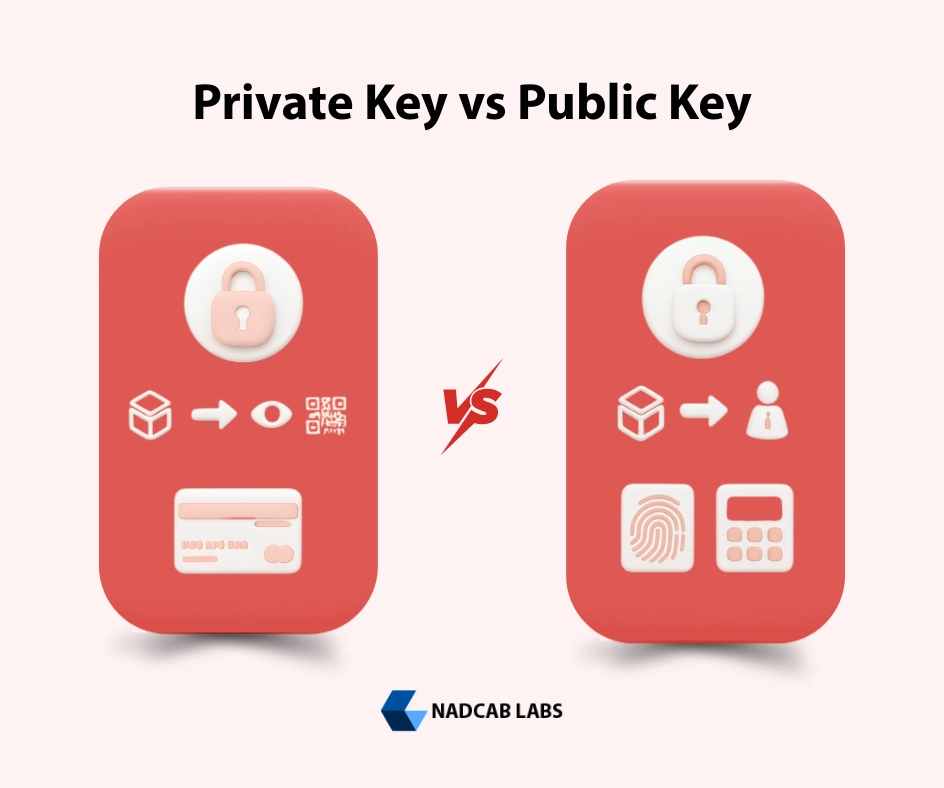
The key function of a wallet is not to store your digital coins, but to secure the private key, which acts as your access tool to digital assets. A wallet uses this private key to sign transactions safely while protecting it from hackers, malware, or accidental exposure. When understanding Private vs Public Keys in Crypto Wallets, the main focus is that the public key (or address) allows others to send funds to you, while the private key must remain secret to control and spend those funds. Different wallets whether mobile apps, exchange wallets, hardware devices, or multisignature solutions are designed to protect this private key in different ways. Your choice of wallet affects convenience, security, and ownership control, but the core principle always stays the same: safeguard the private key and use it correctly to manage crypto securely.
Different Types of Wallets and Where Your Key Lives
Not all wallets are created equal. Understanding private vs public keys in crypto wallets helps you choose the right wallet type and manage your keys safely. A critical distinction arises when comparing a custodial wallet vs non-custodial wallet, as the main difference lies in who controls the private key. In a custodial wallet, a third-party service manages the private keys on your behalf, offering convenience but requiring trust in the provider. In contrast, a non-custodial wallet gives you full control over your private keys, increasing security and ownership responsibility. This control ultimately determines how secure your crypto assets are, how easily you can use the wallet, and who is accountable if anything goes wrong.
| Wallet Type | Who Holds the Private Key? / Where Is It Stored? | What This Means for You |
|---|---|---|
| Custodial Wallets (e.g., Exchange Wallets) | The exchange or company controls the private key not you. | Very easy to use (like a bank), but you don’t truly own your crypto. If the platform blocks withdrawals or gets hacked, you can lose funds. |
| Non-Custodial Software Wallets (Mobile/Desktop) | The private key is created and stored on your phone or computer. You control it. | You fully own your crypto. Good for daily use. But if your device is lost, damaged, or hacked, you may lose access unless backed up. |
| Hardware Wallets (USB-like Devices) | The private key is stored inside a secure hardware device and never leaves it. | Extremely secure even if your phone/computer has a virus. Best for large savings. Requires buying a device and learning how to use it. |
| Paper / Air-Gapped Wallets | The private key is written or engraved on paper/metal and kept completely offline. | Completely offline and hacker-proof. But easy to lose, tear, burn, or misplace. One mistake can permanently lose funds. |
| Multisig / Smart-Contract Wallets | Multiple private keys are required, or smart rules control access. | Very secure. Ideal for companies, teams, or high-value crypto. Harder to set up but reduces risk—no single key can lose everything. |
2026 Crypto Wallet Adoption and Risks
As of 2025, there were approximately 716 million [2] cryptocurrency users globally. Analysts project that by 2026, the number of crypto holders will surpass 820 million, driven by adoption in emerging markets, mobile wallets, and decentralized finance (DeFi wallet).
The wealth within the crypto ecosystem has grown dramatically. In 2025, an estimated 241,700 individuals worldwide became crypto millionaires, and this number is projected to reach around 320,000 by 2026. As more wealth enters blockchain markets, the security of digital assets becomes increasingly important. This rise makes understanding Private vs Public Keys in Crypto Wallets essential, because the private key ultimately decides who truly owns that wealth.
However, with growth comes risk. In 2025 alone, over US$ 2.17 billion was stolen from exchanges and wallet services, with the largest single hack (ByBit breach) accounting for US$ 1.5 billion roughly 69% of total losses. It notes that many stolen-fund victims are concentrated in the USA, Germany, Russia, Canada, Japan, Indonesia, and South Korea. Attacks on personal wallets also increased, with 23% of stolen value coming from individual user wallets.
Projections for 2026 indicate that crypto theft could exceed US$2.5 billion, with hackers increasingly targeting both centralized exchanges and users managing their own keys. As more people adopt digital assets, attacks like phishing, malware injections, and address-poisoning exploits are expected to rise. This highlights why understanding Private vs Public Keys in Crypto Wallets is becoming more critical than ever users who fail to protect their private keys may lose full control of their assets.

Best Practices for Secure Key Management
If you hold (or plan to hold) crypto even small amounts, adopting a few basic habits can greatly reduce risk. Here are recommended practices:
- If your holdings are significant, use a hardware wallet to protect your Private vs Public Keys in Crypto Wallets. Think of it as a secure, safe private key that resides offline, in a tamper-resistant device, and Never store your wallet private key online.
- Avoid storing your seed phrase or private key in plaintext on device, in email drafts, screenshots, notes, cloud storage, or copy/paste. These are very common ways keys are compromised, especially in phishing and malware attacks.
- Use offline backups to secure your wallet public key and seed phrase wallet or metal and ideally keep more than one copy, stored in different secure physical locations (for example: one at home safe, another in a bank’s safe deposit, or a trusted relative’s house).
- Separate your funds by purpose: treat part of your holdings as “hot funds” (small amounts, for frequent use) in software wallets, and the rest as “cold funds” (long-term savings) stored in more secure wallets (hardware, offline). This reduces exposure for your main investments.
- Always manually verify the recipient address before sending funds. Avoid relying on autofill, history, or pre-saved addresses attackers often exploit to trick users into sending to wrong addresses.
- Once you create a backup (seed phrase), test the recovery immediately, restore the wallet using the backup on a separate device and do a small test transfer. This ensures your backup is valid and usable, not a forgotten or mistyped phrase.
- If you manage high-value holdings, or run a business/family fund, consider multisig wallets or smart-contract wallets. Spreading control across multiple keys (or requiring multiple approvals) reduces risk of single-point failure and adds a layer of security.
- Finally stay alert. Keep device OS and wallet software updated. Don’t install suspicious apps or browser extensions. Avoid sharing sensitive information. Treat crypto like a serious financial asset not a “toy”.
The Future of Security Starts With Your Keys
A crypto wallet is a digital safe-box controlled by your Private vs Public Keys in Crypto Wallets. Where and how you store your keys defines your wallet key security. Where and how you store your keys on exchanges, software wallets, hardware devices, or offline backups defines the balance between security, convenience, and control.
In its report, the exchange said it found that 40.8% of all crypto security incidents this year involved fraudsters deceiving victims through fake investment offers or impersonation tactics. The best way to protect yourself is through responsible key management, secure backups, layered security, and awareness of emerging threats. Your private key is your power. Your public address is your identity. Your security depends entirely on how you handle those keys.
Frequently Asked Questions?
Q1.What is a private key in a crypto wallet?
A private key is part of Private vs Public Keys in Crypto Wallets and gives full access to your wallet private key. It is a long, randomly generated code that gives you complete control over your digital assets. Anyone who gains access to your private key can access your funds and transfer them without your permission. That’s why it must always remain confidential and stored in a secure environment. You should never share it with anyone, store it in plain text, or upload it to the internet.
Q2.What is a public key?
The public key is the other half of Private vs Public Keys in Crypto Wallets, used in your wallet public key to receive funds. While the private key must stay secret, the public key can be safely shared with anyone because it only allows them to send crypto to your wallet, not withdraw anything. Public keys are part of the cryptographic process that ensures secure blockchain transactions without exposing sensitive information.
Q3.How is private key and public key connected?
Private and public keys are linked through a cryptographic process called asymmetric encryption. The private key is used to sign and authorize transactions, while the public key allows the blockchain network to verify that the signature truly belongs to the wallet owner. Even though they are mathematically connected, it is impossible to reverse-engineer a private key from a public key, which is a core security feature in the system of Private vs Public Keys in Crypto Wallets.
Q4.Can someone guess my private key from my public key?
No, it is virtually impossible for anyone to guess or calculate your private key from your public key. Most blockchains like Bitcoin use 256-bit cryptography, which is so secure that even the most powerful supercomputers in the world would need millions of years to crack just one private key. This extremely high level of security is one of the main reasons blockchain technology is trusted for financial transactions.
Q5.What happens if I lose my private key ?
If you lose your private key, you permanently lose access to your crypto wallet and all the assets stored within it. Unlike banks, crypto wallets are decentralized, so there is no support team or authority that can recover a lost key. This is why users are strongly advised to back up their private key or seed phrase in a secure offline location. Once it’s lost, the blockchain cannot restore access, emphasizing the critical importance of private key security when understanding Private vs Public Keys in Crypto Wallets.
Q6.Are private vs public keys in crypto wallets safe for beginners?
Yes, modern crypto wallets have evolved significantly and are generally safe for beginners as long as basic security practices are followed. Many wallets now include user-friendly features such as biometric login, social recovery, account abstraction, and secure onboarding flows that simplify private key management. These tools reduce the chances of accidental loss or theft, making it easier for newcomers to navigate the crypto space without fear of making irreversible mistakes.
Q7.What’s the difference between custodial and non-custodial key management?
The main difference between custodial and non-custodial key management comes down to who controls the private key. In a custodial wallet, the company or exchange stores your private key on your behalf, meaning they technically control your funds. This is convenient for beginners but carries risks such as exchange hacks, frozen accounts, or withdrawal limits. In a non-custodial wallet, you alone control your private key, which aligns with the core idea of Private vs Public Keys in Crypto Wallets, where owning the private key means owning the crypto itself. While non-custodial wallets offer maximum freedom and security, they also place full responsibility on the user to store and protect their keys safely.
Q8.Do private keys and public keys ever change?
Your private key usually remains the same for as long as the wallet exists, and it continues to control your funds as long as you have it. However, depending on the wallet type, your public key or wallet address can change. Some privacy-focused wallets generate a new address every time you receive funds to keep your activity more private. Despite new addresses being generated, the same private key still controls all of them.
Q9.How do wallets keep private keys safe?
Crypto wallets use several layers of modern security to protect private keys from unauthorized access. Most wallets encrypt private keys using advanced methods such as AES-256 encryption, while hardware wallets store keys inside secure chips that are isolated from the internet. Many smartphones use secure enclaves that keep private keys locked away even if the device is compromised. Additionally, multi-party computation (MPC) technology and biometric authentication add extra protection, making it extremely difficult for attackers to steal private keys.
Q10.What is the safest way to store private keys?
The safest way to store private keys is by using a hardware wallet combined with an offline backup of your seed phrase. Hardware wallets keep the private key completely offline, protecting it from internet-based attacks such as malware, phishing, or remote hacking. In the context of Private vs Public Keys in Crypto Wallets, the private key is the most critical to secure since it controls access to your funds, while the public key can be safely shared to receive payments. For added protection, advanced users often use cold storage solutions, multi-signature wallets, or MPC (Multi-Party Computation) wallets, which distribute key control across multiple parties. By keeping your private key offline and storing backups in secure, tamper-proof locations, you greatly reduce the risk of theft or unauthorized access.
Explore Services
Related Services
Reviewed by

Aman Vaths
Founder of Nadcab Labs
Aman Vaths is the Founder & CTO of Nadcab Labs, a global digital engineering company delivering enterprise-grade solutions across AI, Web3, Blockchain, Big Data, Cloud, Cybersecurity, and Modern Application Development. With deep technical leadership and product innovation experience, Aman has positioned Nadcab Labs as one of the most advanced engineering companies driving the next era of intelligent, secure, and scalable software systems. Under his leadership, Nadcab Labs has built 2,000+ global projects across sectors including fintech, banking, healthcare, real estate, logistics, gaming, manufacturing, and next-generation DePIN networks. Aman’s strength lies in architecting high-performance systems, end-to-end platform engineering, and designing enterprise solutions that operate at global scale.