Ai Overview
One of the most persistent friction points preventing mainstream adoption of Web3 applications is the requirement for users to hold native cryptocurrency before they can perform any on-chain action. The key benefit that unifies all approaches is the same: users interact with the application using only a wallet signature, and the economic cost of blockchain execution is absorbed elsewhere in the system. Gas fees create a compounding set of challenges that extend far beyond the simple financial cost of paying them.
Key Takeaways
- ✓Gasless and meta transactions solve the fundamental UX barrier of requiring users to hold ETH before interacting with any decentralized application for the first time.
- ✓ Meta transactions in Web3 use a relay architecture where a third-party relayer submits the signed transaction to the blockchain and pays the gas fee on behalf of the user.
- ✓EIP-712 typed structured data signing is the cryptographic foundation of gasless transactions, enabling wallets to display human-readable signing prompts without raw hex data.
- ✓EIP-2771 defines the Trusted Forwarder standard that smart contracts use to verify that a meta transaction originates from a legitimate relayer and correctly identifies the original signer.
- ✓ERC-4337 Account Abstraction represents the most comprehensive gasless Web3 transactions standard, enabling smart contract wallets with programmable gas sponsorship logic built directly into account contracts.
- ✓Gasless dApp transactions unlock entirely new application categories in Web3 gaming, NFT minting, and micro-payment DeFi that were previously uneconomical due to gas fee overhead.
- ✓Relayer services including Gelato Network, Biconomy, OpenGSN, and the Alchemy AA stack provide production-ready meta transaction infrastructure that eliminates the need to build relayers from scratch.
- ✓Replay attack prevention through nonce tracking is a non-negotiable security requirement for every meta transaction implementation, regardless of which standard or toolkit is used.
- ✓ Gas sponsorship models range from full protocol-subsidized gasless blockchain transactions to user-pays-in-ERC20 models where gas is abstracted but not eliminated from the system economics.
- ✓ Mass blockchain adoption in mainstream markets across the USA, UK, UAE, and Canada depends critically on removing the crypto-knowledge prerequisites that gas fees impose on new users.
Understanding Gasless Transactions in Web3
One of the most persistent friction points preventing mainstream adoption of Web3 applications is the requirement for users to hold native cryptocurrency before they can perform any on-chain action. When a first-time user in the UK downloads a crypto wallet, joins a Web3 gaming platform, or tries to claim an NFT, discovering that they need Ether just to click a button is often enough to end the journey entirely. Gasless Web3 applications solve this problem at the infrastructure level by shifting the gas payment responsibility from the user to the application or a dedicated relayer service. This architectural pattern, most commonly implemented through meta transactions, transforms the onboarding experience from a crypto literacy test into something that feels as natural as signing up for any other internet service. After eight years of building Web3 infrastructure for clients across the USA, UK, UAE, and Canada, we consistently see gasless transaction implementation as one of the highest-impact investments a Web3 product team can make in user experience quality.
What Are Gasless Transactions?
Gasless transactions are blockchain interactions where the end user does not directly pay the gas fee required to execute their transaction. The term “gasless” refers to the user-facing experience rather than the underlying blockchain mechanics: gas still exists and is still paid, but the payment is handled by a different party, typically the application protocol, a relayer service, or a smart contract configured as a paymaster. From the user’s perspective, they simply sign a message with their wallet, and their intended action executes on-chain without any ETH leaving their account. This experience is made possible by the cryptographic separation between message signing, which requires no gas and works without any ETH balance, and transaction submission, which requires gas and is handled by the relayer. Gasless transactions in Web3 can be implemented at different levels of the stack, from application-specific relay contracts to protocol-level standards like ERC-4337, and the appropriate approach depends on the specific application’s requirements, scale, and security model. The key benefit that unifies all approaches is the same: users interact with the application using only a wallet signature, and the economic cost of blockchain execution is absorbed elsewhere in the system.
Why Gas Fees Are a Challenge in Blockchain?
Gas fees create a compounding set of challenges that extend far beyond the simple financial cost of paying them. The first challenge is the prerequisite problem: new users must acquire native cryptocurrency through an exchange, complete KYC verification, wait for account approval, purchase ETH, and transfer it to their wallet before they can perform a single on-chain action in any application. This multi-step process introduces days of friction and requires comfort with financial infrastructure that most internet users have never used. The second challenge is the volatility problem: gas prices on Ethereum mainnet fluctuate by several orders of magnitude depending on network congestion, making cost estimation unreliable and occasionally rendering small-value transactions completely uneconomical when fees exceed the value being transferred. The third challenge is the mental model problem: users from the USA, Canada, and the UAE who are accustomed to internet services that cost nothing to use per-action struggle to understand why each button click in a decentralized application has a variable financial cost. The Web3 gas fees solution that meta transactions provide addresses all three of these challenges simultaneously by making gas invisible to the user entirely.
How Gasless Transactions Improve Web3 User Experience?
The user experience improvement from implementing gasless blockchain transactions extends across every stage of the user journey, from initial onboarding through ongoing engagement. During onboarding, new users can create a wallet and immediately begin using an application without any prior cryptocurrency acquisition, reducing the onboarding funnel from a multi-day process to a process that completes in minutes. During ongoing use, the cognitive overhead of evaluating each transaction’s gas cost against its value is eliminated, enabling spontaneous micro-interactions that feel natural rather than financially calculated. Users engaging with Web3 gaming microtransactions, NFT claiming events, or DAO governance votes no longer need to maintain minimum ETH balances or worry about gas price spikes preventing them from participating in time-sensitive protocol events. Applications built on gasless infrastructure report significantly higher engagement rates because the friction that previously caused users to abandon transactions partway through the signing flow is removed. For enterprise Web3 platforms targeting corporate users in the UK financial sector or retail customers in the UAE, the gasless experience is not a premium feature but a baseline requirement for any application that expects to achieve adoption outside the existing crypto-native user base.
Definition and Core Concept of Meta Transactions
A meta transaction is a signed message that encodes the user’s intended blockchain action in a format that a relayer can verify and execute on the user’s behalf. The core insight enabling meta transactions is that Ethereum’s cryptographic signature system allows anyone to verify that a specific Ethereum address signed a specific piece of data, without requiring that address to submit any transaction itself. A user signs a message containing the target contract address, the function call data, a nonce to prevent replay, and an expiry timestamp. This signed message is transmitted off-chain to a relayer (typically via a standard web API call), which constructs a blockchain transaction that calls the target contract with both the original action data and the user’s signature. The target contract verifies the signature, confirms the signer matches the expected user, checks the nonce, and executes the action as if the user had submitted it directly. The relayer pays all gas costs and is reimbursed through the application’s gas subsidy budget, the protocol’s treasury, or a fee charged to the user in a non-native token. This elegant mechanism achieves the user experience of gasless interaction while maintaining the security guarantees of on-chain action verification.
Difference Between Regular Transactions and Meta Transactions
| Aspect | Regular Transaction | Meta Transaction |
|---|---|---|
| Who pays gas | The user (msg.sender) | The relayer (on behalf of user) |
| ETH requirement | Must hold ETH for gas | Zero ETH balance required |
| Submission method | User submits to mempool | Relayer submits to mempool |
| Identity on-chain | msg.sender is the user | Recovered via signature verification |
| Signing step | Signs and broadcasts | Signs message only, no broadcast |
| User experience | Requires gas knowledge | Transparent to user |
| Security model | Native Ethereum auth | EIP-712 + nonce + forwarder |
| Replay protection | Built-in nonce | Must implement explicitly |
The operational difference between regular and meta transactions becomes most apparent when considering the user journey. In a regular transaction, the user must own ETH, set a gas price, submit the transaction, wait for inclusion, and monitor the mempool. In a meta transaction, the user signs a typed data message in their wallet (which displays a human-readable description of what they are authorizing), submits that signature to the relayer API, and receives confirmation when the relayer’s transaction confirms. The relayer abstracts the entire gas management lifecycle from the user’s perspective, making the interaction feel like an API call rather than a financial transaction. This is precisely the experience gap that meta transactions in Web3 were designed to close.
Why Meta Transactions Are Important for dApps?
Meta transactions in Web3 are architecturally important for decentralized applications for reasons that go beyond simple user convenience. They enable entirely new application categories and business models that are not viable with traditional gas-paying transaction models. Subscription-based Web3 services become possible when users authorize recurring actions through meta transaction signatures rather than manually approving each interaction. Micro-payment systems for content platforms, gaming items, and data purchases become economically viable when the per-transaction overhead of gas fees is eliminated from each individual micro-interaction. Mass-participation events like simultaneous NFT claiming by thousands of users, DAO snapshot voting implementations, and on-chain game move submissions become feasible without requiring every participant to manage gas prices under congested network conditions. For enterprise clients building customer-facing Web3 products in the USA and UAE, meta transactions are the technology that makes it possible to offer blockchain-backed functionality to mainstream consumers without those consumers ever needing to understand that blockchain is involved at all. The abstraction layer that meta transactions provide is, in this sense, one of the most strategically important technologies in the Web3 stack for driving real-world adoption.
Role of Users, Relayers, and Smart Contracts
The Three Parties in Every Meta Transaction
The User
- Signs EIP-712 typed message
- Specifies intended action data
- Pays zero gas directly
- Transmits signature off-chain
- Receives action confirmation
The Relayer
- Receives user’s signed message
- Validates signature and nonce
- Wraps in blockchain transaction
- Pays gas from own ETH wallet
- Seeks reimbursement from protocol
The Smart Contract
- Receives forwarded call
- Verifies EIP-712 signature
- Checks nonce for replay prevention
- Extracts real user address
- Executes action as user
Transaction Signing Without Paying Gas
The ability to sign a transaction without paying gas is the cryptographic foundation of the entire meta transaction architecture. In standard Ethereum, the ECDSA (Elliptic Curve Digital Signature Algorithm) that secures transactions is a pure mathematical operation that can be performed entirely off-chain, with no blockchain state change and therefore no gas cost. When a user signs a meta transaction, their wallet performs this ECDSA signature operation over the EIP-712 encoded message data, producing a 65-byte signature (r, s, v components) that cryptographically proves the wallet owner approved that specific message content. This signature is transmitted to the relayer via a standard HTTPS API call, exactly like any other web application API request. The entire signing step is computationally trivial and free of any blockchain interaction. The relayer then takes this signature and the original message data and constructs a proper Ethereum transaction that calls the forwarder contract. The forwarder contract uses Solidity’s built-in ecrecover function to verify that the provided signature matches the claimed signer address, validating the meta transaction’s authenticity without requiring any direct interaction from the user’s address.
How Relayers Submit Transactions to the Blockchain?
Relayers are the operational backbone of the meta transaction ecosystem, responsible for the reliable and economically viable submission of user-signed messages to the blockchain. A relayer is fundamentally a server-side service that listens for incoming signed meta transaction requests via an API endpoint, validates them according to the protocol’s business rules, and submits corresponding Ethereum transactions using its own funded Ethereum address. The relayer must maintain a sufficient ETH balance to fund transaction submissions, implement gas price estimation logic that ensures transactions confirm within acceptable time windows, and handle transaction replacement when gas prices spike and pending transactions become stuck. Sophisticated relayer services like Gelato Network and Biconomy implement additional features including transaction batching (combining multiple meta transactions into a single on-chain transaction to reduce per-transaction gas costs), automatic gas price bumping for stuck transactions, and multi-chain support that enables a single relayer integration to serve applications across Ethereum, Polygon, Arbitrum, and dozens of other networks. The economic model of relayer operation varies: protocol-owned relayers fund gas from protocol treasuries, third-party relayer services typically charge a fee above gas cost for their service, and decentralized relayer networks like OpenGSN use staking and slashing mechanisms to incentivize honest relayer operation.
Key Technologies Behind Meta Transactions
EIP-712 Typed Data Signing
EIP-712 is the Ethereum Improvement Proposal that defines the standard for signing typed structured data in a way that is both cryptographically secure and human-readable when displayed by wallets. Before EIP-712, signing arbitrary message data in wallets produced opaque hex strings that provided users with no understanding of what they were approving, creating both user experience problems and phishing vulnerability. EIP-712 defines a structured format for message types that allows wallets like MetaMask to display the contents of a signing request in a parsed, labeled format, showing the user exactly which fields they are authorizing with which values. For meta transactions, the EIP-712 message type typically includes fields for the target contract address, the encoded function call data, the user’s nonce, the gas limit, and an expiry timestamp. The structured hashing algorithm defined in EIP-712 ensures that the signed hash is unique to the specific domain (application and chain), preventing cross-chain and cross-application signature reuse. Every production meta transaction system built today uses EIP-712 as its signing standard, and wallet support for EIP-712 is ubiquitous across MetaMask, Coinbase Wallet, WalletConnect, and every other major wallet implementation used by mainstream consumers.
EIP-2771 Trusted Forwarder Standard
EIP-2771 is the smart contract standard that defines how recipient contracts should handle meta transactions forwarded by a trusted forwarder contract. The core problem it solves is the msg.sender ambiguity that arises in meta transactions: when a relayer submits a transaction through a forwarder, the recipient contract’s msg.sender is the forwarder’s address, not the original user’s address. Without a standard approach to resolving the real user’s identity, contracts cannot correctly attribute actions to users. EIP-2771 solves this by appending the original user’s address to the calldata and defining a standard _msgSender() function that recipient contracts override to extract the real sender from the appended data when called by a trusted forwarder. The trusted forwarder is the contract that validates signatures, checks nonces, and executes the forwarded call. The recipient contract’s trust in the forwarder is configured during deployment: only calls from trusted forwarder addresses should trigger the _msgSender() extraction logic. OpenZeppelin’s ERC2771Context contract provides a production-ready implementation of this pattern that Web3 teams can inherit directly in their smart contracts.[1] The standard is widely adopted across the Ethereum ecosystem and is the foundation of most current meta transaction implementations that do not use ERC-4337.
ERC-4337 Account Abstraction
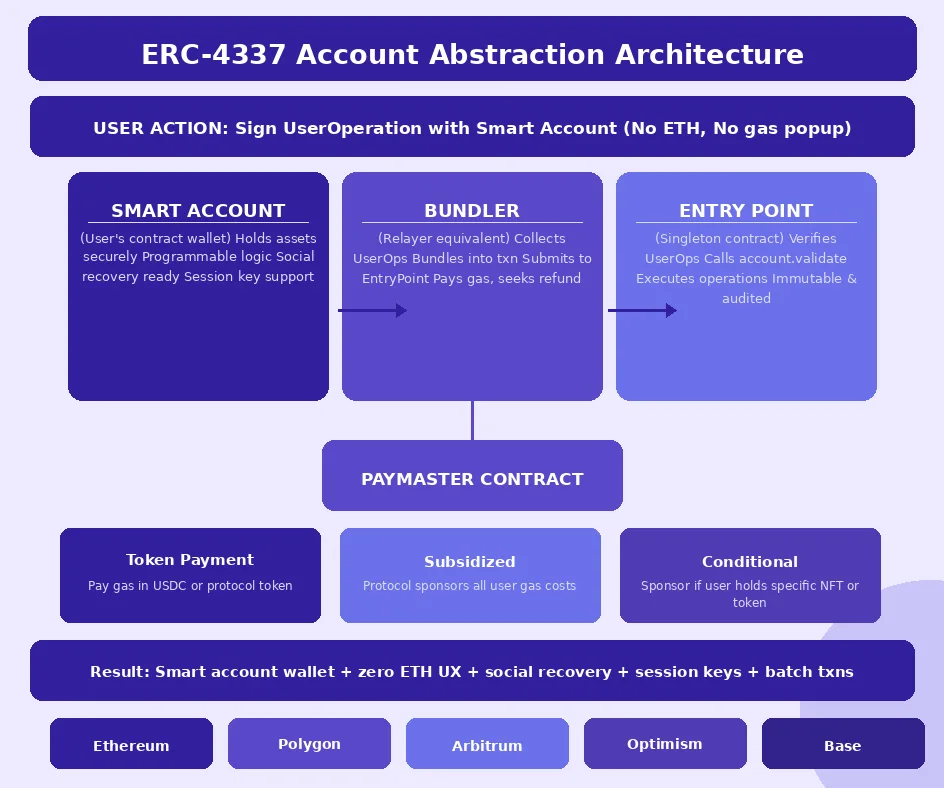
ERC-4337 represents the most significant advancement in Web3 gasless transactions architecture since meta transactions were first introduced. Rather than relying on a separate relay layer that wraps regular transactions, ERC-4337 redesigns the account model itself: users have smart contract wallets (called smart accounts) instead of externally owned accounts, and a new transaction type called a UserOperation replaces traditional transactions. The ERC-4337 ecosystem includes bundlers (analogous to relayers), which collect UserOperations from a separate mempool and bundle them into regular transactions, and paymasters, which are smart contracts that can sponsor gas fees for UserOperations based on programmable logic. A paymaster contract can decide to pay for a user’s transaction based on any on-chain condition: whether the user holds a specific NFT, whether the user has been whitelisted, whether they are paying in USDC rather than ETH, or simply as an unconditional subsidy for all users of a protocol. This programmable gas sponsorship model, combined with the self-custody security of smart account architecture, makes ERC-4337 the definitive future standard for gasless dApp transactions in the Ethereum ecosystem, with production deployments now active on Ethereum mainnet, Polygon, Arbitrum, Optimism, and Base.
Benefits of Gasless and Meta Transactions in Web3
Zero Onboarding Friction: New users in USA, UK, UAE, and Canada can begin using any gasless Web3 application without purchasing ETH or understanding blockchain mechanics, matching the onboarding quality of Web2 platforms.
Higher Conversion Rates: Applications implementing gasless dApp transactions consistently report significantly higher transaction completion rates because the gas confirmation step that caused user abandonment is eliminated from the interaction flow.
Micro-Transaction Viability: Gasless blockchain transactions make micro-payments and micro-actions economically viable by removing the gas overhead that previously made small-value interactions uneconomical compared to transaction costs.
Predictable Application Costs: Protocols can model and budget their gas subsidy costs as a user acquisition expense, converting variable unpredictable transaction fees into a manageable operational cost.
Token Flexibility: ERC-4337 paymasters enable users to pay for gas in ERC-20 tokens like USDC rather than ETH, giving applications more flexible monetization options without sacrificing the Web3 self-custody model.
Mass Event Participation: NFT minting events, DAO governance votes, and gaming tournaments can scale to thousands of simultaneous participants without each user needing to race to set optimal gas prices under congested conditions.
Improved User Onboarding
User onboarding is the single area where gasless Web3 applications deliver the most transformative improvement over traditional gas-paying models. The conventional Web3 onboarding journey requires new users to navigate a sequence of steps that each present opportunities for confusion, frustration, and abandonment: installing a browser extension wallet, understanding seed phrase security, navigating a cryptocurrency exchange, completing identity verification, purchasing ETH, waiting for settlement, transferring funds to the wallet, and finally returning to the application. Industry data consistently shows that multi-step onboarding flows with financial prerequisites have dramatically higher abandonment rates than single-step social login or email-based alternatives. Gasless transaction architecture compresses this entire sequence into: install wallet and sign a message. The signing step itself can be further streamlined with social login solutions and smart account creation services that create a funded smart wallet behind the scenes from a social login, reducing the onboarding to a zero-friction email sign-in that creates an embedded wallet automatically. For consumer Web3 applications targeting mainstream audiences in the UK and Canada, this onboarding quality improvement represents the difference between meaningful scale and crypto-native niche adoption.
Better User Experience in dApps
Beyond onboarding, gasless and meta transactions improve the ongoing user experience of decentralized applications in several important ways. Actions that previously required wallet popup approvals with confusing hex data and gas price fields now show clean, human-readable EIP-712 signing prompts that clearly describe what the user is authorizing. Workflows that previously required multiple separate wallet approvals (such as approve-then-transfer patterns) can be combined into batched meta transactions that execute as a single user action. Real-time applications like blockchain games can process user actions at the speed of web API calls rather than waiting for transaction confirmation, using optimistic updates while the relayer’s transaction confirms in the background. Error handling improves because the relayer layer can implement retry logic, transaction speed-up mechanisms, and user notifications for failed transactions without requiring users to manually manage stuck transactions. For DeFi applications, gasless interactions enable risk management actions like reducing leverage or repaying debt to succeed even when users have no ETH, a critical safety improvement for applications where the inability to act quickly can result in liquidation losses.
Lower Entry Barrier for New Users
The entry barrier reduction achieved by gasless blockchain transactions operates at multiple levels simultaneously, addressing economic, cognitive, and logistical barriers that have historically limited Web3 adoption to a technically sophisticated minority. At the economic level, eliminating the ETH prerequisite removes the requirement for new users to have a relationship with any cryptocurrency exchange before using their first decentralized application. At the cognitive level, removing gas fees from the user-facing experience eliminates the need for users to understand blockchain transaction mechanics, gas price markets, or the EVM execution model. At the logistical level, the simplified signing flow works without any browser extension in environments that support WalletConnect or social login-embedded wallets, enabling Web3 functionality in mobile applications and embedded contexts that are difficult or impossible with extension-based wallets. For enterprise Web3 deployments in the UAE financial services sector, where regulatory clarity around crypto asset ownership is evolving rapidly, the ability to offer blockchain-backed services without requiring customers to hold or manage cryptocurrency directly is a significant regulatory and operational advantage. Gasless transactions transform Web3 from a parallel financial system requiring separate tools and knowledge into an invisible technology layer enhancing familiar application experiences.
NFT Minting Without Gas Fees
NFT minting events represent one of the most commercially impactful and technically straightforward applications of gasless transaction infrastructure. In a conventional paid-gas NFT mint, participants must hold ETH, set competitive gas prices during peak demand, and often fail to mint successfully if their gas bid is outcompeted during high-demand launches. These mechanics restrict participation to experienced crypto users and create inequitable access that disadvantages participants with smaller ETH holdings or less experience with gas price management. Gasless NFT minting implementations allow brands, artists, and protocol teams to create inclusive minting experiences where any user with a connected wallet can claim an NFT simply by signing a message, with all gas costs absorbed by the protocol or collection deployer. Real-world examples include loyalty NFT programs from major consumer brands where customers claim digital collectibles through social login-based wallets with no cryptocurrency knowledge required, and gaming studios that distribute starter item NFTs to new players automatically upon account creation. The gasless mint pattern is implemented either through EIP-2771 meta transaction minting functions in the NFT contract or through ERC-4337 paymaster-sponsored UserOperations, with the choice depending on the contract architecture and the level of UX sophistication targeted.
Web3 Gaming and Microtransactions
Web3 gaming represents the use case category where gasless blockchain transactions deliver the highest user experience improvement relative to the gas-paying alternative. Game mechanics require rapid, frequent interactions: moving a character, attacking an enemy, crafting an item, or completing a quest. In a traditional gas-paying model, each of these actions would require a wallet approval popup, a gas payment, and a confirmation wait time that would completely destroy any semblance of real-time game feel. Gasless meta transaction architecture transforms blockchain game interactions into experiences that are indistinguishable from conventional game actions: the player clicks or taps, the action executes immediately with an optimistic UI update, and the on-chain confirmation occurs silently in the background within seconds. Biconomy’s session key feature, built on Account Abstraction principles, allows players to authorize a session that permits a predefined set of game actions without requiring signature approval for each individual action, further streamlining the in-game experience. Gaming studios in the USA and Canada building blockchain-native games that compete with traditional gaming platforms for mainstream players rely on gasless transaction infrastructure as a non-negotiable foundation for competitive product quality.
DeFi Platforms and Wallet Interactions
DeFi platforms present a nuanced and particularly high-stakes context for gasless transaction implementation. The most compelling DeFi use cases for gasless interactions are defensive and risk-management actions where inability to act due to insufficient gas can result in significant financial losses. A borrower whose collateral ratio is approaching liquidation threshold needs to be able to repay debt or add collateral even if their ETH balance is depleted, a scenario where gasless meta transaction capability is the difference between a near-miss and a liquidation event. Similarly, an arbitrageur executing multi-step DeFi transactions benefits from meta transaction batching that combines multiple approve-and-swap operations into a single atomic user action, reducing complexity and gas costs simultaneously. For protocol teams building DeFi applications that target institutional users in the UK and UAE financial sectors, gasless governance participation enables large token holders to vote on proposals without the operational friction of gas management, increasing governance participation rates and improving protocol decentralization. The Aave and Compound protocols have both implemented meta transaction support for governance voting, allowing delegated voting power to be exercised through signed messages that relayers submit to the blockchain during the voting window.
How Developers Implement Gasless Transactions?
Meta Transaction Implementation Lifecycle
Step 1: Choose Your Standard
Evaluate EIP-2771 for existing contract compatibility or ERC-4337 for new smart account architecture. Consider chain support requirements and available tooling for each approach before committing.
Step 2: Modify Smart Contracts
Inherit OpenZeppelin’s ERC2771Context for EIP-2771 support, or implement IAccount interface for ERC-4337. Replace all msg.sender references with _msgSender() calls throughout contract logic.
Step 3: Configure Relayer Service
Set up Biconomy, Gelato, or OpenGSN relayer with your contract’s forwarder address. Configure gas sponsorship policies, rate limits, and funding mechanisms for the relayer’s ETH wallet.
Step 4: Integrate Frontend SDK
Replace ethers.js provider.sendTransaction calls with relayer SDK’s signAndForward methods. Implement EIP-712 domain configuration matching your contract’s domain separator parameters exactly.
Step 5: Test and Audit
Test replay attack scenarios, nonce management edge cases, forwarder trust configuration, and gas estimation accuracy on testnets. Commission meta transaction-specific security audit before mainnet deployment.
Using Relayer Services
Production meta transaction implementations almost universally leverage existing relayer service platforms rather than building bespoke relay infrastructure, and this is the correct decision for virtually every application team. Building a production-reliable relayer requires solving a non-trivial set of operational engineering challenges: managing transaction pools, handling nonce collisions when multiple meta transactions arrive simultaneously, implementing gas price bumping for stuck transactions, ensuring relayer wallet funding, monitoring relay health, and maintaining uptime across multiple chains. Biconomy is currently the most widely used meta transaction relayer service, offering an SDK that abstracts relay complexity behind simple JavaScript method calls and supporting EIP-2771 forwarding, ERC-4337 bundler operations, and session key management. Gelato Network provides a decentralized relay architecture with its Network feature, enabling smart contract automation and relay services without dependency on a centralized operator. OpenGSN (Gas Station Network) is the original decentralized relay protocol for Ethereum, using a staking model to incentivize a network of independent relayers. For ERC-4337 specifically, Alchemy’s Account Abstraction infrastructure, Stackup, and Pimlico provide production bundler and paymaster services that are the operational backbone of most ERC-4337 implementations in production today.
Integrating Meta Transactions in Smart Contracts
Smart contract modifications for meta transaction support require careful attention to the msg.sender substitution pattern that is the source of most implementation errors. Every location in a smart contract where msg.sender is used to identify the acting user must be replaced with _msgSender(), which in ERC2771Context returns either msg.sender (for direct calls) or the extracted user address from appended calldata (for forwarded calls). Common failure patterns include forgetting to update msg.sender references in inherited contract functions (particularly in ERC-20 and ERC-721 implementations from OpenZeppelin that were not designed for meta transactions), using msg.sender for fee payment logic where the relayer’s address rather than the user’s address should pay, and failing to validate that the trusted forwarder address set during contract deployment matches the production relayer contract address. Domain separator construction for EIP-712 must exactly match the parameters defined in the off-chain signing code, as any mismatch will cause all signature verifications to fail. The domain separator typically includes the contract name, version string, chain ID, and contract address, all of which must be consistent between the contract’s built-in DOMAIN_SEPARATOR and the frontend signing configuration. Comprehensive testing of meta transaction flows, including nonce reuse scenarios and cross-chain domain isolation, is essential before mainnet deployment.
Tools and Platforms for Implementation
The tooling ecosystem for gasless and meta transaction implementation has matured significantly, providing production-ready components for every layer of the stack. OpenZeppelin Contracts provides the foundational smart contract building blocks, including ERC2771Context for EIP-2771 recipient contracts, MinimalForwarder as a reference forwarder implementation, and the ERC-4337 smart account contracts. Biconomy SDK provides JavaScript and TypeScript libraries that handle EIP-712 message construction, relayer API integration, and transaction status monitoring for frontend applications. Viem and ethers.js both support EIP-712 signing through built-in signTypedData methods. Gelato Relay SDK provides a simple API for leveraging Gelato’s decentralized relay network across all major chains. For ERC-4337 specifically, the Permissionless.js library (from Pimlico) provides a comprehensive toolkit for UserOperation construction, bundler interaction, and paymaster integration. Hardhat and Foundry both support comprehensive testing of meta transaction flows through local forwarder deployments and simulated relay operations. The combination of these tools means a skilled team can implement production-grade gasless dApp transactions in a matter of days rather than weeks, with the complexity residing primarily in the security audit and gas subsidy cost modeling rather than the technical integration work.
Security Considerations for Meta Transactions
Preventing Replay Attacks
Replay attacks represent the primary and most critical security risk in meta transaction systems. A replay attack occurs when a signed meta transaction message is submitted to the blockchain more than once, causing the authorized action to execute multiple times when the user intended it to execute only once. Without explicit replay protection, an attacker who observes a signed meta transaction (for example, one that grants a token approval) could resubmit it repeatedly on the same chain or on other chains where the same contract is deployed, with each submission executing the authorized action again. The standard defense against replay attacks is nonce tracking: each user’s meta transaction includes an incrementing nonce value, and the smart contract or forwarder maintains a mapping of each address’s current nonce, rejecting any transaction whose nonce does not exactly match the expected next value. Sequential nonce implementations are simple but prevent concurrent meta transactions from the same user. Unordered nonce implementations using bitmaps (as used in Uniswap’s Permit2) allow multiple outstanding signed permissions simultaneously, at the cost of slightly higher gas overhead for nonce validation. Chain ID inclusion in the EIP-712 domain separator provides cross-chain replay protection, ensuring that a signature created for Ethereum mainnet cannot be replayed on Polygon or Arbitrum. Both protections must be implemented correctly and together; implementing only one leaves the system vulnerable to the replay vector the other protects against.
Managing Relayer Trust and Permissions
The trust model between smart contracts and relayers requires careful design to avoid creating security vulnerabilities more dangerous than the gas UX problem being solved. In EIP-2771 implementations, the trusted forwarder address is typically set at contract deployment and cannot be changed, meaning the security of the entire meta transaction system depends on the security of that forwarder contract. If the forwarder contract is upgradeable or has administrative functions that could change its behavior, the contract owner effectively has the ability to spoof any user’s meta transactions. The forwarder’s signature verification logic must be immutable or verifiably correct for the trust to be justified. For ERC-4337 implementations, the EntryPoint contract is a shared singleton deployed by the Ethereum Foundation, and its immutability is a core security guarantee of the standard. Application-specific paymasters introduce their own trust surface: paymaster contracts should be audited independently of the smart account and EntryPoint contracts, as a malicious or buggy paymaster could drain gas sponsorship budgets or fail to sponsor legitimate user transactions. Access control on the relayer API is equally important: without rate limiting and authentication requirements, relayer endpoints can be abused to exhaust gas sponsorship budgets through spam or to enumerate which addresses hold assets that make meta transactions valuable to replay.
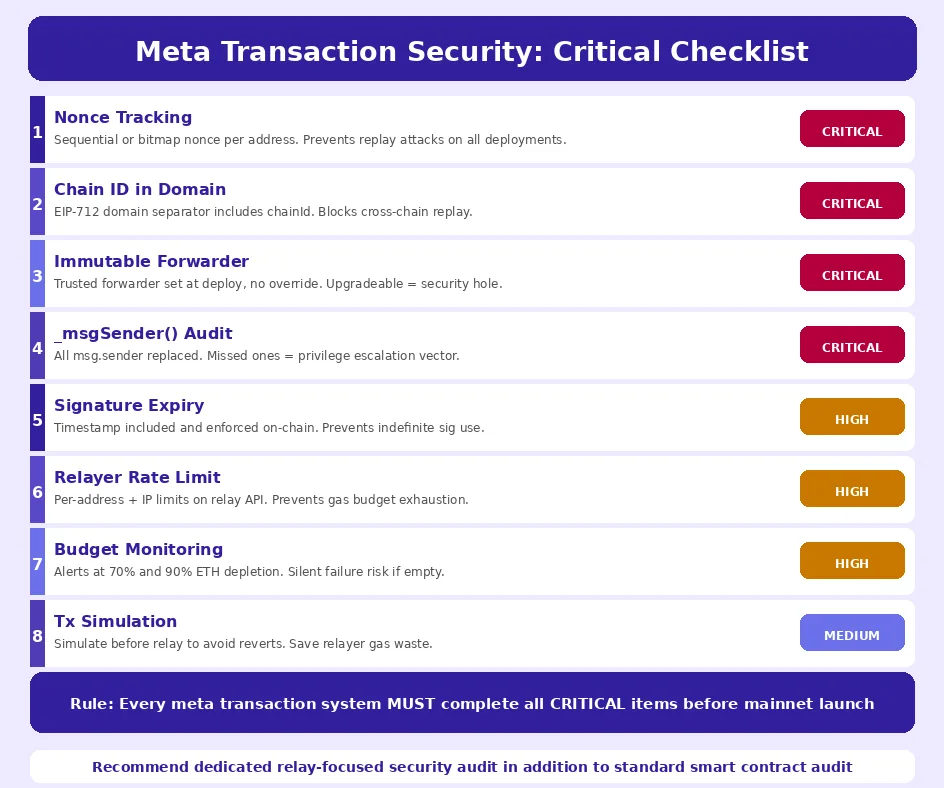
Authoritative Security Standards for Meta Transaction Systems
Standard 1: Every meta transaction implementation must include sequential or bitmap-based nonce tracking with on-chain validation to prevent replay attacks on any chain where the contract is deployed.
Standard 2: The EIP-712 domain separator must include the chain ID to prevent cross-chain signature replay. Contracts deployed on multiple chains must generate distinct domain separators for each deployment.
Standard 3: Trusted forwarder addresses must be immutably set at deployment with no administrative override capability. Upgradeable forwarder contracts negate the security trust model of EIP-2771.
Standard 4: All msg.sender occurrences in recipient contracts must be audited and replaced with _msgSender() before deploying with EIP-2771 support. Missed replacements create privilege escalation vectors.
Standard 5: Meta transaction signature expiry timestamps must be enforced by the smart contract. Signatures without expiry can be held indefinitely and executed at any future time by anyone who possesses them.
Standard 6: Relayer API endpoints must implement rate limiting per wallet address, IP address, and total request volume to prevent gas sponsorship budget exhaustion through automated spam submissions.
Standard 7: All meta transaction contracts must undergo a dedicated security audit that specifically tests for relay-specific vulnerabilities in addition to standard smart contract audit scope. Generic audits often miss relay-specific attack vectors.
Standard 8: Gas sponsorship budgets must be monitored with automated alerts at 70% and 90% depletion thresholds. A depleted relayer wallet causes all meta transactions to silently fail, creating a critical service outage with no user-visible error explanation.
Best Practices for Secure Implementation
Secure meta transaction implementation requires following a set of practices that together address the unique attack surface this architecture introduces. Signature expiry should be set to the minimum practical time window for the use case, typically between 5 and 60 minutes, ensuring that captured signatures cannot be held and executed at an unfavorable future time. The relayer should validate that the user’s signature corresponds to an address that is eligible to perform the requested action before submitting the transaction, preventing wasted gas on transactions that will revert on-chain due to access control failures. Transaction simulation using tools like Alchemy’s simulation API or Tenderly should be performed before every relay submission to confirm the transaction will succeed with the current on-chain state. Gas limit padding should be applied to simulation results to account for state changes between simulation and execution, typically adding 20-30% to the simulated gas estimate. For ERC-4337 implementations, paymaster contracts should implement maximum gas limits per UserOperation to prevent abnormally expensive operations from exhausting the sponsorship budget through a single transaction. Finally, incident response procedures for compromised relayer keys must be defined and tested before deployment, including mechanisms for emergency suspension of meta transaction processing and notification to users that gasless functionality is temporarily unavailable.
Account Abstraction and Web3 UX
Account Abstraction through ERC-4337 is reshaping the Web3 user experience architecture in ways that go significantly beyond gas fee elimination. Smart accounts created through ERC-4337 support social recovery, allowing users to regain access to their accounts through a recovery guardian process if they lose their signing key, eliminating the catastrophic seed phrase loss scenarios that have permanently locked millions of users out of their funds. Batch transactions in smart accounts allow complex multi-step operations like approve-and-swap or multicollateral-deposit to execute as a single atomic user action, reducing both gas costs and the number of signing prompts users encounter. Session keys allow applications to request limited, time-bound permissions to execute specific action types on behalf of users without requiring approval for each individual action, enabling seamless gaming, automated trading strategies, and recurring DeFi operations. The combination of gasless sponsorship, social recovery, batching, and session keys through a single ERC-4337 smart account architecture represents a Web3 user experience that in most respects exceeds what traditional custodial applications can offer, because it combines Web2-quality UX with Web3-quality self-custody and composability. Enterprise Web3 deployments targeting corporate clients in the USA and UK are increasingly specifying ERC-4337 smart accounts as a baseline requirement for new application builds.
Growth of Gasless dApps
The adoption trajectory of gasless dApp transactions is accelerating across all major Web3 application categories. Gaming platforms building on Base, Polygon, and Arbitrum are implementing gasless session keys as a standard feature rather than a differentiating one. NFT projects across every sector from music to sports to luxury fashion are implementing gasless claim flows as a prerequisite for reaching mainstream audiences. DeFi protocols are implementing gasless governance participation to improve proposal participation rates. Consumer Web3 applications targeting audiences in the UAE and Canada are implementing social login with embedded smart accounts that create a fully gasless first experience with no prior crypto knowledge required. The growth is supported by declining costs on Layer 2 networks where gas fees are already a fraction of Ethereum mainnet values, making even relatively inefficient gas sponsorship economically viable for high-engagement consumer applications. The Biconomy platform processes tens of millions of gasless transactions monthly, demonstrating that the infrastructure is production-ready and the demand from application teams is substantial. Applications in every category that have implemented gasless transactions report significant improvements in user engagement metrics, validating the user experience hypothesis that motivated the technology’s creation.
The Role of Gasless Transactions in Mass Adoption
The connection between gasless transaction infrastructure and mass blockchain adoption is direct and well-supported by both theoretical UX principles and empirical adoption data from applications that have implemented the pattern. Every successful technology platform that has achieved mainstream consumer adoption has done so by making its core interaction patterns as simple and friction-free as possible. The internet achieved mass adoption when HTTP made browsing content as simple as clicking links. Smartphones achieved mass adoption when touchscreens eliminated the keyboard and menu complexity of earlier mobile devices. Web3 will achieve mass adoption when interacting with blockchain-powered applications is as simple as using any other internet service, and gasless meta transactions are the technology that makes this simplification possible at the infrastructure level. For the billions of potential Web3 users in markets across the USA, UK, UAE, Canada, and beyond who are not crypto-native, the requirement to understand gas fees, manage ETH balances, and approve wallet popup confirmations is an insurmountable adoption barrier. Gasless transactions do not just reduce this barrier; they eliminate it entirely, enabling the same kind of frictionless onboarding that social media, streaming services, and mobile commerce have used to achieve global adoption. The Web3 teams that implement gasless infrastructure today are not just improving their immediate metrics; they are building the onramps that will connect the next hundred million users to decentralized applications.
Implement Gasless Transactions in Your Web3 App
Our team designs and builds production-grade meta transaction and ERC-4337 infrastructure for Web3 teams across USA, UK, UAE, and Canada.
Frequently Asked Questions
Q1.What are gasless transactions in Web3?
Gasless transactions are blockchain interactions where the end user does not directly pay the network gas fee required to execute their action. Gas still exists and is still paid, but by a relayer or protocol treasury rather than the user. From the user’s perspective, they sign a message with their wallet and their action executes on-chain without any ETH leaving their account. This architecture removes the most significant friction point preventing mainstream users from adopting decentralized applications in markets like the USA and UK.
Q2.How do meta transactions work technically?
Meta transactions work through a relay architecture where a user signs an EIP-712 typed data message encoding their intended action, nonce, and expiry timestamp. This signed message is transmitted off-chain to a relayer service via a standard API call. The relayer validates the signature, wraps it in a real Ethereum transaction calling a forwarder contract, and submits it while paying the gas fee. The forwarder contract verifies the signature using ecrecover, checks the nonce, and calls the target contract with the user’s address correctly attributed through the _msgSender() pattern.
Q3.What is EIP-2771 and why does it matter for meta transactions?
EIP-2771 is the Ethereum Improvement Proposal defining the Trusted Forwarder standard for meta transaction recipient contracts. It solves the msg.sender identity problem that arises in forwarded calls: when a relayer submits a meta transaction through a forwarder, msg.sender is the forwarder’s address, not the user’s. EIP-2771 defines how forwarder contracts append the real user’s address to calldata and how recipient contracts implement _msgSender() to extract it correctly. OpenZeppelin’s ERC2771Context provides a production-ready implementation that any smart contract can inherit.
Q4.What is ERC-4337 Account Abstraction and how does it differ from meta transactions?
ERC-4337 Account Abstraction is a comprehensive redesign of the Ethereum account model that enables smart contract wallets (smart accounts) to replace externally owned accounts. Unlike meta transactions which layer relay infrastructure onto standard contracts, ERC-4337 introduces new primitive types: UserOperations, bundlers, and paymasters. Paymasters are smart contracts that programmatically decide whether to sponsor gas for each UserOperation, enabling features impossible with traditional meta transactions like paying gas in USDC, sponsoring based on NFT ownership, and unlimited session key permissions.
Q5.What relayer services are available for implementing gasless transactions?
Several production-ready relayer services are available for implementing gasless and meta transactions. Biconomy is the most widely used, offering an SDK supporting both EIP-2771 forwarding and ERC-4337 bundler operations with session keys. Gelato Network provides a decentralized relay network using their Relay feature for EIP-2771 and their decentralized automation network. OpenGSN is the original decentralized Gas Station Network using staking incentives for independent relayers. For ERC-4337 specifically, Alchemy AA, Pimlico, and Stackup provide production bundler and paymaster infrastructure that most teams use rather than operating their own.
Q6.How do you prevent replay attacks in meta transactions?
Replay attack prevention in meta transactions requires implementing nonce tracking at the smart contract level. Each user address has an associated nonce value that must be included in every meta transaction message and must exactly match the contract’s expected next nonce for that address. Sequential nonces are simpler but prevent concurrent meta transactions from the same user. Bitmap-based unordered nonces (as used in Uniswap’s Permit2) allow multiple outstanding signed permissions simultaneously. Additionally, including the chain ID in the EIP-712 domain separator prevents the same signature from being replayed on different blockchain networks where the same contract is deployed.
Q7.What are the main use cases for gasless dApp transactions?
The most impactful use cases for gasless dApp transactions span several major Web3 verticals. NFT minting events enable brands and artists to create inclusive claiming experiences accessible to non-crypto users. Web3 gaming platforms use gasless session keys to enable real-time gameplay without per-action wallet approvals. DeFi protocols implement gasless voting to increase governance participation rates and gasless defensive actions (like adding collateral) to protect users from liquidation when ETH balances are depleted. Enterprise Web3 applications target mainstream consumers in the UAE and Canada who require Web2-quality onboarding without cryptocurrency prerequisites.
Explore Services
Related Services
Reviewed by

Aman Vaths
Founder of Nadcab Labs
Aman Vaths is the Founder & CTO of Nadcab Labs, a global digital engineering company delivering enterprise-grade solutions across AI, Web3, Blockchain, Big Data, Cloud, Cybersecurity, and Modern Application Development. With deep technical leadership and product innovation experience, Aman has positioned Nadcab Labs as one of the most advanced engineering companies driving the next era of intelligent, secure, and scalable software systems. Under his leadership, Nadcab Labs has built 2,000+ global projects across sectors including fintech, banking, healthcare, real estate, logistics, gaming, manufacturing, and next-generation DePIN networks. Aman’s strength lies in architecting high-performance systems, end-to-end platform engineering, and designing enterprise solutions that operate at global scale.