Ai Overview
The cryptocurrency market has undergone a fundamental transformation with the rise of decentralized exchanges, creating unprecedented opportunities for traders who understand how to exploit price inefficiencies across these platforms. 05% of trading volume, while in zkSync pools it reaches around 0. 25%, suggesting that price discrepancies are not yet fully addressed in newer rollups. Across nine blockchains, researchers identified 242,535 executed arbitrages totaling $868.
Key Takeaways
- Decentralized exchanges recorded a record $1.5 trillion in trading volume in 2024, up 138.1% from $647.6 billion the previous year, creating abundant arbitrage opportunities on DEX platforms.[1]
- Research analyzing one year of cross-chain transactions from September 2023 to August 2024 across nine blockchains identified 242,535 executed arbitrages totaling $868.64 million in volume.[2]
- According to Flashbots data, the total Realized Extractable Value since Ethereum’s Proof of Stake upgrade has exceeded 416,000 ETH, translating to more than $500 million in arbitrage and MEV profits.[3]
- In January 2024, a MEV bot named 2Fast extracted $1.9 million from a single transaction on the Solana blockchain using a back-running strategy, demonstrating the profit potential of automated arbitrage trading.
- Arbitrage between DEXs on the Ethereum blockchain and external exchange accounts for over a quarter of the volume on Ethereum’s five largest DEXs, according to empirical research findings.[4]
- DEXs achieved an all-time high monthly trading volume of $463 billion in December 2024, with Uniswap processing $106.4 billion and PancakeSwap recording $96.4 billion during that period.[5]
- Research on Uniswap liquidity pools found that in a sample covering 43% of TVL, liquidity providers earned $199.3 million in fees but suffered $260.1 million in impermanent loss, with arbitrageurs capturing much of this value.[6]
- Cross-chain arbitrage activity grew 5.5 times over a one-year study period, with most trades using pre-positioned inventory (66.96%) settling in approximately 9 seconds, while bridge-based arbitrages took 242 seconds.
- Jito’s detection algorithms identified over 90 million successful arbitrage transactions on Solana over a one year period ending in 2025, generating $142.8 million in profits with an average profit of $1.58 per transaction.[7]
- The five largest cross-chain arbitrage addresses execute more than half of all trades, with a single address capturing almost 40% of daily volume after the Ethereum Dencun upgrade in March 2024.
Understanding DEX Arbitrage Trading: The Foundation of Decentralized Profits
The cryptocurrency market has undergone a fundamental transformation with the rise of decentralized exchanges, creating unprecedented opportunities for traders who understand how to exploit price inefficiencies across these platforms. DEX arbitrage trading represents one of the most compelling strategies in the decentralized finance ecosystem, allowing participants to generate profits by capitalizing on price discrepancies that naturally occur when identical assets trade at different values across multiple venues.
At its core, decentralized exchange arbitrage operates on a simple principle: cryptocurrencies frequently trade at slightly different prices on different platforms due to varying levels of liquidity, demand, and trading volumes. These price gaps exist because each DEX operates independently, maintaining its own liquidity pools and pricing mechanisms. A trader who can identify these discrepancies and execute trades quickly enough can purchase an asset at a lower price on one exchange while simultaneously selling it at a higher price on another, capturing the difference as profit.
The mechanics become more interesting when you understand how automated market makers function. Unlike traditional order book exchanges, where buyers and sellers directly match orders, AMMs use mathematical formulas to determine prices based on the ratio of assets in liquidity pools. The most common implementation, the constant product formula (x * y = k), means that as traders remove one asset from a pool, its price relative to the paired asset increases. This creates a self-balancing mechanism that, while elegant, also produces consistent arbitrage opportunities on DEX platforms whenever external market conditions shift.
What makes crypto arbitrage on DEX particularly attractive is the transparency of blockchain technology. Every transaction, every pool balance, and every price movement is visible on chain. Sophisticated traders and their algorithms can monitor these conditions in real time, identifying profitable opportunities the moment they emerge. The decentralized nature of these exchanges also means they operate continuously without the trading halts or market hours that constrain traditional financial markets.
The Mechanics of Liquidity-Based Arbitrage
Liquidity-based arbitrage forms the backbone of most profitable DEX trading strategies. Understanding how liquidity pools create and sustain price discrepancies is essential for anyone looking to participate in this market. When a liquidity pool experiences a significant trade, the balance of tokens shifts, causing the pool’s internal price to diverge from prices on other exchanges. This divergence creates the arbitrage opportunity.
Consider a practical scenario: a large trader sells a substantial amount of Token A into a Uniswap pool, receiving Token B in return. This trade increases the supply of Token A in the pool while decreasing Token B, pushing Token A’s price lower relative to Token B within that specific pool. If Token A is trading at a higher price on another DEX or a centralized exchange, an arbitrageur can purchase Token A from the depressed Uniswap pool and sell it on the other venue for profit.
The constant product formula ensures that these opportunities self-correct over time, but the window for profit can range from milliseconds to several minutes, depending on market conditions and the vigilance of other arbitrageurs. Research has shown that higher volatility increases the likelihood of price jumps and, consequently, arbitrage transactions. The percentage of trade taken as LP fee is typically not linked to volatility, resulting in a less favorable split for liquidity providers when volatility rises.
Pool depth plays a critical role in determining both the size and duration of arbitrage opportunities. Shallow pools with limited liquidity experience more significant price impacts from trades, creating larger but often shorter-lived opportunities. Deeper pools, while more stable, still present consistent, smaller margin opportunities that can be profitable when executed at scale with low transaction costs.
You May Also Like:
Cross DEX Arbitrage Strategies: Maximizing Returns Across Platforms
Cross DEX arbitrage strategies represent the evolution of simple two-venue trading into sophisticated multi-platform operations. Modern arbitrageurs rarely limit themselves to comparing prices between just two exchanges. Instead, they deploy algorithms that simultaneously monitor dozens of DEXs across multiple blockchains, searching for the most profitable paths regardless of where they originate.
1. Triangular Arbitrage Within Single Platforms
This strategy exploits price inconsistencies among three or more trading pairs on a single DEX. A trader might start with ETH, swap to USDC, then to DAI, and finally back to ETH, ending with more ETH than they started with if the exchange rates across these pairs are misaligned. Research on Uniswap V2 has found that arbitrage paths using this method can generate profits as high as one million dollars in some instances, though such opportunities are rare and highly competitive.
2. Inter DEX Arbitrage
The most straightforward form involves buying an asset on one DEX where it trades cheaper and selling on another where it commands a premium. DEX aggregators like 1inch have made this process more accessible by automatically routing trades through the most favorable paths across multiple platforms. The Pathfinder algorithm used by 1inch searches every integrated DEX for the best trading price, often splitting trades across multiple venues to achieve optimal execution.
3. DEX to CEX Arbitrage
Price discrepancies between decentralized and centralized exchanges create persistent opportunities. Centralized exchanges like Binance offer deeper liquidity and faster execution, while DEXs often lag in price discovery. Empirical research has found that arbitrage between DEXs on the Ethereum blockchain and external centralized exchanges accounts for over a quarter of the volume on Ethereum’s five largest DEXs. This strategy requires maintaining balances on both venue types and managing the inherent delays in moving assets between them.
4. Layer 2 Arbitrage
The proliferation of Layer 2 solutions has created new arbitrage frontiers. Research analyzing swap dynamics across Ethereum and its rollups found that the Maximal Arbitrage Value in Arbitrum, Base, and Optimism pools ranges from 0.03% to 0.05% of trading volume, while in zkSync pools it reaches around 0.25%, suggesting that price discrepancies are not yet fully addressed in newer rollups.
Automated Arbitrage Trading: The Role of Bots and Algorithms
Manual arbitrage trading on DEXs is virtually impossible in today’s competitive environment. Price discrepancies that might be visible to human traders typically disappear within seconds or even milliseconds as automated systems execute trades. This reality has driven the development of sophisticated automated arbitrage trading systems that operate continuously, monitoring markets and executing opportunities faster than any human could react.
MEV (Maximal Extractable Value) bots represent the most advanced form of automated arbitrage trading on blockchain networks. These algorithms scan the mempool, the holding area for unconfirmed transactions, to identify profitable opportunities before they even execute on the chain. When a MEV bot detects a large pending trade that will move prices, it can position transactions strategically to capture value from the resulting price movement.
The sophistication of modern arbitrage bots extends beyond simple buy low, sell high logic. Advanced systems incorporate predictive modeling to anticipate price movements, optimize gas fees to ensure transaction priority, and employ complex routing algorithms to find multi-step paths that less sophisticated competitors miss. Building an effective bot requires mastery of blockchain development, mathematical optimization, and real-time data processing.
The infrastructure requirements for competitive automated arbitrage trading are substantial. Professional operations maintain dedicated nodes on multiple blockchain networks, colocate servers near major validators to minimize latency, and invest heavily in proprietary software development. Monthly infrastructure costs for running blockchain nodes can reach $150 to $500, with serious competitors spending considerably more on premium data feeds and custom hardware.
DEX Arbitrage Strategy Comparison: Risk, Reward, and Requirements
| Strategy Type | Capital Requirements | Technical Complexity | Typical Profit Margins |
|---|---|---|---|
| Simple DEX to DEX | $5,000 to $50,000 | Moderate | 0.1% to 0.5% per trade |
| Flash Loan Arbitrage | Minimal (gas fees only) | High | 0.05% to 3% per transaction |
| Cross-Chain Arbitrage | $50,000 to $500,000+ | Very High | 1% to 5% per cycle |
| MEV Extraction | $100,000+ | Expert Level | 5 to 20 ETH per profitable block |
| Triangular Arbitrage | $10,000 to $100,000 | High | 0.2% to 1% per cycle |
| Stablecoin Arbitrage | $20,000 to $200,000 | Low to Moderate | 0.05% to 0.3% per trade |
Smart Contract Arbitrage: Flash Loans and Atomic Transactions
Smart contract arbitrage has revolutionized how traders approach opportunities on DEX platforms. The introduction of flash loans through protocols like Aave and dYdX created an entirely new paradigm where traders can borrow massive sums without collateral, execute arbitrage strategies, and repay the loan all within a single atomic transaction. If any step fails, the entire transaction reverts, limiting the trader’s risk to only the gas fees spent on the failed attempt.
The mechanics of flash loan arbitrage illustrate the power of blockchain composability. A trader identifies a price discrepancy between two pools, borrows the necessary capital from a flash loan provider, executes the buy and sell transactions across the relevant DEXs, repays the loan plus a small fee, and pockets the profit. This entire sequence occurs within a single transaction block, which on Ethereum takes approximately 12 seconds.
Flash loan fees are remarkably modest, typically ranging from 0.05% to 0.09% of the borrowed amount. This creates a low barrier to entry for traders who understand smart contract development but lack the capital to pursue traditional arbitrage strategies. However, the technical complexity is substantial. Writing smart contracts that reliably execute complex multi-step arbitrage strategies without vulnerabilities requires sophisticated programming skills and thorough testing.
The atomic nature of flash loan transactions provides an important safety mechanism. Because the loan must be repaid within the same transaction, failed arbitrage attempts simply revert without loss of principal. This stands in contrast to traditional arbitrage, where a trader might complete one leg of a trade only to find the other leg no longer profitable, leaving them exposed to adverse price movement.
You May Also Like:
Cross-Chain Arbitrage: Bridging Blockchains for Profit
The multi-chain future of DeFi has opened vast new territories for arbitrage opportunities on DEX platforms. As liquidity fragments across Ethereum, Solana, Binance Smart Chain, Avalanche, and numerous Layer 2 networks, price discrepancies between chains have become a significant source of profit for sophisticated traders. Cross-chain arbitrage represents both one of the most lucrative and most technically challenging forms of decentralized exchange arbitrage.
Research analyzing cross-chain arbitrage between September 2023 and August 2024 revealed remarkable activity levels. Across nine blockchains, researchers identified 242,535 executed arbitrages totaling $868.64 million in volume. This activity generated a lower bound profit of approximately $9.5 million for the traders involved. The study found that activity clustered heavily on Ethereum-centric L1 to L2 pairs and grew 5.5 times over the study period.
Two primary execution methods dominate cross-chain arbitrage: inventory-based and bridge-based approaches. Inventory-based strategies involve pre-positioning capital on multiple chains, allowing for rapid execution when opportunities arise. This method accounts for approximately 67% of cross-chain arbitrage activity and settles in about 9 seconds on average. Bridge-based approaches, which move assets between chains for each trade, take considerably longer at around 242 seconds, but require less initial capital deployment.
The infrastructure requirements for cross-chain arbitrage are substantial. Traders need reliable connections to multiple blockchain networks, sophisticated monitoring systems to track prices across chains, and either significant capital deployed across networks or access to fast bridging solutions. The technical complexity of managing positions across chains with different confirmation times, fee structures, and smart contract languages creates high barriers to entry.
The Role of DEX Aggregators in Arbitrage Efficiency
DEX aggregators have transformed how traders interact with decentralized exchanges and, paradoxically, both compete with and enable arbitrage strategies. Platforms like 1inch, ParaSwap, and Jupiter scan multiple liquidity sources to find optimal trading routes, often splitting large trades across numerous pools to minimize price impact. This aggregation reduces obvious arbitrage opportunities while simultaneously creating more complex multi-path opportunities for sophisticated traders.
The 1inch Aggregation Protocol exemplifies modern aggregator technology. Its Pathfinder algorithm searches across all integrated DEXs to find the best swap routes and rates, often routing trades through multiple venues simultaneously. At the time of recent reporting, 1inch processed 522 liquidity sources and supported more than 86.4 million trades. The platform’s routing can incorporate collateral tokens from lending protocols like Aave and Compound directly into swap paths, creating optimization possibilities that manual traders would struggle to identify.
For arbitrageurs, aggregators present both competition and opportunity. The efficiency of aggregator routing reduces the duration and magnitude of simple price discrepancies between venues. However, aggregators cannot always capture every optimization, particularly for complex multi-step strategies or situations where their routing algorithms make suboptimal assumptions. Sophisticated traders study aggregator behaviour to identify systematic opportunities that automated routing misses.
Meta DEX aggregators represent the next evolution, comparing quotes from multiple aggregators to find the absolute best execution. Platforms like Swoop Exchange and Defillama Swap pit aggregators against each other, ranking their quotes and routing trades through whichever offers the best current rate. This cascading efficiency continues to compress simple arbitrage margins while rewarding traders who develop novel strategies.
Major DEX Platforms: Trading Volume and Arbitrage Potential (2024)
| Platform | Monthly Volume (December 2024) | Primary Blockchain | Key Arbitrage Features |
|---|---|---|---|
| Uniswap | $106.4 billion | Ethereum, Multi-chain | Concentrated liquidity, multiple fee tiers |
| PancakeSwap | $96.4 billion | BNB Chain | Lower fees, high retail activity |
| Raydium | $58 billion | Solana | Fast block times, concentrated pools |
| Aerodrome | $31.03 billion | Base | L2 efficiency, growing liquidity |
| Orca | $22.8 billion | Solana | Whirlpools concentrated liquidity |
| Hyperliquid | $225+ billion (perpetuals) | Hyperliquid L1 | Perpetual futures, basis trading |
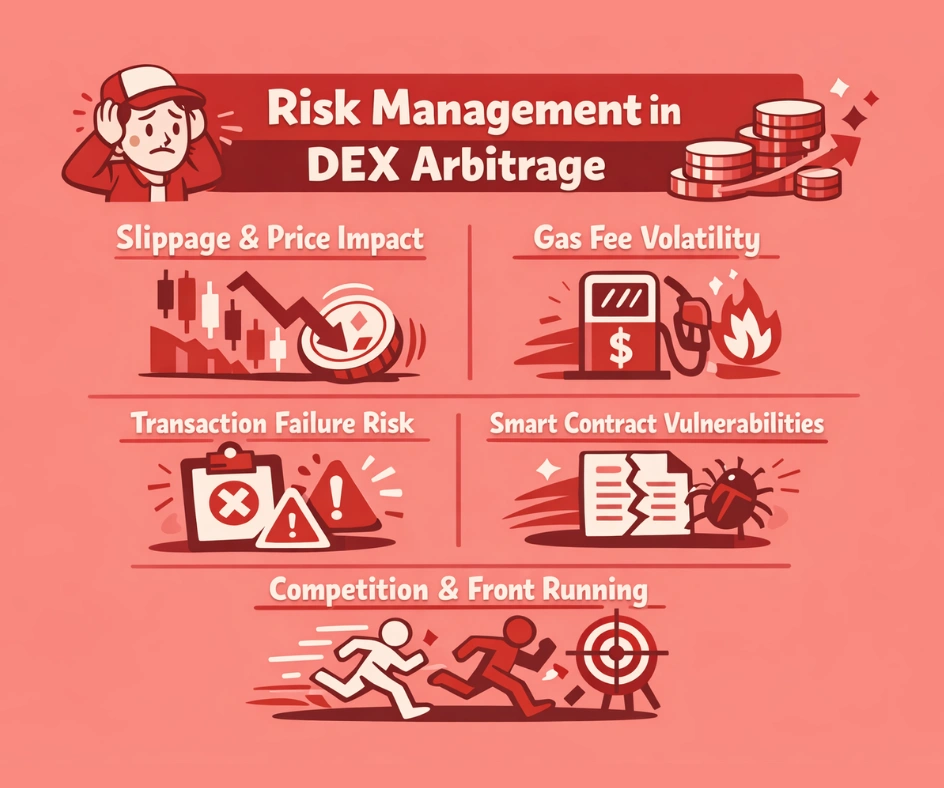
Risk Management in DEX Arbitrage
Profitable arbitrage trading requires sophisticated risk management that accounts for the unique challenges of decentralized finance. Unlike traditional markets, where execution is generally predictable, DEX trading involves variables that can transform apparently profitable opportunities into losses. Understanding and mitigating these risks separates successful arbitrageurs from those who quickly exit the market.
1. Slippage and Price Impact
The mathematical formulas underlying AMMs mean that trade execution affects prices. Large trades experience significant slippage, where the actual execution price differs from the quoted price. Arbitrageurs must accurately model expected slippage and ensure sufficient profit margins to absorb this impact. The constant product formula (x * y = k) makes slippage calculation deterministic but still requires precise accounting in profit calculations.
2. Gas Fee Volatility
Ethereum and other networks experience significant gas price fluctuations, particularly during periods of high demand. An arbitrage opportunity that appears profitable at current gas prices can become unprofitable if network congestion spikes before transaction confirmation. Sophisticated traders implement gas price monitoring and dynamic fee adjustment to maintain profitability across varying network conditions.
3. Transaction Failure Risk
Failed transactions still consume gas fees, creating a drag on profitability. Network congestion, competing transactions, and rapid price movements can all cause trades to fail. Flash loan arbitrage mitigates some of this risk through atomic execution, but traditional multi-transaction strategies remain vulnerable. Tracking success rates and optimizing for reliability is essential for sustainable operations.
4. Smart Contract Vulnerabilities
Interacting with smart contracts carries inherent risks. Bugs in DEX contracts, arbitrage bot code, or the interfaces between them can result in lost funds. The DeFi ecosystem has experienced numerous exploits, with researchers documenting incidents where attackers exploited logic flaws in protocols to steal millions. Thorough code auditing and careful interaction with only verified contracts reduce but do not eliminate this risk.
5. Competition and Front Running
The transparent nature of blockchain mempools means that submitted transactions are visible to other participants before execution. Sophisticated actors can front-run profitable arbitrage trades by submitting competing transactions with higher gas fees. This MEV extraction means that even identifying a profitable opportunity does not guarantee capturing the profit.
You May Also Like:
DEX API for Decentralized Exchanges: Key Benefits and Use Cases
Tools and Infrastructure for DEX Arbitrage
Success in DEX arbitrage trading depends heavily on the quality of tools and infrastructure deployed. The competitive landscape has evolved to where basic monitoring and execution capabilities are merely table stakes. Professional operations invest significantly in specialized technology stacks that provide informational and execution advantages.
1. Price Monitoring and Analysis
Real-time price feeds from multiple DEXs form the foundation of any arbitrage operation. Services like DexScreener, CoinGecko, and specialized API providers offer varying levels of data quality and latency. Professional traders often run their own nodes on multiple networks to access unfiltered blockchain data with minimal delay. The ability to identify opportunities milliseconds faster than competitors can determine profitability.
2. DEX Aggregator Integration
Integrating with aggregator APIs allows traders to quickly evaluate optimal execution routes. The 1inch API, for example, provides programmatic access to its Pathfinder algorithm, enabling automated systems to request optimal swap routes before deciding whether to execute. Many arbitrage bots use aggregator quotes as benchmarks even when executing through direct pool interactions.
3. Mempool Monitoring
Watching pending transactions provides crucial intelligence about upcoming market movements. Services like Blocknative offer mempool data feeds that show unconfirmed transactions, allowing sophisticated traders to anticipate price impacts before they occur on the chain. This capability is essential for both identifying opportunities and avoiding being front-run.
4. Smart Contract Development Environments
Building and deploying arbitrage smart contracts requires robust development tooling. Frameworks like Hardhat and Foundry provide testing environments where strategies can be simulated against historical data before risking real capital. Formal verification tools help identify potential vulnerabilities in contract code before deployment.
5. Transaction Management Systems
Executing arbitrage at scale requires systems that manage transaction submission, monitor confirmation status, handle failures gracefully, and adjust strategies based on changing conditions. These systems must balance speed with reliability, ensuring that profitable opportunities are captured without excessive failed transaction costs.
Market Dynamics and Opportunity Distribution
Understanding how arbitrage opportunities distribute across markets helps traders allocate resources effectively. Research consistently shows that opportunity concentration varies significantly by market conditions, time periods, and token characteristics. Adapting strategies to these patterns can substantially improve returns.
Volatility drives arbitrage opportunity creation. When markets experience rapid price movements, the mechanisms that keep prices aligned across venues struggle to keep pace. Research has demonstrated that higher volatility increases both the frequency and magnitude of price discrepancies. Traders who position themselves to capture opportunities during volatile periods often generate outsized returns compared to those active only during calm markets.
Token liquidity inversely affects opportunity size but positively affects execution reliability. Highly liquid pairs like ETH/USDC show smaller price discrepancies but allow larger trades with minimal slippage. Illiquid pairs may present dramatic price differences, but cannot support meaningful trade sizes without excessive price impact. Sophisticated traders balance opportunity size against executable volume to optimize capital deployment.
The geographic and temporal distribution of trading activity creates predictable patterns. DEX volume tends to surge during U.S. and European market hours when the most active traders are awake. Conversely, periods of lower activity can present opportunities for traders willing to operate when competition is reduced. Understanding these rhythms helps in planning operational coverage.
Market structure evolution continuously reshapes the opportunity landscape. The launch of new DEXs, upgrades to existing protocols, and changes in fee structures all create transient arbitrage opportunities as markets adjust. Traders who monitor protocol governance discussions and technical roadmaps can position themselves to capture value during these transitions.
Regulatory Considerations and Compliance
The regulatory environment for DEX arbitrage trading remains fluid across jurisdictions. While decentralized exchanges operate without traditional intermediaries, the traders who use them remain subject to applicable laws regarding taxation, reporting, and, in some cases, licensing requirements. Understanding the regulatory landscape is essential for sustainable operations.
Tax treatment of arbitrage profits varies by jurisdiction, but generally treats such gains as taxable income. The frequency and scale of trading may affect classification as capital gains versus ordinary income in some jurisdictions. The complexity of tracking cost basis across numerous rapid transactions creates substantial compliance burdens. Specialized cryptocurrency tax software has emerged to address these challenges, but traders remain responsible for accurate reporting.
Anti-money laundering regulations increasingly affect even decentralized finance participants. While DEXs themselves may not perform know your customer checks, on ramps and off ramps to traditional financial systems typically do. Traders moving significant volumes should understand how their activities may be viewed by financial institutions and regulators.
The regulatory trajectory suggests increasing scrutiny of DeFi activities. Proposed and enacted legislation in various jurisdictions aims to bring aspects of decentralized finance under existing regulatory frameworks. Traders should monitor these developments and adapt their operations to remain compliant as requirements evolve.
Building a Sustainable Arbitrage Operation
Creating a durable arbitrage trading business requires treating the activity as a professional endeavor rather than a casual pursuit. The most successful operations combine technical excellence with sound business practices, creating organizations capable of adapting to market evolution over time.
1. Capital Management
Allocating capital appropriately across strategies, networks, and individual opportunities determines risk-adjusted returns. Professional operations maintain reserves to handle unexpected losses, avoid over-concentration in single strategies, and continuously reallocate based on changing opportunity sets. Position sizing models that account for correlation between strategies prevent catastrophic drawdowns.
2. Technology Investment
Continuous improvement of the trading infrastructure is necessary to maintain competitiveness. This includes upgrading node infrastructure, refining execution algorithms, expanding coverage to new protocols, and improving monitoring and alerting systems. Technology investment should be viewed as an ongoing operational expense rather than a one-time setup cost.
3. Strategy Diversification
Relying on a single arbitrage strategy creates vulnerability to market evolution that may eliminate that specific opportunity. Successful operations develop portfolios of strategies that perform differently under varying conditions. When one approach becomes less profitable due to competition or market changes, others may continue generating returns.
4. Research and Development
Allocating resources to identify new opportunities before they become widely recognized provides a lasting competitive advantage. This includes analyzing new protocol launches, studying academic research on market microstructure, and experimenting with novel strategy variations. Operations that rest on existing capabilities inevitably see margins compressed by increasing competition.
5. Operational Security
Protecting trading systems and funds from both external attacks and internal failures requires comprehensive security practices. This includes secure key management, access controls, system monitoring, and disaster recovery planning. The permissionless nature of blockchain transactions means that security failures can result in immediate, irreversible losses.
Build Your DEX Arbitrage Infrastructure with Expert Development
Whether you need custom arbitrage bot development, smart contract auditing, cross-chain integration, or a comprehensive DeFi trading infrastructure, our experienced development team delivers high-performance implementations tailored to your trading strategy. We combine deep expertise in blockchain development with advanced algorithmic trading knowledge to build systems you can trust.
Final Thoughts
DEX arbitrage trading represents a compelling opportunity for traders who possess the technical skills, capital resources, and operational discipline to compete in this demanding market. The fundamental principle of buying low and selling high remains timeless, but the implementation in decentralized finance requires mastery of blockchain technology, smart contract development, and algorithmic execution.
The market continues to mature with decentralized exchanges processing record volumes and sophisticated infrastructure emerging to serve traders at every level of complexity. While increasing competition has compressed margins on simple strategies, the expansion of DeFi across multiple chains and the introduction of new protocol designs continuously creates fresh opportunities for those prepared to capture them.
Success in this field demands treating arbitrage as a serious business rather than a get-rich-quick scheme. The traders who sustain profitability over time invest continuously in their capabilities, adapt to changing market conditions, and maintain rigorous risk management practices. They view each challenge, whether technical, competitive, or regulatory, as a problem to be solved rather than an obstacle to avoid.
For those willing to make the necessary investments in knowledge and infrastructure, DEX arbitrage trading offers the potential for consistent returns that do not depend on market direction. Whether prices rise or fall, price discrepancies will continue to emerge whenever information disperses imperfectly across fragmented markets. The arbitrageur who identifies and captures these opportunities provides a valuable service to market efficiency while generating profits in the process.
The path to profitability requires patience, continuous learning, and a willingness to adapt as the market evolves. Those who approach DEX arbitrage with appropriate seriousness will find a challenging but rewarding field at the frontier of financial technology innovation.
Frequently Asked Questions
Q1.What is DEX arbitrage trading and how does it work?
DEX arbitrage trading involves exploiting price differences for the same cryptocurrency asset across different decentralized exchanges. Traders buy an asset at a lower price on one exchange and simultaneously sell it at a higher price on another, capturing the price difference as profit. This works because each DEX operates independently with its own liquidity pools, causing prices to diverge temporarily before arbitrageurs bring them back into alignment.
Q2.How much capital do I need to start DEX arbitrage trading?
Capital requirements vary significantly by strategy. Flash loan arbitrage requires only enough capital to cover gas fees, as the borrowed funds are obtained and repaid within a single transaction. Traditional DEX to DEX arbitrage typically requires $5,000 to $50,000 to generate meaningful returns after accounting for transaction costs. Cross-chain strategies may require $50,000 or more deployed across multiple networks. The minimum recommended deposit for spot trading arbitrage is generally around $300, though larger amounts improve profitability.
Q3.What are the main risks of DEX arbitrage?
The primary risks include slippage that erodes expected profits, gas fee volatility that can make trades unprofitable, failed transactions that still consume fees, smart contract vulnerabilities that could result in fund loss, and front running by other traders who see your pending transactions. Market volatility can also cause prices to move against your position between identifying an opportunity and executing the trade. Competition from sophisticated bots means many opportunities disappear faster than manual traders can act.
Q4.Do I need programming skills for DEX arbitrage?
While basic arbitrage can be performed manually using DEX interfaces, competitive arbitrage trading essentially requires programming skills. Flash loan arbitrage specifically requires Solidity development experience to write the smart contracts that execute trades. Effective automated trading bots need custom code in languages like Python or JavaScript. Even traders who purchase existing tools typically need technical knowledge to configure, monitor, and troubleshoot their systems effectively.
Q5.How do flash loans enable arbitrage without capital?
Flash loans from protocols like Aave allow borrowing large amounts without collateral, provided the loan is repaid within the same blockchain transaction. An arbitrageur can borrow funds, execute buy and sell trades across DEXs, repay the loan plus a small fee (typically 0.05% to 0.09%), and keep any profit, all atomically. If the arbitrage fails to generate profit, the entire transaction reverts, and the trader loses only the gas fee for the failed attempt rather than the principal.
Q6.What tools do professional DEX arbitrageurs use?
Professional operations typically employ dedicated blockchain nodes for low-latency data access, mempool monitoring services to see pending transactions, DEX aggregator APIs for route optimization, custom smart contracts for execution, specialized monitoring and alerting systems, and sophisticated risk management frameworks. Many also use services like Flashbots to submit transactions privately and avoid front-running. Development frameworks like Hardhat or Foundry are used for testing strategies before deployment.
Explore Services
Related Services
Reviewed by

Aman Vaths
Founder of Nadcab Labs
Aman Vaths is the Founder & CTO of Nadcab Labs, a global digital engineering company delivering enterprise-grade solutions across AI, Web3, Blockchain, Big Data, Cloud, Cybersecurity, and Modern Application Development. With deep technical leadership and product innovation experience, Aman has positioned Nadcab Labs as one of the most advanced engineering companies driving the next era of intelligent, secure, and scalable software systems. Under his leadership, Nadcab Labs has built 2,000+ global projects across sectors including fintech, banking, healthcare, real estate, logistics, gaming, manufacturing, and next-generation DePIN networks. Aman’s strength lies in architecting high-performance systems, end-to-end platform engineering, and designing enterprise solutions that operate at global scale.