Ai Overview
The DEX to CEX spot trading volume ratio grew from 6. 2% by November 2025, showing a sustained shift toward decentralized trading platforms. DEX spot trading volumes reached an all-time high of $419. 25% of total supply) delegated to an address before it can submit governance proposals, and proposals require 40 million yes-votes to pass, showing how delegation is structurally built into major DEX protocols.
Key Takeaways: Delegated Governance in DEX
- The DEX to CEX spot trading volume ratio grew from 6.0% in January 2021 to 21.2% by November 2025, showing a sustained shift toward decentralized trading platforms.[1]
- DEX spot trading volumes reached an all-time high of $419.76 billion in October 2025, further highlighting the need for strong governance frameworks in decentralized exchanges.[2]
- Uniswap requires a minimum of 2.5 million UNI (0.25% of total supply) delegated to an address before it can submit governance proposals, and proposals require 40 million yes-votes to pass, showing how delegation is structurally built into major DEX protocols.[3]
- Research from Ethereum-based DAOs found that less than 1% of token holders actively exercised voting rights in protocols like Uniswap and Compound, making delegation a practical solution for low-participation governance.[4]
- Uniswap’s Delegate Reward Initiative passed with 47.51 million votes (99.45% in favor) in March 2025, compensating top-performing delegates with up to $6,000 in UNI tokens per month for maintaining at least 80% voting participation.[5]
- The 12 delegates selected during Cycle 1 of Uniswap’s rewards program maintained a 100% voting participation rate for all proposals during that period.[6]
- DAO voter participation averages 17% globally in 2025, while top DAOs exceed 22% participation for critical votes, underscoring how delegation helps bridge the gap between available voting power and actual engagement.[7]
- There are now over 13,000 active DAOs worldwide in 2025, with more than 6,000 showing regular governance activity, meaning the demand for efficient governance models like delegation is growing across the ecosystem.[8]
- Perpetual futures trading volume on DEXs reached $898 billion in Q2 2025, with Hyperliquid alone recording $653 billion and holding roughly 73% market share, showing how rapidly DEX products are evolving and requiring governance oversight.[9]
- A DL News “State of DeFi” report found that while the number of individual voters declined across major DAOs in 2025, total votes cast actually increased, confirming a structural shift toward delegated governance where professional delegates carry growing influence.[10]
Decentralized exchanges have grown from experimental projects into essential infrastructure for on-chain trading. According to CoinGecko, the DEX to CEX spot trading volume ratio climbed from 6.0% in January 2021 to 21.2% by November 2025, and DEX spot trading volumes hit an all-time high of $419.76 billion in October 2025. With this kind of growth, the question of how these platforms should be governed has become more important than ever. The delegated governance model offers a practical answer, allowing token holders to assign their voting power to informed representatives who can make well-considered decisions on behalf of the wider community. This blog explores why delegated governance in DEX platforms is not just useful but essential for the long-term health of decentralized trading.
Understanding Governance in Decentralized Exchanges
Before diving into the specifics of delegated governance in decentralized exchanges, it helps to first understand why governance matters at all in the context of a DEX. A decentralized exchange operates without a central authority. There is no board of directors, no CEO making top-down decisions, and no corporate structure pulling the strings behind the scenes. Instead, the protocol itself runs on smart contracts deployed on a blockchain, and the community of users collectively decides how the platform should evolve over time.
This is where DEX governance mechanisms come into play. Governance in a DEX typically involves token holders who use their governance tokens to propose, discuss, and vote on changes to the protocol. These changes can range from adjusting fee structures and adding new trading pairs to making fundamental upgrades to the smart contract architecture. The core idea is that the people who use the platform should also be the ones who shape its future.
But there is a catch. While this model sounds appealing in theory, in practice, it can be messy. Many token holders do not have the technical knowledge to evaluate complex proposals. Others simply do not have the time to stay involved. And in many cases, voter turnout remains extremely low. Research examining Ethereum-based DAOs has shown that less than 1% of token holders actively exercise their voting rights in protocols like Uniswap and Compound. This kind of apathy can lead to governance stagnation, where proposals either fail to pass because the quorum is not met or pass with input from only a small fraction of the community.
Token-based governance in DEX environments aims to give every holder a voice, but without mechanisms to channel that voice effectively, it risks becoming either a rubber stamp for the most active participants or an empty process that nobody engages with. This is exactly the problem that the delegated governance model was designed to solve.
You may also like:
The Challenges and Benefits of Decentralized Governance in DEXs
What Is Delegated Governance and How Does It Work in a DEX?
Delegated governance is a system in which token holders assign their voting power to trusted representatives, often called delegates, rather than voting on every proposal themselves. Think of it like a representative democracy. Instead of every citizen showing up to parliament to debate every piece of legislation, they elect representatives who study the issues and vote on their behalf.
In the context of a DEX, the delegated governance model works through on-chain mechanisms built directly into the protocol’s smart contracts. A token holder can delegate their voting weight to another address. This does not transfer ownership of the tokens. The tokens stay in the original holder’s wallet. What gets transferred is the right to use those tokens’ voting power for governance decisions.
The delegate then uses that combined voting power to participate in proposal discussions and cast votes. If a token holder is unsatisfied with how their delegate is voting, they can revoke the delegation at any time and either delegate to someone else or begin voting directly on their own.
How Delegation Differs from Direct Voting
In a direct voting model, every token holder must individually review each proposal, understand its implications, and submit their vote. While this is the purest form of decentralized governance, it places a heavy burden on every participant. In a delegated governance model, participants only need to choose their delegate wisely. The delegate handles the rest.
Uniswap provides one of the most well-documented examples of how this works. According to Uniswap’s governance documentation, any address with more than 2.5 million UNI (0.25% of total supply) delegated to it can propose governance actions. When a proposal is created, the community has a 7-day voting period. Proposals require a simple majority with at least 40 million “For” votes to pass. This structure makes delegation not just useful but structurally necessary. Without enough UNI delegated to their address, a community member cannot even submit a proposal, regardless of how good the idea might be.
The Role of Liquid Delegation
Some protocols take delegation a step further with what is known as liquid delegation or liquid democracy. In this model, token holders can delegate their voting power on a per-topic or per-proposal basis. So, for example, a holder might delegate their vote to a DeFi expert for proposals about fee structures but delegate to a different person for proposals about smart contract upgrades. This adds a layer of flexibility that allows the most knowledgeable people to weigh in on the issues they understand best. Not all DEX platforms support liquid delegation yet, but the concept is gaining traction as governance frameworks become more sophisticated.
Why Decentralized Exchanges Need Strong Governance
The rapid growth of DEX trading volumes has made governance not just a nice-to-have but a necessity. When DEXs collectively processed over $1.76 trillion in spot trading volume in 2024, and DEX spot volumes hit an all-time high of $419.76 billion in a single month in October 2025, the stakes involved in governance decisions became enormous.
Every governance decision in a DEX carries real financial weight. A vote to change fee parameters can directly affect the income of thousands of liquidity providers. A decision to upgrade smart contracts can either improve or break the trading experience for millions of users. And a poorly considered proposal that passes without enough scrutiny could expose billions of dollars in user funds to new risks.
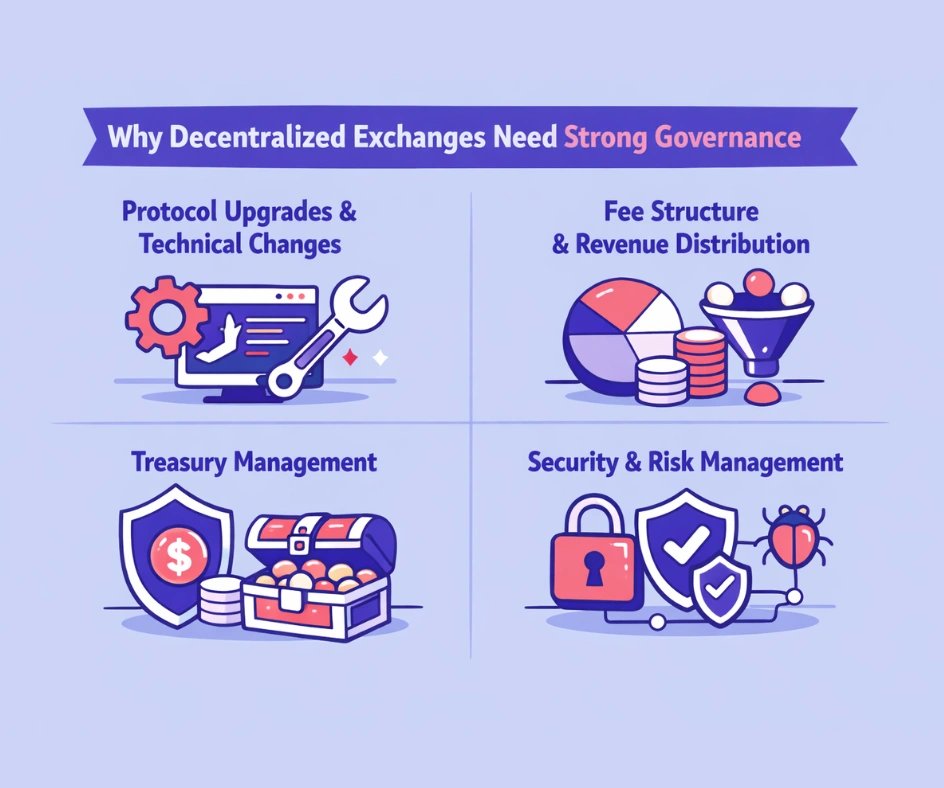
1. Protocol Upgrades and Technical Changes
As DEX technology continues to evolve, platforms regularly need to upgrade their smart contracts, integrate with new blockchains, and add support for new types of trading. These technical decisions require deep expertise. A delegated governance model ensures that the people making these calls have the technical understanding to do so responsibly.
2. Fee Structure and Revenue Distribution
One of the most debated governance topics in DEX communities revolves around fees. How much should users pay in trading fees? How should those fees be distributed between liquidity providers, the protocol treasury, and token holders? Uniswap’s long-running debate about its “fee switch” is a perfect example. The fee switch is a governance-controlled toggle that could redirect a portion of trading fees to UNI token holders. This decision, which passed through governance in late 2025, affects the economic model of the entire protocol.
3. Treasury Management
Major DEXs manage substantial treasuries. The Uniswap DAO, for example, oversees a treasury that has been valued at over $1.4 billion. Decisions about how to allocate these funds, whether for grants, development, marketing, or token buybacks, require careful deliberation. Delegated governance helps ensure that these decisions are made by informed participants rather than a handful of large token holders voting without context.
4. Security and Risk Management
In Q1 2025 alone, over $2 billion was lost to Web3 exploits and attacks. A DEX’s governance framework must be able to respond quickly to security threats while still maintaining the decentralized decision-making that users expect. Delegates who are actively monitoring the protocol can respond faster and more thoughtfully than a diffuse crowd of casual token holders.
The Core Benefits of Delegated Governance in DEX Platforms
Delegated governance in DEX platforms brings a set of concrete advantages that address the well-documented weaknesses of direct on-chain voting. These benefits are not theoretical; they are playing out in real time across major DeFi protocols.
1. Higher Effective Participation
When DAO voter participation averages just 17% globally in 2025, according to data compiled by SQ Magazine, it is clear that most token holders are not voting. Delegation does not force people to become governance experts. Instead, it allows them to channel their voting power through someone who is. This raises effective participation rates because the voting power that would otherwise sit idle is now being used. The DL News “State of DeFi” report confirmed this pattern: while the number of individual voters in major DAOs declined in 2025, total votes cast actually increased. This means delegates are casting votes on behalf of more token holders, leading to higher participation in practice even if fewer individuals are clicking the vote button.
2. Better-Informed Decision-Making
Not every token holder has the knowledge to evaluate whether a proposed smart contract upgrade is sound or whether a new fee structure will attract or repel liquidity. Delegates, particularly those who make governance participation part of their professional work, can dedicate the time and expertise needed to study proposals in depth. Organizations like FranklinDAO, Michigan Blockchain, and Wintermute Governance are among the active delegates in the Uniswap ecosystem. These are groups with deep technical and financial expertise that individual token holders typically lack.
3. Faster Response to Critical Issues
When a vulnerability is discovered or a market condition shifts rapidly, governance needs to act fast. Waiting for tens of thousands of individual token holders to review a proposal and vote is not practical in a crisis. With delegated governance, a smaller number of well-informed delegates can assess the situation quickly, discuss among themselves, and vote within the required timeframe. This makes the protocol more agile without sacrificing decentralization, since the delegates derive their power from the broader community.
4. Accountability and Transparency
One of the strengths of on-chain delegation is that everything is visible. A delegate’s voting history is recorded on the blockchain for anyone to inspect. Token holders can see exactly how their delegate voted on every proposal. If a delegate votes against the interests of the community, token holders can revoke their delegation immediately. This creates a natural feedback loop that incentivizes delegates to act responsibly.
5. Lower Barrier to Engagement
For many users, the complexity of governance proposals is intimidating. Delegated governance lowers the barrier to engagement by letting users participate meaningfully without needing to understand every technical detail. A user can read a delegate’s pitch, review their voting history, and make an informed choice about who to support. This is a much more accessible form of participation than deciphering smart contract code or analyzing tokenomics models.
Comparing DEX Governance Models
Different DEX platforms adopt different approaches to governance. The table below compares the main governance models and highlights how delegated governance stacks up against direct voting and other frameworks.
| Governance Model | How It Works | Participation Level | Decision Quality | Notable Examples |
|---|---|---|---|---|
| Direct Token Voting | Every token holder votes on each proposal individually | Low (often less than 1% of holders vote) | Variable, depends on voter knowledge | Early MakerDAO polls |
| Delegated Governance | Token holders assign voting power to expert representatives | Higher effective participation through delegation | Generally higher due to delegate expertise | Uniswap, Compound, Arbitrum |
| Quadratic Voting | Users express intensity of preference; cost increases quadratically | Moderate, more balanced between large and small holders | Strong for representing minority views | Gitcoin Grants |
| Multisig Council | A small elected council signs off on governance decisions | Very low, concentrated in a few individuals | Fast execution but limited community input | Some smaller DEX protocols |
| Hybrid DAO Governance | Combines delegation, direct voting, and council oversight | Moderate to high, depending on implementation | Balances speed with broad representation | Optimism, Lido |
| DPoS (Delegated Proof of Stake) | Token holders elect validators who also participate in governance | Moderate, relies on active staker engagement | Good for consensus-level decisions | EOS, TRON, Lisk |
Real-World Examples of Delegated Governance in DEX Protocols
Delegated governance is not a theoretical concept. Several major DEX and DeFi protocols already rely on it as the backbone of their decision-making process. Let us look at how some of these protocols have implemented delegated governance and what the results have been.
1. Uniswap: The Gold Standard for DEX Delegation
Uniswap is arguably the most studied example of delegated governance in decentralized exchanges. The UNI token was launched in September 2020 through a retroactive airdrop to early users, and its governance system has been active ever since. To submit a proposal, an address must have at least 2.5 million UNI delegated to it. The governance process goes through multiple phases: a Request for Comment (RFC) phase lasting at least 7 days, a Temperature Check requiring 10 million UNI yes-votes, and a final on-chain vote with a quorum of 40 million UNI.
What makes Uniswap particularly interesting is its Delegate Reward Initiative. This program, which passed governance with 47.51 million votes (99.45% in favor) in March 2025, compensates top-performing delegates with up to $6,000 worth of UNI tokens per month. Delegates earn up to $3,000 by maintaining a minimum of 80% voting participation and an additional $3,000 for writing detailed vote rationales. During Cycle 1 of this program, the 12 selected delegates achieved a 100% voting participation rate, demonstrating how financial incentives can dramatically improve governance engagement.
2. Compound: Pioneering On-Chain Delegation
Compound was one of the first DeFi protocols to implement a robust delegation mechanism. Its COMP token allows holders to delegate their voting power to any Ethereum address. Compound’s governance has been used to make major decisions about lending parameters, risk management, and protocol upgrades. Like Uniswap, Compound has seen voting power concentration among a small group of active delegates, but this concentration has also led to more thoughtful and well-researched voting outcomes compared to purely direct voting systems.
3. Arbitrum: DAO Governance at Scale
Arbitrum’s ARB token governance involves a delegation system where token holders can delegate to professional governance participants. The Arbitrum DAO has managed significant treasury allocation decisions through its delegated governance framework, demonstrating how delegation can work for layer-2 protocols that host numerous DEX applications.
4. Balancer and SushiSwap: Evolving Governance Models
Both Balancer (BAL) and SushiSwap (SUSHI) have implemented governance mechanisms that allow token holders to participate in protocol decisions. While their delegation mechanisms are structured differently from Uniswap’s, they share the same underlying principle: enabling informed community members to represent the interests of the broader token holder base.
You may also like:
Governance Proposals in DEX: How Decentralized Decision-Making Works
DAO Governance in DEX: The Structural Foundation
DAO governance in DEX platforms provides the structural framework within which delegated governance operates. A DAO, or Decentralized Autonomous Organization, is essentially the organizational wrapper around a protocol’s governance system. It encompasses the smart contracts, voting mechanisms, treasury management systems, and community processes that together allow a decentralized group of token holders to collectively manage a platform.
For a DEX, the DAO is what turns a collection of smart contracts into a living, evolving platform. Without it, a DEX would be a static piece of code that nobody can update or improve. With it, the DEX becomes a community-driven project where upgrades, expansions, and course corrections happen through structured proposals and votes.
The growth of DAOs has been remarkable. There are now over 13,000 active DAOs worldwide in 2025, with more than 6,000 showing regular governance activity. DeFi dominates the landscape with 70 DAOs holding a combined $7.5 billion in total assets. These numbers reflect a governance ecosystem that is maturing rapidly and where delegated governance plays an increasingly central role.
The DAO structure also provides a legal and organizational framework for important decisions like treasury spending. The Uniswap DAO, for instance, manages a treasury that gives it the financial resources to fund development grants, security audits, marketing initiatives, and other activities that keep the protocol competitive. These spending decisions go through governance, and delegation ensures that the people voting on them have the context and expertise to make wise choices.
The Challenge of Voter Apathy and How Delegation Addresses It
Voter apathy is the single biggest challenge facing on-chain governance today. The data paints a clear picture: DAO voter participation averages just 17% globally in 2025. For many individual proposals, participation can be even lower. Research from the ACM Web Conference found that in the majority of DAOs with more than 1,000 voters, more than 50% of voting power is controlled by roughly 1% of voters or less.
This creates what governance researchers call the “iron law of oligarchy” in decentralized systems. Even though DAOs are designed to be open and democratic, in practice, a small number of highly motivated participants end up making most of the decisions. This is not necessarily bad if those participants are acting in the community’s interest, but it becomes problematic when their interests diverge from those of the broader user base.
Delegated governance does not eliminate this dynamic entirely, but it does address it in several important ways. First, it makes the concentration of voting power explicit and accountable. When someone becomes a delegate, their voting record is public. If they vote against the community’s interest, they lose their delegated votes. This is a much healthier dynamic than one where a few whale wallets silently dominate governance without any public accountability.
Second, delegation lowers the cost of participation. In a direct voting system, every token holder needs to spend time reviewing proposals and paying gas fees to vote. With delegation, the cost of governance participation is concentrated on delegates, while the broader community can participate by simply choosing their delegate. This is especially important for smaller token holders whose gas costs might exceed the impact of their vote.
Third, some protocols have begun incentivizing delegation directly. Uniswap’s Delegate Reward Initiative is a prime example. By paying delegates for maintaining high voting participation rates and writing detailed vote rationales, the protocol ensures that governance remains active and well-informed even when the broader community is not engaged on a proposal-by-proposal basis.
Key Governance Metrics Across Major DEX Protocols
The following table provides a snapshot of governance activity across some of the leading DEX and DeFi protocols that use delegated governance mechanisms.
| Protocol | Governance Token | Delegation Supported | Key Governance Features | Delegate Incentives |
|---|---|---|---|---|
| Uniswap | UNI | Yes, on-chain delegation | Multi-phase proposals, 40M quorum, Snapshot + Tally | Up to $6,000/month in UNI tokens |
| Compound | COMP | Yes, on-chain delegation | Governor Bravo, time-locked execution | Community-driven recognition |
| Arbitrum | ARB | Yes, with active delegate programs | Constitutional proposals, DAO treasury management | Delegate incentive programs |
| Balancer | BAL | Yes, via Snapshot voting | Fee voting, gauge weights, protocol parameters | veBAL staking rewards |
| SushiSwap | SUSHI | Yes, via Snapshot voting | Forum discussions, community proposals, multi-chain | xSUSHI staking rewards |
| 1inch | 1INCH | Yes, Snapshot-based delegation | Community voting on aggregator parameters | Staking incentives for active participants |
Risks and Limitations of Delegated Governance
While delegated governance in DEX platforms offers significant advantages, it is not without its risks. Understanding these limitations is essential for anyone building or participating in a DEX governance system.
1. Concentration of Power Among Delegates
One of the most frequently cited concerns is that delegation can lead to a new form of centralization. If a small number of delegates accumulate a disproportionate share of voting power, they can effectively control governance outcomes. Research published by ScienceDirect found that while voting power in protocols like Uniswap and Compound is concentrated in a small number of addresses, these powerful entities rarely overturn votes by choosing a different outcome than the overall community. Still, the potential for this kind of power concentration remains a structural risk.
2. Delegate Apathy and Misalignment
Just as individual token holders can become apathetic, so can delegates. If a delegate stops actively participating in governance or begins voting in ways that do not reflect the interests of their delegators, the system can degrade. The challenge is compounded by the fact that many token holders delegate once and then forget about it, rarely revisiting their choice. Programs like Uniswap’s Delegate Reward Initiative attempt to address this by tying compensation to ongoing participation, but the problem of “set and forget” delegation remains widespread.
3. Whale Influence and Vote Buying
Because delegation is tied to token holdings, wealthier participants naturally have more influence. This creates a dynamic where governance outcomes can be influenced by a few large token holders who either delegate to aligned representatives or vote directly with their substantial holdings. The risk of vote buying, where delegates or voters are compensated outside the protocol’s official channels to vote in a particular way, is also a concern in token-based governance in DEX systems.
4. Gaming Governance for Financial Gain
In some cases, governance proposals can have direct financial implications for specific participants. For example, a proposal to change fee structures might benefit certain liquidity providers at the expense of others. Delegates with financial interests in particular outcomes might vote based on their personal benefit rather than the community’s best interest. This kind of conflict of interest is difficult to prevent entirely in a permissionless system.
5. Technical Complexity of Governance Infrastructure
The smart contracts that power delegation must be carefully designed and audited. Bugs in governance contracts can have catastrophic consequences, from stolen treasury funds to incorrectly executed proposals. As governance systems become more complex, with features like liquid delegation and cross-chain voting, the attack surface grows. This makes ongoing security investment a non-negotiable requirement for any DEX that uses delegated governance.
Best Practices for Implementing Delegated Governance in a DEX
Building a healthy delegated governance system requires more than just deploying a delegation smart contract. Protocols that have succeeded in creating active, well-functioning governance ecosystems share several common practices.
1. Make Delegation Easy and Accessible
The delegation process should be as simple as possible. Users should be able to browse potential delegates, review their voting histories, and delegate with a single transaction. Tools like Tally, Snapshot, and custom governance dashboards play a key role in making delegation accessible to non-technical users. The less friction involved in the delegation process, the more likely people are to participate.
2. Incentivize Active Delegation
As Uniswap’s Delegate Reward Initiative has shown, financial incentives can significantly improve governance participation. Protocols should consider compensating delegates for their time and expertise, especially for tasks like writing vote rationales, attending governance calls, and engaging in community discussions. These incentives should be structured to reward quality participation, not just showing up to vote.
3. Establish Clear Governance Processes
A well-defined governance process with clear stages, timeframes, and requirements helps ensure that proposals are thoroughly vetted before going to a vote. Uniswap’s three-phase process (RFC, Temperature Check, Governance Proposal) is a good template. Each phase gives the community time to review, debate, and refine proposals before they reach the final vote.
4. Encourage Delegate Diversity
A healthy governance system needs diverse perspectives. Protocols should actively encourage a wide range of delegates, including technical experts, financial analysts, community advocates, and representatives from different geographic regions. This helps prevent groupthink and ensures that governance decisions consider multiple viewpoints.
5. Build Transparency and Accountability Mechanisms
All delegate voting records should be easily accessible. Delegation pitches, where delegates explain their governance philosophy and priorities, should be prominently displayed. Regular governance reports summarizing voting outcomes, participation rates, and delegate performance can help keep the community informed and engaged.
6. Plan for Security and Upgrades
Governance smart contracts should be thoroughly audited and designed with upgradeability in mind. Timelocks, which introduce a mandatory delay between a proposal passing and its execution, give the community a window to react if a malicious proposal somehow passes. Uniswap’s governance system includes a hard-coded minimum delay of 2 days for all governance actions, with major upgrades potentially requiring up to 30 days.
You may also like:
The Future of Delegated Governance in Decentralized Exchanges
The governance landscape for decentralized exchanges is evolving rapidly. Several trends are shaping the future of how DEXs will be governed in the coming years.
1. Cross-Chain Governance
As DEXs increasingly operate across multiple blockchains, governance systems will need to evolve to support cross-chain voting. A token holder on Ethereum should be able to participate in governance decisions that affect the protocol’s deployments on Arbitrum, Optimism, Base, and other networks. Building this kind of cross-chain governance infrastructure is technically challenging but essential for protocols that operate in a multi-chain world.
2. AI-Assisted Governance Analysis
As governance proposals become more complex, AI tools may help delegates and token holders better understand the implications of proposed changes. AI could analyze smart contract code changes, model the financial impact of fee adjustments, or summarize lengthy governance discussions into digestible summaries. This would lower the knowledge barrier for participation and help delegates make better-informed decisions.
3. Reputation-Based Delegation
Future governance systems may move beyond pure token-weighted voting to incorporate reputation scores. Under this model, delegates who consistently participate, vote thoughtfully, and contribute positively to governance discussions would earn higher reputation scores. These scores could then amplify their voting power or provide other governance privileges. This would help counter the influence of wealth-based voting and reward genuine contributions.
4. Institutional Participation in DEX Governance
As institutional interest in DeFi grows, large funds and traditional financial firms may begin participating in DEX governance through delegation. This could bring additional capital and expertise to governance processes, but also raises concerns about the influence of traditional financial interests on decentralized protocols. How DEX communities manage this transition will be an important governance challenge in the years ahead.
5. Governance as a Competitive Advantage
In an increasingly competitive DEX landscape, governance quality may become a differentiating factor. Protocols with well-functioning, responsive governance systems that can adapt quickly to market changes and user needs will have an edge over those with stagnant or dysfunctional governance. This means that investing in governance infrastructure, including delegation mechanisms, is not just a theoretical exercise but a competitive necessity.
DEX and Blockchain Governance Implementations in the Real World
The following projects reflect how decentralized governance and exchange architecture are already being applied in live platforms. Each implementation showcases the same principles discussed throughout this article, from token-based voting and community-driven decision-making to delegated governance models and transparent on-chain operations.
🔄
Gravix: Decentralized Exchange Platform
Built a decentralized exchange platform for trading various assets, including cryptocurrencies, stocks, and forex. The platform prioritizes user privacy and governance transparency, offering on-chain trading directly from crypto wallets with community-driven protocol decisions and governance mechanisms that align with delegated governance principles.
🌐
Rubic: Multi-Chain Crypto Exchange
Developed a decentralized exchange aggregating over 200 DEXs across 80+ blockchain networks. The platform incorporates community-driven governance for protocol decisions, cross-chain operations, and fee structure management, demonstrating how token-based governance and delegation can work at scale across multiple chains.
Build Your Decentralized Exchange with Expert Development
Whether you need a DEX platform with built-in governance mechanisms, token-based voting systems, DAO infrastructure, or delegated governance smart contracts, our experienced blockchain development team delivers community-focused implementations tailored to your protocol’s requirements. We combine deep expertise in decentralized exchange architecture with advanced governance frameworks to build platforms your community will trust and actively participate in.
Final Thoughts
Delegated governance in decentralized exchanges represents a practical and proven approach to solving one of the most persistent challenges in blockchain: how to make collective decision-making work at scale. The data tells the story clearly. While raw voter participation rates in DAOs often hover around 17%, protocols with strong delegation mechanisms see significantly higher effective participation because voting power that would otherwise sit idle is channeled through informed representatives.
The success of programs like Uniswap’s Delegate Reward Initiative, which achieved 100% voting participation among selected delegates, demonstrates that the right incentive structures can turn governance from a neglected afterthought into an active, well-functioning system. And the structural shift identified in the “State of DeFi” report, where fewer individual voters are casting more total votes through delegation, confirms that this model is not a passing experiment. It is becoming the standard approach for major DeFi protocols.
That said, delegated governance is not a perfect system. Concentration of power among a small number of delegates, the risk of delegate apathy, and the potential for financial conflicts of interest are all real concerns that protocol designers must address. The best governance systems will be those that combine delegation with strong transparency mechanisms, thoughtful incentive design, and ongoing community engagement.
As DEX trading volumes continue to grow and governance decisions carry ever-larger financial implications, the protocols that invest in robust delegated governance frameworks will be best positioned to adapt, evolve, and thrive. The future of decentralized trading depends not just on the technology powering the swaps but on the governance systems that guide the protocols forward. Delegated governance, with all its strengths and acknowledged limitations, is the most practical path toward that future.
Frequently Asked Questions
Q1.What is delegated governance in a decentralized exchange?
Delegated governance in a DEX is a system where token holders assign their voting power to trusted representatives (called delegates) who vote on governance proposals on their behalf. The tokens remain in the holder’s wallet; only the voting rights are delegated. This allows community members who lack the time or expertise to evaluate complex proposals to still participate in governance through someone they trust.
Q2.How does delegated governance differ from direct voting in a DEX?
In direct voting, every token holder must individually review each proposal and cast their own vote. In delegated governance, token holders choose a delegate who votes on their behalf. Delegation typically leads to higher effective participation rates because voting power that would otherwise go unused is activated through delegates. Token holders can revoke their delegation and switch delegates at any time.
Q3.Can I lose my tokens by delegating my voting power?
No. Delegating your voting power does not transfer your tokens to anyone. Your tokens remain safely in your wallet at all times. Delegation only assigns the governance voting rights associated with your tokens to another address. You can revoke the delegation or transfer it to a different delegate whenever you choose, and your token balance is never affected.
Q4.Which major DEX protocols use delegated governance?
Several major DEX and DeFi protocols use delegated governance, including Uniswap (UNI), Compound (COMP), Arbitrum (ARB), Balancer (BAL), SushiSwap (SUSHI), and 1inch (1INCH). Each of these protocols allows token holders to delegate their voting power to representatives who participate actively in governance decisions like fee adjustments, protocol upgrades, and treasury allocations.
Q5.What are the risks of delegated governance in DEX platforms?
The main risks include concentration of voting power among a few delegates, potential conflicts of interest where delegates vote based on personal financial gain, delegate apathy where representatives stop actively participating, and the possibility of vote buying. Protocols address these risks through transparency (on-chain voting records), incentive programs, and allowing token holders to revoke delegation at any time.
Q6.How do delegates get compensated for their governance work?
Compensation models vary by protocol. Uniswap, for example, runs a Delegate Reward Initiative that compensates top-performing delegates with up to $6,000 worth of UNI tokens per month, split between voting participation (up to $3,000) and writing detailed vote rationales (an additional $3,000). Other protocols offer staking rewards, reputation-based incentives, or community recognition for active delegates.
Explore Services
Related Services
Reviewed by

Aman Vaths
Founder of Nadcab Labs
Aman Vaths is the Founder & CTO of Nadcab Labs, a global digital engineering company delivering enterprise-grade solutions across AI, Web3, Blockchain, Big Data, Cloud, Cybersecurity, and Modern Application Development. With deep technical leadership and product innovation experience, Aman has positioned Nadcab Labs as one of the most advanced engineering companies driving the next era of intelligent, secure, and scalable software systems. Under his leadership, Nadcab Labs has built 2,000+ global projects across sectors including fintech, banking, healthcare, real estate, logistics, gaming, manufacturing, and next-generation DePIN networks. Aman’s strength lies in architecting high-performance systems, end-to-end platform engineering, and designing enterprise solutions that operate at global scale.