Ai Overview
The evolution of decentralized applications (dApps) has fundamentally transformed how we approach data storage and management in the Web3 ecosystem. Storage miners bid on these deals, with clients selecting miners based on reputation, pricing, and geographic location. Advantages: Complete control, no third-party dependencies, cost-effective at scale, custom optimization possible. A single 1MB image would cost roughly $20,000 to store on-chain at typical gas prices.
Key Takeaways
- ✓Decentralized storage infrastructure eliminates single points of failure by distributing data across global peer-to-peer networks, ensuring higher availability and censorship resistance for Web3 applications.
- ✓IPFS uses content addressing through cryptographic hashing, making files permanently addressable and verifiable regardless of their physical location on the distributed network.
- ✓Filecoin creates an open marketplace for storage providers, incentivizing long-term data persistence through blockchain-based contracts and cryptographic proof mechanisms for dApps requiring guaranteed storage.
- ✓Arweave offers permanent storage through its blockweave architecture and endowment model, making it ideal for immutable frontend deployments and NFT metadata requiring truly perpetual availability.
- ✓Hybrid storage strategies combining IPFS for distribution, Filecoin for incentivized persistence, and Arweave for permanent archives deliver optimal cost-performance balance for enterprise dApp deployments.
- ✓Integration patterns for decentralized storage include direct node operation, managed gateway services, and pinning services, each offering different trade-offs between decentralization and operational complexity.
- ✓Security considerations include encryption at rest, access control through cryptographic signatures, and regular verification of storage proofs to maintain data integrity across decentralized networks.
- ✓Leading dApps across USA, UK, UAE, and Canada markets increasingly adopt decentralized storage solutions, driven by regulatory compliance needs and user demands for data sovereignty.
Introduction to Decentralized Storage in dApps
The evolution of decentralized applications (dApps) has fundamentally transformed how we approach data storage and management in the Web3 ecosystem. As organizations across the USA, UK, UAE, and Canada increasingly adopt blockchain technology, the demand for robust storage infrastructure for dApps continues to accelerate. With over 8 years of experience implementing enterprise-grade Decentralized Platforms, we have witnessed firsthand the paradigm shift from centralized cloud providers to distributed storage networks.
Traditional dApps rely on smart contracts for logic execution, but storing large files, media assets, or application frontends on-chain remains prohibitively expensive and inefficient. This creates a critical infrastructure gap. Decentralized storage protocols like IPFS (InterPlanetary File System), Filecoin, and Arweave emerged as purpose-built solutions, offering cryptographically verifiable, censorship-resistant alternatives to centralized storage providers. These protocols enable dApps to maintain their decentralized ethos throughout the entire application stack, from smart contracts to user interfaces and data layers.
The storage infrastructure for dApps represents more than technical innovation. It embodies the core principles of Web3: data sovereignty, censorship resistance, and user empowerment. By distributing data across thousands of nodes globally, these systems eliminate single points of failure while providing cryptographic guarantees of data integrity and availability.
Why Traditional Storage Fails for Web3 Applications?
Centralized storage solutions, despite their maturity and performance advantages, introduce fundamental contradictions when integrated with decentralized applications. The most glaring issue involves trust assumptions. When a dApp stores critical data on Amazon S3, Google Cloud Storage, or Azure Blob Storage, it reintroduces centralized control points that undermine the trustless nature of blockchain applications. A single corporate decision, government order, or service disruption can render the entire dApp inoperable.
Industry Standard Principle: Web3 applications must maintain end-to-end decentralization across all layers, from consensus mechanisms to data storage, to preserve censorship resistance and trustless operation. This principle guides architectural decisions for enterprise implementations across regulated markets including the USA, UK, UAE, and Canada.
Critical Failures of Centralized Storage in Web3
Single Point of Failure
- Service outages affect all dependent applications simultaneously
- No redundancy across independent infrastructure providers
- Corporate bankruptcy or service discontinuation risks
Censorship Vulnerability
- Governments can compel providers to block content
- Terms of service violations lead to arbitrary deletions
- Geopolitical restrictions limit global accessibility
Data Sovereignty Loss
- Users cannot verify data integrity independently
- Provider controls access, modification, and deletion rights
- Opaque data handling contradicts blockchain transparency
Cost Unpredictability
- Pricing changes without user consent or negotiation
- Bandwidth charges scale unpredictably with usage
- Vendor lock-in prevents cost-effective migration
Privacy Concerns
- Providers scan content for compliance monitoring
- Metadata collection enables user profiling
- Third-party data access through legal channels
Trust Dependencies
- Users must trust provider security practices
- No cryptographic verification of data integrity
- Contradicts trustless blockchain architecture
These limitations become especially problematic in jurisdictions with strict data localization requirements or content regulations. Enterprise dApps operating across multiple markets need storage infrastructure that provides consistent, predictable behavior regardless of geopolitical boundaries.
Key Principles Behind Decentralized Data Models
Decentralized storage systems operate on fundamentally different architectural principles compared to traditional cloud storage. Understanding these principles is essential for effectively implementing storage infrastructure for dApps. The shift from location-based addressing to content-based addressing represents the most significant conceptual change.
In centralized systems, data is retrieved using location identifiers like URLs or file paths that point to specific servers. If the server moves, changes, or becomes unavailable, the data becomes inaccessible despite potentially existing elsewhere. Decentralized storage uses cryptographic hashes of the content itself as addresses. This content addressing ensures that regardless of where data physically resides, it can be retrieved and verified for integrity.
This retrieval mechanism provides several advantages for dApps. Content automatically migrates toward areas of high demand, popular files load faster through distributed caching, and the system gracefully degrades rather than failing completely when nodes become unavailable. Enterprise implementations in markets like the USA, UK, UAE, and Canada leverage these characteristics to build resilient applications.
Filecoin as a Decentralized Market for Permanent Storage
While IPFS provides excellent content addressing and retrieval mechanisms, it lacks built-in economic incentives for long-term storage persistence. Content remains available only as long as nodes choose to pin and host it. Filecoin emerged as IPFS’s incentivization layer, creating a marketplace where storage providers compete to offer persistent storage services in exchange for FIL tokens.
Filecoin transforms storage into a commodity traded on an open market. Storage providers (miners) commit disk space and computational resources, earning rewards for reliably storing client data. Clients pay for storage based on market rates, which fluctuate according to supply and demand. This economic model ensures sustainable storage infrastructure for dApps without relying on altruistic node operators or centralized subsidies.
The protocol uses cryptographic proofs to verify that miners actually store the data they claim to store. Proof-of-Replication ensures that miners create unique physical copies of data, preventing sybil attacks where a single copy masquerades as multiple. Proof-of-Spacetime requires miners to repeatedly prove they continue storing data over time, with automated slashing penalizing miners who fail to maintain data availability.
Real-World Example: Audius Decentralized Music Streaming
Audius, a blockchain-based music streaming platform with over 6 million users globally including significant traction in North American and European markets, uses Filecoin for long-term storage of high-quality audio files. Artists upload their tracks to IPFS, and Audius automatically creates Filecoin storage deals to ensure permanent availability. This hybrid approach provides fast streaming via IPFS while guaranteeing data persistence through Filecoin’s economic incentives.
How Filecoin Storage Mining and Retrieval Markets Work?
Filecoin operates two interconnected markets: the storage market and the retrieval market. The storage market handles the storage of data, while the retrieval market optimizes data delivery. Understanding how Filecoin manages storage and retrieval is essential for implementing efficient storage infrastructure for dApps.
In the storage market, clients publish storage deals specifying their requirements including data size, storage duration, replication factor, and price. Storage miners bid on these deals, with clients selecting miners based on reputation, pricing, and geographic location. Once a deal is accepted, the client transfers data to the miner, who seals it into a sector through a computationally intensive process that creates the Proof-of-Replication.
| Storage Market Component | Function | Key Metrics | Typical Values |
|---|---|---|---|
| Deal Proposal | Client specifies storage requirements and maximum price | Duration, Size, Price per GiB/epoch | 180-540 days, 0.0001-0.001 FIL/GiB |
| Miner Selection | Automated or manual selection based on reputation and pricing | Miner Score, Slashing History | Score >95%, Zero slashing incidents |
| Data Transfer | Client transmits data to miner via secure channels | Transfer Speed, Verification | 10-100 MB/s, CID-based verification |
| Sector Sealing | Miner performs Proof-of-Replication computation | Sealing Time, Sector Size | 1.5-3 hours, 32GiB or 64GiB sectors |
| Proof Generation | Ongoing Proof-of-Spacetime submissions to blockchain | WindowPoSt Frequency | Every 24 hours (2880 epochs) |
| Payment & Rewards | Automatic FIL payments upon proof verification | Block Rewards, Deal Fees | Variable based on network power |
| Slashing Mechanism | Penalties for failed proofs or sector faults | Fault Fee, Termination Penalty | 2.14 days rewards + ongoing penalties |
The retrieval market operates independently, optimizing for fast data delivery. When clients need to retrieve data, retrieval miners compete to provide the fastest service at competitive prices. This separation allows specialization with some miners focusing on reliable storage while others optimize for high-bandwidth retrieval.
Performance Consideration: For dApp implementations requiring frequent data access, maintain active IPFS pinning alongside Filecoin storage deals. This hybrid approach provides retrieval performance comparable to traditional CDNs while ensuring long-term persistence through economic incentives.
Arweave and the Concept of Permanent Data Storage
Arweave introduces a fundamentally different approach to storage infrastructure for dApps through its permanent storage model. Instead of recurring storage fees, users make a one-time payment calculated to ensure data permanence for at least 200 years. This radical departure from subscription-based models aligns perfectly with use cases requiring immutable, permanent records such as NFT metadata, historical archives, and scientific datasets.
The protocol achieves this through its blockweave architecture, a variation of blockchain where each block is linked not only to the previous block but also to a random earlier block. This creates a woven structure ensuring that miners must store historical data to mine new blocks. The economic model relies on an endowment that pays storage providers perpetually from initial upfront fees, with the assumption that storage costs will continue declining over time.
Arweave’s Unique Permanent Storage Features
One-Time Payment Model
- Single upfront fee covers perpetual storage
- Endowment fund managed through smart contracts
- Storage cost calculated using declining price oracle
- Eliminates recurring subscription management
Blockweave Structure
- Blocks link to previous and random historical blocks
- Mining requires access to historical data
- Incentivizes long-term data retention organically
- Creates economic dependency on data preservation
Permaweb Applications
- Entire web applications stored permanently
- Frontend code, assets, and content immutable
- No hosting fees or domain renewals required
- Applications accessible through Arweave gateways
Content Moderation Layer
- Gateway operators can filter displayed content
- Data remains permanently stored on-chain
- Balances permanence with regional compliance
- Multiple gateways provide censorship resistance
SmartWeave Contracts
- Lazy evaluation smart contracts on Arweave
- Contract state computed client-side from transactions
- Lower costs than traditional blockchain execution
- Enables complex dApp logic with permanent storage
Bundling & Optimization
- Bundle multiple transactions into single submission
- Reduces per-transaction overhead significantly
- Bundling services optimize cost and speed
- Nested bundles enable efficient data organization
Real-World Example: Mirror Decentralized Publishing Platform
Mirror, a Web3 publishing platform popular among crypto writers and DAOs, stores all articles permanently on Arweave. When writers publish content, it receives a unique Arweave transaction ID, ensuring the article remains accessible indefinitely without recurring hosting costs. This permanence is particularly valuable for time-sensitive reporting, investigative journalism, and historical records that traditional platforms might censor or delete.
Comparing IPFS, Filecoin and Arweave for dApp Storage Needs
Selecting the appropriate storage infrastructure for dApps requires understanding the distinct strengths, limitations, and ideal use cases for each protocol. IPFS, Filecoin, and Arweave each solve different aspects of the decentralized storage challenge, and many successful implementations combine multiple protocols to leverage their complementary capabilities.
IPFS excels at content distribution and retrieval performance but requires active pinning services to maintain data availability. Filecoin adds economic incentives for persistence but involves ongoing storage fees and complex deal management. Arweave provides true permanence with one-time payments but operates at higher per-gigabyte costs suitable for critical, immutable data rather than general-purpose storage.
| Comparison Factor | IPFS | Filecoin | Arweave |
|---|---|---|---|
| Storage Guarantee | No guarantee, depends on pinning | Cryptographic proofs for deal duration | Permanent (200+ years) |
| Cost Model | Free (bandwidth costs only) | Recurring fees per epoch | One-time payment upfront |
| Typical Price | $0-5 per GB/month via pinning | $0.0001-0.001 FIL per GB/epoch | $3-8 per MB one-time |
| Retrieval Speed | Fast (P2P with caching) | Moderate (negotiated retrieval) | Moderate (gateway dependent) |
| Data Mutability | Immutable content, mutable pointers | Immutable sealed sectors | Permanently immutable |
| Storage Duration | While pinned | Deal duration (renewable) | Permanent by design |
| Verification Method | Content-addressed CIDs | Proof-of-Replication, Proof-of-Spacetime | Blockweave consensus |
| Best Use Case | Frequently accessed content, CDN | Large datasets, archival storage | NFT metadata, immutable records |
| Smart Contract Integration | Easy via CID references | On-chain deal management | SmartWeave contracts, transaction IDs |
Recommended Risk Check: Evaluate storage protocol selection against data criticality, access frequency, budget constraints, and regulatory requirements. For mission-critical applications serving global markets including USA, UK, UAE, and Canada, implement multi-protocol redundancy strategies to mitigate single-protocol risks.
How dApps Integrate IPFS Nodes, Gateways and Pinning?
Integrating IPFS into decentralized applications requires understanding three critical components: nodes, gateways, and pinning services. Each serves distinct functions in the storage infrastructure for dApps, and their proper configuration significantly impacts performance, reliability, and user experience.
IPFS nodes are the fundamental building blocks, software instances that store content, participate in the DHT, and communicate with peers. dApps can leverage these nodes in multiple ways depending on their needs: they can run dedicated nodes for maximum control and performance, use managed node services like Infura or Pinata, or connect to public nodes through gateway interfaces. Running dedicated nodes provides complete control and reliability for dApp solutions but requires infrastructure management, while managed services offer convenience, scalability, and faster deployment at subscription costs. By carefully choosing the right node strategy, dApps can optimize data availability, latency, and decentralization, ensuring a robust user experience.
IPFS Integration Architectural Patterns
Dedicated Node Architecture
Configuration: Self-hosted IPFS nodes integrated directly into application backend infrastructure.
Advantages: Complete control, no third-party dependencies, cost-effective at scale, custom optimization possible.
Challenges: Requires DevOps expertise, infrastructure management overhead, monitoring and maintenance burden.
Managed Service Integration
Configuration: API connections to services like Infura, Pinata, nft.storage, or Web3.Storage for simplified IPFS access.
Advantages: Rapid deployment, enterprise SLA guarantees, automatic scaling, built-in pinning and CDN features.
Challenges: Recurring costs, vendor lock-in risks, less granular control, potential rate limiting.
Hybrid Multi-Gateway Approach
Configuration: Combination of dedicated nodes for uploads, multiple public gateways for retrieval, paid pinning for persistence.
Advantages: Balanced cost-performance, resilience through redundancy, gateway failover capability, optimized for scale.
Challenges: Complex orchestration logic, multiple integration points, coordinated monitoring required across providers.
Gateways serve as HTTP bridges to IPFS, translating traditional web requests into IPFS lookups. Public gateways like ipfs.io or cloudflare-ipfs.com allow anyone to access IPFS content through browsers without running nodes. However, public gateways introduce centralization risks and potential bottlenecks. Production dApps typically operate private gateways or use multiple gateway providers with failover logic.
Pinning services ensure content persistence by actively maintaining copies on dedicated infrastructure. Without pinning, content may become unavailable if all nodes storing it go offline. Enterprise pinning services like Pinata provide APIs for programmatic pin management, allowing dApps to automatically pin user-generated content while maintaining organized pin sets for efficient management.
Real-World Example: Uniswap Interface Hosting
Uniswap, the leading decentralized exchange, hosts its frontend application on IPFS to maintain censorship resistance. Each release receives a unique CID, which is then linked through ENS (Ethereum Name Service) allowing users to access the latest version via uniswap.eth. The application frontend is pinned across multiple pinning services and accessible through numerous public gateways, ensuring availability even if centralized hosting platforms block access. This architecture proved crucial when regulatory pressures targeted DeFi applications in various jurisdictions.
Ensuring Data Persistence using Filecoin and IPFS Together
The combination of IPFS and Filecoin creates a comprehensive storage infrastructure for dApps that addresses both performance and persistence requirements. IPFS provides efficient content addressing and retrieval while Filecoin adds economic guarantees for long-term data availability. This symbiotic relationship has become the de facto standard for production decentralized applications requiring reliable storage.
The integration workflow typically begins with uploading content to IPFS, which generates a CID. This CID is then used to create Filecoin storage deals, with miners retrieving the content from IPFS nodes during the data transfer phase. Once sealed into sectors, the data persists on Filecoin with cryptographic guarantees, while IPFS nodes can cache frequently accessed content for fast retrieval.
Services like Web3.Storage and nft.storage provide simplified APIs that handle this integration automatically. Developers simply upload content, and the service manages both IPFS pinning and Filecoin deal creation behind the scenes. This abstraction significantly reduces implementation complexity for dApp developers while maintaining the benefits of both protocols.
Storing Smart Contract Data vs Off Chain Assets
A fundamental architectural decision in storage infrastructure for dApps involves determining which data belongs on-chain versus off-chain. Smart contracts execute on blockchain virtual machines with every node storing and validating all state changes. This makes on-chain storage exceptionally expensive but provides maximum security and verifiability. Off-chain storage sacrifices some trustlessness for dramatically lower costs and better performance.
On-chain storage suits small, critical data requiring consensus validation such as account balances, ownership records, access permissions, and state transitions. Ethereum charges approximately $0.02 per byte for permanent storage, making it prohibitively expensive for images, videos, or large documents. A single 1MB image would cost roughly $20,000 to store on-chain at typical gas prices.
Process Principle: Store only cryptographic commitments on-chain (hashes, signatures, Merkle roots) while maintaining actual content in decentralized storage systems. This hybrid approach provides cryptographic verifiability at blockchain security levels while leveraging cost-effective storage for bulk data.
Data Storage Classification Framework
On-Chain Storage
- Token balances and ownership records
- Smart contract state variables
- Access control permissions
- Cryptographic hashes of off-chain content
- Governance voting records
IPFS (Temporary/Cached)
- Frequently accessed user-generated content
- Application frontend assets (HTML, JS, CSS)
- Temporary file transfers between users
- Preview images and thumbnails
- Real-time collaborative documents
IPFS (Pinned)
- Active application data requiring fast access
- User profile images and avatars
- Recent transaction receipts
- Dynamic content with moderate longevity
- Social media posts and comments
Filecoin Storage
- Large media files (videos, high-res images)
- Application backups and snapshots
- Historical transaction logs
- Archived user content
- Dataset storage for AI/ML applications
Arweave Permanent
- NFT metadata and associated media
- Smart contract source code
- Legal documents and agreements
- Immutable audit trails
- Historical records and archives
Hybrid Approach
- Reference IPFS CID on-chain for verification
- Maintain Filecoin deals for persistence
- Archive critical data on Arweave
- Use IPFS gateways for retrieval
- Implement multi-layer redundancy strategies
The typical pattern involves storing a CID or Arweave transaction ID in the smart contract, pointing to the actual content in decentralized storage. When users request data, applications retrieve the reference from the blockchain, then fetch the content from the appropriate storage network. This provides cryptographic proof that content matches what the smart contract references while avoiding prohibitive on-chain storage costs.
Real-World Example: Ethereum Name Service (ENS)
ENS stores domain ownership and resolver contract addresses on-chain in Ethereum smart contracts. However, associated metadata like avatar images, social profiles, and website content is stored off-chain using IPFS. The on-chain record contains only the IPFS content hash, which resolvers use to fetch the actual metadata. This hybrid approach allows ENS to support rich profiles and decentralized websites while maintaining reasonable gas costs for domain operations.
Using Arweave for Immutable Frontend and Metadata Storage
Arweave has become the preferred solution for storing dApp frontends and NFT metadata due to its permanent storage guarantees and one-time payment model. When applications host their user interfaces on Arweave, they achieve true decentralization with interfaces that remain accessible regardless of the development team’s continued involvement or traditional hosting providers’ policies.
The workflow involves bundling the complete application (HTML, JavaScript, CSS, images) and uploading it to Arweave. Each deployment receives a unique transaction ID that serves as a permanent, immutable reference. Users access the application through Arweave gateways, which serve the content over HTTPS. The gateway translates between traditional web protocols and Arweave’s blockweave, enabling seamless browser compatibility.
For NFT projects, Arweave provides critical assurances that metadata and associated media will remain accessible permanently. Unlike centralized hosting where a failed startup or discontinued service can render NFTs worthless, Arweave-stored metadata persists independently of any single entity. This permanence significantly impacts NFT valuations, especially for high-value collectibles and digital art in markets across USA, UK, UAE, and Canada.
Arweave Frontend Deployment Workflow
Build Production Assets
Compile application using production build process, optimizing JavaScript bundles, compressing assets, and generating static HTML for optimal performance and minimal storage costs.
Create Deployment Bundle
Package all assets into structured bundle with manifest file listing resources, ensuring proper path resolution and including necessary metadata for gateway serving.
Calculate Storage Cost
Use Arweave price oracle to determine one-time storage fee based on bundle size, current network price, and storage endowment calculations for perpetual availability.
Submit Transaction
Upload bundle to Arweave network through gateway or direct node connection, paying storage fee in AR tokens with transaction metadata including content type and tags.
Await Block Confirmation
Monitor transaction for blockchain confirmation (typically 10-20 blocks), verifying successful inclusion in blockweave and retrieving final transaction ID for permanent reference.
Configure Access & Distribution
Set up ArNS (Arweave Name System) domain or integrate transaction ID with ENS for user-friendly access, configure multiple gateway endpoints for redundancy and performance.
Security Considerations in Decentralized Storage Networks
Security in storage infrastructure for dApps extends beyond traditional data protection to include unique challenges inherent to decentralized systems. While decentralization provides resilience against single-entity attacks, it introduces new attack vectors related to content addressing, peer-to-peer networking, and cryptographic verification.
Data confidentiality represents a primary concern. Content stored on IPFS, Filecoin, or Arweave is inherently public and discoverable by anyone with the CID or transaction ID. Applications handling sensitive data must implement client-side encryption before uploading to decentralized storage. This ensures that even though storage nodes can access encrypted data, they cannot read its contents without the decryption keys maintained by authorized users.
Security Standard: Implement end-to-end encryption for all sensitive data before decentralized storage upload, with key management handled through hardware wallets, multi-party computation, or threshold encryption schemes. Never store unencrypted private information on public storage networks.
Security Threats and Mitigation Strategies
Content Discovery Risks
Threat: CIDs are deterministic, allowing enumeration attacks to discover content.
Mitigation: Add random salt to sensitive files before hashing, implement access control at application layer, use encryption for confidential data.
Gateway Compromise
Threat: Malicious gateways could serve altered content or inject tracking scripts.
Mitigation: Verify content hashes client-side, use multiple gateway fallbacks, implement subresource integrity (SRI) for critical assets.
Sybil Attacks
Threat: Attackers create multiple fake nodes to manipulate DHT or eclipse specific users.
Mitigation: Connect to trusted bootstrap nodes, maintain diverse peer connections, use pinning services with reputation systems.
Data Availability Attacks
Threat: Critical content becomes unavailable if all hosting nodes go offline simultaneously.
Mitigation: Maintain high replication factors, use multiple pinning providers, implement Filecoin storage deals, monitor content availability continuously.
Operational Guideline: When designing storage infrastructure for dApps, prioritize content addressing and cryptographic verification as non-negotiable requirements. These principles ensure data integrity and enable trustless operation across distributed systems.
Storage Scalability and Performance Challenges in Web3
Scalability challenges in decentralized storage manifest differently than in traditional centralized systems. While centralized providers scale through adding data center capacity, decentralized networks depend on organic growth of independent storage providers joining voluntarily. This creates bootstrapping challenges where networks must attract sufficient provider participation to offer competitive performance and pricing. Early-stage networks struggle with content availability as limited node participation creates sparse connectivity where content may be difficult or slow to retrieve. Mature networks like IPFS benefit from thousands of participants globally, but newer protocols must overcome initial adoption hurdles.
Performance bottlenecks in decentralized storage primarily arise from network latency and content discovery overhead. Unlike centralized CDNs optimized for minimal latency through extensive edge infrastructure, peer-to-peer networks introduce variable performance depending on peer locations and network topology. Content discovery through DHTs adds latency compared to centralized indexes, particularly for rare content with few providers. Gateway infrastructure partially addresses these challenges by caching popular content and maintaining always-on connections to storage networks, but this introduces centralization trade-offs that conflict with decentralization principles.
Data replication strategies significantly impact both scalability and performance in decentralized storage infrastructure for dApps. Higher replication factors improve availability and retrieval speed by creating more potential content sources but increase storage costs proportionally. Applications must balance these trade-offs based on content characteristics and usage patterns. Frequently accessed content justifies higher replication for performance, while archival data can maintain minimal replication focused on durability. Geographic distribution of replicas allows latency optimization for global user bases spanning USA, UK, UAE, and Canadian markets by ensuring local content sources exist in major regions.
Real-World Example: Audius, a decentralized music streaming platform with substantial user bases across North America and Europe, implements sophisticated caching and replication strategies to achieve performance comparable to Spotify while using IPFS and custom storage infrastructure. By intelligently pre-caching trending content and maintaining regional replication, Audius demonstrates that decentralized storage can meet demanding real-time streaming requirements when architecturally optimized for specific workloads.
Risk Assessment Principle: Performance testing under realistic load conditions is essential before production deployment of storage infrastructure for dApps. Synthetic benchmarks often fail to capture real-world variability in decentralized networks where peer availability fluctuates and network conditions change dynamically. Comprehensive testing should span peak and off-peak periods across multiple geographic regions to identify performance degradation risks.
Best Practices for Designing dApps with Decentralized Storage
Architectural best practices for integrating decentralized storage begin with clearly separating concerns between on-chain and off-chain data. Smart contracts should maintain minimal state containing only information requiring consensus and atomic updates, with CIDs serving as cryptographic references to larger off-chain datasets. This separation optimizes both cost and performance while maintaining verification capabilities. Design patterns like storing merkle roots on-chain with full data off-chain enable efficient verification of large datasets without prohibitive blockchain storage costs, particularly valuable for applications processing substantial data volumes.
Implementing progressive decentralization allows teams to ship production applications while gradually transitioning to fully decentralized infrastructure. Initial releases might use managed pinning services or gateway providers offering familiar operational models and SLA guarantees. As applications mature and teams develop expertise, they can migrate toward self-hosted nodes and direct protocol integration for maximum decentralization. This pragmatic approach balances immediate usability requirements against long-term architectural goals, reducing technical risk while maintaining trajectory toward full decentralization.
Content addressing strategies should account for mutability requirements even within immutable storage systems. While IPFS CIDs make content immutable, applications often need mutable references to evolving content. IPNS (InterPlanetary Name System) provides mutable pointers to IPFS content, allowing applications to update references while maintaining content addressing benefits. Alternative patterns use smart contract-stored CIDs that can be updated through governance mechanisms, creating programmable mutability within otherwise immutable infrastructure. These patterns enable applications to balance immutability benefits for archived content against flexibility needs for active data.
Comprehensive monitoring and observability deserve particular attention in decentralized systems where traditional centralized monitoring approaches don’t fully apply. Applications should instrument content upload success rates, retrieval latencies from various geographic regions, pinning service health, and storage deal status for Filecoin integrations. Alerting on anomalous patterns like sudden retrieval failures or unexpected cost increases enables proactive issue resolution. For enterprise deployments across regulated markets like USA financial services or UAE virtual asset platforms, detailed audit logs capturing all storage operations support compliance requirements and incident investigation.
Recommended Operational Guideline: Implement multi-provider redundancy where critical content replicates across independent storage providers using different underlying protocols. This defense-in-depth approach protects against provider-specific failures, protocol vulnerabilities, and business continuity risks while maintaining decentralization benefits through provider diversity rather than centralized redundancy.
Real-World dApps Using IPFS, Filecoin and Arweave
Leading decentralized applications across diverse sectors demonstrate practical implementations of storage infrastructure patterns. Uniswap, the dominant decentralized exchange processing billions in daily trading volume, hosts its frontend interface on IPFS with Arweave backups, ensuring the trading interface remains accessible even if centralized web hosting fails. This architecture proved critical during periods of regulatory uncertainty where traditional hosting providers faced pressure to block access, while the decentralized frontend remained available through IPFS gateways and local nodes worldwide.
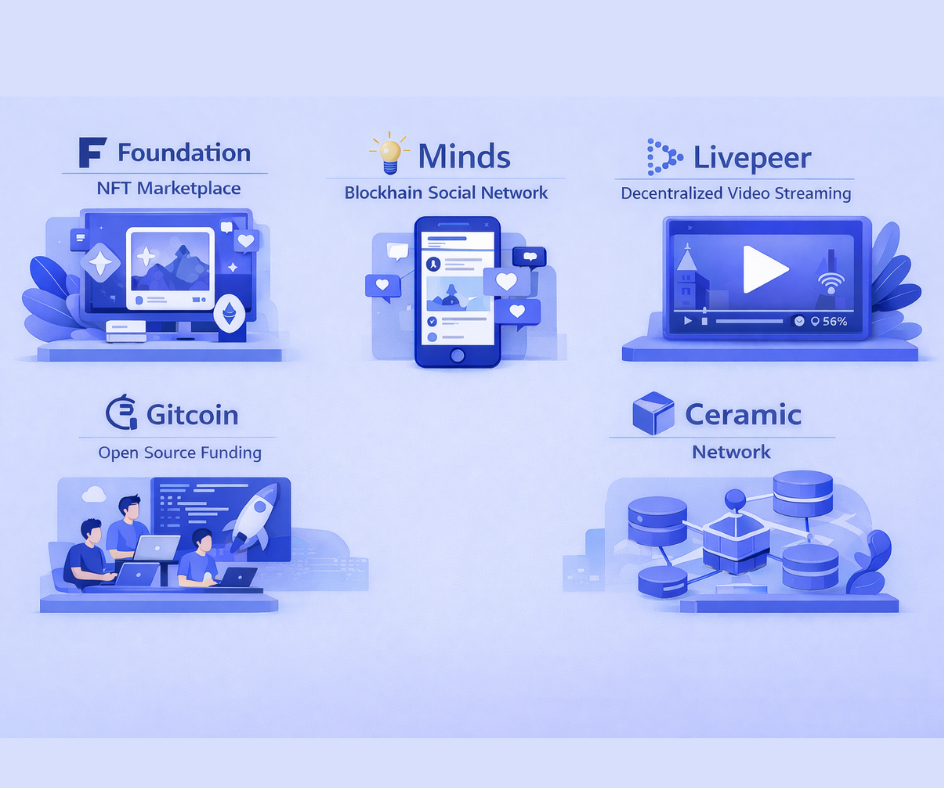
Foundation, a premier NFT marketplace for digital art popular among collectors in USA and UK markets, utilizes IPFS for content distribution with Arweave permanence for high-value artwork. Each minted NFT stores metadata and media on both platforms, with IPFS providing fast retrieval for browsing while Arweave ensures perpetual availability even if IPFS pinning services discontinue operations. This redundant architecture addresses collector concerns about long-term value preservation, with permanent storage becoming a selling point for artists marketing their work.
Minds, a blockchain-based social network positioning itself as a censorship-resistant alternative to Facebook, leverages IPFS for user-generated content storage. Posts, images, and videos upload to IPFS with CIDs stored in smart contracts, creating permanent records of social interactions resistant to content moderation or platform censorship. The platform also complements modern content tools like a Facebook Caption Generator, helping users craft engaging posts while maintaining ownership and permanence of their data. Minds attracts users across Canada and the USA who are particularly concerned with free speech principles, demonstrating how decentralized storage enables business models difficult or impossible with centralized infrastructure.
Livepeer, a decentralized video transcoding network serving streaming platforms globally, integrates IPFS for distributing transcoded video segments. Source videos upload to IPFS, transcode jobs reference content by CID, and resulting video segments return to IPFS for distribution. This architecture allows Livepeer to coordinate global transcoding work without centralized file servers while enabling efficient content delivery through IPFS’s peer-to-peer distribution mechanisms. The platform serves customers across USA, Europe, and Asia, demonstrating decentralized storage scalability for bandwidth-intensive workloads.
Gitcoin, a platform for funding open-source development with strong adoption in North American and European developer communities, uses IPFS for storing grant proposals, project documentation, and governance materials. This ensures critical information about funded projects remains publicly accessible and verifiable, supporting transparency goals central to the platform’s mission. Grant applicants can reference their IPFS-stored materials in funding proposals, creating permanent records supporting due diligence and project evaluation.
Ceramic Network implements a decentralized data network for Web3 applications, using IPFS as its underlying data layer while adding mutable document streams. Applications like self-sovereign identity systems, reputation platforms, and social graphs build on Ceramic, which manages the complexity of mutable data on IPFS while exposing simpler abstractions to developers. This middleware approach demonstrates how higher-level protocols can make decentralized storage more accessible for application developers without deep expertise in underlying technologies.
Real-World Example: Lens Protocol, a decentralized social graph launched in 2022 and rapidly gaining adoption across crypto communities in USA and Europe, stores user profiles, posts, and social connections using a combination of IPFS for content and Arweave for permanent archival. This architecture enables censorship-resistant social networking while giving users true ownership of their social data and connections, portable across applications building on the Lens ecosystem.
Real-World Example: Snapshot, the dominant governance platform for DAO voting with participation from thousands of organizations globally including entities in USA, UK, Canada, and UAE, stores governance proposals and voting records on IPFS. This ensures transparency and permanent accessibility of governance decisions, critical for organizations requiring auditable decision-making processes for regulatory compliance or community accountability.
Real-World Example: Rarible, an NFT marketplace facilitating millions in monthly trading volume across international markets, provides creators the option to store NFT assets on IPFS, Arweave, or both protocols simultaneously. This flexibility allows creators to optimize for their specific requirements around cost, permanence, and performance while maintaining decentralization benefits that differentiate the platform from centralized marketplaces like OpenSea’s traditional cloud hosting.
The Future of Decentralized Storage Infrastructure for dApps
The evolution of decentralized storage infrastructure points toward increasing sophistication, better economics, and deeper blockchain integration. Protocol development roadmaps across IPFS, Filecoin, and Arweave focus on improving performance through better peer discovery algorithms, optimized content routing, and intelligent caching strategies. Filecoin’s ongoing work on programmable storage through FVM (Filecoin Virtual Machine) enables smart contracts executing directly on storage networks, creating possibilities for automated storage management, dynamic pricing, and complex data workflows coordinated entirely through decentralized infrastructure.
Interoperability between storage protocols will likely increase through bridging mechanisms and unified abstraction layers. Projects like Web3.Storage already provide simplified interfaces abstracting away protocol-specific complexity, allowing developers to integrate decentralized storage without managing IPFS nodes, pinning services, or Filecoin deal lifecycles manually. As these abstractions mature, dApps will be able to store metadata on Arweave, distribute assets across IPFS, and anchor proofs on Filecoin through a single unified API, enabling hybrid storage models optimized for performance, cost, and permanence.
Another major shift will be the rise of storage rollups and zero knowledge proofs for storage verification. By combining zk-proofs with decentralized storage, networks can verify data integrity and storage commitments more efficiently, reducing overhead on both storage providers and dApps. This will especially benefit large-scale applications such as AI models, gaming assets, L2 data availability layers, and real time content networks.
Take Your dApp Storage to the Next Level
Connect with our Web3 team to implement IPFS, Filecoin & Arweave for robust data management.
We also expect decentralized storage to become essential for AI driven dApps. As models, datasets, and inference logs grow larger, decentralized storage networks offer a scalable backbone capable of supporting verifiable AI pipelines. IPFS DAG structures are ideal for managing dataset versions, while Filecoin provides persistent storage for large binary assets, and Arweave offers immutable audit trails required for model transparency.
User experience improvements will further accelerate adoption. Gateway censorship resistance, faster retrieval markets, smart caching layers, and local-first dApp frameworks will reduce latency to Web2-like performance. This shift will make decentralized applications feel as fast and seamless as traditional apps while remaining trustless, censorship-resistant, and permanently verifiable.
Long term, decentralized storage infrastructure is moving toward a world where dApps dynamically shift between storage networks based on data type, cost, retention requirement, security sensitivity, and access patterns. This adaptive, intelligent, multi-layered design will power the next generation of Web3 applications, delivering reliability, immutability, and efficiency at global scale.
Frequently Asked Questions
Q1.What is decentralized storage infrastructure for dApps and why is it important?
Decentralized storage infrastructure for dApps refers to distributed systems like IPFS, Filecoin and Arweave that store data across a global peer network rather than a centralized server. It is important because dApps require high availability, tamper resistance, censorship protection and cost optimized storage. Centralized systems are prone to outages and single point failures, making decentralized storage a foundational layer for secure and scalable Web3 applications across multiple industries.
Q2.How does IPFS improve data retrieval and storage for dApps?
IPFS uses content addressing, assigning each file a unique hash rather than relying on a traditional location based URL. This ensures users always receive the exact content requested. For dApps, IPFS enhances performance through distributed retrieval, data integrity, version control and global availability. Its peer to peer architecture enables efficient delivery of images, metadata, documents and even entire frontends without depending on cloud servers or centralized storage vendors.
Q3.What role does Filecoin play in decentralized storage?
Filecoin acts as a verifiable storage marketplace where providers commit storage space using cryptographic proofs. This ensures long term data persistence and economic incentives for reliability. While IPFS handles distribution, Filecoin ensures durability, making them a strong combination for production dApps storing large files, media assets or archives. Many enterprises adopt Filecoin for its transparency, cost efficiency and strong security guarantees in long term storage operations.
Q4.Why do dApps choose Arweave for permanent storage?
Arweave offers permanent storage using its blockweave architecture, making it ideal for data that must remain available indefinitely. dApps rely on Arweave for immutable frontends, NFT metadata, audit trails, documents and compliance critical content. Instead of renewing storage contracts, developers store files once and maintain long term accessibility. This makes Arweave a top choice for applications requiring trust anchored permanence and predictable future availability without recurring operational costs.
Q5.How do IPFS and Filecoin work together in Web3 architecture?
IPFS handles distributed content delivery using hashes, while Filecoin ensures long term reliability through incentive based storage commitments. dApps typically upload files to IPFS, pin them, and then store them on Filecoin for guaranteed persistence. This hybrid model ensures efficient retrieval and durable availability. It is widely used in Web3 applications such as NFT platforms, decentralized social networks, knowledge bases and media heavy dApps that require long shelf life content.
Q6.What should be stored on chain vs off chain in a dApp?
On chain data should be limited to smart contract logic, critical state variables and essential validation checkpoints due to high transaction costs and block size limits. Off chain data should include UI assets, metadata, media files, documents and large datasets stored using networks like IPFS, Filecoin or Arweave. This separation helps reduce costs, improve scalability, enhance application performance and maintain decentralized integrity across the overall system architecture.
Q7.Are decentralized storage networks secure for enterprise grade dApps?
Yes. Networks like IPFS, Filecoin and Arweave provide cryptographic integrity, checksum based verification, distributed redundancy and resistance to single point failures. Data is stored across multiple nodes, reducing risks of unauthorized tampering or downtime. These networks also support encryption and proof based validation, making them suitable for enterprise dApps that require dependable storage guarantees. With proper configuration, they can meet compliance, auditability and operational resilience standards.
Q8.How much does it cost to use IPFS, Filecoin or Arweave for dApp storage?
IPFS itself is free, but developers often use paid pinning services to ensure persistence. Filecoin offers competitive pricing based on long term storage commitments, making it cost effective for large datasets. Arweave has a higher initial cost but provides permanent storage with a one time fee. The final cost depends on factors like data volume, retrieval frequency, desired permanence and storage provider availability across different regions.
Q9.How do developers ensure data persistence in decentralized storage?
Developers ensure persistence by combining IPFS for distribution, Filecoin for long term reliability and Arweave for permanent or immutable datasets. Additional strategies include using pinning services, redundancy across multiple nodes, periodic verification of content hashes, gateway caching and encryption. Automated workflows can re store or replicate data when needed. These best practices help maintain consistent accessibility, minimize data loss risks and strengthen the durability of decentralized applications.
Q10.What advancements are expected in decentralized storage for dApps?
Future advancements include faster retrieval protocols, cross network interoperability, decentralized indexing, zero knowledge based verification, improved pinning networks and more efficient pricing models. Emerging storage focused Layer 2 solutions may also reduce latency and enhance throughput. As more industries adopt Web3, decentralized storage systems will evolve to support richer data types, enterprise workflows, compliance requirements and developer friendly tooling, making them a fundamental component of next generation dApps.
Explore Services
Related Services
Reviewed by

Aman Vaths
Founder of Nadcab Labs
Aman Vaths is the Founder & CTO of Nadcab Labs, a global digital engineering company delivering enterprise-grade solutions across AI, Web3, Blockchain, Big Data, Cloud, Cybersecurity, and Modern Application Development. With deep technical leadership and product innovation experience, Aman has positioned Nadcab Labs as one of the most advanced engineering companies driving the next era of intelligent, secure, and scalable software systems. Under his leadership, Nadcab Labs has built 2,000+ global projects across sectors including fintech, banking, healthcare, real estate, logistics, gaming, manufacturing, and next-generation DePIN networks. Aman’s strength lies in architecting high-performance systems, end-to-end platform engineering, and designing enterprise solutions that operate at global scale.