

Key Takeaways
- Crypto MLM software combines multi-level marketing structures with blockchain technology and cryptocurrency payments
- Regulatory compliance is critical before starting development to avoid legal issues
- Smart contracts automate commission distribution and create transparent transactions
- Security measures must be built into every layer of the system to protect user funds and data
- Proper planning for scalability ensures the platform can handle growth without performance issues
- The development process typically takes 3-6 months depending on feature complexity
Introduction to Crypto MLM Software Development
Crypto MLM software represents the intersection of traditional network marketing and modern blockchain technology. Over the past eight years, we’ve watched this industry transform from simple pyramid schemes into sophisticated platforms that offer genuine value to participants. The software automates commission calculations, tracks referrals across multiple levels, and processes cryptocurrency payments without manual intervention.
The global MLM industry generates over $180 billion annually according to Wikipedia, and cryptocurrency integration has opened new opportunities for international transactions. When you build a crypto MLM platform, you’re creating a system where members earn commissions in digital currencies like Bitcoin, Ethereum, or custom tokens. This eliminates the delays and fees associated with traditional banking systems.
The development process requires careful planning because you’re dealing with real money and legal regulations. A poorly designed system can lead to financial losses, security breaches, or regulatory penalties. Our experience building these platforms has taught us that success depends on understanding both the technical requirements and business objectives from day one.
Also Read: What is MLM? Meaning, Types, Earnings, and Global Legality
Understanding the Business Requirements and MLM Model Selection
Before writing a single line of code, you need to define your business model clearly. Different MLM compensation plans create different software requirements. The four most common models we implement are:
| MLM Model | Structure | Best For | Technical Complexity |
|---|---|---|---|
| Binary Plan | Two legs only, balanced growth required | Fast-growing startups | Medium |
| Matrix Plan | Fixed width and depth (3×7, 5×5, etc.) | Controlled growth businesses | Low |
| Unilevel Plan | Unlimited width, fixed depth levels | Product-focused companies | Low |
| Hybrid Plan | Combines multiple compensation structures | Established enterprises | High |
During requirement gathering sessions, we work with clients to document every commission rule, bonus structure, and rank advancement criteria. For example, one client wanted to pay 10% direct referral bonuses, 5% on level two, and 3% on levels three through five. These percentages directly impact database design and smart contract logic.
You also need to decide on the product or service your network will promote. Some platforms sell physical products, others offer digital services, and some focus purely on investment opportunities. The product type influences inventory management features, shipping integrations, and whether you need an e-commerce component.
Regulatory Compliance and Legal Planning for Crypto MLM Software
 Legal compliance is where many crypto MLM projects fail. Different countries have different regulations regarding network marketing and cryptocurrency. In the United States, the Federal Trade Commission scrutinizes MLM companies to ensure they’re not operating as illegal pyramid schemes. The key difference is that legitimate MLM businesses generate revenue primarily from product sales to end consumers, not from recruiting new members.
When cryptocurrency enters the picture, you face additional regulatory requirements. The Securities and Exchange Commission may classify your tokens as securities if they meet certain criteria. We always recommend consulting with legal experts who specialize in both MLM and cryptocurrency law before development begins.
Your software must include features that support compliance. This includes KYC (Know Your Customer) verification to prevent money laundering, transaction limits to comply with financial regulations, and detailed reporting tools for tax purposes. We build audit trails that record every transaction, commission payment, and membership change. These logs become essential if regulators request documentation.
Geographic restrictions are another consideration. Some countries have banned MLM entirely, while others restrict cryptocurrency trading. Your software should include IP blocking and jurisdiction checks to prevent users from restricted locations from accessing the platform. This protects you from legal liability and demonstrates good faith compliance efforts.
Choosing Blockchain Technology and Cryptocurrency Integration
The blockchain you select impacts transaction speed, costs, and scalability. Ethereum remains popular because of its robust smart contract capabilities and large developer community. However, high gas fees during network congestion have pushed many projects toward alternatives like Binance Smart Chain, Polygon, or Tron.
| Blockchain | Transaction Speed | Average Fee | Smart Contract Support |
|---|---|---|---|
| Ethereum | 15-30 seconds | $2-$50 (variable) | Excellent |
| Binance Smart Chain | 3 seconds | $0.10-$0.50 | Excellent |
| Polygon | 2 seconds | $0.01-$0.05 | Excellent |
| Tron | 3 seconds | $0.01-$0.10 | Good |
We typically recommend Polygon for new projects because it offers Ethereum compatibility with significantly lower fees. This matters when you’re processing hundreds of commission payments daily. A platform with 1,000 active members might generate 500 transactions per day. At $5 per transaction on Ethereum, that’s $2,500 in daily fees. On Polygon, the same volume costs under $25.
Cryptocurrency selection depends on your target market. Bitcoin and Ethereum are widely recognized and easier for mainstream adoption. Custom tokens give you more control and can create scarcity, but they require additional development work and liquidity management. Some platforms support multiple cryptocurrencies to give users flexibility.
Integration with cryptocurrency exchanges allows users to convert their earnings to local currency. We connect platforms to exchanges through APIs, enabling automated conversions. This feature improves user experience because members don’t need to understand blockchain technology to benefit from crypto payments.
System Architecture Design and Technology Stack Selection
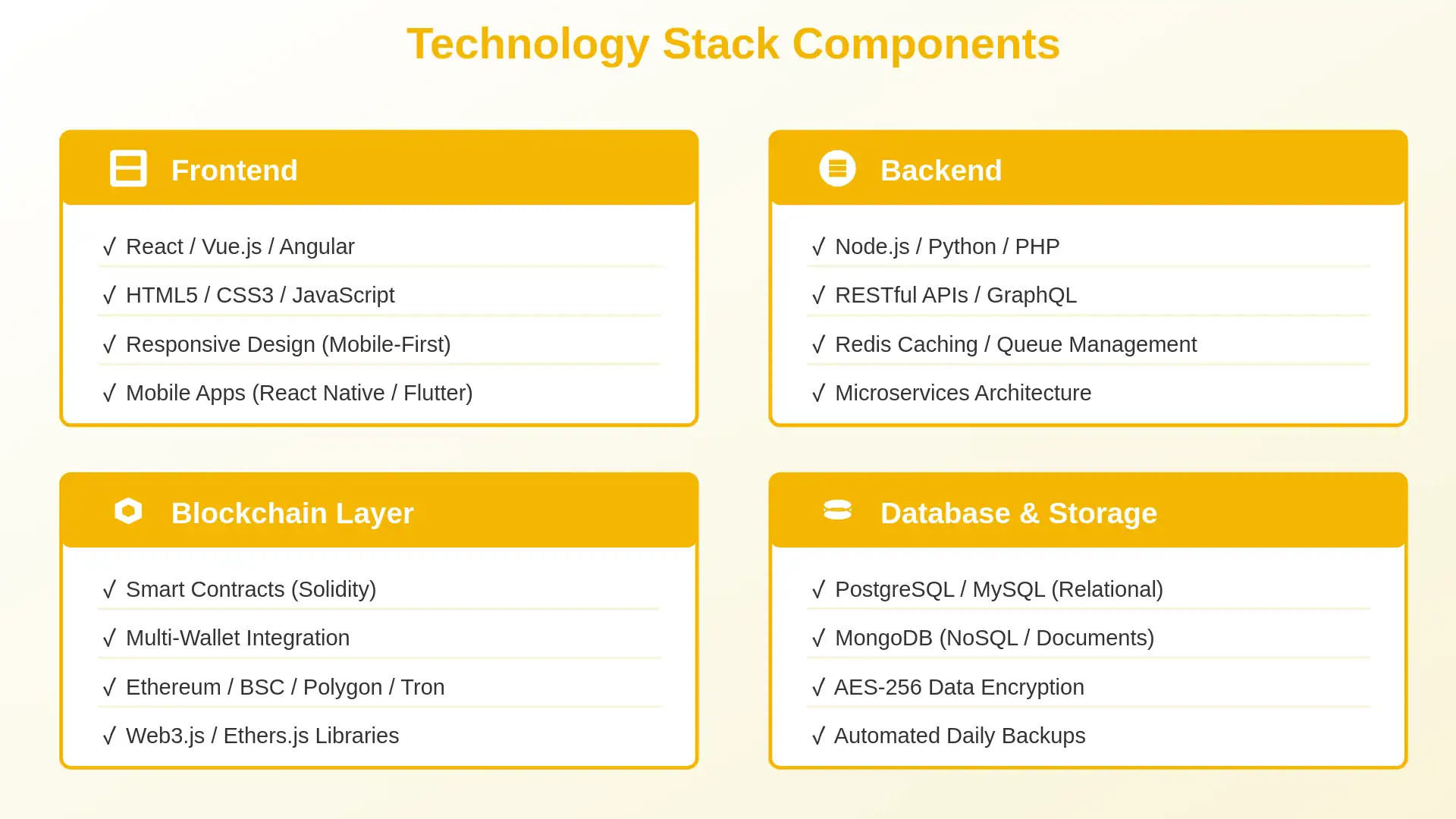
The system architecture determines how well your platform performs under load. We use a microservices approach that separates different functions into independent services. The user management service handles registrations and profiles. The commission calculation service processes earnings. The blockchain service manages wallet interactions. This separation allows you to scale individual components without affecting the entire system.
For the backend, Node.js works well because of its non-blocking architecture and extensive blockchain libraries. Python is another solid choice, particularly if you need complex mathematical calculations for commission algorithms. The database layer typically combines PostgreSQL for transactional data and MongoDB for flexible document storage.
Caching is critical for performance. We implement Redis to store frequently accessed data like user balances and network genealogies. Without caching, database queries slow down as your network grows. A genealogy tree with 10,000 members can take several seconds to load without proper caching. With Redis, the same operation completes in milliseconds.
The frontend can be built with React, Vue.js, or Angular. React is our preferred choice because it handles complex state management well and has a large ecosystem of components. Mobile apps use React Native or Flutter to maintain a single codebase across iOS and Android. This reduces development time by 40% compared to building native apps separately.
Core Feature Planning for Crypto MLM Software
Every crypto MLM platform needs a set of core features that make the business operational. User registration and authentication come first. The system must verify email addresses, implement two-factor authentication, and allow password recovery. We see many platforms skip 2FA to simplify onboarding, but this creates security vulnerabilities that hackers exploit.
The genealogy tree visualization shows members their downline structure. This feature requires careful optimization because trees can grow exponentially. A binary plan where each member recruits just two people creates 1,024 members by the 10th level. Rendering this tree efficiently requires lazy loading and pagination techniques.
Commission calculation is the heart of the system. The software must track every purchase, referral, and rank advancement to calculate earnings accurately. We run these calculations daily, typically during off-peak hours to minimize server load. The process involves querying thousands of transactions, applying complex rules, and updating hundreds of user accounts. Proper indexing and query optimization prevent these jobs from taking hours to complete.
E-wallet functionality allows members to view their balances, transaction history, and make withdrawals. Integration with the blockchain means every wallet operation triggers a smart contract call. The wallet must handle pending transactions gracefully because blockchain confirmations take time. Users get frustrated when withdrawals appear stuck without clear status updates.
Real-time notifications keep members engaged. Push notifications alert users when they earn commissions, when downline members make purchases, or when they reach new ranks. Email notifications provide detailed breakdowns. SMS notifications work for critical security alerts. A multi-channel notification system increases user engagement by 60% based on our client data.
Designing User Interface and User Experience (UI/UX)
Good UI/UX design can make or break user adoption. MLM platforms attract users with varying technical skills, from crypto experts to complete beginners. The interface must be intuitive enough for anyone to understand within minutes. We follow a dashboard-first approach where users see their key metrics immediately after logging in: current balance, today’s earnings, active referrals, and rank progress.
Navigation should be simple and consistent across all pages. We limit main menu items to 5-7 options: Dashboard, Network, Wallet, Reports, and Support. Everything else goes into sub-menus. This prevents overwhelming users with too many choices. Color coding helps users understand different sections quickly. Financial information appears in green shades, network data in blue, and alerts in red.
Mobile responsiveness is not optional. Over 70% of MLM users access platforms from smartphones according to our analytics. The mobile interface needs larger buttons, simplified forms, and touch-friendly navigation. We test on actual devices, not just browser emulators, because touch interactions behave differently than mouse clicks.
Onboarding flows guide new users through initial setup. A step-by-step wizard walks them through profile completion, wallet creation, and their first referral link generation. Progress indicators show how many steps remain. Tooltips explain unfamiliar terms without requiring users to leave the page. A well-designed onboarding process reduces abandonment rates by 50%.
Smart Contract Development and Wallet Integration
Smart contracts are self-executing programs on the blockchain that automate commission distribution. When a member makes a purchase, the smart contract automatically calculates and distributes commissions to upline members based on predefined rules. This eliminates manual processing and creates transparent, immutable records of all transactions.
We write smart contracts in Solidity for Ethereum-based networks. The contract includes functions for registration, purchases, commission calculation, and withdrawals. Security is paramount because smart contracts cannot be modified after deployment. Every line of code goes through rigorous testing to prevent vulnerabilities that hackers could exploit. The DAO hack in 2016 resulted in $50 million in losses because of a smart contract bug, so we take this seriously.
Gas optimization reduces transaction costs. Expensive operations like loops and storage writes can quickly drain user funds. We minimize storage usage by keeping only essential data on-chain and storing everything else in the traditional database. We batch transactions when possible to spread gas costs across multiple operations.
Wallet integration connects user accounts to blockchain addresses. Each member gets a unique wallet address when they register. The system can either generate wallets automatically or allow users to connect existing wallets like MetaMask. Automatic generation is simpler for beginners but requires secure key management. External wallet connections give users full control but add technical complexity.
Multi-signature wallets add an extra security layer for admin functions. Instead of a single person controlling critical operations, multiple team members must approve significant actions like changing commission rates or withdrawing platform funds. This prevents internal fraud and distributes risk across trusted parties.
Backend Development and Database Management
The backend handles all business logic and data processing. We structure the code using MVC (Model-View-Controller) architecture to separate concerns. Models represent data structures, views generate user interfaces, and controllers manage application flow. This organization makes the codebase maintainable as features expand.
API development follows RESTful principles. Each endpoint serves a specific purpose: /api/users for user operations, /api/transactions for payment history, /api/commissions for earnings data. We document every endpoint with Swagger so frontend developers understand exactly how to interact with the backend. Clear API documentation reduces integration bugs by 70%.
Database schema design requires careful planning. User tables store personal information and authentication credentials. Network tables track referral relationships using parent-child references. Transaction tables record every financial operation with timestamps and status indicators. Commission tables maintain earning records with breakdowns by commission type.
We implement database indexing on columns that are frequently queried. Indexes on user IDs, transaction dates, and referral IDs speed up searches significantly. A query that takes 5 seconds without indexes completes in 50 milliseconds with proper indexing. However, indexes slow down write operations, so we balance read and write performance carefully.
Data backup systems run automatically every 24 hours. Backups are stored in multiple geographic locations to prevent data loss from server failures or natural disasters. We maintain 30 days of rolling backups and permanent monthly snapshots. This strategy allows us to restore data from any point in time if needed.
Security Measures and Data Protection Strategies
Security vulnerabilities in crypto platforms lead to devastating losses. We implement defense in depth, meaning multiple security layers protect the system. If one layer fails, others provide backup protection. This approach has kept our platforms secure through eight years of operations.
Encryption protects data both in transit and at rest. All communication between users and servers uses HTTPS with TLS 1.3. Database encryption ensures that even if someone gains physical access to servers, they cannot read sensitive information. We use AES-256 encryption for stored data, which is considered military-grade security.
Input validation prevents SQL injection and cross-site scripting attacks. Every piece of data users submit gets sanitized before processing. We validate email formats, check password strength, and limit text field lengths. These simple checks block the majority of common attacks. We also implement rate limiting to prevent brute force attacks on login endpoints.
Private keys for hot wallets are stored in hardware security modules (HSMs) that provide tamper-proof storage. Cold wallet storage keeps the majority of platform funds offline, inaccessible to hackers. Only the amount needed for daily operations stays in hot wallets. This strategy limits potential losses if a breach occurs.
Regular security audits identify vulnerabilities before attackers find them. We conduct penetration testing quarterly and review code for security issues during development. Third-party security firms provide independent assessments that catch problems internal teams might miss. The cost of audits is minimal compared to potential losses from breaches.
Testing, Quality Assurance, and Performance Optimization
Testing begins during development, not after. We write unit tests for individual functions, integration tests for component interactions, and end-to-end tests for complete user workflows. This catches bugs early when they’re cheapest to fix. A bug found during development costs $100 to fix. The same bug found after deployment costs $10,000 due to investigation time, patch development, and potential data cleanup.
Load testing simulates hundreds or thousands of concurrent users to identify performance bottlenecks. We use tools like Apache JMeter to generate realistic traffic patterns. These tests reveal how the system behaves under stress. For example, commission calculations might work fine with 100 users but crash with 10,000 users. Load testing uncovers these limits before real users experience problems.
Smart contract testing is particularly critical because blockchain transactions are irreversible. We test contracts on local blockchain instances first, then on test networks like Rinkeby or Mumbai. Every possible code path gets executed with various inputs to ensure correct behavior. Automated testing frameworks like Truffle or Hardhat streamline this process.
Performance optimization focuses on the slowest operations. Database queries get optimized with better indexes and query structures. Frontend code gets minified and compressed to reduce page load times. Images are compressed and served from CDNs for faster delivery. These optimizations improve user experience and reduce server costs.
Quality assurance includes manual testing by humans who use the platform like real users would. Automated tests miss usability issues and edge cases that humans naturally discover. QA testers document every bug with screenshots, reproduction steps, and severity ratings. This organized approach ensures nothing falls through the cracks.
Deployment, Hosting, and Blockchain Network Configuration
Deployment moves your application from development environments to production servers where real users can access it. We use containerization with Docker to package applications with all their dependencies. This ensures the software runs identically regardless of the underlying server configuration. Containers eliminate the “it works on my machine” problem that causes so many deployment headaches.
Cloud hosting provides scalability and reliability that traditional servers cannot match. Amazon Web Services, Google Cloud, and Microsoft Azure all offer excellent platforms for crypto MLM software. We typically choose AWS because of its comprehensive service offerings and global infrastructure. Load balancers distribute traffic across multiple servers to handle spikes in usage.
The deployment pipeline automates the process of moving code from development to production. When developers push code to the repository, automated tests run. If tests pass, the code deploys to staging servers for final verification. After manual approval, it goes to production. This process reduces human error and speeds up releases from days to minutes.
Blockchain node configuration connects your platform to the blockchain network. You can run your own nodes for maximum control or use services like Infura or Alchemy. Running nodes requires significant technical expertise and hardware resources but gives you full independence. Third-party services simplify management but create dependencies on external providers.
SSL certificates encrypt data between users and servers. We use Let’s Encrypt for free, automatically renewing certificates. CDN (Content Delivery Network) integration speeds up content delivery by serving files from servers geographically close to users. A user in Japan accessing a server in the United States experiences slower load times than accessing a server in Tokyo.
Post-Launch Maintenance and Software Upgrades
Launching is just the beginning. Ongoing maintenance keeps the platform secure and functional. We monitor servers 24/7 to detect issues before users report them. Automated alerts notify the team immediately when error rates spike, server resources run low, or unusual traffic patterns occur. Quick response times minimize downtime and user impact.
Bug fixes happen on regular schedules. Minor issues get patched weekly. Critical security vulnerabilities receive emergency fixes within hours. We maintain a staging environment that mirrors production so updates can be tested thoroughly before deployment. Rolling back problematic updates takes minutes when you have proper version control.
Feature updates add new capabilities based on user feedback and market trends. The development roadmap extends 6-12 months into the future. Users appreciate knowing what’s coming and when. Transparent communication about updates builds trust and keeps members engaged with the platform.
Database maintenance includes optimization, backup verification, and cleanup of obsolete data. Over time, databases accumulate redundant information that slows performance. Regular maintenance keeps query times fast. We also update database software to benefit from performance improvements and security patches in newer versions.
User support systems handle questions and problems that arise. A comprehensive knowledge base reduces support tickets by 40%. Live chat support resolves issues quickly for urgent matters. Ticket systems track complex problems until resolution. Good support improves user satisfaction and reduces churn.
Scalability Planning and Future Enhancements
 Scalability determines whether your platform can grow from 100 users to 100,000 users without complete reengineering. We design systems with growth in mind from day one. Horizontal scaling adds more servers to distribute load. Vertical scaling increases the power of existing servers. Most successful platforms use a combination of both approaches.
Database sharding splits data across multiple databases as the volume grows. Instead of one database handling all users, you might have one database for users A-M and another for N-Z. This distributes load and prevents any single database from becoming a bottleneck. Implementing sharding after the fact is complex, so planning for it early saves headaches later.
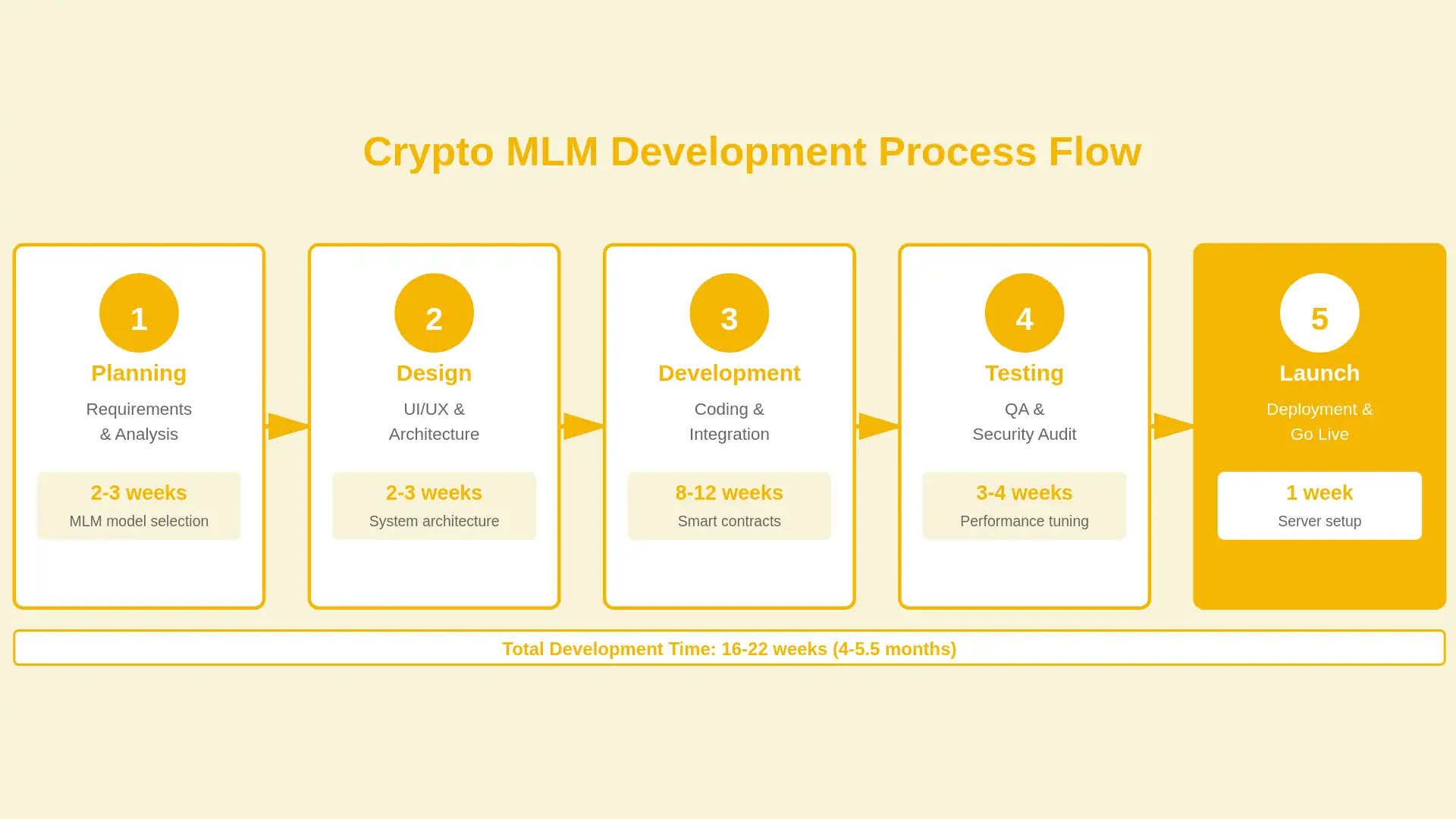
Here is a typical development lifecycle that shows the progression from initial planning through ongoing operations:
Crypto MLM Software Development Lifecycle
Requirements gathering, MLM model selection, legal consultation, technology stack decisions
UI/UX design, system architecture, database schema, smart contract specifications
Frontend development, backend APIs, smart contracts, wallet integration, admin panel
Unit testing, integration testing, security audits, performance optimization, user acceptance testing
Server setup, blockchain configuration, database migration, DNS configuration, SSL setup
Soft launch, user onboarding, performance monitoring, bug fixes, feature updates
Future enhancements keep your platform competitive. Mobile apps expand accessibility. Social features like member chat and community boards increase engagement. Integration with third-party services like payment processors and CRM systems streamline operations. Gamification elements like leaderboards and achievement badges motivate members to stay active.
AI integration is becoming more common in MLM platforms. Chatbots handle routine support questions. Predictive analytics forecast which members are likely to become inactive so you can intervene early. Recommendation engines suggest products based on purchase history. These features require machine learning expertise but provide significant value.
Cross-chain compatibility allows members to use multiple cryptocurrencies. Bridge technologies connect different blockchains so assets can move between them. This flexibility attracts a wider user base because people aren’t locked into a single cryptocurrency. However, cross-chain operations add complexity and security considerations.
DeFi (Decentralized Finance) integration opens new possibilities. Members could stake their earnings in liquidity pools to earn additional returns. Decentralized exchanges could provide instant token swaps. Lending protocols could allow members to borrow against their earnings. These features appeal to crypto-savvy users who want maximum utility from their digital assets.
Key Development Considerations
When building crypto MLM software, prioritize these critical factors that we’ve learned matter most over years of implementations:
- Legal compliance must be addressed before writing any code, not as an afterthought
- Security layers should protect every component because hackers target crypto platforms aggressively
- User experience determines adoption rates more than technical features
- Scalability planning prevents expensive rewrites as your network grows
- Testing thoroughness directly correlates with post-launch stability
- Transparent communication with members builds trust that drives long-term success
The crypto MLM software development process is complex but manageable with proper planning and expertise. Our eight years in this space have taught us that success comes from balancing technical excellence with business understanding. The platforms that thrive are those that solve real problems for members while operating within legal boundaries and maintaining strong security.
Whether you’re launching a new network or upgrading an existing platform, the principles remain constant. Start with clear business requirements. Design for scalability from day one. Build security into every layer. Test exhaustively before launch. Monitor and maintain continuously after deployment. This approach has helped our clients build platforms that process millions in transactions while keeping members satisfied and secure.
The technology will continue evolving. New blockchains will emerge with better performance. Regulatory frameworks will mature and clarify. User expectations will rise. However, the fundamentals of good software development remain unchanged. Focus on solving real problems, prioritize user experience, and never compromise on security. These principles guide successful crypto MLM platforms regardless of technological changes.
Ready to Build Your Crypto MLM Platform?
With proper planning, the right technology choices, and experienced development partners, you can create a platform that serves your network effectively while scaling with your growth.
Frequently Asked Questions
Crypto MLM software is a digital platform that combines traditional multi-level marketing structures with blockchain technology and cryptocurrency payments. It automates user registration, referral tracking, commission calculation, and payout distribution using smart contracts. When a member joins or makes a purchase, the system records the activity, calculates earnings across multiple levels, and distributes commissions in cryptocurrency without manual intervention. This automation improves transparency, accuracy, and trust among participants.
Yes, crypto MLM software can be legal, but its legality depends heavily on the business model and regional regulations. Legitimate platforms focus on product or service sales rather than recruitment-based income. Regulatory bodies like the FTC and SEC closely monitor MLM and crypto activities. To operate legally, the software must support compliance features such as KYC, audit logs, transaction transparency, and geographic restrictions. Consulting legal experts before development is essential to avoid regulatory violations.
The development timeline typically ranges from 3 to 6 months, depending on the complexity of features, MLM compensation plan, blockchain integration, and security requirements. Basic platforms with standard MLM models and single-chain integration take less time, while advanced systems with hybrid plans, smart contracts, mobile apps, and multi-chain support require longer development cycles. Proper planning and clear requirements can significantly reduce delays.
Crypto MLM software can support various compensation plans, including Binary, Matrix, Unilevel, and Hybrid models. Each plan has unique rules for referral structure and commission distribution. The software must be customized to accurately calculate earnings based on the selected plan. Hybrid plans are more complex but offer flexibility for growing businesses. Choosing the right plan early is important because it directly affects system architecture and smart contract logic.
The best blockchain depends on transaction costs, speed, scalability, and target audience. Ethereum is popular for its mature smart contract ecosystem, but high gas fees can be a challenge. Many platforms prefer Polygon, Binance Smart Chain, or Tron due to lower fees and faster transactions. Polygon is often recommended for startups because it offers Ethereum compatibility with significantly reduced costs, making it ideal for frequent commission payouts.
Commission distribution is handled through smart contracts, which are self-executing programs deployed on the blockchain. When a qualifying transaction occurs, the smart contract automatically calculates commissions according to predefined rules and transfers funds to eligible members’ wallets. This eliminates manual errors, delays, and manipulation. All transactions are recorded on the blockchain, ensuring transparency and trust across the network.
Security depends on how well the platform is designed and maintained. High-quality crypto MLM software uses multiple security layers, including encryption, two-factor authentication, secure wallet management, smart contract audits, and regular penetration testing. Funds are typically split between hot wallets for daily operations and cold wallets for long-term storage. When best practices are followed, crypto MLM software can be highly secure and resilient against common attack vectors.
Yes, scalability is a core design requirement for successful crypto MLM platforms. Modern systems use microservices architecture, caching mechanisms, load balancing, and cloud hosting to handle growth. Features like database sharding and horizontal scaling allow the platform to support tens of thousands of users without performance degradation. Scalability planning during early development prevents costly reengineering later.
Absolutely. Most crypto MLM platforms are designed with mobile-first or mobile-responsive interfaces, as a majority of users access MLM systems via smartphones. Developers often use React Native or Flutter to build cross-platform mobile apps for iOS and Android. Mobile support improves user engagement, simplifies onboarding, and allows members to track earnings, referrals, and wallet activity on the go.
Essential features include secure user registration, referral tracking, genealogy visualization, commission calculation, crypto wallets, smart contract integration, real-time notifications, admin dashboards, and compliance tools like KYC and reporting. A strong UI/UX, reliable performance, and ongoing maintenance are equally important. Platforms that balance technical strength with user-friendly design and legal compliance tend to achieve long-term success.
Reviewed By

Aman Vaths
Founder of Nadcab Labs
Aman Vaths is the Founder & CTO of Nadcab Labs, a global digital engineering company delivering enterprise-grade solutions across AI, Web3, Blockchain, Big Data, Cloud, Cybersecurity, and Modern Application Development. With deep technical leadership and product innovation experience, Aman has positioned Nadcab Labs as one of the most advanced engineering companies driving the next era of intelligent, secure, and scalable software systems. Under his leadership, Nadcab Labs has built 2,000+ global projects across sectors including fintech, banking, healthcare, real estate, logistics, gaming, manufacturing, and next-generation DePIN networks. Aman’s strength lies in architecting high-performance systems, end-to-end platform engineering, and designing enterprise solutions that operate at global scale.