Ai Overview
The cryptocurrency exchange industry has evolved into one of the most profitable segments within Web3 applications ecosystem. 10 percent taker fees generates approximately $1 million in daily revenue. Total initial investment typically ranges from $2 million for basic platforms serving niche markets to $50 million or more for comprehensive global exchange platforms targeting institutional traders.
Key Takeaways
- Trading fees from maker and taker transactions represent the primary revenue source for crypto exchanges, typically generating 70 percent of total platform income.
- Crypto exchange ROI typically requires 18 to 36 months to achieve profitability, with successful platforms demonstrating 2x to 15x returns over five-year periods.
- Daily trading volume directly impacts profitability, as 10 percent volume increases translate to proportional revenue gains in transaction fee collection across markets.
- Operational costs including security, compliance, and customer support consume 50 to 70 percent of revenue, making cost optimization critical for sustainable margins.
- 24/7 cryptocurrency market operations enable continuous trading opportunities unavailable in traditional finance, driving higher revenue potential in USA, UK, UAE, and Canada.
- User retention above 40 percent monthly reduces acquisition costs by up to 80 percent compared to new customer acquisition, directly improving long-term ROI metrics.
- Additional revenue streams from listing fees, lending services, and staking rewards diversify income beyond trading fees, enhancing overall platform profitability.
- Regulatory compliance in established jurisdictions requires 10 to 20 percent operational investment but enables institutional capital access and sustainable long-term growth.
- Liquidity provision through market-making agreements ensures order book depth, supporting higher trading volumes and improved revenue collection capabilities.
- Exchanges implementing tiered fee structures and premium features increase average revenue per user by 25 to 40 percent compared to flat-fee models.
Understanding Crypto Exchange Profitability
The cryptocurrency exchange industry has evolved into one of the most profitable segments within Web3 applications ecosystem. Exchanges serve as critical infrastructure enabling billions of dollars in daily asset transfers and trading activity across global markets. Understanding the mechanics of crypto exchange profitability requires analyzing multiple interconnected factors including trading volume, user base dynamics, operational efficiency, and regulatory positioning. Platforms operating in USA, UK, UAE, and Canada markets demonstrate distinctly different profitability profiles based on local regulations, market maturity, and competitive density.
The profitability trajectory of cryptocurrency exchanges has transformed dramatically over the past decade. Early-stage exchanges in 2010 generated modest revenues from a small user base conducting spot trading on emerging cryptocurrency markets. Today’s mature platforms process trillions of dollars in annual trading volume, generating billions in annual revenue. This evolution reflects both market growth and technological advancement, enabling exchanges to capture increasing shares of global crypto trading activity. However, profitability projections must account for cyclical market patterns, regulatory changes, and competitive disruptions that fundamentally alter revenue expectations.
What Determines the Profitability of a Crypto Exchange?
Crypto exchange profitability depends on a carefully balanced combination of factors spanning market conditions, operational efficiency, user acquisition, and strategic positioning. Each factor contributes distinct leverage points affecting overall revenue generation and cost efficiency. Successful platforms optimize across all dimensions simultaneously while maintaining flexibility to adapt to changing market conditions. The complexity of managing these variables explains why few new entrants achieve meaningful profitability relative to established competitors with optimized operations and established user bases.
Trading Volume and Market Activity
Trading volume represents the single most important driver of crypto exchange revenue generation. Higher volume directly translates to increased transaction fee collection, with each trade generating marginal revenue. A platform processing $1 billion in daily trading volume with 0.10 percent taker fees generates approximately $1 million in daily revenue. Volume dynamics vary significantly across markets, with 24/7 cryptocurrency markets experiencing peak activity during overlapping trading sessions across Asia, Europe, and North America. Seasonal patterns create significant volatility, with bull market periods generating 3 to 5 times higher trading volumes compared to bear market conditions.
User trading behavior patterns directly influence revenue consistency and predictability. Retail traders tend to concentrate trading activity during peak volatility periods and market news events, creating lumpy revenue patterns. Institutional traders and market makers provide more consistent baseline volumes through algorithmic trading and liquidity provision programs. Exchanges attracting diverse user segments including retailers, professionals, and institutions achieve more stable revenue streams less vulnerable to market sentiment fluctuations. Geographic diversification across USA, UK, UAE, and Canada markets enables exchanges to capture trading activity across different time zones, reducing dependency on any single market’s peak hours.
User Base and Platform Adoption
User base size and growth trajectory fundamentally determine revenue ceiling and growth potential for crypto exchanges. Platforms with multi-million user bases achieve economies of scale in marketing, compliance, and technology operations. Each marginal user contributes revenue through trading fees, listing inquiries, and premium service adoption. User acquisition costs vary dramatically based on market maturity, with USA and UK markets showing higher acquisition expenses than emerging markets due to competitive intensity. However, USA, UK, UAE, and Canada markets provide higher average revenue per user through institutional traders and compliance-conscious users paying premium fees.
Platform adoption speed influences time-to-profitability and capital requirements. Exchanges achieving rapid user adoption can reach profitability sooner, reducing total capital invested and improving overall ROI metrics. User retention rates determine the long-term value of acquired users, with monthly retention above 40 percent indicating sustainable growth patterns. Active user metrics more accurately reflect profitability potential than total registered accounts, as only active traders generate transaction fees. Exchanges tracking daily, weekly, and monthly active users can accurately forecast revenue based on activity levels and average transaction values.
Fee Structure and Transaction Charges
Fee structure design directly determines revenue per transaction and competitive positioning within target markets. Maker-taker models charge lower fees for providing liquidity (makers) and higher fees for consuming liquidity (takers), incentivizing market depth and order book health. Typical maker fees range from 0.01 percent to 0.05 percent, while taker fees span 0.05 percent to 0.20 percent. Volume-based fee tiers reduce fees for high-volume traders, attracting institutional capital while maintaining per-transaction profitability. Premium fee models for derivatives trading, margin services, and advanced features generate additional revenue from active professional traders.
Fee structure optimization requires balancing competitive positioning against profitability objectives. Lower fees attract higher volumes but reduce per-transaction margins. Higher fees protect margins but may discourage volume growth and user acquisition. Successful exchanges implement dynamic fee structures adjusting based on market conditions, liquidity levels, and competitive positioning. Promotional fee reductions during user acquisition phases sacrifice short-term revenue for long-term user base growth. Fee structure decisions must consider target market expectations, with USA and UK traders expecting more competitive fees than emerging market users.
Why Crypto Exchanges Are Considered High-Revenue Businesses
Cryptocurrency exchanges command exceptional revenue multiples relative to comparable fintech businesses due to several structural advantages inherent to crypto market characteristics. The global cryptocurrency market continues expanding, with increasing institutional adoption driving transaction volumes to all-time highs. Exchanges positioned to capture crypto trading activity benefit from exponential market growth and professionalization trends reshaping the asset class. Revenue generation from trading fees demonstrates margin characteristics superior to many financial services businesses, with incremental trading volume generating significant revenue leverage.
Growth of the Global Crypto Trading Market
Global cryptocurrency trading volume has grown from approximately $1 billion annually in 2010 to over $15 trillion annually by 2024, representing extraordinary compound annual growth rates exceeding 100 percent over sustained periods. This explosive growth creates massive revenue opportunities for exchanges positioned to capture market share. USA, UK, UAE, and Canada markets represent developed cryptocurrency ecosystems with billions of dollars in daily trading activity. Institutional adoption by hedge funds, asset managers, and corporations accelerates volume growth while raising average transaction values. Regulatory clarity in established markets attracts institutional capital, further driving volume increases and supporting revenue expansion.
Market professionalization introduces new market participants and trading strategies previously absent from cryptocurrency markets. Futures, options, and derivatives trading generate higher fee revenue per transaction compared to spot trading. Cross-border capital flows and arbitrage trading create consistent baseline volume regardless of market sentiment. Stablecoin adoption enables faster settlement and capital efficiency, increasing trader willingness to execute higher volumes. Exchange-traded funds (ETFs) and regulated investment products introduce massive capital inflows requiring exchange infrastructure for underlying asset trading and settlement.
Continuous Trading Opportunities (24/7 Market)
Unlike traditional equity markets operating on fixed trading hours, cryptocurrency markets operate continuously 24 hours daily, 7 days weekly, across all time zones. This operational characteristic creates permanent profit opportunities unavailable in conventional finance sectors. Exchanges capture trading activity during every market session, generating revenue streams continuously rather than during limited trading windows. A platform processing identical volumes in 24-hour operations generates higher annual revenue compared to an 8-hour trading window market. Price discovery mechanisms operating continuously maintain accurate market valuations and reduce gaps between trading sessions.
24/7 market operations attract sophisticated traders exploiting global price differentials and leveraging algorithmic trading strategies. Market makers maintain continuous presence generating consistent liquidity and transaction volume. Retail traders from different time zones trade according to local hours, creating diversified demand patterns. Risk management traders continuously rebalance portfolios across 24-hour cycles, generating additional trading volume. Emergency liquidations and margin calls operate continuously, creating reactive trading volume during market stress periods. Exchanges optimizing for 24/7 operations through robust infrastructure and global customer support maximize capture of continuous market activity.
Key Factors That Influence Crypto Exchange ROI
Return on investment calculations for crypto exchanges must incorporate multiple cost and revenue variables spanning initial platform creation through operational scaling. Each factor contributes distinct impact on ROI metrics and profitability timelines. Comprehensive ROI analysis requires detailed financial modeling incorporating scenario analysis for different market conditions and competitive outcomes. Understanding individual ROI factor contributions enables strategic decision-making regarding capital allocation and operational priorities.
Initial Investment in Cryptocurrency Exchange Infrastructure
Initial capital requirements for new exchange platforms have increased significantly as regulatory compliance, security standards, and competitive technology expectations have elevated. Modern crypto exchange platforms require substantial upfront investment in technology, security, compliance, and market positioning before generating meaningful revenue. Platforms launching in USA, UK, UAE, and Canada markets face higher compliance costs compared to emerging market venues. Total initial investment typically ranges from $2 million for basic platforms serving niche markets to $50 million or more for comprehensive global exchange platforms targeting institutional traders.
Platform Development and Technology Costs
Technology infrastructure represents a critical initial investment component determining platform reliability, feature richness, and competitive positioning. Trading engine technology capable of processing thousands of transactions per second requires sophisticated software architecture and specialized talent. Matching engines, order books, and price feeds demand low-latency infrastructure supporting millisecond execution. Mobile applications, web interfaces, and API connectivity require ongoing maintenance and feature enhancement. Wallet integration, blockchain connectivity, and multi-asset support add complexity and development cost. Initial technology investment typically ranges from $1 million to $10 million depending on feature scope and quality standards. Ongoing technology maintenance represents 10 to 15 percent of annual operational budgets for continuous improvement, security patching, and feature additions.
Cloud infrastructure, server capacity, and data center requirements scale with trading volume and user base growth. Geographic redundancy and disaster recovery infrastructure add cost but provide resilience critical for operational continuity. Content delivery networks optimize latency for global users accessing the platform from different regions. API infrastructure supporting third-party integrations and professional trading tools requires additional investment. Backup systems, failover mechanisms, and high-availability architectures prevent revenue losses from platform outages.
Security, Compliance, and Infrastructure Expenses
Security infrastructure investment protects against fraud, hacking, and operational disruptions that could devastate platform reputation and user confidence. Multi-layer security architectures, cold storage for user assets, and hot wallet management systems require specialized security personnel and infrastructure. Regular security audits by third-party firms cost $100,000 to $500,000 annually depending on platform complexity. Insurance coverage for operational risks, cyber liability, and asset custody adds ongoing expense. Compliance infrastructure including KYC systems, AML monitoring, transaction surveillance, and regulatory reporting systems require substantial initial and ongoing investment. USA, UK, UAE, and Canada jurisdictions maintain increasingly sophisticated compliance requirements driving infrastructure investment. Initial compliance setup costs range from $500,000 to $5 million, with ongoing compliance staff and systems adding 20 to 30 percent to annual operational budgets.
Regulatory licensing and approval processes require legal expertise, consulting fees, and compliance personnel investment. Bank relationships, custody partnerships, and fiat on-ramp infrastructure require compliance arrangements and integration costs. Stablecoin integration, blockchain partnerships, and liquidity provider agreements involve legal agreements and technical integration work. Data privacy, cybersecurity insurance, and operational risk management systems provide essential protections. These infrastructure investments reduce near-term ROI but provide competitive advantages and regulatory moats protecting against new entrants.
Operational Costs of Running an Exchange
Ongoing operational costs represent the largest ongoing expense category for mature crypto exchange platforms, consuming 50 to 70 percent of generated revenue. Understanding operational cost structure enables accurate profitability projections and ROI calculations. Controlling operational costs while maintaining service quality and growth determines whether platforms achieve attractive ROI metrics. Operational expenses tend to scale with user base growth and trading volume, creating leverage opportunities for high-volume platforms.
Liquidity Management
Maintaining sufficient order book liquidity requires ongoing market-making programs, liquidity provider agreements, and market-making incentives. Market makers provide essential liquidity enabling user trades at competitive prices, justifying fee reductions or subsidies. Initial market-making partnerships may involve profit-sharing arrangements or guaranteed payment structures costing millions monthly. As platform volume grows, market-making costs typically decline as a percentage of revenue due to improved volume leverage. Professional market makers operate consistently across 24-hour markets, providing baseline liquidity during low-volume periods. Liquidity provision costs represent 5 to 15 percent of platform revenue depending on market conditions and competitive positioning.
Liquidity provider selection influences price competitiveness and order execution quality affecting user experience and retention. Blockchain bridges and cross-chain liquidity solutions add technical complexity and operational cost. Stablecoin liquidity pools and fiat on-ramp partnerships require ongoing agreements and integration maintenance. Liquidity monitoring systems track order book health and identify gaps requiring market-making intervention. Market impact analysis informs trading operations and risk management during volatile market periods.
Customer Support and Maintenance
Customer support operations scale with user base growth, requiring substantial staffing investment for 24/7 support coverage across global markets. Support ticket volume grows with user acquisition, creating staffing requirements and quality management challenges. USA, UK, UAE, and Canada markets expect professional customer support with rapid response times and multilingual capabilities. Support staff training, quality assurance, and escalation management add operational complexity. Support costs typically range from 10 to 15 percent of operational budgets, scaling with user base and complexity. Automated support systems, chatbots, and knowledge bases reduce per-ticket costs while improving user satisfaction. Community moderators and forums provide peer-to-peer support supplementing official channels. Premium support tiers generate additional revenue offsetting support costs. Technical support for wallet operations, transaction issues, and account access represents ongoing operational requirement.
Maintenance windows, system updates, and technology refresh cycles require coordination minimizing user disruption. On-call engineering teams handle emergency incidents and production issues during off-hours. Monitoring systems, alerting infrastructure, and incident response procedures prevent revenue-impacting downtime. Documentation, knowledge bases, and training materials reduce support load and improve user self-service resolution. Community building initiatives reduce support burden through peer assistance and user education.
Calculating Crypto Exchange ROI
ROI calculations for crypto exchanges require comprehensive financial modeling incorporating revenue projections, cost structures, and profitability timelines. Traditional ROI formulas comparing net profit to initial investment provide simplified metrics missing important nuances specific to exchange business models. Multi-year ROI analysis accounting for cumulative profitability provides better understanding of value creation over platform lifetime. Scenario analysis exploring optimistic, base, and pessimistic cases reveals risk factors affecting ROI outcomes.
Revenue vs Operational Costs
Daily revenue generation from trading fees provides observable metrics for assessing financial performance. A platform processing $500 million daily trading volume at 0.10 percent average fee rate generates approximately $500,000 daily revenue or $180 million annually. However, this revenue finances all operational costs including staff, infrastructure, compliance, marketing, and development. Platforms with optimized cost structures achieving 40 to 50 percent net margins generate attractive profits. Less efficient platforms with cost ratios exceeding 80 percent generate minimal profits despite substantial revenue. Cost ratio optimization through automation, global staffing, and operational efficiency directly determines ROI outcomes.
Quarterly financial performance tracking revenue trends, cost inflation, and profitability margins enables real-time ROI assessment. Year-over-year revenue growth exceeding 50 percent indicates strong market positioning and user acquisition success. Cost control maintaining expense growth below revenue growth indicates improving operational efficiency and expanding profit margins. Cohort analysis comparing profitability across user acquisition periods and markets reveals which channels and regions drive profitable growth. Return on marketing spend (ROMS) metrics inform marketing budget allocation and customer acquisition sustainability.
Break-Even Point for Crypto Exchanges
Break-even analysis identifies the trading volume and user base thresholds required for platforms to achieve profitability. Platforms with $10 million annual fixed costs require generating $10 million cumulative trading fees to reach break-even. Break-even timelines vary dramatically based on initial capital availability, market conditions, and user acquisition success. Well-capitalized platforms with strong marketing can reach profitability within 18 to 24 months. Underfunded platforms may require three to five years achieving profitability. Break-even analysis informs capital raise requirements and operational scaling decisions.
Contribution margin analysis tracks incremental revenue from each user or transaction after variable costs. If average transaction generates $1 revenue while incurring $0.20 variable costs, each transaction contributes $0.80 toward covering fixed costs. Platforms requiring 12.5 million transactions monthly to cover $10 million fixed costs can calculate precise break-even volumes. Sensitivity analysis exploring how changes in transaction volumes or fee rates affect break-even points reveals business vulnerability. Break-even analysis combined with growth projections informs realistic ROI timelines and capital requirements.
Understanding the Crypto Exchange Revenue Model
Cryptocurrency exchange revenue models have evolved from simple trading fee structures into sophisticated multi-stream income systems capturing value across diverse platform services. Understanding individual revenue components and their contribution to total profitability enables strategic focus on highest-return activities. Revenue model optimization balances maximizing per-user value against maintaining competitive positioning and user retention. Successful platforms diversify beyond trading fees, reducing dependency on trading volume fluctuations.
Trading Fees (Primary)
Transaction-based revenue from maker and taker fees representing 70 percent of total revenue for most platforms
Listing Fees (Secondary)
One-time and recurring revenue from blockchain projects seeking token listings on exchange platforms
Services Revenue (Tertiary)
Recurring revenue from lending, staking, premium features, and API access creating diverse income streams
Trading Fees – The Primary Revenue Source
Trading fees represent the foundational revenue source for virtually all cryptocurrency exchanges, typically generating 60 to 80 percent of total platform revenue. Fee structures directly impact competitive positioning, with lower fees attracting higher volumes but reducing margins. Most platforms implement maker-taker fee models providing incentives for liquidity provision while capturing profit from liquidity consumption. Fee revenue scales linearly with trading volume, making volume growth the primary ROI driver for exchange business models.
Maker and Taker Fees
Maker-taker models charge different fees for limit orders (makers providing liquidity) and market orders (takers consuming liquidity). Typical maker fees range from 0.01 percent to 0.05 percent, while taker fees range from 0.05 percent to 0.20 percent. This structure incentivizes limit order placement, improving order book depth and execution prices for all users. Platforms implementing aggressive fee reductions for makers (0.01 percent or zero) and higher taker fees (0.15 percent to 0.25 percent) attract market makers while maintaining revenue per taker transaction. Volume-based fee tiers provide rebates for traders exceeding monthly volume thresholds, attracting institutional capital. VIP tiers offer premium traders reduced fees in exchange for guaranteed minimum volumes.
Fee structure optimization requires balancing ecosystem objectives with revenue maximization. Some platforms implement zero-fee models for makers to attract order book liquidity, recovering revenue entirely from taker fees. Others implement rebate programs returning portions of taker fees to makers executing high volumes. Advanced fee structures incorporate liquidity rebates, incentivizing specific order types or market conditions. Dynamic fee models adjust rates based on order book depth, volatility, or market conditions. Promotional fee reductions during user acquisition periods sacrifice short-term revenue for long-term volume growth.
Spot and Derivatives Trading Fees
Spot trading fee revenue comes from immediate asset exchanges at current market prices. Derivatives trading including futures and options generates higher per-transaction fees (0.02 percent to 0.20 percent) due to increased complexity and leverage. Perpetual futures contracts with 24/7 trading generate consistent revenue streams substantially higher than spot trading on equal volumes. Leveraged trading enables small account balances to control large positions, increasing transaction count and fee revenue. Margin trading enables short selling and leveraged long positions, expanding tradable markets and generating additional fee revenue. Platforms offering diverse trading products generate higher average fee revenue per user compared to spot-only exchanges.
Derivatives trading introduces additional revenue through funding rates charged to perpetual futures positions. These rates incentivize position liquidation during imbalanced market conditions while generating revenue for the exchange. Liquidation events from over-leveraged positions generate additional trading fees when forced position closures execute. Options trading fees include premium charges and exercise fees providing granular revenue opportunities. Each trading product category attracts different user segments with distinct profitability profiles, enabling portfolio optimization across user types.
Additional Revenue Streams for Exchanges
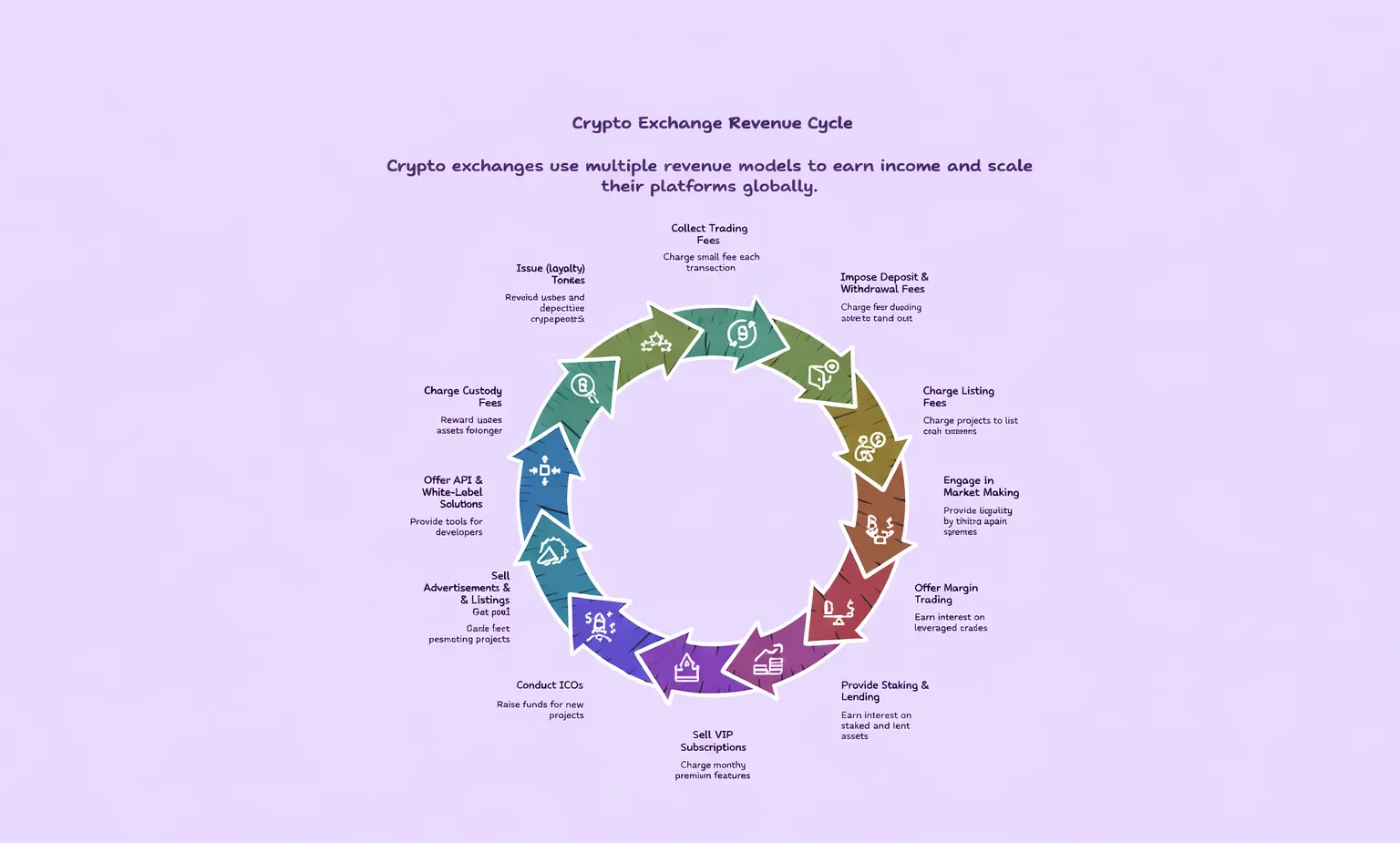
Cryptocurrency exchange revenue models have expanded substantially beyond trading fees, with successful platforms generating 30 to 40 percent of revenue from non-trading-fee sources. This revenue diversification reduces dependency on trading volume cycles and improves profitability stability. Additional revenue sources often demonstrate superior margins compared to trading fees, contributing disproportionately to platform profitability. Revenue stream innovation creates competitive differentiation and justifies premium positioning in crowded markets.
Listing Fees for New Tokens
Blockchain projects pay listing fees ranging from $50,000 to $5 million for token exchange listings, representing significant revenue opportunities for established platforms. Listing fee revenue depends on volume of new token launches and exchange prestige attracting premium projects. Major exchanges conduct rigorous evaluation processes justifying premium listing fees. Tier-1 exchange listings provide marketing exposure and liquidity essential for token success, justifying high listing fees. Tier-2 and emerging exchanges charge lower listing fees competing on cost and niche audience focus. Listing fees represent pure profit opportunity with minimal operational cost once token listing systems are operational. Annual listing revenue for major exchanges ranges from $50 million to $500 million depending on market activity levels.
Listing fee optimization requires balancing platform prestige against volume of project applications. Overly selective approaches limit revenue while overly permissive approaches harm user trust in token quality. Community voting systems enabling user participation in listing decisions reduce exchange liability while increasing perceived fairness. Listing requirements including security audits, token economics review, and regulatory compliance assessment increase credibility. Listing fee structures may include discounts for projects meeting specific criteria or volume thresholds, incentivizing strategic partnerships.
Withdrawal and Deposit Fees
Deposit and withdrawal fee revenue represents pure profit margin services with minimal operational cost beyond payment processor fees. Most platforms charge 0 to 0.5 percent withdrawal fees depending on asset class and blockchain network. High-value withdrawals, international transfers, and fiat on-ramp services command premium fees. Blockchain network fees for token transfers pass through to users as base withdrawal costs, with platforms capturing margin between actual costs and user fees. Premium withdrawal features including expedited processing or multiple address registrations generate fee revenue. Deposit fees for fiat channels including wire transfers, credit cards, or third-party processors range from 1 to 5 percent depending on processor and payment method.
Fee structures must balance user experience objectives against revenue capture opportunities. Overly aggressive fee structures drive users to competitors with lower costs. Transparent fee disclosure builds user trust and reduces churn. Free deposit and withdrawal tiers for high-volume users retain valuable customers while monetizing casual traders. White-label solutions for custody and transfer management generate partnership fee revenue. Bank partnerships enabling low-cost deposit and withdrawal enhance user acquisition without internal payment processing complexity.
Margin Trading and Lending Services
Margin trading services enabling leveraged trading generate substantial additional revenue through interest charges and trading fee increases. Lending services provide users capital at interest rates of 10 to 100 percent annually for leveraged positions. Interest revenue from lending pools creates passive income streams for user capital providers. Platforms may offer up to 10x leverage subject to margin requirements and liquidation mechanisms. Margin trading fee rates typically exceed standard trading fees, capturing additional revenue from increased trading activity. Liquidation fees charged during forced position closures generate reactive revenue during market stress periods.
Lending services including borrowing programs provide returns for idle user capital through staking and lending pools. Annual returns of 5 to 20 percent attract institutional capital seeking yield. Lending management systems, credit risk assessment, and default handling add operational complexity. Automated market makers (AMMs) and liquidity pools generate protocol fees capturing value from decentralized trading. These services create network effects as users earn returns encouraging capital deployment and increased trading activity.
How Much Crypto Exchange Business Profit Can You Expect?
Profit expectations for cryptocurrency exchanges vary dramatically based on platform scale, market positioning, and operational efficiency. Understanding realistic profit ranges for different platform categories informs business planning and capital raise requirements. Successful platforms demonstrate sustainable profitability with net margins of 30 to 60 percent for mature operations. Early-stage platforms operating at losses during user acquisition phases eventually achieve attractive profitability as volumes scale.
Small-Scale Exchanges
Small-scale regional exchanges serving specific markets or niche user segments typically generate $1 to $10 million in annual revenue. These platforms may operate at break-even or small losses during establishment phases before achieving profitability. Profit margins for small exchanges range from negative to 20 percent as they achieve scale efficiencies. Small platforms focusing on specific regional markets like USA, UK, UAE, or Canada can achieve faster profitability through targeted user acquisition. Limited feature sets and specialized markets reduce operational complexity and costs. Acquisition by larger platforms represents common exit strategies for successful small exchanges, with valuations typically ranging from 2x to 5x annual revenue. Annual profit potential for small-scale exchanges ranges from $0 to $2 million for profitable operations.
Mid-Level Trading Platforms
Mid-level exchanges serving significant regional markets or specialized user segments generate $50 to $500 million in annual revenue. These platforms typically demonstrate 15 to 35 percent net profit margins as they achieve meaningful scale efficiencies. Mid-tier platforms positioning in USA, UK, UAE, or Canada markets with differentiated offerings can achieve premium valuations. Specialized focus on derivatives, DeFi, or NFT trading creates competitive positioning justifying premium fees. Annual profit potential for mid-level exchanges ranges from $7 million to $175 million depending on operational efficiency and market conditions. Mid-level exchanges often pursue strategic acquisitions of smaller competitors to consolidate market share and achieve scale economies.
Large Global Exchanges
Large global exchanges serving mainstream users and institutional traders generate $1 billion to $5+ billion in annual revenue. These tier-1 platforms achieve 30 to 50 percent net profit margins through substantial scale efficiencies and operational optimization. Major platforms process 20 to 30 percent of all cryptocurrency trading globally, enabling significant profitability. Annual profit potential for large exchanges ranges from $300 million to $2.5 billion+, justifying multi-billion dollar valuations. Tier-1 platforms can raise billions in venture capital at premium valuations reflecting profit potential and market position. International operations across USA, UK, UAE, and Canada markets provide geographic diversification and risk mitigation.
Real-World Profit Examples from Major Exchanges
Examining real-world profitability from established cryptocurrency exchanges provides concrete understanding of profit potential. Top-tier exchanges have disclosed financial information through regulatory filings or investor presentations, enabling profit analysis. These examples demonstrate exceptional profitability available to platforms achieving scale and operational excellence. However, most exchanges operate privately, limiting available financial data for comparative analysis.
Revenue Growth in High-Volume Markets
Major exchanges operating in USA, UK, UAE, and Canada markets have demonstrated exceptional revenue growth tracking cryptocurrency market maturation. Platforms achieving 100 percent plus annual revenue growth during bull markets show exceptional scaling capabilities. Revenue growth acceleration indicates increasing market share capture and user base expansion. However, revenue volatility during market downturns demonstrates business model sensitivity to market cycles. Platforms maintaining year-over-year revenue growth above 30 percent during both bull and bear markets demonstrate sustainable competitive positioning and diversified revenue sources.
Profitability case studies examining successful platforms reveal common characteristics including operational efficiency, user retention focus, and revenue diversification. Exchanges maintaining overhead ratios below 40 percent demonstrate superior profitability. Revenue per employee metrics above $1 million indicate productivity and automation advantages. Market share gains during competitive intensity periods reveal platform differentiation and user preference strength. Exchanges successfully navigating regulatory changes and expanding into new jurisdictions demonstrate adaptability and management quality. These operational characteristics correlate strongly with long-term profitability and investor returns.
Cost Breakdown of Cryptocurrency Exchange Development
Understanding detailed cost breakdowns enables accurate financial forecasting and capital raise requirements for new exchange platforms. Platform creation represents significant capital investment requiring 12 to 36 months before achieving meaningful trading volumes. Cost categories span one-time development expenses and ongoing operational costs requiring careful financial planning. Cost management during platform creation phase critically influences time-to-profitability and overall ROI outcomes.
| Cost Category | Typical Investment | Ongoing Annual Cost | Impact on ROI |
|---|---|---|---|
| Platform Technology | $2M – $10M | $500K – $2M | Critical |
| Security Infrastructure | $500K – $2M | $200K – $800K | Critical |
| Compliance & Legal | $500K – $5M | $300K – $1.5M | Critical |
| Customer Support | $200K – $500K | $1M – $5M | High |
| Marketing & Acquisition | $500K – $3M | $1M – $10M | High |
| Infrastructure & Operations | $300K – $1M | $500K – $2M | Medium |
Technology Stack and Platform Features
Technology stack selection fundamentally determines platform scalability, feature richness, and operational costs. Modern exchange technology requires sophisticated distributed systems handling millions of transactions daily with millisecond latency requirements. Technology decisions made during platform creation constrain future capabilities and expansion options. Underinvestment in technology creates limitations hampering competitive positioning while overinvestment in premature features consumes capital without revenue generation.
Trading Engine and Liquidity Integration
Trading engines represent the most technically sophisticated platform components, matching millions of orders daily with strict performance requirements. Building custom trading engines requires specialized talent in distributed systems, financial engineering, and performance optimization. Commercial trading engine platforms enable faster time-to-market but reduce customization and competitive differentiation opportunities. Trading engine development costs range from $500,000 to $3 million depending on feature scope and performance targets. Liquidity integration connecting to blockchain networks, layer-2 solutions, and cross-chain bridges adds significant complexity. Market data feeds providing price feeds, order book snapshots, and trade history require specialized infrastructure and partnerships. Matching algorithms, order cancellation mechanisms, and partial fill handling determine execution quality and user satisfaction.
Security Protocols and Wallet Systems
Security infrastructure protecting user assets from theft, fraud, and operational failures represents non-negotiable platform investment. Multi-signature wallet systems, hardware security modules, and cold storage mechanisms provide asset protection. Key management systems controlling access to user funds require sophisticated cryptographic implementations. Wallet integration with blockchain networks, smart contracts, and cross-chain protocols adds implementation complexity. Security audits by reputable firms cost $100,000 to $500,000 annually validating implementation quality. Bug bounty programs identifying vulnerabilities cost $10,000 to $100,000+ annually depending on program scope. Insurance coverage for operational risks and asset custody provides additional protection. Wallet systems must handle deposits, withdrawals, and custody across dozens of cryptocurrency networks and assets.
Marketing and User Acquisition Costs
User acquisition represents a major cost category determining time-to-profitability and capital requirements. Effective marketing strategies balancing paid acquisition, organic growth, and community building determine acquisition efficiency. Customer acquisition cost (CAC) metrics below $50 for retail users and below $1,000 for institutional clients indicate effective marketing. CAC payback periods below 12 months signal sustainable user acquisition models. Marketing spend efficiency varies dramatically by channel, with influencer partnerships and community engagement providing superior returns compared to paid advertising.
Community Building
Community building through social media, forums, and user engagement creates organic growth while reducing paid acquisition dependency. Active communities generate word-of-mouth referrals reducing per-user acquisition costs. Community managers, content creators, and event organizers build platform reputation and user loyalty. Educational content including tutorials, trading guides, and market analysis attracts users while building brand authority. Discord servers, Telegram channels, and community forums enable peer-to-peer support reducing support costs. Community-driven governance, voting mechanisms, and user suggestions increase engagement and retention. Successful community building requires ongoing investment but generates substantial long-term ROI through reduced acquisition costs and improved retention.
Strategic Partnerships
Strategic partnerships with blockchain projects, payment processors, and complementary services accelerate user acquisition and feature availability. Token partnerships enabling exclusive features or fee discounts create mutual value and user growth. Payment processor integrations reduce fiat on-ramp friction enabling simpler user acquisition. Liquidity provider partnerships ensure adequate trading volume supporting user experience quality. Custody partnerships with regulated institutions enable compliance and institutional user acquisition. Affiliate and referral partnerships expand reach while converting new users. Partnership development requires business development resources but generates outsized user acquisition returns.
How to Maximize Crypto Exchange Profitability
Achieving maximum profitability requires executing across multiple operational dimensions simultaneously while maintaining strategic focus on highest-return activities. Successful platforms identify bottlenecks limiting profitability and systematically eliminate constraints. Continuous improvement processes tracking key performance indicators enable data-driven optimization. Profitability maximization often requires short-term sacrifices in user growth for long-term margin improvement.
Optimizing Fee Structures and Trading Incentives
Fee structure optimization balances revenue per transaction against volume impact determining net profit contribution. Dynamic fee models adjusting rates based on market conditions, liquidity levels, and user segments maximize revenue across varying demand. Promotional fee periods attracting new users sacrifice short-term revenue for long-term lifetime value. VIP loyalty programs retaining high-value users improve user lifetime value and reduce acquisition cost dependency. Fee transparency builds user trust while competitive benchmarking informs rate optimization. A/B testing fee structures across user cohorts reveals optimal pricing without disrupting existing users. Revenue attribution analysis identifying highest-value user segments informs targeted fee optimization strategies.
Trading incentive programs including rebates, bonuses, and loyalty rewards strategically allocate revenue toward user segments with highest lifetime value. New user onboarding bonuses reduce user acquisition costs while increasing platform trial. Volume-based tier progression rewards loyal users while incentivizing increased trading activity. Referral programs generating user-generated growth reduce marketing spend while improving conversion quality. Trading competitions generating excitement and engagement drive temporary volume spikes monetizing through fees. Incentive program ROI tracking ensures marketing spend delivers acceptable customer acquisition returns.
Improving Liquidity and User Experience
Liquidity provision quality determines user execution experience, satisfaction, and retention directly impacting long-term profitability. Tight bid-ask spreads resulting from abundant liquidity enable competitive execution attracting higher volumes. Poor liquidity causing slippage and execution delays frustrates users driving churn. Market-making program optimization ensures efficient liquidity provision minimizing cost while meeting quality targets. Blockchain bridge integration and cross-chain liquidity enable trading across multiple networks increasing total liquidity. Spot and derivatives market linking through triangulation opportunities attract sophisticated traders and market makers. User interface improvements reducing trading friction and providing superior execution information enhance user experience and retention.
Mobile application quality and web platform responsiveness determine user retention and trading frequency. Push notifications informing users of price movements, new listings, and trading opportunities drive engagement. Charting tools, technical analysis features, and market research enhance user experience for sophisticated traders. API availability and documentation enable algorithmic trader participation increasing volume. Trading bots and automated strategies increase user engagement and trading frequency. Educational resources and trading tutorials reduce knowledge barriers attracting retail traders. These experience improvements increase user lifetime value and trading frequency justifying investment.
Leveraging Advanced Trading Features
Advanced trading features including derivatives, margin trading, and complex order types enable higher fee capture from sophisticated traders. Perpetual futures contracts generating higher fee revenue than spot trading drive profitability for active traders. Options trading enabling sophisticated hedging and speculation attracts professional traders willing to pay premium fees. Margin trading and leveraged positions increase trading frequency and transaction count proportionally to leverage multiples. Stop-loss orders, take-profit orders, and advanced order types provide user convenience justifying premium fees. Algorithmic trading tools and trading bots increase platform engagement and transaction volume. Crypto exchange profitability increases substantially as user base becomes more sophisticated and fee-willing.
Professional trading features attract institutional traders and hedge funds executing substantial volumes justifying infrastructure investment. Market data endpoints, trade execution APIs, and connectivity tools enable high-frequency trading. Co-location services reducing network latency for professional traders command premium fees. Prime brokerage features including credit facilities and clearing services attract institutional capital. These advanced features increase average revenue per user dramatically, with professional traders generating 10 to 100 times higher revenue compared to retail users. Platform profitability scales as user base composition shifts toward professional traders and institutions.
Authoritative Industry Standards for Exchange Operations
Standard 1: Implement multi-signature wallets requiring three independent approvals for asset transfers protecting against unauthorized withdrawals.
Standard 2: Maintain cold storage for 95 percent of user assets with less than 5 percent in hot wallets for operational requirements.
Standard 3: Conduct independent security audits by tier-1 security firms quarterly minimum validating security controls.
Standard 4: Implement KYC verification and AML screening for all users meeting regulatory requirements in jurisdictions including USA, UK, UAE, Canada.
Standard 5: Maintain insurance coverage for custodial liability, cyber risk, and operational losses providing user protection.
Standard 6: Publish transparent financial statements and third-party attestations demonstrating platform solvency and reserve adequacy.
Standard 7: Implement 99.99 percent uptime commitments through redundant infrastructure and disaster recovery capabilities.
Standard 8: Establish compliance monitoring systems detecting suspicious activity patterns and reporting regulatory violations.
Exchange Model Selection Criteria
Step 1: Market Analysis and Target Positioning
Evaluate target markets (USA, UK, UAE, Canada, or emerging markets) and identify underserved user segments. Assess competitive intensity, regulatory clarity, and growth potential in selected markets. Determine whether platform targets retail users, professional traders, or institutional investors influencing feature prioritization and cost structure. Market analysis informs technology requirements, compliance needs, and marketing strategy determining total capital requirements and profitability potential.
Step 2: Feature Scope and Technology Requirements
Define minimum viable product (MVP) features versus future enhancement roadmap balancing time-to-market against competitive positioning. Spot trading platforms require less complexity than derivative exchanges affecting technology costs. Multi-asset support complexity scales with number of blockchain networks and assets supported. Mobile-first versus web-first prioritization affects platform development approach and user acquisition patterns. Technology selections directly determine initial capital requirements and operational scaling capabilities.
Step 3: Revenue Model and Profitability Timeline
Project profitability timelines based on trading fee assumptions, operational cost structures, and user acquisition models. Calculate break-even volumes and achieve profitability under various market scenarios. Evaluate revenue diversification opportunities including listing fees, lending services, and premium features. Conservative profitability estimates enable realistic capital raise targets and investor expectations. Profitability modeling informs strategic decisions regarding market positioning, feature prioritization, and capital requirements.
| Compliance Area | Regulatory Requirements | Implementation Checklist |
|---|---|---|
| User Verification | KYC/AML compliance in USA (FinCEN), UK (FCA), UAE (DFSA), Canada (FINTRAC) | ✓ Identity verification ✓ Address confirmation ✓ Source of funds documentation |
| Transaction Monitoring | AML screening, sanctions list monitoring, suspicious transaction reporting | ✓ Real-time monitoring ✓ Pattern detection ✓ Regular reporting |
| Data Privacy | GDPR (Europe/UK), CCPA (California), local privacy laws per jurisdiction | ✓ Privacy policies ✓ Data encryption ✓ User consent management |
| Licensing | Money services licenses, securities permits, regulatory approvals per jurisdiction | ✓ License applications ✓ Compliance documentation ✓ Regulatory filings |
| Custody & Security | Asset custody requirements, insurance mandates, security standards | ✓ Insurance coverage ✓ Third-party audits ✓ Custody agreements |
| Consumer Protection | Dispute resolution, fraud prevention, segregated accounts, cybersecurity standards | ✓ Complaint procedures ✓ Segregation policies ✓ Incident response plans |
Ready to Launch Your Crypto Exchange?
Our agency brings 8+ years of expertise building profitable cryptocurrency exchanges. Partner with us to maximize your ROI and capture market share in USA, UK, UAE, and Canada markets.
Final Thoughts
Cryptocurrency exchange profitability requires balancing multiple competing objectives including user acquisition, operational efficiency, regulatory compliance, and competitive positioning. Successful platforms demonstrate exceptional ability executing across all dimensions while adapting to evolving market conditions. Trading volumes, user retention, and operational efficiency determine whether platforms achieve attractive ROI or struggle achieving profitability.
Crypto exchange business profit potential ranges from negligible for poorly executed platforms to billions annually for tier-1 global exchanges. Average successful platforms achieving scale generate $50 million to $500 million annual profit with net margins of 30 to 50 percent. Time-to-profitability typically spans 18 to 36 months for well-capitalized platforms with effective execution. Platforms operating in USA, UK, UAE, and Canada markets benefit from regulatory clarity and substantial user demand supporting faster profitability.
Maximizing crypto exchange ROI requires continuous optimization across revenue generation, cost management, and competitive positioning. Fee structure optimization, advanced trading features, and operational efficiency improvements directly increase profit potential. User retention focus and community building create sustainable competitive advantages reducing long-term acquisition costs. Revenue diversification beyond trading fees improves profitability stability and reduces business model vulnerability.
Future cryptocurrency exchange profitability will increasingly depend on regulatory compliance, institutional capital capture, and platform differentiation in crowded markets. Platforms investing in compliance infrastructure and institutional features position themselves for accelerating profitability as the industry matures. Successful exchanges will demonstrate exceptional operational excellence, customer focus, and adaptability to regulatory changes. Organizations understanding these profitability dynamics and executing strategically will capture outsized returns as cryptocurrency trading becomes globally distributed and professionally managed.
Frequently Asked Questions
Q1.What are the primary revenue sources for crypto exchanges?
Crypto exchanges generate revenue through multiple channels, with trading fees being the dominant income source. These platforms charge maker and taker fees on spot trading, derivatives, and margin trading activities. Additional revenue streams include listing fees paid by blockchain projects seeking to trade their tokens on the platform, deposit and withdrawal fees, lending and borrowing services, premium features for professional traders, and API access fees. Major exchanges in the USA, UK, UAE, and Canada have diversified their income to reduce dependency on trading volume fluctuations. Staking rewards, affiliate commissions, and venture investments in emerging projects further bolster profitability across different market cycles.
Q2.How does trading volume impact exchange profitability?
Trading volume is the primary driver of crypto exchange revenue, directly correlating with transaction fees collected. A 10 percent increase in daily trading volume can translate to proportional increases in platform revenue, assuming fee structures remain constant. Exchanges with large global user bases, such as those serving USA, UK, UAE, and Canada markets, benefit from continuous 24/7 trading activity and price volatility. Higher volume attracts institutional traders and market makers, which further increases revenue per transaction. Seasonal market cycles and cryptocurrency bull runs create significant profit spikes for platforms positioned to capture trading activity during peak periods. Liquidity pools and order matching efficiency determine how effectively exchanges monetize available trading volume.
Q3.What is the typical ROI timeline for a new crypto exchange?
Most new crypto exchange platforms require 18 to 36 months to achieve profitability from launch, depending on initial capitalization, market conditions, and user acquisition strategy. The initial phases involve substantial infrastructure investment, security compliance, and regulatory approval processes, particularly in regulated markets like USA, UK, UAE, and Canada. Break-even points typically occur when accumulated transaction fees exceed operational costs and initial platform investment. Exchanges with strong financial backing can accelerate profitability by investing heavily in marketing and liquidity incentives during launch phases. Crypto exchange ROI projections must account for regulatory changes, market volatility, and competitive pressures that may extend the timeline. Successful platforms demonstrate ROI multiples ranging from 2x to 15x over five-year periods, depending on their market positioning.
Q4.Which operational costs consume the largest portion of exchange revenue?
Security infrastructure, compliance, and regulatory operations typically represent 20 to 35 percent of total operational costs for crypto exchanges operating in regulated jurisdictions. Customer support, fraud prevention, and Know Your Customer (KYC) processes require substantial staffing investment. Technology infrastructure, including trading engines, API servers, and data centers, accounts for 15 to 25 percent of costs. Marketing and user acquisition represent 10 to 20 percent of operational budgets, especially for platforms targeting USA, UK, UAE, and Canada markets with high customer acquisition costs. Legal and compliance teams ensure adherence to evolving regulations in each jurisdiction. Liquidity provision and market-making arrangements consume additional resources to maintain order book depth. Understanding cost structure helps exchanges optimize crypto exchange business profit margins and improve overall ROI metrics.
Q5.How do fee structures differ between exchanges in different markets?
Fee structures vary significantly across crypto exchanges serving USA, UK, UAE, and Canada markets, reflecting regulatory requirements and competitive positioning. Maker fees typically range from 0.01 percent to 0.10 percent, while taker fees span 0.05 percent to 0.20 percent. Exchanges targeting retail traders often charge higher percentage-based fees, while institutional platforms offer volume-based discounts and tiered fee structures. USA-regulated exchanges comply with SEC oversight, whereas UK platforms follow FCA guidelines, and UAE exchanges operate under DFSA jurisdiction. Premium features, such as advanced charting tools or margin trading, command additional fees. Crypto exchange revenue model optimization requires balancing competitiveness with profitability, as lower fees attract higher trading volume while higher fees generate better per-transaction returns. Dynamic fee structures adjusted based on market conditions and user loyalty programs further differentiate revenue generation across platforms.
Q6.What role does user retention play in exchange profitability?
User retention directly impacts crypto exchange profitability through increased lifetime value, reduced customer acquisition costs, and higher trading frequency per user. Platforms maintaining retention rates above 40 percent monthly demonstrate stronger revenue stability and reduced churn-related revenue losses. Engaged users generate additional revenue through premium service subscriptions, lending programs, and staking features. Exchanges with superior user experience and reliable technology platforms achieve better retention metrics across USA, UK, UAE, and Canada markets. Community building initiatives, educational content, and responsive customer support strengthen user loyalty and repeat trading activity. Retention metrics significantly influence long-term ROI calculations, as acquiring new customers costs five to seven times more than retaining existing users. Platforms implementing gamification, rewards programs, and personalized trading tools achieve retention improvements of 15 to 30 percent annually.
Explore Services
Related Services
Reviewed by

Aman Vaths
Founder of Nadcab Labs
Aman Vaths is the Founder & CTO of Nadcab Labs, a global digital engineering company delivering enterprise-grade solutions across AI, Web3, Blockchain, Big Data, Cloud, Cybersecurity, and Modern Application Development. With deep technical leadership and product innovation experience, Aman has positioned Nadcab Labs as one of the most advanced engineering companies driving the next era of intelligent, secure, and scalable software systems. Under his leadership, Nadcab Labs has built 2,000+ global projects across sectors including fintech, banking, healthcare, real estate, logistics, gaming, manufacturing, and next-generation DePIN networks. Aman’s strength lies in architecting high-performance systems, end-to-end platform engineering, and designing enterprise solutions that operate at global scale.