Ai Overview
A significant share of British adults have owned or used cryptocurrency at some point, and interest continues to grow year over year. Common revenue models include trading fees, withdrawal fees, listing fees, and margin trading spreads. The cost to launch crypto exchange UK depends heavily on the type of platform you choose and how much custom development is involved.
Key Takeaways
- FCA Registration Is Mandatory: Any crypto exchange operating in the UK must register with the Financial Conduct Authority before going live.
- AML and KYC Are Non-Negotiable: UK law requires strict anti-money laundering checks and identity verification for all users.
- Choose Your Exchange Type Early: Deciding between a centralized, decentralized, or white label model shapes your entire development path.
- Development Costs Vary Widely: Building from scratch costs more than a white label solution, but both have valid use cases depending on your goals.
- Security Is a Core Requirement: Cold storage, two-factor authentication, and regular audits are baseline expectations in the UK market.
- Liquidity Needs Planning: Without liquidity, a new exchange cannot attract or retain traders, so this must be addressed before launch.
- A Reliable Tech Partner Matters: Working with an experienced cryptocurrency Exchange development company reduces risk and speeds up your timeline significantly.
- Timeline Is Typically 3–9 Months: Depending on the complexity of the platform, a full launch can take anywhere from a few months to close to a year.
The United Kingdom has become one of the more active markets for cryptocurrency activity in Europe. With millions of people already using digital assets and a growing number of businesses exploring blockchain, the demand for new trading platforms continues to rise. If you are thinking about launching crypto exchange software UK, this guide covers everything you need to know, from legal requirements and development options to cost estimates and launch steps.
This blog is written for anyone who wants to understand the full process clearly, whether you are a business owner, a startup founder, or a developer planning your next big project.
Why Launch a Crypto Exchange in the UK?
The UK has a large base of crypto-aware users. A significant share of British adults have owned or used cryptocurrency at some point, and interest continues to grow year over year. The country also has a well-developed financial technology sector, which means there is strong existing infrastructure, talent, and investor interest to support new crypto ventures.
The UK government has also moved toward creating a clearer regulatory framework for digital assets, which gives businesses more confidence to enter the space.[1] For entrepreneurs, this combination of market demand, skilled developers, and improving legal clarity makes the UK an attractive place to launch crypto exchange UK operations.
Legal Requirements for a Crypto Exchange in the UK
Before you write a single line of code or pick a hosting provider, you need to understand the legal side. This is the area where most new entrants underestimate the effort required.
FCA Registration
In the UK, any business that carries out crypto asset activity must register with the Financial Conduct Authority (FCA). This is not optional. The FCA reviews your business model, your anti-money laundering policies, and the background of your team members. Failure to register before operating can lead to serious legal consequences.
AML and KYC Policies
The UK has firm rules on anti-money laundering (AML) and know-your-customer (KYC) practices. Your exchange must verify the identity of every user before they can trade. This includes collecting government-issued ID, proof of address, and in some cases, proof of funds. These checks must be ongoing, not just a one-time step at sign-up. The UK crypto exchange license requirements also expect you to have a compliance officer and a written AML policy in place.
Data Protection and GDPR
Since the UK has its own version of GDPR (UK GDPR), your platform must handle user data carefully. This means collecting only what is necessary, storing it securely, and giving users control over their information.[2]
Types of Crypto Exchange Platforms
Before choosing a development path, you need to decide what kind of exchange you want to run. Each type has different technical requirements, regulatory considerations, and audience expectations.
Centralized Exchange (CEX)
A centralized exchange is the most common type. Users create accounts, deposit funds, and trade through the platform. The exchange holds custody of user funds and matches buy and sell orders internally. Examples include Binance and Coinbase. Centralized crypto exchange development UK is generally more straightforward from a user experience perspective, but it requires more security infrastructure since you are holding customer assets.
Decentralized Exchange (DEX)
A decentralized exchange runs on smart contracts and does not hold user funds. Trades happen directly between wallets using liquidity pools or order books on a blockchain. Decentralized exchange development UK requires strong blockchain expertise and a different approach to compliance, since the platform itself does not control funds. However, regulatory pressure on DEXs in the UK is increasing, and this is something to monitor closely.
White Label Crypto Exchange
A white label solution is a pre-built exchange platform that you can brand as your own. It is faster and cheaper than building from scratch. If you need to build crypto exchange platform within a tight timeline, this route is worth considering. Most white label solutions come with essential features already built, including trading engines, wallets, and admin panels.
Steps to Launch Crypto Exchange Software in the UK
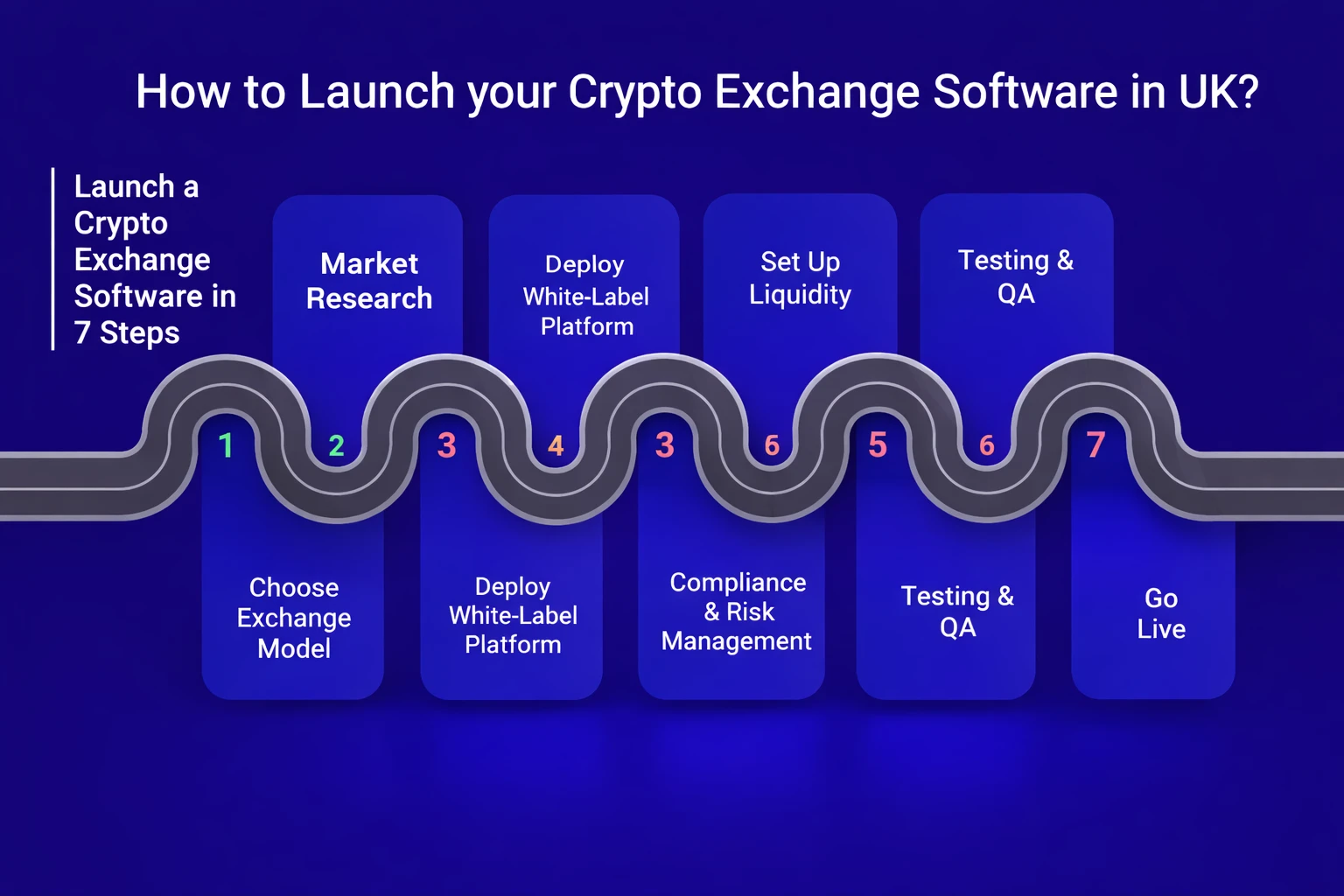
Here is a clear breakdown of the steps to launch crypto exchange software in UK, from the planning stage to going live.
Step 1: Define Your Business Model
Start by deciding what kind of exchange you want to run, which cryptocurrencies you will support, and how you plan to make money. Common revenue models include trading fees, withdrawal fees, listing fees, and margin trading spreads.
Step 2: Complete Legal and Compliance Setup
Register your company in the UK, begin your FCA application, and put your AML and KYC processes in place. This step takes time and should run in parallel with your technical development rather than after it.
Step 3: Choose a Development Approach
Decide whether you will build from scratch, use a white label solution, or work with a Crypto Exchange Creation partner who can handle the technical side while you focus on business and compliance.
Step 4: Build Core Features
Your platform will need a trading engine, user registration and KYC module, wallet integration, an admin dashboard, and a matching engine. For a platform similar to a major exchange, security layers, API access, and a mobile app may also be required. Understanding how to build a crypto exchange like Binance in UK means looking at these components and deciding which to build custom versus which to integrate from existing providers.
Step 5: Security Testing and Audit
Before going live, conduct a full security audit. This should include penetration testing, a review of your smart contracts (if applicable), and stress testing of your trading engine. UK users and the FCA both expect a high standard of security.[3]
Step 6: Liquidity Setup
Connect to liquidity providers or set up market-making arrangements so that your order books are active from day one. An exchange with no liquidity cannot retain users.
Step 7: Launch and Monitor
Go live with a limited rollout if possible. Monitor performance, gather user feedback, and fix issues quickly. Your compliance obligations do not end at launch; they are ongoing.
Cost to Launch a Crypto Exchange in the UK
The cost to launch crypto exchange UK depends heavily on the type of platform you choose and how much custom development is involved. Below is a general breakdown to give you a realistic picture.
| Development Approach | Estimated Cost (USD) | Timeline |
|---|---|---|
| White Label Solution | $15,000 – $50,000 | 4–10 weeks |
| Custom CEX (Basic) | $80,000 – $150,000 | 4–6 months |
| Custom CEX (Advanced) | $200,000 – $500,000+ | 6–12 months |
| Decentralized Exchange (DEX) | $50,000 – $200,000 | 3–8 months |
These figures cover development only. Additional costs include FCA registration fees, legal consultation, security audits, infrastructure hosting, and ongoing compliance. The crypto exchange development cost UK in total can range from under $100,000 for a simple white label setup to well over $500,000 for a fully custom platform with advanced features.
Understanding the Timeline to Build a Crypto Exchange early in the process helps you budget correctly and set realistic expectations with investors or stakeholders.
Key Features Your Exchange Must Have
Whether you are doing crypto trading platform development UK from scratch or using a white label, these features are essential.
Matching Engine
This is the core of any exchange. It matches buy and sell orders in real time. Speed and accuracy matter here. A slow matching engine leads to poor user experience and slippage, which drives traders away.
Wallet Integration
You need both hot wallets (for active trading) and cold wallets (for secure storage). Most exchanges keep a small percentage of funds in hot wallets and the majority in cold storage. This reduces the risk of a large-scale hack.
KYC and AML Module
This is required by UK law. Your platform must verify identities, screen for sanctions, and flag suspicious activity automatically. Third-party KYC providers can be integrated to handle this at scale.
Trading Interface
Users expect a clean, responsive interface with real-time charts, order books, and trade history. A poor interface is one of the top reasons users abandon an exchange for a competitor.
Admin Dashboard
Your team needs a backend panel to manage users, review KYC submissions, track transactions, and handle support requests. This is often overlooked in early planning but is critical for day-to-day operations.
Choosing the Right Development Partner
Most businesses that successfully launch a crypto exchange in the UK do not build everything in-house. Finding a reliable crypto exchange development services UK provider saves time, reduces errors, and brings in expertise that would take years to develop internally.
When evaluating a partner for crypto exchange platform development UK, look at their past work, their understanding of UK compliance requirements, and their ability to provide ongoing support after launch. A development company that has already built and launched exchanges in regulated markets is significantly more valuable than one that has only worked in unregulated environments.[4]
For crypto exchange development UK, it is also worth asking whether the partner can help with FCA registration guidance, third-party integrations like payment gateways and liquidity providers, and post-launch monitoring and maintenance.
Common Mistakes to Avoid
Many exchange projects in the UK stall or fail due to the same preventable problems. Here are the most common ones.
Skipping Compliance Until the End
Legal setup is not something to do after the product is built. The FCA registration process takes months, and your technical architecture must support the compliance tools you need. Build compliance into the product from day one.
Underestimating Security Costs
Security is not a feature you add at the end. It needs to be baked into your infrastructure, your code, and your operating procedures from the start. Budget for regular audits and penetration testing.
Launching Without Liquidity
An empty order book makes users feel like the exchange is not active. Before you go live, have a liquidity strategy ready. This might include partnering with a market maker or connecting to an aggregated liquidity pool.
Ignoring User Experience
Even experienced traders will leave a platform that is confusing or slow. Invest in UX design and test your interface with real users before going live.
How to Start a Crypto Exchange in UK – Quick Summary
If you are looking for a clear answer to how to start a crypto exchange in UK, here is a condensed version of the full process.
You begin by registering a UK company and deciding on your exchange model. Then you start the FCA registration process and build your compliance framework. In parallel, you work with a cryptocurrency exchange development company UK to build or configure your platform. Once the platform is built, you conduct security testing, connect liquidity, and launch. After going live, you continue meeting your compliance obligations and improving the product based on user feedback.
The entire process, when done properly, takes between three months for a white label solution and up to nine months or more for a fully custom platform.
Ready to Launch Your Crypto Exchange in the UK?
Nadcab Labs builds compliant, secure, and scalable crypto exchange platforms tailored to UK regulatory requirements. From FCA-ready KYC modules to high-performance trading engines, we handle the full development lifecycle.
Frequently Asked Questions
Q1.Is FCA registration required for crypto exchanges?
Yes, any business running a crypto exchange in the UK must register with the Financial Conduct Authority. Operating without FCA registration is illegal and can lead to fines or shutdown of the platform.
Q2.How much does a crypto exchange cost?
Costs range from around $15,000 for a white label solution to over $500,000 for a fully custom platform. Compliance, security audits, and infrastructure are additional costs beyond development.
Q3.How long does exchange development take?
A white label exchange can be ready in four to ten weeks. A custom-built centralized or decentralized exchange typically takes four to twelve months depending on feature complexity and regulatory requirements.
Q4.What are the UK KYC requirements for exchanges?
UK exchanges must verify user identity using government-issued ID and proof of address. Ongoing transaction monitoring and sanctions screening are also required under UK AML regulations.
Q5.What features does every crypto exchange need?
A matching engine, wallet integration, KYC and AML module, trading interface, and admin dashboard are the minimum features every crypto exchange must have to operate effectively and legally in the UK.
Explore Services
Related Services
Reviewed by

Aman Vaths
Founder of Nadcab Labs
Aman Vaths is the Founder & CTO of Nadcab Labs, a global digital engineering company delivering enterprise-grade solutions across AI, Web3, Blockchain, Big Data, Cloud, Cybersecurity, and Modern Application Development. With deep technical leadership and product innovation experience, Aman has positioned Nadcab Labs as one of the most advanced engineering companies driving the next era of intelligent, secure, and scalable software systems. Under his leadership, Nadcab Labs has built 2,000+ global projects across sectors including fintech, banking, healthcare, real estate, logistics, gaming, manufacturing, and next-generation DePIN networks. Aman’s strength lies in architecting high-performance systems, end-to-end platform engineering, and designing enterprise solutions that operate at global scale.