Ai Overview
Many businesses want to build a crypto trading platform and start their journey. But before starting, you need to make one important decision, Crypto Broker vs Exchange. So, choosing between a Crypto Broker vs Crypto Exchange depends on your business idea, budget, and target users. A Crypto Exchange lets users buy and sell directly using real market prices.
The crypto market is growing very fast. Many businesses want to build a crypto trading platform and start their journey. But before starting, you need to make one important decision, Crypto Broker vs Exchange.
A Crypto Exchange lets users buy and sell directly using real market prices. A Crypto Broker makes trading simple by giving fixed prices and easy buying options. Both models are useful, but they work in different ways. So, choosing between a Crypto Broker vs Crypto Exchange depends on your business idea, budget, and target users.
In this blog, we explain how both models work and how to choose the right one for your business.
Key Takeaways
- ◆A Crypto Exchange is a crypto trading platform that matches buyers and sellers using an order book.
- ◆A Crypto Broker provides direct prices by connecting to external liquidity sources.
- ◆In Crypto Broker vs Exchange, exchanges offer more control and transparency, while brokers focus on simplicity.
- ◆Crypto Exchange needs strong systems like a matching engine, wallet, and security layers.
- ◆A Crypto Broker requires less setup and mainly depends on liquidity, pricing, and risk systems.
- ◆Exchanges earn from trading and listing fees, while brokers earn through spreads and commissions.
- ◆A Crypto Exchange is suitable for professional traders and high-volume trading platforms.
- ◆A Crypto Broker is ideal for beginners and businesses that want fast market entry.
- ◆Choosing between Crypto Broker vs Crypto Exchange depends on your goals, budget, and control needs.
What is a Crypto Broker?
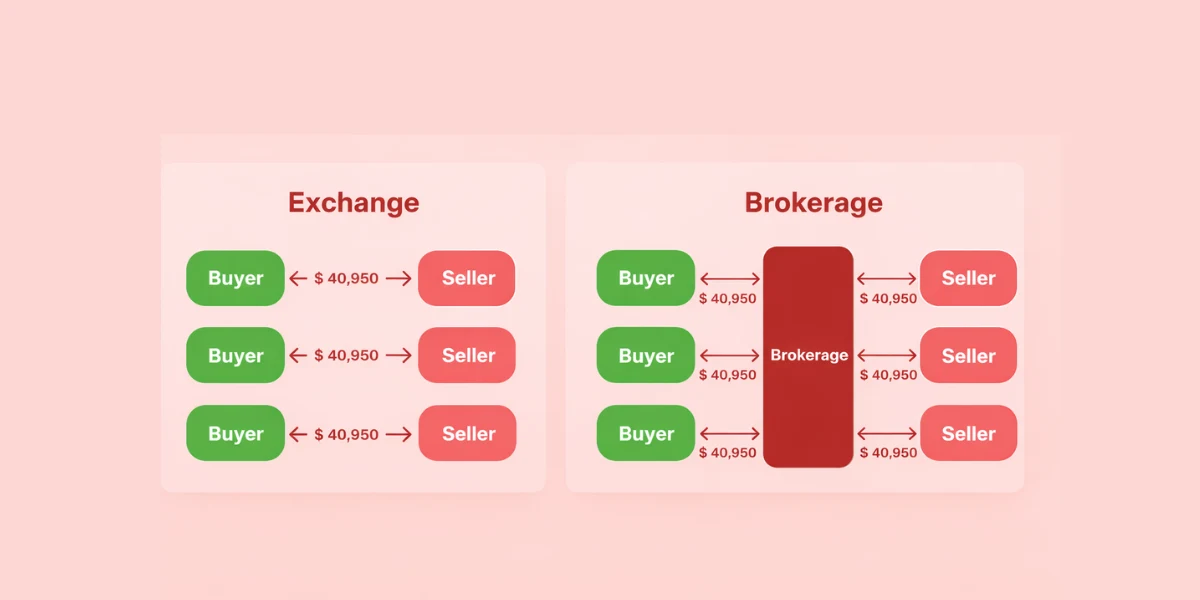
A Crypto Broker is a platform that allows users to buy and sell cryptocurrencies without using an order book. Instead of matching buyers and sellers directly, the broker provides prices and executes trades on behalf of the user.
The platform does not rely on market participants for each trade. It connects to external liquidity sources and offers ready-to-execute prices. Users can simply choose an asset, see the price, and complete the trade instantly without dealing with complex trading systems.
Types of Crypto Brokers
Crypto brokers are platforms that let users buy and sell cryptocurrencies without handling complex order books. Different types of brokers offer various ways to execute trades, control pricing, and manage liquidity. Choosing the right type depends on your business model and the user experience you want to provide.
1. Market Maker Broker
This broker sets its own buy and sell prices and manages trades internally. Profits come from spreads. It is fast, reliable, and simple for users.
2. STP (Straight Through Processing) Broker
STP brokers send user trades directly to liquidity providers. Prices are transparent, and users see market-driven rates without internal price manipulation.
3. ECN (Electronic Communication Network) Broker
ECN brokers connect users to multiple liquidity providers at once. Trades are executed at the best available market prices, ideal for advanced traders seeking tighter spreads.
4. Hybrid Broker
Hybrid brokers combine market making and external liquidity. Some trades are handled internally, while others are routed to liquidity providers. This balances execution speed and cost.
How a Crypto Broker Works
A Crypto Broker operates by aggregating prices from multiple liquidity providers such as exchanges or OTC desks. It combines this data and shows a single buy and sell price to the user.
When a trade is placed, the broker executes it through these external sources. The entire process happens in the background, while the user experiences a smooth and instant transaction flow.
The broker also manages pricing, spreads, and execution logic internally. This allows better control over how trades are processed and delivered.
Core Capabilities of a Crypto Broker
Behind a simple interface, a Crypto Broker runs several important systems. It includes a pricing engine that updates real-time buy and sell rates. It connects to liquidity providers to ensure trade execution at scale.
It also uses a risk management system to control exposure and maintain balance between incoming and outgoing trades. In addition, brokers often integrate basic trading tools, account management, and payment systems to support user activity.
Benefits of a Crypto Broker
The Crypto Broker model is designed for simplicity and speed. It removes the need for an internal order book and reduces overall system complexity. This makes it easier to launch and operate compared to a full exchange.
It also allows businesses to offer crypto trading alongside other financial products like forex or CFDs. With controlled pricing and execution, brokers can deliver a consistent and user-friendly trading experience.
Disadvantages of a Crypto Broker
A Crypto Broker gives less transparency compared to an exchange. Since prices are quoted internally, users do not see the real market depth or order flow.
The platform depends on external liquidity providers, which means execution quality can vary during high volatility. In some cases, users may not directly own the underlying crypto asset, depending on the business model.
This setup also requires careful management of spreads and risk to maintain profitability and stability.
What is a Crypto Exchange?
A Crypto Exchange is a platform where users trade cryptocurrencies directly with each other using a shared order book. It does not set prices or act as a middleman in trades. Instead, it matches buy and sell orders based on real-time market activity.
Users can place orders, track market prices, and execute trades with full control. Most exchanges also allow users to deposit, store, and withdraw digital assets, giving complete ownership and custody support.
Types of Crypto Exchanges
Crypto exchanges are platforms where users can trade digital assets. Different types of exchanges offer varying levels of control, liquidity, and user experience. Choosing the right type depends on whether you want speed, decentralization, or advanced trading features.
1. Centralized Exchange (CEX)
A Centralized Crypto Exchange is managed by a company. It holds user funds in custody, provides liquidity, and ensures fast trade execution. Most large exchanges like Binance and Coinbase are CEX.
2. Decentralized Exchange (DEX)
A Decentralized Crypto Exchange operates without a central authority. Users trade directly from wallets via smart contracts. DEXs are popular for privacy, control, and token swapping, but may have lower liquidity.
3. Hybrid Exchange
Hybrid exchanges combine centralized and decentralized models. They offer custody, liquidity, and fast execution while allowing peer-to-peer trading via smart contracts.
4. Peer-to-Peer Exchange (P2P)
P2P exchanges connect buyers and sellers directly, without an order book or intermediary pricing. Payments and crypto transfers happen between users, making them ideal for regions with limited banking access.
How a Crypto Exchange Works
A Crypto Exchange works through an order matching system. Buyers and sellers place their orders with specific prices, and the platform matches them when conditions are met.
The exchange continuously updates market prices based on supply and demand. It also connects to liquidity sources to ensure smooth trading, especially during high-volume activity.
All trades are processed through a matching engine, which ensures fast and accurate execution. Behind the scenes, the platform manages wallets, transaction records, and system performance.
Core Capabilities of a Crypto Exchange
A Crypto Exchange runs on strong infrastructure. It includes a matching engine that handles trade execution in real time. It also has a wallet system for storing and managing user funds securely.
The platform integrates liquidity, pricing data, and trading tools like charts and order types. Security systems, transaction monitoring, and high uptime are also critical parts of the exchange environment.
Benefits of a Crypto Exchange
A Crypto Exchange offers full transparency and control over trading. Users can see real market prices and trade directly without price manipulation.
It supports advanced features like margin trading, staking, and multiple order types. This makes it suitable for high-volume trading and professional users.
Exchanges also allow businesses to scale by adding more assets, services, and trading options over time.
Disadvantages of a Crypto Exchange
A Crypto Exchange requires complex infrastructure and high development costs. Managing order books, liquidity, and custody systems requires strong technical expertise.
It also involves strict regulatory requirements, especially for handling user funds. Security is another major challenge, as exchanges are common targets for cyber attacks.
Maintaining uptime, speed, and system stability under heavy trading load can also be difficult.
Crypto Broker vs Crypto Exchange: Key Differences
| Factor | Crypto Exchange | Crypto Broker |
|---|---|---|
| Trading Method | Matches buyers and sellers using an order book | Provides direct buy/sell prices to users |
| Pricing | Based on real market demand and supply | Prices are set by the broker with a spread |
| User Experience | More complex, designed for active traders | Simple and easy, designed for beginners |
| Execution | Depends on order matching in the market | Instant execution through liquidity providers |
| Liquidity | Comes from users and external sources | Fully depends on external liquidity providers |
| Asset Ownership | Users own and can withdraw crypto | In some cases, users only get price exposure |
| Revenue Model | Trading fees, listing fees, withdrawal fees | Spread, commission, and service fees |
| Technology Complexity | High (matching engine, wallets, security systems) | Lower (API integration, pricing engine) |
| Time to Launch | Longer due to complex development | Faster due to simpler setup |
| Control | Full control over the trading system and operations | Limited control, depends on liquidity providers |
| Target Users | Professional traders and institutions | Beginners and retail users |
| Scalability | High, supports advanced features and services | Moderate, depends on external systems |
Crypto Broker or Exchange? Real Business Scenarios Explained
Choosing between a Crypto Broker vs. a Crypto Exchange becomes easier when you look at real business use cases. Each model solves a different problem. It depends on your users, product goals, and how you want to run your crypto trading platform.
When a Crypto Broker Makes More Sense
A Crypto Broker works best when your goal is simplicity and fast user adoption. It removes the complexity of trading and gives users a smooth experience.
For example, imagine you are building a fintech mobile app like a digital wallet. Your users want to buy Bitcoin or Ethereum quickly, without learning charts or order books. In this case, a Crypto Broker is the right choice. It shows a fixed price and allows instant buying.
Another example is a trading platform that already offers Forex or CFDs. Adding a Crypto Brokerage model allows you to integrate crypto easily into your existing system. You can offer multiple assets in one place without building heavy infrastructure.
This model is also useful for:
- Startups that want quick launch
- Apps targeting beginners
- Businesses that want simple operations
A Crypto Broker focuses on ease, speed, and clean user experience.
When a Crypto Exchange Is the Better Choice
A Crypto Exchange is better when your platform targets serious traders and high-volume activity. It gives full control over trading and real market access.
For example, if you are building a professional crypto trading platform like Binance or Coinbase, users expect advanced features. They want live charts, order types, and real-time market data. A Crypto Exchange provides all of this through an order book system.
Another real case is institutional trading platforms. These users need deep liquidity, fast execution, and transparency. They also use strategies like arbitrage or high-frequency trading. Only a Cryptocurrency Exchange can support this level of activity.
This model is ideal for:
- Professional and active traders
- High trading volume platforms
- Businesses planning long-term scalability
A Crypto Exchange focuses on control, transparency, and advanced trading features.
How to Start a Crypto Exchange Development: Step-by-Step Process
Building a crypto platform requires proper planning, strong technology, and a clear goal. A well-structured crypto exchange development process helps you create a secure and scalable platform that can grow over time. Below are the key steps to follow.
1. Define Your Business Model
Start by deciding how your platform will work. Choose your target audience, such as beginners, traders, or institutions. You should also decide the type of platform: centralized, decentralized, or hybrid.
This step sets the base for your cryptocurrency exchange development and helps you plan features and revenue streams clearly.
2. Choose Legal Framework and Compliance
Every crypto platform must follow regulations. Select a country or region where crypto rules support your business. You also need to add KYC and AML systems to verify users.
Strong compliance makes your platform trustworthy and ensures smooth operations.
3. Design and Develop the Platform
This is the core stage of crypto exchange development. You need to build important systems like the trading engine, user dashboard, and admin panel.
Focus on creating a simple and fast interface so users can trade without confusion. Good design improves user experience and retention.
4. Integrate Liquidity and Payments
Your platform needs liquidity so users can trade easily. Connect with external providers or other exchanges to ensure smooth transactions.
You should also add payment options like bank transfer or cards to make deposits and withdrawals simple.
5. Implement Security Features
Security is a critical part of cryptocurrency exchange development. Use features like two-factor authentication, data encryption, and secure wallets.
Regular testing and monitoring help protect user funds and maintain platform reliability.
6. Test, Launch, and Scale
Before launching, test your platform for performance and security. Fix any issues and ensure everything runs smoothly.
After launch, focus on marketing, user support, and updates. Continuous improvement helps your crypto exchange development platform grow and stay competitive.
How to Start a Crypto Broker Platform: Step-by-Step Process
Starting a brokerage platform is faster and simpler compared to an exchange, but it still needs the right setup and planning. A well-structured Crypto Broker model helps you launch quickly while offering smooth and easy trading for users. Below are the key steps to follow.
1. Define Your Brokerage Model
Start by deciding how your Crypto Broker platform will work. Choose your target users, such as beginners, retail traders, or multi-asset investors. You should also decide whether you want to offer only crypto or combine it with forex, stocks, or CFDs.
This step helps you shape your platform and define your services clearly.
2. Choose Jurisdiction and Compliance
Even a Crypto Broker must follow regulations. Select a region where you can legally operate and obtain the required licenses if needed.
You also need to implement KYC and AML processes to verify users. This builds trust and ensures your platform runs without legal issues.
3. Connect to Liquidity Providers
A Crypto Broker does not run its own order book. Instead, it connects to external liquidity providers like exchanges or OTC desks.
These providers supply real-time prices and execute trades. Choosing reliable liquidity partners is important for smooth trading and accurate pricing.
4. Develop the Trading Platform
Now build your platform interface. A Crypto Broker platform should be simple, fast, and easy to use.
You need a pricing engine, user dashboard, and admin panel. The focus should be on clean design and quick execution so users can trade without confusion.
5. Set Up Risk Management and Security
Risk management is important for every Crypto Broker. You need systems to manage spreads, control exposure, and handle market changes.
At the same time, implement security features like two-factor authentication and data protection. This keeps user accounts and transactions safe.
6. Launch and Grow Your Platform
After testing, launch your Crypto Broker platform. Make sure everything works smoothly before going live.
Once launched, focus on marketing, customer support, and adding new features. Continuous updates help your platform grow and stay competitive.
How to Choose Between a Crypto Broker vs Crypto Exchange for Your Business
Choosing the right model is one of the most important decisions when building a crypto trading platform. The choice between Crypto Broker vs Exchange depends on your business goals, target users, and how much control you want over your platform.
If your focus is on simplicity and fast market entry, a Crypto Broker model is a better option. It allows you to launch quickly with less technical complexity. You can offer easy buy and sell options, which is ideal for beginners and retail users. This model is also useful if you want to add crypto services to an existing app or financial platform.
On the other hand, a Crypto Exchange is the right choice if you want to build a full-featured trading platform. It gives you complete control over trading, pricing, and user experience. A Cryptocurrency Exchange is suitable for businesses targeting professional traders, high-volume transactions, and long-term scalability.
You should also consider your budget and resources. A Crypto Exchange requires more investment, advanced infrastructure, and ongoing maintenance. A Crypto Broker needs less setup and can be managed with a smaller team.
In Crypto Broker vs Crypto Exchange, there is no one-size-fits-all solution. The right approach depends on what kind of users you want to serve and how you plan to grow your business.
Take the Next Step with a Trusted Development Partner
Building a crypto platform is not easy. It needs the right technology, planning, and support. This is why choosing a trusted cryptocurrency exchange development company is very important. A good development partner helps you at every step. From idea to launch, they guide you in building a secure and scalable platform. They understand the market and help you avoid common mistakes.
A professional cryptocurrency exchange development company also provides the right features like security systems, trading tools, and smooth user experience. This makes your platform more reliable and easy to use. With the right partner, you can save time, reduce risk, and focus on growing your business. It also becomes easier to upgrade your platform as your users increase.
Choosing an experienced crypto exchange development company is the first step toward building a strong and successful crypto platform.
Ready to Build Your Crypto Broker or Exchange Platform?
Whether you choose a Crypto Broker or Crypto Exchange, the right development approach makes all the difference. Our expert cryptocurrency exchange development company helps you build secure, scalable, and high-performance crypto trading platforms tailored to your business goals.
Frequently Asked Questions
Q1.What is the main difference between a Crypto Broker and a Crypto Exchange?
The main difference in Crypto Broker vs Crypto Exchange is how trading happens. A Crypto Exchange connects buyers and sellers directly using an order book, where prices are decided by the market. A Crypto Broker gives prices directly to users and completes trades through external liquidity providers. Exchanges offer more control and transparency, while brokers focus on simplicity and fast trading.
Q2.Which is better for starting a crypto business: Crypto Broker or Crypto Exchange?
The answer depends on your business goals. If you want a simple platform with fast launch and easy user experience, a Crypto Broker is a better option. But if you want to build a full-featured crypto trading platform with advanced tools and long-term scalability, then a Crypto Exchange is the right choice. In Crypto Broker vs Crypto Exchange, both models serve different types of users.
Q3.How long does cryptocurrency exchange development take?
The time required for cryptocurrency exchange development depends on the features and complexity. A basic platform can take a few months, while a fully advanced exchange with high security and trading features may take longer. Choosing an experienced team can help speed up the crypto exchange development process and ensure better results.
Q4.Is a Crypto Broker easier to develop than a Crypto Exchange?
Yes, a Crypto Broker is easier to develop because it does not require an order book or complex matching engine. It mainly depends on liquidity provider integration and a pricing system. On the other hand, a Crypto Exchange needs advanced infrastructure, which makes development more complex and time-consuming.
Q5.How does a Crypto Exchange make money?
A Crypto Broker earns through spreads, which is the difference between buy and sell prices. It may also charge commissions or service fees. This model allows brokers to control pricing and create flexible revenue streams.
Q6.Do users own crypto on a Crypto Broker platform?
In a Crypto Broker model, users may or may not own the actual crypto, depending on how the platform is built. Some brokers provide real asset ownership, while others only offer price exposure. In contrast, a Crypto Exchange usually allows full ownership and withdrawal of assets.
Explore Services
Related Services
Reviewed by

Aman Vaths
Founder of Nadcab Labs
Aman Vaths is the Founder & CTO of Nadcab Labs, a global digital engineering company delivering enterprise-grade solutions across AI, Web3, Blockchain, Big Data, Cloud, Cybersecurity, and Modern Application Development. With deep technical leadership and product innovation experience, Aman has positioned Nadcab Labs as one of the most advanced engineering companies driving the next era of intelligent, secure, and scalable software systems. Under his leadership, Nadcab Labs has built 2,000+ global projects across sectors including fintech, banking, healthcare, real estate, logistics, gaming, manufacturing, and next-generation DePIN networks. Aman’s strength lies in architecting high-performance systems, end-to-end platform engineering, and designing enterprise solutions that operate at global scale.