Ai Overview
The Cost of Cryptocurrency Wallet Creation typically ranges from $15,000 to $500,000+ depending on complexity, features, and security requirements. Security architecture, including MPC and encryption, can account for 25-40% of total development costs. Starting with an MVP approach can reduce initial costs by 40-60% while validating your product-market fit. Ongoing maintenance typically costs 15-25% of initial development annually.
Key Takeaways: Cost of Cryptocurrency Wallet Creation
- The Cost of Cryptocurrency Wallet Creation typically ranges from $15,000 to $500,000+ depending on complexity, features, and security requirements.
- Hot wallets (web/mobile) are more affordable to develop than cold wallets or hardware-integrated solutions.
- Security architecture, including MPC and encryption, can account for 25-40% of total development costs.
- Multi-chain support and DeFi integrations significantly increase development complexity and budget requirements.
- Starting with an MVP approach can reduce initial costs by 40-60% while validating your product-market fit.
- Ongoing maintenance typically costs 15-25% of initial development annually.
- Choosing an experienced development partner with 8+ years of blockchain expertise ensures cost-efficiency and security compliance.
What Is a Cryptocurrency Wallet?
Before diving into the Cost of Cryptocurrency Wallet Creation, it is crucial to understand what a cryptocurrency wallet actually does. Contrary to popular belief, crypto wallets do not store your digital assets directly. Instead, they securely manage the private keys that prove ownership of assets recorded on blockchain networks.
A cryptocurrency wallet performs several critical functions: generating and storing cryptographic key pairs, signing transactions to authorize asset transfers, interacting with blockchain networks to broadcast transactions, and displaying real-time balance information by querying on-chain data. The sophistication of these functions directly impacts the overall development cost.
Different user segments have varying requirements that influence wallet architecture. Startups typically need cost-effective solutions with essential features. Enterprises require robust security, compliance features, and scalability. Cryptocurrency exchanges need high-performance wallets capable of handling millions of transactions. DeFi platforms require seamless integration with smart contracts and decentralized protocols. Understanding your target users is the first step in accurately estimating the Cost of Cryptocurrency Wallet Creation for your specific project.
Why the Cost of Cryptocurrency Wallet Creation Varies
One of the most common misconceptions is that wallet development has a fixed price. In reality, the Cost of Cryptocurrency Wallet Creation varies dramatically based on project-specific requirements. Two wallets may look similar on the surface but have vastly different underlying architectures, security implementations, and feature sets that result in cost differences of hundreds of thousands of dollars.
The primary cost drivers include the type of wallet being developed, the breadth of supported blockchains, security architecture complexity, user interface design requirements, third-party integrations, and regulatory compliance needs. Each of these factors can significantly impact your total investment.
From our experience delivering over 150 blockchain projects, we have observed that clients who clearly define their requirements upfront typically save 20-30% on development costs compared to those who make decisions iteratively during development. This is because scope changes mid-project require architectural modifications that multiply effort and expenses.
Expert Insight: The most expensive wallet is not always the best wallet. We have seen projects succeed with lean, focused solutions and fail with over-engineered platforms. The key is aligning your wallet features with actual user needs and business objectives while maintaining uncompromising security standards.
Types of Cryptocurrency Wallets and Their Cost Impact
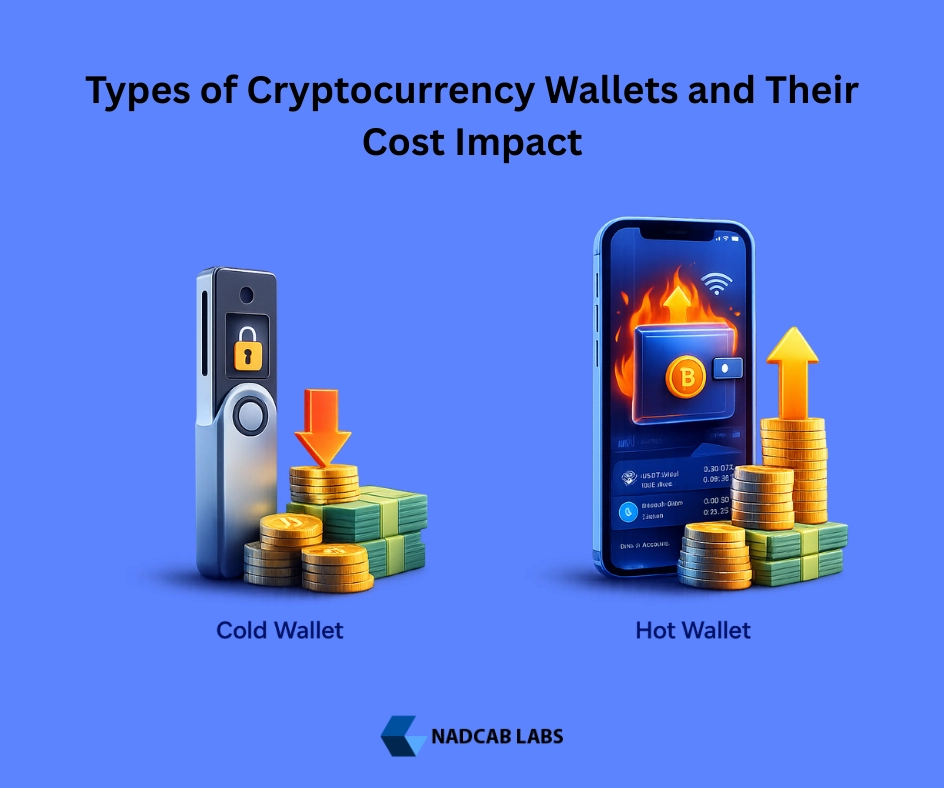
The type of wallet you choose to develop has the most significant impact on the Cost of Cryptocurrency Wallet Creation. Each wallet type serves different use cases and comes with distinct technical requirements, security considerations, and development complexities.
Hot Wallets (Web and Mobile)
Hot wallets maintain a constant internet connection, making them convenient for frequent transactions but requiring robust security measures. Web wallets run in browsers and are accessible from any device, while mobile wallets offer native app experiences on iOS and Android. The Cost of Cryptocurrency Wallet Creation for hot wallets typically ranges from $30,000 to $150,000 depending on features and security implementations.
Cold Wallets
Cold wallets store private keys offline, providing enhanced security for long-term asset storage. Development involves creating secure signing mechanisms that can operate without network connectivity. These solutions often integrate with hardware devices and require specialized security expertise, increasing costs significantly.
Custodial Wallets
Custodial wallets hold users’ private keys on behalf of customers, similar to traditional banking. This approach simplifies user experience but introduces regulatory requirements and significant liability. The Cost of Cryptocurrency Wallet Creation for custodial solutions includes compliance infrastructure, insurance considerations, and enterprise-grade security systems.
Non-Custodial Wallets
Non-custodial wallets give users complete control over their private keys. While this reduces regulatory burden, it requires sophisticated key management systems and clear user education to prevent asset loss. Recovery mechanisms and backup solutions add to development complexity.
Multi-Currency and Multi-Chain Wallets
Supporting multiple cryptocurrencies and blockchain networks significantly increases development scope. Each blockchain has unique protocols, transaction formats, and integration requirements. The Cost of Cryptocurrency Wallet Creation scales with each additional network supported.
Wallet Type Cost Comparison
| Wallet Type | Development Cost Range | Development Timeline | Complexity Level |
|---|---|---|---|
| Basic Hot Wallet (Single Chain) | $15,000 – $40,000 | 2-3 months | Low |
| Mobile Wallet (iOS/Android) | $40,000 – $120,000 | 3-5 months | Medium |
| Multi-Chain Wallet | $80,000 – $200,000 | 4-7 months | High |
| Cold Wallet Solution | $100,000 – $250,000 | 5-8 months | High |
| Custodial Enterprise Wallet | $150,000 – $500,000+ | 6-12 months | Very High |
Core Features That Influence the Cost of Cryptocurrency Wallet Creation
Every cryptocurrency wallet requires certain fundamental features to function effectively. These core features form the baseline of your development budget and directly impact the Cost of Cryptocurrency Wallet Creation regardless of wallet type.
User Authentication: Implementing secure authentication is non-negotiable. Basic PIN protection costs less than biometric authentication (fingerprint, face recognition) or two-factor authentication integration. Multi-layer authentication systems that combine multiple methods provide the highest security but increase development costs by $5,000 to $15,000.
Wallet Address Generation and Key Management: The cryptographic foundation of any wallet involves generating secure key pairs and deriving addresses according to blockchain-specific standards (BIP-32, BIP-39, BIP-44). Hierarchical deterministic (HD) wallet implementation allows generating unlimited addresses from a single seed phrase, which is now industry standard. Proper implementation requires deep cryptographic expertise.
Transaction Processing and Gas Fee Handling: Building reliable transaction creation, signing, and broadcasting mechanisms requires understanding each blockchain’s transaction format and fee structure. Dynamic gas fee estimation that helps users avoid failed transactions or overpayment adds complexity but significantly improves user experience.
Real-Time Balance Tracking: Users expect instant balance updates. This requires efficient blockchain indexing solutions or reliable third-party API integrations. Supporting multiple tokens on networks like Ethereum means tracking thousands of potential assets, which increases infrastructure requirements.
Push Notifications: Alerting users to incoming transactions, price movements, or security events requires backend notification infrastructure. While seemingly simple, reliable notification delivery across both iOS and Android platforms involves platform-specific implementations that add to development scope.
QR Code Functionality: Scanning and generating QR codes for addresses and payment requests is an essential convenience feature. Implementing secure QR code handling that prevents address spoofing attacks requires careful validation logic.
Core Feature Cost Breakdown
| Core Feature | Estimated Cost | Development Time |
|---|---|---|
| User Authentication (Basic) | $3,000 – $8,000 | 1-2 weeks |
| Biometric + 2FA Authentication | $8,000 – $18,000 | 2-4 weeks |
| HD Wallet Key Management | $10,000 – $25,000 | 3-5 weeks |
| Transaction Processing | $8,000 – $20,000 | 2-4 weeks |
| Balance Tracking System | $5,000 – $15,000 | 2-3 weeks |
| Push Notifications | $3,000 – $8,000 | 1-2 weeks |
Advanced Features and Their Cost Implications
Modern cryptocurrency wallets are expected to offer functionality far beyond basic storage and transfers. These advanced features differentiate premium solutions and significantly impact the Cost of Cryptocurrency Wallet Creation.
Multi-Chain Support: Supporting both EVM-compatible chains (Ethereum, Polygon, BNB Chain, Arbitrum) and non-EVM chains (Solana, Bitcoin, Cosmos) requires implementing multiple blockchain protocols. Each network has unique characteristics that demand specialized development effort. Comprehensive multi-chain support can add $50,000 to $150,000 to your total budget.
DeFi and Staking Integration: Connecting users to decentralized finance protocols enables earning opportunities directly within the wallet. This requires smart contract interactions, yield calculation displays, and careful handling of protocol-specific risks. Staking integration for proof-of-stake networks involves validator selection interfaces and reward tracking systems.
NFT Storage and Marketplace Connectivity: Supporting non-fungible tokens means displaying diverse media formats, connecting to NFT marketplaces, and handling collection metadata. The visual nature of NFTs demands thoughtful UI design that adds to development costs.
Cross-Chain Bridges: Enabling asset transfers between different blockchains is highly complex and security-sensitive. Bridge integrations require careful vetting of bridge providers and implementing safeguards against common bridge exploits that have resulted in billions of dollars in losses industry-wide.
Fiat On-Ramp and Off-Ramp: Allowing users to purchase cryptocurrency with traditional currency or withdraw to bank accounts requires partnerships with payment processors and compliance with money transmission regulations. These integrations typically involve revenue-sharing arrangements and technical API implementations.
WalletConnect and dApp Browser: Supporting WalletConnect protocol enables users to connect their wallet to thousands of decentralized applications. An integrated dApp browser provides seamless Web3 experiences but requires building a secure browser environment that properly isolates dApp interactions.
Case Study: A fintech client approached us to build a multi-chain wallet with DeFi integration. Initial estimates from other vendors ranged wildly from $80,000 to $400,000. After our detailed requirements analysis, we delivered a focused solution for $165,000 that included five major chains, staking for three networks, and DEX aggregator integration. The project succeeded because we prioritized features based on actual user research rather than attempting to build everything simultaneously.
Security Architecture and Its Impact on Wallet Development Cost
Security is not optional in cryptocurrency wallet development. It is the foundation upon which user trust is built. The security architecture you implement significantly influences the Cost of Cryptocurrency Wallet Creation, often accounting for 25-40% of the total development budget.
Private Key Encryption: Implementing industry-standard encryption for private keys at rest and in transit is fundamental. Advanced implementations use multiple encryption layers and hardware-backed key storage on mobile devices (Secure Enclave on iOS, StrongBox on Android).
Multi-Party Computation (MPC): MPC technology splits private keys into multiple shares that never exist together in one location. This eliminates single points of failure and enables institutional-grade security. MPC implementation adds significant complexity and typically costs $40,000 to $100,000 for proper implementation.
Hardware Wallet Integration: Connecting to hardware wallets like Ledger or Trezor for transaction signing combines the convenience of a software interface with hardware-level security. This requires implementing device communication protocols and handling various device states.
Secure Enclaves: Leveraging hardware security modules on user devices provides tamper-resistant key storage. Proper implementation requires platform-specific development and extensive testing across device variations.
Smart Contract Wallet Security: Account abstraction wallets use smart contracts for enhanced functionality like social recovery, spending limits, and multi-signature requirements. Developing secure smart contracts demands specialized expertise and comprehensive testing.
Security Audits and Penetration Testing: Professional security audits from reputable firms typically cost $20,000 to $100,000 depending on scope. This investment is essential before launch and should be factored into your Cost of Cryptocurrency Wallet Creation budget.
Security Implementation Cost Analysis
| Security Feature | Cost Range | Security Level | Recommended For |
|---|---|---|---|
| Standard Encryption | $5,000 – $12,000 | Basic | MVP / Consumer Apps |
| Hardware-Backed Storage | $15,000 – $35,000 | Enhanced | Consumer / Business |
| MPC Implementation | $40,000 – $100,000 | Institutional | Enterprise / Custody |
| Hardware Wallet Integration | $10,000 – $25,000 | High | Power Users |
| Smart Contract Wallet | $30,000 – $80,000 | Advanced | DeFi / Enterprise |
| Security Audit | $20,000 – $100,000 | Essential | All Production Wallets |
UI/UX Design Cost for Cryptocurrency Wallet Apps
User experience can make or break a cryptocurrency wallet. Complex blockchain concepts must be presented intuitively to users with varying technical backgrounds. Design quality significantly impacts the Cost of Cryptocurrency Wallet Creation and directly correlates with user adoption and retention.
A mobile-first design approach acknowledges that most users interact with crypto wallets on smartphones. This requires careful consideration of touch interfaces, screen sizes, and mobile-specific interaction patterns. Cross platform design company that maintains consistency across iOS, Android, and web interfaces demands additional design effort.
Custom design versus template-based approaches represents a significant cost decision. Premium custom designs that establish unique brand identity typically cost $15,000 to $50,000, while template-based approaches range from $5,000 to $15,000. The choice depends on your competitive positioning and brand requirements.
Accessibility considerations ensure your wallet can be used by people with disabilities. Implementing proper color contrast, screen reader support, and alternative input methods is increasingly required by regulations and expands your potential user base. Onboarding UX that guides new users through wallet setup and security concepts reduces support burden and improves activation rates.
From our extensive portfolio of wallet projects, we have observed that investing an additional 15-20% in UX design typically results in 40-60% higher user retention rates. This makes design investment one of the highest-ROI decisions in the Cost of Cryptocurrency Wallet Creation calculation.
Technology Stack and Development Cost Breakdown
The technologies chosen for your wallet impact development speed, maintenance costs, scalability, and the Cost of Cryptocurrency Wallet Creation overall. Making informed technology decisions early prevents costly rewrites later.
Frontend Technologies
For mobile wallets, React Native offers cross-platform development efficiency, reducing costs by 30-40% compared to separate native iOS and Android development. However, native development (Swift/Kotlin) provides better performance and platform-specific security feature access. For web wallets, React.js dominates due to its component-based architecture and extensive ecosystem.
Backend and APIs
Node.js is popular for its JavaScript ecosystem compatibility, while Go and Rust offer superior performance for high-throughput scenarios. Python remains relevant for data processing and analytics features. RESTful APIs are standard, while GraphQL offers flexibility for complex data requirements.
Blockchain Integration
Integrating with different blockchains requires understanding their specific libraries and SDKs. Ethereum and EVM chains use web3.js or ethers.js. Solana has its own @solana/web3.js library. Bitcoin requires libraries handling its unique UTXO model. Layer 2 networks often need additional considerations for deposits, withdrawals, and state verification.
Cloud Infrastructure and Hosting
AWS, Google Cloud, and Azure all offer suitable infrastructure for wallet backends. Costs depend on transaction volume, data storage needs, and redundancy requirements. Running your own blockchain nodes versus using third-party providers (Infura, Alchemy, QuickNode) is another key decision affecting both cost and decentralization.
Technology Stack Cost Comparison
| Component | Budget Option | Premium Option | Cost Difference |
|---|---|---|---|
| Mobile Development | React Native | Native iOS + Android | +40-60% |
| Backend | Node.js | Rust/Go | +20-30% |
| Node Infrastructure | Third-Party APIs | Self-Hosted Nodes | +$2,000-8,000/month |
| Database | PostgreSQL | Distributed Systems | +25-40% |
Mobile App vs Web Wallet: Cost Comparison
Deciding between mobile and web platforms significantly affects the Cost of Cryptocurrency Wallet Creation. Each platform offers distinct advantages and cost implications that should align with your target user behavior.
Android wallet development typically costs 10-15% less than iOS due to more flexible development tools and less stringent app store requirements. However, iOS users historically show higher engagement with financial applications and may represent a more valuable user segment for your business.
Web wallets offer the lowest initial development cost and provide universal accessibility without app store approvals. However, they face browser security limitations and cannot access device-level security features like biometric authentication as seamlessly as native apps.
Cross-platform frameworks like React Native and Flutter enable code sharing between platforms, reducing development costs by 30-40% compared to maintaining separate native codebases. The trade-off is slightly reduced performance and occasional platform-specific issues that require native workarounds.
Our recommendation based on hundreds of successful projects: start with a single platform (typically mobile) to validate product-market fit, then expand to additional platforms once your core value proposition is proven. This approach optimizes the Cost of Cryptocurrency Wallet Creation while managing risk.[1]
Build My Crypto Wallet Now!
Turn your dream into reality with a powerful, secure crypto wallet built just for you. Start building now and watch your idea come alive!
Third-Party Integrations and Licensing Costs
Modern cryptocurrency wallets rarely operate in isolation. Third-party services enhance functionality but add recurring costs and integration complexity to the Cost of Cryptocurrency Wallet Creation.
Blockchain Nodes and RPC Providers: Services like Infura, Alchemy, and QuickNode provide reliable blockchain access without running your own infrastructure. Costs range from free tiers for development to $500-5,000+ monthly for production-level usage depending on request volume.
KYC/AML Services: Compliance requirements often necessitate identity verification integration. Providers like Jumio, Onfido, or Sumsub charge per verification, typically $1-5 per user, plus platform fees. Annual costs can reach $50,000-200,000 for high-volume applications.
Price Oracles: Displaying accurate asset prices requires reliable data feeds. CoinGecko, CoinMarketCap, and Chainlink provide various pricing tiers from free to enterprise levels. Real-time pricing with high update frequency commands premium pricing.
Push Notification Services: Firebase Cloud Messaging offers free basic notifications, while enterprise solutions like OneSignal or Braze provide advanced segmentation and analytics at $500-5,000+ monthly.
Analytics and Monitoring: Understanding user behavior requires analytics integration. Mobile analytics platforms and blockchain-specific monitoring tools help optimize product decisions and detect issues. Budget $200-2,000 monthly for comprehensive monitoring.
Compliance, Legal, and Regulatory Cost Considerations
Regulatory compliance increasingly impacts the Cost of Cryptocurrency Wallet Creation, especially for custodial solutions or wallets with fiat integration. Ignoring compliance can result in costly legal issues and market access restrictions.
KYC/AML compliance requires identity verification systems, transaction monitoring, and suspicious activity reporting mechanisms. Implementation costs range from $20,000 to $100,000, with ongoing compliance operations adding $50,000-200,000 annually depending on user volume and jurisdiction requirements.
Regional regulations vary dramatically. Operating in the United States requires navigating state-by-state money transmitter licensing, while European operations must comply with MiCA regulations. Singapore, Switzerland, and UAE offer more crypto-friendly frameworks but still impose specific requirements. Legal consultation for multi-jurisdictional compliance typically costs $30,000-100,000.
Data privacy regulations like GDPR (Europe), CCPA (California), and emerging frameworks elsewhere mandate specific data handling practices. Implementing proper consent management, data retention policies, and user rights fulfillment adds to development and operational costs.
Custodial wallet operators may require specific licenses depending on jurisdiction. License applications, ongoing compliance reporting, and capital requirements can add $100,000-500,000+ to initial costs with substantial ongoing obligations.
Wallet Development Lifecycle and Cost Distribution
Understanding how the Cost of Cryptocurrency Wallet Creation distributes across development phases helps with budgeting and resource planning. Each phase requires specific expertise and contributes differently to the total investment.
Phase 1: Discovery and Planning (8-12% of budget)
Requirements gathering, technical architecture design, security planning, and project roadmap creation. This foundational phase prevents costly mistakes in later stages.
Phase 2: UI/UX Design (10-15% of budget)
User research, wireframing, visual design, prototyping, and usability testing. Investment here directly impacts user adoption.
Phase 3: Core Development (40-50% of budget)
Frontend and backend development, blockchain integrations, and feature implementation. The largest budget allocation reflects the intensive technical work required.
Phase 4: Security Implementation (15-20% of budget)
Encryption systems, security testing, penetration testing, and audit remediation. Never compromise on security investment.
Phase 5: Testing and QA (10-15% of budget)
Functional testing, integration testing, performance testing, and user acceptance testing. Thorough testing prevents post-launch issues.
Phase 6: Launch and Initial Support (5-8% of budget)
Deployment, app store submissions, initial monitoring, and bug fixes. Plan for immediate post-launch support needs.
Estimated Cost of Cryptocurrency Wallet Creation: Realistic Ranges
Based on our extensive experience delivering wallet projects across various scales, here are realistic Cost of Cryptocurrency Wallet Creation ranges for different solution tiers.
Comprehensive Cost Estimation by Wallet Tier
| Wallet Tier | Cost Range | Timeline | Features Included |
|---|---|---|---|
| Basic MVP | $15,000 – $40,000 | 2-3 months | Single chain, basic send/receive, simple UI, standard encryption |
| Standard Consumer | $50,000 – $120,000 | 3-5 months | Multi-chain (3-5), custom UI, biometrics, token support, basic DeFi |
| Advanced Multi-Chain | $120,000 – $250,000 | 5-8 months | 10+ chains, DeFi integration, NFT support, hardware wallet support, dApp browser |
| Enterprise Grade | $250,000 – $500,000+ | 8-14 months | MPC security, full compliance, multi-sig, institutional features, white-label options |
These estimates include development, basic security audit, and initial deployment. They do not include ongoing maintenance, marketing, or regulatory licensing costs which must be budgeted separately.
Maintenance, Updates, and Long-Term Cost Considerations
The Cost of Cryptocurrency Wallet Creation does not end at launch. Long-term success requires ongoing investment in maintenance, updates, and improvements. Budget 15-25% of initial development costs annually for maintenance.
Security Patches: Cryptocurrency is a high-value target for attackers. Continuous security monitoring, vulnerability patching, and periodic re-audits are essential. Budget $10,000-50,000 annually depending on wallet complexity.
Blockchain Upgrades and Hard Forks: Networks regularly update their protocols. Ethereum’s various upgrades, Bitcoin’s Taproot activation, and similar changes require wallet updates to maintain compatibility. Each major upgrade may require $5,000-20,000 in development effort.
Feature Enhancements: User expectations evolve rapidly in cryptocurrency. Regular feature additions keep your wallet competitive. Budget $30,000-100,000 annually for meaningful feature development.
Infrastructure Scaling: Growing user bases require infrastructure expansion. Cloud costs increase with usage, and database optimization becomes necessary. Plan for 20-40% infrastructure cost growth annually during scaling phases.
Customer Support: Users need assistance with transactions, security concerns, and feature questions. Support systems including ticketing, documentation, and potentially 24/7 coverage add operational costs that scale with user base.[2]
How to Reduce Cryptocurrency Wallet Development Cost Without Compromising Security
Strategic decisions can significantly optimize the Cost of Cryptocurrency Wallet Creation without sacrificing security or user experience. Here are proven approaches from our project experience.
MVP Approach: Launch with core features and expand based on validated user needs. This can reduce initial costs by 40-60% while providing real market feedback. Focus on one platform, one or two blockchains, and essential functionality first.
Modular Development: Architecture that allows independent feature additions enables incremental investment. Build a solid core and add modules for DeFi, NFTs, or additional chains as resources allow.
Open-Source Components: Leverage battle-tested open-source libraries for cryptographic functions, blockchain interactions, and common features. This reduces development time while benefiting from community-audited code. However, always audit integration points and customize security-critical components.
Choosing the Right Development Partner: Experienced teams deliver faster with fewer mistakes. While hourly rates may be higher, total project cost is often lower due to efficiency. Look for partners with proven blockchain expertise and transparent pricing.
Pro Tip: We have seen projects reduce their Cost of Cryptocurrency Wallet Creation by 35% simply by defining clear requirements before development begins. Invest time in planning to save money in execution.
Choosing the Right Cryptocurrency Wallet Development Company
Your choice of development partner significantly impacts both the Cost of Cryptocurrency Wallet Creation and the quality of the final product. Here is what to look for based on our observations of successful projects.
Blockchain-Specific Experience: General software development skills are insufficient for wallet development. Look for partners with demonstrated cryptocurrency expertise, understanding of cryptographic principles, and familiarity with multiple blockchain protocols.
Security-First Mindset: Security should be embedded in development culture, not added as an afterthought. Ask about secure development practices, code review processes, and experience with security audits.
Transparent Pricing: Reputable partners provide detailed cost breakdowns and explain what drives expenses. Be wary of estimates that seem too low, as they often indicate scope misunderstanding or plans to charge more later.
Post-Launch Support: Wallet development is an ongoing relationship. Ensure your partner offers maintenance services, can respond to security incidents, and can implement blockchain upgrades as needed.
Portfolio and References: Review completed projects and speak with past clients. Ask specifically about budget adherence, communication quality, and how challenges were handled.
With over 8 years of experience delivering blockchain solutions, we have refined our processes to provide predictable outcomes and transparent pricing. Our team combines deep cryptographic expertise with practical product development skills to deliver wallets that are secure, user-friendly, and built to scale.
Future Trends Affecting the Cost of Cryptocurrency Wallet Creation
The cryptocurrency wallet landscape continues evolving rapidly. Understanding emerging trends helps you plan for future requirements and their cost implications.
Account Abstraction: EIP-4337 and similar initiatives enable smart contract wallets with enhanced features like social recovery, session keys, and gasless transactions. Implementing account abstraction adds development complexity but significantly improves user experience.
Smart Contract Wallets: Moving beyond externally owned accounts (EOAs) to smart contract-based wallets enables programmable security policies and recovery mechanisms. This trend will reshape the Cost of Cryptocurrency Wallet Creation as smart contract development becomes standard.
AI-Powered Fraud Detection: Machine learning systems that identify suspicious transactions and protect users from scams are becoming expected features. Integration costs are currently $20,000-50,000 but will likely decrease as solutions mature.
Gasless Transactions: Meta-transactions and relayer networks allow users to transact without holding native tokens for gas. Implementing gasless experiences requires additional infrastructure but removes a major onboarding friction point.
Wallets as Financial Super-Apps: The convergence of traditional finance and cryptocurrency is driving wallets to become comprehensive financial platforms. Integration of banking services, investment features, and payment capabilities expands scope and cost substantially.
Conclusion: Planning Your Wallet Investment Strategically
The Cost of Cryptocurrency Wallet Creation varies widely based on your specific requirements, security needs, and target market. From basic MVPs at $15,000 to enterprise solutions exceeding $500,000, understanding the factors that drive costs enables informed decision-making.
Success in wallet development comes from balancing ambition with pragmatism. Start with clearly defined requirements, prioritize security without compromise, and choose features that directly serve your users’ needs. Partner with experienced developers who understand both the technical complexities and business realities of blockchain development.
The cryptocurrency industry rewards quality and security. Cutting corners on the Cost of Cryptocurrency Wallet Creation often leads to security incidents, user dissatisfaction, and ultimately higher total costs. Invest appropriately from the start, plan for ongoing maintenance, and build a foundation that can scale with your success.
With 8+ years of blockchain development experience and over 150 successful projects delivered, we have helped startups and enterprises navigate the complexities of wallet development. Whether you are building your first crypto product or expanding an existing platform, understanding the true Cost of Cryptocurrency Wallet Creation is the first step toward success.
Final Summary Cost of Cryptocurrency Wallet Creation
Planning your crypto wallet budget requires understanding the interplay of wallet type, security requirements, features, compliance needs, and long-term maintenance. The Cost of Cryptocurrency Wallet Creation is an investment in your digital asset infrastructure that, when executed properly, provides lasting value for your users and business.
Whether you are exploring a basic MVP or planning an enterprise-grade solution, partner with experienced developers who can guide you through the complexities of blockchain development. The right partnership transforms the Cost of Cryptocurrency Wallet Creation from an expense into a strategic investment.
Frequently Asked Questions
Q1.What is the cost of cryptocurrency wallet creation in 2026?
The cost of cryptocurrency wallet creation in 2026 typically ranges from basic MVP budgets to higher enterprise-level investments, depending on features, security, and blockchain integrations.
Q2.What factors affect the cost of cryptocurrency wallet creation?
Key factors include wallet type, supported blockchains, security architecture, UI/UX design, backend infrastructure, third-party integrations, and ongoing maintenance.
Q3.Is mobile wallet development more expensive than web wallets?
Yes. Mobile wallet development generally costs more due to platform-specific requirements, app store compliance, and enhanced security testing compared to web wallets.
Q4.Does blockchain selection impact wallet development cost?
Absolutely. Supporting multiple blockchains or non-EVM chains increases the cost of cryptocurrency wallet creation due to added complexity in integration and maintenance.
Q5.How much does security increase cryptocurrency wallet development cost?
Security is one of the largest cost drivers. Advanced encryption, MPC, hardware wallet support, and security audits significantly increase development costs but are essential for trust.
Q6.Can I reduce the cost of cryptocurrency wallet creation with an MVP?
Yes. Starting with an MVP allows you to launch core features first, validate the market, and reduce initial development costs before scaling functionality.
Q7.What is the difference in cost between custodial and non-custodial wallets?
Custodial wallets often cost more due to compliance, KYC, and infrastructure requirements, while non-custodial wallets focus more on cryptographic security and user control.
Q8.Are ongoing maintenance costs included in wallet development?
Initial development costs usually exclude maintenance. Ongoing expenses include security updates, blockchain upgrades, server costs, and feature enhancements.
Q9.How long does it take to build a cryptocurrency wallet?
Depending on complexity, cryptocurrency wallet development can take from a few weeks for basic wallets to several months for advanced, enterprise-grade solutions.
Q10.Is it better to hire a cryptocurrency wallet development company?
Yes. An experienced cryptocurrency wallet development company ensures secure architecture, scalable design, regulatory awareness, and long-term technical support.
Explore Services
Related Services
Reviewed by

Aman Vaths
Founder of Nadcab Labs
Aman Vaths is the Founder & CTO of Nadcab Labs, a global digital engineering company delivering enterprise-grade solutions across AI, Web3, Blockchain, Big Data, Cloud, Cybersecurity, and Modern Application Development. With deep technical leadership and product innovation experience, Aman has positioned Nadcab Labs as one of the most advanced engineering companies driving the next era of intelligent, secure, and scalable software systems. Under his leadership, Nadcab Labs has built 2,000+ global projects across sectors including fintech, banking, healthcare, real estate, logistics, gaming, manufacturing, and next-generation DePIN networks. Aman’s strength lies in architecting high-performance systems, end-to-end platform engineering, and designing enterprise solutions that operate at global scale.