Ai Overview
USDT, also known as Tether, is a stablecoin, a type of cryptocurrency designed to maintain a stable value. Its price stays close to $1 USD at all times because it is backed by equivalent reserves such as cash, treasury bills or other assets held by the issuing company, Tether Limited. Unlike Bitcoin or Ethereum, which can change in value within minutes, USDT remains pegged to $1, making it a safer choice for both traders and regular users.
Key Takeaways
- USDT wallets provide price stability, protecting users from crypto market volatility while preserving value.
- Modern USDT wallets in 2026 offer advanced security such as non-custodial control, biometric authentication, encryption, and multi-signature protection.
- Multi-chain support across ERC20, TRC20, BEP20, Solana, and other networks enables faster transfers and lower transaction fees.
- USDT wallets enable instant global payments, eliminating banking delays, high fees, and cross-border restrictions.
- DeFi-integrated wallets allow users to earn passive income through staking, liquidity pools, and yield farming.
- High liquidity makes USDT easy to trade, swap, or convert on almost every exchange and DeFi platform worldwide.
- Beginner-friendly interfaces combined with advanced tools make USDT wallets suitable for both new and experienced crypto users.
- USDT wallets function as digital savings and emergency funds, maintaining value even during major market downturns.
- Mobile-first USDT wallets improve accessibility with QR payments, real-time alerts, biometric login, and on-the-go asset control.
- Full ownership without intermediaries ensures users retain complete control over their funds, unlike centralized exchanges.
The cryptocurrency world continues to evolve rapidly and as we enter 2026, the demand for safer, faster and more stable digital asset storage has never been higher. With more people shifting towards digital currencies for global payments, savings and investment, USDT (Tether) remains the most trusted stablecoin worldwide. Its stability, liquidity and multi-chain compatibility make it an ideal choice for storing value without worrying about market volatility.
Whether you are a beginner or an experienced crypto user in 2026, having a USDT Wallet or a reliable cryptocurrency wallet has become essential for safely holding and managing digital assets. This updated 2026 guide explains why USDT wallets are the perfect choice, what new features modern wallets offer and how they ensure maximum security and convenience.
What is a USDT Wallet?
USDT, also known as Tether, is a stablecoin, a type of cryptocurrency designed to maintain a stable value. Its price stays close to $1 USD at all times because it is backed by equivalent reserves such as cash, treasury bills or other assets held by the issuing company, Tether Limited. Built on infrastructure developed by a blockchain development company, it allows users to securely control their assets using private keys. Beyond storage, a USDT wallet also facilitates transactions and payments. These wallets support multiple blockchain networks, including:
- ERC-20: Built on the Ethereum network, widely adopted but has higher transaction fees.
- TRC-20: Built on the TRON network, known for faster and cheaper transactions, making it one of the most popular USDT networks.
- Omni: Based on the Bitcoin network, highly secure but slower and costlier.
Regardless of the network, the primary function of a USDT wallets[1]are to securely store, manage and transfer USDT.
What USDT Is Also Called And Why
1. Tether
Because USDT is issued by the company Tether Ltd.
2. Stablecoin
Because its value stays “stable” at 1 USDT = 1 USD as of now (Nov 2025)
3. Digital Dollar
Because it behaves like a digital version of the US dollar, used for payments, trading and storing value.
4. USD-Pegged Token
Because its value is pegged (linked) to the US dollar.
Difference Between USDT and USD
| Feature | USDT (Tether) | USD (US Dollar) |
|---|---|---|
| Type | Cryptocurrency (Stablecoin) | Traditional Fiat Currency |
| Issued By | Tether Limited | U.S. Government / Federal Reserve |
| Value Stability | Pegged to USD (1 USDT = 1 USD) | Stable by nature of government backing |
| Form | Digital-only | Physical cash + digital bank money |
| Transfer Speed | Seconds to minutes (blockchain-based) | Minutes to days (banking system) |
| Transaction Fees | Very low (TRC20 nearly free) | Can be high (bank charges) |
| Global Access | Works worldwide without banks | Requires banks or payment gateways |
| Use Cases | Trading, DeFi, remittances, global payments | Shopping, savings, everyday payments |
| Control | User-controlled (non-custodial wallets) | Controlled by banks and institutions |
| Security | Blockchain-based depends on wallet security | Government-backed but subject to bank risks |
| Volatility | Very low (stablecoin) | No volatility (fiat standard) |
| Legal Status | Crypto asset (varies by country) | Fully legal national currency |
How Does a USDT Wallet Work?
A USDT wallet works by leveraging blockchain technology through a combination of private and public keys.
Private Key-
The private key is the most critical component, similar to a bank password, giving the owner full control over their USDT. Losing this key means losing access to the wallet, so it must be securely stored.
Public Key-
The public key is linked to the private key and serves as a wallet address to receive USDT, much like sharing a bank account number.
Blockchain Integration-
Every USDT transaction is recorded on the blockchain. The wallet interacts with the blockchain to display real-time balances and transaction history. To complete a transaction, the private key is required to sign it, ensuring both security and authenticity.
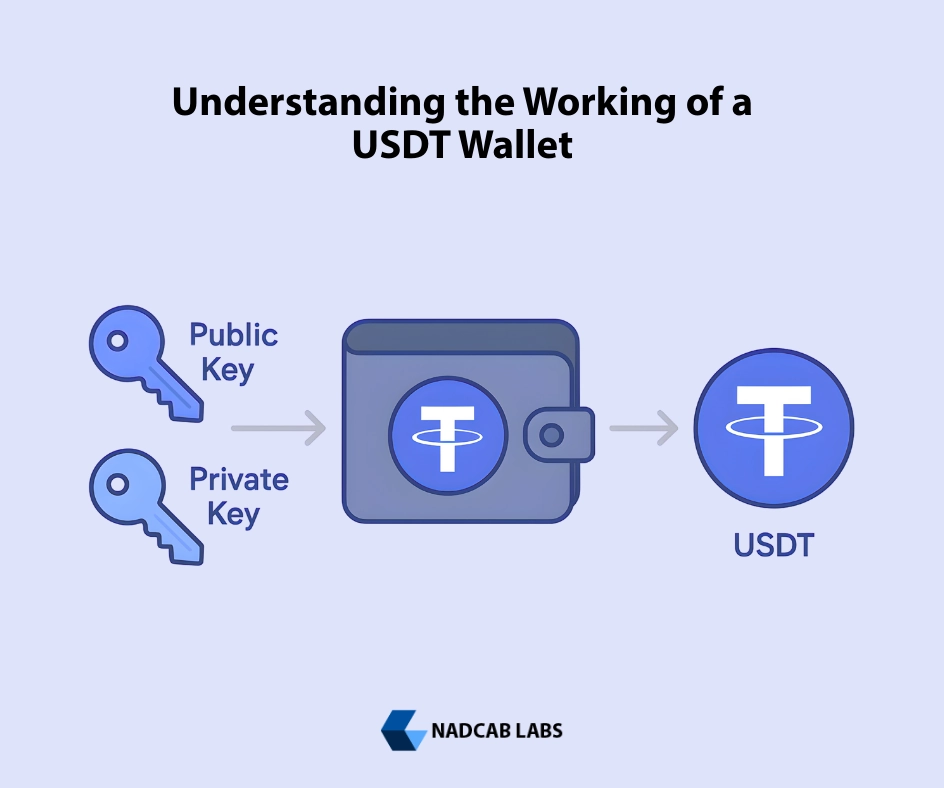
A USDT wallet securely stores these keys and allows you to send, receive and manage USDT across different networks like Ethereum (ERC20), Tron (TRC20), BNB Chain (BEP20), Solana and more. Different users prefer different networks based on fees, speed and compatibility.
For example:If you want low transaction fees, TRC20 USDT on Tron is widely preferred. If you need compatibility with decentralized apps, ERC20 USDT on Ethereum is a better choice.
A good USDT wallet supports multi-network USDT, which gives users flexibility and reduces limitations.
USDT wallets and their advantages in 2026
| USDT Wallet Type | Key Advantages | Best For |
|---|---|---|
| Hardware Wallets | Offline storage for maximum security, protection from hacks, multi-signature support | Long-term holders, high-value users |
| Mobile Wallets | Fast transactions, easy access on the go, push notifications, biometric login | Daily users, freelancers, traders |
| Web Wallets | Convenient online access, quick transactions, no installation needed | Quick access, casual users |
| Multi-Chain Wallets | Supports multiple networks (ERC20, TRC20, BEP20, Solana), cross-chain transfers, lower fees | Advanced users, cross-network traders |
| DeFi Integrated Wallets | Enables staking, yield farming, liquidity provision, passive income | Crypto investors, DeFi users |
| Non-Custodial Wallets | User-controlled private keys, encrypted backups, device-level authentication, no third-party access | Security-focused users, privacy-conscious individuals |
Why Are USDT Wallets Considered Perfect for Storing Digital Assets ?
1. Strong Price Stability Protects Your Funds
The primary advantage of USDT wallets is stability. Unlike Bitcoin or Ethereum, which can change in value within minutes, USDT remains pegged to $1, making it a safer choice for both traders and regular users.
For someone who doesn’t want to take risks or lose value due to volatility, a USDT wallet becomes a trusted option. It acts like a safe digital savings account where your money won’t fluctuate.
2. High-Level Security Features Keep Your Funds Protected
Modern USDT wallets use high-end security layers that keep hackers away. These features may include biometric verification, passphrase backups, PIN protection, multi-device authentication and hardware-level encryption.
Some USDT wallets use non-custodial technology, giving users full control over their private keys. This means that even if the wallet provider’s servers are compromised, your funds remain secure because only you have access. Additional security layers include flexible private key management, encrypted backups, device-level authentication and multi-network address protection, ensuring your digital assets stay safe from unauthorized access at all times.
3. Faster Global Transfers Without Banking Delays
Traditional bank transfers can take hours or even days, especially for international payments. USDT wallets allow near-instant transfers across blockchain networks.
For example, a business owner in India can transfer payment to a supplier in the UAE in under a minute using USDT, avoiding bank delays, high fees and paperwork. This speed and convenience make USDT wallets ideal for freelancers, remote employees, international traders, students abroad and crypto businesses, giving users full control over their funds without relying on traditional banking systems.
4. Support for Multiple Blockchains and Cross-Chain Movement
Most advanced USDT wallets now support cross-chain transfers. This means you can move USDT across different networks depending on your needs.
For example, you can bridge USDT from Ethereum to Solana or from TRC20 to BEP20 within the same wallet. This feature helps users reduce gas fees, access multiple blockchain ecosystems and manage their assets more efficiently. Multi-network support ensures faster transactions, lower fees, better compatibility and more earning opportunities, making cross-chain wallets highly valuable in a multi-chain crypto ecosystem.
5. Easy Access to DeFi, Staking and Earning Opportunities
A powerful reason USDT wallets are preferred is that they open the door to earning opportunities. Many wallets integrate with DeFi platforms, allowing users to stake USDT, provide liquidity, participate in yield farming or earn interest.
For example: A user may stake USDT for 8–12% APY or join liquidity pools for additional rewards. This is far more rewarding than traditional bank interest rates. By storing USDT in a compatible wallet, you not only protect your money but also grow it through passive-income features.
6. Low Transaction Fees on Multiple Networks
People prefer USDT wallets because they offer the flexibility to choose the network with the lowest transaction fees. For example, ERC20 on Ethereum may become expensive during high network congestion, while TRC20 on Tron is known for its consistently low transfer fees. BEP20 on the BNB Chain also provides affordable and fast transactions, making it a popular alternative. Additionally, Solana offers ultra-fast processing with very low costs, giving users multiple efficient options to move their USDT depending on their needs and budget.
Depending on your situation, you can pick the network that suits you best. This flexibility helps you save money while making frequent transactions.
7. High Liquidity Makes It Easy to Trade or Convert
USDT is one of the most traded and highly liquid digital assets in the world, which makes it extremely easy to exchange on almost any crypto platform. With a USDT wallet, users get direct access to essential actions like trading, swapping, converting, cashing out and even buying crypto instantly. Because USDT is supported universally across exchanges and DeFi platforms, it offers far more convenience and accessibility compared to lesser-known tokens, allowing users to move their funds quickly and efficiently whenever needed.
8. Perfect for Beginners and Advanced Crypto Users
Unlike many complicated crypto wallets, USDT wallets are designed to be simple and beginner-friendly, making them easy to use even for people new to digital currencies. Users only need to understand basic actions like sending, receiving, backing up and checking their balance. At the same time, advanced users can enjoy features like multi-chain support, DApp connectivity, portfolio tracking, DeFi tools, multiple account management and enhanced security options such as multi-sig. This combination of simplicity and advanced functionality makes USDT wallets suitable for every type of user, from complete beginners to experienced professionals.
9. Great for Savings, Emergency Funds and Daily Use
Because USDT remains stable in value, a USDT wallet functions much like a digital savings account. Many users now keep their emergency funds in USDT because it holds its price even during major crypto market crashes. Beyond long-term saving, USDT wallets are also highly practical for everyday use. They support daily microtransactions, subscription payments, online purchases, e-commerce settlements and even business transactions. Thanks to the stability of USDT, these wallets can be used for real-world financial needs without worrying about sudden price drops that affect other cryptocurrencies.
10. User-Friendly Mobile Apps Enhance Accessibility
Most modern USDT wallets now include mobile apps, allowing users to manage their funds from anywhere without needing a computer. Your smartphone becomes your secure, always-accessible wallet. These mobile wallets offer important features such as quick sending and receiving, accurate network fee estimations, QR code payment support, real-time balance updates, instant push notifications and biometric login for added security. With this level of convenience and accessibility, USDT wallets have become a natural part of the daily routine for many crypto users, making transactions faster and wallet management easier than ever.
11. Complete Control Without Middlemen
When you use a centralized exchange, your money is technically stored under their control. If the exchange shuts down or gets hacked, you may lose everything.
A USDT wallet, especially a non-custodial one, gives you full ownership. You become your own bank. You decide how to store, transfer or use your funds without relying on third parties. This independence is one of the biggest reasons USDT wallets are perfect for holding digital assets.
12. Useful for Businesses and Online Stores
Many businesses now accept USDT payments because it is stable, fast and global. A USDT wallet allows business owners to receive payments instantly from customers worldwide.
It solves multiple issues like delayed settlement, high bank fees, currency conversion charges and international restrictions. USDT wallets make business payments smoother and more efficient.
USDT Wallet Market Stats That Matter in 2026
In 2026, This adoption has translated into deep liquidity, the stablecoin’s total supply exceeds $182 billion[2] far larger than most competitors. On the TRON network, USDT circulating supply has exceeded $80 billion [3] with millions of daily transactions, underscoring its dominance. Cross-border payments using USDT have grown rapidly, with businesses saving up to 80% in fees compared to traditional bank transfers, and more than 60% of international crypto remittances now rely on USDT for fast settlement. Mobile USDT wallet adoption has increased by 40% and 65% of crypto users prefer multi-chain wallets to switch networks and reduce gas fees. With over 580 million crypto users worldwide and USDT being held by 40% of them, it remains the most widely used stablecoin for trading, savings, global payments, and decentralized finance in 2026.
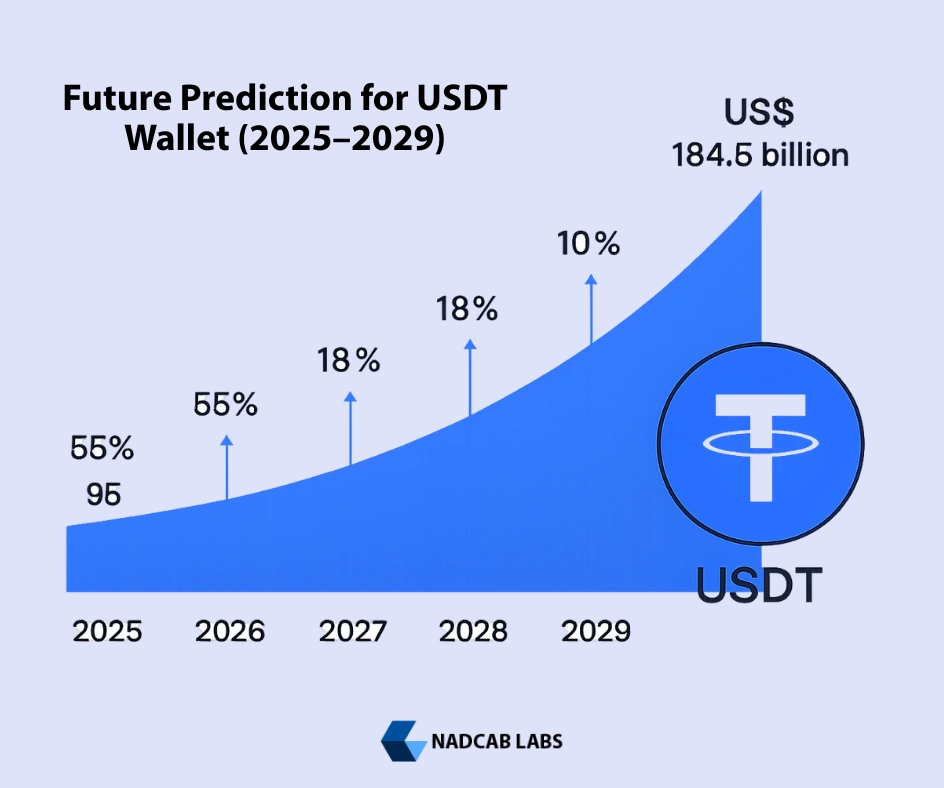
The USDT market is projected to grow steadily from 2025 to 2029, driven by rising global crypto adoption, increased cross-border payment usage, and expanding DeFi activity. In 2025, the stablecoin market anchored by USDT begins its upward trajectory with an estimated market size of around US$55 billion. This momentum continues through 2026, crossing approximately US$95 billion as more users adopt digital wallets while Tron and Ethereum remain dominant networks for USDT transfers. By 2027, the market expands further to nearly US$118 billion, supported by institutional trading, global remittances and multi-chain wallet adoption. Growth accelerates in 2028, rising another 10% year-over-year as liquidity deepens and businesses increasingly use stablecoin’s for settlements. By 2029, USDT reaches its strongest projected value of approximately US$184.5 billion, reflecting a rapid rise in adoption, liquidity depth and global relevance solidifying its position as one of the most important assets in the digital economy.
Why a USDT Wallet Is Essential in 2026
As we move deeper into 2026, stable digital wallets are playing a more significant role in the global financial system. Many people now treat USDT wallets as digital savings accounts, emergency funds, income wallets, business transaction tools and gateways to decentralized finance. The stability of USDT and the increasing strength of wallet security features make it the safest and most practical option for storing digital assets this year.
Whether you’re trading, saving, earning or receiving cross-border payments, a USDT wallet in 2026 ensures you maintain full control, full security and full flexibility without relying on banks or centralized intermediaries. Its stability, high liquidity, low fees and multi-chain compatibility make it the most reliable choice for anyone looking to protect and grow their digital wealth.
Frequently Asked Questions
Q1.What is a USDT Wallet ?
A USDT Wallet in 2026 is a secure digital wallet used to store, send and manage Tether (USDT) across multiple blockchain networks like Tron, Ethereum, Solana and BSC. Modern USDT wallets support faster transactions, account abstraction, staking options and upgraded security tools that better protect your stablecoin assets.
Q2.Are USDT Wallets safe to use in 2026?
Yes, USDT Wallets are safer than ever in 2026. Wallets now include advanced features like biometric security, multi-signature protection, hardware-level encryption, anti-phishing alerts and real-time threat detection. As long as users secure their private keys, a USDT wallet remains one of the safest ways to store digital assets.
Q3.Which type of USDT Wallet is best in 2026?
In 2026, the best USDT wallet depends entirely on your usage needs. Hardware wallets remain the safest option for long-term storage because they keep your private keys offline. Mobile USDT wallets are ideal for daily use and fast transfers, while web wallets offer quick and convenient online access. For users who manage USDT across multiple networks, multi-chain wallets provide seamless cross-network support. Overall, most users prefer a combination of a mobile wallet for everyday transactions and a hardware wallet for maximum security.
Q4.Can I store USDT on multiple blockchains in one wallet?
Yes, most advanced USDT Wallets in 2026 support multi-network storage. You can store USDT on networks like TRC-20, ERC-20, BEP-20, Solana USDT and Polygon USDT within a single interface. This makes transferring USDT across networks faster, cheaper and more flexible.
Q5.How fast are USDT transactions ?
USDT transactions are extremely fast in 2026, especially on networks like Tron and Solana. Transfers typically complete in 1–3 seconds, depending on network load. Modern USDT wallets also use optimized routing and gas-fee automation for consistent speed and low transaction costs.
Q6.Are USDT Wallet fees still low in 2026?
Yes. USDT wallet fees remain low in 2026, especially on TRC-20, Solana and BSC networks. Most USDT transfers cost under $0.01–$0.20, depending on the chain. Wallets now also show real-time fee comparisons so users can choose the cheapest network instantly.
Q7.Can I use a USDT Wallet for cross-border payments in 2026?
Absolutely. In 2026, USDT wallets are widely used for global payments due to instant settlement, low fees and USD-backed stability. Businesses and freelancers use USDT wallets to receive international payments faster than banks, with no currency conversion delays.
Q8.Do USDT Wallets support staking or earning rewards ?
Some USDT wallets integrate staking, savings vaults or yield-earning options in 2026. While USDT itself does not generate yield, third-party DeFi options inside USDT wallets offer secure lending pools, liquidity modes or flexible APY rewards for stablecoin’s. Always choose verified platforms for safety.
Q9.What is the most secure way to store USDT in 2026?
The most secure method in 2026 is using a hardware USDT wallet combined with offline storage of your recovery phrase. Multi-signature protection, cold storage and encrypted backups provide maximum protection against hacks and phishing attacks.
Q10.Can beginners use a USDT Wallet easily in 2026?
Yes. Modern USDT wallets in 2026 are beginner-friendly, with clean interfaces, guided setup steps, easy backup features and simple send/receive options. Many wallets now include built-in help tools, AI-based security alerts and one-tap network switching to make crypto management easier for first-time users.
Explore Services
Related Services
Reviewed by

Aman Vaths
Founder of Nadcab Labs
Aman Vaths is the Founder & CTO of Nadcab Labs, a global digital engineering company delivering enterprise-grade solutions across AI, Web3, Blockchain, Big Data, Cloud, Cybersecurity, and Modern Application Development. With deep technical leadership and product innovation experience, Aman has positioned Nadcab Labs as one of the most advanced engineering companies driving the next era of intelligent, secure, and scalable software systems. Under his leadership, Nadcab Labs has built 2,000+ global projects across sectors including fintech, banking, healthcare, real estate, logistics, gaming, manufacturing, and next-generation DePIN networks. Aman’s strength lies in architecting high-performance systems, end-to-end platform engineering, and designing enterprise solutions that operate at global scale.