Ai Overview
Corporate Software Inspector (CSI) is an enterprise-level tool that helps organizations check the security of the software running on their systems and identify vulnerabilities. One of its biggest strengths is its ability to cover more than 20,000 applications, making it a powerful and reliable solution for maintaining enterprise-level security.
Key Takeaways
- ✓ Corporate Software Inspector (CSI) by Flexera is an authenticated enterprise vulnerability scanner covering 20,000+ applications across multiple platforms.
- ✓ CSI reduces unpatched vulnerabilities by up to 50% within 90 days and shrinks attack surface risk by 80% for enterprise organizations.
- ✓ Flexera CSI integrates seamlessly with Microsoft SCCM and WSUS, extending native patch coverage to non-Microsoft third-party applications.
- ✓ Vulnerability intelligence from Secunia Research powers CSI, providing verified, daily-updated advisories for accurate and timely risk prioritization.
- ✓ CSI supports Windows, Mac OS X, and Red Hat Enterprise Linux, making it ideal for heterogeneous enterprise IT environments worldwide.
- ✓ Compliance reporting in CSI maps directly to ISO 27001, NIST, HIPAA, GDPR, SOX, and PCI-DSS frameworks for audit-ready documentation.
- ✓ Pre-configured, tested patch packages for hundreds of non-Microsoft applications enable faster and safer patch deployment with minimal effort.
- ✓ Both agent-based and agentless scanning options in CSI offer deployment flexibility across managed and unmanaged endpoint environments.
- ✓ Industries including healthcare, finance, government, and manufacturing leverage CSI to maintain proactive security postures and reduce breach risks.
- ✓ CSI has evolved into Flexera Software Vulnerability Manager (SVM), preserving all core capabilities while adding cloud-native delivery and advanced analytics.
What is Corporate Software Inspector (CSI)?
Corporate Software Inspector (CSI) is an enterprise-level tool that helps organizations check the security of the software running on their systems and identify vulnerabilities. It was originally developed by Secunia and is now offered under the Flexera brand. In simple terms, CSI detects outdated or insecure applications and automatically updates them with secure patches, preventing hackers from exploiting those weaknesses. The platform combines verified vulnerability data, multi-platform scanning, and ready-to-use patch updates into a single system, so IT teams don’t need to rely on multiple tools.
It provides clear visibility into which software is secure and which is at risk, while also reducing manual effort through automation. One of its biggest strengths is its ability to cover more than 20,000 applications, making it a powerful and reliable solution for maintaining enterprise-level security.
How CSI Works in Enterprise Environments?
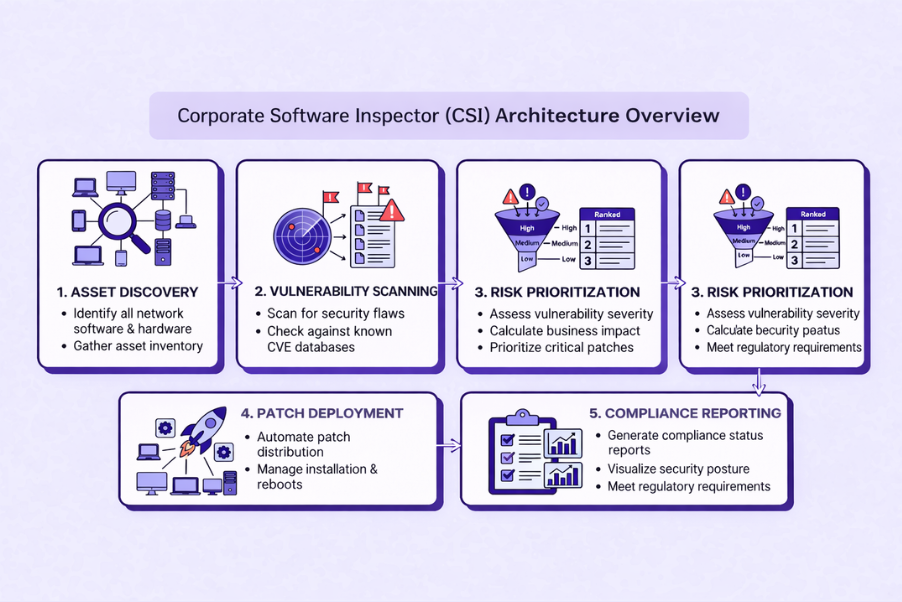
In an enterprise environment, Corporate Software Inspector operates through a continuous lifecycle of assess, mitigate, and verify. The process begins with an authenticated software inventory scan that identifies all programs installed across every managed endpoint. This inventory is then cross-referenced against Flexera’s Secunia Research vulnerability database, which is updated daily with new advisories covering thousands of products. Once vulnerable software is identified, CSI ranks those risks by severity and exploitability, enabling IT security teams to prioritize patches based on actual risk to the business rather than treating all vulnerabilities equally. Pre-configured, tested patch packages are then deployed automatically or via integration with Microsoft SCCM or WSUS. After deployment, CSI conducts post-patch rescans to verify that vulnerabilities have been successfully remediated, generating documentation that supports compliance audits. This closed-loop approach ensures that no vulnerability goes unaddressed and that every remediation action is recorded.
CSI Software Vulnerability Management Lifecycle
Step 1: Asset Discovery and Inventory
CSI performs authenticated scans across all endpoints to build a complete inventory of installed software across Windows, Mac, and RHEL platforms.
Step 2: Vulnerability Assessment
The software inventory is cross-referenced against the Secunia Research database to identify known vulnerabilities and calculate risk levels for each finding.
Step 3: Risk Prioritization
Security teams receive prioritized risk reports based on criticality, exploitability, and business impact, enabling data-driven remediation decisions.
Step 4: Patch Deployment
Pre-configured, tested patch packages for non-Microsoft applications are deployed via SCCM, WSUS, or CSI’s native deployment engine, automating remediation at scale.
Step 5: Verification and Rescanning
After patches are applied, CSI rescans endpoints to confirm successful remediation and flags any outstanding issues for follow-up action.
Step 6: Compliance Reporting
Detailed reports and audit trails are generated, providing evidence of proactive patch management for regulatory frameworks such as ISO 27001, HIPAA, and GDPR.
Key Components of CSI Architecture
The architecture of Corporate Software Inspector is built around four tightly integrated components that together form a complete software vulnerability management platform. The first component is the Secunia Research Intelligence Engine, which serves as the knowledge backbone, providing daily-updated advisories and verified vulnerability data for over 55,000 products. The second is the Authenticated Scanner, which performs deep, credentialed scans to build accurate software inventories across endpoints. The third component is the Patch Repository, which houses hundreds of pre-built, pre-tested patch packages for non-Microsoft applications, enabling rapid deployment without manual packaging work. The fourth is the Integration Layer, which connects CSI with Microsoft SCCM, WSUS, and other enterprise IT management tools. Together, these components deliver a streamlined and intelligent security operation that significantly reduces Mean Time to Detect (MTTD) and Mean Time to Patch (MTTP) for organizations of all sizes.
Why Software Vulnerability Management Matters Today?
The cybersecurity threat landscape has grown exponentially more complex, with software vulnerabilities representing the most commonly exploited attack vector in corporate environments. According to industry research, over 60% of data breaches involve an unpatched vulnerability for which a patch was already available at the time of the breach. In markets like the USA, UK, UAE, and Canada, regulatory requirements around data protection and security governance have intensified, placing a legal obligation on organizations to demonstrate active vulnerability management programs.
The reality is that most enterprise environments run hundreds of third-party applications alongside Microsoft software, and native Windows update tools simply cannot address this broader application estate. This gap is precisely where a dedicated software vulnerability scanner like Corporate Software Inspector proves indispensable. The cost of a single breach now vastly outweighs the investment in proactive vulnerability scanning and patch management, making CSI a strategic security asset. [1]
Overview of Flexera Corporate Software Inspector
Flexera Corporate Software Inspector has its roots in the Secunia research organization, which began investigating and verifying software vulnerabilities back in 2002. In 2015, Secunia was acquired by Flexera, integrating the world-class Secunia Research team into the Flexera platform. Since then, Flexera CSI has been continuously refined and expanded, ultimately evolving into what is now called the Software Vulnerability Manager (SVM). The platform today serves over 80,000 customers worldwide and is recognized by industry analysts as a leading vulnerability management software solution.
Flexera CSI is available in both on-premises and cloud delivery models, providing flexible deployment options that accommodate enterprise infrastructure requirements. Pricing is per device with no minimum device count, making it accessible to organizations of varying sizes. With its unique combination of intelligence, scanning, patching, and integration capabilities, Flexera remains the only vendor offering software vulnerability assessment and patching within a single unified platform.
Key Features of Corporate Software Inspector (CSI)
Core CSI Feature Categories
Vulnerability Intelligence
- Daily-updated Secunia Research advisories
- 55,000+ verified product coverage
- Severity and exploitability scoring
- Zero-day vulnerability tracking
Patch Automation
- Hundreds of pre-configured patch packages
- Automated non-Microsoft patching
- Packaging wizard for custom patches
- Patch testing before deployment
System Integration
- Native SCCM and WSUS integration
- SC2012 plugin for unified console
- Agent-based and agentless scanning
- Cloud and on-premises delivery
Vulnerability Intelligence and Scanning
Corporate Software Inspector (CSI) uses a strong research system built by Secunia, now part of Flexera. This team has been tracking software vulnerabilities since 2002 and provides verified updates daily. Unlike other tools, it avoids false alerts by using accurate data. CSI scans systems across Windows, Mac, and Linux, finding all installed apps and checking them against its database. This helps companies clearly understand their risks without confusion or too many unnecessary alerts.
Automated Patch Creation and Deployment
One of the best features of CSI is automatic patching for non-Microsoft software. It comes with many ready-to-use patch packages that can be applied instantly, saving time and effort. For apps without ready patches, it offers a simple wizard to create custom ones. IT teams can also set rules, like applying critical patches within 48 hours. This automation helps companies stay secure and meet deadlines without depending on manual work or complex processes.
Third-Party Patch Management
CSI is very powerful when it comes to managing third-party software updates. Tools like Microsoft updates mainly handle their own products, but CSI covers thousands of other apps like browsers, PDF readers, and media tools. These apps are often targeted by hackers because they are not updated on time. CSI supports over 20,000 applications and makes updating them as easy as regular system updates, helping companies close important security gaps quickly and efficiently.
Real-Time Alerts and Risk Prioritization
CSI helps security teams focus on what matters most by sending real-time alerts for new vulnerabilities. When a new issue is found, it checks which systems are affected and ranks the risk level. The ranking is based on severity, known threats, and system importance. This means critical issues are handled first, while smaller ones can wait. It reduces alert overload and helps teams take smarter actions instead of treating every problem as urgent.
Integration with Existing IT Systems (SCCM, WSUS)
CSI works smoothly with existing tools like SCCM and WSUS, so companies don’t need to learn new systems. It adds its features directly into these platforms, allowing IT teams to manage everything from one place. This reduces extra work and training time. It also uses existing system data for scanning, avoiding the need for additional setups. This makes it easier for organizations to improve security without changing their current IT infrastructure.
Advanced Reporting and Analytics Dashboards
CSI offers detailed reports and dashboards for different users in an organization. Security teams can see real-time risks and patch status, while managers get simple summaries of overall security. It also helps with compliance by generating ready-to-use reports for audits. Reports can be customized and scheduled automatically. The system tracks past data too, helping companies show improvement over time. This is useful during audits and proves that proper security steps are being followed consistently.
Benefits of Using Corporate Software Inspector (CSI)
Improved Security and Risk Reduction
The biggest benefit of using Corporate Software Inspector (CSI) is stronger security. It continuously scans all systems and finds vulnerabilities before they become serious threats. With help from Flexera, it provides accurate data and trusted patches. Many organizations see fewer security risks within a few months. It also uses tested patches, so updates don’t break applications. This helps companies stay protected without delaying updates or increasing their exposure to cyberattacks.
Faster Patch Deployment and Automation
CSI makes patching much faster by automating the entire process. Normally, finding and applying patches takes a lot of time, but CSI already has tested patches ready to use. IT teams just approve them or set automatic rules. This reduces patching time from weeks to hours. Faster updates mean fewer chances for hackers to attack. It is especially useful for large organizations where managing multiple systems manually can slow down security operations.
Enhanced Compliance and Reporting
CSI helps organizations meet security and compliance requirements easily. It keeps a complete record of vulnerabilities, patches, and updates with timestamps. This makes audits much simpler because all data is already organized. Companies following rules like GDPR or HIPAA can quickly generate reports. It also alerts teams if security levels drop. This ensures continuous compliance and reduces the effort needed to prepare for audits or inspections.
Reduced Manual Effort for IT Teams
CSI reduces the workload for IT teams by automating major tasks like scanning, risk analysis, and patch deployment. Instead of spending hours on manual work, teams can focus on more important security tasks. This improves productivity and saves time. It also reduces errors caused by manual processes. For companies with limited staff, this automation helps manage security more efficiently without needing extra resources.
Better Visibility Across Software Assets
CSI gives a clear view of all software running in an organization. It finds installed apps, including hidden or unauthorized ones, using its scanning system. This helps companies understand what needs to be secured or updated. It also supports license tracking and better IT planning. With complete visibility, organizations can manage risks more effectively and ensure no vulnerable software is missed during security checks.
Use Cases of Corporate Software Inspector (CSI)
Healthcare (USA/UK): Hospitals and healthcare networks use CSI to maintain HIPAA compliance, patching medical workstations and clinical software that handle protected patient health information across thousands of endpoints.
Financial Services (UAE/Canada): Banks and investment firms deploy CSI to meet SOX and PCI-DSS patching requirements, ensuring all third-party financial applications and trading platforms are continuously secured.
Government Agencies: Public sector organizations in the UK and UAE use CSI to meet government security standards and demonstrate proactive vulnerability management to oversight bodies and internal auditors.
Manufacturing: Industrial manufacturers use CSI to secure specialized software including SCADA and MES systems, protecting operational technology environments that cannot afford downtime from a security breach.
Education (Canada/UK): Universities and school districts deploy CSI to manage diverse software environments across student and faculty devices, maintaining security without disrupting academic operations.
Retail and E-Commerce: Large retail organizations use CSI to protect customer data by maintaining patched POS systems, inventory management software, and web application stacks across distributed store networks.
How CSI Compares with Other Vulnerability Management Tools?
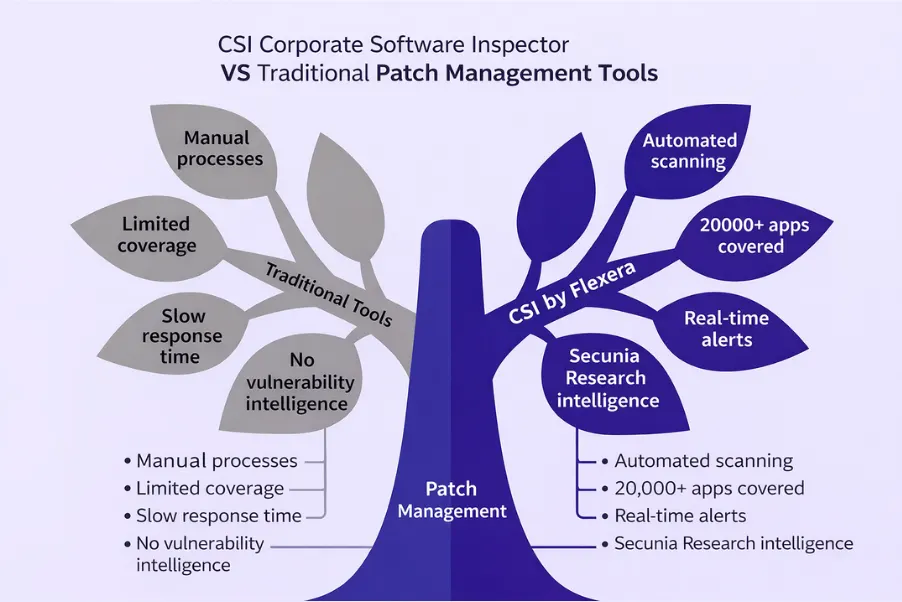
When evaluating Corporate Software Inspector against traditional patch management tools, the differences are substantial and go beyond simple feature comparisons. Traditional patch management tools, including basic WSUS configurations and older endpoint management platforms, were built primarily for Microsoft product updates and operate on a reactive model: wait for Patch Tuesday, test available patches, deploy them on a scheduled cadence. This model served adequately when Microsoft software represented the majority of enterprise application risk, but it is fundamentally inadequate for today’s diverse software estates. CSI takes a fundamentally different approach by combining proactive vulnerability intelligence with automated patch creation and deployment in a continuous cycle, rather than a monthly reactive cadence. The platform’s coverage of 20,000+ third-party applications fills the most significant gap in traditional patch management workflows. Additionally, the verified intelligence from Secunia Research means that CSI users get confirmation that a vulnerability is real and exploitable before being asked to act on it, whereas traditional tools often surface theoretical vulnerabilities that may not require immediate action.
| Capability | Traditional Tools | Flexera CSI |
|---|---|---|
| Third-Party App Coverage | Limited | 20,000+ Apps |
| Vulnerability Intelligence | Generic/Unverified | Verified Secunia Research |
| Patch Automation | Manual/Scheduled | Fully Automated |
| SCCM/WSUS Integration | Basic | Native Deep Integration |
| Compliance Reporting | Limited | Comprehensive Frameworks |
| Patch Testing | Manual | Pre-Tested by Flexera |
| Delivery Models | On-Premises Only | On-Premises and Cloud |
CSI vs Modern Vulnerability Scanners
When comparing Corporate Software Inspector against modern standalone vulnerability scanners, the key differentiator is CSI’s end-to-end integration of intelligence, scanning, and remediation. Modern vulnerability scanners such as network-based tools typically excel at discovering vulnerabilities across a broad range of network devices and services, but they often lack the built-in remediation capabilities that make CSI uniquely valuable for patch management operations. Many vulnerability scanners produce extensive lists of findings without providing the pre-tested patch packages or deployment integration needed to act on those findings efficiently. CSI bridges this gap by being both a software vulnerability scanner and a patch deployment platform simultaneously. The Secunia Research intelligence that powers CSI is also specifically focused on software products running on endpoints, which is a more targeted and operationally relevant scope than the broad network vulnerability scanning offered by general-purpose scanners. For IT security teams in organizations across the USA and UK that want to reduce the gap between vulnerability discovery and remediation, this integrated approach delivers measurably better outcomes than using separate scanning and patching tools in isolation.
Best Practices for Using Corporate Software Inspector
Regular Vulnerability Scanning and Updates
Establishing a consistent and frequent scanning cadence is the foundation of effective use of Corporate Software Inspector. Many organizations fall into the trap of treating vulnerability scanning as a periodic compliance exercise rather than a continuous operational process. With CSI, we strongly recommend configuring automated scans to run at least weekly across all managed endpoints, with more frequent scans for high-criticality systems such as servers handling sensitive data or externally accessible services. This frequency ensures that new vulnerabilities introduced by software installations, updates, or configuration changes are detected promptly. The Secunia Research intelligence database is updated daily, meaning that even if a new vulnerability is disclosed between scan cycles, the next scan will immediately detect it if the affected software is present in the environment. Organizations in the USA and UAE that have adopted continuous scanning cadences report significantly lower average dwell times for vulnerabilities compared to those running monthly scan cycles, which translates directly into reduced breach risk.
Prioritizing Critical Patches
With potentially thousands of vulnerability findings across a large enterprise environment, the ability to prioritize effectively is what separates high-performing security programs from those that are perpetually overwhelmed. Corporate Software Inspector’s risk prioritization engine does the heavy lifting here by scoring each vulnerability based on its CVSS rating, the availability of public exploit code, and the criticality of the affected system. Our experience working with enterprise clients across the UK and Canada confirms that focusing on the top 10-15% of vulnerabilities by risk score eliminates the vast majority of meaningful exposure. Specifically, we recommend creating automated deployment policies for critical (CVSS 9.0+) and high (CVSS 7.0-8.9) severity vulnerabilities, while placing medium and low severity findings in a scheduled maintenance window queue. This tiered approach ensures that the most dangerous vulnerabilities are addressed with the greatest urgency without creating operational chaos by treating every patch as equally critical.
Integrating CSI with Security Workflows
Corporate Software Inspector delivers its greatest value when integrated into the broader security workflow rather than operated as a standalone patching tool. By connecting CSI’s vulnerability data with your Security Information and Event Management (SIEM) platform, you create a real-time correlation layer that can alert on active exploitation attempts against known unpatched vulnerabilities in your environment. Integration with ticketing systems such as ServiceNow or Jira ensures that every vulnerability finding is automatically assigned to the appropriate team with clear SLA expectations. Connecting CSI with your change management process ensures that patch deployments follow proper approval workflows without adding bureaucratic friction that delays critical security updates. For organizations building out their security operations capabilities in the USA and UAE, we also recommend connecting CSI to threat intelligence feeds that can flag when specific vulnerabilities are being actively exploited in the wild, enabling targeted emergency patching outside the normal scan-and-patch cycle when the risk environment demands it.
CSI Selection and Deployment Model Criteria
On-Premises Deployment
- Best for organizations with strict data residency requirements
- Requires Red Hat Enterprise Server infrastructure
- Full control over data and scan schedules
- Requires SCCM or WSUS already in place
- Ideal for regulated industries (healthcare, finance, government)
Cloud Delivery Model
- Fastest time-to-value with minimal infrastructure setup
- Ideal for organizations migrating to cloud-first IT strategies
- Automatic platform updates and maintenance by Flexera
- Scales easily as organization grows
- Suited for distributed remote workforce environments
Right-Sizing Your CSI Deployment
- Pricing is per device with no minimum device count
- Agent and agentless options based on endpoint accessibility
- Choose based on existing infrastructure investment
- Evaluate regulatory requirements before selecting model
- Implementation typically completed in 15 consulting days
Compliance Governance Checklist for CSI Deployments
| Governance Area | Required Action | Applicable Standard |
|---|---|---|
| Patch SLA Policy | Define and document tiered patching timelines by severity | NIST, ISO 27001 |
| Audit Trail Maintenance | Retain scan and patch deployment records for minimum 12 months | HIPAA, PCI-DSS |
| Vulnerability Reporting | Generate monthly vulnerability posture reports for leadership and compliance teams | GDPR, SOX |
| Exception Management | Document risk acceptance and compensating controls for all patching exceptions | ISO 27001, NIST |
| Access Controls | Implement role-based access in CSI limiting patch approval rights to authorized personnel | PCI-DSS, HIPAA |
| Post-Patch Verification | Rescan all affected endpoints within 24 hours after each patch deployment cycle | NIST CSF, CIS |
| Third-Party Software Inventory | Maintain complete and current inventory of all third-party applications across all endpoints | ISO 27001, GDPR |
Is CSI the Right Solution for Your Business?
After 8+ years of working with enterprise security teams across the USA, UK, UAE, and Canada, our assessment is clear: Corporate Software Inspector (now Flexera Software Vulnerability Manager) is the right choice for any organization with more than a few hundred endpoints that relies on third-party software and operates under regulatory or compliance obligations. It is particularly well-suited for organizations already invested in Microsoft SCCM and WSUS infrastructure, as the integration maximizes the value of both platforms simultaneously.
For organizations in the healthcare, financial services, government, or manufacturing sectors, where compliance documentation is non-negotiable and breach consequences are severe, CSI’s combination of verified intelligence, automated remediation, and audit-ready reporting provides a uniquely complete solution. Smaller organizations below 500 endpoints may find the per-device pricing more manageable than anticipated given there is no minimum device count requirement, making CSI accessible to a broader range of businesses than is commonly assumed. The critical question is not whether your organization needs vulnerability management software, but whether you are willing to accept the risk of operating without it in today’s threat environment.
Ready to Strengthen Your Software Vulnerability Management?
Let our team help you assess, implement, and optimize Corporate Software Inspector for your enterprise security needs.
Frequently Asked Questions
Q1.What is Corporate Software Inspector (CSI)?
Corporate Software Inspector (CSI), originally created by Secunia and now operated under the Flexera brand, is an enterprise-grade authenticated vulnerability scanner and patch management solution. It continuously identifies vulnerable software across an organization’s network and deploys security patches before those vulnerabilities can be exploited. CSI assesses more than 20,000 applications across Windows, Mac OS, and Red Hat Enterprise Linux platforms, providing a complete software vulnerability management lifecycle from detection to remediation and compliance reporting.
Q2.What is Flexera Corporate Software Inspector used for?
Flexera Corporate Software Inspector is used primarily for software vulnerability assessment and security patch management across large and mid-sized enterprises. It enables IT teams in organizations across the USA, UK, UAE, and Canada to detect outdated or unpatched software, prioritize security risks based on criticality, and deploy tested patches for non-Microsoft third-party applications. It integrates directly with Microsoft SCCM and WSUS, making it a practical extension of existing IT infrastructure rather than a standalone tool requiring separate management overhead.
Q3.How does Flexera CSI differ from traditional patch management software?
Unlike traditional patch management software that focuses mostly on Microsoft operating system updates, Flexera CSI provides deep coverage for over 20,000 third-party applications including browsers, plugins, and productivity tools. It combines verified vulnerability intelligence sourced from Secunia Research with automated scanning, patch creation, and deployment in a single platform. Traditional tools typically rely on manual processes and offer limited intelligence on non-Microsoft software, while CSI delivers real-time risk prioritization and pre-tested patch packages that dramatically reduce remediation time.
Q4.What operating systems does Corporate Software Inspector support?
Corporate Software Inspector supports scanning and vulnerability assessment across multiple operating system environments. It covers Microsoft Windows (all major enterprise versions), Apple Mac OS X, and Red Hat Enterprise Linux (RHEL). This multi-platform support makes it suitable for heterogeneous enterprise environments, particularly those operating across mixed OS infrastructures. Organizations in regulated industries such as healthcare and financial services across the US and UK find this broad coverage particularly valuable when managing compliance across diverse endpoint environments with different platform requirements.
Q5.How does CSI integrate with SCCM and WSUS?
Flexera Corporate Software Inspector integrates seamlessly with Microsoft System Center Configuration Manager (SCCM) and Windows Server Update Services (WSUS). This integration allows IT administrators to manage third-party software patches from within the same Microsoft consoles they already use, eliminating the need to switch between platforms. CSI makes its pre-configured patch packages available directly through the SCCM interface. The integration is designed to maximize return on existing infrastructure investments while extending patch coverage well beyond what WSUS and SCCM can provide natively for non-Microsoft applications.
Q6.Is Corporate Software Inspector suitable for compliance management?
Yes, Corporate Software Inspector is well-suited for compliance management across multiple regulatory frameworks. It provides continuous reporting and documentation that supports alignment with standards including ISO 27001, NIST, HIPAA, GDPR, SOX, and PCI-DSS. Organizations in regulated industries such as healthcare in the USA, financial services in the UK, and government entities in the UAE and Canada rely on CSI to demonstrate a proactive patching posture during audits. Its reporting dashboards deliver real-time compliance insights that reduce the manual burden on security and governance teams.
Q7.What are the main benefits of using Corporate Software Inspector?
The main benefits of using Corporate Software Inspector include a reported 50% reduction in unpatched vulnerabilities within the first 90 days of deployment and an 80% decrease in overall attack surface risk. Beyond security improvements, CSI delivers significant cost savings through reduced manual patching effort, better license compliance visibility, and streamlined workflows. IT teams gain complete visibility into software assets across all endpoints, enabling data-driven risk decisions. The tool’s automation capabilities reduce Mean Time to Patch (MTTP) substantially, which is a critical metric for cybersecurity teams in enterprises of all sizes.
Explore Services
Related Services
Reviewed by

Aman Vaths
Founder of Nadcab Labs
Aman Vaths is the Founder & CTO of Nadcab Labs, a global digital engineering company delivering enterprise-grade solutions across AI, Web3, Blockchain, Big Data, Cloud, Cybersecurity, and Modern Application Development. With deep technical leadership and product innovation experience, Aman has positioned Nadcab Labs as one of the most advanced engineering companies driving the next era of intelligent, secure, and scalable software systems. Under his leadership, Nadcab Labs has built 2,000+ global projects across sectors including fintech, banking, healthcare, real estate, logistics, gaming, manufacturing, and next-generation DePIN networks. Aman’s strength lies in architecting high-performance systems, end-to-end platform engineering, and designing enterprise solutions that operate at global scale.