Ai Overview
Blockchain is a digital record book that is shared across many computers at the same time. 6 million rough diamonds and 400,000 polished stones, each given a unique digital identity on the blockchain. UPS, for example, uses its ORION system to process 30,000 route optimizations per minute, saving 38 million liters of fuel every year. 91 billion in 2025 and is expected to climb to USD 2,730.
Moving goods from one country to another has never been easy. There are documents to fill out, customs to clear, payments to process, and multiple parties to coordinate. A single mistake in paperwork can hold up a container at a port for days. A payment dispute between a buyer in Germany and a supplier in Vietnam can stretch on for weeks. These are the daily realities of cross-border logistics, and they cost businesses time, money, and trust.
Now, blockchain in logistics is starting to change how all of this works. It is not magic, and it does not solve every problem overnight. But the results from companies that have already adopted it are clear: faster customs clearance, less fraud, lower payment fees, and better visibility into where goods actually are at any given moment.
The global blockchain in logistics market was valued at USD 7.91 billion in 2025 and is projected to grow to USD 2,730.54 billion by 2034 at a CAGR of 91.44%. That is not a small trend. It is a fundamental shift in how cross-border logistics works. And with the global cross-border e-commerce market touching USD 1.14 trillion in 2024, the pressure to build better logistics infrastructure has never been higher.
This blog covers everything you need to know about blockchain in cross-border logistics. We look at what it is, how it works, where it is already being used, what problems it still faces, and how it connects with AI route optimization in logistics to build a smarter, faster supply chain for international trade.
Blockchain is a digital record book that is shared across many computers at the same time. When someone adds a new entry to this record book, it gets verified by all the computers in the network before being locked in permanently. No single person or company controls it, and no one can go back and change what has already been written.
In the world of logistics, this is a very big deal. Think about a shipment of electronics traveling from a factory in Shenzhen, China, to a retail store in London, UK. Along the way, that shipment passes through a manufacturer, a freight agent, a container terminal, a shipping line, a port authority, a customs office, a warehouse, and finally a delivery driver. Each one of these parties keeps its own records, often managed through different logistics software solutions. They rarely talk to each other in real time. This creates gaps, errors, and opportunities for fraud.
Blockchain in logistics puts all of these parties on the same shared record. Every time the shipment moves from one hand to the next, that event is recorded on the blockchain. All parties can see it. No one can alter it. If something goes wrong, you can trace exactly where and when it happened.
This is why blockchain in cross-border logistics is getting so much attention. Cross-border logistics involves more parties, more documents, more jurisdictions, and more chances for things to go wrong than domestic shipping. Blockchain addresses many of these problems at the root level by creating a single version of the truth that everyone can trust.
The blockchain in the logistics market currently has three main technology types driving adoption. Private blockchains hold the largest share at 52 percent, favored by companies that want control over who sees the data. Public blockchains account for 28 percent, often used for maximum transparency across open trade networks. Consortium and hybrid models cover the remaining 20 percent, typically used when a group of companies in the same industry wants to share data without giving control to any single participant.
Before understanding how blockchain helps, it is worth looking at what makes cross-border logistics so difficult in the first place. These are not minor inconveniences. They are structural problems that cost companies billions of dollars every year and make international trade slower and riskier than it needs to be.
A single international shipment can require more than 30 documents, including bills of lading, certificates of origin, packing lists, customs declarations, letters of credit, and insurance certificates. Most of these documents are still prepared manually, sent by email or fax, and verified by hand. Processing and administration costs have risen to as high as 20 percent of transportation’s overall costs because of this over-reliance on paper-based transactions. A McKinsey analysis found that digitalizing trade documents could cut trade transaction costs by 80 percent and reduce the trade finance gap by 50 percent, showing just how costly this paper-heavy system really is.
Once a shipment leaves the factory, many businesses lose clear visibility into where it is and what condition it is in. Different carriers use different tracking systems. Handoffs between parties are often poorly recorded. Importers waiting for cargo frequently have no way of knowing whether a delay is at the port, in transit, or stuck at customs. This lack of visibility makes it very hard to plan ahead, manage inventory, or keep customers informed.
Every country has its own customs rules, tariff codes, import restrictions, and documentation requirements. A small error in a tariff value or product classification can trigger an inspection, a fine, or a hold that delays a shipment for days. For cross-border e-commerce logistics, where customers expect fast delivery, these delays are especially damaging. Forty-two percent of total shipment value in cross-border e-commerce is now associated with highly complex customs categories such as electronics and luxury goods, making compliance errors even more costly.
Cross-border payments in logistics are a pain point for everyone involved. Traditional wire transfers and letters of credit are slow, expensive, and disputed frequently. Fraud also runs high. Consumer confidence in international e-commerce dropped from 65 percent to lower levels in recent years, partly because of fraud-related concerns. Cargo theft across North America rose by 13 percent in Q2 of 2025 alone. On the payments side, credit card fees for cross-border transactions typically sit at 2 to 3 percent per transaction, while disputes and chargebacks add even more cost.
Fake products entering supply chains through cross-border trade are a massive problem across industries ranging from pharmaceuticals to luxury goods to electronics. Once a counterfeit product enters the supply chain, it is very difficult to identify without a complete, verifiable record of the product’s journey from manufacturer to end buyer. This is where blockchain in international logistics provides one of its most powerful advantages.
Understanding how blockchain actually works in cross-border logistics—whether tracking high-tech electronics or sustainable pet accessories like hundeleinen helps move the conversation from theory to practice. Here is a simple breakdown of what happens when a blockchain-based logistics system is in use.
When a product is manufactured or a shipment is prepared, a digital record is created on the blockchain. This record includes details like the product description, quantity, origin, destination, weight, and any certifications or quality checks that have been done. This first entry is the foundation. Everything that happens after this is linked back to it.
Every time the shipment changes hands, whether that is from a factory to a freight agent, from a freight agent to a container terminal, or from a port to a customs authority, a new entry is made on the blockchain. These entries are time-stamped, cannot be changed, and are visible to all authorized parties in real time. If an IoT sensor is attached to the shipment, it can automatically record temperature, location, or other conditions onto the blockchain without any human input.
Smart contracts are programs stored on the blockchain that run automatically when certain conditions are met. In cross-border logistics, a smart contract might be set up so that payment is automatically released to a supplier once the shipment is confirmed as delivered and accepted. This removes the need for invoices, approval processes, and payment follow-up calls. It also greatly reduces the chance of a payment dispute because the contract executes based on verified data, not on anyone’s word.
When a shipment approaches a border, the customs authority can access the blockchain record instantly. All the documents they need, such as the bill of lading, certificate of origin, and customs declaration, are already there, verified, and cannot have been tampered with. This is why blockchain has been shown to reduce customs clearance time so dramatically. Research published by the European Customs Authority in early 2025 found that blockchain usage reduced clearance time by 27 percent. DHL’s blockchain system on China-to-Germany air freight cut customs processing time by up to 90 percent.
When the buyer receives the shipment, they can scan a QR code or access the blockchain to see the entire history of that product from its point of origin. They can verify that it is genuine, that it was handled correctly, and that every step in the journey matches what was agreed. This kind of transparency is especially important in cross-border e-commerce logistics, where buyers often cannot visit a warehouse or inspect goods before purchasing.
The benefits of blockchain in logistics go well beyond what most competitor content covers. Here are the most important advantages that businesses operating in cross-border e-commerce logistics are experiencing right now.
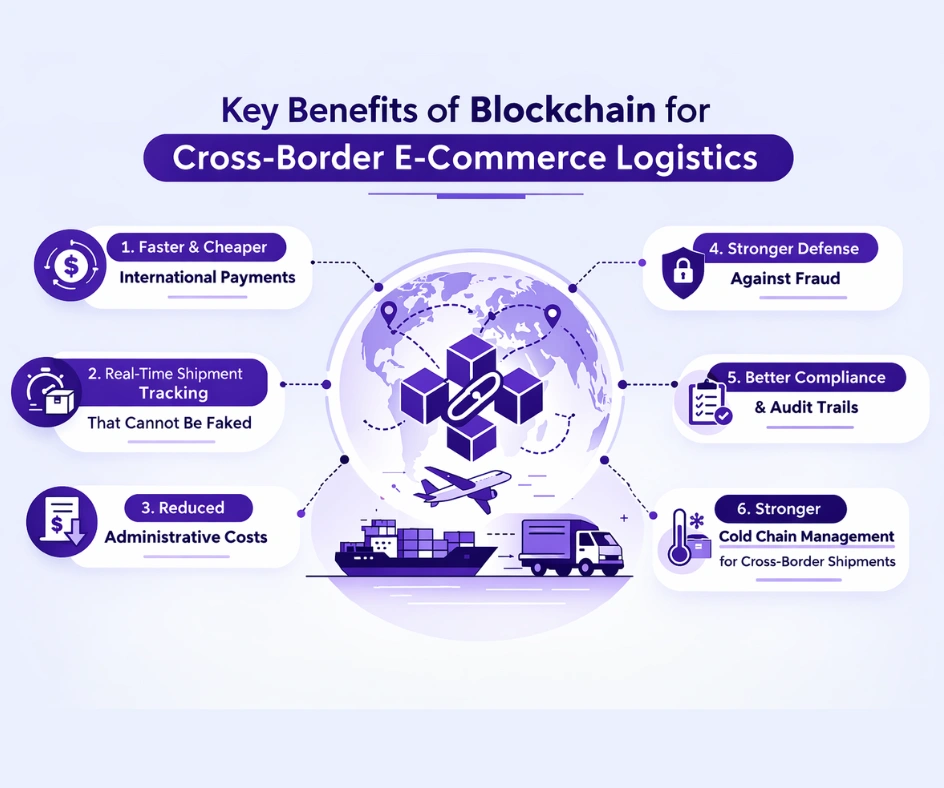
Cross-border payments through traditional banking routes are slow and expensive. A typical bank wire transfer for an international trade payment can take three to five business days and cost anywhere from 1 to 5 percent of the total amount. Blockchain payments, on the other hand, cost between 0.5 and 1 percent and can settle in minutes or even seconds. Studies estimate that using blockchain can cut transaction costs by 40 to 80 percent. For businesses that process thousands of international payments each month, that saving adds up to a very large number very quickly.
Traditional tracking systems rely on data that can be manually entered, delayed, or incorrect. Blockchain-based tracking records each event automatically and permanently. When combined with IoT sensors, it can update the record every time a shipment moves, changes temperature, or crosses a checkpoint. No party can alter the record after the fact. This creates a level of trust in shipment data that simply does not exist with conventional systems. Track and trace applications currently lead blockchain logistics adoption with a 30 percent market share, showing how much the industry values this particular benefit.
Research findings published on the impact of blockchain systems on international logistics transparency show that blockchain implementation can reduce administrative costs by 15 to 20 percent. When you consider that documentation and administration costs have historically accounted for up to 20 percent of total freight costs, the math becomes very persuasive. Automating document verification, customs submissions, and payment instructions through blockchain removes the need for large administrative teams to manually check, correct, and resubmit paperwork.
Cargo fraud is a serious and growing problem. Blockchain makes fraud significantly harder because every transaction in the supply chain is recorded permanently and is visible to all authorized parties. If someone tries to substitute counterfeit goods or alter a document, the blockchain record will show a break in the chain of custody. This does not just apply to physical goods. It also applies to digital documents like bills of lading. When a bill of lading is issued on a blockchain, it cannot be duplicated or altered, eliminating one of the most common forms of shipping fraud.
Regulatory compliance in international trade is complex and getting more so every year. Blockchain creates a permanent, time-stamped audit trail for every transaction. When a customs authority or regulatory body asks for documentation, a blockchain-based system can produce a complete, verified record instantly. This is far more convincing than a stack of PDFs that could theoretically have been altered. Transparency and compliance applications currently represent 22 percent of blockchain logistics adoption, showing how seriously companies are taking this particular use case.
Cold chain logistics, which involves keeping temperature-sensitive products like food, medicine, and chemicals within specific temperature ranges throughout their journey, is one of the hardest parts of cross-border logistics to manage. Blockchain combined with IoT temperature sensors creates a complete, verified record of the conditions experienced by a product from factory to final destination. If a product was exposed to unsafe temperatures at any point, the blockchain record shows exactly when and where this happened, who was responsible, and what action was taken. This is critical for cross-border e-commerce logistics in the food and pharmaceutical sectors.
The best way to understand the practical impact of blockchain in international logistics is to look at companies that have already deployed it at scale. These are not pilot projects with a dozen participants. These are real systems handling real trade volumes.
Walmart partnered with IBM to build a blockchain-based food tracking system using the IBM Food Trust platform, which runs on Hyperledger Fabric. The goal was to improve food safety by being able to trace the origin of any product on a Walmart shelf within seconds. Before blockchain, tracing the origin of a food item from the shelf back to its farm took an average of seven days. After blockchain, that same trace takes 2.2 seconds. Walmart can now trace the origin of over 25 products from five different suppliers using this system. The company also reported a 50 percent decrease in food waste as a result of improved inventory management linked to the blockchain data.
DHL partnered with Accenture to create a blockchain-based pharmaceutical tracking system with nodes spread across six different geographies. The system tracks medicines from the point of manufacture to the final consumer, ensuring that the product is genuine and has been stored correctly at every stage. This is one of the most important applications of blockchain for global supply chain management in the pharmaceutical industry, where counterfeit drugs are a major public health risk. DHL has also used blockchain on air freight between China and Germany, cutting customs processing time by up to 90 percent on those routes.
De Beers launched the Tracr platform, which uses blockchain to track diamonds from the mine to the final point of sale. The platform currently tracks 2.6 million rough diamonds and 400,000 polished stones, each given a unique digital identity on the blockchain. This digital identity records the diamond’s carat weight, cut, clarity, color, and origin country. Buyers anywhere in the world can verify that their diamond is genuine and was sourced ethically. This is a powerful example of blockchain in cross-border logistics applied to high-value goods where provenance and authenticity are critical.
Everledger developed a blockchain platform specifically for tracking diamonds and other high-value items from raw material source through to sales. By assigning each item a unique blockchain identity, Everledger helps insurers, customs agencies, and buyers verify that a product is genuine and has not been stolen or traded illegally. The platform demonstrates how blockchain in logistics can move beyond large container shipments to protect individual high-value items moving through complex international trade routes.
FedEx uses blockchain to collect data from shippers, recipients, and carriers to eliminate freight fraud and speed up the resolution of disputes. When a dispute arises about whether a package was delivered, damaged, or lost, the blockchain record provides a verifiable account of every step in the shipment’s journey. This makes it much faster to identify where a problem occurred and who was responsible, reducing the time and cost of dispute resolution for all parties involved.
One of the areas that competitor blogs almost never talk about in depth is what happens when you combine blockchain in logistics with AI route optimization in logistics. These two technologies serve very different functions, but when they work together, the results are genuinely impressive.
AI route optimization in logistics uses machine learning algorithms to calculate the fastest, cheapest, or most fuel-efficient route for a delivery. It factors in traffic conditions, weather, road closures, vehicle capacity, fuel prices, delivery time windows, and dozens of other variables simultaneously. UPS, for example, uses its ORION system to process 30,000 route optimizations per minute, saving 38 million liters of fuel every year. AI-driven route optimization has reduced delivery times by up to 20 percent in real-world applications across multiple logistics companies.
Here is where blockchain adds a critical layer. AI route optimization is only as good as the data it works with. If the location data, delivery status information, or shipment conditions fed into an AI system are inaccurate or delayed, the AI makes worse decisions. Blockchain ensures that the data AI systems receive is accurate, real-time, and verified. Every checkpoint a shipment passes through is recorded on the blockchain immediately, giving the AI route optimization system a precise, up-to-the-minute picture of where everything is.
When a blockchain ledger records that a container left Port A at 14:30 and arrived at customs checkpoint B at 18:45, that data is factually verified. No one can alter it. When an AI route optimization system uses this verified data to plan the next leg of the journey, it makes more accurate decisions than if it were working from manually entered or potentially outdated information. Over time, as more verified data accumulates on the blockchain, the AI becomes smarter and more precise in its predictions.
In a blockchain-plus-AI logistics setup, smart contracts can trigger automatic responses to route disruptions. For example, if a border crossing records a longer-than-normal queue time on the blockchain, a smart contract can signal the AI route optimization system to consider an alternative crossing point for shipments that have not yet departed. This kind of automatic, data-driven rerouting is only possible when shipment data is trustworthy and instantly available, which is exactly what blockchain provides.
For cross-border e-commerce logistics companies managing thousands of individual parcels moving across multiple borders each day, the combination of blockchain traceability and AI route optimization in logistics is particularly powerful. Blockchain keeps a verified record of every parcel’s location and customs status. AI uses that data to route the next batch of parcels through the fastest, most cost-effective path. The result is lower delivery costs, faster transit times, and fewer customs-related delays for customers who are often expecting their orders within a few days of purchase.
The growth numbers for blockchain in logistics are some of the highest in any technology segment. The global blockchain in logistics market was at USD 7.91 billion in 2025 and is expected to climb to USD 2,730.54 billion by 2034 at a CAGR of 91.44%. The blockchain supply chain market is expected to grow at a 90.2 percent CAGR from 2024 to 2030 to reach USD 192.93 billion. These are not small numbers. They point to a technology that is moving from early adoption to mainstream use very quickly.
Governments and international trade bodies are increasingly recognizing blockchain-based documents as legally valid. The World Trade Organization has highlighted that going entirely digital in trade documentation could save up to 15 percent of the cost of international maritime transport. Singapore’s port has already cut processing times by 30 percent through digital trade document adoption. As more countries accept digital blockchain-based records, paper-heavy cross-border logistics processes will continue to shrink, bringing down costs and speeding up trade for everyone.
The integration of blockchain with IoT sensors for cold chain management is moving from a niche use to a standard practice in pharmaceuticals and food logistics. As regulatory requirements for temperature-verified shipping tighten across major markets, companies that do not have blockchain-IoT cold chain systems in place will find it harder to meet compliance requirements for cross-border shipments. This is especially true for cross-border e-commerce logistics in the food and health product sectors.
Rather than every company running its own separate blockchain, the industry is moving toward shared consortium blockchains where multiple companies, ports, and regulatory agencies share a common ledger. This is already happening at major ports and trade corridors. When a whole industry corridor operates on the same blockchain, the benefits multiply. Every new participant adds more data, more verifications, and more trust to the shared record. The blockchain in logistics market data shows that consortium and hybrid models, while currently at 20 percent adoption, are growing fastest in terms of new deployments.
Central bank digital currencies (CBDCs) are digital versions of national currencies being developed by governments around the world. When CBDCs are linked to blockchain logistics systems, payment for an international shipment can be triggered automatically by a smart contract the moment delivery is confirmed on the ledger. This could fundamentally change how cross-border trade finance works, reducing the need for letters of credit, foreign exchange hedging, and slow bank transfers that currently add time and cost to every international transaction.
Blockchain in logistics is not without its difficulties. Any business considering adoption needs to understand these challenges honestly, not just the benefits.
Building a blockchain-based logistics platform requires significant investment in technology, staff training, and process redesign. Most AI and blockchain use cases require initial investments of USD 500,000 to USD 1 million per application. For smaller logistics companies and cross-border e-commerce operators, this is a serious barrier. The good news is that cloud-based blockchain platforms are reducing this cost by removing the need for companies to build and maintain their own infrastructure. Cloud-based platforms already command 58 percent of the digital logistics market.
A blockchain in cross-border logistics is only useful if all the parties involved in a shipment are using it. If a supplier, carrier, customs authority, or warehouse is not on the system, there will be gaps in the data. Getting dozens or hundreds of different organizations across multiple countries to adopt the same blockchain platform is a major coordination challenge. It requires industry agreements, regulatory support, and sometimes government mandates to achieve the kind of network participation that makes blockchain truly effective.
Many logistics companies still use software systems that were built ten or twenty years ago. Connecting these legacy systems to a modern blockchain platform is technically complex and can be very expensive. The systems were not designed to share data in real time with external networks, and adapting them requires significant custom development work. This is one of the main reasons why even large companies with the resources to invest in blockchain sometimes move slowly on adoption.
Cross-border logistics, by definition, involves multiple legal jurisdictions. What is legally acceptable as a digital document in one country may not be recognized in another. Regulations around data privacy, digital signatures, and smart contracts differ widely between nations. The absence of universal blockchain standards means that a system built to work in the EU may not be compatible with one used in Southeast Asia. Until international regulatory bodies develop common standards for blockchain in international logistics, this will remain a significant obstacle.
While blockchain makes data more visible and verifiable, not all supply chain data should be public. Commercial pricing information, supplier relationships, and proprietary product details are things companies want to protect. Public blockchains are unsuitable for this reason in many business contexts. Private and consortium blockchains solve part of this problem by restricting who can see what, but designing the right permissions structure requires careful planning and ongoing management.
Build Your Blockchain Logistics Platform Today:
We bring years of blockchain expertise to cross-border logistics development. Our team handles everything from smart contract automation and supply chain traceability to IoT integration and customs compliance systems, making sure your platform is built for speed, transparency, and international trade at scale. Whether you need a full cross-border logistics blockchain solution or a focused freight tracking system, we deliver results that work in the real world.
Start Your Blockchain Logistics Project
Blockchain in logistics is solving problems that have troubled cross-border trade for decades. From the mountains of paper that slow customs clearance to the payment disputes that cost businesses thousands of dollars per incident, blockchain is providing a practical, proven answer. The numbers back this up clearly. Customs clearance times are down by 27 percent. Administrative costs reduced by 15 to 20 percent. Payment transaction fees cut from 3 percent to under 1 percent. Food traceability from seven days to 2.2 seconds. These are not projected outcomes. These are results that companies like Walmart, DHL, De Beers, and FedEx have already achieved.
Cross-border logistics is under more pressure than ever before. The global cross-border e-commerce market hit USD 1.14 trillion in 2024, and it is growing. Customers want faster delivery, more transparency about where their products come from, and stronger guarantees against fraud. Traditional logistics infrastructure was simply not built to handle this volume at this speed with this level of accountability. Blockchain in cross-border logistics fills that gap in a way that no other technology currently does.
When you add AI route optimization in logistics to the picture, the potential grows further. AI makes routing decisions faster and more precisely. Blockchain makes sure the data AI works with is accurate and unalterable. Together, they create a logistics system that is smarter, more honest, and more efficient than anything built on paper-based processes could ever be.
The blockchain in the logistics market is growing at a CAGR of 91.44 percent is not a coincidence. It is a reflection of the fact that companies around the world, across industries from food to pharmaceuticals to luxury goods to automotive, are discovering that blockchain in international logistics is not just a nice-to-have technology. It is becoming a core part of how international trade operates. The companies that adopt it now will have a measurable advantage over those that wait.
Frequently Asked Questions
Q1.What is blockchain in logistics, and how does it work in cross-border shipping?
Blockchain in logistics is a shared digital record system where every event in a shipment’s journey is recorded permanently and cannot be altered. In cross-border shipping, it means that every time a product changes hands, from manufacturer to freight agent to customs to warehouse to buyer, that event is logged on a shared ledger visible to all authorized parties. This creates a complete, verified history of the shipment that all participants can trust without relying on any single company to manage the records.
Q2.How does blockchain help with customs clearance in cross-border logistics?
Blockchain helps customs clearance by making all required documents, such as the bill of lading, certificate of origin, and customs declaration, available to customs authorities instantly and in a form that has already been verified. Customs officials no longer have to wait for documents to arrive by email or fax and then manually verify them. Research published in early 2025 found that blockchain usage reduced customs clearance time by 27 percent. DHL achieved up to a 90 percent reduction in customs processing time on China-to-Germany air freight using blockchain.
Q3.What is the difference between public, private, and consortium blockchains in logistics?
A public blockchain is open for anyone to view and participate in, which is good for maximum transparency but not suitable for sensitive commercial data. A private blockchain is controlled by one company, which gives more control over access but limits the network effect. A consortium blockchain is shared and governed by a group of organizations, such as a group of shipping lines or port authorities, and is currently considered the best model for most cross-border logistics applications because it balances transparency with controlled data access.
Q4.How do smart contracts work in cross-border logistics payments?
Smart contracts are programs stored on the blockchain that execute automatically when predefined conditions are met. In cross-border logistics, a smart contract can be set up to release payment to a supplier automatically the moment the blockchain records that a shipment has been delivered and accepted. This removes the need for invoices, manual approvals, and payment follow-ups. It also dramatically reduces payment disputes because the contract runs on verified data, not on claims made by either party.
Q5.Can small and medium-sized businesses benefit from blockchain in cross-border logistics?
Yes, and increasingly so as cloud-based blockchain platforms lower the entry cost. Smaller businesses do not need to build their own blockchain infrastructure. They can subscribe to platforms like IBM Food Trust or similar services that already have the network and technology in place. The main challenge for smaller businesses is ensuring that their trading partners, carriers, and customs authorities are also on compatible systems. As industry-wide adoption grows, the network effect makes it easier and cheaper for companies of all sizes to participate.
Q6.What are the biggest challenges in implementing blockchain for international logistics?
The biggest challenges are the high upfront cost of building or integrating blockchain systems, the difficulty of getting all supply chain participants to adopt the same platform, integration with older legacy software that was not designed for real-time data sharing, differences in legal and regulatory requirements between countries, and concerns about keeping sensitive commercial data private on a shared ledger. Businesses that plan carefully, start with a specific use case rather than trying to transform everything at once, and choose a reputable technology partner are most likely to overcome these obstacles successfully.
Explore Services
Related Services
Reviewed by

Aman Vaths
Founder of Nadcab Labs
Aman Vaths is the Founder & CTO of Nadcab Labs, a global digital engineering company delivering enterprise-grade solutions across AI, Web3, Blockchain, Big Data, Cloud, Cybersecurity, and Modern Application Development. With deep technical leadership and product innovation experience, Aman has positioned Nadcab Labs as one of the most advanced engineering companies driving the next era of intelligent, secure, and scalable software systems. Under his leadership, Nadcab Labs has built 2,000+ global projects across sectors including fintech, banking, healthcare, real estate, logistics, gaming, manufacturing, and next-generation DePIN networks. Aman’s strength lies in architecting high-performance systems, end-to-end platform engineering, and designing enterprise solutions that operate at global scale.