Ai Overview
At its core, AI route optimization means using artificial intelligence to determine the most efficient path for a delivery vehicle or a fleet of vehicles. UPS noted that a single driver’s daily route can have over 200,000 possible sequences. UPS’s ORION system reduces CO2 emissions by 100,000 metric tons annually, which is equivalent to removing over 21,000 cars from the road.
Key Takeaways
- The global route optimization software market was valued at USD 7.93 billion in 2024 and is expected to grow to USD 25.75 billion by 2033, growing at a CAGR of 13.98%.[1]
- The global AI in logistics and supply chain market was valued at USD 20.1 billion in 2024 and is projected to grow at a CAGR of 25.9% between 2025 and 2034.
- UPS’s ORION system cuts 100 million miles from delivery routes each year, saves 10 million gallons of fuel annually, and reduces CO2 emissions by 100,000 metric tons per year.[2]
- Companies using AI route optimization report a 15 to 25 percent reduction in transportation costs and 10 to 20 percent fuel savings compared to manual planning.[3]
- Machine learning holds the largest share in AI in logistics technology, capturing 47 percent of the market share in 2024, growing at a CAGR of over 24% from 2025 to 2034.
- An Australian study found that council trucks switching to AI route optimization reduced fuel consumption by 62 percent on predictable daily routes and 11 percent on unpredictable routes within one month.[4]
- Over 65 percent of companies were expected to implement AI in at least one part of their logistics operations by 2024, as reported by DHL.
Logistics has always been about moving things from one place to another as efficiently as possible. But if you have ever managed a fleet of delivery vehicles or worked in a warehouse operations team, you know that getting from Point A to Point B is never as simple as drawing a straight line on a map. Traffic jams, road closures, driver schedules, vehicle load limits, changing weather, and last-minute order updates can turn even the most carefully planned route into a mess within minutes.
This is where AI route optimization steps in. It is not just another software tool. It is a complete shift in how logistics companies think about planning, dispatching, and managing deliveries. Often built as part of broader logistics software development solutions, AI route optimization in logistics uses data, machine learning algorithms, and real-time inputs to figure out the best possible route for every vehicle, every day, under any condition, instead of relying on experience-based decisions or basic GPS directions.
In this blog, we will walk through everything you need to know about AI route optimization, including how it works, what makes it better than traditional methods, which industries are using it, what the data says about its impact, and what to look for in AI route optimization software. Whether you are a logistics manager, a fleet owner, or someone exploring AI in logistics, this guide covers it all.
Logistics & Transportation Digital Solutions: Automation & Cost Reduction
What Is AI Route Optimization and Why Does It Matter?
At its core, AI route optimization means using artificial intelligence to determine the most efficient path for a delivery vehicle or a fleet of vehicles. The word “efficient” here does not just mean the shortest distance. It means factoring in dozens of variables at the same time: traffic patterns, delivery time windows, vehicle capacity, driver hours, fuel type, road restrictions, weather, and more.
Traditional route planning tools either use static maps or simple distance-based calculations. A dispatcher might spend an hour manually building routes in a spreadsheet, and by the time drivers leave the warehouse, those routes may already be outdated because of a traffic incident on the highway.
AI route optimization works differently. It uses machine learning algorithms that learn from historical delivery data, customer behavior, and traffic trends. It also connects with live data feeds to adjust routes as conditions change throughout the day. The result is a system that keeps getting smarter the more it is used.
The numbers behind this growth tell a clear story. The global route optimization software market was valued at USD 7.93 billion in 2024 and is expected to climb to USD 25.75 billion by 2033, growing at a CAGR of 13.98%. Meanwhile, the broader AI in logistics and supply chain market was valued at USD 20.1 billion in 2024 and is projected to grow at a CAGR of 25.9% through 2034.
These are not just market statistics. They point to a real shift happening on the ground: logistics companies of all sizes are replacing manual processes with AI-powered route planning because the financial and operational benefits are too significant to ignore.
Where Traditional Route Planning Falls Short
Before understanding what AI does differently, it helps to look at where older methods break down. Many logistics companies, even today, rely on a combination of driver experience, basic GPS apps, and manual scheduling. This approach worked reasonably well when delivery volumes were lower and customer expectations were more flexible.
But the logistics world has changed fast. E-commerce has pushed delivery volumes through the roof. Customers now expect same-day or next-day delivery as standard. Urban areas are more congested than ever. And fuel prices swing unpredictably. Against this backdrop, traditional route planning reveals several weak points.
1. It cannot Handle Too Many Variables at once.
Human planners are good at building routes based on a few key factors, but when you have 50 delivery stops, five different vehicle types, multiple time windows, and live traffic to consider all at once, the complexity grows exponentially. Manual planning simply cannot process all of these at the same time. The result is routes that look reasonable on paper but cost more to run in practice.
2. It Reacts Slowly to Disruptions
When a road is closed due to an accident, a traditional route plan is essentially broken. A dispatcher has to call the driver, figure out an alternative, and relay instructions while the driver is already on the road. This wastes time and often leads to missed delivery windows. Dynamic route optimization powered by AI can detect the disruption instantly and push an updated route directly to the driver’s device without any manual intervention.
3. Static Data Goes Stale Quickly
Route planning tools built on static maps and fixed datasets do not account for how traffic patterns change by day of the week, time of day, season, or local events. A route that works well on a Tuesday morning might be completely impractical on a Friday afternoon because of different school zones, market days, or shift changes at nearby factories.
4. It Gets Worse as Volume Grows
Scaling a manual route planning process is painful. Adding more drivers and more stops does not just add work linearly. It multiplies the complexity. Companies often solve this by hiring more dispatchers, which adds cost and introduces more chances for human error. AI route optimization software scales without proportional increases in staff or planning time.
5. No Learning Happens Over Time
A dispatcher who has worked a route for two years builds up useful knowledge: which customers are usually not home in the morning, which road has roadworks every winter, and which drop-off point takes longer than expected. But when that dispatcher leaves, that knowledge leaves too. AI systems capture this kind of pattern automatically and build it into their routing logic permanently.
How AI Route Optimization Actually Works
Understanding the mechanics behind AI-powered route planning helps explain why it performs so much better than older approaches. There are several stages involved, and they work together as a continuous loop rather than a one-time calculation.
1. Data Collection and Integration
AI route optimization systems pull in data from multiple sources simultaneously. This includes GPS data from vehicles, real-time traffic information, historical delivery records, weather forecasts, order management systems, and telematics from vehicle sensors. Some platforms also use IoT devices fitted to trucks to monitor vehicle performance and load weight in real time.
The quality of this data collection stage is what separates strong AI routing platforms from weaker ones. More data sources mean the system can make more accurate predictions and handle more edge cases without human input.
2. Machine Learning Models Identify Patterns
Once data is flowing in, machine learning algorithms begin analyzing it to find patterns. These models can predict how long a specific delivery stop will take based on hundreds of past visits. They can learn that traffic on a particular stretch of highway builds up around 5 pm on weekdays. They can identify that certain customers almost always need extra time at the door and factor that into estimated arrival times.
This is where route planning in logistics gets genuinely intelligent rather than just automated. The system is not just following rules someone wrote into it. It is learning from experience and continuously updating its predictions.
3. Route Calculation Using Optimization Algorithms
With all this data, the AI solves what is known as the Vehicle Routing Problem (VRP), a mathematical challenge that involves assigning deliveries to vehicles and sequencing stops to minimize cost, distance, or time while meeting all constraints. This is computationally very complex. UPS noted that a single driver’s daily route can have over 200,000 possible sequences. Finding the best one manually is essentially impossible.
AI route optimization software handles this using advanced algorithms, including genetic algorithms, reinforcement learning, and neural networks. These methods allow the system to explore a huge number of possible routes very quickly and identify the best option.
4. Dynamic Rerouting Throughout the Day
This is where dynamic route optimization and real-time routing come into play. Once drivers are on the road, conditions keep changing. An AI routing system monitors these changes continuously and automatically generates updated routes when needed. If a new delivery order comes in, the system can slot it into the most efficient position in an existing driver’s route without disrupting the other stops. If traffic builds up on a planned road, the system reroutes before the driver reaches that point.
This ability to operate in real time is one of the biggest differences between AI routing and older software, which generates a plan once at the start of the day and then leaves drivers to handle problems on their own.
5. Continuous Improvement Over Time
After every delivery cycle, AI systems analyze what happened: which routes were faster than predicted, which stops took longer, and how fuel consumption compared to estimates. This feedback loop means the system’s predictions become more accurate over time. The longer a company uses an AI route optimization platform, the better it performs for that company’s specific routes, customers and vehicle types.
AI Route Optimization vs Traditional Route Planning: A Direct Comparison
| Factor | Traditional Route Planning | AI Route Optimization |
|---|---|---|
| Planning Speed | Hours of manual work by dispatchers | Minutes, fully automated |
| Variables Considered | Limited (distance, basic road data) | Dozens simultaneously (traffic, weather, load, time windows, vehicle type, driver hours) |
| Response to Disruptions | Requires a manual dispatcher call and re-planning | Automatic real-time rerouting pushed to the driver’s device |
| Learning Over Time | Dependent on individual dispatcher experience, lost when staff leave | Built into the system permanently, improves with every delivery cycle |
| Fuel Efficiency | Often suboptimal, up to 25% fuel budget wasted | 10 to 20% fuel savings reported by companies using AI routing |
| Scalability | Requires hiring more dispatchers as volume grows | Handles volume growth without proportional staffing increase |
| ETA Accuracy | Estimated manually, often imprecise | Predicted dynamically with real-time data for higher accuracy |
The Real Business Benefits of AI Route Optimization in Logistics
When logistics companies move from traditional planning to AI route optimization in logistics, the results show up quickly across multiple parts of the business. Here is a detailed look at what the research and real-world results actually show.
1. Lower Fuel Costs and Reduced Mileage
Fuel is one of the biggest operating expenses for any logistics company. In 2024, fuel expenses accounted for 28 percent of trucking operating budgets. A logistics software development company can help businesses implement AI-powered routing solutions that directly reduce these costs by finding shorter, faster paths and eliminating unnecessary mileage.
According to research, companies implementing AI route optimization report fuel savings of 10 to 20 percent compared to manual planning. McKinsey research indicates that improved routing can cut mileage by up to 20 percent. For a company running 100 vehicles, even a 10 percent fuel reduction translates to very significant annual savings.
An Australian study published in Science Direct put this into practical numbers: council trucks that switched to optimized route planning reduced fuel consumption by 62 percent on predictable routes and 11 percent on variable routes within just one month.
2. Transportation Costs Come Down Significantly
Fuel savings are just one part of the cost picture. AI route optimization also reduces vehicle wear and tear, lowers maintenance frequency, decreases labor costs from unnecessary overtime, and cuts the administrative overhead associated with manual dispatching. Altogether, companies using AI routing report a 15 to 25 percent reduction in total transportation costs.
3. More Deliveries Completed in Less Time
When routes are tightly optimized, drivers spend less time driving and more time delivering. This means each vehicle can handle more stops per shift without adding hours. Companies using AI routing report delivery time improvements of 25 to 30 percent compared to manual planning, allowing them to process higher order volumes without adding vehicles or drivers.
4. Customer Satisfaction Improves Through Better ETAs
One of the things customers care most about is knowing exactly when their delivery will arrive. AI routing systems provide highly accurate estimated arrival times and update them throughout the day as conditions change. When customers receive precise delivery windows and get notified if anything changes, satisfaction scores go up. Failed first delivery attempts drop, which saves money on re-delivery costs and keeps customers happier.
5. Carbon Emissions Drop in Line With Sustainability Goals
With fewer miles driven and better fuel efficiency, AI route optimization directly reduces a logistics company’s carbon footprint. UPS’s ORION system reduces CO2 emissions by 100,000 metric tons annually, which is equivalent to removing over 21,000 cars from the road. For companies trying to meet ESG targets or green logistics certifications, AI routing is one of the most impactful tools available.
6. Drivers Have Better, Less Stressful Work Days
Drivers who follow AI-optimized routes spend less time stuck in traffic, take fewer wrong turns, and deal with fewer last-minute changes. This reduces driver fatigue and stress, which in turn improves safety and reduces the likelihood of accidents. Better working conditions also help with driver retention, which is a significant challenge across the logistics industry. For teams evaluating their options, top logistics routing software typically combines these operational benefits — fuel savings, ETA accuracy, and dynamic rerouting into a single platform built for daily delivery workflows.
AI Demand Forecasting in Supply Chain
The UPS ORION Case Study: What AI Can Do at Scale
No discussion of AI route optimization in logistics is complete without looking at UPS’s ORION system. It stands as one of the most studied and most successful examples of artificial intelligence in transportation anywhere in the world.
UPS faced a challenge that most logistics companies can relate to, just on a much bigger scale. With over 125,000 delivery vehicles covering millions of miles daily, even small inefficiencies in route planning were costing hundreds of millions of dollars every year. Traditional planning tools and driver knowledge could not keep pace with the growing complexity of urban delivery networks.
The company began developing ORION, which stands for On-Road Integrated Optimization and Navigation, in 2003. It took over a decade to build and refine before full deployment in 2016. The system analyzes over 200,000 possible routing options for each driver daily, factoring in package details, traffic patterns, delivery time windows, and even turn direction (the system famously limits left turns, which waste time and fuel at traffic lights).
The results have been transformative. ORION cuts 100 million miles from delivery routes each year, saves 10 million gallons of fuel annually, and reduces CO2 emissions by 100,000 metric tons per year. Financially, UPS achieves an annual cost avoidance of USD 300 to USD 400 million because of ORION’s efficiency gains. Every single mile removed from every driver’s route saves UPS approximately USD 50 million per year across the full fleet.[5]
The 2024 upgrade, called Dynamic ORION, took things even further by enabling real-time route updates throughout the delivery day rather than just planning routes in the morning. This upgrade reduced driver routes by an additional two to four miles per driver on top of the original eight-mile per driver reduction from the first version.
The ORION story is important because it shows what happens when a company commits to AI routing over the long term. The benefits compound as the system learns, the technology improves, and the organization builds processes around data-driven decision making.
Industries Using AI Route Optimization and How They Benefit
AI route optimization is not limited to parcel delivery giants. It is being applied across many different industries, each with its own specific routing challenges.
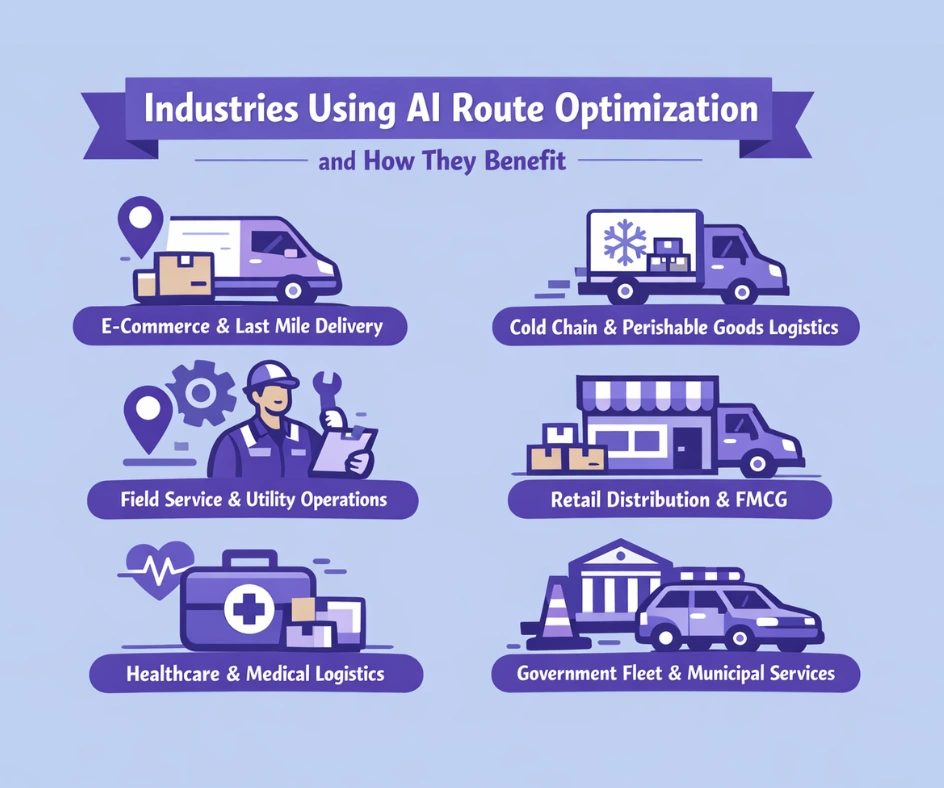
1. E-Commerce and Last Mile Delivery
This is where AI routing has had its most visible impact. E-commerce companies handle enormous delivery volumes with tight time windows and customers who expect precise delivery notifications. AI route optimization software allows these companies to plan hundreds or thousands of daily deliveries in minutes, dynamically add new orders to driver routes during the day, and send accurate ETA updates to customers. During peak periods like holiday seasons, AI routing allows companies to handle volume spikes without proportional increases in fleet size or staff.
2. Cold Chain and Perishable Goods Logistics
Delivering fresh food, pharmaceuticals, or temperature-sensitive products adds another layer of urgency to route planning. Every extra minute in transit increases spoilage risk. AI routing in cold chain logistics considers delivery time windows as a hard constraint and automatically prioritizes stops where goods will deteriorate fastest. It also monitors traffic and road conditions in real time to reroute drivers before delays can compromise product quality.
3. Field Service and Utility Operations
Utility companies, telecom engineers, and maintenance teams face a different kind of routing problem. They have multiple technicians covering different service zones, and jobs can vary significantly in the time they take. AI routing systems in field service operations allocate jobs efficiently based on technician skill level, location, and current workload. This means more jobs completed per day, faster response times for customers, and lower travel costs across the team.
4. Retail Distribution and FMCG
Large retailers and fast-moving consumer goods companies run complex distribution networks where goods move from central warehouses to regional hubs and then to hundreds of individual stores. AI route optimization handles the full supply chain routing picture, including middle-mile transport between hubs and last-mile delivery to stores. It can manage mixed delivery types (full truckloads and part loads) and ensure that vehicle capacity is used as efficiently as possible on every run.
5. Healthcare and Medical Logistics
Medical supply chains require precise timing. Blood products, organs for transplant, medicines with strict temperature requirements, and urgent medical equipment all need to arrive exactly when they are needed. AI routing in healthcare logistics accounts for the criticality of each delivery and ensures that time-sensitive items are always prioritized in the routing logic.
6. Government Fleet Operations and Municipal Services
AI routing is also making its way into the public sector. In the United Kingdom, advanced route optimization in municipal waste management systems has cut fuel costs by up to 20 percent. In the United States, 72 percent of government fleet managers now use GPS-enabled route optimization to improve resource allocation and service efficiency.
Key Features to Look for in AI Route Optimization Software
| Feature | What It Does | Why It Matters for Logistics |
|---|---|---|
| Real-Time Traffic Integration | Pulls live traffic data and updates routes accordingly | Prevents drivers from entering congestion zones before delays happen |
| Multi-Stop Optimization | Sequences dozens or hundreds of stops into the most efficient order | Eliminates backtracking and reduces total miles driven per route |
| Delivery Time Window Management | Builds customer-requested delivery windows into the routing logic | Reduces failed delivery attempts and improves customer satisfaction |
| Vehicle Capacity Matching | Assigns loads based on vehicle weight limits, volume, and type | Maximizes vehicle utilization and avoids unnecessary extra runs |
| Driver App Integration | Pushes updated routes directly to driver mobile devices | Ensures drivers always have the latest route without dispatcher calls |
| Predictive Analytics | Forecasts delivery times based on historical data and conditions | Improves ETA accuracy and helps plan fleet capacity ahead of time |
| EV-Specific Routing | Plans routes around charging station locations and battery range | Essential for fleets transitioning to electric vehicles |
| API Integrations | Connects with warehouse management, order management, and TMS systems | Creates end-to-end visibility across the full logistics operation |
The Role of Machine Learning Algorithms in Route Optimization
Machine learning is the engine inside every AI route optimization platform. Understanding what it does helps explain why these systems can make decisions that human planners simply cannot match.
1. Supervised Learning for Predicting Delivery Times
Supervised learning models are trained on historical delivery data. They learn to predict how long each stop will take based on factors like time of day, customer type, delivery size, and past performance at that specific address. Over thousands of deliveries, these predictions become very accurate, and the routing system can build schedules that reflect reality rather than theoretical ideal conditions.
2. Reinforcement Learning for Dynamic Decision Making
Reinforcement learning is a type of machine learning where a system learns by trying different options and receiving feedback on what worked and what did not. In the context of AI route optimization, reinforcement learning models can test different routing strategies over time and gradually learn which approaches produce the best outcomes in terms of speed, cost, and customer satisfaction.
3. Neural Networks for Pattern Recognition
Neural networks excel at recognizing patterns in large, complex datasets. In logistics routing, they can identify patterns in traffic data that a human analyst would never spot, such as how traffic in a specific area changes based on a combination of weather conditions, day of week, and time of year. These patterns feed into more accurate route predictions.
4. Graph Neural Networks for Network Optimization
A university trial published in early 2025 tested a hybrid model combining generative adversarial networks, Transformers, and graph neural networks on live delivery data. The results showed trip distances reduced by 15 percent, routing times cut by 20 percent and energy consumption down by 10 percent. This points to the direction AI route optimization is heading: increasingly sophisticated combinations of machine learning methods working together.
Real-Time Data: The Backbone of Modern AI Route Optimization
If machine learning is the engine, then real-time data is the fuel that keeps it running. The ability to act on live information as conditions change is what separates AI-powered route planning from older optimization methods.
1. Live Traffic Data Feeds
Modern AI routing platforms connect to traffic data providers that track road conditions, accidents, roadworks, and congestion levels in real time. When the system detects that a planned route will encounter a delay, it calculates an alternative path and updates the driver’s route instantly. This happens continuously throughout the delivery day, not just at the start of the shift.
2. IoT and Telematics Data
IoT sensors fitted to delivery vehicles send live data on vehicle speed, fuel consumption, engine status, and cargo temperature. For logistics teams managing hourly drivers, a GPS time clock can add another useful layer of real-time data by confirming when drivers clock in, clock out, or reach job sites during delivery routes. AI routing systems use this data to monitor driver behavior, detect maintenance needs before they become breakdowns, and optimize delivery sequences based on current vehicle load weight. For electric fleets, IoT data also tracks battery levels and factors charging needs into route planning.
3. Weather Data Integration
Severe weather can completely disrupt delivery operations. AI routing platforms that integrate weather data can anticipate these disruptions and adjust routes before drivers even leave the depot. In winter, this might mean routing around roads prone to ice or flooding. In summer, it could mean scheduling deliveries in high-temperature areas earlier in the day to protect temperature-sensitive goods.
4. Order Management System Feeds
When new orders come in throughout the day, AI routing systems can automatically assess where they fit within existing driver routes. Rather than requiring a dispatcher to manually assign and communicate new stops, the system evaluates every active driver’s current route and position, then slots the new delivery into the most efficient location. This is how large e-commerce platforms manage to handle same-day delivery orders that come in just hours before the driver needs to arrive.
AI Recommendation Engines in OTT Platforms
How to Implement AI Route Optimization: A Practical Roadmap
Many logistics companies understand the benefits of AI route optimization but are unsure where to start. Implementation does not have to be a complete overnight overhaul. A phased approach tends to work best.
1. Audit Your Current Routing Process
Before choosing any software, map out exactly how route planning works today. Where are the bottlenecks? How long does planning take each morning? How often do routes need to be changed during the day? What percentage of deliveries miss their time windows? These baseline numbers will tell you where AI routing can have the biggest impact and will help you measure results after implementation.
2. Assess Your Data Infrastructure
AI routing systems need clean, accessible data to work well. Check whether your vehicle GPS systems are reliable, whether your customer addresses are accurate and geocoded, and whether your order management system can feed data to an external routing platform via API. Gaps in data quality will limit what the AI system can achieve.
3. Start With a Pilot
Rather than rolling out AI routing across your entire fleet at once, pick one geographic region or one vehicle type and run a controlled pilot. Compare the AI-generated routes against your current approach on the same set of deliveries. Measure fuel consumption, delivery completion rates, time per stop, and driver feedback. A pilot that runs for four to six weeks gives you solid evidence to support a wider rollout and helps you identify integration issues early.
4. Train Your Team
One of the lessons from UPS’s ORION deployment was that technology alone does not deliver results. Drivers and dispatchers need to understand how the system works and trust its recommendations. UPS had to rebuild its training programs entirely around the idea that following the algorithm was more efficient than relying on personal experience. This cultural shift took time but was essential to capturing the full value of the technology.
5. Integrate With Existing Systems
AI route optimization software delivers the most value when it is connected to your warehouse management system, order management platform, customer notification tools and vehicle tracking dashboard. Look for platforms that offer pre-built integrations or APIs that fit cleanly into your existing technology stack.
6. Monitor, Measure, and Keep Improving
Once the system is live, track key performance indicators weekly: fuel costs, delivery success rates, average miles per delivery, driver hours, and customer satisfaction scores. Share this data with your team regularly. AI routing platforms improve over time as they process more of your specific delivery data, so the results in month six will be better than in month one.
Where AI Route Optimization Is Heading: Trends Shaping the Future
The logistics route optimization software market is evolving rapidly. Several developments are already reshaping what these systems can do.
1. Generative AI for Logistics Planning
Generative AI is beginning to move beyond language applications into operational logistics. In June 2025, Amazon announced an initiative to upgrade its delivery network using AI-powered mapping and routing tools built in-house. The platform combines granular geospatial maps, live traffic data, weather, and fuel prices to reroute drivers while they are already on the road. This represents a significant step toward fully autonomous logistics routing.
2. Electric Vehicle Route Optimization
As logistics fleets shift toward electric vehicles, route optimization becomes more complex. EVs have range constraints that petrol vehicles do not, and routes need to factor in charging station locations, charging times, and how load weight affects battery consumption. AI routing platforms are building EV-specific logic into their algorithms, making them essential tools for the transition to electric fleets.
3. Autonomous Delivery and Drones
China’s Ministry of Transport announced in early 2025 the development of standards for AI integration in low-altitude logistics, including drone deliveries. Approximately 2.7 million parcels were delivered by drones across the country in 2024. As autonomous delivery vehicles and drones become more common, AI route optimization will need to coordinate fleets that include multiple vehicle types operating across ground and air simultaneously.
4. Multimodal Transport Optimization
AI routing is expanding beyond road delivery to cover the full logistics network, including rail, sea, and air freight connections. Future platforms will optimize across all transport modes simultaneously, choosing the most cost-effective combination for each shipment based on time constraints, cost targets, and environmental impact.
5. Sustainability as a Core Routing Variable
With new carbon regulations tightening across major markets in 2024 and 2025, logistics companies are under pressure to reduce emissions actively rather than just report on them. AI routing platforms are building carbon emission calculations directly into their optimization logic, allowing companies to choose between routes that minimize cost, minimize time, or minimize emissions depending on their priorities for each delivery.
Build Your AI Route Optimization Solution:
We bring deep expertise in AI and logistics technology to help companies build custom route optimization platforms and logistics intelligence systems. Our team handles everything from machine learning model development to real-time data integration, fleet management APIs, and driver app connectivity. Whether you need a last-mile delivery optimizer, a dynamic fleet routing system, or a full logistics automation platform, we build solutions that work in the real world.
Final Thoughts
AI route optimization in logistics has moved well beyond being an experimental technology. It is now a proven operational tool that companies of all sizes are using to cut costs, speed up deliveries, and reduce environmental impact. The data from real deployments, from UPS saving 100 million miles a year to small fleets cutting fuel bills by 20 percent, shows clearly that the technology delivers on its promises when implemented well.
What makes AI routing genuinely different from older planning tools is not just that it is faster or more automated. It is that it learns, adapts, and keeps improving. Traditional route planning treats every day as a fresh problem to solve. AI route optimization treats every day as an opportunity to get better than yesterday.
The market growth numbers back this up. With the route optimization software market heading toward USD 25 billion by 2033 and the broader AI in logistics market growing at nearly 26 percent CAGR through the next decade, investment in this technology is only going to accelerate. Companies that adopt AI-powered route planning now will build a knowledge and efficiency advantage that becomes harder for late movers to close over time.
For logistics teams weighing the decision, the starting point does not need to be a full company-wide transformation. A well-designed pilot on a single region or fleet type is enough to see real results in a matter of weeks. The technology exists, the evidence is clear, and the tools are more accessible than ever. The question is no longer whether AI route optimization works. It is how quickly your organization will start using it.
Frequently Asked Questions
Q1.What exactly is AI route optimization and how is it different from basic GPS navigation?
Basic GPS navigation finds a path between two points using current map data. AI route optimization goes much further. It plans multi-stop delivery routes for entire fleets simultaneously, considers dozens of variables at once (vehicle load, time windows, driver hours, fuel type, historical traffic patterns), learns from past delivery data to improve predictions over time, and dynamically updates routes throughout the delivery day as conditions change. GPS navigation helps a single driver get somewhere. AI routing helps a company run its entire delivery operation more efficiently.
Q2.How much can a company actually save by switching to AI route optimization?
Research across companies using AI route optimization shows transportation cost reductions of 15 to 25 percent and fuel savings of 10 to 20 percent compared to manual planning. The UPS ORION case is the most well-documented example: the system saves USD 300 to USD 400 million annually and cuts 100 million delivery miles per year. For smaller fleets, savings will be proportionally smaller but remain very significant relative to operating costs. A fleet of 50 vehicles spending USD 500,000 a year on fuel could realistically save USD 50,000 to USD 100,000 in fuel costs alone.
Q3.Does AI route optimization software work for small and medium logistics businesses or only large enterprises?
It works for businesses of all sizes, though the implementation approach differs. Large enterprises often build custom systems or heavily configure enterprise platforms. Small and medium businesses benefit most from cloud-based AI routing software that offers flexible pricing models and does not require a large upfront investment. The route optimization software market is seeing its fastest growth in the SME segment, with a projected CAGR of 14.9 percent from 2025 to 2032 as more affordable options become available.
Q4.What data does an AI route optimization system need to function properly?
The core data requirements include accurate customer delivery addresses, vehicle details (capacity, type, fuel type), driver schedules and working hours, delivery time window requirements, and GPS tracking from vehicles. More advanced systems also use real-time traffic feeds, weather data, historical delivery performance data, IoT sensor data from vehicles, and live order management system feeds. The quality and completeness of this data directly affect how well the AI system performs.
Q5.How long does it take to see results after implementing AI route optimization?
Most companies see measurable improvements within the first few weeks of using AI route optimization software. Early gains often come from route consolidation and mileage reduction. Greater improvements in prediction accuracy and dynamic rerouting build up over several months as the system learns from your specific delivery patterns. Companies that commit to using the system consistently and integrating it with other operational data sources see the best long-term results.
Q6.Can AI route optimization handle electric vehicles differently from standard petrol or diesel fleets?
Yes, and this is an increasingly important feature as fleets shift toward electric vehicles. AI routing platforms with EV support factor in battery range, charging station locations, current battery level and how vehicle load affects energy consumption when building routes. Some systems can even optimize the delivery sequence to reduce the vehicle’s weight load earlier in the route, which extends battery range. For mixed fleets with both electric and petrol vehicles, AI routing assigns the right vehicle type to each route based on the specific requirements of that delivery run.
Explore Services
Related Services
Reviewed by

Aman Vaths
Founder of Nadcab Labs
Aman Vaths is the Founder & CTO of Nadcab Labs, a global digital engineering company delivering enterprise-grade solutions across AI, Web3, Blockchain, Big Data, Cloud, Cybersecurity, and Modern Application Development. With deep technical leadership and product innovation experience, Aman has positioned Nadcab Labs as one of the most advanced engineering companies driving the next era of intelligent, secure, and scalable software systems. Under his leadership, Nadcab Labs has built 2,000+ global projects across sectors including fintech, banking, healthcare, real estate, logistics, gaming, manufacturing, and next-generation DePIN networks. Aman’s strength lies in architecting high-performance systems, end-to-end platform engineering, and designing enterprise solutions that operate at global scale.