Ai Overview
The blockchain in media and entertainment market was valued at USD 395. 6 million in 2024 and is projected to reach USD 11,511. Digital video piracy costs the global media and entertainment industry approximately $75 billion annually, with losses expected to reach $125 billion by 2028, growing at roughly 11% per year. 6 billion in 2024, with streaming revenues exceeding $20 billion for the first time, representing 69% of total recorded music revenues.
Key Takeaways:
- The blockchain in media and entertainment market was valued at USD 395.6 million in 2024 and is projected to reach USD 11,511.61 million by 2032, growing at a CAGR of 52.4% during the forecast period.[1]
- Digital video piracy costs the global media and entertainment industry approximately $75 billion annually, with losses expected to reach $125 billion by 2028, growing at roughly 11% per year.[2]
- Global recorded music revenue reached $29.6 billion in 2024, with streaming revenues exceeding $20 billion for the first time, representing 69% of total recorded music revenues.[3]
- The Music NFT market was valued at USD 2.85 billion in 2024 and is anticipated to reach USD 26.71 billion by 2033, growing at a CAGR of 28.23% during the forecast period.[4]
- Audius, a decentralized music streaming platform built on blockchain, has surpassed 7.5 million monthly active users and has attracted over 250,000 artists to its platform.[5]
- Traditional royalty systems often result in payment delays of three months to a year between when a song is played and when artists receive their earnings due to complex multi-party calculations.[6]
- There are still $424 million in unmatched royalties being held by the Mechanical Licensing Collective (MLC) due to inconsistent metadata tracking and a lack of a uniform database.[7]
Introduction: The Digital Revolution in Content Ownership
The creative industries have long operated on foundations built for a different era. Musicians, filmmakers, writers, and digital artists pour their souls into creating work that captivates audiences worldwide, yet many find themselves navigating a labyrinth of intermediaries, opaque accounting practices, and delayed payments that can stretch from months to years. The traditional systems governing content ownership and royalty management were designed when physical distribution ruled the market, and they have struggled to keep pace with the digital transformation reshaping how we create, share, and consume content, highlighting the need for modern entertainment solutions.
Enter blockchain technology, a distributed ledger system that promises to fundamentally alter the relationship between creators and their audiences. At its core, blockchain for content ownership offers something that has been sorely missing from creative industries: transparency, immediacy, and verifiable proof of rights. When a musician uploads a track to a blockchain-based platform, that moment is timestamped and recorded in a manner that cannot be altered or disputed. When that track generates revenue, smart contracts can automatically distribute payments to all stakeholders within seconds rather than seasons.
This transformation extends far beyond mere technical improvements. Blockchain content ownership represents a philosophical shift in how we think about creative rights in the digital age. For decades, power in the entertainment industries has concentrated in the hands of labels, studios, publishers, and platform operators who serve as gatekeepers between creators and consumers. Blockchain technology offers tools that could redistribute this power, enabling direct relationships between artists and audiences while providing immutable records of ownership that travel with content wherever it goes.
The numbers tell a compelling story about why change is overdue. The global media and entertainment industry generates hundreds of billions of dollars annually, yet creators frequently receive only a fraction of this value. Music streaming services now dominate how listeners discover and enjoy songs, yet artists often earn less than one cent per stream, with payments arriving months after listens occur. Meanwhile, digital piracy continues to drain billions from the creative economy each year, with traditional enforcement mechanisms struggling to keep pace with technological innovation on the wrong side of the law.
Blockchain based royalties and digital content ownership blockchain solutions are emerging as potential answers to these systemic challenges. From decentralized music platforms processing millions of transactions to NFT marketplaces enabling direct sales between creators and collectors, the infrastructure for a more equitable creative economy is taking shape. Major companies and independent innovators alike are investing heavily in these technologies, recognizing that the intersection of blockchain and creative content represents one of the most promising application areas for distributed ledger systems.
This guide explores the full landscape of blockchain in entertainment, examining how these technologies work, where they are already making an impact, and what the future might hold for creators seeking greater control over their work. Whether you are a musician tired of waiting months for royalty statements, a filmmaker seeking transparent revenue sharing with your team, or simply someone curious about how technology is reshaping creative industries, understanding blockchain’s role in content ownership has become essential knowledge for navigating the evolving digital economy.
Understanding the Problems Blockchain Aims to Solve
Before examining the solutions blockchain technology offers, it is worth understanding the depth of problems plaguing traditional content ownership and royalty systems. These issues are not minor inconveniences; they represent fundamental structural flaws that have persisted for decades despite the digital revolution transforming virtually every other aspect of media creation and distribution.
1. The Transparency Crisis in Traditional Royalty Systems
Traditional royalty systems operate in ways that would be considered unacceptable in almost any other industry. Imagine investing in a business and receiving annual or semi-annual reports that offer only vague summaries of how your investment performed, with limited ability to verify the underlying data. This is precisely the situation facing most creators in the entertainment industry. Royalty statements often arrive months or years after content has been consumed, filled with complex calculations that creators have little ability to audit or verify independently.
The music industry provides a stark illustration of this opacity. When a song streams on a digital platform, the revenue it generates must travel through a complex web of intermediaries before reaching the artists and songwriters who created it. The streaming service calculates payments based on proprietary formulas that weigh various factors. These payments then flow to distributors, labels, publishers, and performing rights organizations, each taking its share and operating on its own payment schedules. By the time money reaches the creator who wrote and performed the song, the original stream might be a distant memory.
This lack of transparency creates fertile ground for disputes and distrust. Artists frequently question whether they are receiving their fair share, but verifying this independently requires navigating a labyrinth of contracts, accounting systems, and business relationships. The asymmetry of information between large institutions and individual creators tilts the playing field dramatically, leaving many artists feeling powerless to ensure they are being compensated correctly for their work.
2. Payment Delays That Damage Creator Livelihoods
The timeline for royalty payments creates real hardship for creators trying to build sustainable careers from their work. In traditional publishing, authors might wait six months or longer to learn how their books have sold and receive corresponding royalty payments. Musicians navigating mechanical royalties for streaming can face similar delays, with some payments taking up to a year to arrive. Performance royalties collected by organizations around the world can take even longer to flow back to creators, particularly for international plays.
These delays might seem like administrative inconveniences, but they have profound effects on creative careers. Musicians who depend on royalty income to fund their next project, pay their bills, and sustain their lives cannot plan effectively when they have no visibility into when money will arrive. The unpredictability forces many artists to seek alternative income sources, often at the expense of time they could spend creating. For emerging artists operating on thin margins, these delays can mean the difference between pursuing their craft and abandoning it for more predictable employment.
The problem compounds when considering how streaming has transformed consumption patterns. A song might go viral and accumulate millions of streams in a matter of days, but the creator behind that sudden success will not see corresponding income for months. By the time payments arrive, the cultural moment has passed, and the opportunity to capitalize on momentum has often faded.
3. The Piracy Problem That Keeps Growing
Digital piracy represents one of the most persistent challenges facing content creators, and traditional approaches to combating it have achieved limited success. Online video piracy costs the global media industry approximately $75 billion annually, with losses growing at roughly 11% each year. These figures are projected to reach $125 billion by 2028 as piracy techniques evolve faster than enforcement mechanisms can adapt.
The scope of piracy extends across every creative medium. Film and television content becomes available on unauthorized platforms within hours of official release, undermining the carefully planned distribution windows that studios depend upon for revenue optimization. Music piracy continues despite the widespread availability of affordable streaming services. Software, games, e-books, and academic publications all face their own piracy ecosystems, each draining revenue from creators and legitimate distributors.
Traditional anti-piracy efforts focus on identifying and shutting down unauthorized distribution channels, pursuing legal action against operators, and implementing digital rights management systems that attempt to control how legitimate content can be used. While these approaches achieve some success, they often feel like fighting an endless game of whack-a-mole, with new pirate sites appearing as quickly as old ones are shut down. Meanwhile, DRM systems frequently create friction for legitimate users while doing little to deter determined pirates who quickly develop circumvention tools.
How Blockchain Technology Transforms Content Ownership
Understanding how blockchain technology applies to creative content requires grasping several fundamental concepts that make these systems uniquely suited to addressing ownership and rights management challenges. Unlike traditional databases controlled by single entities, blockchain operates as a distributed ledger maintained across networks of participants, creating records that are transparent, verifiable, and resistant to tampering.
1. Immutable Proof of Creation and Ownership
When a creator registers their work on a blockchain, that registration becomes part of a permanent, timestamped record that cannot be altered retroactively. This seemingly simple capability addresses one of the most fundamental challenges in creative industries: proving who created something and when they created it. In traditional systems, establishing creation dates often relies on documentation that can be disputed, lost, or fabricated. Blockchain registration provides cryptographic proof that a specific piece of content existed at a specific moment, attributed to a specific creator.
This immutable record travels with the content throughout its lifecycle. When rights are transferred, licensed, or sold, these transactions are recorded on the blockchain as well, creating a complete chain of ownership that any interested party can verify. This transparency benefits not only creators but also licensees, platforms, and audiences who can confirm they are dealing with legitimate rights holders rather than unauthorized parties.
The practical implications extend across creative disciplines. A photographer can prove they captured an image before anyone else claims to have created it. A musician can demonstrate when they first recorded a melody that later appears in someone else’s work. A screenwriter can establish the timeline of their script’s creation, providing evidence in cases of disputed authorship. These capabilities address problems that have plagued creative industries since the advent of easy digital copying made provenance difficult to establish.
2. Smart Contracts: Automating Trust and Payment
Smart contracts represent perhaps the most transformative application of blockchain technology for content creators. These self-executing programs, stored on the blockchain, automatically enforce agreed-upon terms when specified conditions are met. For royalty management, this means payments can be triggered and distributed instantly whenever content is consumed, without requiring manual intervention, third-party verification, or the delays inherent in traditional accounting cycles.
Consider how a smart contract might work for a song with multiple contributors. The contract could specify that when streaming revenue is received, 40% goes to the songwriter, 30% to the performer, 20% to the producer, and 10% to the label. Every time the song generates income, the smart contract automatically executes these splits and sends payments to the appropriate wallets. No one needs to wait for quarterly reports. No one needs to trust that intermediaries will calculate correctly. The code enforces the agreement automatically and transparently.
This automation extends to complex scenarios that would be nightmarishly difficult to manage manually. Imagine a film with hundreds of stakeholders entitled to different percentages of revenue from different territories and distribution channels. Traditional accounting for such arrangements involves substantial administrative overhead and creates numerous opportunities for errors or disputes. Smart contracts can encode all of these relationships and execute them flawlessly every time revenue flows, with complete transparency, allowing all parties to verify they are receiving their agreed shares.
3. Decentralization: Removing Gatekeepers
The distributed nature of blockchain systems enables new models of content distribution that bypass traditional gatekeepers. Instead of requiring approval from labels, studios, or publishers to reach audiences, creators can publish directly to blockchain-based platforms and retain control over their work. This disintermediation has profound implications for how creative careers can develop and how value flows through entertainment ecosystems.
Decentralized music platforms illustrate this potential vividly. Artists can upload their work directly, set their own terms for how it can be accessed and used, and receive payments immediately when fans engage with their content. The platform serves as infrastructure facilitating these connections rather than a gatekeeper deciding which artists deserve distribution. This model empowers artists who might never have been signed by traditional labels to build audiences and careers on their own terms.
The removal of gatekeepers also reduces the fees and cuts that traditionally drain creator earnings. When record labels, publishers, distributors, and platform operators each take their share, artists frequently receive a small fraction of the revenue their work generates. Blockchain-based systems can dramatically reduce these intermediary costs, allowing more value to flow directly to creators. While some platform fees remain necessary to maintain infrastructure, the overall economics can shift substantially in creators’ favor.
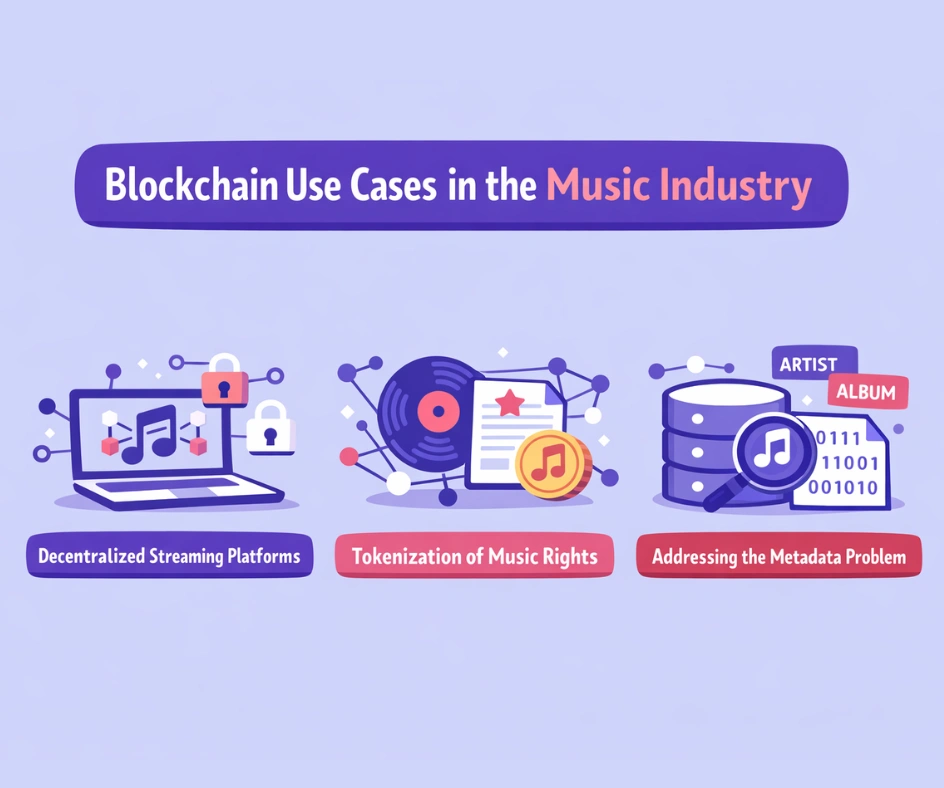
Blockchain Use Cases in the Music Industry
The music industry has emerged as a leading testing ground for blockchain in media applications, driven by the industry’s particularly acute challenges with transparency, payment delays, and power imbalances between creators and institutions. Several platforms and initiatives are demonstrating what becomes possible when blockchain principles are applied to how music is created, distributed, and monetized.
1. Decentralized Streaming Platforms
Platforms like Audius represent a fundamentally different approach to music streaming. Unlike traditional services that operate as centralized businesses making decisions about artist payments, content policies, and platform development, Audius operates as a decentralized protocol owned and governed by its community of artists, fans, and developers. Artists upload music directly to the platform, setting their own terms for how it can be accessed, and receive payments through the platform’s native cryptocurrency when fans engage with their work.
Audius has achieved remarkable growth, surpassing 7.5 million monthly active users and attracting over 250,000 artists to its platform. The service has drawn notable artists, including Skrillex, deadmau5, Zedd, and Disclosure, lending credibility to the decentralized model while partnerships with performing rights organizations like ASCAP, BMI, and SESAC help bridge the gap between blockchain innovation and traditional music industry infrastructure.
The platform’s model addresses several pain points simultaneously. Artists retain control over their work and receive a larger share of generated revenue. Fans can support artists directly rather than through intermediaries who capture most of the value. The decentralized governance structure means the platform evolves based on community decisions rather than corporate priorities that may not align with creator interests.
2. Tokenization of Music Rights
Music tokenization represents another frontier where blockchain enables previously impossible business models. By converting ownership rights to songs into digital tokens, artists can sell fractional shares of their future royalties to fans and investors. This creates new funding mechanisms for artists while allowing supporters to invest in music they believe in and share in its financial success.
The concept has gained traction through high-profile examples demonstrating its potential. DJ 3LAU raised $16 million for his blockchain music platform Royal, which enables fans to purchase tokens representing ownership stakes in songs. Through this platform, Grammy-nominated rapper Nas sold royalty shares to fans, allowing them to participate in earnings from his songs. These examples point toward a future where the relationship between artists and fans becomes one of partnership rather than simple consumption.
Tokenization also addresses the challenge of catalog valuation and liquidity. Traditionally, music rights are illiquid assets that can be difficult to value and sell. Tokenization creates markets where these rights can trade more freely, potentially providing artists with options to access capital against their catalogs without selling outright. For investors, it opens access to an asset class previously available only to well-connected industry insiders or wealthy collectors.
3. Addressing the Metadata Problem
One of the most persistent and underappreciated problems in music royalties involves metadata—the information describing who created a song, who owns various rights, and how revenue should be split. Inconsistent metadata standards across different systems and organizations lead to mismatches that prevent royalties from reaching their rightful recipients. The Mechanical Licensing Collective in the United States holds $424 million in unmatched royalties that cannot be distributed because the underlying ownership data does not align properly.
Blockchain technology offers a potential solution by creating unified, authoritative records of song metadata that travel with the music wherever it goes. When a song is registered on a blockchain with complete information about all contributors and their respective shares, that information becomes the definitive source of truth. Any platform or service using the music can reference the blockchain to determine precisely how revenue should be distributed, eliminating the mismatches and gaps that plague current systems.
NFTs (non-fungible tokens) can enhance this further by serving as digital certificates of ownership that embed all relevant metadata directly into verifiable tokens. These NFTs can track song information from creation through every subsequent transaction, maintaining complete records of rights ownership and ensuring that when music generates revenue, the current rights holders receive their shares automatically.
Blockchain Applications Across Entertainment Sectors
The applications of blockchain for content ownership extend far beyond music into virtually every creative medium. Each sector presents unique challenges that blockchain technology can address through its core capabilities of transparency, automation, and decentralized trust.
| Entertainment Sector | Key Challenges | Blockchain Solutions | Notable Platforms/Initiatives | Current Adoption Stage |
|---|---|---|---|---|
| Music | Royalty delays, unmatched payments, intermediary fees | Smart contract royalties, tokenized ownership, decentralized streaming | Audius, Royal, Opulous, Sound.xyz | Early Mainstream |
| Film & Television | Complex revenue sharing, opaque accounting, production financing | Automated revenue allocation, transparent reporting, and tokenized financing | FilmChain, SingularDTV, Cinezen | Growth Phase |
| Publishing | Slow royalty cycles, piracy, and limited author visibility | Automated royalty distribution, proof of authorship, and direct publishing | Po.et, Publica, various NFT platforms | Emerging |
| Gaming | Centralized control of assets, no true ownership for players | NFT-based assets, play-to-earn models, and cross-game interoperability | Axie Infinity, The Sandbox, Gods Unchained | Active Growth |
| Digital Art | Proving authenticity, enabling resale royalties, and preventing forgery | NFT certification, automatic creator royalties on secondary sales | OpenSea, SuperRare, Foundation, Rarible | Established |
| Photography | Unauthorized use, proving ownership, tracking licensing | Timestamped registration, automatic licensing, usage tracking | KodakOne, Pixsy integration concepts | Early Stage |
| Advertising | Ad fraud, verification of impressions, supply chain opacity | Verified ad delivery, transparent impression tracking, and fraud prevention | AdChain, Basic Attention Token | Growing |
| Sports | Counterfeit merchandise, ticket scalping, and fan engagement | NFT collectibles, verified ticketing, tokenized fan experiences | NBA Top Shot, Sorare, various team initiatives | Active Growth |
Blockchain in Film and Television Production
The film and television industry faces its own distinctive challenges that blockchain in media & entertainment technologies can address. Productions involve complex webs of stakeholders, from investors and producers to directors, actors, crew members, and post-production specialists. Tracking how revenue flows to all of these participants creates accounting nightmares that often leave creative contributors uncertain whether they are receiving their fair share.
1. FilmChain: Bringing Transparency to Film Finance
FilmChain exemplifies how blockchain can transform film industry operations. This UK-based startup, founded by Maria Tanjala and Irina Albita, combines digital banking with blockchain technology to modernize payments and royalties management for film, television, and gaming productions. The platform collects revenues and automatically allocates them to all participants invested in a project, reducing friction, increasing transparency, and cutting settlement times from months to days.
The company’s technology utilizes a private Ethereum blockchain to create immutable records of revenue flows and ownership stakes. Every dollar that a film generates is tracked and distributed according to predefined smart contracts, with all parties able to verify they are receiving their agreed shares. This level of transparency was previously impossible, as traditional film accounting often operated as a black box that producers and investors had to trust without the ability to verify.
FilmChain has achieved significant traction, operating with more than 1,900 clients across the UK, Europe, and Australia. The company secured $3 million in seed funding in 2024, reflecting investor confidence in its approach to solving real industry problems. Partnerships with organizations like the German Producers Association have extended their reach and demonstrated that blockchain solutions can integrate with existing industry structures rather than requiring complete disruption.
2. New Models for Film Financing
Blockchain also enables innovative approaches to film financing that democratize investment in productions. Traditional film financing involves complex arrangements of equity investors, debt facilities, pre-sales, and tax incentives that are generally accessible only to sophisticated industry players. Tokenization allows productions to offer fractional ownership stakes to broader pools of investors, potentially changing how films get funded.
Initial Coin Offerings (ICOs) and Security Token Offerings (STOs) have been used to fund film projects, allowing fans and investors to purchase tokens representing ownership in specific productions. While these approaches remain experimental and face regulatory complexities, they point toward futures where audiences can directly invest in content they want to see created. This aligns creator and audience interests in ways that traditional financing structures do not.
The “crewfunding” model pioneered by FilmChain offers another innovation, where crew members accept reduced upfront fees in exchange for profit participation, with their shares tracked and enforced through blockchain. This allows productions to optimize budgets while ensuring that creative contributors share in success when it occurs. The blockchain ensures these arrangements are honored transparently rather than disappearing into opaque accounting systems.
You may also like:
Healthcare IT Transformation: Data Protection, Compliance & Performance
NFTs and the Transformation of Digital Art Ownership
Non-fungible tokens have emerged as one of the most visible applications of blockchain for content ownership, transforming how digital art and collectibles are bought, sold, and owned. While the NFT market has experienced significant volatility since its explosive growth in 2021, the underlying technology continues to evolve and find sustainable applications across creative industries.
1. How NFTs Enable True Digital Ownership
The fundamental innovation of NFTs is establishing verifiable scarcity and ownership for digital assets. Before NFTs, digital files could be copied infinitely with no way to distinguish an “original” from a copy. NFTs change this by creating unique tokens on a blockchain that represent ownership of specific digital items. While the underlying file can still be copied, ownership of the NFT cannot be duplicated, creating the possibility of authentic “originals” in the digital realm.
For digital artists, this capability is transformative. Artists can create limited edition works and sell them with confidence that buyers are acquiring something genuinely scarce. The blockchain provides proof of provenance, showing the complete history of who has owned a particular piece. Smart contracts embedded in NFTs can automatically distribute royalties to creators whenever their works sell on secondary markets, a capability that traditional art markets never provided to artists.
The secondary sale royalty feature is particularly significant for creators. In traditional art markets, artists typically benefit only from the initial sale of their work. If a piece later appreciates significantly and sells for multiples of its original price, the artist receives nothing from this subsequent transaction. NFTs can be programmed so that artists automatically receive a percentage of every future sale, aligning incentives and ensuring creators benefit from the long-term success of their work.
2. The Music NFT Marketplace
Music NFTs have emerged as a distinct category with their own dynamics and opportunities. The Music NFT market was valued at USD 2.85 billion in 2024 and is projected to reach USD 26.71 billion by 2033, reflecting substantial growth expectations despite broader NFT market fluctuations. Independent artists are particularly drawn to the model, with over 62% exploring NFTs as a monetization tool.
Music NFTs take various forms that offer different value propositions to fans and collectors. Single songs can be sold as NFTs, providing owners with unique digital artifacts that may include exclusive content, special audio versions, or access to artist experiences. Full albums released as NFTs offer comprehensive ownership experiences that go beyond what streaming services provide. Collections tied to artist communities can include ongoing benefits and access that deepen fan relationships.
The economics of music NFTs can significantly favor artists compared to streaming. While artists might earn fractions of pennies per stream on traditional platforms, NFT sales can generate substantial immediate income while secondary market royalties provide ongoing revenue when collectors trade pieces. Artists on NFT platforms can receive up to 85% of primary sale proceeds, compared to the roughly 12% of industry revenue that artists received historically through traditional channels.
3. Challenges and Evolution of the NFT Market
The NFT market has faced significant challenges that temper enthusiasm with important realities. After explosive growth in 2021, trading volumes declined substantially, with market revenue stabilizing around $600-700 million by 2024-2025 compared to peaks of $1.58 billion. Critics point to speculative excess, wash trading that artificially inflates apparent trading volumes, and questions about the actual value proposition of many NFT projects.
Environmental concerns about the energy consumption of proof-of-work blockchains led to significant criticism of NFTs, though the transition of Ethereum to proof-of-stake has substantially addressed these issues. Legal and regulatory questions around whether certain NFTs constitute securities remain unsettled in many jurisdictions, creating uncertainty for platforms and participants. The accessibility challenges of interacting with blockchain systems remain barriers for mainstream adoption.
Despite these challenges, the underlying technology continues to mature and find applications that deliver genuine value. The transition from speculative mania to sustainable utility suggests the market is evolving rather than disappearing. Projects focused on fan engagement, creator monetization, and genuine community building rather than pure speculation appear to have the strongest foundations for long-term success.
Smart Contracts for Automated Royalty Distribution
Smart contracts represent the technological foundation enabling blockchain-based royalties to function. Understanding how these automated agreements work illuminates why they hold such transformative potential for creative industries.
1. The Mechanics of Smart Contract Royalties
A smart contract is essentially a program stored on a blockchain that executes automatically when predefined conditions are met. For royalty distribution, this means encoding the terms of revenue sharing directly into code that runs without human intervention. When revenue arrives, the smart contract immediately calculates how it should be divided among stakeholders and executes those transfers.
The process begins when a piece of content is registered on a blockchain with its associated smart contract. This contract specifies all the parties entitled to royalties and their respective shares. It might define that the songwriter receives 35% of streaming revenue, the performer receives 35%, the producer receives 15%, and the publisher receives 15%. These percentages are encoded directly into the contract and cannot be changed without a new agreement from all parties.
When the content generates revenue, the smart contract springs into action. It receives the incoming payment, calculates how much each stakeholder should receive based on the encoded percentages, and distributes those amounts to each party’s designated wallet. All of these transactions are recorded on the blockchain, creating an auditable trail that any participant can verify. The entire process happens automatically, without requiring accountants to calculate shares or administrators to process payments.
2. Advantages Over Traditional Royalty Systems
The advantages of smart contract royalties over traditional systems are substantial. Speed is perhaps the most immediately obvious benefit. While traditional royalty payments can take months or years to reach creators, smart contracts can distribute revenue within seconds of it being received. This transforms creator cash flow, making income from content consumption available almost immediately rather than as a distant future payment.
Accuracy improves dramatically as well. Traditional royalty calculations involve complex processes with multiple opportunities for errors. Data must be gathered from various sources, calculations performed across potentially thousands of stakeholders, and payments processed through financial systems that introduce their own friction. Smart contracts eliminate most of these error-prone steps by executing calculations exactly as programmed every time.
Transparency addresses one of the most persistent complaints from creators about traditional systems. With smart contracts, every transaction is recorded on a public blockchain where any party can verify that payments were calculated and distributed correctly. This eliminates the black box nature of traditional royalty accounting, where creators must trust that institutions are reporting accurately without the ability to verify independently.
Cost reduction benefits all parties by eliminating many of the administrative expenses associated with traditional royalty management. The collection societies, auditing firms, payment processors, and administrative staff required to run traditional systems all add costs that ultimately reduce the share reaching creators. Smart contracts automate these functions at minimal marginal cost, allowing more revenue to flow to those who created the content.
3. Complex Arrangements Made Simple
Smart contracts excel at managing complex arrangements that would be nightmarishly difficult to administer manually. Consider a song with multiple versions, each involving different collaborators entitled to different shares depending on which version generates revenue. Traditional accounting for such arrangements involves substantial overhead and creates opportunities for errors or disputes. Smart contracts can encode all of these relationships and execute them flawlessly every time.
Territorial variations add another layer of complexity that smart contracts handle gracefully. Revenue from different countries might be subject to different tax treatments, involve different performing rights organizations, or be governed by different contractual arrangements. Smart contracts can be programmed to recognize the source of revenue and apply appropriate rules automatically, something that would require substantial manual effort in traditional systems.
The concept of cascading royalties demonstrates smart contracts’ sophisticated capabilities. When an NFT representing a song is sold, the original creator can receive a percentage. When that song is sampled in a new work, smart contracts can ensure the original creator continues to benefit. When the new work generates its own revenue, smart contracts can trace back through the chain of creativity to ensure all contributors receive their shares. This level of automated attribution and compensation was simply impossible before blockchain technology.
Comparing Traditional vs Blockchain Royalty Systems
Understanding the practical differences between traditional and blockchain-based royalty systems helps illustrate why this technology is gaining traction among creators and industry participants.
| Aspect | Traditional Systems | Blockchain Systems | Creator Impact |
|---|---|---|---|
| Payment Speed | 3 months to 1+ year delays | Near instant (seconds to minutes) | Improved cash flow and financial planning |
| Transparency | Limited visibility into calculations | Complete transaction history is visible | Ability to verify payments independently |
| Intermediaries | Multiple layers (labels, publishers, PROs) | Direct or minimal intermediation | Higher percentage of revenue retained |
| Ownership Verification | Paper contracts, disputes are common | Immutable blockchain records | Clear proof of rights ownership |
| Global Reach | Complex international collection | Borderless by design | Access to global markets without local representation |
| Secondary Sales | Creators rarely benefit | Automatic royalties on resales (NFTs) | Ongoing revenue from appreciating works |
| Administrative Cost | High (staff, systems, auditing) | Low (automated execution) | More of gross revenue becomes net income |
| Dispute Resolution | Legal processes, audits | Verifiable records reduce disputes | Lower legal costs and faster resolution |
Challenges and Limitations of Blockchain in Media
While the potential of blockchain in media and entertainment is substantial, realizing this potential requires overcoming significant challenges. Understanding these limitations is essential for a realistic assessment of where blockchain technology stands today and what must happen for it to achieve mainstream adoption.
1. Technical Scalability Constraints
Current blockchain networks face limitations in processing the volume of transactions that mainstream media consumption would generate. A popular song might be streamed millions of times per day, each stream theoretically requiring a transaction to distribute royalties. Most blockchain networks cannot process transactions at this scale with the speed and cost efficiency required for practical implementation.
Layer 2 solutions and new blockchain architectures are addressing these constraints, but the technology remains a work in progress. Some platforms compromise by batching transactions or operating on faster but more centralized networks, trade-offs that may be acceptable in some contexts but undermine the decentralization benefits that make blockchain compelling in the first place.
Energy consumption concerns have diminished significantly with the transition of major networks like Ethereum from proof-of-work to proof-of-stake consensus mechanisms. However, perceptions of blockchain as environmentally problematic persist in some circles, and not all blockchain networks have made this transition.
2. User Experience and Accessibility
Interacting with blockchain systems requires navigating concepts and tools that remain unfamiliar to most people. Managing cryptocurrency wallets, understanding gas fees, protecting private keys, and executing transactions on blockchain networks all present barriers that can prevent mainstream adoption. Until these systems become as intuitive as the digital services people use daily, broad adoption will remain limited.
The complexity barrier particularly affects creators who most need these tools. Independent musicians, filmmakers, and artists often lack technical backgrounds and have limited time to learn complex new systems. If blockchain solutions require substantial learning investment before providing benefits, many creators will simply continue using familiar tools despite their limitations.
Platform developers are working to abstract away blockchain complexity, allowing users to interact with services that use blockchain infrastructure without needing to understand the underlying technology. These efforts are essential for mainstream adoption but are still evolving.
3. Regulatory Uncertainty
The legal and regulatory landscape for blockchain applications in creative industries remains unclear in many jurisdictions. Questions about whether certain tokens constitute securities, how blockchain transactions should be taxed, and how existing intellectual property frameworks apply to blockchain-registered works remain unsettled. This uncertainty creates risk for platforms and participants alike.
Different jurisdictions are taking different approaches to blockchain regulation, creating complexity for platforms operating globally. What is permissible in one country may face restrictions in another, complicating the borderless nature that is theoretically one of blockchain’s key advantages.
Traditional entertainment industry structures also create friction. Existing contracts, collection societies, and industry relationships were not designed with blockchain in mind. Integrating blockchain solutions often requires renegotiating agreements, obtaining approvals from multiple parties, and navigating entrenched interests that may not benefit from more transparent and direct systems.
4. Adoption and Network Effects
Blockchain solutions for content ownership face classic network effect challenges. These systems become more valuable as more participants join, but attracting early participants requires demonstrating value that depends on broad adoption. A decentralized music platform with few listeners offers limited appeal to artists, while a platform with few artists offers limited appeal to listeners.
Established platforms have enormous advantages in terms of existing user bases, content libraries, and brand recognition. Convincing users to abandon familiar services for blockchain alternatives requires compelling value propositions that overcome switching costs. While some early adopters are attracted by the technology itself or by ideological commitment to decentralization, mainstream users typically require practical benefits that clearly outweigh the effort of switching.
Industry incumbents also have substantial resources to protect their positions. Major labels, streaming services, and other established players can develop their own blockchain solutions, acquire promising startups, or use their market power to maintain existing structures. The extent to which blockchain truly disrupts entertainment industries versus being absorbed into existing power structures remains to be seen.
You may also like:
The Future of Blockchain in Content Industries
Looking ahead, the trajectory of blockchain for content ownership will be shaped by technological evolution, regulatory development, and the choices of creators, platforms, and audiences. Several trends point toward directions this transformation might take.
1. Integration with Existing Systems
Rather than completely replacing traditional structures, blockchain is more likely to integrate with existing systems in ways that enhance rather than destroy current value chains. Major labels are already exploring blockchain for rights management. Performing rights organizations are investigating how distributed ledger technology might improve their collection and distribution processes. Streaming services are considering how blockchain might address transparency concerns without disrupting their business models.
This integration approach acknowledges that revolutionary disruption is rare and that most technological transitions involve gradual evolution. Blockchain capabilities like transparent record-keeping, automated royalty distribution, and verifiable ownership can provide value within existing industry structures while those structures slowly evolve to accommodate new possibilities.
Standards development will be critical for this integration to succeed. Different platforms and organizations need common protocols for representing content rights on blockchains, exchanging information across systems, and ensuring interoperability. Industry consortia and standards bodies are working on these challenges, though progress is slow given the complexity of stakeholder interests involved.
2. Expansion of Creator Tools
The range of tools available to creators for leveraging blockchain will continue expanding. Today’s platforms for minting NFTs, receiving cryptocurrency payments, and publishing to decentralized networks represent early steps in what will become increasingly sophisticated ecosystems. Future tools might seamlessly integrate blockchain capabilities into the creative software artists already use, making registration, rights management, and royalty collection automatic rather than requiring separate conscious effort.
Fan engagement represents a particularly fertile area for innovation. Beyond simple ownership of NFTs, blockchain enables complex relationships between creators and supporters. Token-gated communities can offer exclusive content and experiences to holders. Voting rights embedded in tokens can give fans influence over creative decisions. Revenue-sharing arrangements can align fan and artist interests in ways that transform passive consumption into an active partnership.
The convergence of blockchain with other emerging technologies will create additional possibilities. Integration with artificial intelligence could automate content recognition and rights enforcement at scales impossible for human administrators. Connection with virtual and augmented reality platforms could establish new digital experiences where blockchain proves ownership. Internet of Things integration could enable automated licensing and payment for content used across connected devices.
3. Regulatory Frameworks Taking Shape
As blockchain applications in creative industries mature, regulatory frameworks will evolve to provide clearer guidelines for participants. This clarity, while potentially limiting some applications, will also reduce uncertainty that currently inhibits adoption by risk-averse organizations and individuals.
Different jurisdictions will likely develop different approaches, creating a regulatory patchwork that global platforms must navigate. Some countries may embrace blockchain innovation in creative industries, seeking to become hubs for these emerging sectors. Others may take more cautious approaches, prioritizing consumer protection and financial stability concerns over innovation facilitation.
The creative industries themselves will play important roles in shaping these frameworks. Organizations representing artists, labels, publishers, and other stakeholders are engaging with regulators to explain how blockchain applications work and advocate for approaches that enable innovation while protecting legitimate interests. The outcomes of these discussions will significantly influence how blockchain technology develops within the entertainment sector.
How Creators Can Start Exploring Blockchain Today
For creators curious about blockchain technology, practical paths exist for beginning to explore these systems without requiring deep technical expertise or substantial financial commitment.
1. Registering Work on Blockchain
Creators can begin by registering their work on blockchain platforms designed for this purpose. Services exist that allow uploading content and receiving timestamped certificates proving that a particular work existed at a particular moment, attributed to a particular creator. While this does not automatically generate income or solve all the problems blockchain promises to address, it provides verifiable proof of creation that could prove valuable in disputes.
The process typically involves creating an account on a registration platform, uploading the work to be registered, and receiving a certificate or record that can be verified on the underlying blockchain. Many of these services offer free or low-cost registration, making them accessible to creators at any stage of their careers.
2. Experimenting with NFT Platforms
NFT marketplaces have become increasingly accessible, allowing creators to mint and sell tokens representing their work without deep technical knowledge. Platforms like OpenSea, Rarible, and Foundation guide users through the process of connecting wallets, uploading work, setting prices and royalty terms, and listing items for sale.
Starting small and experimental allows creators to learn how these systems work without substantial risk. Minting a few pieces, setting reasonable prices, and observing how the market responds provides practical education that informs future decisions. Not every creator will find NFTs to be the right fit for their work or audience, but experimentation helps make informed judgments.
3. Joining Decentralized Platforms
Platforms like Audius offer opportunities for musicians to explore decentralized distribution without abandoning traditional channels. Uploading music to Audius can happen alongside continued presence on Spotify, Apple Music, and other established services. This parallel presence allows artists to compare experiences, reach different audiences, and develop familiarity with how decentralized platforms operate.
Community participation provides additional learning opportunities. Decentralized platforms often have active communities discussing how the technology works, sharing experiences, and collectively shaping platform development. Engaging with these communities can accelerate learning and connect creators with others navigating similar journeys.
4. Education and Informed Decision Making
Perhaps most importantly, creators can invest in understanding these technologies well enough to make informed decisions about if and when to adopt them. The hype surrounding blockchain can make it difficult to distinguish a genuine opportunity from speculation and marketing. Critical thinking about both the promises and limitations of these systems helps creators avoid pitfalls while identifying applications that might genuinely serve their interests.
This educational investment need not be overwhelming. Understanding basic concepts like how blockchains work, what smart contracts do, and what NFTs represent can be accomplished through freely available resources. Building on this foundation, creators can evaluate specific platforms and opportunities with appropriate skepticism rather than either blind enthusiasm or reflexive dismissal.
Transform Your Content Business with Expert Blockchain Development
Whether you need a custom blockchain solution for royalty management, NFT marketplace development, smart contract implementation for automated payments, or decentralized platform architecture, our experienced development team delivers creator-focused solutions tailored to your specific requirements. We combine deep expertise in blockchain technology with a comprehensive understanding of entertainment industry dynamics to build systems you can trust.
Conclusion: A More Equitable Creative Economy
The transformation of content ownership and royalty management through blockchain technology represents one of the most significant developments in how creative industries operate. While the technology remains in relatively early stages of development and adoption, the fundamental capabilities it offers address real and persistent problems that have plagued creators for decades.
The promise of blockchain for content ownership extends beyond mere technical improvements in how payments are processed or records are kept. At its core, this technology offers the possibility of rebalancing power relationships that have historically favored institutions over individual creators. When artists can prove ownership of their work through immutable records, receive payments directly through automated smart contracts, and verify they are being compensated fairly through transparent ledgers, the fundamental dynamics of creative industries shift in their favor.
This is not to suggest that blockchain will solve all problems or that its adoption will be smooth or universal. Significant technical challenges remain around scalability, usability, and integration with existing systems. Regulatory frameworks are still evolving. Incumbent interests have resources to protect their positions. Many creators will reasonably choose to observe from the sidelines rather than becoming early adopters of complex new technologies.
Yet the direction of travel seems clear. The market for blockchain applications in media and entertainment is projected to grow substantially over the coming years. Major industry players are investing in these technologies. New platforms are launching regularly, each improving on predecessors and expanding what is possible. Artists who once had no alternative to traditional systems increasingly have options to explore.
The vision of a creative economy where ownership is clear, payments are immediate, transparency is guaranteed, and creators retain more of the value their work generates is not yet realized. But the tools to build such an economy exist and are improving rapidly. For creators willing to explore these possibilities, the current moment offers an opportunity to shape how these technologies develop and to benefit from being early participants in systems that may define how creative work is managed in the future.
Digital content ownership, blockchain solutions, and blockchain-based royalties systems are not merely technological curiosities. They are an emerging infrastructure for a creative economy that better serves those who bring art, music, film, and other content into the world. Whether this transformation unfolds over years or decades, understanding its trajectory and possibilities has become essential knowledge for anyone whose livelihood depends on creating content in the digital age.
Frequently Asked Questions
Q1.What exactly is blockchain for content ownership, and how does it work?
Blockchain for content ownership uses distributed ledger technology to create permanent, verifiable records of who created and owns creative works. When a creator registers their content on a blockchain, that registration is timestamped and stored across a network of computers in a way that cannot be altered or disputed. Smart contracts, which are automated programs on the blockchain, can then execute royalty payments automatically whenever the content generates revenue. This combination of immutable ownership records and automated payments addresses the transparency and delay problems that plague traditional content management systems.
Q2.How do blockchain-based royalties differ from traditional royalty systems?
Traditional royalty systems involve multiple intermediaries between content consumption and creator payment, resulting in delays of months or years, limited visibility into calculations, and substantial fees that reduce what creators receive. Blockchain-based royalties use smart contracts to distribute payments automatically and immediately when content generates revenue, with complete transaction transparency on the public ledger. This means faster payments, lower costs, and the ability for creators to verify independently that they are being compensated correctly.
Q3.Which entertainment sectors are adopting blockchain technology most rapidly?
Music and digital art have seen the most significant blockchain adoption so far, driven by particularly acute problems with royalty transparency and the natural fit between NFTs and digital collectibles. Film and television are following, with platforms like FilmChain demonstrating how blockchain can improve revenue tracking for complex multi-stakeholder productions. Gaming has also embraced blockchain for in-game asset ownership. Sports organizations have found success with NFT collectibles for fan engagement.
Q4.Are there successful real-world examples of blockchain content platforms?
Yes, several platforms have achieved meaningful scale. Audius, a decentralized music streaming platform, has surpassed 7.5 million monthly active users and attracted over 250,000 artists, including notable names like Skrillex and deadmau5. FilmChain operates with more than 1,900 clients across the UK, Europe, and Australia, managing film and television royalties on blockchain. Royal has enabled artists like Nas to sell fractional royalty ownership to fans. NBA Top Shot has processed hundreds of millions of dollars in NFT trading for basketball collectibles.
Q5.What are the main challenges preventing wider blockchain adoption in entertainment?
Key challenges include technical scalability limitations that make processing high transaction volumes difficult, user experience complexity that creates barriers for non-technical creators and audiences, regulatory uncertainty in many jurisdictions, and the network effect challenge of building platforms that require both creator and audience adoption to provide value. Integration with existing industry structures and interests also creates friction, as established players may resist changes that threaten current business models.
Q6.How can creators start using blockchain technology for their work today?
Creators can begin by registering their work on blockchain timestamping services to establish proof of creation. Experimenting with NFT platforms like OpenSea or Foundation allows creators to learn how minting and selling work without substantial commitment. Musicians can upload to decentralized platforms like Audius alongside their presence on traditional streaming services. Most importantly, investing time in understanding how these technologies work helps creators make informed decisions about whether and when blockchain solutions make sense for their specific situations.
Explore Services
Related Services
Reviewed by

Aman Vaths
Founder of Nadcab Labs
Aman Vaths is the Founder & CTO of Nadcab Labs, a global digital engineering company delivering enterprise-grade solutions across AI, Web3, Blockchain, Big Data, Cloud, Cybersecurity, and Modern Application Development. With deep technical leadership and product innovation experience, Aman has positioned Nadcab Labs as one of the most advanced engineering companies driving the next era of intelligent, secure, and scalable software systems. Under his leadership, Nadcab Labs has built 2,000+ global projects across sectors including fintech, banking, healthcare, real estate, logistics, gaming, manufacturing, and next-generation DePIN networks. Aman’s strength lies in architecting high-performance systems, end-to-end platform engineering, and designing enterprise solutions that operate at global scale.