Ai Overview
BEP-20 tokens represent the foundation of the BNB Chain ecosystem, enabling developers to create diverse digital assets ranging from stablecoins to governance tokens. As the token standards for Binance Smart Chain (BSC), BEP-20 extends Ethereum’s widely-adopted ERC-20 standard while offering enhanced speed and significantly lower transaction fees. While Ethereum gas fees can spike to $50 or more during congestion, BSC transactions typically cost less than $0.
BEP-20 tokens represent the foundation of the BNB Chain ecosystem, enabling developers to create diverse digital assets ranging from stablecoins to governance tokens. As the token standards for Binance Smart Chain (BSC), BEP-20 extends Ethereum’s widely-adopted ERC-20 standard while offering enhanced speed and significantly lower transaction fees. Understanding BEP-20 tokens is essential for anyone navigating the decentralized finance landscape, building blockchain applications, or managing crypto assets. This comprehensive guide explores what BEP-20 is, how these tokens work, their key features, and why they’ve become fundamental to the rapidly expanding BNB ecosystem.
Key Takeaways
- BEP-20 Overview: BEP-20 is the token standard for BNB Smart Chain, extending Ethereum’s ERC-20 for faster, cheaper transactions.
- Smart Contract-Based: Tokens are created via smart contracts on BSC with defined attributes like name, symbol, supply, and functionality.
- BNB Chain Advantage: Low fees (~$0.10–$0.50) and high-speed transactions (~3 seconds per block) make BSC attractive for users and developers.
- Cross-Chain Compatibility: BEP-20 tokens can bridge to Ethereum and other blockchains via Binance Bridge, enabling interoperability.
- Standardized Features: Includes transfers, balance queries, approvals, minting, burning, pausing, and ownership tracking for easy integration.
- Token Types: Supports native tokens (BNB), pegged tokens (BTCB, USDT), stablecoins (BUSD), and governance/utility tokens (CAKE).
- Wallet Support: Compatible with Trust Wallet, MetaMask (BSC), Ledger, and Komodo for secure token management.
- Use Cases: Widely used in DeFi, gaming, NFTs, payments, and tokenized assets due to flexibility and low transaction costs.
- Developer-Friendly: EVM compatibility and comprehensive documentation make BEP-20 ideal for launching tokens, dApps, and DeFi projects efficiently.
What is BEP-20 Token?
A BEP-20 token is a digital asset that operates on the BNB Smart Chain (BSC) and adheres to the BEP-20 technical standard. These cryptocurrency tokens can represent virtually anything from utility access within decentralized applications to governance rights in DeFi protocols, stablecoins pegged to fiat currencies, or even shares in tokenized real-world assets.
BEP-20 tokens are created through smart contracts deployed on BSC, with each contract defining specific attributes including the token’s name, symbol, total supply, decimal precision, and functional capabilities. Once deployed, these blockchain tokens become tradable assets that can be transferred between wallets, exchanged on decentralized platforms, used within dApps, or held as investments.
What distinguishes BEP-20 tokens from native cryptocurrencies like Bitcoin is that they don’t operate on their own independent blockchains. Instead, they leverage the existing BNB Smart Chain infrastructure, benefiting from its security, speed, and established ecosystem. This makes creating BEP-20 tokens significantly more accessible and cost-effective than launching entirely new blockchain networks.
BEP-20 Token Standard Explained
BEP-20 is a token standard on BNB Smart Chain that defines the technical specifications and rules for creating tokens within the BSC ecosystem. The acronym “BEP” stands for Binance Smart Chain Evolution Proposal, representing the framework through which new standards and improvements are introduced to the network.
The BEP-20 token standard serves as a blueprint determining how tokens can be spent, who can spend them, and the overall rules governing their usage. Similar to how architectural blueprints ensure buildings meet specific standards, the BEP-20 standard ensures tokens conform to baseline functionality requirements including transferring, viewing balances, checking ownership, and interacting with smart contracts.
BEP-20 was conceived as a technical specification for BNB Smart Chain with the goal of providing a flexible format through which developers can launch a range of different tokens. These could represent anything from shares in a business to dollars stored in a bank vault (stablecoins), utility tokens for decentralized applications, or governance tokens for decentralized protocols.
What is Binance Smart Chain (BNB Chain)?
To understand BEP-20 tokens, we must first understand Binance Smart Chain, the blockchain network where these tokens operate. Binance Smart Chain serves as an alternative to the Ethereum network, specifically designed to address scalability issues like slow transaction times and high fees that have plagued Ethereum during periods of network congestion.
BSC was created by cryptocurrency exchange Binance in May 2020 to run in parallel but independently from the original Binance Chain. While Binance Chain was optimized for fast trading and is favored among traders for its rapid processing times, it lacked smart contract functionality. BSC was developed to incorporate this crucial feature without overburdening the original Binance blockchain.
The high-speed blockchain network achieves faster and more cost-effective transaction processing through a different consensus mechanism than Ethereum. BSC uses Proof of Staked Authority (PoSA), combining elements of Proof of Stake and Proof of Authority to validate transactions quickly while maintaining decentralization. This architecture enables BSC to process blocks every 3 seconds with transaction fees typically measured in cents rather than dollars.
Additionally, Binance Smart Chain supports smart contracts, allowing developers to create decentralized applications (dApps) for various purposes directly within the ecosystem. This smart contract functionality, combined with low transaction fees and high throughput, has made BSC a popular platform for DeFi protocols, NFT marketplaces, and blockchain games.
Understanding the Differences BEP-20 vs ERC-20
The relationship between BEP-20 and ERC-20 is fundamental to understanding both standards. BEP-20 was derived from and is fully compatible with the ERC-20 standard, which remains one of the most common Ethereum token standards. The code defining BEP-20 standard functions represents modifications of the ERC-20 standard, optimized specifically for the BSC environment.
| Feature | BEP-20 | ERC-20 |
|---|---|---|
| Blockchain | BNB Smart Chain (BSC) | Ethereum |
| Transaction Speed | ~3 seconds per block | ~12-15 seconds per block |
| Gas Fees | Very low (cents) | Variable (can be high) |
| Consensus Mechanism | Proof of Staked Authority | Proof of Stake (post-merge) |
| Native Currency | BNB | ETH |
| Compatibility | Compatible with ERC-20 | Original standard |
| Developer Ecosystem | Growing rapidly | Largest and most established |
While ERC-20 operates on Ethereum, known for its robust smart contract functionality and extensive developer community, BEP-20 tokens are native to BNB Chain, offering faster transaction times and lower fees. This makes BNB Chain a preferred choice for many new projects and dApps, particularly those focused on providing accessible DeFi services to broader user bases.
How BEP-20 Tokens Work
BEP-20 tokens work through smart contracts deployed on the BNB Smart Chain. When developers create a crypto token using the BEP-20 standard, they deploy a smart contract that specifies the token’s attributes including its name, symbol, total supply, and various functionalities.
Token creation on BSC is relatively straightforward. BEP-20 tokens were developed to be compatible with both BEP-2 Binance tokens and ERC-20 tokens through peg-in and peg-out conversions using the Binance Bridge or other compatible wallets. This cross-chain compatibility enables seamless movement of assets between different blockchain ecosystems.
BEP-20 token transfers are fueled by BNB, the native Binance Coin. When users transfer BEP-20 tokens, they pay gas fees on BSC in BNB. These fees provide incentives for validators to include transactions in the blockchain, as validators collect BNB as rewards for their work securing the network. The fee structure on BSC remains significantly lower than Ethereum, typically costing just a few cents even during periods of high network activity.
The token supply and balance for BEP-20 tokens are managed through standardized functions defined in the smart contract. These include functions to check total supply, query individual account balances, transfer tokens between addresses, and approve third parties to spend tokens on behalf of owners—essential functionality for decentralized exchanges and DeFi protocols.
Key Features of BEP-20 Tokens
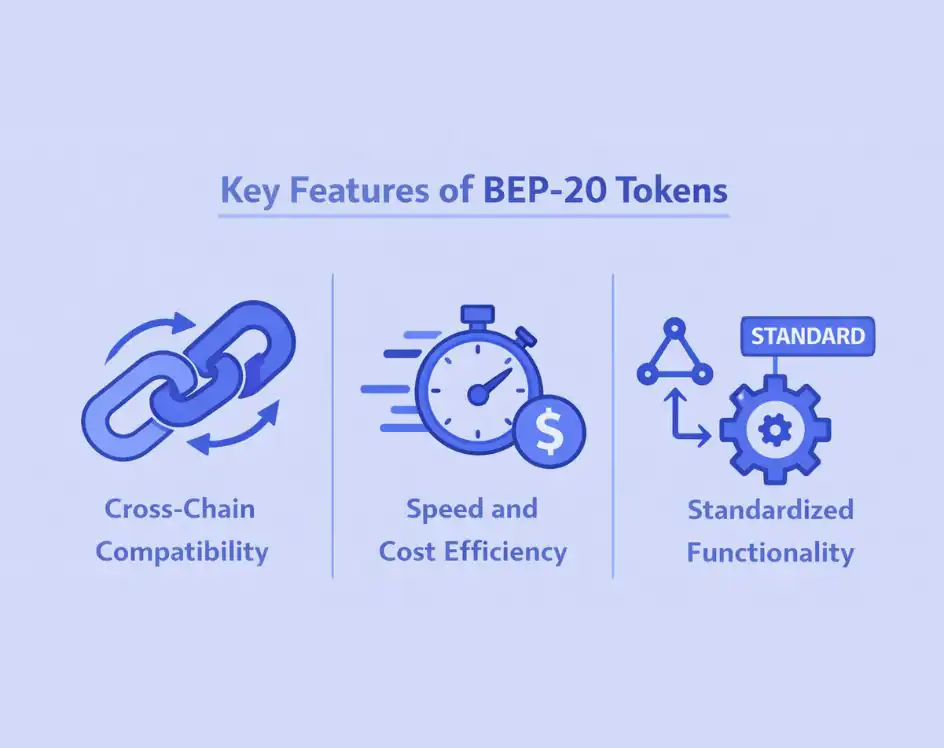
BEP-20 tokens offer several key features that contribute to their popularity among developers and investors. Understanding these features helps explain why the BEP-20 token standard has become fundamental to the growing BSC ecosystem.
Cross-Chain Compatibility
The standout feature of BEP-20 tokens is their interoperability. BEP-20 tokens can seamlessly transfer between various wallets and exchanges supporting the standard. More importantly, blockchain interoperability allows BEP-20 tokens to bridge to other networks, particularly Ethereum, through mechanisms like the Binance Bridge.
This cross-chain compatibility means that existing Ethereum projects can easily port to BSC, and users can move assets between chains as needed. For developers working with token development solutions, this flexibility significantly reduces barriers to multi-chain deployment.
Speed and Cost Efficiency
BEP-20 tokens provide faster and more cost-effective transactions compared to ERC-20 tokens. The low transaction fees blockchain architecture of BSC makes it particularly attractive for applications requiring frequent transactions, such as gaming, microtransactions, and high-frequency DeFi operations.
This efficiency is crucial for peer-to-peer transactions, enabling users to send and receive tokens swiftly and affordably. While Ethereum gas fees can spike to $50 or more during congestion, BSC transactions typically cost less than $0.50, making blockchain technology accessible to broader audiences.
Standardized Functionality
BEP-20 tokens come with a standard set of functions that simplify interaction and integration into other projects. This programmer-friendly aspect appeals to developers seeking to build applications on Binance Smart Chain tokens without reinventing basic functionality.
The standardization ensures that all BEP-20 tokens share common interfaces, making them compatible with wallets, exchanges, and dApps that support the standard. This consistency reduces development time and improves user experience across the ecosystem.
Parameters of the BEP-20 Token Standard
The BEP-20 token standard includes specific parameters that define token functionality and provide enhanced control compared to some other standards. Understanding these parameters is essential for developers and project managers working with cryptocurrency development services.
| Parameter | Function | Purpose |
|---|---|---|
| Blacklist | Address blocking | Blacklist suspicious addresses and restrict malicious activity |
| Can Mint | Token creation | Inflationary mechanism – mint new tokens to increase supply |
| Can Burn | Token destruction | Deflationary mechanism – burn tokens to reduce supply |
| Can Pause | Emergency stop | Pause all token operations in response to threats or attacks |
| Get Owner | Ownership tracking | Identify token owner for governance and administrative functions |
Unlike ERC-20 tokens where symbol and decimal specifications are optional, these parameters are required for BEP-20 tokens. The “get owner” function is mandated in the BEP-20 standard, helping identify the token owner for administrative and governance purposes. These additional controls provide enhanced security and management capabilities compared to simpler token standards.
Types of BEP-20 Tokens
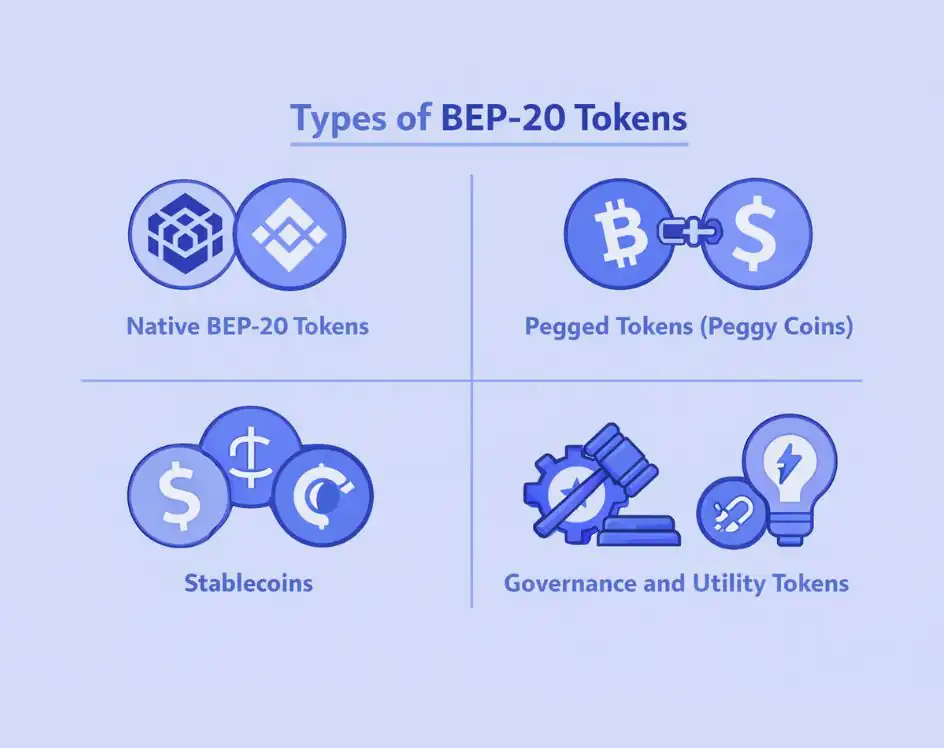
The BEP-20 standard’s flexibility enables creation of various token types serving different purposes within the crypto ecosystem. Understanding these categories helps clarify what is crypto token functionality in practice.
Native BEP-20 Tokens
Native BEP-20 tokens are created originally on BNB Chain for specific projects and applications. Examples include Binance Coin (BNB), the native token of the Binance ecosystem used for transaction fees, governance, and various utilities; PancakeSwap (CAKE), the governance and utility token for the leading BSC decentralized exchange; and FLOKI token, a community-driven meme coin that gained traction in the BSC ecosystem.
Pegged Tokens (Peggy Coins)
Pegged tokens represent BEP-20 versions of crypto assets from other blockchains. These cross-chain tokens are created through locking mechanisms where users lock assets on their native blockchain to receive equivalent BEP-20 tokens on BSC. Popular examples include Tether USDT BEP-20 (stablecoin pegged to USD), pegged ETH, BTC, ADA, and other major cryptocurrencies.
According to Binance documentation, peggy coins are backed 1:1 by crypto assets locked on their native chains. For instance, if you lock 10 BTC, you receive 10 BTCB on Binance Chain. You can trade this BTCB for the underlying 10 BTC at any time, meaning BTCB price closely tracks native BTC price while enabling BTC usage in the BSC ecosystem.
Stablecoins
Stablecoins maintain value pegs to fiat currencies, providing price stability in volatile crypto markets. BEP-20 stablecoins like USDT, BUSD, and USDC enable users to store value, facilitate trading, and participate in DeFi without exposure to crypto price volatility.
Governance and Utility Tokens
Many DeFi protocols and dApps on BSC issue governance tokens allowing holders to vote on protocol changes and development decisions. Utility tokens provide access to specific platform features, services, or rewards within their respective ecosystems.
Popular BEP-20 Tokens and Examples
Several BEP-20 tokens have achieved widespread adoption and recognition within the cryptocurrency space. These examples demonstrate the standard’s versatility and the diverse use cases it supports.
Binance Coin (BNB): The flagship token of the BNB ecosystem serves multiple purposes including paying transaction fees on BSC, participating in token sales on Binance Launchpad, accessing premium features on the Binance exchange, and serving as collateral in DeFi protocols. BNB’s multi-utility nature demonstrates how fungible tokens can provide comprehensive ecosystem value.
Tether (USDT): One of the most widely-used stablecoins globally, USDT exists as a BEP-20 token providing a stable store of value pegged to the U.S. dollar. Its BSC version enables traders and DeFi users to access dollar-denominated value with minimal transaction costs.
PancakeSwap (CAKE): The native token of PancakeSwap, BSC’s largest decentralized exchange, CAKE serves as both a governance token and provides staking rewards. PancakeSwap’s success demonstrates how dApps on BSC can build substantial user bases by leveraging BEP-20’s efficiency.
FLOKI: A meme coin inspired by Elon Musk’s Shiba Inu, FLOKI gained significant community traction and demonstrates the BEP-20 standard’s ability to support community-driven projects with lower barriers to entry than Ethereum.
BEP-20 Wallet: Managing Your Tokens Securely
A BEP-20 wallet is essential for storing and managing BEP-20 tokens securely. These specialized digital wallets support BSC and provide interfaces for interacting with BEP-20 tokens and dApps on the network.
Types of BEP-20 Wallets
BEP-20 wallet options include software wallets (web and mobile applications), hardware wallets providing offline cold storage, and browser extension wallets enabling dApp interaction. Each type offers different balances of convenience, security, and functionality.
Popular BEP-20 Wallets
Trust Wallet: Binance’s official mobile wallet offers native BEP-20 support with user-friendly interfaces, built-in dApp browsers, and robust security features. Its integration with Binance Smart Chain makes it ideal for BSC users.
MetaMask BSC: Originally an Ethereum wallet, MetaMask has extended support for BSC, making it versatile for users managing tokens across both networks. Configuration for BSC requires adding custom network settings.
Ledger Nano: Hardware wallets like Ledger Nano S and X provide top-tier security for storing BEP-20 tokens offline, protecting against online threats while still enabling transactions when needed.
Komodo Wallet: A multi-currency wallet with built-in decentralized exchange and crypto bridge functionality, supporting cross-chain operations including BEP-20 tokens.
BEP-20 Wallet Security
BEP-20 wallet security requires following best practices including private key protection (never share or store insecurely), enabling two-factor authentication where available, using hardware wallets for significant holdings, verifying addresses before transactions, and maintaining secure backups of recovery phrases.
Users should choose BNB Chain wallets from reputable providers with proven security track records, active development, and strong community support. Regular software updates ensure wallets maintain security against emerging threats.
Difference Between BEP-2 and BEP-20
Understanding the difference between BEP-2 and BEP-20 helps clarify Binance’s dual-blockchain strategy and how these standards complement each other within the broader BNB ecosystem.
BEP-2 is the technical standard governing token implementation and issuance on the BNB Beacon Chain (formerly Binance Chain). BEP-2 was designed for fast, decentralized trading but lacks smart contract functionality. It excels at simple token transfers and trading operations.
BEP-20, by contrast, operates on BNB Smart Chain and includes full smart contract support. This enables complex programmable logic, DeFi protocols, NFTs, and sophisticated dApps impossible on the original Binance Chain.
Both standards coexist and are entirely compatible. Given that Binance Smart Chain is an extension of Binance Chain, the two are fully interoperable. This blockchain interoperability enables seamless token swapping between BEP-2 tokens on Binance Chain and BEP-20 tokens on BSC through the Binance Bridge.
Users can easily convert BEP-2 tokens to BEP-20 versions (peg-in) or convert BEP-20 tokens back to BEP-2 (peg-out), choosing the blockchain best suited for their specific use case—Binance Chain for fast trading or BSC for DeFi and smart contract interactions.
Advantages of Using BEP-20 on BSC
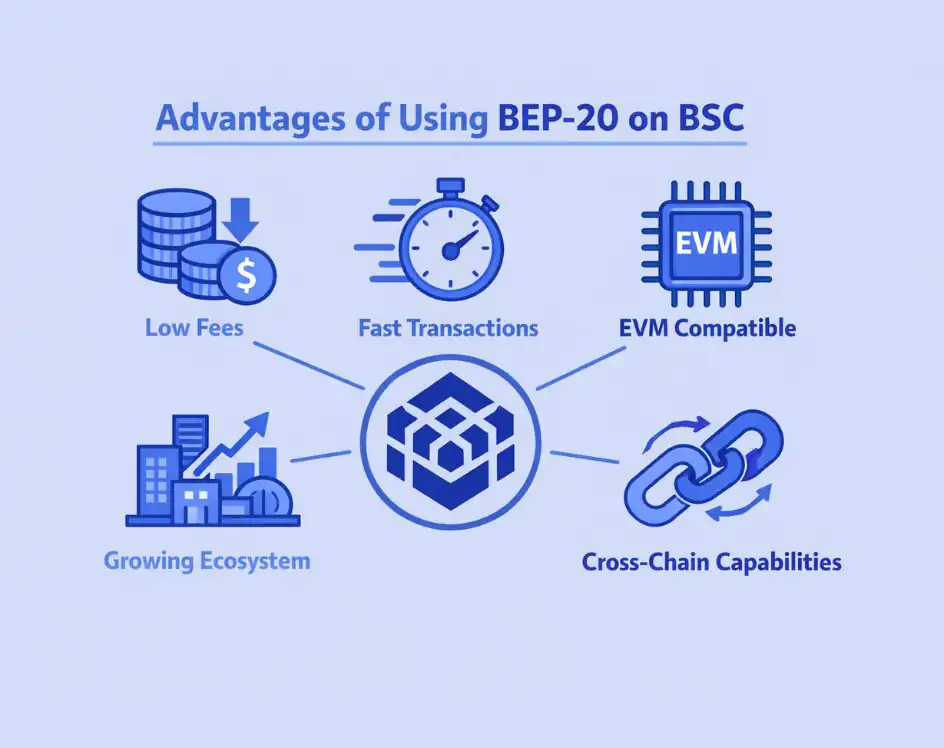
The BEP-20 token standard offers numerous advantages that have driven its rapid adoption and made BSC a leading blockchain platform for DeFi and dApp development.
Extremely Low Transaction Fees
Gas fees on BSC remain a fraction of Ethereum costs. While Ethereum transactions can cost $10-$100+ during congestion, BSC transactions typically cost $0.10-$0.50, making DeFi accessible to users with smaller portfolios. This cost-efficiency particularly benefits applications requiring frequent transactions.
High Transaction Speed
BSC’s high throughput ensures quick confirmation times, with blocks generated every 3 seconds. This high-speed blockchain network provides near-instant transaction finality, enhancing user experience significantly compared to networks with longer block times.
EVM Compatibility
BSC’s Ethereum Virtual Machine compatibility means developers can port Ethereum projects to BSC with minimal code changes. This dramatically reduces development time and allows projects to offer multi-chain deployments, reaching users across both ecosystems.
Growing Ecosystem
The BNB ecosystem continues expanding with hundreds of dApps, DeFi protocols, NFT marketplaces, and blockchain games. This vibrant ecosystem provides BEP-20 tokens with extensive utility and integration opportunities.
Cross-Chain Capabilities
The Binance Bridge and other cross-chain solutions enable BEP-20 tokens to bridge to Ethereum and other networks. This cross-chain compatibility ensures users aren’t locked into single ecosystems and can move assets as needed.
Creating BEP-20 Tokens
Token creation on BSC is accessible to developers of varying skill levels. The process involves deploying a smart contract that implements the BEP-20 standard interfaces and functions. For those looking to understand crypto and coin development, BEP-20 provides an excellent starting point due to its comprehensive documentation and active developer community.
Creating BEP-20 tokens can be accomplished through several approaches including writing smart contracts from scratch using Solidity, using token creation platforms that provide templates and interfaces, or working with a Token Development services specializing in cryptocurrency development.
For projects requiring custom functionality, professional cryptocurrency development services ensure tokens are built according to best practices with proper security audits. A cryptocurrency development company can implement advanced features like governance mechanisms, staking functionality, or integration with existing systems while ensuring compliance with the BEP-20 standard.
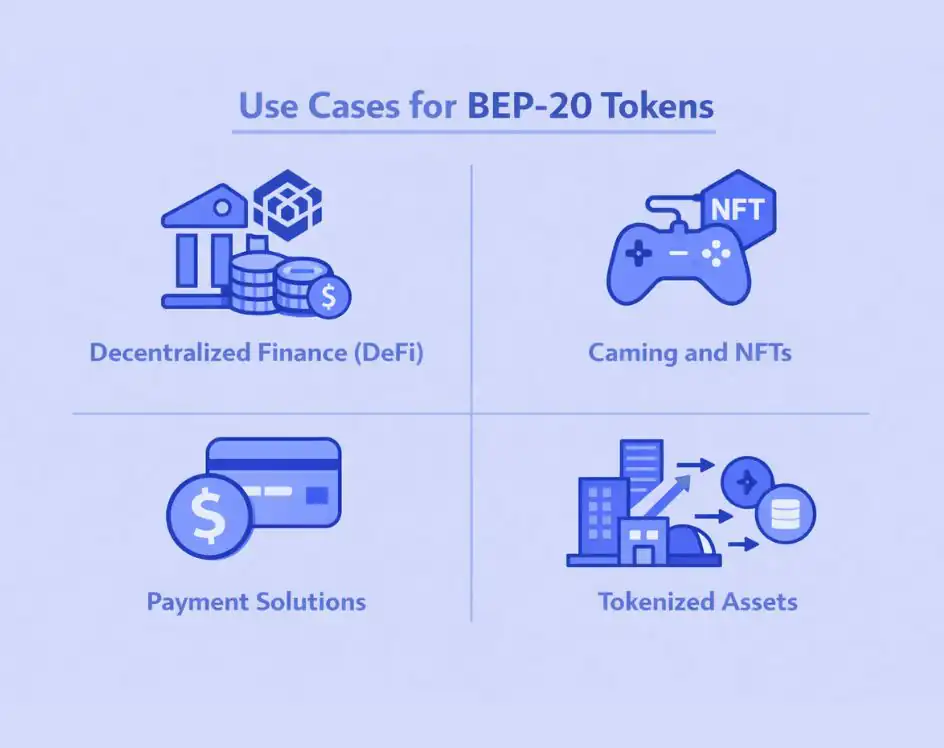
Use Cases for BEP-20 Tokens
BEP-20 tokens enable diverse applications across the blockchain ecosystem. Understanding these use cases demonstrates the standard’s versatility and real-world value.
Decentralized Finance (DeFi)
DeFi represents the largest use case for BEP-20 tokens. Lending protocols, decentralized exchanges, yield farming platforms, and liquidity pools all rely on BEP-20 tokens. Projects like Venus, PancakeSwap, and Alpaca Finance demonstrate how BEP-20 enables sophisticated financial services without traditional intermediaries.
Gaming and NFTs
Blockchain games use BEP-20 tokens for in-game currencies, rewards, and governance. The low transaction fees make play-to-earn models economically viable, allowing players to earn and spend tokens frequently without prohibitive costs.
Payment Solutions
BEP-20 stablecoins provide efficient payment rails for remittances, merchant payments, and peer-to-peer transfers. The combination of stability and low fees makes them practical for real-world commerce.
Tokenized Assets
Real-world assets can be tokenized as BEP-20 tokens, representing ownership of physical goods, securities, or other valuable items. This enables fractional ownership and easier transfer of traditionally illiquid assets.
Ready to Launch Your BEP-20 Token?
Get expert guidance on BEP-20 token development, smart contracts, and launch strategies to make your BNB Smart Chain project a success.
Final Thoughts
BEP-20 tokens represent a crucial component of the modern blockchain ecosystem, providing the foundation for thousands of projects across DeFi, gaming, payments, and beyond. By extending Ethereum’s proven ERC-20 standard while optimizing for speed and cost-efficiency, BEP-20 has established BNB Smart Chain as a leading platform for blockchain innovation.
Understanding what BEP-20 is and how these tokens work empowers users to participate effectively in the BSC ecosystem, whether trading, investing, developing, or using decentralized applications. The standard’s combination of ERC-20 compatibility, low transaction fees, high speed, and robust feature set makes it ideal for both developers building new projects and users seeking accessible blockchain services.
As blockchain technology continues evolving, BEP-20 tokens will likely remain fundamental to the decentralized finance landscape. For developers and entrepreneurs looking to launch token-based projects, partnering with experienced providers of cryptocurrency development services ensures professional implementation aligned with industry best practices. Whether creating native tokens, stablecoins, or governance mechanisms, the BEP-20 standard provides a proven framework supporting innovation while maintaining security and interoperability across the expanding multi-chain ecosystem.
Frequently Asked Questions
Q1.What makes BEP-20 different from other token standards?
BEP-20 combines ERC-20 compatibility with BSC’s speed and low fees. It includes additional parameters like pause functionality and blacklisting capabilities not standard in ERC-20, providing enhanced security and control for token administrators.
Q2.Can I convert ERC-20 tokens to BEP-20?
Yes, through the Binance Bridge or other cross-chain bridges. Users can peg ERC-20 tokens to create equivalent BEP-20 versions on BSC, enabling use of Ethereum-based assets in the BSC ecosystem with lower fees.
Q3.Are BEP-20 tokens safe to use?
BEP-20 tokens themselves are as safe as their smart contract implementation and the BSC network security. Users should verify token contracts, use reputable wallets, follow security best practices, and be cautious of scam tokens.
Q4.What wallet should I use for BEP-20 tokens?
Popular options include Trust Wallet for mobile, MetaMask configured for BSC for browser-based access, and Ledger hardware wallets for maximum security. Choose based on your security needs, usage patterns, and preference for hot or cold storage.
Q5.How much does it cost to create BEP-20 tokens?
Basic token creation on BSC costs minimal gas fees (less than $1). However, professional development, security audits, and marketing can cost thousands to hundreds of thousands of dollars depending on project complexity and scope.
Q6.Can BEP-20 tokens be used for NFTs?
No, BEP-20 defines fungible tokens where each unit is identical and interchangeable. NFTs on BSC use the BEP-721 or BEP-1155 standards, which define non-fungible or semi-fungible tokens respectively.
Q7.What is the relationship between BNB and BEP-20?
BNB serves as the native currency of BSC, used to pay gas fees for all transactions including BEP-20 token transfers. While BNB itself exists as both a native coin and a BEP-20 token, its primary function is facilitating network operations.
Explore Services
Related Services
Reviewed by

Aman Vaths
Founder of Nadcab Labs
Aman Vaths is the Founder & CTO of Nadcab Labs, a global digital engineering company delivering enterprise-grade solutions across AI, Web3, Blockchain, Big Data, Cloud, Cybersecurity, and Modern Application Development. With deep technical leadership and product innovation experience, Aman has positioned Nadcab Labs as one of the most advanced engineering companies driving the next era of intelligent, secure, and scalable software systems. Under his leadership, Nadcab Labs has built 2,000+ global projects across sectors including fintech, banking, healthcare, real estate, logistics, gaming, manufacturing, and next-generation DePIN networks. Aman’s strength lies in architecting high-performance systems, end-to-end platform engineering, and designing enterprise solutions that operate at global scale.