Ai Overview
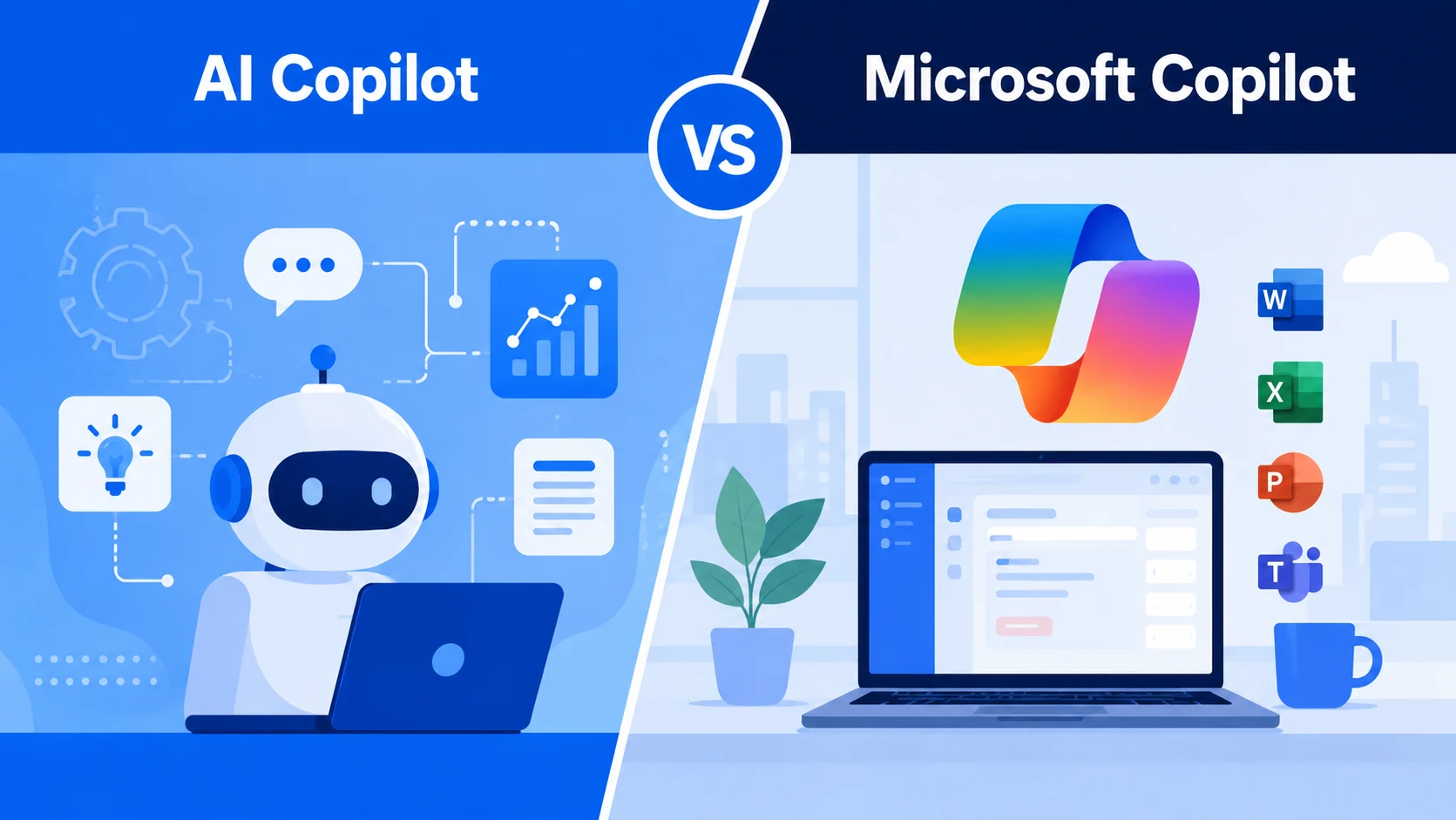
To understand the AI Copilot vs AI Agent distinction at a foundational level, it helps to think about where human judgment sits in the workflow relative to AI action. AI Copilot and AI Agent sit at different points on this spectrum, and that positioning determines everything about how each system behaves in practice. AI Agents deliver operational tasks at a cost per execution that is dramatically lower than human agent cost at equivalent volume.
Key Takeaways
- ›In the AI Copilot vs AI Agent comparison, the fundamental distinction is human control: a Copilot assists and humans decide, while an Agent executes and decides autonomously within defined boundaries.
- ›AI Copilot systems are interaction-driven, requiring a human user to initiate and direct each task, while AI Agents are goal-driven and capable of initiating and completing task sequences independently.
- ›AI Copilot is the appropriate choice when domain expertise, quality judgment, and human accountability must remain central to the workflow, as in clinical decision support or legal document review.
- ›AI Agent is the appropriate choice when tasks are well-defined, repeatable, and high-volume, such as order processing, alert triage, data synchronization, and routine communication workflows.
- ›The AI Copilot vs AI Agent distinction is converging in 2026 as hybrid architectures emerge, where a Copilot handles complex judgment tasks while delegating defined sub-tasks to embedded agents.
- ›AI Agents carry higher security risk than AI Copilots because their autonomous action capability means errors or manipulations can propagate through multiple system actions before human review occurs.
- ›In the AI Copilot vs AI Agent implementation cost comparison, AI Agents typically cost more to implement due to more complex orchestration, action planning, safety guardrail, and error recovery requirements.
- ›Enterprises in India, UAE, and the US are increasingly deploying AI Copilot vs AI Agent systems simultaneously, with Copilots serving knowledge workers and Agents handling back-office automation.
- ›Neither AI Copilot nor AI Agent replaces human expertise in high-stakes domains; the AI Copilot vs AI Agent debate is about optimizing where AI fits in the workflow, not whether humans remain involved.
- ›The most successful enterprise AI strategies in 2026 treat AI Copilot vs AI Agent as complementary tools deployed in different workflow layers rather than mutually exclusive technology choices.
Understanding AI Copilot vs AI Agent in AI Systems
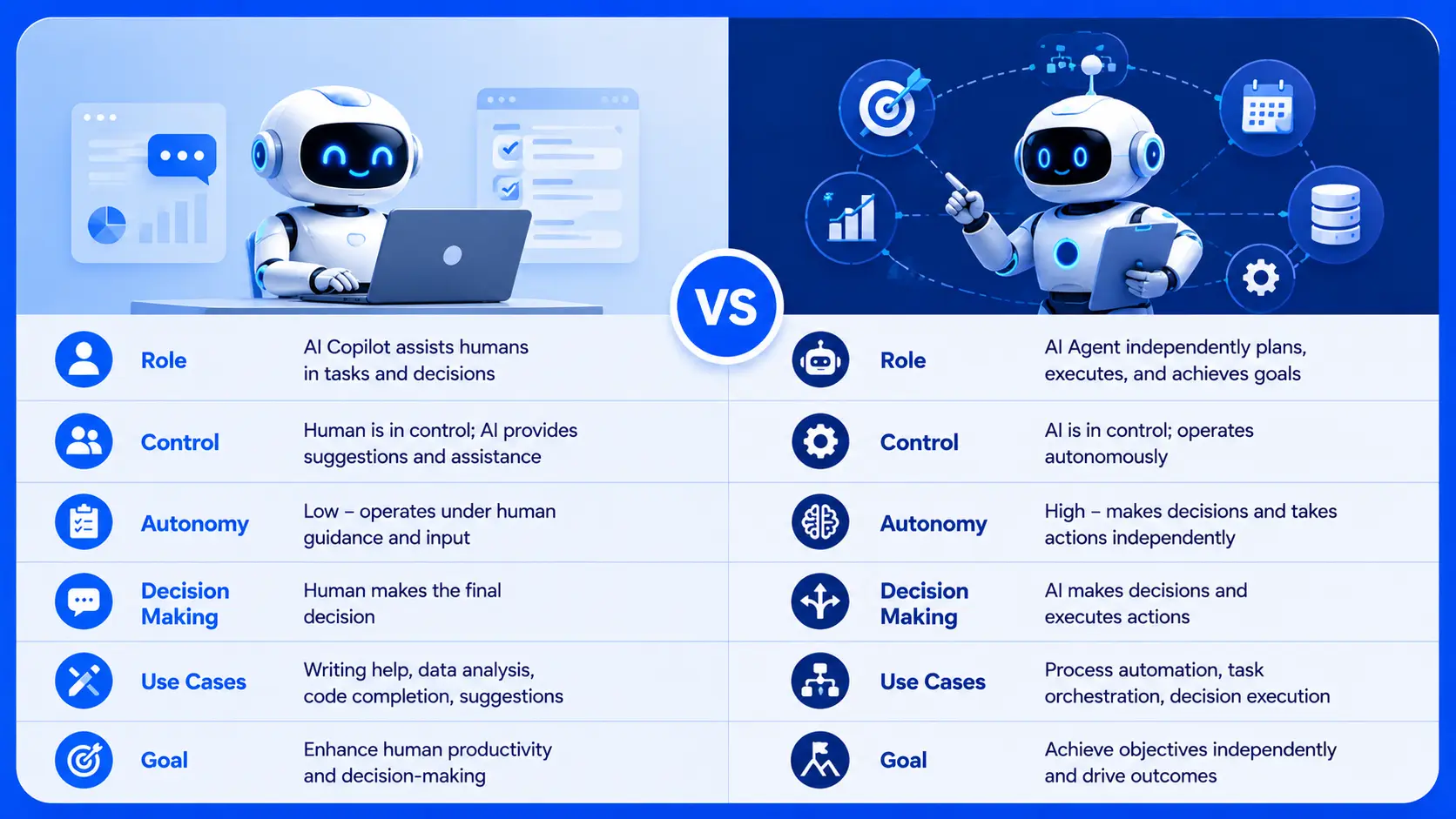
To understand the AI Copilot vs AI Agent distinction at a foundational level, it helps to think about where human judgment sits in the workflow relative to AI action. In every AI system, there is a spectrum of human involvement, ranging from fully human-driven processes where AI provides no assistance, all the way to fully autonomous AI processes where humans define goals but do not participate in execution. AI Copilot and AI Agent sit at different points on this spectrum, and that positioning determines everything about how each system behaves in practice.
As artificial intelligence Copilot systems and AI agents both proliferate across enterprise technology stacks in 2026, one of the most persistent sources of confusion among business leaders and technology teams is the distinction between the two. Both AI Copilot vs AI Agent systems are powered by large language models. Both use natural language interfaces. Over eight years of designing and deploying AI-powered systems for enterprises across the US, UAE, and India, we have seen AI Copilot vs AI agent architectures deployed at scale across dozens of industries.
An AI Copilot sits near the human end of this spectrum. It is an AI system designed to work alongside a human user, providing information, generating content, making suggestions, and executing tasks at the user’s explicit direction. The human remains the decision-maker throughout the workflow. The Copilot enhances the human’s capability without replacing their judgment or taking independent action.
An AI Agent sits further toward the autonomous end of the spectrum. It is designed to receive a goal or objective and pursue it through a sequence of self-directed actions, using tools, querying information sources, and making intermediate decisions along the way, without requiring human instruction at each step. The human defines the goal and reviews the outcome, but the AI Agent determines and executes the path between them.
AI Copilot vs AI Agent: The Autonomy Spectrum
What is an AI Copilot and How It Assists Users?
An AI Copilot is an intelligent assistant system that works alongside a human user to help them accomplish tasks more effectively. The word “copilot” is the key to understanding the architecture: in aviation, the copilot assists the pilot but does not override pilot authority or take independent control of the aircraft. The human pilot remains responsible for decisions. The AI Copilot operates on the same principle within business and technology workflows.
AI Copilot systems are interaction-driven. Every meaningful action the AI Copilot takes is initiated by or explicitly approved by a human user. The user asks a question and the Copilot retrieves and synthesizes an answer. The user requests a draft and the Copilot generates it. The user asks for a summary and the Copilot produces one. The human can accept, reject, modify, or ignore every output the AI Copilot produces. The workflow moves forward based on human decision-making, with AI Copilot vs AI Agent as a powerful accelerant of the human’s capability.
The technical architecture of an AI Copilot reflects this interaction-centric design. At its core is a language model that processes the user’s input and generates a response. For production AI agents, an inference engine is the runtime layer that determines how quickly and reliably those language models generate responses at scale. Surrounding that core is a retrieval layer that accesses business-specific knowledge, a memory layer that maintains conversation context, and an integration layer that allows the Copilot to read from and write to connected business systems as directed by the user. Every component is oriented toward making the human user more capable, faster, and better informed, not toward acting independently on the user’s behalf.
This design philosophy makes AI Copilot systems appropriate for any workflow where the quality and accountability of outputs must remain with the human user. Clinical decision support in India’s healthcare system, legal document review in US law firms, financial advisory assistance in Dubai’s wealth management sector, and technical analysis in any regulated environment are all contexts where the AI Copilot model is the correct choice precisely because human judgment and accountability remain central to the process.
What is an AI Agent and How It Works Autonomously?
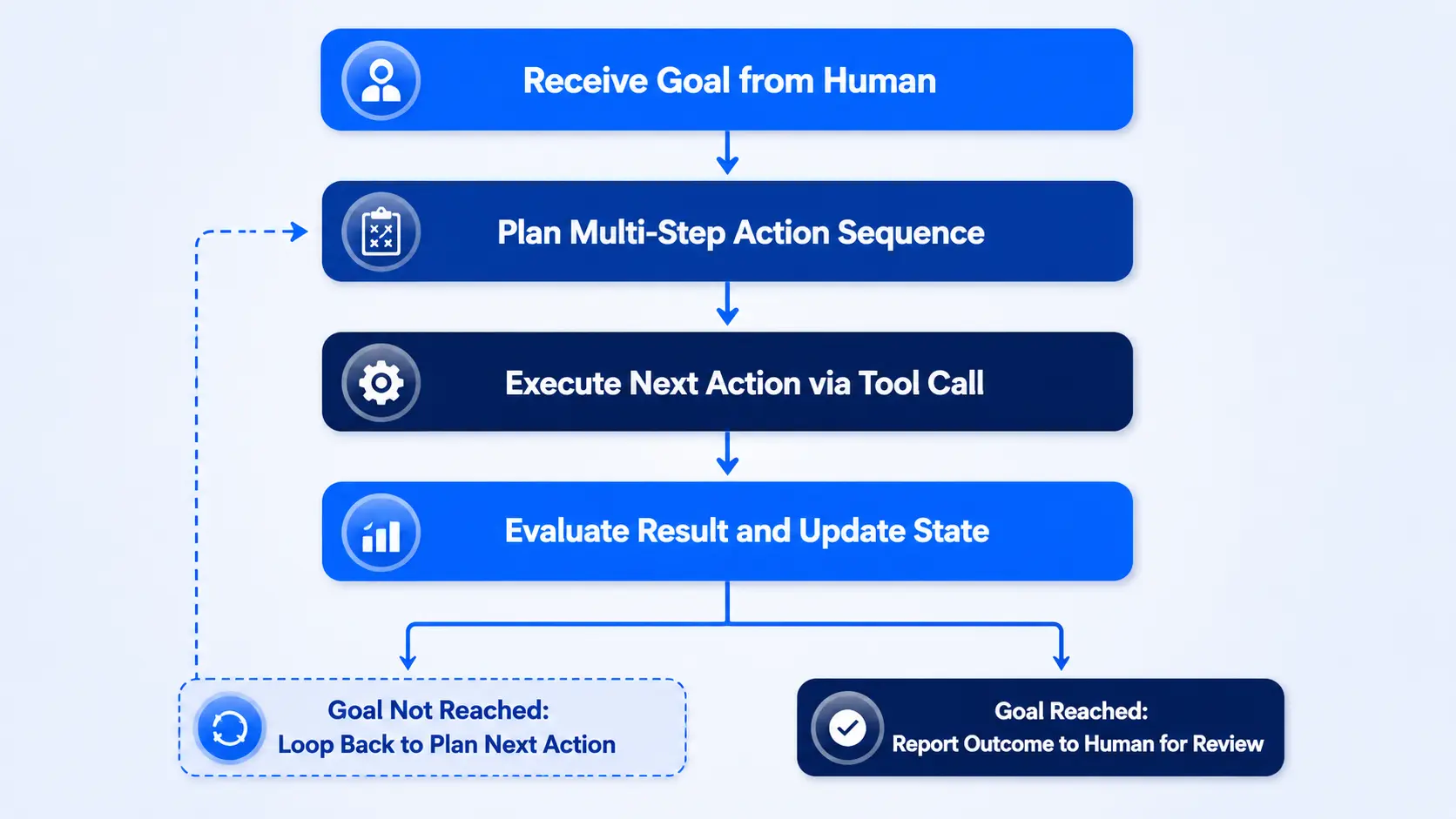
An AI Agent is a system designed to autonomously pursue a defined goal through a sequence of self-directed actions. Unlike an AI Copilot that waits for human instruction at each step, an AI Agent receives a goal, plans a strategy for achieving it, executes that strategy through a series of tool calls and system interactions, evaluates the results of each action, adapts its approach based on what it observes, and continues until the goal is achieved or an explicit stopping condition is met.
The architecture of an AI Agent reflects this goal-driven autonomy. At its core is an action planning module that can decompose a high-level goal into a sequence of achievable steps. This planning module works with a tool registry that gives the agent access to APIs, databases, and system functions it can call autonomously. A memory component tracks the agent’s progress, observations, and intermediate results across the multi-step execution. An evaluation component assesses whether each action produced the expected result and determines what the next action should be. Together, these components enable an AI Agent to operate as an autonomous participant in a workflow rather than a responsive assistant to a human participant.
Common AI Agent architectures include ReAct (Reasoning and Acting) patterns where the agent alternates between reasoning about its situation and taking actions, chain-of-thought planning where the agent explicitly maps out a multi-step plan before executing, and multi-agent frameworks where several specialized agents collaborate on different aspects of a complex goal. Each architecture is suited to different types of tasks and levels of complexity, and the choice among them is an important design decision in AI Agent implementation.
AI Agents are appropriate for workflows characterized by high volume, clear rules, well-defined success criteria, and low tolerance for the latency of human review at each step. Automated order processing for an e-commerce operation in India, alert triage in a security operations center in the UAE, data synchronization across multiple enterprise systems, and routine customer communication workflows in a US contact center are all contexts where the autonomous execution capability of an AI Copilot vs AI Agent cannot match.
AI Agent Autonomous Operation Loop
AI Copilot vs AI Agent Key Differences Explained
The AI Copilot vs AI Agent distinction manifests across multiple dimensions of system behavior and architecture. Understanding each dimension helps organizations make deployment decisions that match system characteristics to workflow requirements.
- Initiation: Human triggers each interaction
- Control: Human approves every output
- Scope: Single-turn or short multi-turn
- Actions: Reads and generates, limited writes
- Error handling: Human catches errors before action
- Accountability: Clearly with the human user
- Risk level: Lower, human review intercepts errors
- Best for: Knowledge work, judgment-heavy tasks
- Initiation: Goal set once, agent self-directs
- Control: Agent executes autonomously
- Scope: Multi-step, long-horizon workflows
- Actions: Full read-write-trigger capability
- Error handling: Agent self-corrects or escalates
- Accountability: Shared between AI design and operator
- Risk level: Higher, errors can propagate through actions
- Best for: High-volume, rule-defined, repetitive tasks
How AI Copilot vs AI Agent Handle Tasks Differently?
The most practical way to understand the AI Copilot vs AI Agent difference is through concrete task scenarios. Consider a common enterprise task: processing a customer complaint that requires investigating the issue, identifying a resolution, communicating with the customer, and updating the relevant records.
With an AI Copilot, the customer service agent receives the complaint and opens the AI Copilot interface. The agent asks the Copilot to retrieve the customer’s order history, past interactions, and the specific product issue details. The Copilot surfaces the relevant information. The agent reviews it and decides on the appropriate resolution. The agent asks the Copilot to draft a response email with the resolution. The Copilot generates the draft. The agent reviews and edits the email before sending it. The agent asks the Copilot to update the CRM record with the resolution summary. The Copilot performs the update. Each step requires the human agent’s direction and approval.
With an AI Agent, the customer complaint triggers an automated workflow. The agent receives the complaint, retrieves the customer’s full history, analyzes the issue against defined resolution policies, selects the appropriate resolution from the policy framework, generates and sends the resolution email under predefined authorization parameters, updates all relevant records, and closes the ticket. If the issue falls outside its defined resolution authority, the agent escalates to a human support specialist with a complete summary of what it has done so far. The entire process completes in minutes with no human involvement in standard cases.
Neither approach is universally superior. For high-judgment, relationship-sensitive customer interactions, the AI Copilot model produces better outcomes because human empathy and judgment shape the resolution. For high-volume, standard complaint categories where resolution paths are clear and speed matters, the AI Agent model produces better outcomes because it eliminates the bottleneck of human review for predictable decisions.
AI Copilot vs AI Agent in Task Automation Explained
Task automation is a domain where the AI Copilot vs AI Agent distinction is particularly important because the two systems approach automation from fundamentally different positions. Understanding these different automation philosophies helps organizations decide which system is appropriate for specific automation objectives.
AI Copilot automates the cognitive heavy lifting within a human-managed workflow. It automates the retrieval and synthesis of information, the generation of first drafts, the formatting of outputs, and the routine data entry tasks that do not require human judgment. The human remains in the workflow loop, but their effort is concentrated on the genuinely judgment-intensive parts of each task rather than the information processing and formatting work that the Copilot handles. This model of automation is additive to human capability without removing human agency.
AI Agent automates entire workflow sequences end to end. It replaces human involvement in the execution layer of defined, repeatable processes. The automation is not additive to a human’s task execution; it substitutes for it within the defined scope of the agent’s capability and authority. This model of AI Copilot vs AI Agent is appropriate when the process is sufficiently well-defined that removing human execution involvement produces better outcomes through speed, consistency, and volume than retaining human involvement at each step.
The risk profile of these two automation approaches differs significantly. AI Copilot automation carries low risk because human review intercepts any errors or inappropriate outputs before they produce business consequences. AI Agent automation carries higher risk because errors can propagate through multiple automated actions before detection, potentially creating situations that are more difficult to reverse than a single incorrect human decision would have been.
AI Copilot vs AI Agent Automation Capability Comparison
| Automation Dimension | AI Copilot | AI Agent |
|---|---|---|
| Task Initiation | Human-initiated, every interaction | Goal-triggered, self-initiating within scope |
| Execution Length | Single task or short conversation sequence | Extended multi-step sequences across multiple systems |
| Human Touchpoints | At every output before action is taken | At goal definition and outcome review only |
| Error Interception | Human reviews before consequence | Self-correction or escalation after action |
| Volume Capability | Bounded by human interaction rate | Scales to arbitrarily high volume without human rate limit |
| Output Modification | Human modifies freely before use | Actions already executed before human review |
Decision Making in AI Copilot vs AI Agent Models
Decision-making architecture is one of the most significant dimensions of the AI Copilot vs AI Agent comparison because it determines where judgment resides in the workflow and how errors manifest when they occur. The two models place decision-making authority in fundamentally different locations, with important consequences for governance, accountability, and risk management.
In an AI Copilot model, the AI system generates recommendations, options, and outputs, but the decision of what to do with those outputs rests entirely with the human user. The AI Copilot can draft a contract clause, but the lawyer decides whether to include it. The AI Copilot can generate a risk assessment summary, but the risk officer decides how to act on it. The AI Copilot can suggest a customer resolution, but the agent decides whether it is appropriate. This decision architecture is highly compatible with regulated environments and high-stakes domains because accountability remains clearly with the human professional.
In an AI Agent model, the AI system makes operational decisions autonomously within its defined scope of authority. It decides which tool to call next, how to interpret the results, whether the current approach is working, and when the goal has been successfully achieved. AI Copilot vs AI Agent are genuine decisions with real consequences, not just output suggestions that a human can accept or reject. The AI Agent’s decision quality is therefore a direct determinant of operational outcomes, not just a factor in how useful the human finds the AI’s assistance.
This distinction in decision-making architecture is why AI Agent deployments require substantially more rigorous pre-deployment testing and governance frameworks than AI Copilot deployments. When an AI Copilot makes a poor judgment, the human catches it. When an AI Agent makes a poor judgment, the consequences accumulate through subsequent automated actions before any human reviews what has occurred. For enterprises in regulated sectors across the US, UAE, and India, this difference in error propagation risk is a critical factor in determining which architecture is appropriate for specific use cases.
Which is More Powerful AI Copilot or AI Agent?
The AI Copilot vs AI Agent “which is more powerful” question is one of the most frequently asked and most often incorrectly framed questions in enterprise AI planning. Power in the context of AI systems is not an absolute property; it is a relationship between system capability and context requirements. AI Copilot vs AI Agent is not universally powerful. Each is more powerful than the other in specific contexts.
An AI Copilot is more powerful in contexts where human expertise, judgment, and contextual awareness are irreplaceable components of the output quality. A senior consultant in Mumbai advising a multinational client on restructuring strategy produces far better advice with an AI Copilot that enhances their analytical capability than they would by delegating the analysis to an AI Agent. The Copilot amplifies irreplaceable human expertise. An AI Agent attempting the same task would produce outputs that lacked the strategic judgment, relationship awareness, and contextual nuance that make the consultant’s advice genuinely valuable.
An AI Agent is more powerful in contexts defined by volume, consistency, speed, and well-defined rules. An e-commerce operation in Dubai processing 10,000 order status inquiries per day cannot operate at the speed and cost efficiency required using AI Copilot-assisted human agents for each interaction. An AI Agent handling these inquiries autonomously delivers dramatically better performance on the metrics that matter in this context: response speed, 24/7 availability, cost per interaction, and consistency of information quality. A human agent with AI Copilot assistance would be slower, more expensive, and inconsistent at this scale.
The most sophisticated enterprise AI deployments in 2026 have stopped framing the AI Copilot vs AI Agent question as a choice and started treating it as a design exercise. The right architecture for most complex enterprise workflows involves AI Copilot for the human-facing, judgment-intensive components and AI Agent for the high-volume, rule-defined, execution-layer components. These architectures work together rather than competing for the same deployment budget.
Benefits of AI Copilot vs AI Agent for Users
Each model in the AI Copilot vs AI Agent comparison delivers distinct benefits that serve different user needs and organizational objectives. Understanding these benefit profiles helps teams make deployment decisions that match system strengths to specific requirements.
AI Copilot: Human Augmentation
AI Copilot makes every professional more capable, faster, and better informed without changing their fundamental role in the workflow. Junior analysts perform at senior levels with Copilot assistance. Senior professionals handle larger workloads without quality sacrifice. This benefit scales across every knowledge worker in the organization.
AI Agent: Process Throughput
AI Agents scale process execution to volumes that human teams cannot match, with perfect consistency at any time of day or night. For enterprises in India managing high-volume customer operations or logistics coordination, AI Agents eliminate the throughput ceiling that human staffing creates in repetitive, rule-based workflows.
AI Copilot: Maintained Accountability
Because every AI Copilot output requires human review before action, the accountability chain remains clear. In regulated industries across the US, UAE, and India, this maintained accountability is not merely preferable but legally required. AI Copilot architecture is natively compatible with regulatory frameworks that assign responsibility to human professionals.
AI Agent: Cost Efficiency at Scale
AI Agents deliver operational tasks at a cost per execution that is dramatically lower than human agent cost at equivalent volume. For standard, repetitive business processes, AI Agent execution costs are typically 80 to 95 percent lower than equivalent human labor costs, creating significant operational leverage that compounds with volume.
AI Copilot: Flexible Adaptation
AI Copilot systems adapt to novel situations naturally because the human user provides the contextual judgment needed to handle exceptions. When a situation falls outside the knowledge base or requires genuinely new thinking, the human redirects the Copilot with new instructions. This adaptability makes AI Copilot robust across diverse and changing business contexts.
AI Agent: 24/7 Operations
AI Agents operate continuously without fatigue, shift limits, or time zone constraints. For UAE enterprises managing cross-regional operations or US companies serving global customers, AI Agents eliminate the service gap that human staffing creates outside business hours and deliver consistent performance across all operational periods without cost escalation.
AI Copilot vs AI Agent in Intelligent Automation
Intelligent automation is the domain where the AI Copilot vs AI Agent comparison is most strategically significant for enterprise technology leaders. As organizations build automation strategies for 2026 and beyond, understanding how each model contributes to a comprehensive automation architecture is essential for investment decisions that deliver compound returns over time.
AI Copilot’s role in intelligent automation is to eliminate the cognitive overhead within human-managed workflows. It makes every step that requires a human faster, better informed, and more accurate. In an intelligent automation framework, AI Copilot handles the information retrieval, content generation, and routine data management that consumes professional time without requiring professional judgment, freeing human attention for the genuinely judgment-intensive aspects of each workflow.
AI Agent’s role in intelligent automation is to eliminate human involvement from entirely automatable workflow segments. Where a complete process from trigger to resolution follows defined rules with predictable inputs and clear success criteria, an AI Agent replaces the human execution layer with autonomous AI execution. This substitution is only appropriate when the error consequences of autonomous action are acceptable and the quality of AI judgment has been validated through rigorous testing.
The most sophisticated intelligent automation architectures deployed in 2026 integrate AI Copilot vs AI Agent in layered configurations. An AI Agent handles the high-volume, standardized tier of a customer service workflow automatically, while an AI Copilot assists human agents with the complex escalations that require judgment. An AI Agent processes routine compliance checks and flags anomalies, while an AI Copilot assists compliance officers in reviewing and resolving the flagged cases. This layered architecture delivers the throughput benefits of AI Agent automation and the quality benefits of AI Copilot assistance simultaneously. [1]
What This Comparison Means for Everyday AI Users?
For professionals and business users who interact with AI systems daily rather than designing them, the AI Copilot vs AI Agent distinction has practical implications for how they should engage with and evaluate the AI tools available to them. Understanding which type of system they are working with helps users set appropriate expectations, apply the right trust levels, and get maximum value from each interaction.
When working with an AI Copilot, users should engage actively and critically. The Copilot’s outputs are inputs to the user’s judgment, not final decisions. Users who treat AI Copilot vs AI Agent outputs as authoritative without applying their own review are misusing the system and introducing risk. The correct mental model is of a highly capable research and drafting assistant whose work always benefits from professional review before it influences any business decision or action.
When working with systems that include AI Agent components, users should understand the boundaries of the agent’s autonomous authority and the escalation conditions that bring issues to human attention. They should review agent-completed work at the quality sampling level rather than reviewing every output, focusing their attention on exception cases and edge situations that the agent’s design may not have anticipated. They should also maintain an awareness of what actions the agent is authorized to take, so they can design appropriate approval gates for the highest-consequence actions within the agent’s scope.
Choosing Between AI Copilot vs AI Agent for Your Workflow
| Workflow Characteristic | Choose AI Copilot | Choose AI Agent |
|---|---|---|
| Task Predictability | Highly varied, requires contextual judgment | Highly predictable, rules-based, well-defined |
| Volume Level | Lower volume, each case deserves individual attention | High volume, manual processing is not scalable |
| Error Consequence | High stakes, errors have significant consequences | Errors are recoverable and acceptable within scope |
| Regulatory Context | Regulated, human accountability required | Operational, automation is regulatory-neutral |
| Speed Requirement | Human review timing is acceptable | Speed is critical, human review creates unacceptable latency |
| Knowledge Complexity | Requires nuanced domain expertise in outputs | Follows defined decision trees and rule sets |
For everyday users evaluating which AI system to advocate for or request in their organization, the practical guidance is straightforward. If your work involves judgment, expertise, relationship context, and accountability, advocate for AI Copilot vs AI Agent tools that enhance your capability without removing your decision authority. If your team manages high-volume, repetitive processes where the bottleneck is execution speed and consistency rather than judgment quality, advocate for AI Agent solutions that remove the execution burden and let your team focus on the oversight, exception handling, and strategic work that genuinely requires human involvement.
AI Copilot vs AI Agent is a Design Choice, Not a Competition
The AI Copilot vs AI Agent comparison is not a contest to determine a winner. Both systems represent important and complementary capabilities in the enterprise AI toolkit. The value of each depends entirely on the match between system characteristics and workflow requirements. Deploying the wrong model for a specific use case, whether using an AI Copilot where speed and volume demand an agent, or using an AI Agent where judgment and accountability require a Copilot, is a design error that undermines the value of the investment regardless of how well the individual system is built.
After eight years of designing AI systems for organizations across India, the UAE, and the US, our consistent recommendation is to start with a clear map of your workflows, categorize each by its predictability, volume, error consequence, and accountability requirements, and then select the system architecture that best fits each category. In most enterprise environments, that analysis leads to a portfolio of AI Copilot vs AI Agent deployments working together at different layers of the operational stack.
The organizations that understand this distinction clearly, and invest accordingly, are the ones building AI capabilities that compound in value over time rather than generating isolated point solutions that never add up to a coherent strategy.
Build the Right AI Architecture for Your Business
Whether you need AI Copilot, AI Agent, or a hybrid architecture, we design and build the right solution for your workflows across US, UAE, and India.
Frequently Asked Questions
Q1.1. What is the main difference between AI Copilot vs AI Agent?
In the AI Copilot vs AI Agent comparison, the key difference is human control. An AI Copilot assists a human who makes every decision, while an AI Agent autonomously executes tasks toward a defined goal with minimal human involvement during execution.
Q2.2. When should I use an AI Copilot instead of an AI Agent?
In the AI Copilot vs AI Agent decision, choose an AI Copilot when your workflow requires human judgment, professional accountability, or contextual expertise at every step. Clinical documentation, legal review, financial advisory, and high-stakes communications all benefit from AI Copilot rather than autonomous AI Agent execution.
Q3.3. Can an AI Agent replace an AI Copilot in my business?
No. The AI Copilot vs AI Agent distinction is not about replacement but about different roles. AI Agents replace human execution in high-volume, rules-based processes. AI Copilots enhance human capability in judgment-intensive workflows. Most enterprises need both deployed in complementary configurations rather than choosing one over the other.
Q4.4. Is an AI Agent more advanced than an AI Copilot?
In the AI Copilot vs AI Agent comparison, neither is universally more advanced. An AI Agent is more autonomous, but autonomy is not the same as capability. AI Copilots operating in complex knowledge domains can be technically more sophisticated than AI Agents handling routine, rule-based process automation. The right choice depends on the workflow, not on a power hierarchy.
Q5.5. How does an AI Agent make decisions without human input?
An AI Agent uses a planning module to decompose a goal into steps, executes each step through tool calls and API interactions, evaluates results, and adapts its approach based on what it observes. Unlike an AI Copilot that awaits human direction, the AI Agent determines its own action sequence within predefined authorization boundaries.
Q6.6. Is it safe to use an AI Agent for sensitive business workflows?
In the AI Copilot vs AI Agent safety comparison, AI Agents carry higher risk for sensitive workflows because errors can propagate through multiple automated actions before human review occurs. AI Copilots are safer for sensitive processes because human review occurs before any action is taken. Sensitive workflows in regulated industries should favor AI Copilot architectures.
Q7.7. What types of tasks are AI Agents best suited for?
AI Agents excel in the AI Copilot vs AI Agent comparison for high-volume, repetitive, rule-defined tasks where consistency and speed matter more than judgment. Order processing, alert triage, data synchronization, routine customer communications, and standardized reporting are all tasks where AI Agents deliver significantly better outcomes than AI Copilot-assisted human workflows.
Q8.8. Can AI Copilot and AI Agent be used together in the same system?
Yes, and this is increasingly the standard approach in enterprise AI architecture. In the AI Copilot vs AI Agent combined model, an AI Agent handles the high-volume execution tier of a workflow while an AI Copilot assists human professionals with the complex exception cases and judgment-intensive escalations that the agent identifies but cannot resolve autonomously.
Q9.9. How do I explain AI Copilot vs AI Agent to my non-technical team?
For non-technical audiences, the AI Copilot vs AI Agent distinction is simple: a Copilot is like a highly capable assistant who prepares work for you to review and decide on. An Agent is like a highly capable contractor who receives a task, completes it autonomously, and reports back when done. One supports your decisions; the other makes and executes decisions within defined boundaries.
Q10.10. What industries are moving fastest toward AI Agent adoption versus AI Copilot?
In the AI Copilot vs AI Agent adoption comparison, e-commerce, logistics, cybersecurity, and high-volume customer operations are moving fastest toward AI Agent adoption for their execution-heavy workflows. Financial services, healthcare, legal, and advisory sectors are prioritizing AI Copilot systems because professional accountability requirements make autonomous AI Agent execution incompatible with their regulatory frameworks.
Explore Services
Related Services
Reviewed by

Aman Vaths
Founder of Nadcab Labs
Aman Vaths is the Founder & CTO of Nadcab Labs, a global digital engineering company delivering enterprise-grade solutions across AI, Web3, Blockchain, Big Data, Cloud, Cybersecurity, and Modern Application Development. With deep technical leadership and product innovation experience, Aman has positioned Nadcab Labs as one of the most advanced engineering companies driving the next era of intelligent, secure, and scalable software systems. Under his leadership, Nadcab Labs has built 2,000+ global projects across sectors including fintech, banking, healthcare, real estate, logistics, gaming, manufacturing, and next-generation DePIN networks. Aman’s strength lies in architecting high-performance systems, end-to-end platform engineering, and designing enterprise solutions that operate at global scale.