Ai Overview
The EU’s Markets in Crypto-Assets Regulation (MiCA) is fully in force. Any company providing crypto exchange services to EU users must now hold a Crypto-Asset Service Provider (CASP) license. MiCA mandates a permanent minimum capital requirement of between €50,000 and €150,000 depending on the type of crypto-asset services provided. MiCA-compliant exchanges reported a 40% lower user churn rate than non-compliant platforms in 2025, reflecting the commercial value of operating within the regulated framework.
The EU’s Markets in Crypto-Assets Regulation (MiCA) is fully in force. Any company providing crypto exchange services to EU users must now hold a Crypto-Asset Service Provider (CASP) license. The transition deadline across all member states is July 1, 2026, after which entities operating without MiCA authorization will be in breach of EU law and must cease offering those services.
For companies that want to enter the European crypto market without building a platform entirely from scratch, a white-label MiCA-compliant exchange is the most direct route. It is a ready-made crypto exchange software product that already includes the technical infrastructure required under MiCA: KYC and AML modules, order book records in the correct format, segregated client fund systems, and cybersecurity controls aligned with DORA. The builder licenses the platform, adds their own branding, applies for a CASP license in their chosen member state, and launches.
This guide explains exactly what MiCA requires, how a white-label crypto exchange EU solution addresses those requirements, how the launch process works step by step, and what the real costs look like.[1]
Key Takeaways
- Hard Deadline: July 1, 2026 is the final date by which all CASPs must hold MiCA authorization to legally serve EU users. Operating without it after this date is a breach of EU law.
- CASP License Required: Any exchange offering crypto trading services to EU residents must apply for a CASP license from a National Competent Authority (NCA) in an EU member state.
- Passporting Advantage: Once licensed in one EU member state, the exchange can passport its services across all 27 member states without applying separately in each country.
- White-Label Speed: A white-label exchange platform reduces time to market from 12 to 18 months for custom builds down to 6 to 12 weeks for technical deployment, with the licensing process running in parallel.
- Minimum Capital: MiCA requires a permanent minimum capital of between €50,000 and €150,000 depending on the services offered, which must be maintained at all times.
- Consolidation Is Happening: Over 3,100 active VASPs operated in the EU in early 2025. By 2026, fewer than 500 unregulated platforms are expected to remain. Compliant operators are gaining market share rapidly.
- Consumer Preference Shifted: In 2024, 38% of EU crypto users preferred regulated platforms. By 2025, that figure rose to over 80%, showing strong commercial demand for licensed exchanges.
- Built-In Compliance Modules: A MiCA-ready white-label platform should already include KYC, AML, Travel Rule compliance, segregated client accounts, market abuse surveillance, and ESMA-format order book record keeping.
- Licensing Timeline: Plan for 3 to 6 months from complete application submission to authorization. Smaller member states such as Lithuania and Malta tend to process faster than Germany or France.
What MiCA Actually Requires from a Crypto Exchange
MiCA (EU Regulation 2023/1114) creates a single, harmonized regulatory framework for crypto-asset service providers across all 27 EU member states. Before MiCA, each country had different rules. A company licensed in Estonia, for example, could not automatically serve users in France. MiCA replaces that fragmented system with one set of standards and one license that covers the entire EU.
For a crypto exchange specifically, MiCA compliance means meeting the following requirements before applying for a CASP license.
Organizational and Governance Requirements
The exchange must have a registered legal entity within the EU and a permanent management body. Senior management and board members must satisfy “fit and proper” criteria, meaning they must demonstrate relevant experience, clean regulatory history, and the absence of any past convictions related to financial crime. Company executives can be held personally liable for violations under MiCA, and individual bans from the crypto industry are a possible enforcement outcome.[2]
Capital Requirements
MiCA mandates a permanent minimum capital requirement of between €50,000 and €150,000 depending on the type of crypto-asset services provided. This capital must be maintained continuously and is not a one-time registration fee. Proof of financial stability must be provided as part of the CASP license application.
KYC, AML, and the Travel Rule
All MiCA-regulated exchanges must implement Know Your Customer (KYC) procedures, including identity verification upon account opening. The Transfer of Funds Regulation Travel Rule, which came into effect December 30, 2024, requires every CASP to collect and transmit originator and beneficiary information for every crypto transfer. Systems must be able to exchange this data with other CASPs in real time during transaction processing.
Cybersecurity and DORA Compliance
The Digital Operational Resilience Act (DORA) applies to all MiCA-licensed entities from January 2025. This requires documented business continuity plans, regular ICT risk assessments, incident reporting procedures, and employee communications monitoring to detect insider trading. Major IT incidents must be reported to the relevant NCA promptly, with root cause and remediation details included.[3]
Order Book Record Keeping in ESMA Format
ESMA published a standardized JSON schema for order book and trade records on November 28, 2025. All exchanges must store and report trade data in this machine-readable format. NCAs began requesting data in this format within six months of publication. An exchange whose platform cannot output records in this schema will face compliance issues regardless of how well it meets other requirements.
Client Fund Segregation
MiCA requires strict separation between client assets and the exchange’s own operational funds. Client crypto and fiat holdings must be held in segregated accounts and cannot be used by the exchange for its own business purposes. This was the fundamental failure at FTX, and MiCA’s fund segregation rules are a direct regulatory response to that type of misuse.
What Is a White-Label MiCA-Compliant Exchange?
A white-label exchange platform is a pre-built, ready-made crypto exchange software product developed by a technology provider. The buyer (the exchange operator) licenses the software, applies their own brand name and design, configures the trading pairs and features they want, and launches under their own identity. The underlying technology is built and maintained by the platform provider.
A MiCA-compliant white-label exchange specifically means the platform has been built with MiCA’s technical obligations already integrated. This includes built-in KYC and AML modules, Travel Rule data collection and transmission capabilities, DORA-aligned cybersecurity architecture, ESMA-format record keeping, client fund segregation infrastructure, and market abuse surveillance tools. The operator still needs to obtain a CASP license and meet governance requirements, but the technical infrastructure for compliance is already in place rather than needing to be built from scratch.
This is what distinguishes a MiCA-ready white-label solution from a generic exchange software product. A generic product may have basic trading functionality but will require significant additional development to meet MiCA’s specific technical reporting, data handling, and security standards. A MiCA-compliant platform addresses these requirements by design.
Why White-Label Is Faster Than Building from Scratch in the EU
Building a crypto exchange from the ground up that meets MiCA’s technical requirements takes a minimum of 12 to 18 months for most development teams. This includes building the trading engine, wallet infrastructure, KYC and AML systems, order book with ESMA-format reporting, Travel Rule integration, DORA-compliant cybersecurity architecture, and client fund segregation systems. The CASP license application process then runs on top of that timeline.
A white-label crypto exchange EU solution compresses the technical phase to 6 to 12 weeks because the core infrastructure already exists. The operator’s team focuses on configuration, branding, trading pair selection, and integration with their chosen banking or payment partners. The CASP license application can begin immediately because the technical compliance infrastructure documentation is already available from the platform provider.[4]
Licensing itself takes 3 to 6 months from complete application submission, according to documented NCA processing timelines. Smaller member states including Lithuania, the Czech Republic, and Malta process applications faster than larger ones such as France or Germany. The fastest operators in 2025 and 2026 completed full launch, from contract signing to live trading, in under nine months by running licensing and technical setup in parallel.
Choosing the Right EU Member State for CASP Licensing
MiCA’s passporting mechanism means that a CASP license obtained in one EU member state allows the exchange to offer services across all 27 member states. The choice of member state for initial licensing matters because processing speed, regulatory interpretation, and language requirements differ significantly.
| Member State | Processing Speed | Notes |
|---|---|---|
| Lithuania | Fast (3 to 4 months) | Popular fintech hub, experienced regulator, English documentation accepted |
| Malta | Fast (3 to 5 months) | Established crypto-friendly history, active MFSA oversight |
| Czech Republic | Fast (3 to 5 months) | Lower cost of operations, growing fintech infrastructure |
| France | Moderate (5 to 7 months) | AMF has strong institutional credibility, more documentation required |
| Germany | Slower (6 to 9 months) | BaFin is thorough; strong credibility but longer review process |
France, Malta, Luxembourg, and Estonia have adopted the full 18-month transitional period allowed under MiCA, providing the longest runway for firms applying before the July 2026 deadline. The Netherlands and Poland implemented shorter windows that expired in mid-2025. Germany and Austria used a 12-month period that concluded by end of 2025. For new applicants, processing timelines are the key variable, not the transitional period.[5]
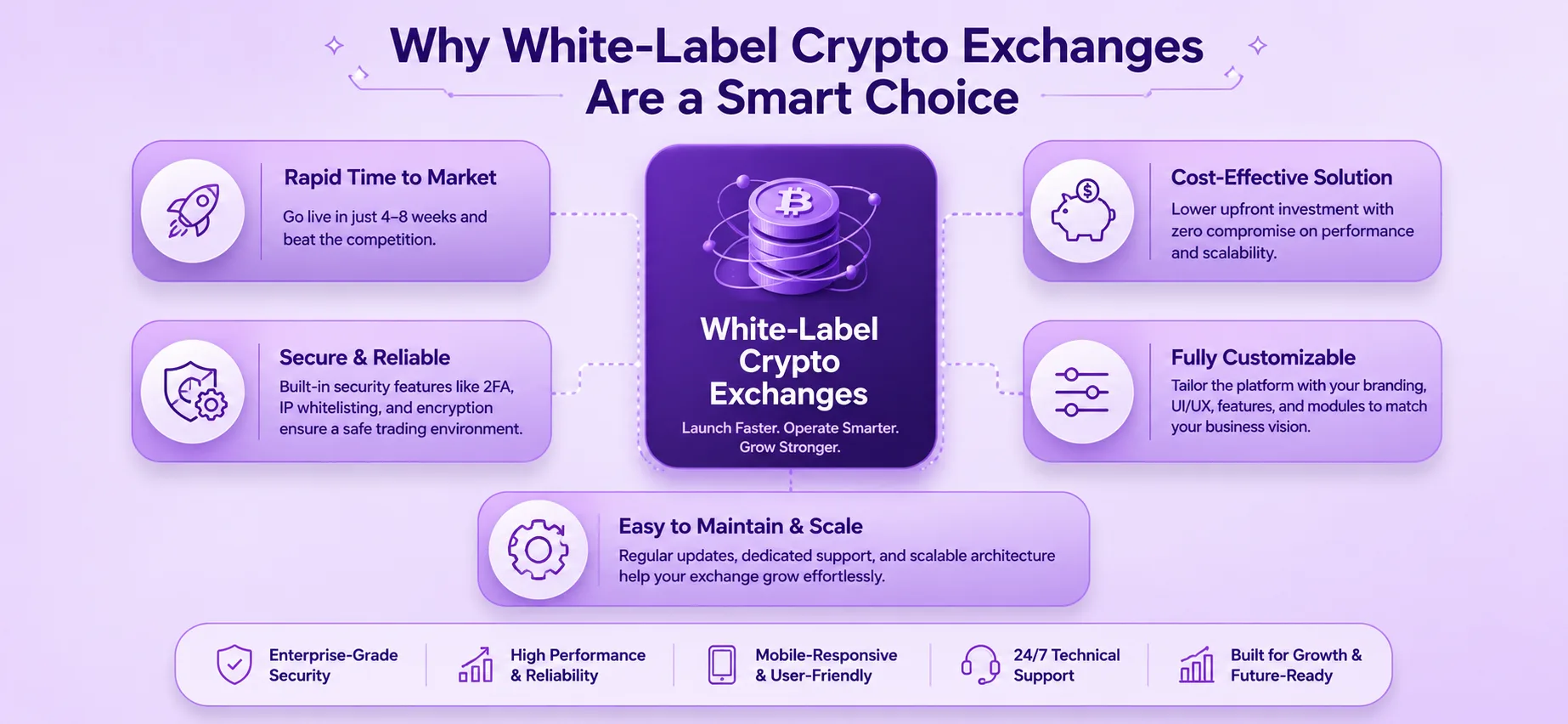
Key Features a White-Label Exchange EU Platform Must Include
Not all white-label exchange platforms are built equally. For the EU market under MiCA, a platform must include specific compliance-related features that go beyond what standard global exchange software provides. Here is what to verify before selecting a white-label exchange platform provider.
Integrated KYC and AML Engine
The platform must include automated identity verification at onboarding, ongoing transaction monitoring, sanctions screening, and suspicious activity reporting. These functions must be configurable to meet the standards of the NCA in the chosen member state. Some NCAs have jurisdiction-specific requirements beyond the MiCA baseline, particularly around source of funds documentation for high-value accounts.
Travel Rule Data Module
Travel Rule compliance requires the platform to collect originator and beneficiary data for every crypto transfer and exchange it with the receiving CASP before the transaction is processed. The platform must support the major Travel Rule messaging protocols used by other EU-registered CASPs.[6]
ESMA-Format Order Book Records
The platform must be capable of generating order book and trade records in ESMA’s standardized JSON schema format. This is a technical requirement that many older exchange software systems cannot meet without significant modification. Verify this explicitly with any platform vendor before signing a contract.
Client Fund Segregation Architecture
The platform’s wallet and account architecture must separate client assets from the exchange’s operational funds at the infrastructure level. This is not a policy choice but a technical requirement. The platform should support multi-custody wallet structures that enforce this segregation automatically.
Market Abuse Surveillance
MiCA requires exchanges to implement systems that detect and report suspected market manipulation, wash trading, and insider trading. The white-label platform should include automated trade pattern analysis tools that flag anomalous activity for compliance review.
White-Label vs. Custom Exchange: Cost and Timeline Comparison
The decision to use a white-label solution versus building a custom exchange from scratch is primarily a question of timeline and capital allocation. Both options can result in a fully MiCA-compliant exchange. The difference is how long it takes and what it costs to get there.
| Factor | White-Label Platform | Custom Build |
|---|---|---|
| Technical Deployment | 6 to 12 weeks | 12 to 18 months |
| Development Cost | License fee plus configuration | Full build cost ($300,000 to $1 million+) |
| MiCA Technical Modules | Pre-built if MiCA-ready platform | Must be built separately |
| CASP License Timeline | 3 to 6 months (runs in parallel) | 3 to 6 months (must follow build) |
| Customization Level | Moderate (branding, features, pairs) | Full control over all components |
| Maintenance | Platform provider handles core updates | Operator’s team responsible for all updates |
For a detailed breakdown of what each approach costs at different project scales, the comparison of white-label vs. custom exchange cost covers the full range of expenses including development, integration, compliance tooling, and ongoing maintenance for both models.
The commercial case for white-label is clearest for operators who need to enter the EU market before July 2026 and who do not have an existing technical team capable of building MiCA-compliant infrastructure from scratch. In 2025, more than 60 new crypto exchanges applied for MiCA licenses. Those that launched fastest were using white-label platforms that had compliance modules already built.
Step-by-Step: How to Launch Using a White-Label Exchange Platform Provider
The process from decision to live trading follows a predictable sequence when using a white-label exchange solution EU approach.
Step 1: Select a MiCA-Ready White-Label Provider
Verify that the provider’s platform specifically includes Travel Rule compliance, ESMA-format order book records, KYC and AML modules, DORA-aligned security infrastructure, and segregated client account architecture. Ask the provider to document how each MiCA technical requirement is addressed within their platform. Check the ESMA Interim MiCA Register to confirm the provider’s own compliance status if they also operate as a CASP.[7]
Step 2: Establish Your EU Legal Entity
Register a legal entity in the EU member state where you intend to apply for the CASP license. Appoint qualified senior management who can pass the NCA’s fit and proper assessment. Prepare the governance documentation, compliance policies, conflict of interest procedures, and business continuity plan that the CASP application will require.
Step 3: Deploy and Configure the Platform
Work with the white-label provider to deploy the platform, configure trading pairs, set fee structures, integrate with your banking and payment partners, and apply your branding. This phase typically takes 6 to 12 weeks. Compliance module configuration — including KYC thresholds, AML rules, and Travel Rule partner connections — should be completed in parallel with legal entity setup.
Step 4: Submit the CASP License Application
Submit a complete application to the chosen NCA. A complete application includes the business plan, governance documentation, proof of capital requirements, AML and KYC procedures, cybersecurity and DORA documentation, and technical descriptions of all systems. The NCA clock starts when the application is confirmed as complete, not when it is first submitted. Incomplete applications are returned without processing.
Step 5: Respond to NCA Queries and Obtain Authorization
Most NCAs issue follow-up questions during review. The speed of authorization depends heavily on how quickly and completely the applicant responds. Having legal and compliance counsel familiar with the specific NCA significantly reduces delays at this stage.
Step 6: Go Live and Use EU Passporting
Once CASP authorization is granted, the exchange is live in the home member state and can passport services across all other EU member states using the ESMA notification process. MiCA-compliant exchanges reported a 40% lower user churn rate than non-compliant platforms in 2025, reflecting the commercial value of operating within the regulated framework.
For teams evaluating providers and wanting to understand the full scope of what a professional White Label Crypto Exchange Development engagement covers, including platform architecture, compliance module specifications, and post-launch support structures, reviewing provider documentation in detail before committing to a contract is essential.
Launch a MiCA-Compliant White-Label Exchange in the EU
Nadcab Labs provides white-label crypto exchange solutions with built-in MiCA compliance modules including KYC, AML, Travel Rule, ESMA-format record keeping, client fund segregation, and DORA-aligned cybersecurity architecture for EU market entry.
Frequently Asked Questions
Q1.What is a MiCA-compliant white-label exchange?
A MiCA-compliant white-label exchange is a ready-made crypto exchange software platform built with all the technical requirements of the EU’s Markets in Crypto-Assets Regulation already integrated. This includes KYC, AML, Travel Rule compliance, ESMA-format order book records, client fund segregation, and DORA-aligned cybersecurity. The operator licenses it, brands it, and applies for a CASP license to operate legally in the EU.
Q2.What does MiCA require from crypto exchanges?
MiCA requires EU crypto exchanges to obtain a CASP license from a National Competent Authority, maintain minimum capital of €50,000 to €150,000, implement KYC and AML systems, comply with the Travel Rule for all transfers, maintain ESMA-format order book records, segregate client funds, implement DORA cybersecurity standards, and have qualified management who pass fit and proper assessments.
Q3.How long does CASP license application take?
Plan for 3 to 6 months from the date the NCA confirms your application is complete. Smaller member states such as Lithuania, Malta, and the Czech Republic process faster than larger ones such as France or Germany. The biggest variable is how quickly the applicant responds to NCA follow-up questions. Incomplete applications are returned and the clock restarts from scratch.
Q4.Which EU country is best for crypto licensing?
Lithuania, Malta, and the Czech Republic are commonly chosen for faster processing, lower operational costs, and regulators experienced with fintech licensing. France and Germany offer stronger institutional credibility but take longer. Any of these choices grants the same passporting rights across all 27 EU member states once authorization is issued.
Q5.What is the MiCA CASP deadline in 2026?
July 1, 2026 is the final EU-wide deadline for all crypto-asset service providers. After this date, any entity providing crypto exchange services to EU users without a valid CASP license will be in direct breach of EU law, subject to fines, shutdown orders, and blacklisting across the European Union. No further transitional periods will be available after this date.
Explore Services
Related Services
Reviewed by

Naman Singh
Co-Founder & CEO, Nadcab Labs
Naman Singh is the Co-Founder and CEO of Nadcab Labs, where he drives the company’s vision, global growth, and strategic expansion in blockchain, fintech, and digital transformation. A serial entrepreneur, Naman brings deep hands-on experience in building, scaling, and commercializing technology-driven businesses. At Nadcab Labs, Naman works closely with enterprises, governments, and startups to design and implement secure, scalable, and business-ready Web3 and blockchain solutions. He specializes in transforming complex ideas into high-impact digital products aligned with real business objectives. Naman has led the development of end-to-end blockchain ecosystems, including token creation, smart contracts, DeFi and NFT platforms, payment infrastructures, and decentralized applications. His expertise extends to tokenomics design, regulatory alignment, compliance strategy, and go-to-market planning—helping projects become investor-ready and built for long-term sustainability. With a strong focus on real-world adoption, Naman believes in building blockchain solutions that deliver measurable value, solve practical problems, and unlock new growth opportunities for organizations worldwide.