Ai Overview
At its simplest, Gen AI refers to artificial intelligence systems that can create new content. According to recent market research, the generative AI market is expected to reach USD 1,260. For content teams, drafting a 1,500-word article that once took four hours can now take under 30 minutes when generative AI tools handle the initial draft. This approach has consistently produced the strongest ROI for our clients across both markets.
Key Takeaways
- 01. Generative AI is a branch of artificial intelligence that produces original text, images, audio, code, and video by learning patterns from massive training datasets.
- 02. The global Gen AI market is projected to exceed USD 161 billion in 2026, growing at a CAGR of over 29% through 2034, signaling massive enterprise adoption worldwide.
- 03. Businesses in the UAE and India are rapidly integrating generative AI tools to cut operational costs, personalize customer experiences, and accelerate content production at scale.
- 04. Core Gen AI use cases span healthcare diagnosis, marketing automation, software engineering, education, and financial modeling across every major industry vertical.
- 05. Leading generative AI tools like ChatGPT, Midjourney, GitHub Copilot, and Gemini are already used daily by millions of professionals to save hours of repetitive work.
- 06. The key Gen AI benefits include faster content creation, reduced human error, improved customer personalization, and the ability to scale operations without proportional cost increases.
- 07. Responsible generative AI adoption requires clear governance frameworks, human oversight, bias monitoring, and data privacy compliance to manage associated ethical risks effectively.
- 08. Future Gen AI trends include multimodal AI agents, real-time personalization engines, and industry-specific foundation models tailored to domains like law, medicine, and finance.
- 09. Choosing the right Gen AI tools depends on your industry, use case, data sensitivity, budget, and the level of customization required for your specific business context.
- 10. Gen AI is not a passing trend. It is the foundational layer of the next wave of digital transformation that will define business competitiveness well into the 2030s globally.
Over the past eight years, we have helped businesses across India and the UAE harness the potential of generative AI to unlock automation, content intelligence, and smarter workflows. What once appeared a futuristic concept is now a core business capability reshaping how organizations in Dubai, Mumbai, Bengaluru, and beyond operate every single day. This guide covers everything from what AI is and how it works, to the best Gen AI tools, real-world Gen AI applications, and what the future holds for this transformative technology.
What Is Generative AI? A Simple Guide for Beginners
At its simplest, Gen AI refers to artificial intelligence systems that can create new content. Unlike traditional AI models that detect or classify existing data, Gen AI produces original outputs including text, images, code, audio, and video. It learns from vast datasets and identifies patterns, then uses those patterns to generate something entirely new on demand.
Think of it this way. When you ask a Gen AI model to write an email, design a logo, or produce a product description, it does not copy from a database. Instead, it generates fresh content based on the context you provide. This is what makes Gen AI applications so powerful and why they have become indispensable tools across businesses in Dubai’s tech ecosystem and India’s rapidly growing startup landscape.
The technology is powered by large language models (LLMs), generative adversarial networks (GANs), and diffusion models. Each architecture is suited to different content types. LLMs like GPT-4 and Gemini excel at text. GANs power image synthesis. Diffusion models are behind tools like Midjourney and DALL-E. Together, these form the backbone of modern Gen AI tools that businesses around the world are actively deploying today.
How Generative AI Works in Easy Words
Gen AI works through a training and generation cycle. During training, the model is exposed to enormous amounts of data, whether that is millions of web pages, images, or lines of code. It learns statistical patterns, relationships between words, pixel arrangements, or code syntax. This training is computationally intensive and requires significant infrastructure.
Once trained, the model enters the generation phase. When you type a prompt, the model predicts the most contextually appropriate output token by token, pixel by pixel, or note by note. This process happens in milliseconds and produces responses that feel remarkably human. The quality of the output is determined by how large and diverse the training data was, and how well the model was fine-tuned for your specific task.
Fine-tuning and reinforcement learning from human feedback (RLHF) then make these models even more accurate, helpful, and aligned with what real users actually want. This is why models like ChatGPT feel natural to interact with, even for users in non-technical roles.
Top Generative AI Tools You Should Know About
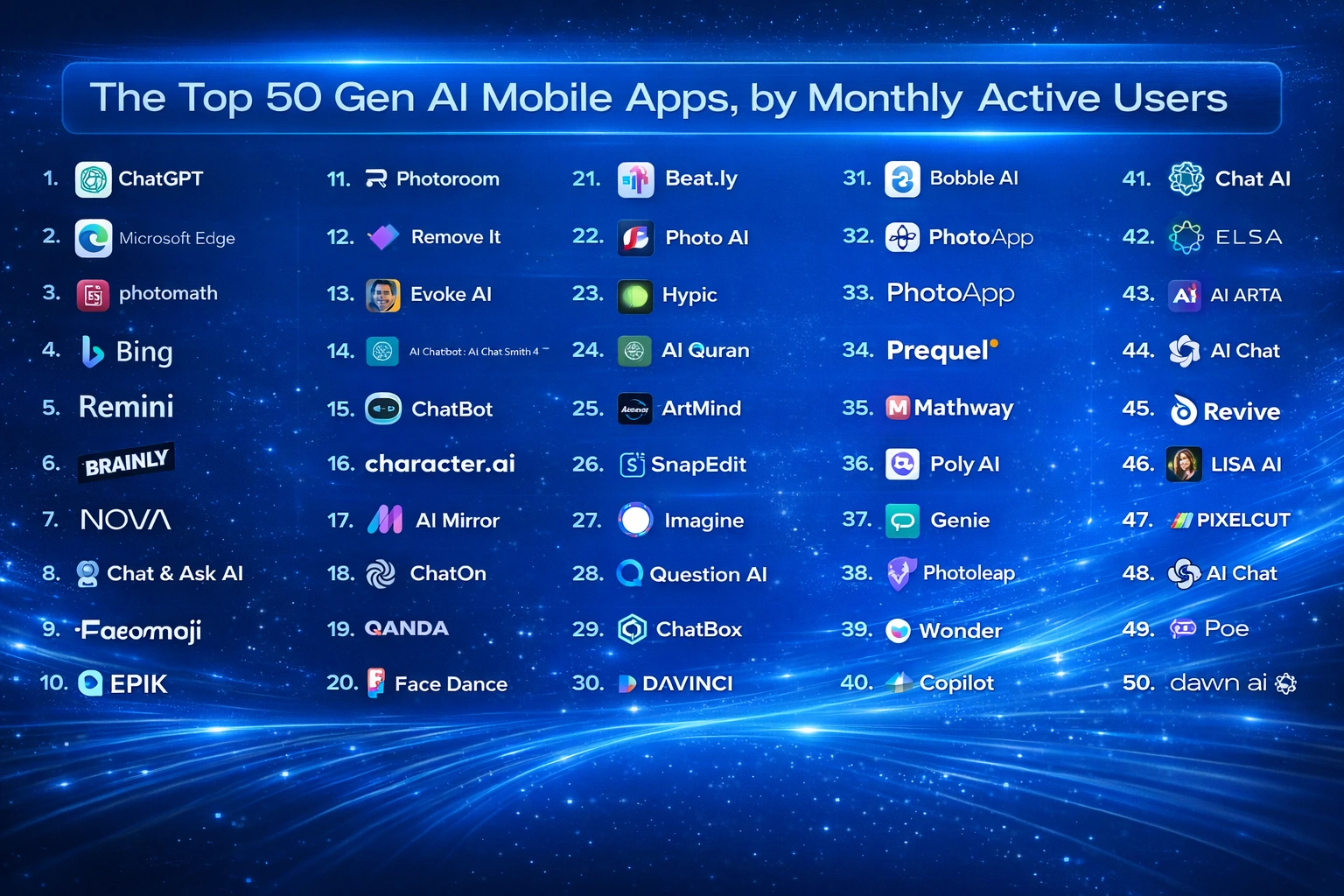
Having worked with businesses across India and the UAE for over eight years, we have evaluated dozens of Gen AI tools across categories. Here are the platforms that consistently deliver results in real-world deployments.
The most widely adopted text generative AI tool globally. Ideal for drafting, summarization, coding assistance, customer support scripts, and research. Available in free and enterprise tiers.
A leading image generative AI application for creating stunning visuals from text prompts. Extensively used by marketing agencies in Dubai and creative studios across India.
Purpose-built for engineers, GitHub Copilot is one of the most impactful generative AI tools for software teams. It suggests code, catches bugs, and writes tests in real time.
Google’s flagship generative AI model handles text, images, and data simultaneously. Deep integration with Google Workspace makes it highly practical for enterprise users.
A generative AI application that turns text scripts into professional-quality Training videos with AI avatars. Widely used by e-learning platforms in India and corporate trainers in the UAE.
Adobe’s generative AI toolkit is built for designers and creative professionals. It enables text-to-image, generative fill, and text effects directly inside familiar Adobe products.
Key Benefits of Generative AI for Businesses and Users
The Gen AI benefits are not merely theoretical. Our eight-year track record of implementing AI solutions across verticals in India and the UAE has shown us the following measurable advantages that businesses experience once they adopt these tools strategically.
Popular Generative AI Use Cases in Different Industries
Gen AI use cases span virtually every sector. Below is an overview of how different industries across India, the UAE, and globally are leveraging generative AI to solve real business problems today.
Industry-Wise Generative AI Use Cases Overview
| Industry | Primary Generative AI Use Cases | Business Impact |
|---|---|---|
| Healthcare | Medical report summarization, drug discovery, clinical note generation, patient communication | Reduced admin time by up to 40%, faster diagnostics |
| Marketing | Ad copy, email campaigns, social media content, SEO blog writing, campaign visuals | 70% faster content cycles, improved personalization |
| Finance | Risk analysis reports, fraud detection summaries, financial model narratives, regulatory filings | Improved compliance accuracy, significant time savings |
| Education | Personalized tutoring, curriculum generation, interactive quizzes, exam prep chatbots | Higher student engagement, scalable access to quality content |
| Retail & E-commerce | Product descriptions, recommendation engines, virtual try-on, chatbot customer service | Higher conversion rates, lower customer support costs |
| Real Estate (Dubai/India) | Property description generation, virtual staging, AI-powered chatbots for lead qualification | Faster listings, improved buyer experience, higher lead quality |
| Software Engineering | Code generation, bug fixing, test writing, documentation, code reviews | Up to 55% faster task completion for developers |
| Media & Entertainment | Script writing, video subtitling, music composition, localization, AI voice generation | Shorter production timelines, broader multilingual reach |
According to recent market research, the generative AI market is expected to reach USD 1,260.15 billion by 2034, driven by its accelerating integration across all of the industries listed above.[1]
Real-Life Generative AI Applications You Use Every Day
Generative AI applications are not confined to tech companies or research labs. They are woven into everyday products and platforms that billions of people use daily. You may already be benefiting from Gen AI without realizing it.
When Gmail suggests how to complete your sentence, that is Gen AI. When Spotify creates a weekly personalized playlist, that is generative AI at work. When you shop on Amazon and see product recommendations that feel oddly accurate, or when your favorite app’s chatbot answers a query in natural English, Gen AI is the engine behind it. In India, platforms like Swiggy and Zomato use Gen AI to craft hyper-personalized push notifications. In Dubai, real estate platforms deploy generative AI chatbots to qualify leads in both Arabic and English, 24 hours a day.
How Generative AI Helps Save Time and Increase Productivity
Productivity is where generative AI benefits become most tangible for everyday workers. McKinsey research has highlighted that generative AI could automate tasks accounting for 60 to 70 percent of employees’ work time. This translates to enormous value for businesses of all sizes, from a startup in Bengaluru to a multinational corporation in Dubai Media City.
For content teams, drafting a 1,500-word article that once took four hours can now take under 30 minutes when generative AI tools handle the initial draft. For customer support teams, generative AI applications can resolve the most common queries automatically with zero human intervention, freeing agents to handle only the most complex and sensitive issues.
Generative AI in Marketing, Healthcare, Education, and More
The breadth of Gen AI applications across industries deserves dedicated attention. Let us go deeper into the four sectors where we have observed the most significant transformation through generative AI Solutions.
Generative AI in Marketing
Marketing has been the fastest-adopting sector for Gen AI tools. Teams in Dubai’s thriving startup ecosystem and India’s massive e-commerce market are using generative AI to produce A/B tested ad copy, generate hundreds of product descriptions simultaneously, and create visual content for social media campaigns in minutes. Platforms like Jasper, Copy.ai, and Canva’s AI suite have democratized high-quality content production for businesses of every scale.
Generative AI in Healthcare
In healthcare, generative AI applications are beginning to transform clinical workflows. Hospitals in India are piloting AI-powered tools that summarize patient histories, flag drug interactions, and draft discharge summaries in seconds. In the UAE, Dubai Health Authority has been actively exploring AI-driven diagnostic support tools. Drug discovery pipelines are now accelerated by generative AI models that can predict molecular structures and protein interactions, compressing years of research into months.
Generative AI in Education
The education sector is experiencing a paradigm shift. EdTech platforms across India, including BYJU’S, Vedantu, and numerous regional e-learning providers, use Gen AI to personalize learning paths for millions of students. Gen AI tools can generate adaptive quiz questions, create practice papers aligned to specific syllabi, and produce explanatory content at different difficulty levels, often reflecting concepts covered in a generative ai certificate curriculum. For teachers, AI tools for teachers reduce the time spent on administrative and content creation tasks, leaving more room for meaningful student interaction.
Generative AI in Finance and Banking
Major banks and fintech companies in the UAE and India use Gen AI to draft financial analysis reports, power intelligent customer service chatbots, and generate regulatory compliance documentation. AI-generated risk narratives help analysts communicate complex quantitative data to non-technical stakeholders more clearly and efficiently than ever before.
Challenges and Risks of Using Generative AI
With nearly a decade of implementing AI-powered systems, we understand that acknowledging the risks of Gen AI is just as important as celebrating its benefits. No responsible expert should present this technology without a clear-eyed view of its current limitations and potential pitfalls.
Key Risks and Mitigation Strategies for Generative AI
| Risk Category | Description | Mitigation Approach |
|---|---|---|
| Hallucination | Models generate confident but factually incorrect information, creating trust and accuracy risks in high-stakes contexts. | Implement human-in-the-loop review processes and fact-checking workflows for all critical outputs. |
| Data Privacy | Proprietary data or personal information used in prompts may be retained or leaked through model training processes. | Use private or on-premise model deployments for sensitive data. Establish clear data governance policies. |
| Bias and Fairness | Generative AI models inherit biases from training data, potentially producing discriminatory or culturally insensitive outputs. | Regularly audit model outputs, fine-tune on diverse datasets, and maintain editorial oversight. |
| Copyright Issues | AI-generated content may inadvertently reproduce copyrighted material, exposing businesses to intellectual property liability. | Use commercially licensed AI tools and implement content originality checks before publication. |
| Over-Reliance | Teams may become dependent on generative AI tools, reducing critical thinking and eroding domain expertise over time. | Position AI as a collaborator, not a replacement. Maintain training programs for core human skills. |
Future Trends of Generative AI You Should Watch
The pace of change in Gen AI is extraordinary. Based on our ongoing work with clients across the UAE and India, combined with monitoring of leading research from OpenAI, Google DeepMind, and Anthropic, here are the most significant trends shaping the next phase of generative AI growth.
Next-generation generative AI tools will seamlessly process and generate text, images, audio, and video within a single agent, enabling fully autonomous business workflows.
Industry-specific generative AI models trained exclusively on legal, medical, or financial data will deliver superior accuracy and regulatory compliance compared to general-purpose models.
Brands in Dubai and India will deploy generative AI systems that adapt website content, product recommendations, and pricing in real time based on each user’s unique behavioral profile.
Both the UAE’s AI regulatory body and India’s emerging AI governance framework will formalize standards for responsible generative AI use, creating new compliance requirements for enterprises.
Lightweight generative AI models running directly on smartphones and edge devices will bring AI capabilities to users with limited connectivity, particularly in Tier 2 and Tier 3 cities across India.
Generative AI will increasingly be used to create high-quality synthetic training datasets, accelerating AI model training without the need for large volumes of real-world proprietary data.
How to Choose the Best Generative AI Tools for Your Needs
Selecting the right Gen AI tools for your business is a strategic decision that should not be made based on hype alone. After helping dozens of organizations across India and the UAE navigate this landscape, we recommend evaluating tools across five critical dimensions.
Generative AI Tool Selection Framework
| Evaluation Dimension | What to Ask | Why It Matters |
|---|---|---|
| Use Case Fit | Is this tool purpose-built for your specific task — text, image, code, or video? | A general-purpose tool often underperforms a specialized one in production settings. |
| Data Security | How does the vendor handle your data? Is there a private or enterprise deployment option? | Critical for businesses in regulated industries like healthcare and finance in the UAE and India. |
| Integration Capability | Does it offer APIs and connectors for your existing tech stack and workflows? | Seamless integration determines whether adoption succeeds or stalls after the pilot phase. |
| Cost and Scalability | What is the pricing model? Does cost scale linearly or exponentially with usage? | Surprising generative AI tool costs at scale have derailed several promising enterprise pilots. |
| Output Quality and Customization | Can the model be fine-tuned or instructed with your brand voice, domain knowledge, and style guidelines? | Generic outputs that do not match your brand reduce trust and increase editing overhead significantly. |
Start with a clear business problem, not a tool. Identify where time is being lost or where quality is inconsistent, then evaluate Gen AI tools that address that specific gap. Run structured pilots with defined success metrics before committing to enterprise-wide rollouts. This approach has consistently produced the strongest ROI for our clients across both markets.
Why Generative AI Is the Future of Innovation
Over our eight-plus years in this space, we have seen many technologies described as transformative. Most delivered incremental value. Gen AI is genuinely different. It is not a point solution for a narrow problem. It is a general-purpose intelligence layer that can augment virtually every knowledge-intensive function in a modern organization.
The UAE has made generative AI a cornerstone of its National AI Strategy 2031, aiming to become a global hub for AI innovation and application. India, with its deep engineering talent pool and billion-user digital market, is positioned to be one of the largest consumers and producers of generative AI solutions in the world. Businesses in both regions that invest in generative AI capabilities today will find themselves structurally advantaged as the technology matures.
The key is intentionality. Businesses that approach Generative AI with a clear strategy, strong governance, and a focus on genuine problem-solving will extract disproportionate value. Those that chase every new model or tool without strategic alignment will find themselves with impressive demos and disappointing results..
Gen AI is not the future. It is already the present for thousands of businesses globally. The question now is not whether to adopt it, but how thoughtfully and quickly you can build organizational capability around it. That is the challenge we help businesses solve every day, and it is a challenge that the most competitive companies in India and the UAE are already treating as a strategic priority.
Ready to Implement Generative AI in Your Business?
From strategy to execution, we help companies in India and UAE integrate generative AI tools that deliver measurable ROI and competitive advantage fast.
People Also Ask
Q1.1. What is generative AI in simple terms?
Generative AI is a type of artificial intelligence that creates new content like text, images, audio, and video by learning patterns from existing data. It can write articles, generate designs, and even compose music on its own.
Q2.2. How is generative AI different from regular AI?
Regular AI recognizes or classifies existing data, while generative AI creates entirely new content. For example, regular AI identifies a cat in a photo, but generative AI can draw a brand new cat from scratch based on a text prompt.
Q3.3. What are the most popular generative AI tools available today?
Popular generative AI tools include ChatGPT for text, Midjourney and DALL-E for images, GitHub Copilot for coding, and Synthesia for video. These tools are widely used by businesses across India and UAE to boost productivity.
Q4.4. Is generative AI safe to use for businesses?
Generative AI is generally safe when used responsibly with proper data governance. Businesses in Dubai and India are increasingly adopting it with compliance frameworks to ensure data privacy and ethical usage across different industries.
Q5.5. Can generative AI replace human jobs?
Generative AI automates repetitive tasks but does not fully replace humans. It works best as a productivity tool that handles drafting, designing, and analysis so professionals can focus on strategy, creativity, and complex decision-making.
Q6.6. What industries are using generative AI the most?
Q7.7. How does generative AI help in marketing?
Generative AI helps marketers create ad copy, social media posts, product descriptions, and email campaigns at scale. It personalizes content for different audiences and reduces the time and cost of content production dramatically.
Q8.8. What are the risks of using generative AI?
Key risks include generating inaccurate information, copyright concerns, data privacy issues, and potential misuse for creating fake content. Organizations must implement clear usage policies and human oversight when deploying generative AI tools.
Q9.9. How much does it cost to use generative AI tools?
Costs vary widely. Free tiers exist for tools like ChatGPT and Canva AI, while enterprise solutions can cost hundreds to thousands of dollars monthly. Indian and UAE startups often start with freemium plans before scaling to paid tiers.
Q10.10. What is the future of generative AI in the next five years?
Generative AI will become deeply embedded in every industry workflow, from personalized medicine to autonomous content pipelines. Experts predict multimodal AI, real-time collaboration agents, and industry-specific models will dominate the next wave of innovation.
Explore Services
Related Services
Reviewed by

Aman Vaths
Founder of Nadcab Labs
Aman Vaths is the Founder & CTO of Nadcab Labs, a global digital engineering company delivering enterprise-grade solutions across AI, Web3, Blockchain, Big Data, Cloud, Cybersecurity, and Modern Application Development. With deep technical leadership and product innovation experience, Aman has positioned Nadcab Labs as one of the most advanced engineering companies driving the next era of intelligent, secure, and scalable software systems. Under his leadership, Nadcab Labs has built 2,000+ global projects across sectors including fintech, banking, healthcare, real estate, logistics, gaming, manufacturing, and next-generation DePIN networks. Aman’s strength lies in architecting high-performance systems, end-to-end platform engineering, and designing enterprise solutions that operate at global scale.