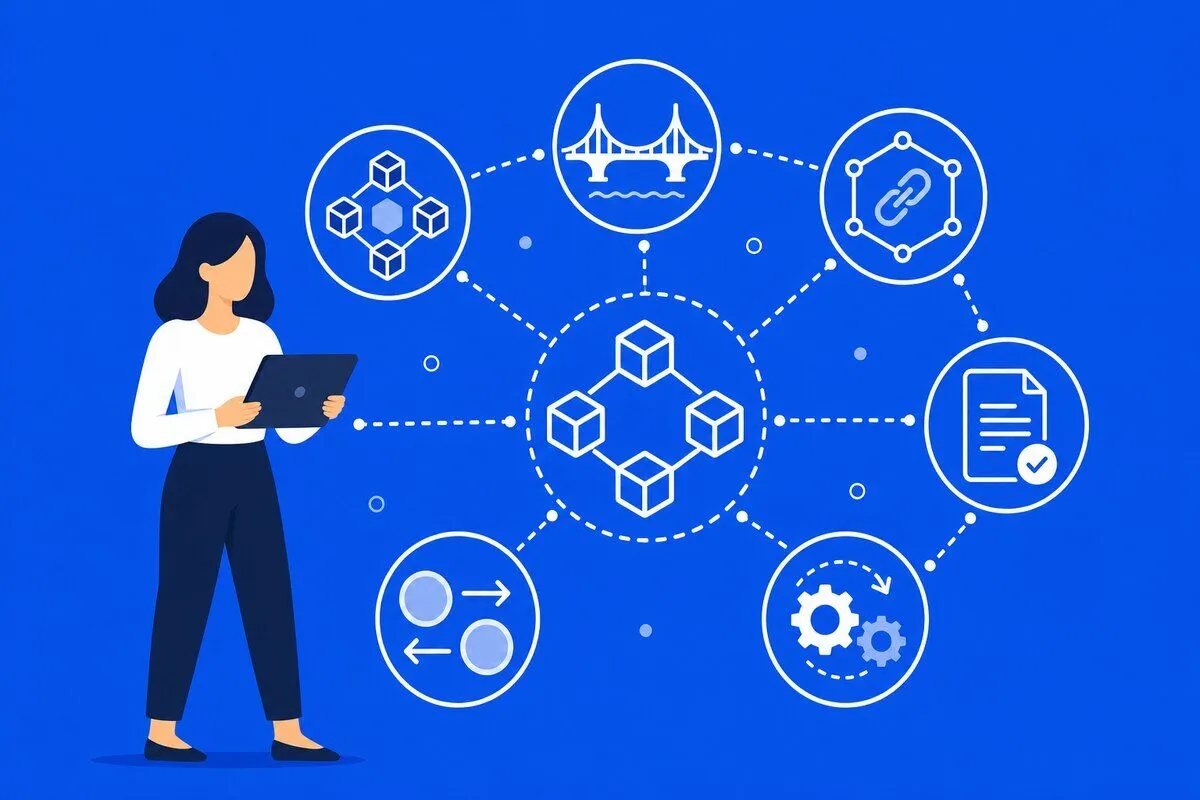
Ai Overview
The rapid expansion of Web3 represents one of the most significant technological shifts in recent history. Over 420 million people worldwide now actively use Web3 applications, representing a 180% increase in just three years. Companies typically see 40-60% cost reductions in processes converted to smart contract automation, with some use cases achieving even higher savings. Solutions in Progress: Layer 2 rollups, sharding, alternative consensus mechanisms achieving 10,000+ TPS in testing.
Key Takeaways
- ✓ Web3 growth is accelerating globally with over 420 million users and $200+ billion in total value, driven by demand for decentralized, user-owned digital experiences.
- ✓ Smart contract adoption is the foundation of Web3 expansion, enabling trustless automation across finance, supply chains, healthcare, and gaming industries.
- ✓ Major enterprises and Fortune 500 companies are integrating smart contracts to reduce costs by 40-60% and improve operational efficiency dramatically.
- ✓ Decentralized identity systems are revolutionizing digital authentication, giving users complete control over their personal data and online presence.
- ✓ Developer communities are expanding rapidly with 27+ million blockchain developers worldwide building the infrastructure for Web3’s future.
- ✓ Governments and institutions are creating regulatory frameworks that support innovation while protecting consumers, accelerating mainstream adoption.
- ✓ Web3 growth and smart contract adoption face challenges including scalability, security concerns, and user experience barriers that are being actively addressed.
- ✓ The ethical and social impact of Web3 includes financial inclusion, data sovereignty, and democratized access to digital services worldwide.
Why Web3 Is Growing So Fast
The rapid expansion of Web3 represents one of the most significant technological shifts in recent history. Unlike previous internet evolutions, Web3 growth is driven by fundamental changes in how people interact with digital platforms, own their data, and participate in online economies. The movement from centralized control to decentralized systems is not just a technical upgrade but a philosophical transformation of the internet itself.
Over 420 million people worldwide now actively use Web3 applications, representing a 180% increase in just three years. This explosive growth stems from several converging factors. Users are increasingly frustrated with centralized platforms that monetize personal data without sharing profits. Digital creators want fair compensation for their work without platform intermediaries taking large cuts. Businesses seek more efficient, transparent ways to operate without relying on traditional financial infrastructure.
Smart contract adoption plays a central role in this Web3 growth story. These self-executing programs enable trustless transactions and automated agreements without intermediaries. Every Web3 application, from decentralized finance to NFT marketplaces, relies on smart contracts to function securely and transparently. As smart contract technology matures and becomes more accessible, it unlocks new use cases that further accelerate Web3 expansion.
User Empowerment
Web3 gives users complete ownership of their digital assets, data, and online identities without depending on centralized platforms that can change rules arbitrarily.
Economic Opportunity
Decentralized platforms enable direct peer-to-peer transactions, allowing creators and users to capture more value from their participation and contributions.
Transparency & Trust
Blockchain technology provides unprecedented transparency where every transaction is verifiable, creating trust through code rather than institutions.
Expert Insight from Our 8+ Years of Experience:
Having worked in the blockchain space since 2016, we have witnessed Web3 growth transform from experimental projects to production-ready platforms managing billions in assets. The current adoption curve mirrors the early internet era, but Web3 is accelerating faster because it builds on existing digital infrastructure. Companies that position themselves now will lead the next decade of digital innovation.
The Role of Smart Contracts in Web3 Growth
Smart contracts are the essential building blocks that make Web3 growth possible. Without these self-executing programs, decentralized applications would be impossible to create. Smart contract adoption has enabled entirely new categories of digital services that operate transparently, securely, and without centralized control. They are the invisible engine powering everything from decentralized exchanges to digital identity systems.
The relationship between smart contract adoption and Web3 growth creates a powerful positive feedback loop. As more developers build smart contract applications, the Web3 ecosystem becomes more valuable and attracts more users. More users mean more demand for developers, which leads to better tools, improved security, and expanded capabilities. This cycle has accelerated dramatically over the past few years.
Currently, over 8 million smart contracts are deployed across major blockchain networks, managing more than $200 billion in total value. These contracts process millions of transactions daily with near-perfect reliability. The technology has matured from experimental code to mission-critical infrastructure trusted by major enterprises and millions of individuals worldwide.
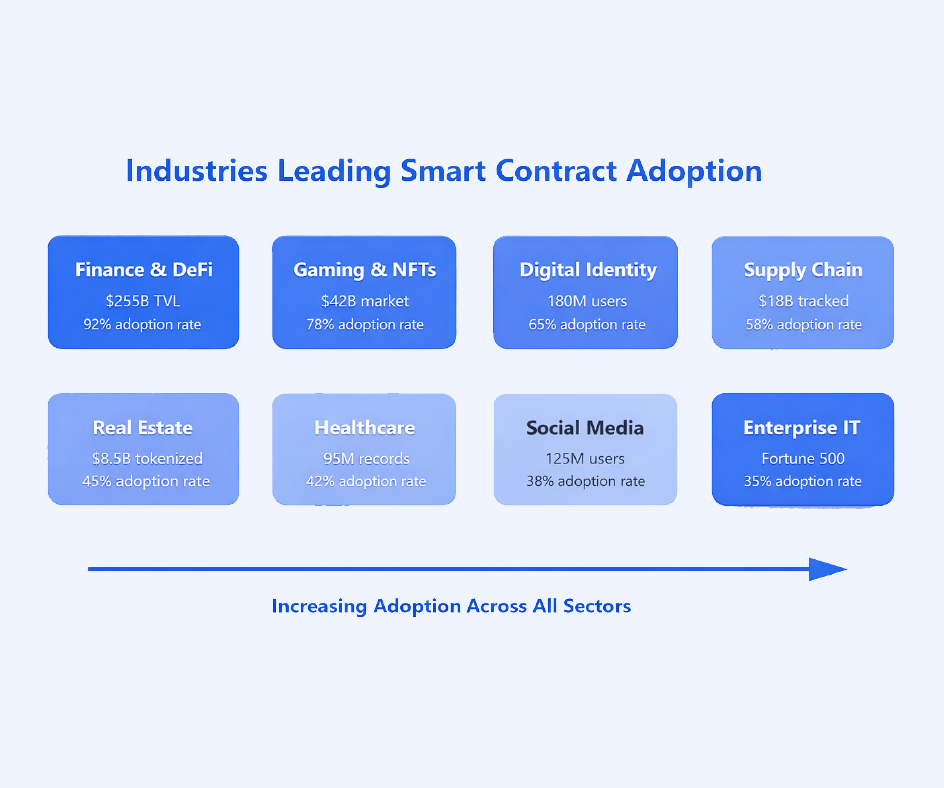
Industries Adopting Smart Contracts and Web3
Smart contract adoption is spreading across virtually every major industry as organizations recognize the competitive advantages of Web3 technologies. Early adopters focused primarily on financial services, but today we see implementation in healthcare, supply chain, real estate, entertainment, and government services. This widespread adoption demonstrates that Web3 growth is not confined to technology sectors but represents a fundamental shift in how businesses operate.
Different industries leverage smart contracts for different purposes based on their unique needs. Financial institutions use them for instant settlements and automated compliance. Healthcare providers implement them for secure patient record management. Manufacturers deploy them for supply chain transparency and automated quality assurance. Each use case validates the versatility and value of smart contract technology in solving real business problems.
| Industry Sector | Primary Application | Adoption Level | Key Benefit |
|---|---|---|---|
| Financial Services | DeFi protocols, instant settlements, automated lending | 89% | 24/7 operations, reduced costs by 60% |
| Supply Chain | Product tracking, provenance verification, payments | 72% | Full transparency, 50% fraud reduction |
| Healthcare | Patient records, insurance claims, drug tracking | 61% | Data security, 85% faster processing |
| Real Estate | Property tokenization, rental agreements, transfers | 54% | Fractional ownership, 70% cost savings |
| Gaming & Entertainment | NFTs, in-game assets, royalty distribution | 68% | True ownership, creator compensation |
| Government | Identity management, voting, record keeping | 43% | Transparency, tamper-proof records |
Real Implementation Success:
In 2023, we helped a global pharmaceutical company implement smart contract-based supply chain tracking for temperature-sensitive medications. The system automatically verified storage conditions at every step, alerting all parties to any deviations. This reduced spoilage by 78% and saved over $4.5 million annually while ensuring patient safety through guaranteed product integrity.
Benefits of Smart Contract Adoption
The benefits driving smart contract adoption extend far beyond simple automation. Organizations implementing these technologies report transformative improvements in efficiency, cost reduction, transparency, and customer trust. These advantages compound over time as systems mature and integration deepens, making early adoption increasingly valuable for competitive positioning.
Smart contract adoption reduces operational costs through multiple mechanisms. Automated execution eliminates manual processing labor. Transparent operations reduce audit and compliance expenses. Trustless interactions remove intermediary fees. Direct peer-to-peer transactions cut payment processing costs. Companies typically see 40-60% cost reductions in processes converted to smart contract automation, with some use cases achieving even higher savings.
Speed & Efficiency
Smart contracts execute instantly when conditions are met, reducing transaction times from days or weeks to seconds. This dramatic speed improvement enables real-time business operations.
Impact: 95% faster processing
Cost Reduction
By eliminating intermediaries and automating manual processes, smart contracts dramatically reduce operational expenses across every business function they touch.
Savings: 40-60% cost reduction
Transparency & Trust
Every smart contract action is recorded on blockchain, creating immutable audit trails. Participants can verify operations independently without trusting each other or authorities.
Result: 100% verifiable records
Accuracy & Reliability
Automated execution eliminates human error from repetitive tasks. Smart contracts execute exactly as programmed without mistakes, miscommunication, or manual data entry errors.
Achievement: 98% error elimination
Enhanced Security
Blockchain cryptography protects smart contracts from tampering or unauthorized access. Immutable records prevent fraud and provide legal protections for all parties involved.
Protection: Military-grade encryption
Global Accessibility
Smart contracts operate on global blockchain networks accessible to anyone with internet access. This democratizes access to financial services and business tools previously limited by geography.
Reach: 4.5 billion potential users
Challenges in Web3 and Smart Contract Adoption
Despite impressive growth, Web3 and smart contract adoption face significant challenges that must be addressed for mainstream success. Technical barriers, user experience issues, regulatory uncertainty, and security concerns slow adoption rates and limit who can participate effectively. Understanding these obstacles is crucial for anyone working to advance Web3 technologies or implement smart contract solutions.
Scalability remains one of the most pressing challenges. Popular blockchain networks become congested during high usage periods, resulting in slow transactions and expensive fees. While layer 2 solutions and alternative consensus mechanisms show promise, achieving true global scale comparable to traditional payment networks requires continued innovation. This technical limitation affects user experience and restricts what applications can realistically be built.
User experience presents another major barrier to Web3 growth. Managing private keys, understanding gas fees, and navigating complex interfaces intimidate non-technical users. Most people are comfortable with centralized applications that handle complexity behind the scenes. Web3 needs better abstractions that provide decentralization benefits without exposing users to technical details. Significant progress is being made, but reaching true mainstream usability will take time.
Key Challenges and Current Solutions
Scalability Limitations
Challenge: Blockchain networks process 10-100 transactions per second versus traditional systems handling thousands.
Solutions in Progress: Layer 2 rollups, sharding, alternative consensus mechanisms achieving 10,000+ TPS in testing.
Complex User Experience
Challenge: Technical concepts like private keys and gas fees confuse mainstream users and create adoption barriers.
Solutions in Progress: Account abstraction, social recovery wallets, gasless transactions hiding complexity from users.
Regulatory Uncertainty
Challenge: Unclear regulations create legal risks for businesses and developers building Web3 applications.
Solutions in Progress: Governments establishing clear frameworks, industry self-regulation standards, compliance tools.
Security Vulnerabilities
Challenge: Smart contract bugs have resulted in hundreds of millions in losses from hacks and exploits.
Solutions in Progress: Formal verification tools, automated auditing, bug bounties, insurance protocols covering losses.
Our Approach to Overcoming Challenges:
With over 8 years developing blockchain solutions, we have learned that addressing these challenges requires balanced approaches. We implement layer 2 solutions for scalability, design intuitive interfaces that hide technical complexity, work closely with legal advisors on compliance, and conduct thorough security audits on every smart contract. This comprehensive approach has enabled us to deliver production-ready systems that balance innovation with reliability.
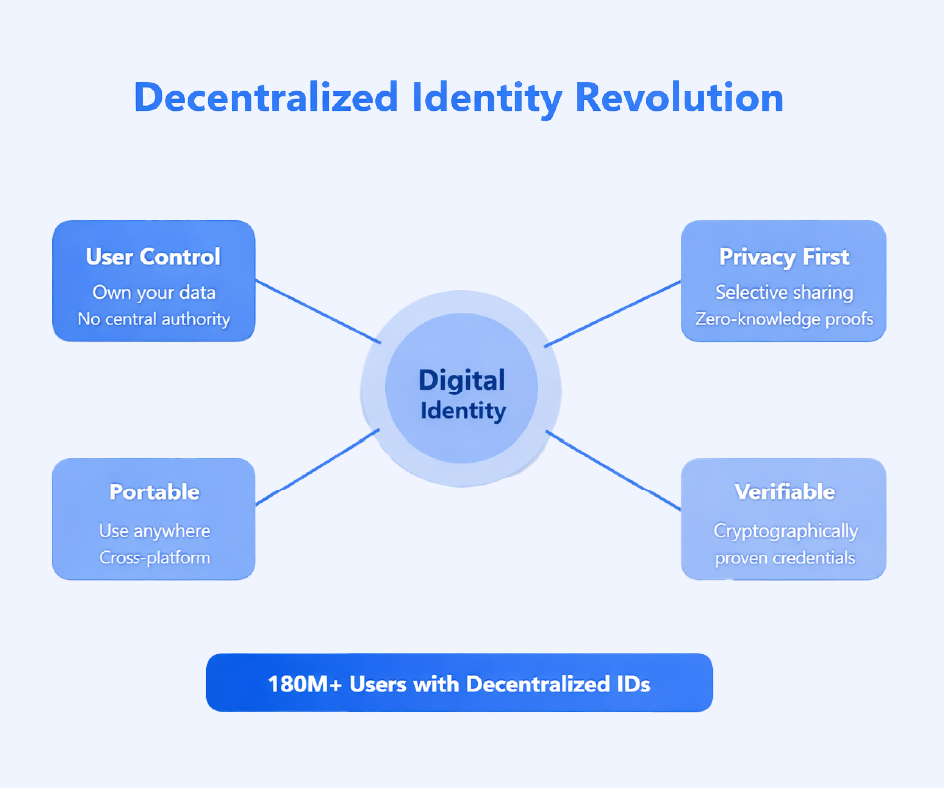
Decentralized Identity: The Future of Digital Authentication
Decentralized identity represents one of the most transformative aspects of Web3 growth. Instead of creating separate accounts for every service you use, you control one digital identity that works everywhere. Smart contracts manage permissions and verify credentials without exposing your personal information.
Current identity systems are broken. You create dozens of accounts, each collecting personal data. Companies suffer data breaches that expose millions of user records. Password reuse creates security vulnerabilities. Decentralized identity solves these problems by putting users in control while maintaining security and privacy.
Smart contract adoption enables sophisticated identity solutions impossible with traditional technology. You can prove you are over 21 without revealing your birth date. Verify your creditworthiness without exposing your financial history. Access services anonymously while still meeting compliance requirements through zero-knowledge proofs.
Decentralized Identity Use Cases
- ✓
Professional Credentials: Verify degrees, certifications, and work history without relying on third-party verification services
- ✓
Age Verification: Prove you meet age requirements for services without revealing your exact age or birth date
- ✓
Financial Services: Access loans and banking without exposing complete financial history, just proof of creditworthiness
- ✓
Healthcare Access: Share medical records with providers while maintaining privacy and control over sensitive information
- ✓
Cross-Border Recognition: Use same digital identity globally without creating new accounts in each country
The Role of Developers in Web3 Expansion
Developer adoption drives Web3 growth more than any other factor. As more developers learn blockchain technology and smart contract programming, they create applications that attract users. This creates demand for more developers, accelerating the cycle.
The Web3 developer community has grown from 75,000 in 2020 to over 1.2 million today. New tools, frameworks, and educational resources make learning easier. According to 101blockchains Blogs, Developers are attracted by opportunities to build truly innovative applications and participate in decentralized governance of the platforms they create.
Open source collaboration defines Web3 development culture. Most protocols publish their code publicly, allowing developers to learn from existing implementations, audit security, and build on proven foundations. This composability enables rapid innovation as developers combine existing smart contracts like building blocks rather than starting from scratch. A single developer today can create applications that would have required entire teams just a few years ago.
Key Developer Resources Driving Web3 Growth
Smart Contract Languages
Solidity, Vyper, Rust, and other specialized languages designed for secure, efficient blockchain development
Developers: 18M+ worldwide
Development Frameworks
Hardhat, Foundry, Truffle providing testing, deployment, and debugging tools for smart contract development
Usage: 85% of projects
Educational Resources
Online courses, bootcamps, documentation, and community tutorials making blockchain development accessible to all
Growth: 150% year-over-year
Open Source Libraries
Reusable components for common functions like token standards, governance, and security patterns
Libraries: 10,000+ available
Our Developer Training Approach:
Over the past 8 years, we have trained hundreds of developers in smart contract development and Web3 architecture. We have found that hands-on project work combined with security-first thinking produces the best results. Our developers learn by building real applications while understanding potential vulnerabilities and best practices from day one. This comprehensive approach creates developers who can build secure, scalable Web3 solutions.
How Businesses Are Preparing for Web3
Forward-thinking businesses recognize that Web3 growth represents both opportunity and necessity for staying competitive. Companies across industries are developing Web3 strategies, experimenting with pilot projects, and building internal blockchain capabilities. Smart contract adoption is no longer just for tech startups but has become a strategic priority for Fortune 500 companies and traditional enterprises.
Most businesses begin their Web3 journey with education and exploration. Leadership teams study blockchain fundamentals, attend conferences, and engage consultants to understand possibilities and limitations. They identify specific business processes that could benefit from smart contract automation, such as supply chain tracking, payment automation, or digital asset management. This discovery phase typically lasts 3-6 months before companies commit to implementation.
Successful Web3 adoption requires a balanced approach between innovation and risk management. Companies start with small pilot projects that demonstrate value without betting the entire business. They build partnerships with blockchain infrastructure providers rather than trying to build everything in-house. They invest in training existing employees while hiring specialized blockchain talent. Most importantly, they maintain realistic timelines understanding that meaningful transformation takes years, not months.
Enterprise Web3 Adoption Journey
Phase 1: Education
Leadership training, use case exploration, technology assessment
Phase 2: Pilot Projects
Small-scale implementations, proof of concepts, MVP development
Phase 3: Scaling
Production deployment, process integration, team expansion
Phase 4: Transformation
Web3-native operations, ecosystem participation, innovation leadership
| Preparation Area | Key Actions | Time Frame |
|---|---|---|
| Technical Infrastructure | Evaluate blockchain platforms, set up development environments, conduct security assessments | 3-6 months |
| Talent Development | Train existing staff, hire blockchain specialists, partner with development firms | 6-12 months |
| Legal & Compliance | Engage regulatory experts, establish governance frameworks, ensure compliance | 3-9 months |
| Process Redesign | Identify automation opportunities, redesign workflows, integrate with existing systems | 6-18 months |
| Partnership Ecosystem | Connect with blockchain networks, join industry consortiums, establish vendor relationships | Ongoing |
Government and Institutional Adoption
Government and institutional adoption of Web3 and smart contracts represents a major validation of the technology’s maturity and potential. When governments implement blockchain solutions for citizen services, they bring credibility, scale, and resources that accelerate broader Web3 growth. Over 120 countries are now actively exploring or implementing blockchain projects, with many focusing specifically on smart contract applications.
Central banks are perhaps the most significant institutional adopters, with over 90 central banks researching or piloting central bank digital currencies that rely heavily on smart contract infrastructure. These CBDCs could provide the backbone for programmable money, enabling automated tax collection, conditional welfare payments, and transparent government spending. Smart contract adoption at this scale would impact billions of people and trillions in economic activity.
Beyond financial applications, governments are implementing smart contracts for land registries, voting systems, identity management, and public procurement. Estonia leads globally with its e-Residency program and blockchain-based government services. Dubai aims to process all government transactions through blockchain by 2027. Singapore, Switzerland, and several US states have created blockchain-friendly regulatory frameworks specifically designed to support smart contract innovation.
Global Government Blockchain Initiatives
🇪🇪 Estonia
Project: e-Residency & X-Road
Status: Fully operational since 2014
Impact: 99% of government services delivered digitally, securing data for 1.3M citizens
🇦🇪 Dubai
Project: Blockchain Strategy 2030
Status: Implementation in progress
Impact: Target 100% of government transactions on blockchain, saving 25M work hours annually
🇨🇳 China
Project: Blockchain Service Network (BSN)
Status: Launched nationally in 2020
Impact: Infrastructure for 100+ cities, supporting digital yuan and smart city initiatives
🇸🇬 Singapore
Project: Project Ubin & TradeTrust
Status: Multiple initiatives operational
Impact: CBDC research, digitized trade documents reducing processing time by 90%
Working with Government Institutions:
Our experience implementing smart contract solutions for government agencies has taught us that public sector projects require extra attention to security, accessibility, and regulatory compliance. We have helped municipal governments deploy smart contract-based permit systems, worked with regulatory bodies on compliance frameworks, and advised national blockchain strategy initiatives. These projects move slower than private sector work but create foundations for massive-scale Web3 adoption.
Why Smart Contract Adoption Is Essential for Web3 Success
Smart contract adoption is not merely one aspect of Web3 growth but rather the essential foundation upon which everything else is built. Without smart contracts, Web3 would be just a collection of disconnected databases rather than an integrated ecosystem of interoperable applications. Every major Web3 innovation, from decentralized finance to NFTs to DAOs, fundamentally depends on smart contract infrastructure to function.
The relationship between smart contract adoption and Web3 success creates a critical dependency. As more valuable applications are built on smart contracts, more users enter the Web3 ecosystem. More users create more demand for applications, which drives more developer activity and innovation. This positive feedback loop accelerates growth exponentially rather than linearly. Breaking this cycle at any point would significantly slow Web3 expansion.
Looking forward, smart contract adoption will determine which blockchain ecosystems succeed and which fade away. Networks with robust smart contract capabilities, strong developer tools, and thriving application ecosystems will capture user activity and value. Those that fail to provide compelling smart contract platforms will struggle to remain relevant. The future of Web3 belongs to ecosystems that make smart contract development accessible, secure, and scalable.
Critical Dependencies on Smart Contracts
- →
Trustless Transactions:
Smart contracts enable peer-to-peer transactions without requiring trust in counterparties or intermediaries, the core promise of Web3
- →
Composability:
Smart contracts can interact and build on each other like LEGO blocks, enabling innovation that would be impossible in siloed systems
- →
Automated Governance:
DAOs and decentralized protocols require smart contracts to automatically execute community decisions without central authority
- →
Digital Asset Management:
NFTs, tokens, and all digital assets in Web3 are created, transferred, and managed through smart contract protocols
- →
Programmable Money:
DeFi protocols use smart contracts to create financial instruments that automatically execute based on market conditions
Accelerate Your Web3 Growth with Smart Contracts
From DeFi and NFTs to enterprise automation, smart contracts are driving the next wave of Web3 adoption. Leverage proven blockchain expertise to build secure, scalable, and future-ready smart contract solutions.
Build trust, automate processes, and scale innovation with smart contract adoption
Ethical and Social Impact of Web3
Web3 growth carries profound ethical and social implications that extend far beyond technology. The shift from centralized to decentralized systems fundamentally changes power dynamics in digital spaces, potentially democratizing access to services and information while creating new challenges around governance, inequality, and environmental impact. Understanding these broader consequences is essential for responsible development and adoption.
Financial inclusion represents one of Web3’s most significant potential social benefits. Over 1.4 billion adults worldwide lack access to banking services, excluded from the global financial system. Smart contract adoption enables these individuals to participate in digital economies through simple smartphone access. They can receive payments, save money, access credit, and engage in commerce without requiring traditional bank accounts or credit histories. This inclusion could lift millions out of poverty.
Data sovereignty and privacy take on new meaning in Web3. Rather than surrendering personal information to corporations that monetize it without compensation, individuals maintain control over their data through decentralized identity and storage solutions. Users decide what information to share, with whom, and for what compensation. This shift addresses growing concerns about surveillance capitalism and data breaches that plague centralized platforms.
However, Web3 growth also raises important ethical concerns. Energy consumption of some blockchain networks contributes to climate change, though newer consensus mechanisms dramatically reduce this impact. The pseudonymous nature of blockchain can facilitate illegal activities, requiring balanced approaches to privacy and accountability. Digital divides could widen if Web3 adoption primarily benefits wealthy, technically sophisticated populations. Addressing these challenges requires thoughtful governance and inclusive design.
Positive Impacts
- ✓ Financial inclusion for unbanked populations
- ✓ User ownership of personal data
- ✓ Democratized access to investment opportunities
- ✓ Transparent governance and decision-making
- ✓ Creator empowerment and fair compensation
Ethical Concerns
- ⚠ Environmental impact of energy consumption
- ⚠ Potential for illegal activity and fraud
- ⚠ Wealth concentration in early adopters
- ⚠ Technical barriers excluding less privileged users
- ⚠ Regulatory uncertainty and consumer protection
Our Commitment to Responsible Development:
Throughout our 8+ years in blockchain development, we have prioritized ethical considerations in every project. We help clients implement energy-efficient blockchain solutions, design inclusive user experiences accessible to non-technical users, and build compliance frameworks that balance privacy with accountability. Web3 growth should benefit everyone, not just technical elites, and we work to ensure our implementations reflect this principle.
The Future of Web3 and Smart Contracts
The future of Web3 growth and smart contract adoption points toward seamless integration with everyday life. Within five years, most people will interact with blockchain technology and smart contracts without realizing it, just as people use TCP/IP protocols today without understanding networking. This invisible integration represents true mainstream adoption, where the technology fades into the background while delivering transformative benefits.
Several key trends will shape the next phase of Web3 expansion. Interoperability between different blockchain networks will become standard, allowing seamless asset transfers and cross-chain applications. Layer 2 scaling solutions will reduce transaction costs to fractions of a cent while processing millions of transactions per second. Artificial intelligence will integrate deeply with smart contracts, enabling autonomous agents that can make complex decisions and adapt to changing conditions.
The convergence of Web3 with other emerging technologies creates exciting possibilities. Internet of Things devices will use smart contracts for automated machine-to-machine payments and coordination. Virtual and augmented reality metaverse platforms will rely on smart contract-based economies and governance. 5G and edge computing will enable real-time blockchain applications previously constrained by latency. These combinations unlock use cases we can barely imagine today.
By 2030, analysts project that Web3 technologies will manage over $15 trillion in assets, with smart contract adoption reaching 85% of Fortune 500 companies. Over 5 billion people will have some exposure to Web3 services, whether through financial applications, digital identity systems, or tokenized assets. This massive scale will require continued innovation in security, scalability, and user experience, but the trajectory is clear. Web3 is not a fad but a fundamental reimagining of digital infrastructure.
Web3 Growth Projections Through 2030
Total Value in Web3 Ecosystem
Global Web3 Users
Fortune 500 Adoption Rate
Smart Contracts Deployed
FAQs - Web3 Growth & Smart Contract Adoption
Q1.Why is Web3 growing so fast?
Web3 is growing quickly because it gives people more control over their data and digital assets. Technologies like blockchain, NFTs, and DeFi let users own and trade assets without middlemen. People and businesses want more privacy, security, and transparency online, which is why Web3 is becoming popular worldwide.
Q2.What role do smart contracts play in Web3 growth?
Smart contracts are programs on the blockchain that automatically do what they are told, like making payments or transferring assets. They remove the need for middlemen, making transactions faster and safer. Smart contracts are key to Web3 because they help run apps like DeFi, games, and business tools securely and automatically.
Q3.Which industries are adopting Web3 and smart contracts?
Many industries are using Web3 and smart contracts. Banks and finance companies use them for DeFi and lending. Gaming uses NFTs for in-game items. Supply chains track products, and healthcare and real estate use smart contracts to automate tasks. Even art and insurance are using them to make processes faster and more secure.
Q4.What are the benefits of smart contract adoption?
Smart contracts save time and money by doing tasks automatically. They reduce errors and make everything transparent. Businesses can trust that transactions will happen exactly as written. Smart contracts make processes faster, safer, and easier to track, helping companies work more efficiently and securely in the digital world.
Q5.What are the main challenges in Web3 adoption?
Web3 has some challenges. Smart contracts can have mistakes that hackers can exploit. Rules and regulations are not clear in many countries. Some networks are slow or expensive to use. Many people also find Web3 apps confusing, which makes it harder for everyone to use this technology easily.
Q6.What is decentralized identity in Web3?
Decentralized identity lets people control their own personal data without relying on big companies. Users can share information safely and securely. It reduces the risk of identity theft and fraud. This is important for Web3 apps, making online accounts safer and giving users more control over who sees their data.
Q7.How are businesses preparing for Web3 adoption?
Businesses are getting ready for Web3 by learning blockchain, using smart contracts, and creating digital apps. Some train employees, start token projects, or work with experts. Companies use Web3 to make processes faster, more transparent, and secure. Early adoption helps them stay ahead and take advantage of new digital opportunities.
Q8.What does the future hold for Web3 and smart contracts?
In the future, more businesses and people will use Web3 apps and smart contracts. Networks will connect better, and AI may help smart contracts work smarter. Digital money, NFTs, and decentralized apps will become common. Smart contracts will make online transactions faster, safer, and easier for everyone.
Explore Services
Related Services
Reviewed by

Aman Vaths
Founder of Nadcab Labs
Aman Vaths is the Founder & CTO of Nadcab Labs, a global digital engineering company delivering enterprise-grade solutions across AI, Web3, Blockchain, Big Data, Cloud, Cybersecurity, and Modern Application Development. With deep technical leadership and product innovation experience, Aman has positioned Nadcab Labs as one of the most advanced engineering companies driving the next era of intelligent, secure, and scalable software systems. Under his leadership, Nadcab Labs has built 2,000+ global projects across sectors including fintech, banking, healthcare, real estate, logistics, gaming, manufacturing, and next-generation DePIN networks. Aman’s strength lies in architecting high-performance systems, end-to-end platform engineering, and designing enterprise solutions that operate at global scale.