Ai Overview
XRP has established itself as one of the most actively traded digital assets in the cryptocurrency market, and the demand for XRP futures trading has grown in parallel with the token’s expanding utility and institutional interest. A 10x leveraged futures position means $1,000 in margin controls $10,000 worth of XRP exposure. A trader using 10x leverage on XRP is liquidated if the price moves approximately 10% against their position. 01%, but during extreme volatility, it can spike significantly.
Key Takeaways
- XRP futures trading allows traders to speculate on XRP price movements with leverage, offering both long and short positions without requiring ownership of the underlying token.
- The best XRP futures platforms combine deep liquidity, competitive maker/taker fees, robust security measures, regulatory compliance, and high-performance trading engines that remain stable during volatility.
- XRP perpetual futures dominate the XRP derivatives trading landscape, using funding rate mechanisms instead of fixed expiry dates to maintain price alignment with the spot market.
- Effective risk management in XRP futures trading requires appropriate leverage selection (5x-20x recommended), stop-loss orders, margin monitoring, and disciplined position sizing.
- Fee structures across XRP futures exchange platforms vary significantly, with hidden costs in funding rates, withdrawal fees, and spread markups impacting overall trading profitability.
- Regulated crypto derivatives exchange platforms offer superior user protection through insurance funds, segregated accounts, KYC compliance, and transparent operational practices.
- The XRP futures market in 2026 benefits from improved regulatory clarity, deeper institutional participation, and advancing exchange technology that reduces slippage and improves execution speed.
- Beginners should start with demo accounts, lower leverage, and smaller positions on reputable platforms before scaling their XRP margin trading activity.
Introduction to XRP Futures Trading
XRP has established itself as one of the most actively traded digital assets in the cryptocurrency market, and the demand for XRP futures trading has grown in parallel with the token’s expanding utility and institutional interest. Whether you are looking to hedge an existing XRP position, speculate on short-term price movements, or build a systematic trading strategy around XRP derivatives, choosing the right platform is the single most important decision you will make.
The landscape of platforms that let you trade XRP futures has evolved significantly. From early unregulated exchanges offering dangerous leverage levels to today’s sophisticated, regulated platforms with institutional-grade infrastructure, the options available in 2026 are vastly more mature. But with maturity comes complexity. Fee structures, leverage options, liquidation mechanics, security protocols, and regulatory compliance all vary across platforms, and getting these details wrong can be costly.
This guide breaks down everything you need to know about selecting and using the best XRP futures platforms. We will cover the mechanics of XRP futures contracts, the key features to evaluate, risk management practices, fee comparisons, and a step-by-step process for getting started. By the end, you will have a clear framework for choosing a platform that matches your trading goals, risk tolerance, and regulatory requirements.
What Is XRP Futures Trading?
XRP futures trading is the practice of buying and selling financial contracts that derive their value from the future price of XRP. Instead of purchasing and holding actual XRP tokens, traders enter into agreements to buy or sell XRP at a specified price at a future point in time, or in the case of perpetual contracts, indefinitely until the position is closed. This structure allows traders to profit from both rising and falling XRP prices, use leverage to amplify returns, and implement sophisticated trading strategies.
The XRP futures market has matured considerably, with daily trading volume regularly exceeding billions of dollars across major platforms. This growth reflects both the broader adoption of crypto derivatives and XRP’s specific appeal as a highly liquid, volatile asset with strong institutional interest. For a deeper understanding of futures mechanics, the XRP futures investing guide provides foundational context for new traders entering this space.
XRP Futures Contract Explained
An XRP futures contract is a standardized agreement between two parties to exchange the value difference of XRP between the contract entry price and the settlement or exit price. The contract specifies the contract size (usually denominated in USD or USDT), the leverage available, and for traditional futures, the expiration date. Traders post margin (collateral) to open a position, and their profit or loss is calculated based on the price movement of XRP relative to their entry point.
Most XRP futures on major exchanges are settled in USDT (linear contracts), meaning both margin and P&L are denominated in USDT. Some platforms also offer inverse contracts denominated in XRP itself. The choice between linear and inverse contracts affects margin management, P&L calculations, and hedging dynamics.
XRP Perpetual Futures vs Traditional Contracts
XRP perpetual futures are the dominant trading instrument, accounting for the vast majority of XRP derivatives trading volume. Unlike traditional futures that expire on a set date and require contract rollover, perpetual futures have no expiration. They maintain price alignment with the spot market through a funding rate mechanism where long and short positions periodically pay each other based on the premium or discount to spot price.
Traditional XRP futures contracts, while less popular, serve important purposes for institutional hedging and basis trading strategies. They offer predictable settlement dates and avoid ongoing funding rate costs, which can accumulate significantly for positions held over extended periods. The choice between perpetual and traditional contracts depends on your trading horizon and strategy.
XRP Futures vs Spot Trading
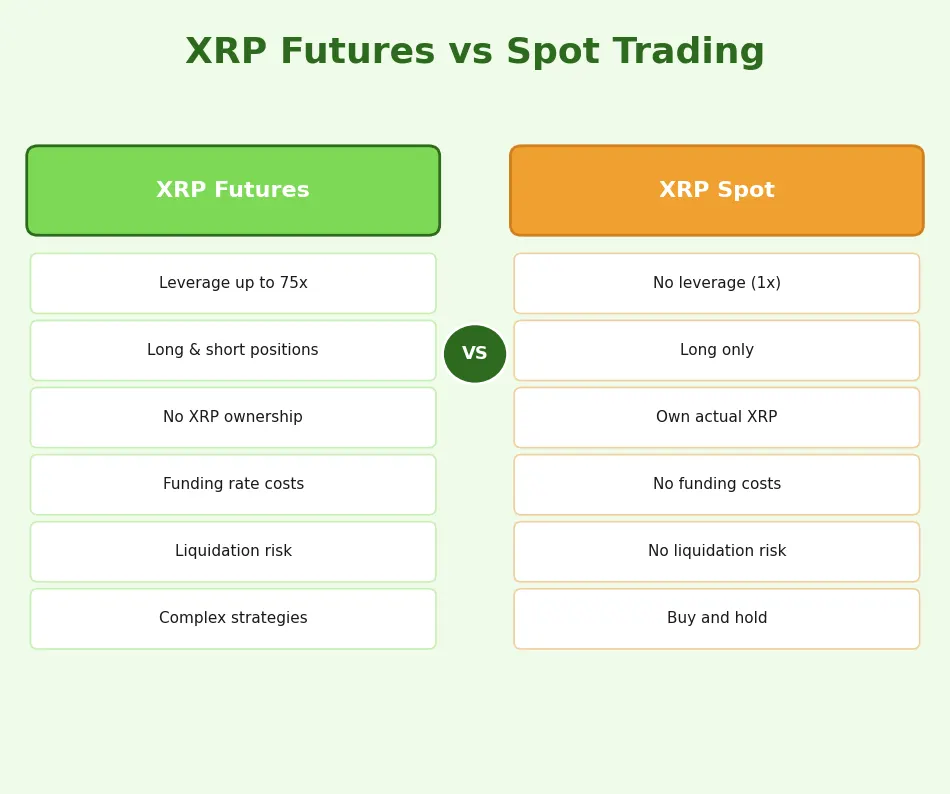
Key Differences in Risk and Leverage
The fundamental difference between XRP futures and spot trading is leverage and directional flexibility. Spot trading means buying actual XRP with your full capital. XRP futures trading lets you control a much larger position with less capital through leverage. A 10x leveraged futures position means $1,000 in margin controls $10,000 worth of XRP exposure. This amplification works both ways: profits are multiplied, but so are losses, and the risk of liquidation exists only in leveraged futures trading.
When to Choose XRP Margin Trading
XRP margin trading through futures is the appropriate choice when you want to hedge an existing XRP spot position, trade both long and short, access leverage for capital efficiency, or implement strategies like basis trading and funding rate arbitrage. It is not appropriate for investors who simply want to accumulate and hold XRP long-term, as the ongoing costs of funding rates, the complexity of margin management, and the risk of liquidation make futures unsuitable for passive holding strategies.
Risk Warning: XRP futures trading involves substantial risk of loss due to leverage. A leveraged position can be liquidated rapidly during volatile market conditions, potentially resulting in the loss of your entire margin deposit. Only trade with capital you can afford to lose, and always use appropriate risk management tools.
How to Trade XRP Futures Safely
Understanding XRP Futures Leverage Trading
Managing Liquidation Risk
Liquidation is the forced closure of a position when the trader’s margin balance falls below the maintenance margin requirement. In XRP futures trading, managing liquidation risk is the most critical safety practice. The key factors are leverage level (lower leverage means more room before liquidation), margin type (cross vs isolated), and position size relative to account balance. A trader using 10x leverage on XRP is liquidated if the price moves approximately 10% against their position. At 50x, a mere 2% move triggers liquidation.
Practical liquidation management involves using isolated margin to cap maximum loss per position, maintaining extra margin buffer beyond the minimum requirement, setting stop-loss orders well before the liquidation price, and avoiding adding to losing positions (averaging down) in leveraged trading. These practices are universal across the best XRP futures platforms.
Margin Requirements in XRP Futures Market
Margin requirements in the XRP futures market consist of initial margin (the minimum collateral to open a position) and maintenance margin (the minimum balance to keep the position open). Most platforms use tiered margin systems where larger positions require higher margin ratios to prevent systemic risk. Understanding these requirements is essential for proper position sizing and risk management on any XRP futures exchange.
Risk Management in Crypto Futures Trading
Stop-Loss and Limit Order Types
Stop-loss orders are the primary defensive tool in XRP futures trading. A stop-loss automatically closes your position when the price reaches a predetermined level, limiting your maximum loss. Limit orders let you enter or exit positions at specific prices rather than market prices, avoiding slippage during volatile conditions. Advanced order types like trailing stops (which follow favorable price movements) and reduce-only orders (which prevent accidental position increases) add additional layers of risk control.
Funding Rate and Position Management
Funding rates in XRP perpetual futures are periodic payments that affect the cost of holding positions. Positive funding rates mean long positions pay shorts, and negative rates mean shorts pay longs. These payments typically occur every 8 hours and can significantly impact profitability for positions held over multiple funding periods. Monitoring the funding rate schedule and adjusting positions accordingly is a key component of effective XRP derivatives trading strategy.
Security Features of a Secure Crypto Futures Platform
Exchange Security Measures
The security of a crypto derivatives exchange is non-negotiable. Essential security measures include cold storage for the majority of user funds, multi-signature wallet infrastructure, regular third-party security audits, DDoS protection, two-factor authentication (2FA), withdrawal whitelisting, and anomaly detection systems. The best XRP futures platforms invest heavily in security infrastructure because a single breach can destroy user trust permanently.
KYC and Compliance in Crypto Derivatives Exchange
KYC (Know Your Customer) compliance is increasingly standard across regulated crypto derivatives exchange platforms. While some traders view KYC as inconvenient, it provides important protections: it helps prevent fraud, enables account recovery, and ensures the exchange operates within legal boundaries. Platforms that skip KYC may offer convenience but often lack the regulatory protections and insurance mechanisms that keep user funds safe. For broader context on how these compliance systems fit into exchange architecture, the crypto derivatives exchange guide covers the full spectrum of compliance requirements.
Key Features of the Best XRP Futures Platforms
XRP Futures Liquidity and Trading Volume
Importance of Deep Order Books
Deep order books are critical for XRP futures trading because they determine how large a position you can open or close without significantly moving the price. A deep order book means there are substantial buy and sell orders at multiple price levels, allowing large trades to be executed with minimal price impact. Thin order books lead to slippage, where the actual execution price differs from the intended price, directly eating into trading profits.
Slippage Control in XRP Futures Trading
Slippage control involves both platform-level and trader-level measures. Platform-level controls include deep liquidity, fast matching engines, and smart order routing. Trader-level controls include using limit orders instead of market orders, avoiding trading during low-liquidity periods, and sizing positions appropriately relative to available order book depth. On the best XRP futures platforms, slippage on standard-sized orders is typically under 0.01%, but during extreme volatility, it can spike significantly.
XRP Futures Fees Comparison
Maker vs Taker Fees
Maker fees are charged when your order adds liquidity to the order book (typically limit orders that do not immediately fill). Taker fees are charged when your order removes liquidity (typically market orders or limit orders that fill immediately). On most XRP futures exchange platforms, maker fees are lower than taker fees, incentivizing limit order placement that improves market quality.
Hidden Costs in XRP Futures Exchange
Beyond the published maker/taker fees, XRP futures trading involves several hidden costs that affect profitability. Funding rates can accumulate into significant costs for positions held across multiple periods. Spread costs (the difference between bid and ask prices) represent an implicit trading cost. Withdrawal fees vary by platform. And some exchanges charge insurance fund fees or liquidation penalties. Evaluating the total cost of trading, not just the headline fee, is essential for choosing the right platform.
XRP Futures Fee Structure Comparison
| Fee Component | Top-Tier Platform | Mid-Tier Platform | Budget Platform |
|---|---|---|---|
| Maker Fee | 0.01% – 0.02% | 0.02% – 0.04% | 0.04% – 0.06% |
| Taker Fee | 0.04% – 0.05% | 0.05% – 0.06% | 0.06% – 0.10% |
| Funding Rate (avg) | 0.005% – 0.01% per 8h | 0.01% – 0.015% per 8h | 0.01% – 0.02% per 8h |
| Liquidation Fee | 0.5% – 1.0% | 1.0% – 1.5% | 1.5% – 2.5% |
| Withdrawal Fee | Low / Free (USDT) | Moderate | Variable |
| Max Leverage (XRP) | Up to 75x | Up to 50x | Up to 100x+ |
Trading Engine Performance
Execution Speed
Execution speed is measured in milliseconds and determines how quickly your order is processed by the matching engine. In XRP futures trading, where prices can move rapidly, even small delays between order submission and execution can result in meaningful slippage. Top-tier XRP futures trading platform infrastructure achieves sub-millisecond matching, while lower-quality engines may introduce delays of 50-200 milliseconds, which can cost traders significantly during fast market moves.
Stability During High Volatility
Platform stability during high volatility is perhaps the most critical performance metric for any XRP futures exchange. Many exchanges have experienced outages during major market moves, leaving traders unable to close positions as prices crash or spike. The best XRP futures platforms invest in redundant infrastructure, auto-scaling systems, and load balancing to maintain uptime during peak trading activity. Teams focused on building crypto exchanges prioritize this stability as a core differentiator.
Top XRP Futures Exchanges to Consider
Regulated Crypto Derivatives Exchange Options
Platform Security and Compliance
When evaluating XRP futures exchange options, regulated platforms should be your first consideration. Regulation provides several concrete benefits: mandatory insurance funds that protect traders against exchange insolvency, segregated account structures that keep user funds separate from exchange operations, regular audits that verify fund reserves, and legal recourse mechanisms that protect traders in case of disputes. These protections come at the cost of KYC requirements and sometimes lower maximum leverage, but the trade-off is worthwhile for serious traders.
User Protection Mechanisms
Beyond basic security, the best XRP futures platforms implement specific user protection mechanisms for leveraged trading. Insurance funds absorb losses from bankrupt positions that exceed a trader’s margin. Auto-deleveraging (ADL) systems fairly distribute losses when insurance funds are insufficient. Partial liquidation mechanisms close only enough of a position to restore margin ratios rather than liquidating the entire position. And mark price systems use multi-exchange index prices to prevent manipulation-driven liquidations.
Platform Evaluation Criteria
| Criteria | What to Look For | Red Flags |
|---|---|---|
| Regulation | Licensed in major jurisdictions, transparent entity | No regulatory information, offshore-only registration |
| Liquidity | Deep order books, consistent volume, tight spreads | Thin orders, wide spreads, volume discrepancies |
| Security | Cold storage, 2FA, audits, insurance fund | History of hacks, no proof of reserves |
| Fees | Transparent fee schedule, competitive rates, VIP tiers | Hidden fees, unclear funding rates, excessive charges |
| Engine Performance | Sub-ms matching, 99.9%+ uptime, no overloads | Frequent outages, slow fills, lagging prices |
| User Experience | Intuitive UI, mobile app, TradingView integration | Confusing interface, no mobile support, basic charting |
Low Fees XRP Futures Exchange Comparison
Funding Rates and Cost Efficiency
Funding rates are often the largest hidden cost in XRP perpetual futures trading. During strong trending markets, funding rates can spike to 0.1% or more per 8-hour period, meaning a position held for a full day could incur 0.3% in funding costs alone. Over a week, this adds up to over 2% of position value, which can erode profits significantly. The most cost-efficient XRP futures trading platform options offer competitive funding rates and tools that help traders monitor and manage these ongoing costs.
Platform Interface and Tools
The trading interface and tools available on an XRP futures exchange directly impact execution quality and decision-making. Essential tools include advanced charting with TradingView integration, real-time order book visualization, position calculator with liquidation price estimation, funding rate history and forecasts, and portfolio analytics. Mobile apps with full trading functionality are equally important for traders who need to monitor and manage positions on the move. For organizations building their own platforms, partnering with experienced crypto derivatives exchange solution providers ensures these critical tools are implemented properly.
Step-by-Step Guide to Trade XRP Futures
How to Choose XRP Futures Trading Platform
Evaluating Liquidity and Fees
When choosing where to trade XRP futures, start by evaluating the platform’s XRP perpetual futures order book depth. Place a small test order and observe the spread, slippage, and fill quality. Compare the total cost of a round-trip trade (entry and exit) including maker/taker fees, spread costs, and expected funding rate. The cheapest platform on headline fees may not be the cheapest once all costs are factored in.
Checking Security and Regulatory Status
Verify the platform’s regulatory status in your jurisdiction. Check for proof-of-reserves attestations, review the insurance fund size and history, and research any past security incidents. Read the terms of service carefully, paying attention to the dispute resolution mechanism and the jurisdiction governing the agreement. For traders looking to understand the broader OTC and institutional landscape, the OTC derivatives platform guide provides additional context on institutional-grade compliance.
XRP Futures Trading for Beginners
Setting Up an Account
Setting up an account on an XRP futures trading platform involves selecting a regulated exchange, completing KYC verification (typically requiring ID and proof of address), enabling two-factor authentication, and transferring margin capital (usually USDT) to the futures wallet. Most platforms separate spot and futures wallets, so you will need to explicitly transfer funds to the derivatives trading section of your account.
Placing Your First XRP USDT Perpetual Trade
For your first XRP USDT perpetual trade, start conservatively. Select the XRP/USDT perpetual contract, choose isolated margin mode, set leverage to 5x or lower, and enter a small position size. Place a limit order at your desired entry price rather than a market order to avoid slippage. Immediately after your position opens, set a stop-loss order to define your maximum acceptable loss. Monitor the position, the funding rate schedule, and the liquidation price displayed on your screen.
XRP Futures Trading Lifecycle
| Step | Action | Key Considerations |
|---|---|---|
| 1. Platform Selection | Choose regulated XRP futures exchange | Regulation, fees, liquidity, security |
| 2. Account Setup | Register, KYC, enable 2FA | Use strong passwords, hardware 2FA |
| 3. Fund Account | Deposit USDT to futures wallet | Only deposit what you can afford to lose |
| 4. Configure Settings | Set margin mode (isolated), leverage level | Start with 5x-10x, use isolated margin |
| 5. Market Analysis | Technical/fundamental analysis, check funding rate | Confirm bias with multiple indicators |
| 6. Enter Position | Place limit order, set stop-loss immediately | Risk no more than 1-2% of capital per trade |
| 7. Manage Position | Monitor P&L, adjust stops, manage funding costs | Trail stops in profitable direction |
| 8. Exit Position | Close at target or stop-loss, review trade | Log results for strategy refinement |
Principle: Successful XRP futures trading is built on process, not prediction. The traders who consistently profit from XRP derivatives trading are those who follow a disciplined process for platform selection, position sizing, entry timing, risk management, and trade review. The platform you choose is the foundation of that process.
Final Thoughts on XRP Futures Trading in 2026
Is XRP Futures Trading Safe?
XRP futures trading is as safe as the platform you choose and the risk management practices you follow. On a well-regulated crypto derivatives exchange with proper security, insurance funds, and fair liquidation mechanics, the platform risk is manageable. The trading risk, which comes from leverage and market volatility, is entirely within the trader’s control through position sizing, leverage selection, and stop-loss discipline. No amount of platform security can protect a trader from overleveraging their account.
Risk vs Reward Analysis
The risk/reward profile of XRP futures trading depends on your strategy and execution. Conservative strategies using 5x-10x leverage with strict stop-losses can offer attractive risk-adjusted returns with manageable drawdowns. Aggressive strategies using 50x+ leverage can generate outsized returns but carry the constant risk of liquidation. The XRP futures market offers enough liquidity and volatility to support both approaches, but the choice must align with your capital, experience, and risk tolerance. For organizations looking to create platforms that serve diverse trading preferences, derivatives exchange engineering solutions can be tailored to support the full spectrum of trader needs.
Launch a High-Performance XRP Futures Exchange Today
Build a secure, high-liquidity crypto derivatives exchange with advanced trading features and scalable infrastructure.
Launch Your Exchange Now
Long-Term Outlook for XRP Derivatives Trading
The long-term outlook for XRP derivatives trading is strongly positive. Regulatory clarity continues to improve, institutional participation is growing, and exchange infrastructure is advancing rapidly. The XRP futures market in 2026 is deeper, more liquid, and better regulated than at any point in its history. New product innovations like XRP options, structured products, and decentralized perpetual protocols are expanding the range of strategies available to traders.
The continued maturation of XRP derivatives trading infrastructure means that the platforms available to traders will only improve over time: faster engines, lower fees, better risk management tools, and stronger regulatory protections. For traders who approach the XRP futures market with discipline, proper risk management, and a well-chosen platform, the opportunities are significant. The key is treating XRP margin trading as a professional activity that demands continuous learning, careful platform evaluation, and unwavering adherence to your risk management rules.
Key Insight: The best XRP futures platforms are not just the ones with the lowest fees or the highest leverage. They are the ones that keep you trading safely through volatile markets, protect your capital from platform-level risks, and provide the tools and data you need to make informed decisions. Choose your platform like you are choosing a business partner, because in leveraged trading, that is exactly what it is.
Frequently Asked Questions
Q1.What is XRP futures trading?
XRP futures trading is the practice of buying and selling contracts that derive their value from the future price of XRP without actually owning the underlying token. Traders can go long (betting the price will rise) or short (betting it will fall) using leverage to amplify their positions. XRP futures are available as both traditional contracts with fixed expiry dates and perpetual contracts that have no expiration, making them versatile instruments for speculation and hedging.
Q2.Where can I trade XRP futures safely?
You can trade XRP futures safely on regulated crypto derivatives exchange platforms that offer robust security measures, proper KYC verification, insurance funds, and transparent fee structures. The best XRP futures platforms combine deep liquidity, competitive fees, strong regulatory compliance, and proven track records of protecting user funds. Always verify that the exchange is licensed in your jurisdiction and implements industry-standard security protocols.
Q3.What is the difference between XRP futures and XRP spot trading?
XRP spot trading involves buying and selling actual XRP tokens at current market prices, while XRP futures trading involves contracts based on XRP’s future price. Futures allow leverage (trading with borrowed capital), short selling (profiting from price drops), and do not require custody of the actual token. Spot trading is simpler and involves direct ownership, while futures offer more sophisticated strategies but carry higher risk due to leverage and liquidation mechanics.
Q4.What are XRP perpetual futures?
XRP perpetual futures are a type of derivatives contract that tracks XRP’s price without an expiration date, allowing traders to hold positions indefinitely. Unlike traditional futures that settle on a specific date, perpetual contracts use a funding rate mechanism to keep prices aligned with the spot market. XRP perpetual futures are the most popular XRP derivatives product, offering flexibility for both short-term and medium-term trading strategies with adjustable leverage.
Q5.How much leverage is available for XRP futures?
Leverage for XRP futures varies by platform and jurisdiction, typically ranging from 5x to 75x on major crypto derivatives exchange platforms. Some exchanges offer up to 100x or 125x leverage on XRP pairs, though higher leverage significantly increases liquidation risk. Most experienced traders recommend using moderate leverage (5x to 20x) for XRP margin trading to maintain a healthy margin ratio and avoid forced liquidations during volatile market conditions.
Explore Services
Related Services
Reviewed by

Aman Vaths
Founder of Nadcab Labs
Aman Vaths is the Founder & CTO of Nadcab Labs, a global digital engineering company delivering enterprise-grade solutions across AI, Web3, Blockchain, Big Data, Cloud, Cybersecurity, and Modern Application Development. With deep technical leadership and product innovation experience, Aman has positioned Nadcab Labs as one of the most advanced engineering companies driving the next era of intelligent, secure, and scalable software systems. Under his leadership, Nadcab Labs has built 2,000+ global projects across sectors including fintech, banking, healthcare, real estate, logistics, gaming, manufacturing, and next-generation DePIN networks. Aman’s strength lies in architecting high-performance systems, end-to-end platform engineering, and designing enterprise solutions that operate at global scale.