Ai Overview
Over the past eight years, our team has designed, audited, and launched crypto MLM platforms across 40+ countries. They launch with aggressive APYs like 200% or 300% annually to attract early users, then cannot sustain those returns as the user base grows. A Bronze member might earn 12% APY while a Diamond member earns 60% plus leadership bonuses.
Over the past eight years, our team has designed, audited, and launched crypto MLM platforms across 40+ countries. What we keep seeing is the same two questions from network marketers: How does staking actually work? and Are these yield models real or just hype? This guide answers both, plainly and honestly.
Key Takeaways
- ✓ Staking locks tokens in a blockchain network to earn rewards, and this mechanism powers most crypto MLM income models today.
- ✓ Yield models vary widely: fixed APY, flexible, and tier-based structures each carry different risk and reward profiles.
- ✓ Smart contracts automate payouts, reducing manual errors and removing the need for central admins to handle funds.
- ✓ Sustainability depends on real token utility, not just referral recruitment. Without genuine utility, the model collapses.
- ✓ Regulatory compliance is no longer optional. Global regulators are actively monitoring crypto MLM platforms.
- ✓ The future of crypto network marketing is moving toward DeFi integration, AI reward optimization, and NFT-based incentives.
1. Introduction to Crypto Network Marketing
What Is Crypto Network Marketing?
Crypto network marketing combines traditional multi-level marketing (MLM) with blockchain technology. Instead of selling physical products through a human chain of distributors, participants stake digital assets, earn yield, and recruit others to do the same. Their earnings come from two places: the platform’s staking rewards and commissions from their referral network.
This is not just an upgrade to old-school MLM. It is a structural shift. The rules, payouts, and membership records all live on a public blockchain, which anyone can verify at any time.
How It Differs from Traditional MLM
Traditional MLM relies on paper contracts, manual commission tracking, and human administrators who hold the money. Mistakes happen, and trust issues are common. Crypto MLM changes this. Everything happens on-chain. A smart contract pays you automatically when conditions are met. No one has to approve your withdrawal or process your check.
Additionally, geographic barriers disappear. Anyone with a crypto wallet can join from anywhere in the world. Compare that to a traditional MLM where crossing a border often means dealing with a completely different distribution entity. For a deeper look at how blockchain changes MLM network structures, our team has covered that in detail.
Role of Blockchain in Transparency and Automation
Blockchain acts as the backbone. Every transaction is timestamped, recorded, and visible. When a distributor earns a commission, that transaction is written permanently to the chain. No admin can alter it. For participants who have been burned by opaque MLM schemes in the past, this level of openness is genuinely new.
Smart contracts also handle automation. Once programmed, they execute payouts at defined intervals or trigger events without any human intervention. This reduces operating costs for the platform and builds confidence among participants.
2. Understanding Staking in Crypto
What Is Staking?
Crypto staking is the process of locking up a certain amount of digital tokens in a blockchain network for a set period. In return, the network pays you rewards, usually in the same token you staked. Think of it like a fixed deposit at a bank, except the entire process is managed by code, not a bank manager.
Staking is most common in Proof of Stake (PoS) blockchains. Instead of miners competing to solve math problems (like in Bitcoin), validators in PoS networks are chosen based on how many tokens they lock up. The more you stake, the higher your chance of being selected to validate transactions and earn block rewards.
How Staking Works in Blockchain Networks
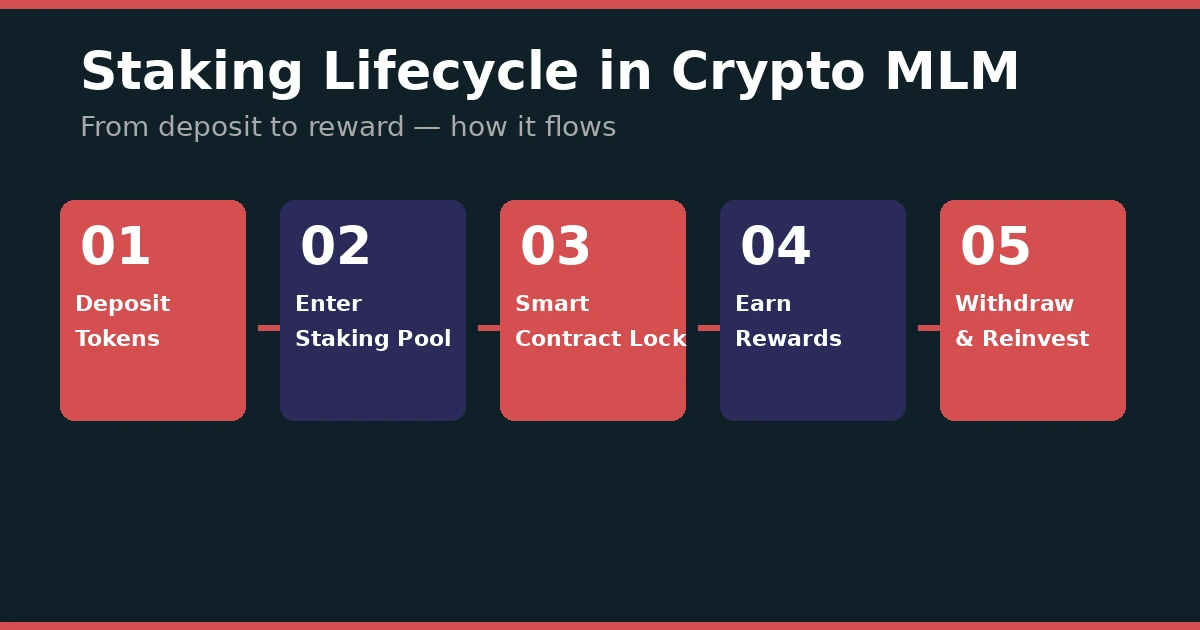
Here is the basic flow: A user deposits tokens into a staking contract. That contract locks the tokens for a defined duration. The network pays rewards at intervals, often daily or weekly. At the end of the lock period, the user can withdraw their original stake plus the earned rewards.
In crypto MLM, this process is layered with referral bonuses. When you bring in new stakers, a portion of their staking fees or generated rewards flows up your referral chain. Smart contracts handle all of this distribution automatically.
Benefits of Staking for Users and Platforms
For users, staking creates a passive income stream. You lock tokens and earn without daily activity. For platforms, staking creates token scarcity. When more tokens are locked in staking contracts, the circulating supply drops, which can support token price stability. This makes staking a mechanism that benefits both sides when the tokenomics are designed properly.
3. What Are Yield Models in Crypto MLM?
Definition of Yield Models
A yield model is the structure that defines how and when participants earn money. It answers questions like: what percentage return do stakers get? How often are rewards distributed? Are bonuses tied to rank, referral volume, or staking amount? Every crypto MLM platform has a yield model, whether it is clearly documented or buried in the fine print.
Types of Earning Mechanisms
Yield in crypto MLM typically comes from three sources. First, staking ROI is a direct return on the tokens you lock in the platform. Second, referral bonuses are commissions earned when people you recruited stake tokens. Third, leadership or rank rewards are additional bonuses given when you or your team crosses certain thresholds.
Each of these mechanisms can be adjusted in the smart contract. A well-designed platform balances all three so that recruitment alone cannot drive the whole model. If referral bonuses are too dominant and staking ROI is minimal, regulators may classify the platform as a pyramid scheme.
Importance of Sustainability in Yield Systems
This is where most platforms fail. They launch with aggressive APYs like 200% or 300% annually to attract early users, then cannot sustain those returns as the user base grows. A sustainable yield model must be funded by real revenue, such as platform fees, DeFi lending returns, or genuine product sales, not purely by new member deposits.
4. Types of Staking Models Used in Network Marketing
Not all staking models are built the same. The model a platform uses directly affects how much you earn, how liquid your funds are, and how much risk you take on. Here is a breakdown of the four most common structures seen in crypto network marketing platforms.
| Model Type | Lock Period | APY Range | Flexibility | Best For |
|---|---|---|---|---|
| Fixed Staking | 30 to 365 days | 8% to 40% | Low | Conservative earners |
| Flexible Staking | No lock | 4% to 18% | High | Beginners and active traders |
| Tier-Based Staking | Varies by tier | 12% to 80% | Medium | Active recruiters in MLM networks |
| Pool-Based Staking | Shared pool term | Variable | Low to Medium | Teams and group investors |
Fixed Staking Models
Fixed staking is straightforward. You deposit a set amount, agree to a lock period, and receive a predetermined annual percentage yield (APY). The rate does not change during your lock period, which makes planning easy. Most entry-level crypto MLM platforms start with fixed staking because it gives new users a clear, predictable outcome.
Flexible Staking Models
Flexible staking lets users deposit and withdraw at any time. The APY is lower because the platform cannot rely on your funds for a set period, but many users prefer this for the control it offers. In volatile markets, being able to exit quickly matters more than a slightly higher return.
Tier-Based Staking Systems
Tier-based systems are the most common in crypto MLM specifically because they align staking rewards with recruitment activity. The more you stake and the larger your downline, the higher your tier and APY. A Bronze member might earn 12% APY while a Diamond member earns 60% plus leadership bonuses.
This model encourages users to grow their network actively. However, it also creates significant risk: if new recruitment slows, higher-tier members stop receiving top rewards, and some platforms cannot sustain payouts if both staking volume and recruitment plateau simultaneously.
Pool-Based Staking Mechanisms
Pool staking aggregates funds from multiple users into a shared liquidity pool. Rewards earned by the pool are distributed proportionally based on each participant’s share. This model is borrowed directly from decentralized finance (DeFi) protocols and is increasingly being incorporated into MLM structures for added legitimacy and yield source diversification.
5. Popular Yield Distribution Models
Once staking rewards are generated, the platform needs a system to distribute them. The distribution model determines who gets paid, how much, and how often.
| Distribution Model | Payout Frequency | Team Requirement | Automation Level |
|---|---|---|---|
| Daily / Weekly ROI | Daily or weekly | None | Fully automated |
| Binary Plan | Weekly / monthly | 2 legs required | Semi-automated |
| Matrix Plan | On completion | Fixed slots | Automated |
| Referral + Leadership | On action trigger | Active downline | Fully automated |
Daily/Weekly ROI Distribution
This is the simplest model. You stake tokens and receive a fixed percentage return every day or every week. It is predictable and easy to communicate to new participants. The challenge is that platforms promising daily ROI must have consistent revenue to back it up, otherwise they are paying earlier investors with newer investors’ funds, which is a structural red flag.
Binary and Matrix Compensation Plans
Binary plans require every distributor to build exactly two downline legs. The weaker leg determines your overall commission, which encourages leaders to help their smaller side grow. Matrix plans cap how many people can be in each level, creating a structured payout cycle when all slots are filled.
Both structures come from traditional MLM playbooks and are now being combined with smart contract automation. This means binary matching bonuses and matrix cycle rewards are paid instantly when conditions on-chain are met, removing the delays that frustrated traditional MLM participants.
Smart Contract-Based Automated Payouts
Smart contracts are self-executing pieces of code on a blockchain. When predefined conditions are met, they execute automatically. In a crypto MLM context, this means: if a user’s staking period ends, the contract releases principal plus rewards instantly. If a referral event occurs, the contract sends the commission to the upline immediately.
This eliminates the need for a payment administrator and reduces the risk of human error or deliberate withholding. Our team has built and audited dozens of these contracts, and the efficiency gains over manual payout systems are significant. If you are evaluating cryptocurrency MLM software, smart contract automation is not optional; it is foundational.
Build Your Staking MLM Platform the Right Way
Design a crypto MLM system backed by real tokenomics, audited smart contracts, and sustainable yield models. Our team has launched 40+ platforms across six continents.
6. Benefits of Staking and Yield Models in Crypto MLM
Passive Income Opportunities
Once tokens are staked, they generate rewards without any daily activity from the holder. This is the core appeal. A participant can stake their tokens, continue their day, and return to find rewards credited to their wallet. Combined with referral commissions, this can create multiple simultaneous income streams from a single platform.
Decentralized Earning Systems
There is no central company holding your funds. Tokens are locked in a smart contract on a public blockchain. The company running the MLM platform cannot access your staked funds any more than you can access theirs. This decentralization removes a major trust barrier that has historically held back adoption of MLM programs globally.
Transparency and Trust Through Blockchain
Every transaction, every commission payment, every staking deposit and withdrawal is recorded on the blockchain. You can verify your own earnings and your downline’s activity without relying on the platform’s internal dashboard. This kind of transparency was simply not possible in traditional MLM. Platforms building on this principle naturally attract more trust from skeptical prospects.
Global Participation Without Intermediaries
A user in Singapore, a user in Nigeria, and a user in Brazil can all stake the same token, earn the same rewards, and refer each other without a single bank transfer or currency conversion. Blockchain removes geographic and financial barriers that made traditional MLM expansion expensive and legally complicated.
7. Risks and Challenges
Staking and yield models sound compelling, but they carry real risks. Anyone evaluating a crypto MLM platform should understand these before committing capital.
Market Volatility
Most crypto MLM platforms pay rewards in their own native token. If that token drops 60% in value during your staking period, your earned rewards may not cover your original investment in fiat terms, even if the APY looked attractive on paper. This is why understanding tokenomics before staking is critical, not optional.
Regulatory Concerns
The regulatory landscape for crypto MLM is evolving fast. Many jurisdictions are treating staking rewards as taxable income. Some regulators classify certain yield models as unlicensed securities offerings. Our detailed coverage of blockchain MLM regulatory compliance outlines what each major market currently requires. Ignoring this is not a viable strategy in 2025.
Ponzi-Like Structures in Unsustainable Models
If a platform’s only source of yield is new member deposits, it is not a staking model. It is a Ponzi scheme wearing blockchain branding. The red flags are always the same: unsustainably high fixed returns, pressure to recruit rather than to stake genuinely, and no external revenue source. When recruitment slows, the whole structure collapses, and late participants lose everything.
Smart Contract Vulnerabilities
Smart contracts are immutable once deployed. If they contain a bug, an attacker can exploit it and drain funds before anyone can respond. Millions of dollars have been lost this way in the broader DeFi space. Every crypto MLM platform must have its smart contracts independently audited by recognized security firms before going live. This is non-negotiable from both a security and a trust perspective.
8. How to Build a Sustainable Crypto MLM Model
We have seen platforms collapse at six months and others thrive at six years. The difference is always in how the model is structured from day one. Here is the framework we use with every platform we build.
| Pillar | What It Means in Practice | Why It Matters |
|---|---|---|
| Real Token Utility | Token serves a purpose beyond staking (governance, fees, access) | Creates genuine demand; not dependent on new entrants alone |
| Balanced Tokenomics | Total token supply, burn mechanisms, and reward pool sizing are set conservatively | Prevents hyperinflation of the reward token |
| Compliance First | KYC/AML processes built in; legal opinions obtained per jurisdiction | Prevents regulatory shutdown; builds user trust |
| Security Audits | Smart contracts independently reviewed pre-launch | Prevents exploit-related fund loss |
Importance of Real Utility and Tokenomics
A token that has no purpose except to be staked for more tokens is a circular economy with no external revenue. Sustainable platforms give their token a real job. Maybe it grants governance voting rights. Maybe it is required to pay platform fees. Maybe it unlocks premium features or services. When external demand for the token exists, the ecosystem can sustain yield without depending entirely on new participant inflows.
“The biggest mistake founders make is setting APY based on what will attract users, not on what the treasury can actually sustain. We always model worst-case staking participation scenarios before publishing any yield figure.” – MLM Blockchain Strategy Team, 2024 Platform Advisory Report
Balancing Rewards and Long-Term Growth
Early rewards need to be attractive enough to bootstrap the community but not so high that they drain the reward pool in 12 months. A decreasing APY schedule tied to total staking volume is one common approach: as more users stake, individual APY decreases gradually, mirroring what happens in well-designed DeFi protocols.
Compliance and Legal Considerations
This is the area most platform builders underestimate. Crypto MLM sits at the intersection of securities law, money transmission rules, and MLM regulations, all of which vary by country. Getting legal opinions in your primary markets before launch is essential. The cost of a good legal review is insignificant compared to the cost of a regulatory enforcement action.
Security Best Practices
Beyond smart contract audits, security covers multi-signature wallet controls for treasury funds, timelocks on major contract changes, regular penetration testing of the web platform, and a clear incident response plan. A security incident at a crypto MLM platform is not just a financial loss; it destroys the community’s trust in an irreversible way.
9. Future Trends in Crypto Network Marketing
Integration with DeFi Platforms
The line between crypto MLM and DeFi is blurring. Several platforms are now routing staked funds into DeFi liquidity pools to generate real external yield. This creates a revenue source that is independent of new member recruitment. User funds earn yield in DeFi, a portion goes to the platform as operating revenue, and the rest is distributed as staking rewards. This is a structurally stronger model than pure recruitment-funded systems.
AI-Driven Reward Optimization
Artificial intelligence is starting to appear in yield management. Platforms are experimenting with AI systems that dynamically adjust APY rates based on treasury health, market conditions, and network participation levels. This removes the human error risk from manually adjusting rewards and allows the system to respond to changing conditions in near-real-time.
Gamification and NFT-Based Rewards
NFTs (non-fungible tokens) are being introduced as status symbols and reward multipliers in crypto MLM networks. A Platinum-tier NFT might boost your staking APY by 15%. An exclusive community NFT might unlock access to private yield pools. Gamification layers make participation more engaging and create secondary market value for platform assets.
Evolution of Decentralized Communities
DAOs (Decentralized Autonomous Organizations) are gradually replacing traditional MLM company structures. In a DAO-based network, major decisions about the yield model, fee structures, and platform direction are voted on by token holders. This shifts power from founders to the community, increasing trust and long-term participant commitment.
10. Conclusion
Staking and yield models have given crypto network marketing a genuine technological foundation. When built correctly, they create transparent, automated, and globally accessible income systems that solve most of the trust problems that held traditional MLM back for decades.
The critical word is “correctly.” The model type matters. Tokenomics matter. Legal structure matters. Smart contract security matters. A platform that gets all of these right can run sustainably for years. One that cuts corners on any of them typically collapses within 12 to 18 months, taking participants’ funds with it.
If you are building a platform, start with utility and compliance, then design the yield. If you are evaluating a platform to join, look past the APY numbers and ask where the yield actually comes from. The answer to that question tells you everything about whether the model is built to last.
For anyone serious about building or scaling a crypto MLM system, working with experienced developers and legal advisors who understand both blockchain and MLM regulation is not optional. It is the difference between building something that lasts and building something that becomes a cautionary tale.
Frequently Asked Questions
Q1.What is staking in crypto network marketing?
Q2.How do yield models work in a crypto MLM?
Q3.Is participating in a crypto staking MLM legal?
Q4.What is the difference between fixed and flexible staking?
Q5.Can I earn consistent passive income from a crypto staking MLM?
Q6.What makes a crypto MLM staking model truly sustainable?
Explore Services
Related Services
Reviewed by

Aman Vaths
Founder of Nadcab Labs
Aman Vaths is the Founder & CTO of Nadcab Labs, a global digital engineering company delivering enterprise-grade solutions across AI, Web3, Blockchain, Big Data, Cloud, Cybersecurity, and Modern Application Development. With deep technical leadership and product innovation experience, Aman has positioned Nadcab Labs as one of the most advanced engineering companies driving the next era of intelligent, secure, and scalable software systems. Under his leadership, Nadcab Labs has built 2,000+ global projects across sectors including fintech, banking, healthcare, real estate, logistics, gaming, manufacturing, and next-generation DePIN networks. Aman’s strength lies in architecting high-performance systems, end-to-end platform engineering, and designing enterprise solutions that operate at global scale.