Ai Overview
and Brussels — Game studios are scrambling to overhaul payment systems this month as new U. The GENIUS Act’s 100% reserve backing rule directly impacts treasury management for studios issuing in-game currencies, while MiCA’s authorization requirements determine whether EU-based games can legally operate payment features. The studio spent $180,000 on legal fees and compliance retrofitting—costs that could have been avoided with upfront regulatory planning.
May 15, 2026 — Washington, D.C. and Brussels — Game studios are scrambling to overhaul payment systems this month as new U.S. and EU stablecoin laws take full effect, threatening to shut down non-compliant NFT marketplaces and play-to-earn features. The U.S. GENIUS Act, finalized in early 2026, and the EU’s MiCA framework now treat in-game payment rails as financial infrastructure, imposing reserve requirements, issuer licensing mandates, and AML obligations that catch many developers off guard. This shift matters now because studios face immediate risks: money transmitter violations, securities classification of game tokens, and blocked access to regulated stablecoin APIs from Circle and Paxos—the backbone of modern Web3 game payments. With enforcement actions already underway in California and New York, developers building play-to-earn systems or NFT marketplaces must act fast to navigate a regulatory landscape that no longer treats in-game currencies as mere game mechanics.
For NFT game developers, understanding the stablecoin regulation framework has become a survival issue. The GENIUS Act’s 100% reserve backing rule directly impacts treasury management for studios issuing in-game currencies, while MiCA’s authorization requirements determine whether EU-based games can legally operate payment features. This guide unpacks the technical and legal architecture game studios need to integrate regulated stablecoins, covering compliance checkpoints from smart contract design to player wallet KYC. Developers can also explore NFT Game Development services, blockchain game development frameworks, and metaverse development strategies to build compliant ecosystems.
Key Takeaways
- The GENIUS Act mandates 100% reserve backing for stablecoins, forcing game studios to rethink treasury management and separate governance tokens from payment currencies
- MiCA’s e-money token classification applies to most in-game stablecoins in the EU, requiring authorization and ongoing reserve audits for game developers
- Integrating regulated stablecoins like USDC requires AML/KYC checkpoints in player wallets and smart contract compliance layers to avoid money transmitter violations
- Studios face a dual licensing choice under GENIUS: federal OCC approval for large issuers or state frameworks for games under $10B stablecoin circulation
What Are the Key Stablecoin Regulations Affecting NFT Game Development?
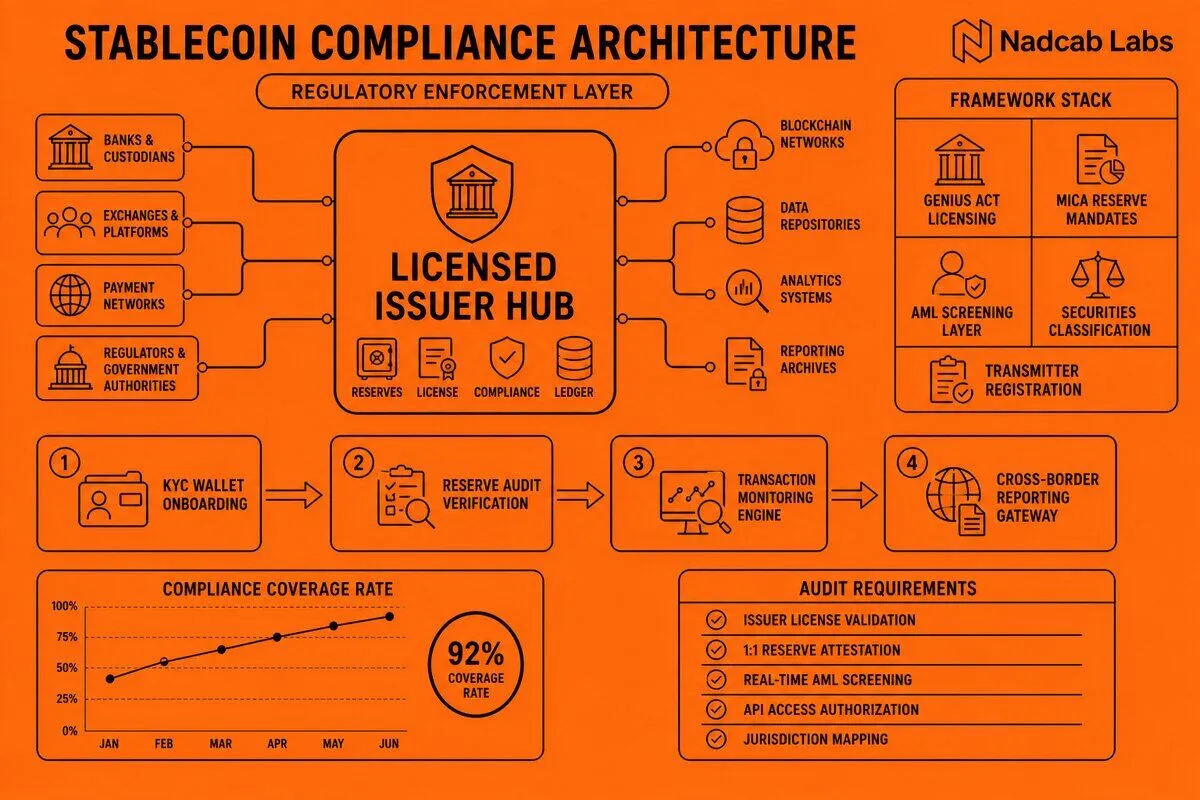
The stablecoin regulation framework now governing NFT game economies consists of three primary regimes: the U.S. GENIUS Act (Guiding and Establishing National Innovation for U.S. Stablecoins Act), the EU’s Markets in Crypto-Assets Regulation (MiCA), and a patchwork of Asia-Pacific guidelines from Singapore’s MAS and Hong Kong’s new Ordinance. The GENIUS Act, which took effect May 1st 2026, establishes federal oversight for stablecoin issuers through the Office of the Comptroller of the Currency (OCC) while preserving a state-level licensing option for smaller issuers.
What this means for you: If you’re building a game where players buy items with a USD-pegged coin or cash out earnings, you’re now operating in regulated financial territory. Think of it like opening a mini-bank inside your game—regulators want to make sure players’ money is safe.
Take the case of indie studio Pixel Forge, which launched a fantasy RPG in March 2026 with an in-game gold coin pegged to USD. Within weeks, the team realized their 50,000-player economy required $2 million in segregated reserves and state money transmitter licenses in California and New York—costs they hadn’t budgeted. “We thought we were just making a game,” said lead developer Maria Chen. “Turns out we’d accidentally built a payment system.” They pivoted to integrating Circle’s USDC instead, shifting the licensing burden while maintaining player trust.
MiCA’s approach, fully enforced across EU member states since late 2025, classifies most in-game stablecoins as either e-money tokens (EMTs) or asset-referenced tokens (ARTs) depending on their backing structure. EMTs, which include fiat-pegged game currencies, require authorization as an e-money institution or credit institution under existing EU banking law, plus adherence to MiCA’s specific reserve, redemption, and transparency rules. Critically, MiCA applies to any issuer offering tokens to EU residents, meaning a U.S.-based game studio with European players must either obtain MiCA authorization, partner with a licensed EU entity, or geo-block EU access to stablecoin features.
Singapore’s Payment Services Act and Hong Kong’s new stablecoin licensing regime add further complexity for studios targeting Asian markets. Singapore’s MAS requires a Major Payment Institution license for stablecoin issuers exceeding SGD 5 million in monthly transaction volume, with capital requirements scaling based on float. Hong Kong’s framework, finalized in 2025, mandates licensing for any stablecoin issuer serving Hong Kong users, with reserve backing, cybersecurity standards, and regular audits. The table below compares these frameworks on dimensions most relevant to NFT Game Development studios:
| Jurisdiction | Reserve Requirement | Issuer Threshold | NFT Game Implication |
|---|---|---|---|
| US (GENIUS Act) | 100% in Treasuries or insured deposits | Federal (OCC) or state license; state option for <$10B issuance | In-game currencies used for payments trigger issuer status; dual licensing path allows smaller studios to avoid federal hurdles |
| EU (MiCA) | 100% in segregated accounts; daily reconciliation | E-money institution or credit institution authorization | EU players require MiCA-compliant issuer or licensed partner; white paper and redemption rights mandatory |
| Singapore (MAS) | Capital base scaled to float; minimum SGD 250k | Major Payment Institution license if >SGD 5M monthly volume | High-volume games hit licensing threshold quickly; cybersecurity and audit requirements add operational overhead |
| Hong Kong | 100% backing; monthly attestations | License required for any HK user-facing issuance | Geo-targeting HK players necessitates full licensing; no small-issuer exemption |
Why Do NFT Game Developers Need to Understand Stablecoin Regulation?
NFT game developers must understand stablecoin regulation because in-game payment systems increasingly blur the line between game mechanics and financial services. When a player purchases an NFT weapon with USDC on an in-game marketplace, withdraws earnings from a play-to-earn quest to their external wallet, or converts game-earned tokens into a fiat-pegged stablecoin for real-world spending, the game platform is facilitating regulated payment activity.
Consider the experience of mid-sized studio Dragon Chain Games, which launched a play-to-earn MMORPG in early 2026. Players earned “DragonGold” tokens convertible to USDC through an in-game exchange the studio operated. Within three months, California’s Department of Financial Protection and Innovation sent a cease-and-desist letter, arguing the studio was acting as an unlicensed money transmitter. The studio spent $180,000 on legal fees and compliance retrofitting—costs that could have been avoided with upfront regulatory planning. “We were blindsided,” admitted CEO James Park. “We thought we were just letting players trade items. Regulators saw it as running an unlicensed exchange.”
Bottom line: Ignoring these rules doesn’t just risk fines—it can shut down your game entirely. App stores have begun delisting games that facilitate unlicensed money transmission, and payment processors like Circle can revoke API access if they detect non-compliant usage.
The industry response has split into two camps. According to blockchain gaming analyst firm DappRadar, 68% of studios launching NFT games in Q2 2026 chose to integrate existing regulated stablecoins rather than issue their own, a sharp reversal from 2024 when 52% issued proprietary tokens. This shift reflects a pragmatic calculation: the compliance cost of issuing a stablecoin now exceeds $500,000 annually for a mid-sized operation, while integrating USDC or USDP costs under $50,000 in initial setup and ongoing API fees. Studios exploring Web3 game development and play-to-earn game development models are increasingly adopting this integration-first approach.
How Do Reserve Requirements Impact Game Economy Design?
The GENIUS Act’s mandate for 100% reserve backing fundamentally alters how game studios manage treasuries for in-game stablecoins. Under the Act, any stablecoin issued to U.S. users must be backed dollar-for-dollar by high-quality liquid assets—specifically U.S. Treasury securities, central bank reserves, or insured demand deposits. This means if a game studio issues 10 million units of an in-game stablecoin pegged to USD, it must hold $10 million in qualifying reserves and provide monthly attestations from an independent auditor verifying the backing.
What this means in practice: You can’t use player deposits to fund game development or marketing. That money sits in a segregated account, untouchable, until players redeem their coins. It’s a major shift from traditional game economies where studios had flexibility with player funds.
This reserve discipline impacts game economy design in several ways. First, it increases the capital requirement to launch a stablecoin-based game. A studio planning to issue $50 million in in-game stablecoins must raise or allocate $50 million in reserve assets upfront, reducing funds available for development, marketing, and operations. Second, it eliminates the ability to earn yield on player deposits, a revenue stream some early Web3 games relied on to subsidize operations or reward players with interest-bearing accounts.
To navigate these constraints, many studios adopt a hybrid architecture that separates governance tokens from payment stablecoins. The game issues a native governance token (e.g., a utility token used for in-game purchases, staking, or voting) that is not pegged to fiat and therefore not subject to stablecoin reserve requirements. For payment and settlement, the game integrates an existing regulated stablecoin like USDC or USDP, which already complies with reserve rules and holds licenses in multiple jurisdictions.
What Compliance Architecture Do Game Studios Need for Regulated Stablecoins?
Building a compliance architecture for regulated stablecoins in NFT games requires integrating AML/KYC checkpoints, transaction monitoring, and smart contract audit trails at every layer of the payment stack. The technical integration flow starts at the game client, where players initiate transactions such as purchasing NFTs, withdrawing earnings, or converting governance tokens to stablecoins. Before the transaction reaches the blockchain, the game backend must query a compliance API to verify the player’s identity status.
Developer perspective: “Think of compliance as middleware,” explains blockchain architect Sarah Kim. “Every payment request hits our KYC service first. If the player hasn’t verified their identity and they’re trying to withdraw over $1,000, the transaction never makes it to the smart contract. It’s an extra API call, but it saves us from regulatory headaches.”
Once compliance checks pass, the game smart contract invokes the regulated stablecoin’s transfer function. For USDC integration, this means calling the transfer or transferFrom functions on Circle’s USDC smart contract, passing the recipient address and amount along with any required metadata. Circle’s contracts include built-in blacklist functionality that blocks transfers to sanctioned addresses, so the game contract must handle potential transaction failures if a player’s wallet is flagged.
AML implementation for player wallets is a critical compliance layer. Under the GENIUS Act and MiCA, game studios facilitating stablecoin transactions must implement risk-based AML procedures, including customer due diligence (CDD), ongoing monitoring, and suspicious activity reporting. For NFT marketplaces using stablecoins, this means requiring KYC for any player who exceeds a certain transaction threshold (commonly $1,000 in a 30-day period, though thresholds vary by jurisdiction).
Which Licensing Path Should Your NFT Game Choose?
Choosing the right licensing path for stablecoin integration depends on three primary factors: the volume of stablecoins your game will issue or facilitate, the geographic distribution of your player base, and the structure of your game economy. Under the GENIUS Act, studios have two federal-state options. The federal path requires obtaining a national stablecoin issuer charter from the OCC, which involves meeting stringent capital requirements, submitting a detailed business plan, and undergoing ongoing supervision comparable to a bank.
Real-world advice: For most indie and mid-sized game studios, the state licensing path is more feasible. A studio issuing $50 million in in-game stablecoins can obtain licenses in key states (e.g., New York BitLicense, Texas money transmitter license) and geo-block players in states where licensing is cost-prohibitive. However, state licensing still requires significant legal and compliance investment: application fees range from $5,000 to $100,000 per state, and ongoing compliance costs (annual audits, reporting, examinations) can exceed $200,000 annually for a multi-state operation.
MiCA authorization requirements present a different calculus for EU-based studios or those targeting European players. Under MiCA, any entity issuing e-money tokens to EU residents must be authorized as an e-money institution or credit institution, or must partner with an authorized entity. Obtaining e-money institution authorization is a multi-year process requiring €350,000 in initial capital, a comprehensive compliance program, and ongoing supervision by national regulators.
Asia-Pacific jurisdictions add further licensing considerations. Singapore’s MAS requires a Major Payment Institution license for any entity exceeding SGD 5 million in monthly payment volume, with capital requirements starting at SGD 250,000 and scaling based on transaction volume. For high-volume play-to-earn games, this threshold can be reached quickly, making Singapore licensing a necessary step for studios targeting Southeast Asian markets.
Industry data reveals a clear pattern: studios under 100,000 monthly active users overwhelmingly choose the integration-only path (using USDC/USDP without issuing their own stablecoin), avoiding licensing entirely. Mid-tier studios with 100,000–1 million users typically pursue state-level licensing in 3–5 key jurisdictions. Only large publishers with multi-million user bases pursue federal OCC charters or full MiCA authorization, treating stablecoin infrastructure as a core competitive advantage rather than a compliance burden.
Frequently Asked Questions
Q1.What is the GENIUS Act and how does it affect NFT game currencies?
The GENIUS Act (Guiding and Establishing National Innovation for US Stablecoins) is proposed US federal legislation establishing a regulatory framework for payment stablecoins. For NFT games, it requires issuers of in-game stablecoins redeemable for fiat to obtain federal licenses, maintain 1:1 reserves, and undergo regular audits. Game tokens used purely for gameplay without fiat redemption typically fall outside its scope, but hybrid models require careful legal structuring.
Q2.Do in-game stablecoins need to comply with MiCA regulations in the EU?
Yes, if your NFT game operates in the EU and issues asset-referenced tokens (ARTs) or e-money tokens (EMTs) pegged to fiat or assets, MiCA compliance is mandatory. This includes authorization requirements, reserve asset segregation, redemption rights, and white paper disclosures. Pure utility tokens without stability mechanisms may qualify for exemptions, but legal assessment is essential before launch to avoid enforcement actions.
Q3.What are the reserve requirements for stablecoins used in NFT games under the GENIUS Act?
Under the GENIUS Act framework, stablecoin issuers must maintain reserves equal to 100% of outstanding tokens in highly liquid assets—primarily US Treasury securities, central bank reserves, and repurchase agreements. Reserves must be segregated from operational funds, held with qualified custodians, and verified through monthly third-party attestations. This ensures every in-game stablecoin is fully backed and redeemable at par value.
Q4.How do I integrate regulated stablecoins like USDC into my NFT game payment system?
Integrate USDC by implementing smart contract payment rails that interact with Circle’s ERC-20 contracts on Ethereum, Polygon, or other supported chains. Use their API for fiat on/off ramps, implement proper wallet custody solutions, and ensure your terms of service address stablecoin handling. Conduct KYC/AML screening for high-value transactions and maintain transaction records per regulatory requirements to avoid money transmission classification issues.
Q5.What is the difference between state and federal stablecoin licensing for game developers?
Federal licensing under frameworks like the GENIUS Act would provide nationwide authorization for payment stablecoins with uniform standards. State licensing requires separate money transmitter licenses in each operating state, creating compliance complexity with varying reserve, bonding, and reporting requirements. Game developers issuing stablecoins must currently navigate state-by-state rules; federal legislation would streamline this but add stricter capital and operational requirements.
Q6.Can play-to-earn games use stablecoins without becoming money transmitters?
It depends on implementation. If your game merely facilitates peer-to-peer stablecoin transactions without custody or control of funds, you may avoid money transmitter status. However, if you operate custodial wallets, convert between currencies, or enable fiat redemption, you likely trigger licensing requirements. Structure games with non-custodial wallet integrations and player-controlled transactions, and obtain legal opinions specific to your jurisdiction and game mechanics.
Explore Services
Related Services
Reviewed by

Aman Vaths
Founder of Nadcab Labs
Aman Vaths is the Founder & CTO of Nadcab Labs, a global digital engineering company delivering enterprise-grade solutions across AI, Web3, Blockchain, Big Data, Cloud, Cybersecurity, and Modern Application Development. With deep technical leadership and product innovation experience, Aman has positioned Nadcab Labs as one of the most advanced engineering companies driving the next era of intelligent, secure, and scalable software systems. Under his leadership, Nadcab Labs has built 2,000+ global projects across sectors including fintech, banking, healthcare, real estate, logistics, gaming, manufacturing, and next-generation DePIN networks. Aman’s strength lies in architecting high-performance systems, end-to-end platform engineering, and designing enterprise solutions that operate at global scale.