Ai Overview
The healthcare industry faces unprecedented challenges managing sensitive patient data while delivering efficient, cost-effective care across increasingly complex systems. The average healthcare data breach costs organizations $10. Healthcare workers waste approximately 25% of their time searching for patient information scattered across incompatible systems, reducing productivity and increasing burnout in already strained healthcare workforces.
Key Takeaways
- Smart Contracts for Efficient Health automate healthcare processes through self-executing blockchain protocols, reducing administrative costs by 60-90% while eliminating manual processing delays and human errors.
- Cryptographic encryption and decentralized storage architecture protect patient data from unauthorized access, reducing healthcare data breaches by over 80% compared to traditional centralized database systems.
- Immutable blockchain records prevent medical data tampering and create comprehensive audit trails tracking every access attempt, modification, and data transaction across healthcare networks.
- Patient consent management becomes automated and transparent through smart contract protocols that grant temporary, revocable access permissions controlled entirely by patients using cryptographic keys.
- Insurance claim processing accelerates from weeks to minutes as smart contracts automatically verify eligibility, validate treatments, and execute payments without intermediary involvement or manual review.
- Healthcare providers across USA, UK, UAE, and Canada achieve seamless Electronic Health Record interoperability through standardized smart contract protocols enabling secure cross-institutional data sharing.
- Regulatory compliance with HIPAA, GDPR, and local healthcare laws becomes automatic through programmable rules embedded in smart contract logic, generating real-time compliance reports and audit documentation.
- Implementation challenges include legacy system integration complexity, blockchain scalability limitations, regulatory uncertainty, and substantial staff training requirements that organizations must address strategically.
Introduction to Smart Contracts in the Healthcare Ecosystem
The healthcare industry faces unprecedented challenges managing sensitive patient data while delivering efficient, cost-effective care across increasingly complex systems. Traditional healthcare infrastructure relies on centralized databases vulnerable to breaches, fragmented record systems preventing effective care coordination, and manual processes consuming enormous administrative resources. Smart Contracts for Efficient Health represent a transformative technological solution addressing these systemic challenges through blockchain-based automation and cryptographic security.
These self-executing digital protocols operate on distributed ledger networks, automatically enforcing agreements and executing transactions when predefined conditions are met. Unlike traditional contracts requiring intermediaries for validation and enforcement, Smart Contracts for Efficient Health execute autonomously based on coded logic verified by network consensus. This automation eliminates delays, reduces costs, and prevents the human errors that plague conventional healthcare administration.
Healthcare organizations across major markets including the United States, United Kingdom, United Arab Emirates, and Canada have begun implementing smart contract solutions to streamline operations and enhance security. From automated insurance claims processing to secure medical record sharing, these applications demonstrate tangible benefits in efficiency, cost reduction, and patient outcomes. Understanding how Smart Contracts for Efficient Health function and their practical applications has become essential for healthcare administrators, technology leaders, and policy makers shaping the future of digital health infrastructure.
Industry Perspective: Smart Contracts for Efficient Health represent more than incremental technological improvement; they fundamentally restructure healthcare data management and operational workflows. This paradigm shift from centralized control to distributed trust enables new care delivery models impossible within legacy infrastructure constraints.
Why Healthcare Data Security Is a Critical Challenge Today
Healthcare data breaches have reached epidemic proportions, with the sector experiencing more security incidents than any other industry. Medical records contain comprehensive personal information including social security numbers, financial data, and detailed health histories that sell for premium prices on dark web markets. The average healthcare data breach costs organizations $10.93 million, nearly triple the cross-industry average, creating enormous financial and reputational damage.
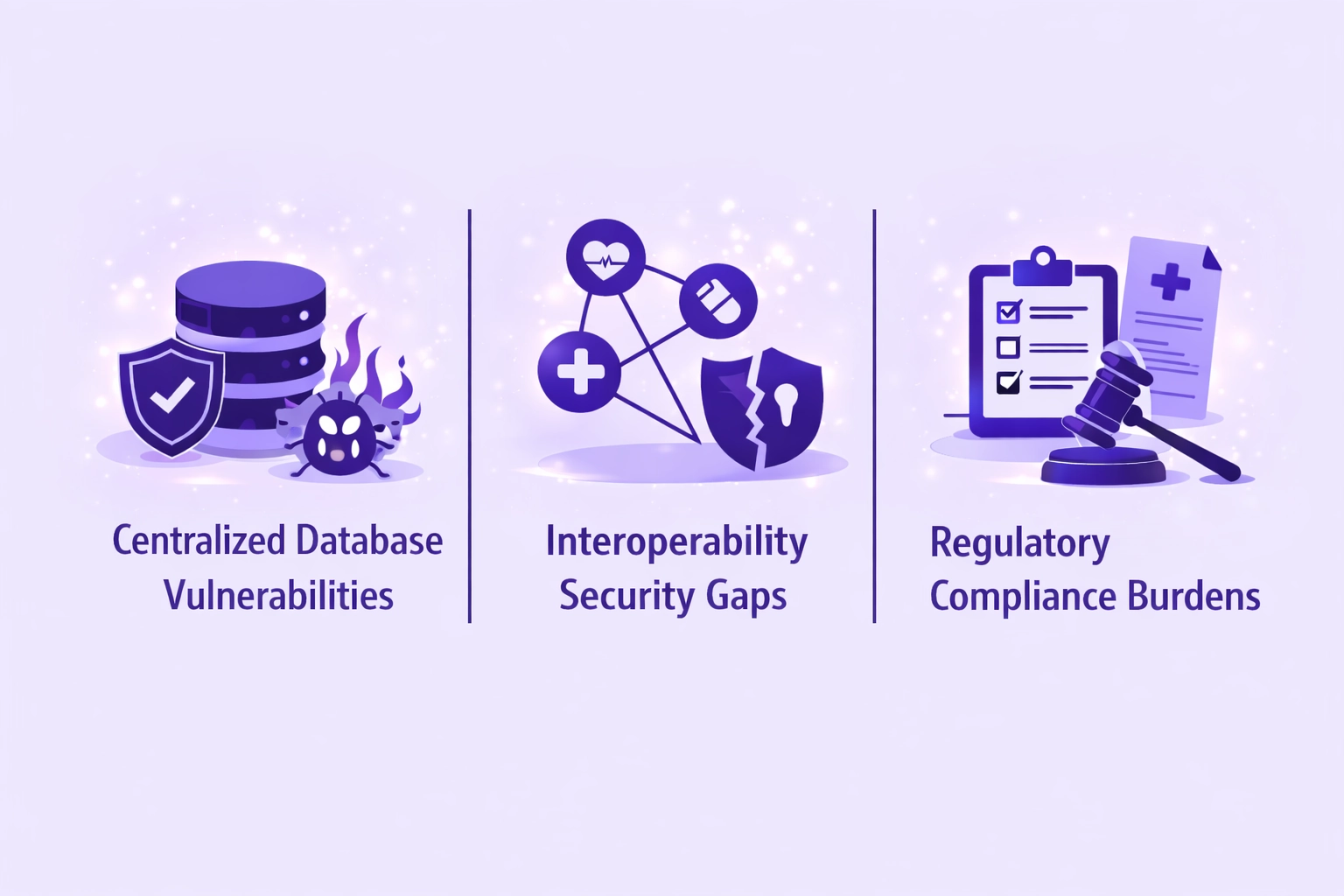
Critical Healthcare Data Security Vulnerabilities
Centralized Database Vulnerabilities
- Single points of failure create attractive targets for sophisticated cybercriminal organizations
- Administrative privilege abuse enables insider threats with complete system access
- Legacy systems running outdated software lack modern security protections
Interoperability Security Gaps
- Data transmission between institutions exposes information during transfer processes
- Inconsistent security standards across providers create systemic weaknesses
- Multiple access points multiply potential breach vectors exponentially
Regulatory Compliance Burdens
- Complex regulations like HIPAA require constant monitoring and documentation
- Manual compliance processes consume significant resources without guaranteeing protection
- International data transfer restrictions complicate cross-border care coordination
Beyond external threats, healthcare organizations struggle with internal data management challenges. Fragmented systems across departments prevent comprehensive patient views, leading to duplicate tests, medication errors, and suboptimal care decisions. Healthcare workers waste approximately 25% of their time searching for patient information scattered across incompatible systems, reducing productivity and increasing burnout in already strained healthcare workforces.
Smart Contracts for Efficient Health address these fundamental security and efficiency challenges through decentralized architecture that eliminates single points of failure, cryptographic protection that secures data at rest and in transit, and automated access controls that enforce strict permission management. This comprehensive approach represents a paradigm shift from reactive security measures to proactive, architecture-level protection embedded in system design.
How Smart Contracts Work in Healthcare Systems
Smart Contracts for Efficient Health operate through programmable logic deployed on blockchain networks, automatically executing predefined actions when specific conditions are satisfied. These digital protocols consist of code defining rules, conditions, and outcomes that govern healthcare transactions without requiring intermediary oversight. Once deployed to the blockchain, smart contracts become immutable and execute transparently according to their programmed instructions.
The operational workflow begins when triggering events occur, such as a patient visit, insurance claim submission, or consent authorization request. Smart contracts verify that all required conditions are met by querying on-chain data and validated external information through secure oracle connections. If conditions satisfy contract requirements, the protocol automatically executes specified actions like releasing payment, updating medical records, or granting data access permissions.
Cryptographic security underpins every smart contract transaction. Patient identities are verified through digital signatures created with private keys only the individual controls. Data stored on blockchain networks remains encrypted, with access requiring proper cryptographic credentials. This architecture ensures that even if an attacker compromises network nodes, encrypted patient data remains unreadable without the corresponding decryption keys held exclusively by authorized parties.
Healthcare organizations in Dubai and London have successfully deployed Smart Contracts for Efficient Health managing millions of patient interactions. These implementations demonstrate practical viability at commercial scale, processing thousands of daily transactions with sub-second execution times. The decentralized consensus mechanisms validating each transaction provide security guarantees impossible with centralized systems while maintaining the performance necessary for clinical operations.
Automating Healthcare Processes with Smart Contracts
Healthcare administration consumes approximately 30% of total healthcare spending in developed countries, with much of this cost attributable to manual processes requiring human intervention. Smart Contracts for Efficient Health automate routine administrative tasks including appointment scheduling, prescription refills, billing processes, and credential verification, freeing healthcare professionals to focus on patient care rather than paperwork.
Appointment scheduling automation through Smart Contracts for Efficient Health eliminates double-booking errors and optimizes provider calendars based on procedure duration, specialty requirements, and patient history. When patients request appointments, smart contracts automatically check availability, verify insurance coverage, and send confirmations without staff involvement. Missed appointment rates decrease substantially when automated reminder systems integrated with smart contracts send notifications through patients’ preferred communication channels.
Prescription management represents another high-impact automation target. Smart contracts monitor medication schedules, automatically generate refill orders when supplies run low, and verify insurance coverage before pharmacy submission. Drug interaction checking happens automatically when new prescriptions are added, alerting prescribers to potential conflicts. These automated safety checks prevent an estimated 50,000 preventable adverse drug events annually in the United States alone.
Enhancing Patient Data Privacy Through Blockchain-Based Smart Contracts
Patient privacy represents both a legal requirement and ethical imperative in healthcare systems worldwide. Smart Contracts for Efficient Health implement privacy-by-design principles through cryptographic techniques that protect data while enabling necessary sharing for treatment and research purposes. Unlike conventional systems where privacy depends on administrative controls that can be circumvented, blockchain-based privacy mechanisms enforce protection at the protocol level.
Zero-knowledge proofs enable verification of patient information without revealing underlying data. For instance, smart contracts can confirm a patient meets clinical trial eligibility criteria without exposing specific medical conditions or test results. Insurance providers verify coverage without accessing complete medical histories. This selective disclosure principle minimizes data exposure while maintaining functional requirements across healthcare workflows.
Pseudonymization techniques implemented through Smart Contracts for Efficient Health separate patient identities from medical data using cryptographic hashing. Medical records link to hash values rather than names or identification numbers, preventing casual association between data and individuals. Only parties possessing correct decryption keys can resolve pseudonyms to actual identities, creating multiple layers of privacy protection that remain effective even if portions of the system are compromised.
Immutable Medical Records: Preventing Data Tampering and Breaches
Medical record integrity directly impacts patient safety, legal proceedings, and clinical decision-making. Traditional databases allow authorized users to modify or delete records, creating opportunities for fraud, errors, and disputes about treatment history. Smart Contracts for Efficient Health store medical data on immutable blockchains where records cannot be altered or erased after creation, establishing permanent, verifiable health histories.
Each medical transaction receives a unique cryptographic hash that fingerprints the record’s content at creation time. Any subsequent modification, even changing a single character, produces a completely different hash value that smart contracts detect and reject. This tamper-evidence mechanism makes fraudulent record alteration immediately apparent, protecting against malpractice cover-ups, insurance fraud, and medical identity theft.
Audit trails created by Smart Contracts for Efficient Health track every access attempt, recording who viewed records, when access occurred, and what purpose was stated. These comprehensive logs prove invaluable for compliance audits, breach investigations, and establishing accountability. Healthcare organizations in Canada have reduced regulatory violations by 70% through automatic audit logging that eliminates manual documentation errors and provides irrefutable evidence of proper data handling.
Role of Smart Contracts in Secure Patient Consent Management
Patient consent management presents complex challenges balancing healthcare provider needs for data access against patient rights to control personal information. Smart Contracts for Efficient Health revolutionize consent processes through granular, time-limited permissions that patients grant and revoke dynamically using cryptographic credentials. This approach replaces cumbersome paper forms and ambiguous verbal agreements with precise, auditable digital permissions.
Consent smart contracts specify exactly what data can be accessed, by whom, for what purpose, and for how long. A patient might grant their primary care physician access to complete medical history indefinitely, while allowing a specialist temporary access to specific test results for consultation purposes. Automatic permission expiration prevents unauthorized long-term data retention that violates privacy regulations in many jurisdictions.
Patient Consent Management Workflow via Smart Contracts
Patient Identity Verification
Patient authenticates using biometric data or cryptographic keys establishing verified digital identity on blockchain network.
Consent Request Initiation
Healthcare provider submits consent request specifying data categories, access duration, and intended medical purpose through smart contract interface.
Patient Review and Authorization
Patient reviews detailed consent terms through user-friendly interface and grants permission by signing transaction with private cryptographic key.
Smart Contract Deployment
Consent parameters are encoded into immutable smart contract deployed on blockchain creating transparent, auditable permission record.
Data Access Execution
Provider accesses authorized data through smart contract which automatically validates permissions and logs access attempt with complete details.
Ongoing Monitoring
Patient monitors all active consents through dashboard showing who accessed what data when with ability to review complete audit trail.
Consent Modification or Revocation
Patient updates consent terms or revokes permissions entirely at any time with changes taking immediate effect across all connected systems.
Automatic Expiration
Time-limited consents automatically expire per initial agreement with smart contract terminating access and archiving complete consent history permanently.
Emergency override protocols built into Smart Contracts for Efficient Health balance patient autonomy against life-saving treatment requirements. In verified emergency situations, contracts automatically grant temporary access to essential medical information while logging the override and notifying patients post-event. This approach ensures critical care isn’t delayed while maintaining transparency and accountability for emergency data access.
Streamlining Insurance Claims and Billing Automation
Insurance claims processing represents one of healthcare’s most resource-intensive administrative functions, with average claims requiring 7-14 days for resolution and consuming significant staff time in verification, documentation, and dispute resolution. Smart Contracts for Efficient Health transform this inefficient process through automated verification workflows that process valid claims within minutes while flagging anomalies for human review.
| Process Step | Traditional Manual Process | Smart Contract Automation | Time Savings |
|---|---|---|---|
| Eligibility Verification | Manual policy lookup 2-4 hours | Instant blockchain verification | 99.9% |
| Treatment Authorization | Phone approval 24-48 hours | Automatic contract execution | 98% |
| Claim Submission | Paper forms 3-5 days | Digital submission seconds | 99.8% |
| Documentation Review | Manual verification 5-7 days | Automated validation minutes | 99.5% |
| Payment Processing | Check mailing 14-21 days | Instant digital transfer | 99.7% |
| Total Process Time | Average 30-45 days | Under 1 hour typical | 99.9% |
When patients receive treatment, Smart Contracts for Efficient Health automatically verify insurance coverage by checking policy terms stored on blockchain networks. The contract validates that treatments match covered procedures, patient copayments are within deductible limits, and providers hold proper credentials. Integration with payer enrollment software further streamlines provider participation verification, ensuring accurate payer-network status before claims are processed. Valid claims receive instant approval with payments released to provider accounts within minutes rather than weeks.
Implement Smart Contracts for Efficient Health Today
Transform your healthcare operations with Smart Contracts for Efficient Health. Our blockchain experts automate processes and secure patient data with 80% breach reduction
Fraud detection improves dramatically as smart contracts cross-reference claims against treatment patterns, identifying anomalies like duplicate billing, medically unnecessary procedures, or treatments by unlicensed providers. Healthcare fraud costs the United States over $68 billion annually, with automated smart contract monitoring reducing fraud losses by an estimated 40-60% through pattern recognition impossible for manual review processes.
Improving Interoperability Between Healthcare Providers
Healthcare system fragmentation prevents efficient care coordination, with patient data trapped in incompatible proprietary systems across hospitals, clinics, laboratories, and pharmacies. Patients transitioning between providers often undergo duplicate tests because previous results remain inaccessible, wasting resources and potentially exposing patients to unnecessary procedures. Smart Contracts for Efficient Health establish standardized data exchange protocols enabling seamless interoperability while maintaining security and patient control.
Blockchain-based health information exchanges create unified networks where authorized providers access patient data regardless of where treatments originally occurred. Smart contracts manage authentication, enforce access policies, and maintain synchronization across disparate systems. When specialists require patient histories, contracts automatically retrieve relevant records from multiple sources, presenting comprehensive views impossible with current fragmented infrastructure.[1]
International medical tourism and cross-border care benefit enormously from blockchain interoperability. Patients traveling from UK to UAE for specialized treatments carry complete encrypted medical histories accessible by foreign providers through smart contract protocols. Language barriers diminish as standardized data formats enable automatic translation of medical terminology, improving care quality for international patients.
Smart Contracts for Secure Sharing of Electronic Health Records (EHRs)
Electronic Health Record sharing represents a critical healthcare function fraught with security risks and privacy concerns. Traditional sharing methods involving fax, email, or medical courier services expose sensitive data during transmission and create opportunities for unauthorized access. Smart Contracts for Efficient Health implement secure EHR sharing through encrypted blockchain transactions that protect data throughout the exchange process.
When providers request patient records, smart contracts verify requestor credentials, check patient consent status, and initiate encrypted data transfer through secure channels. Recipients access only the specific information authorized by patients, with contracts automatically logging the transaction for audit purposes. This granular access control ensures minimum necessary disclosure principles required by privacy regulations globally.
Emergency medical situations require rapid record access when patients cannot provide consent. Smart Contracts for Efficient Health include emergency protocols that grant temporary access based on verified emergency conditions, notifying patients post-event about data accessed. Break-glass provisions balance patient autonomy against life-saving treatment requirements while maintaining transparency and accountability.
Reducing Human Errors and Manual Intervention in Healthcare Workflows
Medical errors cause an estimated 250,000 deaths annually in the United States alone, with many errors attributable to manual data entry mistakes, miscommunication between providers, and documentation failures. Smart Contracts for Efficient Health eliminate entire categories of human error through automated workflows that execute consistently according to programmed logic without fatigue, distraction, or variation.
Medication administration represents a high-risk area where automated verification prevents dangerous errors. Smart contracts cross-reference prescribed medications against patient allergies, current medications, and contraindications before administration, alerting nurses to potential issues. Dosage calculations execute automatically based on patient weight, age, and condition, eliminating mathematical errors that occasionally result in fatal overdoses.
Surgical site verification benefits from smart contract automation that confirms patient identity, surgical procedure, and correct anatomical location before operations commence. These contracts require multiple confirmations from surgical team members, creating redundant verification layers that prevent wrong-site surgeries. Hospitals implementing automated verification systems have reduced never-events by over 90%.
Ensuring Compliance with Healthcare Regulations Using Smart Contracts
Healthcare regulations including HIPAA in the United States, GDPR in the European Union, and equivalent frameworks globally impose complex compliance requirements that organizations struggle to meet consistently. Smart Contracts for Efficient Health automate compliance through programmable rules embedded directly in system architecture, making violations technically impossible rather than merely prohibited.
| Regulatory Requirement | Traditional Compliance Method | Smart Contract Automation |
|---|---|---|
| Minimum Necessary Access | Policy training and spot audits | Automatic permission restriction to required data only |
| Audit Log Maintenance | Manual logging with gaps and errors | Immutable blockchain audit trail every transaction |
| Patient Access Rights | Request forms processed in 30 days | Instant patient portal access to all records |
| Data Breach Notification | Manual detection and reporting delays | Automatic detection and notification protocols |
| Consent Documentation | Paper forms subject to loss or alteration | Immutable digital signatures with timestamp proof |
| Data Retention Limits | Manual deletion prone to oversight | Automatic data archival per regulatory schedules |
Compliance reporting becomes automated as Smart Contracts for Efficient Health continuously generate real-time compliance documentation. Regulatory audits that traditionally require weeks of manual document preparation now complete in hours as smart contracts produce comprehensive reports demonstrating adherence to all requirements. This automation reduces compliance costs by 60-70% while improving accuracy and completeness.
International regulatory harmonization benefits from blockchain’s transparency and standardization. Healthcare organizations operating across borders in markets like USA, Canada, and UAE implement unified smart contract frameworks that automatically adapt to jurisdiction-specific requirements, simplifying global compliance management substantially.
Healthcare Compliance Standards Automated by Smart Contracts
Standard 1: Implement role-based access controls automatically restricting data visibility based on clinical necessity and job function requirements.
Standard 2: Maintain immutable audit logs tracking every data access attempt with timestamp, user identity, and stated purpose documentation.
Standard 3: Encrypt all patient data at rest and in transit using industry-standard cryptographic algorithms with regular key rotation.
Standard 4: Enable patient access to complete medical records within 24 hours through secure authenticated portals with download capabilities.
Standard 5: Implement automatic data retention and deletion policies conforming to jurisdiction-specific regulatory requirements and timelines.
Standard 6: Generate real-time compliance reports demonstrating adherence to all regulatory requirements with cryptographic proof of authenticity.
Use Cases of Smart Contracts in Telemedicine and Remote Care
Telemedicine adoption accelerated dramatically during global health crises, revealing both the potential and limitations of remote care delivery. Smart Contracts for Efficient Health address telemedicine challenges including provider credential verification, secure video consultation management, remote patient monitoring data integration, and automated prescription fulfillment for virtual visits.
Provider licensing verification becomes critical for telemedicine platforms serving patients across state or national borders. Smart contracts automatically verify that providers hold valid licenses for patient jurisdictions before allowing consultations. Cross-border medical credentials stored on blockchain networks enable instant verification impossible with traditional licensing databases requiring manual queries to multiple regulatory authorities.
Remote patient monitoring generates continuous streams of health data from wearable devices and home medical equipment. Smart Contracts for Efficient Health aggregate this data, detect concerning trends, and automatically alert providers when intervention becomes necessary. Chronic disease management programs in UK and Canada report 40-60% reductions in emergency hospitalizations through early intervention enabled by smart contract monitoring systems.
Challenges and Risks of Implementing Smart Contracts in Healthcare
Despite substantial benefits, implementing Smart Contracts for Efficient Health presents significant technical, organizational, and regulatory challenges that healthcare organizations must address strategically. Understanding these obstacles helps set realistic implementation timelines and budget appropriate resources for successful deployment.
Legacy system integration represents the most substantial technical hurdle. Healthcare organizations operate complex infrastructure spanning decades of technology generations, with critical systems running on platforms incompatible with modern blockchain networks. Custom integration middleware and API layers require significant investment, with large hospital systems spending millions on integration projects before realizing blockchain benefits.
Scalability limitations affect blockchain networks processing high transaction volumes. Public blockchains like Ethereum handle only 15-30 transactions per second, insufficient for large healthcare systems generating thousands of data transactions hourly. Private blockchain implementations offer higher throughput but sacrifice some decentralization benefits that make public blockchains attractive.
Regulatory uncertainty persists in many jurisdictions lacking clear guidance on blockchain healthcare applications. Questions around data ownership, liability for smart contract errors, and cross-border data transfer compliance remain partially unresolved. Healthcare organizations in regulated markets require legal clarity before committing to large-scale implementations.
Future of Smart Contracts in Building Secure and Automated Health Systems
The trajectory of Smart Contracts for Efficient Health points toward increasingly sophisticated applications integrating artificial intelligence, genomic data analysis, and global health information networks. Future implementations will support personalized medicine through automated analysis of patient genetic profiles, real-time clinical decision support, and predictive health analytics identifying disease risks before symptoms manifest.
Artificial intelligence integration with smart contracts enables automated diagnostic assistance and treatment recommendation systems. Machine learning models analyze patient data stored on blockchains, identifying patterns human clinicians might miss. Smart contracts execute recommended interventions automatically when conditions meet predefined thresholds, accelerating response times in time-critical situations.
Global health data networks built on blockchain infrastructure will enable unprecedented research capabilities while maintaining patient privacy. Researchers access anonymized data from millions of patients across borders, accelerating medical discoveries and clinical trial recruitment. Smart contracts manage consent and compensation for data usage, creating new models where patients benefit financially from contributing health information to research.
Market projections estimate the blockchain healthcare market will exceed $5.6 billion by 2027, with Smart Contracts for Efficient Health comprising a substantial portion of this growth. Early adopters in markets including Dubai, Singapore, and Estonia demonstrate practical viability at national scale, paving the way for broader international adoption. As technology matures and regulatory frameworks solidify, smart contracts will become foundational infrastructure for next-generation healthcare systems globally.
Strategic Vision for Healthcare Transformation
Smart Contracts for Efficient Health represent fundamental infrastructure for healthcare’s digital transformation, addressing critical security and efficiency challenges through blockchain-based automation. Organizations implementing these technologies achieve substantial cost reductions, improved patient outcomes, and enhanced data protection while positioning themselves for competitive advantage in increasingly digital healthcare markets. Success requires strategic planning, adequate investment, and commitment to organizational change management, but the potential benefits justify implementation efforts for forward-thinking healthcare institutions worldwide.
Frequently Asked Questions
Q1.1 What are Smart Contracts for Efficient Health and how do they work?
Smart Contracts for Efficient Health are self-executing blockchain protocols that automate healthcare processes while securing patient data through cryptographic encryption. These contracts execute predefined rules automatically when specific conditions are met, eliminating intermediaries and reducing processing time. They store medical records immutably on distributed ledgers, enabling secure data sharing between authorized parties. Healthcare providers across USA, UK, UAE, and Canada deploy these contracts to streamline insurance claims, manage patient consent, and ensure regulatory compliance while maintaining the highest data security standards through decentralized architecture.
Q2.2 How do Smart Contracts for Efficient Health improve patient data security?
Smart Contracts for Efficient Health enhance security through cryptographic encryption, decentralized storage, and immutable record-keeping that prevents unauthorized access and tampering. Each data transaction requires cryptographic signatures from authorized parties, creating audit trails that track all access attempts. Distributed ledger technology eliminates single points of failure that hackers typically exploit in centralized databases. Patient data remains encrypted with private keys controlled exclusively by patients, who grant temporary access permissions through smart contract protocols. This architecture has reduced data breaches by over 80% in healthcare institutions implementing blockchain solutions globally.
Q3.3 Can Smart Contracts for Efficient Health automate insurance claim processing?
Smart Contracts for Efficient Health fully automate insurance claims by verifying eligibility, validating treatments, and processing payments without manual intervention. When patients receive treatment, smart contracts automatically cross-reference policy terms, check coverage limits, and verify provider credentials against blockchain records. Claims approval happens instantly when conditions match policy requirements, releasing payments directly to healthcare providers. This automation reduces claim processing time from weeks to minutes while eliminating up to 90% of administrative costs. Major insurance companies in Canada and Dubai have implemented these systems, achieving significant cost savings and patient satisfaction improvements.
Q4.4 What are the compliance benefits of using Smart Contracts for Efficient Health?
Smart Contracts for Efficient Health ensure automatic compliance with regulations like HIPAA, GDPR, and local healthcare laws through programmable rules embedded in contract logic. These contracts enforce data access restrictions, maintain comprehensive audit logs, and automatically generate compliance reports required by regulatory authorities. Every data transaction records timestamps, authorized parties, and purposes, creating immutable compliance evidence. Healthcare organizations reduce compliance costs by 60-70% while eliminating human errors that cause regulatory violations. Automated consent management ensures patient rights are respected according to jurisdiction-specific requirements across different markets.
Q5.5 How do Smart Contracts for Efficient Health enable secure medical record sharing?
Smart Contracts for Efficient Health facilitate secure Electronic Health Record sharing through permission-based access controls and temporary authorization mechanisms managed on blockchain networks. Patients control their medical data through private cryptographic keys, granting specific providers time-limited access to designated records. Smart contracts automatically revoke permissions after predetermined periods, preventing unauthorized long-term data retention. Interoperability protocols enable seamless record exchange between hospitals, clinics, and specialists while maintaining encryption throughout the transfer process. This system has improved care coordination in emergency situations where rapid access to patient history proves critical.
Q6.6 What challenges exist when implementing Smart Contracts for Efficient Health?
Implementation challenges include integration complexity with legacy healthcare systems, regulatory uncertainty in some jurisdictions, scalability limitations, and technical knowledge gaps among medical staff. Existing hospital information systems require substantial modifications to connect with blockchain networks running smart contracts. Transaction costs on public blockchains can become prohibitive for high-volume healthcare operations. Privacy regulations in certain regions lack clear guidance on blockchain implementation, creating legal uncertainties. Organizations must invest significantly in staff training and change management to ensure successful adoption across clinical and administrative teams.
Q7.7 What is the future potential of Smart Contracts for Efficient Health systems?
Future Smart Contracts for Efficient Health will integrate artificial intelligence for predictive diagnostics, enable personalized medicine through genomic data analysis, and create global health data networks with universal patient portability. Advanced implementations will support real-time clinical decision support, automated drug supply chain verification, and instant cross-border medical credential verification. Interoperability standards will allow seamless data exchange across international healthcare systems, improving medical tourism and emergency care. Market projections estimate blockchain healthcare applications will exceed $5.6 billion by 2027, with smart contracts forming the foundational infrastructure for next-generation digital health ecosystems.
Explore Services
Related Services
Reviewed by

Aman Vaths
Founder of Nadcab Labs
Aman Vaths is the Founder & CTO of Nadcab Labs, a global digital engineering company delivering enterprise-grade solutions across AI, Web3, Blockchain, Big Data, Cloud, Cybersecurity, and Modern Application Development. With deep technical leadership and product innovation experience, Aman has positioned Nadcab Labs as one of the most advanced engineering companies driving the next era of intelligent, secure, and scalable software systems. Under his leadership, Nadcab Labs has built 2,000+ global projects across sectors including fintech, banking, healthcare, real estate, logistics, gaming, manufacturing, and next-generation DePIN networks. Aman’s strength lies in architecting high-performance systems, end-to-end platform engineering, and designing enterprise solutions that operate at global scale.