Ai Overview
Metadata is the descriptive information attached to a digital asset. Filecoin raised $205 million across two funding rounds, which shows the scale of ambition behind this protocol. The global cloud storage market was valued at $132. 03 billion in 2024 and is expected to reach $161.
Key Takeaways
- The global decentralised storage market was valued at USD 622.9 million in 2024 and is projected to grow at a CAGR of 22.4% through 2034, showing that demand for alternatives to traditional cloud storage is picking up fast.[1]
- IPFS does not guarantee that your data stays online on its own. Files uploaded to IPFS can disappear over time unless they are manually pinned by a user or third-party pinning service like Pinata or Infura.[2]
- Arweave raised $20.91 million across seven funding rounds from investors including Coinbase Ventures, Multicoin Capital, and Union Square Ventures, and its AR token has a total supply of 66 million with a market cap of approximately $987 million.[3]
- Over 60% of Web3 dApps use IPFS or Filecoin to store NFT metadata and large digital assets, making it the most widely used decentralised storage layer in the Web3 ecosystem today.[4]
- Arweave uses a “pay once, store forever” model backed by an endowment fund. A typical upload costs between $5 and $50, depending on file size and the data is designed to remain available for 200 or more years without recurring fees.[5]
- NFT metadata is usually not stored directly on the blockchain. Most NFTs store only a link on-chain pointing to a separate metadata file, meaning if that storage location goes offline, the NFT loses all its associated content and visual identity.[6]
- Filecoin earned $205 million across two funding rounds and added 2.5 PiB of new sealed storage per day in mid-2024, showing strong network growth backed by its Proof-of-Replication and Proof-of-Spacetime verification model.[7]
If you are building anything in Web3, whether it is an NFT collection, a decentralised app, or a blockchain-based platform, one question comes up sooner or later: where does the metadata actually live?
Most people assume the blockchain holds everything. But that is not how it works. Blockchains are excellent at recording ownership and transaction history. They are not built to hold large files, images, or descriptive JSON data. Storing a high-resolution image directly on Ethereum, for example, would cost thousands of dollars in gas fees. So instead, a link is stored on-chain, and the actual metadata lives somewhere else.
That “somewhere else” is the core question of this blog. Your three main choices are IPFS, Arweave, and traditional cloud storage. Each one works differently, costs differently, and carries different risks. This guide walks through all three honestly so you can make the right call for your project.
NFT Marketplace Development Guide
What Is Metadata Storage and Why Does It Matter?
Metadata is the descriptive information attached to a digital asset. For an NFT, it typically includes the name, description, image URL, rarity attributes, and other details that make the token meaningful. Without metadata, an NFT is just a token ID on a ledger with no image, no name, and no context. It becomes worthless in any practical sense.
Here is the key thing most people miss. The NFT smart contract on Ethereum or Solana stores a function called tokenURI. When called, that function returns a link to the metadata, usually a JSON file. That JSON file is what tells marketplaces like OpenSea or Blur what to display. This is why every NFT marketplace development company focuses heavily on choosing the right metadata storage solution during platform development. If that link breaks or the storage location goes offline, the NFT loses everything that makes it valuable to a buyer.
This is why metadata storage is not a small technical detail. It is the backbone of digital ownership in Web3. Getting it wrong means your NFT collection, dApp assets, or blockchain records could simply disappear one day.
1. What Metadata Typically Contains?
A standard NFT metadata JSON file following the ERC-721 or ERC-1155 standard usually includes fields like name, description, image link, and an attributes array listing properties like rarity, colour, or edition number. These fields are what rarity tools read, what wallets display, and what buyers rely on when making purchase decisions.
2. On-Chain vs Off-Chain Storage
Some projects store metadata fully on-chain inside the smart contract itself. This is the most durable option, but also the most expensive. Gas costs and block size limits make it impractical for most collections with images or video. The majority of projects store metadata off-chain and save only the reference link on the blockchain. This means the storage choice you make off-chain determines whether your NFT survives long-term.
IPFS
IPFS stands for InterPlanetary File System. It is a peer-to-peer protocol developed by Protocol Labs. Instead of storing files at a specific URL hosted by one company, IPFS splits files into chunks, hashes them, and distributes those chunks across a network of nodes. You identify content not by where it lives but by what it is. This is called content addressing.
When you upload a file to IPFS, you get a Content Identifier, or CID. That CID is a cryptographic hash of the file. If anyone changes even a single pixel in the file, the CID changes entirely. This makes IPFS excellent for verifying that content has not been tampered with. This is why IPFS became the default storage layer for NFT metadata across most major projects and platforms.
1. How IPFS Actually Works
When you request a file on IPFS, the network looks for nodes that currently hold that CID. If multiple nodes have it cached, you get it from the nearest one. This makes retrieval faster in some cases than traditional HTTP. The content itself is immutable once hashed. No one can swap out the image your CID points to without changing the identifier itself.
2. The Persistence Problem Nobody Talks About
Here is what most introductory guides leave out. IPFS does not guarantee that your file stays online. Files on IPFS age out of the system over time. If no node has your content pinned, it gets dropped from the network through a process called garbage collection. If the creator of an NFT collection simply adds their files to IPFS and walks away without pinning them permanently, those files can disappear. This has happened to real collections.
To keep files alive on IPFS, you need pinning. Pinning tells a node to keep a specific piece of content and not discard it. You can run your own node and pin files yourself, or use a pinning service like Pinata or Infura. These services charge recurring fees, which means the permanence of your IPFS content depends on whether someone keeps paying.
3. Strengths of IPFS for Metadata Storage
IPFS is free to use in its base form. Storing data on the network costs nothing unless you use a paid pinning service. It is censorship-resistant because files are spread across many nodes with no central point of control. It integrates well with existing Web3 tools and is already built into platforms like OpenSea. If you are building a dApp that needs temporary, verifiable, and distributed file access, IPFS is a solid starting point.
4. Weaknesses Worth Knowing
IPFS is not built for storing very large amounts of data. It works best for metadata JSON files and small-to-medium images. Upload times can be slow, and retrieval speed depends on how many nodes currently have your content cached. Data on IPFS is public by default, so it is not suitable for private files. And managing an IPFS node or pinning setup adds technical overhead that non-developers may struggle with.
Filecoin
Filecoin was built by Protocol Labs as the incentive layer for IPFS. It addresses the persistence problem directly by introducing a marketplace where you pay storage providers to keep your data alive. Filecoin raised $205 million across two funding rounds, which shows the scale of ambition behind this protocol.
When you store data on Filecoin, you enter a deal with a storage miner. That miner earns FIL tokens in exchange for keeping your data available. The protocol uses two types of proofs to verify this. Proof of Replication confirms that the miner has physically stored a unique copy of your data. Proof of Spacetime confirms that the data is still being held over time. Together, these proofs create a verifiable, trustless storage agreement.
1. How Filecoin Differs from IPFS?
IPFS tells the network what you want. Filecoin ensures someone is paid to keep it available. Think of IPFS as the addressing protocol and Filecoin as the storage market built on top of it. Most serious Web3 projects combine both: they use IPFS CIDs to reference content and rely on Filecoin deals to maintain long-term availability.
2. Limitations of Filecoin
Storage deals on Filecoin have expiration dates. When a deal ends, there is no automatic renewal. If no one sets up a new deal, the data can become inaccessible. This means Filecoin offers better guarantees than plain IPFS but still requires ongoing management to maintain truly permanent storage. It is closer to a subscription model with verified delivery than a set-and-forget archive.
Best Blockchain for NFT Marketplace
Arweave
Arweave takes a completely different approach. Where IPFS and Filecoin separate the storage protocol from the persistence incentive, Arweave bakes permanence into the protocol itself. You pay once with AR tokens, and the data is stored indefinitely on a structure called the blockweave. The blockweave is similar to a blockchain but specifically designed for efficient and permanent data archiving.
Arweave uses a consensus mechanism called Succinct Proof of Random Access, or SPoRA. Miners must prove they can access random pieces of historical data before adding new blocks. This design incentivises miners to replicate and hold existing data over time, because holding more historical data increases their chances of earning new block rewards. The economics of the network are designed so that storage costs decline faster than the interest generated by the endowment fund, making permanent storage financially sustainable.
1. The Pay Once Model Explained
When you upload data to Arweave, you pay a one-time fee in AR tokens. Part of that fee goes into an endowment fund. Miners draw from this fund continuously as payment for storing your data. The system is designed to fund storage for at least 200 years. For NFT metadata, legal records, academic research, or any content that needs to survive indefinitely, this model is hard to beat.
2. The Permaweb
Arweave’s most well-known feature is the Permaweb: a decentralised web layer built on top of Arweave’s storage network. It hosts permanent web pages, applications, and data that can never be taken down. Projects like Mirror, decent. land, and Kyve use Arweave to archive Web3 and DeFi data because they need that level of durability. For developers building applications where immutability and long-term availability are non-negotiable, the Permaweb is a meaningful advantage.
3. Arweave AO: What Changed in 2025
In February 2025, Arweave launched AO, a hyper-parallel computing layer built on top of its permanent storage. AO adds on-chain processing to the Permaweb, making it possible to run decentralised AI applications, research archives, and compute-heavy Web3 apps directly within Arweave’s ecosystem. The Arweave v2.8 upgrade that followed reinforced these capabilities further. This development pushed Arweave well beyond simple storage into a full infrastructure layer for the next generation of decentralised applications.
4. Downsides of Arweave
Arweave can be expensive for very large datasets. Storing terabytes of data in one go requires a significant upfront payment. Data uploaded to Arweave is public by default, meaning it is not suitable for private or sensitive files. Once data is uploaded, it cannot be altered or removed, which removes the option to fix mistakes or update content. The network also has a smaller node base compared to IPFS and Filecoin, which can affect overall decentralisation in the near term.
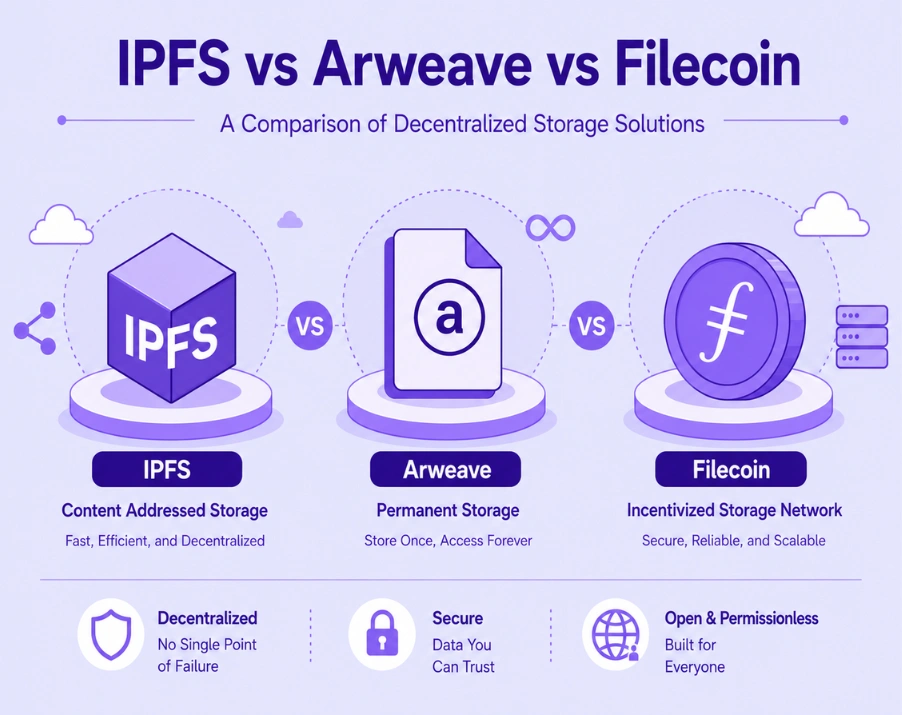
IPFS vs Arweave vs Filecoin
| Feature | IPFS | Filecoin | Arweave |
|---|---|---|---|
| Persistence Model | Pinning required (manual or paid service) | Storage deals with expiry dates | Permanent (built into protocol) |
| Payment Model | Free base; recurring pinning fees | Pay for storage deals (FIL tokens) | One-time fee (AR tokens) |
| Data Mutability | Immutable (new CID on any change) | Immutable (new CID on any change) | Fully immutable, cannot be changed |
| Best For | dApp assets, short-term storage, NFT metadata with managed pinning | Medium-term verifiable storage, enterprise datasets | Permanent archiving, legal records, NFT metadata needing indefinite access |
| Privacy | Public by default | Can encrypt before storing | Public by default |
| Technical Complexity | Moderate (pinning management required) | Higher (deal management and renewals) | Low (upload once, done) |
Cloud Storage for Metadata
Traditional cloud storage services like Amazon S3, Google Cloud Storage, and Microsoft Azure remain the most widely used data storage solutions globally. The global cloud storage market was valued at $132.03 billion in 2024 and is expected to reach $161.28 billion in 2025. These platforms are fast, familiar, and easy to integrate for developers who already work in Web2 environments.
Many early NFT projects, and even some modern ones, rely on centralized servers through AWS cloud because it is quick and convenient to deploy. Developers who already work within the aws cloud ecosystem can get metadata online within minutes. However, this convenience creates serious concerns around ownership, control, and the long-term durability of NFT assets.
1. The Core Problem With Cloud for NFT Metadata
When you store NFT metadata on a cloud server, a private company controls that data. If the company shuts down, raises prices dramatically, or decides to remove your content, your metadata disappears, and the NFT becomes an empty token pointing to nothing. This is not a hypothetical risk. Hosting platforms do go offline. Startups run out of money. Cloud bills can become unsustainable. Any of these situations can permanently break the link between an NFT and its content.
2. Censorship and Control
Cloud storage is also subject to censorship. A company can receive a legal request to take down content and must comply. For NFT collections or decentralised applications that need to operate without interference from any central authority, this is a significant weakness. Decentralised metadata storage solutions remove this point of control entirely.
3. Where Cloud Storage Still Makes Sense?
That said, cloud storage is not entirely wrong for all use cases. Projects that need fast update cycles, private data handling, or complex access controls may still benefit from centralised cloud infrastructure for certain layers of their system. Many real-world projects use hybrid architectures: cloud for mutable or private data, IPFS or Arweave for permanent public metadata. The key is understanding what each layer handles and accepting the trade-offs that come with centralised control.
Decentralised Storage vs Traditional Cloud
| Comparison Point | Decentralised Storage (IPFS / Arweave) | Traditional Cloud (AWS / Google Cloud) |
|---|---|---|
| Control Over Data | User-controlled, no central authority | Provider controls servers and access |
| Censorship Resistance | High (no single point to take down) | Low (can be removed by provider or law) |
| Long-Term Availability | Protocol-level guarantees (especially Arweave) | Dependent on subscription and provider existence |
| Setup Ease | Moderate (technical knowledge helpful) | Easy (familiar tools, quick deployment) |
| Cost Structure | One-time (Arweave) or recurring pinning fees (IPFS) | Monthly subscription, egress fees apply |
| Data Integrity | Cryptographically verified (content addressing) | No built-in tamper verification |
| Privacy Options | Limited (public by default on most protocols) | Full access control and permission management |
How to Pick the Right Metadata Storage for Your Project?
There is no single correct answer here. The right choice depends on what you are building, how long you need the data to last, what your budget looks like, and whether you need private access controls. Here is a practical guide for different types of projects.
1. For NFT Collections
If you are launching an NFT collection and want the metadata to genuinely survive long-term, Arweave is the strongest choice. You pay once, and the data is stored permanently. This matters a great deal for collectors who are buying based on the promise of lasting digital ownership. If the budget is limited, IPFS with a professional pinning service like Pinata is a reasonable middle ground, provided someone commits to maintaining the pinning over time.
2. For dApps and Web3 Applications
Decentralised applications that store user-generated content, application state, or configuration files typically benefit from IPFS or a combination of IPFS and Filecoin. IPFS provides fast and verifiable content retrieval, while Filecoin adds the economic layer that ensures data is not simply dropped from the network without notice.
3. For Enterprise and Hybrid Projects
Many enterprise projects building on blockchain still need features that decentralised storage does not yet offer well, like access controls, GDPR compliance, and fast mutable updates. For these, a hybrid architecture works best. Store your sensitive or frequently updated data on traditional cloud infrastructure. Store permanent records, audit trails, and public metadata on Arweave or IPFS. This approach lets you adopt decentralised storage incrementally without abandoning the reliability of cloud tools you already trust.
4. For Legal Records and Archives
Any data that must survive for decades without question, whether it is legal documentation, academic research, or historical records, is best suited to Arweave. The protocol-level permanence and on-chain provenance tracking mean there is a verifiable record of who uploaded what and when, which matters significantly in legal and compliance contexts.
NFT Marketplace APIs & Third-Party Integrations
Where the Decentralised Storage Market Is Heading?
The numbers tell a clear story. The global decentralised storage market was valued at USD 622.9 million in 2024 and is expected to grow at a compound annual growth rate of 22.4% through 2034. Some estimates put the broader decentralised cloud storage market even higher, at USD 7.4 billion in 2024, growing to USD 61.2 billion by 2034. The differences in these figures come from how broadly each research firm defines the category, but the direction is consistent: this market is growing fast.
Several factors are pushing this growth. Rising concern about data privacy following repeated large-scale breaches in centralised systems is making organisations look at alternatives. Stricter data protection laws like GDPR in Europe and CCPA in the United States are encouraging organisations to think more carefully about who controls their data. The expansion of Web3 applications and NFT platforms is creating natural demand for decentralised storage as a core infrastructure component.
North America leads the market with roughly 35 to 40% of global revenue, driven by strong blockchain startup ecosystems and early adoption of decentralised infrastructure. The enterprise segment accounted for around 45% of the decentralised storage market in 2024, which shows that demand is no longer coming only from crypto-native projects.
Decentralised Storage Implementations in the Real World
The following projects show how decentralised storage principles are already being applied across different domains. Each one draws on the same ideas covered throughout this blog, including distributed node participation, cryptographic verification, and community-driven data governance.
☁️
Iagon: Decentralised Web3 Cloud Storage and Computing
Built a blockchain-based platform on Cardano that provides decentralised storage and computing services for Web3 applications. Iagon uses advanced encryption, sharding, and its Secure Lake technology to protect data across distributed nodes. Users maintain full transparency over where their data lives and who can access it, reflecting the same node-based participation and distributed access principles discussed throughout this article.
🔗
RoninChain: Layer-1 Blockchain for Web3 Gaming
Developed a Layer-1 blockchain specifically for Web3 gaming, where NFT metadata and in-game asset storage are central infrastructure concerns. RoninChain demonstrates how decentralised storage integrates at the protocol layer for gaming ecosystems that require fast, verifiable, and persistent access to NFT attributes, ownership records, and on-chain game data.
Build Your Web3 Storage Infrastructure Today:
We bring deep blockchain and Web3 development expertise to decentralised storage implementation. Our team handles everything from IPFS pinning strategies to Arweave integration and hybrid cloud-Web3 architecture design, ensuring your NFT metadata, dApp assets, and blockchain records remain accessible, verifiable, and durable. Whether you are launching an NFT collection or building enterprise-grade decentralised infrastructure, we deliver solutions that hold up over time.
Final Thoughts
Metadata storage is one of those decisions in Web3 that looks minor from the outside but has long-term consequences you will feel later. Choosing traditional cloud storage for your NFT metadata saves time at launch but puts your entire collection at the mercy of a private company’s servers, billing cycles, and policy decisions. That is a real risk for anyone who cares about what digital ownership actually means.
IPFS is a solid foundation for decentralised metadata storage, especially when paired with a reliable pinning service. It is the most widely used option across the Web3 ecosystem for good reason. But it requires active maintenance, and the permanence is only as strong as whoever is keeping the pins alive. Filecoin adds economic accountability to that picture with verifiable storage deals, though those deals also have expiration dates that need managing.
Arweave stands apart by making permanence the default rather than something you have to work to maintain. One payment, decades of storage, with cryptographic proof of who uploaded what and when. For NFT collections, legal archives, research data, or any use case where losing the data is simply not acceptable, Arweave is the most reliable path.
The market for decentralised storage is growing fast. The global figure stood at USD 622.9 million in 2024 with a projected CAGR of 22.4% through 2034. That growth reflects real demand from real projects solving real problems with data ownership, privacy, and permanence. Understanding which tool fits your specific situation is what separates projects that last from ones that quietly break over time.
Frequently Asked Questions
Q1.What is the difference between IPFS and a regular web server for storing NFT metadata?
A regular web server stores your file at a specific URL tied to one location. If that server goes down or the URL changes, the link breaks. IPFS identifies files by their content, not location. The same file has the same identifier regardless of where it is stored, and anyone holding a copy can serve it. This makes IPFS more resilient to single points of failure, though it still requires pinning to guarantee the file stays available.
Q2.Can IPFS files really disappear?
Yes. IPFS does not guarantee persistence on its own. Files that are not pinned to at least one node can be dropped through garbage collection. If an NFT project adds files to IPFS without setting up permanent pinning, those files can become unreachable over time. This has happened to real collections. Using a pinning service or Filecoin-backed storage is essential if you need data to remain available.
Q3.How much does Arweave storage cost?
Arweave storage costs vary based on file size and the current AR token price. For most NFT metadata files and images, a typical upload costs somewhere between $5 and $50 as a one-time payment. This is paid in AR tokens and covers storage for an estimated 200 or more years through Arweave’s endowment model. There are no recurring fees after the initial upload.
Q4.Is cloud storage ever acceptable for NFT metadata?
Cloud storage is technically workable but carries significant risks for NFT metadata specifically. If the hosting company goes offline, raises costs beyond what is sustainable, or decides to remove content, the metadata disappears, and the NFT loses its identity. For projects where long-term ownership and reliability matter, decentralised storage is far more appropriate. Cloud might be acceptable for short-lived or experimental projects, but not for collections built around lasting digital ownership.
Q5.What is the Permaweb?
The Permaweb is a decentralised web layer built on top of Arweave’s permanent storage network. It hosts web pages, applications, and data that cannot be taken down once published. Unlike the regular internet, where websites go offline when domains expire or servers shut down, content on the Permaweb is archived permanently through Arweave’s endowment-funded storage model. Projects like Mirror use it to permanently archive Web3 publications and records.
Q6.Can I use IPFS and Arweave together?
Yes, and many serious projects do exactly this. IPFS provides fast content-addressed retrieval across a large peer network, which is useful for serving assets to users quickly. Arweave acts as the permanent backup layer, ensuring that the data exists and can always be retrieved even if IPFS nodes drop the file. Using both together gives you the speed and distribution of IPFS with the long-term guarantees of Arweave.
Explore Services
Related Services
Reviewed by

Aman Vaths
Founder of Nadcab Labs
Aman Vaths is the Founder & CTO of Nadcab Labs, a global digital engineering company delivering enterprise-grade solutions across AI, Web3, Blockchain, Big Data, Cloud, Cybersecurity, and Modern Application Development. With deep technical leadership and product innovation experience, Aman has positioned Nadcab Labs as one of the most advanced engineering companies driving the next era of intelligent, secure, and scalable software systems. Under his leadership, Nadcab Labs has built 2,000+ global projects across sectors including fintech, banking, healthcare, real estate, logistics, gaming, manufacturing, and next-generation DePIN networks. Aman’s strength lies in architecting high-performance systems, end-to-end platform engineering, and designing enterprise solutions that operate at global scale.