Ai Overview
The decentralized finance landscape is transforming rapidly, but with great innovation comes significant regulatory uncertainty. FTX, once valued at $32 billion, collapsed due to mishandling customer funds and lack of proper regulatory compliance. This typically costs $5,000 to $15,000 but saves you from costly mistakes later. Violations result in fines up to 4% of revenue or €20M.
Key Takeaways
- ✓Regulatory risks for DeFi startups vary significantly across countries, with some nations embracing crypto while others ban it entirely
- ✓KYC and AML compliance are becoming mandatory requirements even for decentralized platforms
- ✓Smart contract legal risks stem from unclear token classifications and securities law implications
- ✓Non-compliance can result in fines, asset seizures, and complete business closure
- ✓Data privacy laws like GDPR add complexity when handling user information in DeFi platforms
- ✓Decentralization doesn’t shield startups from regulatory liability if they have identified operators or founders
- ✓Building compliant platforms from inception is cheaper than retrofitting compliance later
- ✓Staking rewards, lending protocols, and yield farming all carry different regulatory implications
- ✓Proactive compliance strategies position startups as industry leaders and attract institutional investors
- ✓Partnering with blockchain compliance experts like Nadcab Labs simplifies regulatory navigation
Regulatory risks for DeFi startups represent one of the most critical challenges entrepreneurs face in the decentralized finance space. As governments worldwide tighten crypto regulations, understanding these legal complexities has become essential for building sustainable blockchain businesses.
Understanding Regulatory Risks in DeFi
The decentralized finance landscape is transforming rapidly, but with great innovation comes significant regulatory uncertainty. Regulatory risks for DeFi startups include legal liabilities, operational restrictions, compliance costs, and potential business shutdowns if founders ignore evolving crypto laws.
Unlike traditional finance, where rules are clearly established, DeFi regulations are still being written. Startups often operate in a gray zone, unsure whether their operations comply with local or international laws. This guide breaks down everything you need to know about regulatory risks in DeFi and how to navigate them successfully.
What Are Regulatory Risks in DeFi?
Regulatory risks in decentralized finance refer to the legal, financial, and operational threats that startups face due to unclear, evolving, or non-existent regulations. Think of it like building a business in a frontier town where laws are constantly changing.
Simple Analogy: From Banking to Blockchain
Traditional banks follow strict rulebooks created by government agencies. These rules took decades to develop. DeFi platforms, however, operate in a space where rulebooks are still being written. Regulators are essentially creating laws in real-time while startups are already operating. This mismatch creates substantial risk.
Types of Regulatory Risks DeFi Startups Face
Financial Regulatory Risk
Your platform might be classified as a money services business requiring state licenses
Securities Regulatory Risk
Tokens issued might be classified as securities, triggering SEC registration requirements
Sanctions Regulatory Risk
Users from sanctioned countries accessing your platform could expose you to legal liability
Data Privacy Regulatory Risk
Collecting user data creates obligations under GDPR, CCPA, and other data protection laws
Operational Regulatory Risk
Your business model, governance structure, and how you operate might violate existing financial laws
DeFi Compliance Decision Flowchart
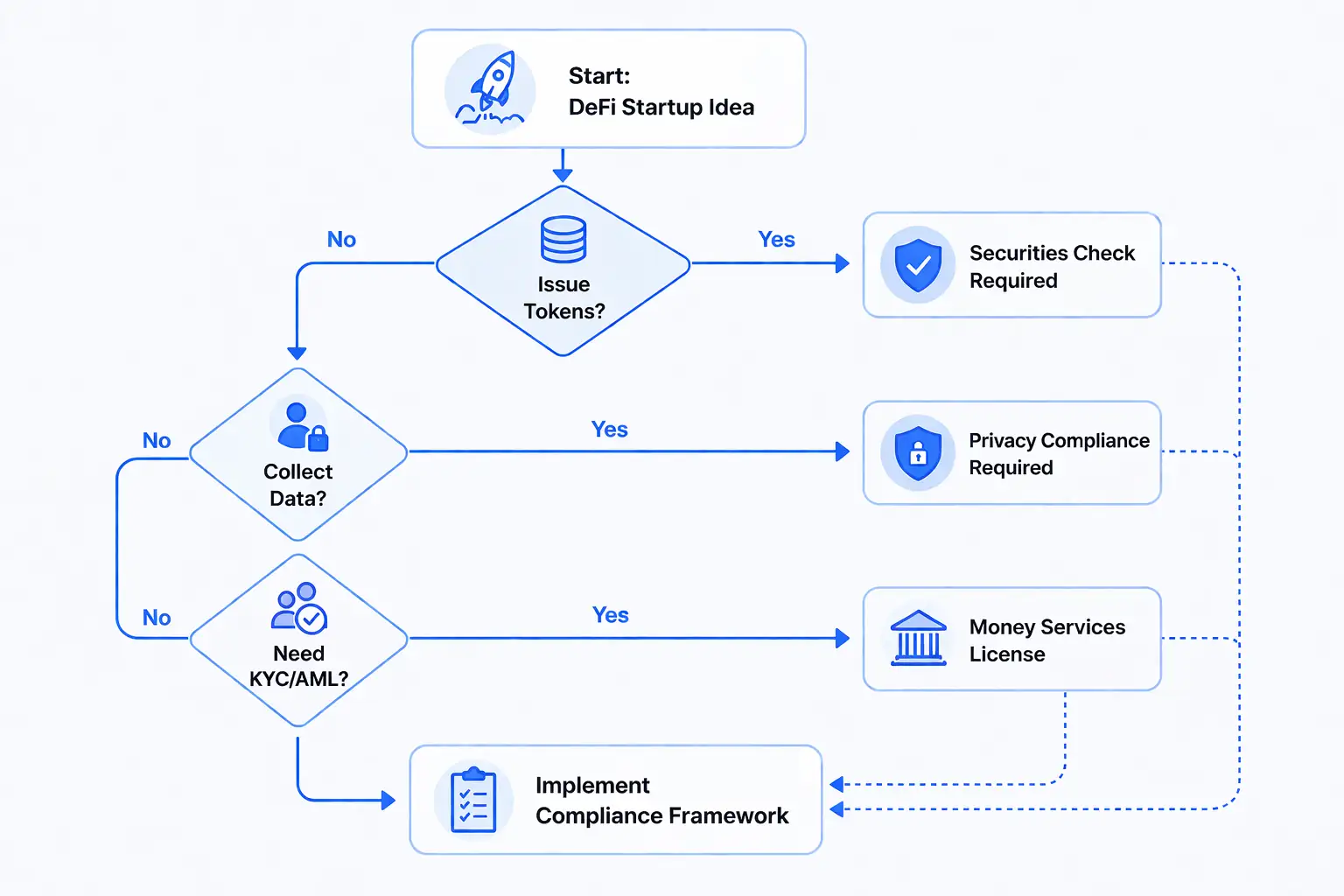
Why Does Regulatory Compliance Matter for DeFi Startups?
Ignoring regulatory risks for DeFi startups is tempting when you’re focused on building innovative technology. However, regulatory compliance creates real business advantages.
Business Advantages of Compliance
Institutional Investment
Venture capital and institutional investors won’t touch non-compliant startups. Compliance opens access to serious funding.
Bank Partnerships
Traditional banks increasingly work with compliant crypto companies. Banking relationships are essential for operations.
User Trust
Users feel safer with compliant platforms. Compliance becomes a marketing advantage that builds customer loyalty.
Operational Stability
Compliant platforms face lower risk of government shutdown, making the business more sustainable long-term.
Consequences of Ignoring Regulations
Civil Penalties: Fines ranging from thousands to millions of dollars depending on jurisdiction and violation severity
Criminal Liability: Founders and executives face potential prison sentences for willful violations
Asset Seizures: Regulatory bodies can freeze company assets and user funds
Business Shutdown: Your platform gets shut down, and all users lose access
Reputational Damage: Your team becomes untouchable in the industry, making future fundraising impossible
Real World Examples: When DeFi Startups Faced Regulatory Action
Learning from others’ mistakes is invaluable. Here are documented cases where regulatory risks for DeFi startups turned into serious problems.
Case Study 1: FTX Exchange
FTX, once valued at $32 billion, collapsed due to mishandling customer funds and lack of proper regulatory compliance. The founder faced criminal charges, and thousands of users lost everything. The lesson: Compliance isn’t optional for exchanges handling user assets.
Case Study 2: Celsius Network
Celsius offered high yield on crypto deposits without proper securities registration. The SEC took action, and the platform filed for bankruptcy. The company paid millions in settlements. The lesson: High-yield products attract regulatory scrutiny if not structured correctly.
Case Study 3: Uniswap and Other DEXs
Uniswap thrived by operating without custodying assets, avoiding money services licensing in most jurisdictions. However, they still faced regulatory challenges around token listings and sanctions compliance. The lesson: Even decentralized platforms need basic compliance controls.
Case Study 4: Terraform Labs (Luna/UST Collapse)
Terraform Labs faced legal investigations in multiple countries after the UST stablecoin collapsed. Founders are now facing fraud charges. The lesson: Lack of financial controls and regulatory oversight can lead to criminal prosecution.
How Does Compliance Work in DeFi? Step by Step
Building a compliant DeFi platform isn’t as hard as it seems. Here’s a practical step-by-step framework.
Conduct a Legal Risk Assessment
Work with blockchain lawyers to analyze your business model. Identify which regulations apply to your platform in target jurisdictions. This typically costs $5,000 to $15,000 but saves you from costly mistakes later.
Determine Your Regulatory Classification
Is your platform a money services business, securities trading platform, or something else? Different classifications trigger different compliance requirements. This decision shapes your entire company structure.
Implement KYC and AML Systems
Integrate identity verification, sanctions screening, and transaction monitoring. Modern KYC tools can be implemented in weeks, not months. Start with this regardless of your classification.
Obtain Required Licenses and Registrations
Depending on your jurisdiction and business model, you might need money services licenses, securities registrations, or money transmitter permits. Timeline varies from weeks to months.
Create Privacy and Data Protection Policies
Develop comprehensive privacy policies compliant with GDPR, CCPA, and other data protection laws. Document how you collect, store, and protect user data.
Set Up Audit and Compliance Monitoring
Implement regular audits of your systems and operations. Monitor for suspicious activity, sanctions violations, and regulatory changes. Consider hiring a Chief Compliance Officer.
Document Everything and Stay Updated
Keep detailed records of all compliance decisions and activities. Subscribe to regulatory updates and adjust your policies as laws change. Regulatory risks for DeFi startups are constantly evolving.
Compliance Requirements: Centralized vs Decentralized Platforms
Different DeFi architecture creates different regulatory obligations. This table compares compliance requirements.
| Aspect | Centralized Exchange (CEX) | Decentralized Exchange (DEX) | Hybrid Model |
|---|---|---|---|
| Licensing Required | Money Services License required in most jurisdictions | Usually no license (no custodial role) | Depends on interface design and control |
| KYC/AML Requirement | Mandatory for all users | Not required by law (but advisable) | Required for centralized parts |
| Data Privacy Laws | Strict compliance with GDPR, CCPA required | Reduced obligations (less data collected) | Partial GDPR compliance needed |
| Compliance Costs | $100K – $500K+ annually | $10K – $50K annually | $40K – $200K annually |
| Regulatory Risk Level | High (heavily regulated) | Medium (emerging regulation) | Medium to High (unclear classification) |
| Operational Flexibility | Limited (must follow regulations) | High (fewer requirements) | Medium (balance needed) |
Note: Regulatory requirements vary by jurisdiction. This table reflects general patterns in major markets (USA, EU, UK).
Global Regulatory Landscape: How Different Regions Handle DeFi
Regulatory risks for DeFi startups vary dramatically by geography. Here’s how major regions approach crypto regulation.
United States Approach
Regulatory Bodies: SEC (Securities), CFTC (Futures), FinCEN (Money Laundering), OCC (Banks)
Key Requirements: Money transmitter licenses (state-by-state), securities registration for tokens, strict AML/KYC
Risk Level: High. Multiple regulators with overlapping authority create compliance complexity. Enforcement has been aggressive.
Compliance Cost: $200K to $1M+ annually depending on business model
European Union Approach
Regulatory Bodies: National Financial Regulators, EBA (European Banking Authority)
Key Requirements: MiCA (Markets in Crypto Assets) regulation, GDPR for data, AML5 and AML6 directives
Risk Level: Medium. The EU is creating comprehensive rules (MiCA), making expectations clearer than the US. Implementation deadline is 2024.
Compliance Cost: €100K to €500K+ annually for EU operations
United Kingdom Approach
Regulatory Bodies: FCA (Financial Conduct Authority)
Key Requirements: FCA registration for crypto businesses, strict operational standards, consumer protection requirements
Risk Level: Medium. The UK has a more structured approach post-Brexit, with clear FCA guidance.
Compliance Cost: £100K to £500K+ annually
Asia Pacific Approach
Singapore: Positive stance. MAS (Monetary Authority of Singapore) requires licenses for exchanges but is supportive of innovation.
Hong Kong: Regulated but restrictive. SFC requires licenses for crypto trading platforms.
Japan: Well-defined rules. FSA requires exchanges to meet strict security and custody standards.
China: Crypto trading banned entirely. Startups must avoid Chinese users and avoid mainland operations.
Risk Level: Varies widely. Singapore and Japan are favorable for compliant startups. China is completely closed.
Emerging Markets
Latin America: Supportive but still developing regulations. El Salvador officially adopted Bitcoin, but regulations remain minimal.
Middle East: Some countries like UAE are building crypto-friendly infrastructure. Others restrict or ban crypto entirely.
Africa: Less regulated but rapidly changing. Nigeria banned crypto in 2021 but partially reversed the ban in 2023.
Risk Level: High uncertainty. Regulations can change rapidly with little notice.
Key Compliance Areas for DeFi Startups
KYC and AML Compliance
KYC (Know Your Customer) and AML (Anti-Money Laundering) are foundational compliance requirements. Even if your platform is decentralized, regulators increasingly expect some level of user verification and transaction monitoring.
What it means: You must verify user identity, monitor transactions for suspicious activity, and report suspicious behavior to authorities.
Practical implementation: Integrate third-party KYC providers like Jumio, Onfido, or Trulioo. Implement transaction monitoring to detect money laundering patterns. Create a compliance team.
Cost: $20K to $100K+ annually depending on user volume and sophistication level
Sanctions Compliance (OFAC)
The Office of Foreign Assets Control (OFAC) in the US maintains lists of sanctioned countries and individuals. You cannot allow users from sanctioned jurisdictions to access your platform.
What it means: Screen users and transactions against OFAC lists. Block access from sanctioned countries. Block transactions involving sanctioned entities.
Practical implementation: Use IP-based geofencing. Implement OFAC screening in your compliance infrastructure. Update lists regularly (OFAC updates frequently).
Consequences of non-compliance: Fines up to $250,000+ and potential criminal prosecution
Smart Contract Legal Risks
Smart contracts themselves create unique legal risks. If your smart contract malfunctions and causes financial loss, regulators may hold you liable even if the code is decentralized.
Key risks: Unintended bugs that cause users to lose funds, regulatory classification of the contract’s function, tax implications
Risk mitigation: Conduct thorough code audits from reputable auditors. Carry cyber insurance. Document your code and design decisions. Consider formal verification for complex protocols.
Token classification: Even a simple token can be classified as a security if it represents ownership or profit sharing. Consult lawyers before creating tokens.
Data Privacy Compliance (GDPR, CCPA)
Collecting user data triggers strict privacy laws in Europe and California. These laws apply even if your company is based elsewhere.
GDPR (Europe): Users have rights to access, correct, and delete their data. You need explicit consent to collect data. Violations result in fines up to 4% of revenue or €20M.
CCPA (California): California residents have similar rights. Non-compliance results in fines up to $7,500 per violation.
Practical implementation: Create clear privacy policies. Implement data minimization (collect only necessary data). Enable data deletion. Use Data Processing Agreements with third parties. Consider hiring a Data Protection Officer.
Decentralization and Regulatory Liability
A common misconception is that decentralized platforms avoid regulatory responsibility. This is false. If you have any identified operators, founders, or control, you can be held liable for regulatory violations.
Key principle: Regulators look at who controls the platform, not how it’s technically built. If you operate the platform, govern it, or profit from it, you may be liable.
Example: Uniswap’s founders were sued because they were seen as operating the protocol, even though it’s technically decentralized.
Risk mitigation: Truly decentralize governance. Transition to a DAO controlled by token holders. Document your lack of control.
Benefits of Being Compliant: Why This Investment Matters
Access to Capital
Venture capital, private equity, and institutional investors increasingly require compliance certifications. Compliance unlocks funding that non-compliant competitors can never access.
Bank Relationships
Banks won’t work with crypto companies lacking compliance. Compliant platforms can maintain banking relationships critical for operations and liquidity management.
Competitive Advantage
Users trust compliant platforms more. You can market your compliance as a feature, attracting risk-averse users that competitors miss.
Lower Legal Costs
Building compliance from the start is cheaper than retrofitting it later. You avoid costly lawsuits, settlements, and restructuring.
Business Sustainability
Regulatory risks for DeFi startups are here to stay. Compliance ensures your business survives and thrives as regulations evolve.
Team Confidence
Your team works with more confidence knowing the company operates legally. This attracts better talent and reduces executive stress.
The Future of DeFi Regulations
Regulatory trends are moving toward stricter requirements. Here’s what to expect.
Emerging Trends
1. Stablecoin Regulation: Governments are creating specific rules for stablecoins. Many require stablecoins to be backed 100% by reserves and issued by licensed entities.
2. DeFi Protocol Licensing: Some jurisdictions are proposing licenses for DeFi protocols themselves, not just exchanges. This is still evolving.
3. Environmental Regulations: Crypto mining and energy-heavy blockchains are facing new environmental regulations, especially in Europe.
4. Yield Product Regulation: High-yield products like staking and yield farming are increasingly classified as securities, requiring registration.
5. Cross-Border Coordination: Regulators worldwide are coordinating through organizations like FATF (Financial Action Task Force), leading to more consistent rules.
Preparing for the Future
- →Build flexibility into your compliance systems so you can quickly adapt to new rules
- →Subscribe to regulatory news and industry associations that track regulatory developments
- →Engage with regulators proactively through industry associations and comments on proposed rules
- →Hire experienced compliance staff who understand regulatory trends
- →Consider how your platform can evolve toward even stricter standards than currently required
Build Your Compliant DeFi Platform Today
Regulatory risks for DeFi startups don’t have to derail your vision. Nadcab Labs specializes in building secure, compliant blockchain solutions tailored to your business model and target jurisdictions.
Our team combines deep technical expertise with legal compliance knowledge to help you navigate the complex regulatory landscape. From smart contract development to KYC/AML integration and ongoing compliance monitoring, we ensure your platform meets the highest standards.
Your Path to Compliant DeFi Success
Regulatory risks for DeFi startups are real, but they’re manageable. The key is understanding the landscape, building compliance into your platform from inception, and staying informed as regulations evolve.
Startups that embrace regulatory compliance gain significant competitive advantages: access to capital, user trust, banking relationships, and long-term sustainability. Those that ignore these risks face fines, shutdowns, and reputational destruction.
The successful DeFi platforms of tomorrow will be those that balance innovation with compliance. They’ll understand that building a trustworthy, legal platform isn’t a limitation, it’s a feature that attracts users, investors, and partners.
Your journey toward regulatory compliance starts with understanding the risks. You’ve now learned the key challenges, real-world examples, step-by-step compliance processes, and global regulatory landscapes. The next step is action: assess your platform against these requirements, consult with legal experts, and implement the necessary changes.
The DeFi space is still young, but maturity brings regulation. By building compliance into your foundation now, you’re not just reducing risk—you’re future-proofing your business.
Frequently Asked Questions
Q1.Can I launch a DeFi platform without regulatory compliance?
Technically, yes. Practically, no. While some platforms operate outside regulations, they face constant shutdown threats, cannot access banking, and struggle to attract serious users or investors. Most successful DeFi platforms eventually implement compliance measures. The risk is too high to ignore.
Q2.What is the difference between a token being classified as a security vs utility?
A security token represents ownership, voting rights, or profit-sharing and requires SEC registration. A utility token gives access to services and may not require registration. However, regulators use the Howey Test to determine classification based on whether tokens are investment contracts offering profits from others’ efforts. Consult lawyers before creating tokens.
Q3.Do I need KYC if my DeFi platform is fully decentralized?
Legally, if your platform truly has no identifiable operators or custodians, you may not be required to implement KYC. However, if you have any control, governance participation, or profit from the platform, regulators may expect KYC implementation. Even decentralized platforms are increasingly implementing optional or mandatory KYC features to attract institutional users.
Q4.How much does it cost to make a DeFi platform compliant?
Costs vary significantly. Initial legal assessment: $5K to $20K. Annual compliance operations: $20K to $500K+ depending on platform type and jurisdiction. Licensing costs vary by jurisdiction (can range from $1K to $100K+). Hiring compliance staff adds $80K to $200K+ annually. Budget accordingly based on your specific business model.
Q5.What happens if I accidentally violate regulations?
It depends on severity, jurisdiction, and whether the violation was intentional. Possible consequences include warning letters, fines, operational restrictions, asset seizures, and criminal prosecution. If you discover violations, consult lawyers immediately and consider voluntary disclosure, which may reduce penalties in some jurisdictions.
Q6.Which jurisdictions are most favorable for compliant DeFi startups?
Singapore, Hong Kong, Switzerland, El Salvador, and Malta have taken proactive approaches to crypto regulation and offer favorable conditions for compliant startups. However, no jurisdiction is perfectly suited for all DeFi models. Choose based on your target users, your operations location, and your specific business model.
Q7.How do I handle sanctions compliance for my global DeFi platform?
Implement IP-based geofencing to block users from sanctioned jurisdictions. Use third-party OFAC screening services to check all users and transactions against government lists. Maintain detailed records of your compliance efforts. Update sanctions lists regularly as OFAC adds and removes entities. Consider consulting sanctions compliance specialists for complex operations.
Q8.What's the difference between regulatory compliance and financial audits?
Regulatory compliance ensures you follow laws and regulations (legal requirement). Financial audits verify the accuracy of financial statements (accountability measure). For DeFi platforms, you may need both: compliance audits to verify regulatory adherence, and financial audits to verify reserve backing or fund handling. These are separate but complementary processes.
Q9.How should I structure my DeFi startup legally to minimize regulatory risk?
Consider forming a regulated entity (corporation, LLC, or foundation) in a crypto-friendly jurisdiction that matches your business model. If you want decentralization, transition to a DAO structure controlled by token holders after launch. Use trusts or foundations in Switzerland for added legitimacy. Consult lawyers specializing in crypto to structure your entity properly based on your specific model and target jurisdictions.
Q10.Are there any DeFi business models that avoid most regulatory requirements?
True decentralized exchanges with no operator control, no token custody, and no user data collection face minimal regulatory requirements in most jurisdictions. However, even these platforms face emerging regulations. Token creation always carries regulatory risk. Any platform offering yield or returns may be classified as a security. There’s no perfect regulatory-free model; every platform must address compliance in its specific context.
Explore Services
Related Services
Reviewed by

Naman Singh
Co-Founder & CEO, Nadcab Labs
Naman Singh is the Co-Founder and CEO of Nadcab Labs, where he drives the company’s vision, global growth, and strategic expansion in blockchain, fintech, and digital transformation. A serial entrepreneur, Naman brings deep hands-on experience in building, scaling, and commercializing technology-driven businesses. At Nadcab Labs, Naman works closely with enterprises, governments, and startups to design and implement secure, scalable, and business-ready Web3 and blockchain solutions. He specializes in transforming complex ideas into high-impact digital products aligned with real business objectives. Naman has led the development of end-to-end blockchain ecosystems, including token creation, smart contracts, DeFi and NFT platforms, payment infrastructures, and decentralized applications. His expertise extends to tokenomics design, regulatory alignment, compliance strategy, and go-to-market planning—helping projects become investor-ready and built for long-term sustainability. With a strong focus on real-world adoption, Naman believes in building blockchain solutions that deliver measurable value, solve practical problems, and unlock new growth opportunities for organizations worldwide.