Ai Overview
Imagine you’re building a vending machine that automatically dispenses a drink based on current temperature. The machine itself cannot check the weather—it needs an external source to provide accurate temperature data. If BTC suddenly drops 30%, the protocol needs to know immediately to liquidate undercollateralized positions. Whether you’re launching a lending protocol, building a stablecoin system, or creating a derivatives platform, we help you architect oracle solutions that are both secure and cost efficient.
Key Takeaways
- Oracles bridge the gap between blockchain smart contracts and real world data that cannot be accessed directly on chain.
- Decentralized oracle networks work like multiple news agencies verifying the same story before publishing it for accuracy and security.
- Oracle infrastructure in DeFi powers lending protocols, DEXs, stablecoins, and insurance platforms by providing reliable price feeds.
- Price feed attacks remain the biggest security risk, where hackers try to manipulate oracle data to exploit smart contracts.
- Chainlink dominates the oracle market by aggregating multiple data sources and using decentralized node operators.
- Smart contracts cannot fetch data directly from the internet due to blockchain determinism and security constraints.
- Oracle redundancy matters because relying on a single data source creates a single point of failure.
- Real world data integration transforms DeFi from isolated systems into applications that respond to actual market conditions.
- Oracle scalability determines how efficiently blockchain networks can serve thousands of DeFi applications simultaneously.
- Future oracle solutions will support verifiable computation and cross chain data to enable advanced DeFi infrastructure.
What Exactly Are Oracles in DeFi?
Imagine you’re building a vending machine that automatically dispenses a drink based on current temperature. The machine itself cannot check the weather—it needs an external source to provide accurate temperature data. This is exactly what oracle infrastructure in DeFi does for blockchain networks. Oracles are specialized systems that connect blockchain smart contracts with real world data, enabling decentralized applications to make informed decisions based on actual information.
Without oracle infrastructure, smart contracts would be like sealed rooms with no windows or doors to the outside world. They can process information internally, but they cannot access prices, weather data, sports scores, or any external information needed to function in the real world. This is where the critical role of DeFi oracles becomes apparent.
Why Blockchain Networks Need Oracle Infrastructure
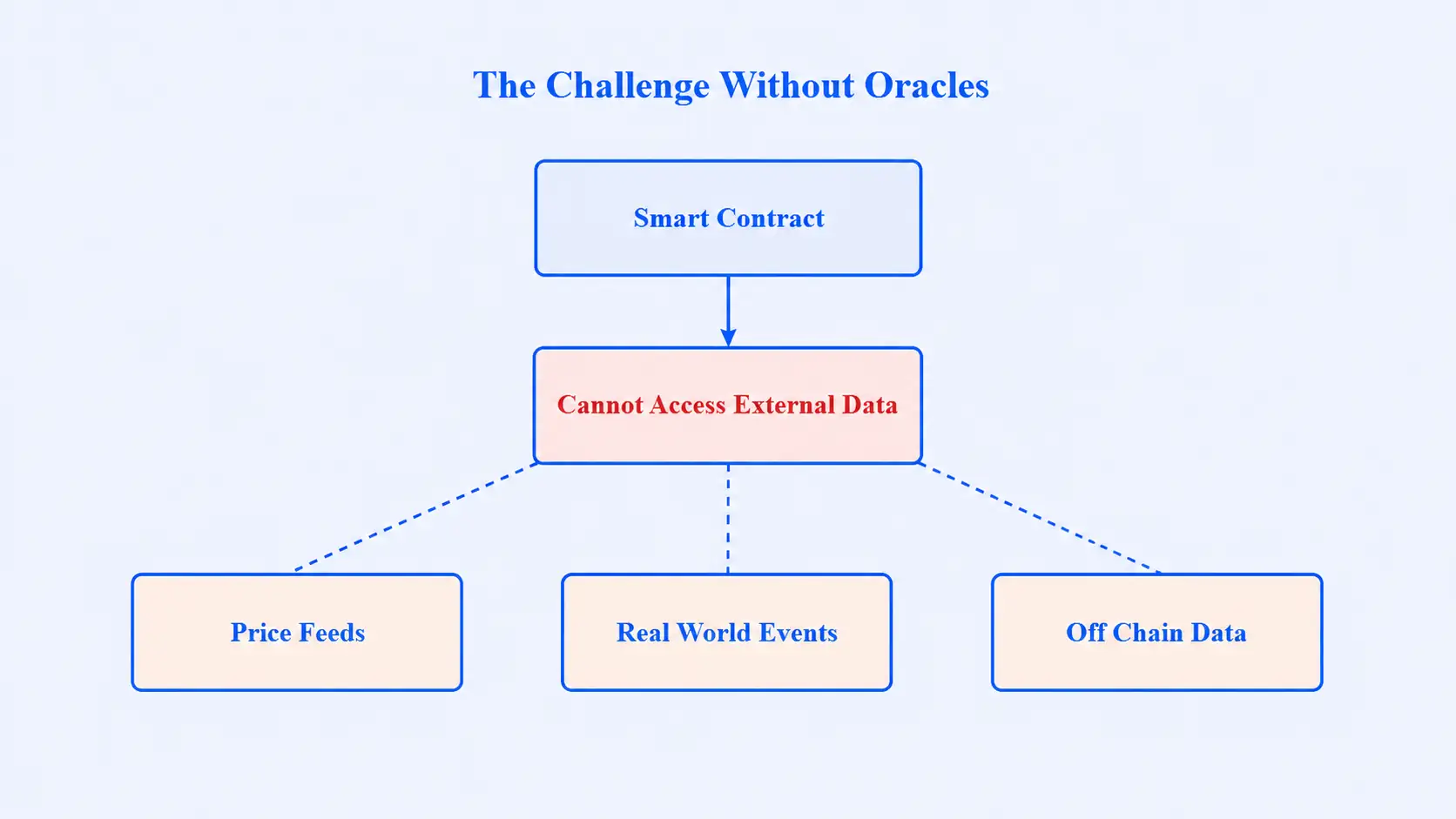
The Core Problem: Smart contracts run on blockchain networks that are isolated from the internet. A smart contract can verify signatures and perform calculations, but it cannot independently fetch data from external APIs or websites. This creates a critical barrier for DeFi applications that need real world information to function properly.
Consider a decentralized lending platform. A user wants to borrow USDC against their Bitcoin collateral. The smart contract needs to know the current Bitcoin price to ensure the borrower has enough collateral. But the contract cannot browse CoinMarketCap or check a crypto exchange to get this price. This is where oracle infrastructure becomes essential.
Smart contracts are deterministic by design. This means given the same input, they always produce the same output. The blockchain must be able to verify the result without depending on external services. If a smart contract could directly query the internet, different nodes might receive different data, breaking consensus across the network.
How Oracle Infrastructure in DeFi Actually Works
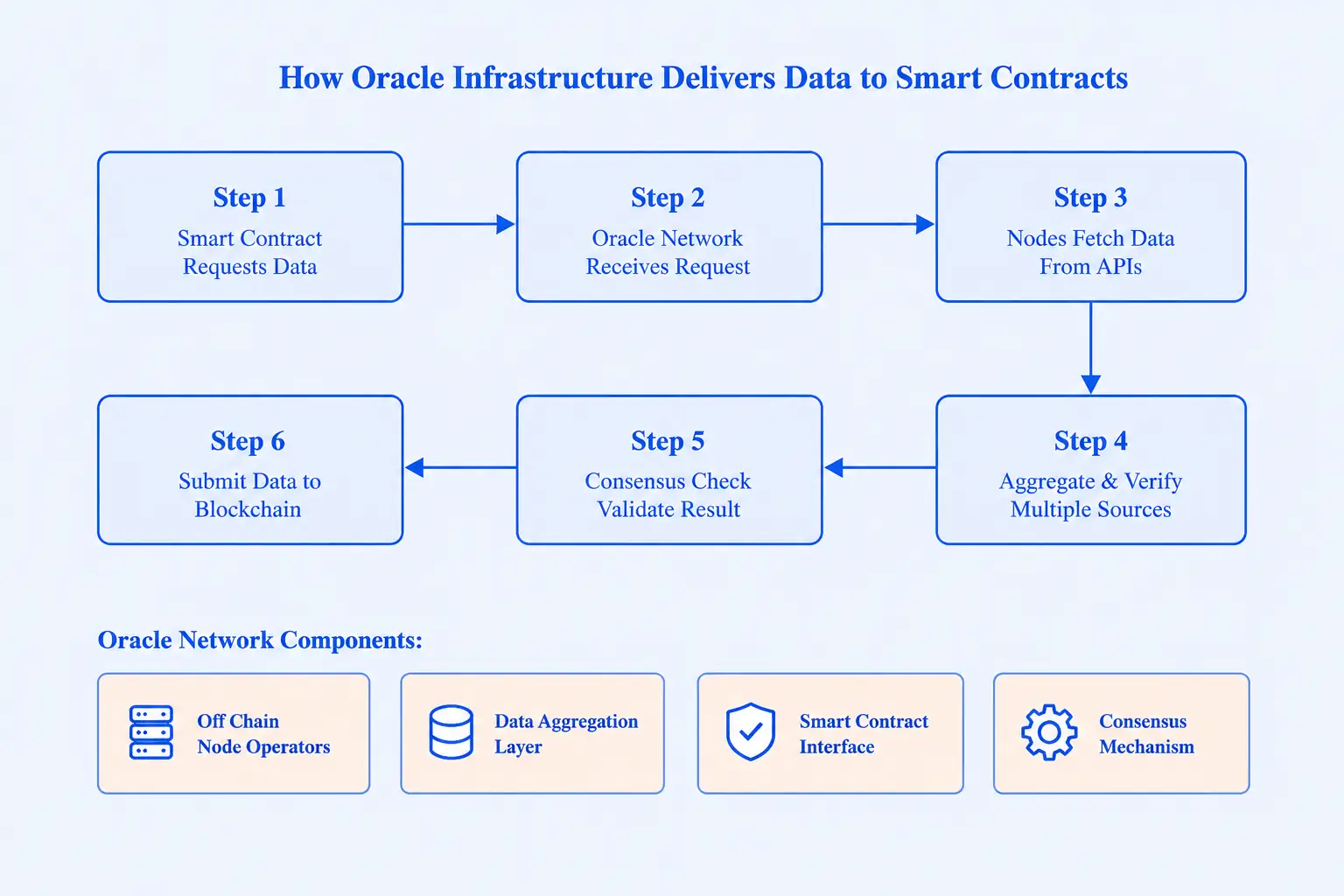
Example in Action: A DeFi lending protocol needs the current ETH/USD price. A user triggers a smart contract function. The contract emits an event requesting oracle data. Multiple independent oracle nodes see this request and simultaneously fetch the ETH price from different exchanges. They aggregate the results by removing outliers and calculating a median price. They verify consensus among themselves. Finally, one node submits the verified price to the blockchain, and the smart contract receives the data it needs.
Types of Blockchain Oracles in DeFi
Oracle infrastructure in DeFi comes in several distinct varieties, each serving different purposes and security models:
Centralized Oracles
A single entity or company provides the data. This is simple and fast but creates a single point of failure. If that entity goes down or acts maliciously, the entire smart contract becomes unreliable. Many early DeFi protocols used centralized oracles before recognizing the security risks.
Decentralized Oracle Networks
Multiple independent node operators verify and submit data. This is like multiple news agencies reporting the same event. If one node provides false data, the consensus mechanism detects and rejects it. This is the gold standard for oracle infrastructure in DeFi, used by protocols protecting billions in total value locked.
Chain Link Oracles
Chainlink is the dominant decentralized oracle network. It uses cryptographic verification and economic incentives to ensure node operators provide accurate data. Nodes that submit false data lose their stake, creating a powerful incentive for honesty.
Band Protocol Oracles
Band Protocol aggregates data from multiple sources and validators stake tokens to provide accurate information. It emphasizes flexibility and supports various data types beyond price feeds.
API3 Oracles
API3 focuses on direct connections between API providers and smart contracts, removing unnecessary intermediaries. This reduces latency and costs while maintaining decentralization through its dAPI architecture.
Comparing Oracle Infrastructure Solutions
| Oracle Type | Decentralization | Security | Speed | Cost | Best For |
|---|---|---|---|---|---|
| Centralized | Low | Low | High | Low | Testing only |
| Chainlink | High | Very High | Medium | Medium | Production DeFi |
| Band Protocol | High | High | Medium | Medium | Multi chain DeFi |
| API3 | High | High | High | Low | Direct integrations |
| Uniswap TWAP | Very High | Medium | High | Very Low | Native protocols |
Real World DeFi Oracle Use Cases
Oracle infrastructure in DeFi enables some of the most innovative financial applications in the world. Here are concrete examples:
Lending Protocols: Aave and Compound
When users deposit cryptocurrency as collateral to borrow other assets, the smart contract must know the real time price of both tokens. If BTC suddenly drops 30%, the protocol needs to know immediately to liquidate undercollateralized positions. Oracle infrastructure provides continuous price feeds ensuring these platforms operate safely.
Decentralized Exchanges: Uniswap and dYdX
DEXs need accurate price data to detect and prevent flash loan attacks. These attacks happen when a hacker temporarily borrowing huge amounts of tokens to manipulate prices. Reliable oracle infrastructure helps DEXs resist such exploits by providing fair price references.
Stablecoin Systems: MakerDAO
MakerDAO’s DAI stablecoin maintains its $1 peg through collateral liquidation. The system constantly monitors the price of crypto assets used as collateral. If values drop, positions are automatically liquidated to protect DAI’s stability. This depends entirely on oracle infrastructure being reliable.
Crypto Insurance Protocols
Protocols like Nexus Mutual use oracles to verify that insured events actually occurred. If a smart contract is hacked or an exchange collapses, oracles provide the evidence needed to process insurance claims automatically.
Derivatives and Prediction Markets
Platforms like Synthetix create synthetic assets that track real world prices. Futures protocols let users bet on asset prices without holding them. All require oracle infrastructure to settle trades fairly based on actual market prices.
Oracle Security Risks and Attack Vectors
The biggest threat to oracle infrastructure in DeFi is compromise of the data itself. Several attack vectors exist that hackers actively exploit:
Price Feed Manipulation
Hackers attempt to pump or dump token prices through large trades, trying to corrupt oracle data. A 2020 attack on bZx protocol exploited price feeds by borrowing a large amount of a token on one exchange to temporarily crash its price, then using that manipulated price on other platforms for profit.
Sybil Attacks on Oracle Networks
A hacker creates multiple fake identities to control many oracle nodes and vote for incorrect data. Decentralized networks use staking requirements and reputation systems to make Sybil attacks expensive.
Flash Loan Attacks
In a single transaction, a hacker borrows a massive amount of tokens from a lending pool, uses them to manipulate a DEX price, exploits that false price in another smart contract, then repays the loan and pockets the profit. All happens in one block before anyone can react.
DNS and API Hijacking
If an oracle node’s connection to data sources is compromised, attackers can inject false data directly. This is why oracle infrastructure uses multiple data sources and requires cryptographic verification.
Front Running and Sandwich Attacks
Miners or validators can see a price update coming and front run it by making a trade right before the oracle submits new data, profiting from the price movement they know is coming.
How Secure Oracle Systems Defend: Modern oracle infrastructure uses time delays between data collection and submission, multiple independent data sources that cannot collude, cryptographic commitments to prevent front running, and economic penalties for nodes providing false data. Chainlink’s design is considered the industry standard for oracle security.
How Chainlink Oracle Explained: The Market Leader
Chainlink dominates the oracle infrastructure market by a wide margin. Understanding how Chainlink works gives insight into why decentralized oracle networks matter so much.
Chainlink Architecture
Oracle Nodes: Chainlink operates a network of thousands of independent node operators worldwide. These nodes compete to provide accurate data and earn fees for their work. They have financial incentive to be honest because their stake can be slashed for providing false information.
Price Feeds: Chainlink maintains continuously updated price feeds for hundreds of cryptocurrency pairs, forex rates, and commodity prices. These feeds aggregate data from multiple exchanges, preventing any single exchange failure from corrupting the oracle.
Verifiable Randomness: Chainlink VRF provides provably fair random numbers for games, NFT minting, and other applications requiring randomness. The randomness is verifiable on chain, so users can confirm it was genuinely random.
Proof of Reserve: Chainlink allows protocols to verify that announced reserves (like stablecoin collateral) actually exist on chain. This protects users from fraudulent backing claims.
Automation: Chainlink Automation lets smart contracts automatically execute actions when conditions are met, without requiring external triggers. This enables features like automatic liquidations and yield harvesting.
Chainlink’s strength comes from its combination of decentralization, security, and feature richness. A smart contract using a Chainlink price feed benefits from multiple independent verification sources, economic incentives for honesty, and continuous monitoring of node operator performance.
Oracle Infrastructure Scalability and Future Development
As DeFi grows, oracle infrastructure must keep pace. Current bottlenecks and solutions shape the future of oracle infrastructure in DeFi:
Current Scalability Challenges
- Update Frequency: More applications need more frequent price updates, increasing blockchain transaction costs. Each update is a transaction that costs gas fees.
- Latency: The time between a price changing in the real world and a smart contract receiving the update can be critical. DeFi is accelerating this, but delays still create arbitrage opportunities.
- Data Types: Beyond prices, DeFi increasingly needs verifiable information about real world events, IoT data, or identity information. Oracle infrastructure must expand beyond numeric data.
- Cross Chain Needs: As blockchain fragmentation accelerates, oracle infrastructure must provide consistent data across different chains.
Emerging Solutions
- Layer 2 Oracles: Running oracle logic on layer 2 scaling solutions before posting final results to the main chain reduces costs dramatically.
- Pull Model Oracles: Instead of continuously pushing price updates on chain, smart contracts pull the latest price on demand. This reduces costs for less frequently used data.
- Zero Knowledge Oracles: Using ZK proofs to verify oracle data opens possibilities for privacy preserving oracle infrastructure.
- Verifiable Computation: Oracle infrastructure could execute entire computations on chain, providing verifiable results without revealing intermediate steps.
Flow Chart: Layers of Oracle Security in Decentralized Networks
Security Mechanisms
- No single node controls data
- Cryptographic proofs prevent tampering
- Slashing penalties discourage bad behavior
- Multiple nodes must agree on results
- Outliers are removed automatically
- Historical performance monitoring
- Continuous network auditing
- Public transparency of operations
Why Oracle Infrastructure Matters for Business and DeFi Growth
From a business perspective, oracle infrastructure in DeFi is more than just technology. It’s the foundation enabling billions in value to move through trustless systems:
Growth Enabler
DeFi protocols can only grow to the extent that oracle infrastructure can reliably and affordably supply data. As oracles improve, new use cases become viable. As costs drop, smaller protocols can afford robust oracle infrastructure.
Risk Management
Businesses providing DeFi infrastructure live or die based on oracle reliability. A lending platform with a poor oracle choice could face cascading liquidation failures during market volatility. This drives demand for premium oracle infrastructure.
Interoperability
As multiple blockchains compete for DeFi activity, oracle infrastructure that works across chains becomes critical. Projects like Chainlink gain competitive advantage through multi chain oracle networks.
Regulatory Compliance
As DeFi matures, regulators scrutinize oracle infrastructure more carefully. Transparent, auditable oracle systems that prove data integrity become more valuable to platforms seeking regulatory approval.
Ready to Build Secure DeFi Infrastructure?
Startups and enterprises building DeFi platforms face critical decisions about oracle infrastructure. The right choice impacts security, scalability, and user trust. The wrong choice can lead to exploit vulnerabilities and loss of user confidence.
Nadcab Labs specializes in implementing secure blockchain and Web3 infrastructure solutions. Our team has deep expertise in oracle integration, smart contract security, and DeFi protocol architecture. Whether you’re launching a lending protocol, building a stablecoin system, or creating a derivatives platform, we help you architect oracle solutions that are both secure and cost efficient.
Let our expert guidance help you make informed decisions about oracle infrastructure and build DeFi applications your users can trust.
Oracle Infrastructure Powers DeFi
Oracle infrastructure in DeFi solves one of blockchain’s most fundamental challenges: connecting decentralized smart contracts to real world information. Without oracles, DeFi applications would be isolated systems unable to respond to market changes or real world events.
We’ve covered how oracle infrastructure works through multiple independent nodes verifying data, the security mechanisms that protect against manipulation, and the real world applications from lending to insurance. We’ve explored different oracle solutions from Chainlink to Band Protocol to understand how mature oracle networks achieve both decentralization and reliability.
The future of oracle infrastructure will likely emphasize scalability through layer 2 solutions, cross chain interoperability, and support for new data types beyond prices. As DeFi matures and pushes boundaries, oracle infrastructure must continue evolving to meet new demands.
For anyone building or using DeFi applications, understanding oracle infrastructure in DeFi is essential. It determines which platforms are secure enough to trust with your assets and which innovations become technically feasible. As you evaluate DeFi opportunities, always examine the oracle infrastructure choices carefully. It’s often the difference between a robust, reliable protocol and one vulnerable to manipulation.
Frequently Asked Questions
Q1.How much does it cost to integrate oracle infrastructure into a smart contract?
Oracle integration costs vary widely based on update frequency and data complexity. A basic price feed might cost $100 to $1,000 monthly, while real time updates for multiple assets could cost significantly more. Chainlink charges per API call, Band Protocol uses subscription models, and API3 offers various pricing tiers. Layer 2 deployments reduce costs by 90%+ compared to mainnet deployments. Always compare costs against your protocol’s revenue.
Q2.Can smart contracts ever be completely independent from oracles?
Only if they don’t need external information. Pure on chain mechanisms like Uniswap’s time weighted average price don’t require external oracles. However, any smart contract needing real time prices, market data, or off chain events needs oracle infrastructure. The question isn’t whether to use oracles, but which oracle infrastructure provides the right security and cost tradeoff.
Q3.What happens if an oracle network goes offline or censors data?
This is a critical risk. If Chainlink goes offline, thousands of smart contracts lose their price feeds. Large protocols implement fallback oracles from multiple providers. Some use on chain reference prices as emergency backups. The solution is redundancy: never depend on a single oracle infrastructure provider, no matter how reliable.
Q4.How do oracle networks prevent 51% attacks where most nodes collude?
Economic incentives are the primary defense. Nodes operating a Chainlink oracle stake LINK tokens that are slashed if they provide false data. Creating enough nodes to control 51% requires purchasing billions in LINK tokens, which cost more than any attack profit. Reputation systems also track node performance, immediately flagging dishonest operators.
Q5.Can you run your own private oracle infrastructure instead of using public oracle networks?
You can, but it introduces significant risks. A private oracle controlled by one company becomes a trusted third party, defeating blockchain principles. Large protocols occasionally run private oracles alongside decentralized infrastructure as emergency backups, but for production use, decentralized oracle networks are essential. Private oracles are only appropriate for internal testing.
Q6.What data can oracle networks provide beyond cryptocurrency prices?
Modern oracle infrastructure supports weather data, sports scores, proof of identity, election results, IoT sensor readings, and more. Band Protocol specializes in diverse data types. The limitation isn’t technical but economic: providing more exotic data costs more because it requires more specialized node operators. As DeFi matures, oracle infrastructure will support increasingly diverse real world data.
Q7.How does oracle infrastructure handle price feeds during extreme market volatility?
During volatility, oracle infrastructure updates more frequently to capture rapid price changes. However, network congestion can cause delays. Many protocols use circuit breakers that pause operations if prices change too quickly, preventing cascading liquidations. Some oracle networks offer SLA guarantees specifying maximum latency, helping platforms know their worst case scenarios.
Q8.Will oracle infrastructure become decentralized enough to fully eliminate trust assumptions?
Oracles create an unavoidable trust model: someone must verify and submit real world data to the blockchain. Decentralization reduces how many entities must be trusted, but can’t eliminate it completely. The goal is making oracle infrastructure trustless enough that attacking it is economically unreasonable, not technically impossible. Current systems like Chainlink achieve this through cost and complexity of attacks.
Q9.How do layer 2 networks and sidechains implement oracle infrastructure differently?
Layer 2 solutions often use optimized oracle designs that take advantage of different security models. Some use light clients to verify data from mainnet instead of running separate oracle networks. Others use sequencer operated oracles for low latency but maintain mainnet fallbacks. As layer 2 matures, specialized oracle infrastructure specifically designed for scaling solutions becomes more important.
Q10.What should DeFi projects prioritize when evaluating oracle infrastructure providers?
Prioritize in this order: (1) Security track record and independent audits, (2) Decentralization and number of independent nodes, (3) Data quality and update frequency, (4) Cost structure and transparency, (5) Community support and development activity. Never choose an oracle provider based solely on cost. Security problems will cost far more than oracle fees savings.
Explore Services
Related Services
Reviewed by

Naman Singh
Co-Founder & CEO, Nadcab Labs
Naman Singh is the Co-Founder and CEO of Nadcab Labs, where he drives the company’s vision, global growth, and strategic expansion in blockchain, fintech, and digital transformation. A serial entrepreneur, Naman brings deep hands-on experience in building, scaling, and commercializing technology-driven businesses. At Nadcab Labs, Naman works closely with enterprises, governments, and startups to design and implement secure, scalable, and business-ready Web3 and blockchain solutions. He specializes in transforming complex ideas into high-impact digital products aligned with real business objectives. Naman has led the development of end-to-end blockchain ecosystems, including token creation, smart contracts, DeFi and NFT platforms, payment infrastructures, and decentralized applications. His expertise extends to tokenomics design, regulatory alignment, compliance strategy, and go-to-market planning—helping projects become investor-ready and built for long-term sustainability. With a strong focus on real-world adoption, Naman believes in building blockchain solutions that deliver measurable value, solve practical problems, and unlock new growth opportunities for organizations worldwide.