Ai Overview
Getting a token or blockchain project listed on a major wallet or exchange is one of the most critical steps in the life of any crypto project. But what many founders and development teams overlook is the sheer volume of technical work that goes into making a listing happen. It is not just about submitting an application and waiting for approval.
Getting a token or blockchain project listed on a major wallet or exchange is one of the most critical steps in the life of any crypto project. But what many founders and development teams overlook is the sheer volume of technical work that goes into making a listing happen. It is not just about submitting an application and waiting for approval. There are protocol checks, API configurations, smart contract audits, and a whole chain of testing steps that need to happen before a project goes live on a platform like Trust Wallet, MetaMask, or a centralized exchange.
This article breaks down exactly what technical support for blockchain listings involves, why it matters, who needs it, and how experienced blockchain development firms like Nadcab Labs handle this process. Whether you are a startup founder launching your first token or an established project looking to expand to new platforms, this guide will give you a practical understanding of the technical side of blockchain listings.
Key Takeaways
- Technical support for blockchain listings covers everything from smart contract audits and API integration to post-launch monitoring and bug fixes.
- Compatibility testing between your blockchain and the target platform is the single most failure-prone step in the listing process.
- Self-managed listings carry a significantly higher risk of rejection or delayed deployment compared to professionally supported ones.
- Platforms like Trust Wallet require strict adherence to token standards (ERC-20, BEP-20, etc.) and metadata formatting rules.
- Firms like Nadcab Labs, with over 8 years in blockchain development, reduce listing timelines from months to weeks through structured processes.
- Post-deployment support is just as important as the initial integration because issues like transaction failures or sync errors can appear after launch.
- Choosing the right blockchain consensus mechanism and architecture early on directly impacts how smooth the listing process will be.
What Does Technical Support for Blockchain Listings Actually Mean?
At its core, technical support for blockchain listings refers to the hands-on engineering work required to get a blockchain token or network integrated with a wallet, exchange, or DeFi platform. This is not a marketing service or a PR campaign. It is deeply technical work that involves code-level changes, protocol alignment, and extensive testing.
Think of it this way. If a token wants to be listed on Trust Wallet, the development team cannot just send the token contract address and expect it to show up. The token has to meet specific standards. The logo and metadata have to be formatted correctly. The API calls between the token’s network and Trust Wallet’s infrastructure have to work without errors. The smart contract needs to be verified and free of vulnerabilities. And all of this needs to be tested across multiple devices and operating systems before deployment.
That is what technical support covers. It is the bridge between having a token that works on its own and having a token that works seamlessly inside a third-party ecosystem. Companies like Nadcab Labs have spent more than 8 years building expertise around exactly this kind of integration work. Their team understands the nuances of different wallet architectures, exchange APIs, and token standards, which makes the difference between a listing that goes smoothly and one that gets stuck in review for months.
If you are exploring how blockchain nodes interact during this process, understanding node synchronization in blockchain gives useful context on how networks stay aligned during integration.
Also Read: Enterprise Blockchain Applications Guide
Core Components of Blockchain Listing Technical Support
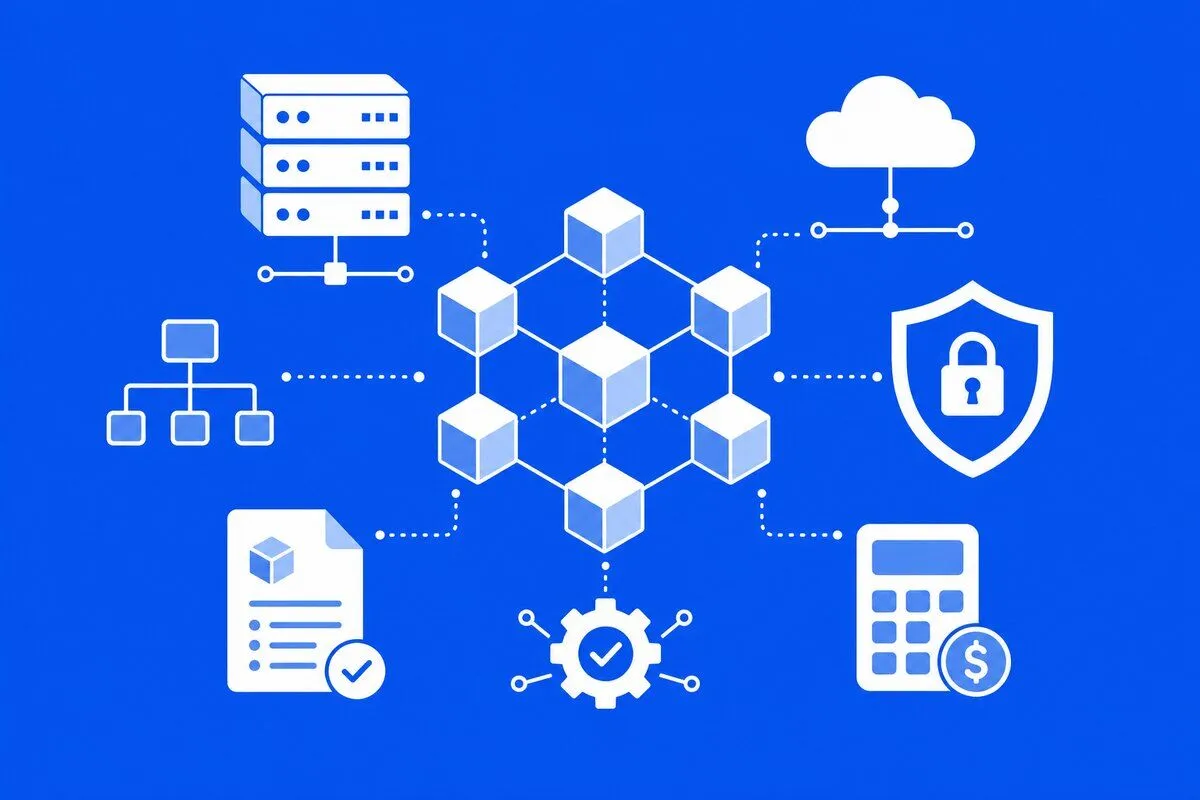
The technical support process is not a single task. It is made up of several distinct components, each of which plays a specific role in getting a project listed. Below is a breakdown of the main areas involved.
| Component | What It Involves | Why It Matters |
|---|---|---|
| Smart Contract Audit | Code review, vulnerability scanning, logic verification | Prevents exploits and builds platform trust |
| Token Standard Compliance | Verifying ERC-20, BEP-20, TRC-20, or other standards | Non-compliant tokens get rejected by platforms |
| API Integration | Connecting token functions to platform endpoints | Enables balance display, transfers, and transaction history |
| Metadata Configuration | Logo files, token name, symbol, decimal precision | Incorrect metadata leads to display errors or rejection |
| Cross-Platform Testing | Testing on iOS, Android, desktop, and browser extensions | Ensures consistent performance for all users |
| Post-Deployment Monitoring | Tracking errors, transaction failures, sync issues | Catches problems before they affect a large user base |
Each of these components requires a different set of skills. A smart contract audit, for example, demands deep Solidity expertise. API integration requires knowledge of RESTful architecture and the specific documentation of the target platform. Metadata configuration might sound simple, but getting the logo resolution, file format, and JSON schema exactly right is where many DIY projects stumble.
Nadcab Labs has dedicated specialists for each of these areas, which is a big reason their clients see faster turnaround times and fewer revision cycles during the listing process.
The Blockchain Listing Lifecycle: Step by Step
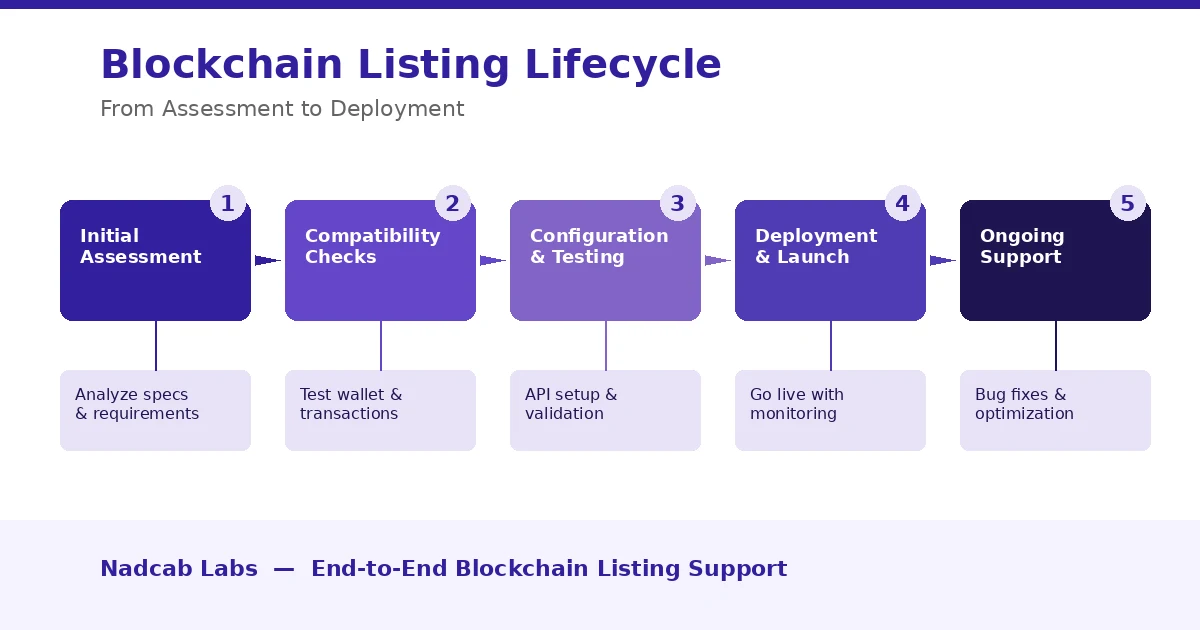
Understanding the full lifecycle of a blockchain listing helps set realistic expectations and shows where technical support adds the most value. Here is the process from start to finish, laid out in practical terms.
Step 1: Project Assessment and Readiness Check
Before anything else, the technical team evaluates the blockchain project itself. Is the smart contract deployed and verified? Is the project running on a testnet or mainnet? What token standard does it follow? Are there any known bugs or unresolved issues in the codebase?
This assessment phase is crucial because it identifies potential roadblocks early. For instance, if a token has a non-standard transfer function, it will likely fail during the platform’s automated checks. Catching this at the assessment stage saves weeks of back-and-forth later. Nadcab Labs’ assessment process draws from over 8 years of working with diverse blockchain architectures, so they know exactly where to look for common pitfalls.
Step 2: Compatibility Testing
This is arguably the most important and most failure-prone step. Compatibility testing checks whether the token works correctly within the target platform’s environment. For a Trust Wallet listing, this means testing wallet creation for the token, send and receive functions, transaction confirmation display, gas fee estimation, and interaction with any associated smart contracts.
A common real-world example: a project built on Binance Smart Chain (BSC) might have a BEP-20 token that works perfectly on PancakeSwap but throws errors when Trust Wallet tries to fetch its balance through its internal API. The issue could be something as subtle as a missing decimal specification in the contract or an incorrect return type in a function. These are the kinds of bugs that only surface during thorough compatibility testing.
For teams interested in how smart contract testing impacts blockchain security, it directly ties into why this compatibility phase exists. A contract that is secure but incompatible with a wallet’s interface is still a failed listing.
Step 3: Configuration and Integration
Once compatibility is confirmed, the team moves to configuration. This involves setting up API endpoints, configuring webhook listeners for transaction events, uploading token metadata to the platform’s asset repository (like the Trust Wallet Assets GitHub repo), and mapping the token’s functions to the platform’s UI elements.
Configuration work also includes setting up block explorers to link correctly, ensuring that transaction history populates accurately, and verifying that token icons and names display without errors across different screen sizes and device types.
Step 4: Testing and Quality Assurance
After configuration, the entire integration goes through a full QA cycle. This includes functional testing (does everything work?), regression testing (did new changes break anything?), performance testing (how fast do transactions confirm?), and security testing (can the integration be exploited?).
Nadcab Labs runs these tests across real devices, not just emulators. Their QA team covers Android, iOS, and browser-based wallets to make sure the user experience is consistent everywhere. This thoroughness is one of the reasons they maintain a listing success rate well above the industry average.
Step 5: Deployment and Go-Live
With testing complete, the token is submitted for final review by the platform. If everything checks out, the listing goes live. But the work does not stop here. The deployment phase includes monitoring the first 48 to 72 hours of live activity closely to catch any issues that testing might have missed.
Step 6: Post-Deployment Support and Maintenance
After the listing is live, ongoing technical support handles bug reports, transaction anomalies, wallet update compatibility, and any changes the platform makes to its API or requirements. Platforms like Trust Wallet update their apps frequently, and each update can potentially break an existing integration if it is not maintained.
This is where many projects that handle their own listings run into problems. They get listed, then six months later an app update causes their token to display incorrectly, and they have no technical team on standby to fix it.
Why Trust Wallet Listing Requires Specialized Technical Support
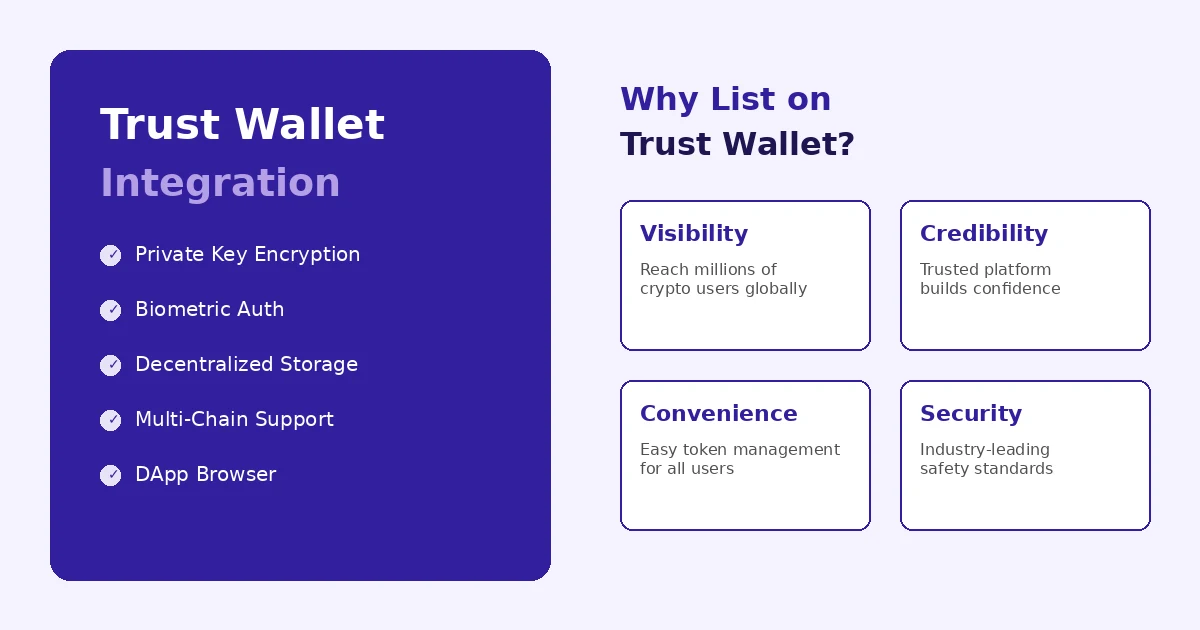
Trust Wallet is one of the most widely used non-custodial wallets in the crypto space, with tens of millions of active users worldwide. It supports multiple blockchain networks, hundreds of thousands of tokens, and integrates directly with decentralized applications through its built-in DApp browser.
Because of its scale and user base, Trust Wallet has strict listing requirements. The token must follow a supported standard. The contract must be verified on a block explorer like Etherscan or BscScan. The project needs to submit a pull request to the Trust Wallet Assets repository on GitHub, following a very specific folder structure and file naming convention. Even the logo has to be a PNG file with exact pixel dimensions and transparent background.
For teams without experience in this process, small mistakes lead to pull request rejections, which then require corrections and resubmissions. Each cycle can take days or weeks depending on review queue length. Professional technical support from a firm like Nadcab Labs eliminates most of these back-and-forth cycles by getting the submission right the first time.
Understanding how different blockchain scaling solutions work can also affect your listing approach. For example, projects using Plasma-based architectures or state channels require different integration strategies compared to standard Layer-1 tokens.
Get Expert Blockchain Listing Support
Skip the guesswork and listing delays. Work with a team that has handled blockchain integrations for over 8 years across wallets, exchanges, and DeFi platforms.
Common Technical Challenges During Blockchain Listings
Even well-prepared projects run into technical issues during the listing process. Knowing what to expect helps teams plan better and reduces the chance of costly delays. Here are the challenges that come up most often.
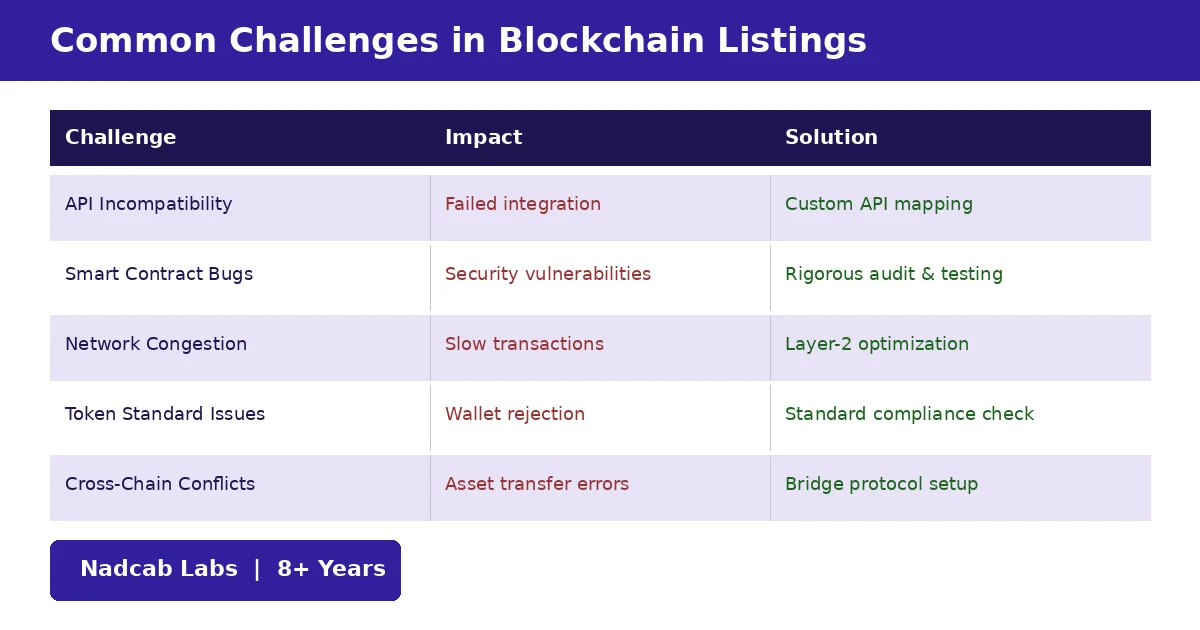
| Challenge | Root Cause | How Professional Support Resolves It |
|---|---|---|
| Token not appearing in wallet | Incorrect metadata or missing asset submission | Proper GitHub PR with validated metadata files |
| Transaction failures after listing | Gas estimation mismatch or nonce conflicts | Custom gas logic and nonce management setup |
| Balance display errors | Decimal mismatch between contract and platform | Contract decimal alignment and API verification |
| Pull request rejected | Logo format, folder structure, or naming error | Pre-submission checklist and format validation |
| Smart contract flagged as risky | Unverified contract or known vulnerability pattern | Full audit, verification, and risk report |
| Cross-chain transfer issues | Incorrect bridge configuration or chain ID mismatch | Bridge protocol setup and chain mapping |
Each of these issues can delay a listing by days or even weeks if not handled correctly. The cost of delay is not just time; it is also lost market opportunity, reduced investor confidence, and potential user churn. Nadcab Labs’ structured approach to listing support is designed specifically to prevent these kinds of setbacks.
Self-Listing vs. Professional Technical Support: A Practical Comparison
Some project teams consider handling the listing process themselves to save money. While that can work for experienced developers who have done it before, most teams underestimate the complexity involved. Here is an honest comparison of both approaches.
| Factor | Self-Listing | Professional Support (e.g., Nadcab Labs) |
|---|---|---|
| Average Timeline | 3 to 6 months | 2 to 4 weeks |
| First-Attempt Success Rate | Around 40 to 50 percent | Above 95 percent |
| Hidden Costs | Developer time, rework, missed deadlines | Transparent fixed pricing |
| Risk of Rejection | High, especially for first-time submissions | Low, due to pre-submission validation |
| Post-Launch Support | Limited to internal team capacity | Dedicated support with monitoring |
| Multi-Platform Listing | Requires separate research per platform | Single team handles all platforms |
The comparison makes it clear that professional support is not just a convenience; it is a strategic advantage. The time saved alone often justifies the investment, especially in fast-moving crypto markets where being listed a few weeks earlier can mean a significant difference in trading volume and community engagement.
The Role of Smart Contracts in the Listing Process
Smart contracts are at the heart of nearly every token listing. They define how the token works, who can interact with it, what happens during transfers, and how supply is managed. When a wallet or exchange reviews a token for listing, the smart contract is one of the first things they examine.
A well-written smart contract follows its respective token standard closely. For Ethereum-based tokens, that means strict adherence to the ERC-20 standard with all required functions implemented correctly: totalSupply, balanceOf, transfer, approve, transferFrom, and allowance. Missing or incorrectly implemented functions will cause the token to fail platform validation checks.
Beyond standard compliance, platforms also look for red flags in smart contracts. These include owner-only mint functions that could inflate supply without limits, hidden transfer fees that are not disclosed, pause mechanisms that could freeze user funds, and proxy patterns that allow the contract logic to be changed after deployment. Any of these can lead to a listing rejection or, worse, a delisting after launch.
Nadcab Labs’ approach to smart contract preparation for listings includes a full audit, optimization for gas efficiency, and verification on the relevant block explorer. Their team has reviewed and prepared hundreds of contracts for listing over the years, giving them a practical understanding of what platforms look for and what triggers rejection.
For a deeper look at how contract testing works, the guide on smart contract testing and blockchain security covers the methodologies and tools used in real-world audits.
How Consensus Mechanisms Impact Listing Requirements
The consensus mechanism your blockchain uses has a direct effect on how the listing process plays out. Different mechanisms handle transaction finality, block production, and network validation in different ways, and these differences matter when integrating with wallets and exchanges.
For example, a blockchain using Delegated Proof of Stake (DPoS) will have different block confirmation times and finality guarantees compared to a Proof of Work chain. This affects how the wallet displays transaction status and when it considers a transaction “complete.” If the wallet expects 12 confirmations but the blockchain only produces blocks every 30 seconds, the user experience will feel slow unless the integration accounts for this.
Similarly, projects exploring newer consensus approaches like Proof of Elapsed Time (PoET) for permissioned blockchains face unique listing challenges because many wallets are not designed with permissioned chains in mind. Technical support in these cases involves custom adapter development and middleware solutions to bridge the gap.
Nadcab Labs has worked with projects using a wide range of consensus mechanisms, from standard PoW and PoS to more specialized models. This breadth of experience means they can anticipate integration challenges based on the underlying blockchain architecture before they become problems.
Blockchain Scalability and Its Effect on Listings
Scalability is not just a performance concern; it directly impacts the listing experience. A blockchain that cannot handle a surge in transactions after a major listing will give users a poor experience, which can lead to negative reviews and reduced adoption.
Platforms are aware of this. When evaluating a listing request, they consider the blockchain’s throughput capacity, average transaction fees under load, and historical uptime. Projects that have experienced network congestion or outages may face additional scrutiny.
This is where scalability solutions like sidechain pegging and Layer-2 technologies come into play. A project that can demonstrate it has a viable scaling strategy is more likely to be approved quickly. For instance, tokens that operate on Layer-2 solutions built on Ethereum benefit from Ethereum’s security while offering lower fees and faster confirmations, which platforms and users both prefer.
Nadcab Labs advises clients on scalability planning as part of their listing support. If a project’s architecture is not ready for the traffic that comes with a major wallet listing, the team will recommend and implement improvements before the listing goes live. This proactive approach prevents the embarrassing scenario of a successful listing followed by a network that cannot keep up with demand.
Decentralized Identity and Its Growing Role in Listings
A newer but increasingly important factor in blockchain listings is decentralized identity. As regulatory requirements evolve and platforms look for ways to verify project legitimacy without centralized gatekeepers, decentralized identifiers (DIDs) are becoming part of the conversation.
Some platforms are beginning to explore or implement identity verification layers that use decentralized credentials. This means that in the near future, projects may need to provide verifiable proof of team identity, organization registration, and audit completion through decentralized identity protocols rather than traditional KYC documents.
Technical support providers who stay ahead of these trends, like Nadcab Labs, are already building the infrastructure and expertise to help clients navigate decentralized identity requirements as they become more widespread.
Real-World Example: What a Listing Gone Wrong Looks Like
Consider a hypothetical but common scenario. A DeFi project launches a governance token on Ethereum. The team builds their smart contract, deploys it, and then submits a listing request to Trust Wallet. They follow what they think are the correct steps based on online guides and forum posts.
Two weeks later, their pull request is rejected. The reason: the token logo was submitted as a JPEG instead of a PNG, and the folder structure in the GitHub submission did not match the required format. They fix these issues and resubmit.
Another week passes. The second submission is also rejected, this time because the smart contract was not verified on Etherscan. The team verifies the contract and submits again.
On the third attempt, the PR is merged, but users report that the token balance shows as zero in their wallets. The issue turns out to be a decimal mismatch: the contract uses 8 decimals, but the metadata submission specified 18. Another fix, another wait for review.
By the time the token is fully functional on Trust Wallet, nearly three months have passed. The project missed its planned marketing window, early community members lost patience, and competitors who listed around the same time captured the momentum.
This kind of scenario is preventable. A technical support partner would have caught all of these issues during the assessment phase, submitted everything correctly on the first attempt, and had the token live within weeks. That is the practical value of professional blockchain listing support.
Projects dealing with unusual block structures should also understand how things like orphan blocks can affect transaction finality and, by extension, how wallets handle confirmations during the listing.
Exchange Listings vs. Wallet Listings: Key Differences
While this article focuses primarily on wallet listings (such as Trust Wallet), it is worth noting that exchange listings involve their own set of technical requirements. Exchange listings typically require deeper integration work, including order book connectivity, trading pair configuration, deposit and withdrawal system setup, and compliance with the exchange’s specific API format.
Wallet listings, on the other hand, are primarily about displaying the token correctly and enabling basic functions like sending, receiving, and viewing balances. Both types benefit from professional technical support, but the scope and complexity differ.
Nadcab Labs provides technical support for both wallet and exchange listings, which is valuable for projects that want a single partner to handle their presence across multiple platforms. Their experience with high-growth crypto projects gives them insight into what platforms prioritize when evaluating listing applications.
Why Nadcab Labs Stands Out in Blockchain Listing Support
There are many blockchain development companies, but few combine the depth of technical expertise with the breadth of listing experience that Nadcab Labs offers. Here are some specific reasons their approach works well for projects seeking listing support.
First, their team has been doing this for over 8 years. That is a long time in an industry where most companies are less than 5 years old. That longevity means they have seen platform requirements change, listing processes evolve, and new challenges emerge. They have adapted to all of it.
Second, they take a full-lifecycle approach. They do not just help with the submission and walk away. Their support starts with the initial assessment and extends through post-deployment monitoring. If something breaks after the listing, they fix it.
Third, they work across platforms. Whether a client needs a Trust Wallet listing, a MetaMask integration, a centralized exchange listing, or all three, Nadcab Labs handles the technical work for each. This saves clients the hassle of managing multiple vendors for different platforms.
Fourth, they understand the broader blockchain ecosystem. Their expertise extends to areas like mobile app development and cloud infrastructure, which means they can handle the full technology stack around a blockchain project, not just the listing piece.
Technical Requirements Checklist for Blockchain Listings
Before initiating the listing process, teams should verify that their project meets these baseline technical requirements. This checklist is based on common standards across major wallets and exchanges.
| Requirement | Details | Status Check |
|---|---|---|
| Smart Contract Deployed | Contract live on mainnet, not just testnet | Required |
| Contract Verified | Source code verified on Etherscan, BscScan, etc. | Required |
| Token Standard Compliant | Follows ERC-20, BEP-20, TRC-20, or equivalent | Required |
| Logo Prepared | PNG, 256×256 px, transparent background | Required |
| Security Audit Completed | Third-party audit report available | Recommended |
| Active On-Chain Activity | Minimum holder count and transaction volume | Recommended |
| Working Website | Professional project website with documentation | Required |
| Social Media Presence | Active community on Twitter, Telegram, Discord | Recommended |
Nadcab Labs uses an expanded version of this checklist during their initial assessment phase. Their version includes additional checks specific to each target platform, which helps identify gaps early and prevents submission delays.
Ready to List Your Blockchain Project?
From smart contract audits to full deployment support, Nadcab Labs handles every technical detail so your listing goes live without setbacks.
Looking Ahead: How Listing Requirements Are Evolving
The blockchain listing landscape is not static. Platform requirements change regularly as wallets and exchanges refine their standards, add support for new blockchain networks, and respond to regulatory developments.
Several trends are shaping the future of blockchain listings. First, there is a growing emphasis on transparency. Platforms want to see verified team identities, published audit reports, and clear tokenomics before approving a listing. Second, multi-chain support is becoming standard. Tokens that only exist on a single chain may find it harder to get listed as platforms prioritize projects that operate across multiple networks.
Third, automated compliance tools are becoming more common. Some platforms are rolling out automated smart contract scanners that check for known vulnerability patterns before human reviewers even look at the submission. Projects with clean, well-structured contracts will pass these automated checks easily, while those with messy or non-standard code will face delays.
Staying ahead of these evolving requirements is part of what makes ongoing technical support valuable. Nadcab Labs continuously monitors platform updates and adjusts their processes accordingly. This means their clients benefit from the latest best practices without having to track these changes themselves.
Final Thoughts
Technical support for blockchain listings is not optional; it is a core part of bringing a token to market successfully. The process involves smart contract preparation, compatibility testing, API integration, metadata configuration, deployment, and ongoing maintenance. Each step has potential pitfalls that can delay or derail a listing if not handled with care.
For projects that want to get listed quickly, correctly, and without unnecessary headaches, partnering with an experienced blockchain development company like Nadcab Labs makes a tangible difference. Their 8-plus years of hands-on experience across wallets, exchanges, and diverse blockchain architectures translates into faster turnaround, fewer rejections, and a smoother experience from start to finish.
The blockchain space moves fast. The difference between launching on time with a clean listing and spending months fixing submission errors can define whether a project gains traction or fades into obscurity. Technical support is the practical, ground-level work that turns a promising blockchain project into one that users can actually find, trust, and use.
Frequently Asked Questions
Q1.What is technical support for blockchain listings and why do projects need it?
Technical support for blockchain listings is the engineering work required to integrate a token or blockchain with a wallet, exchange, or DeFi platform. It covers smart contract audits, API configuration, metadata formatting, compatibility testing, and post-launch monitoring. Projects need this support because listing platforms have strict technical standards, and errors in the submission process lead to rejections and delays that can set a project back by weeks or months.
Q2.How long does it take to get a token listed on Trust Wallet with professional support?
With professional technical support from an experienced firm like Nadcab Labs, a Trust Wallet listing typically takes between 2 to 4 weeks from initial assessment to live deployment. This includes smart contract review, metadata preparation, GitHub submission, and testing. Without professional support, the process often stretches to 3 to 6 months due to repeated submission rejections and troubleshooting that delays each step.
Q3.What are the most common reasons a blockchain listing submission gets rejected by platforms?
The most frequent rejection reasons include incorrect logo format or dimensions, missing smart contract verification on block explorers like Etherscan, non-compliant token standards, incorrect folder structure in the asset repository submission, and decimal mismatches between the contract and metadata. These are all preventable errors that professional technical support teams routinely catch during their pre-submission validation process.
Q4.Can a single technical support provider handle listings across multiple wallets and exchanges?
Yes, experienced blockchain development firms like Nadcab Labs provide technical support for listings across multiple platforms simultaneously. This includes wallets like Trust Wallet and MetaMask, centralized exchanges, and decentralized platforms. Using a single provider is more efficient because the core technical work such as smart contract auditing and metadata preparation overlaps across platforms.
Q5.Is a smart contract audit mandatory for blockchain listings on major platforms?
While not always a formal requirement, a smart contract audit is strongly recommended and increasingly expected by major platforms. Some platforms run automated vulnerability scanners on submitted contracts, and flagged contracts face additional review or outright rejection. Having a completed third-party audit report significantly speeds up the review process and builds trust with both the platform and potential users.
Q6.What happens after a token is listed, and is ongoing technical support really necessary?
After listing, tokens need ongoing maintenance because wallet and exchange platforms update their apps regularly. These updates can introduce API changes, new security requirements, or UI modifications that break existing integrations. Ongoing technical support handles monitoring, compatibility updates, bug fixes, and performance optimization. Without it, projects risk their token becoming non-functional after a platform update.
Explore Services
Related Services
Reviewed by

Aman Vaths
Founder of Nadcab Labs
Aman Vaths is the Founder & CTO of Nadcab Labs, a global digital engineering company delivering enterprise-grade solutions across AI, Web3, Blockchain, Big Data, Cloud, Cybersecurity, and Modern Application Development. With deep technical leadership and product innovation experience, Aman has positioned Nadcab Labs as one of the most advanced engineering companies driving the next era of intelligent, secure, and scalable software systems. Under his leadership, Nadcab Labs has built 2,000+ global projects across sectors including fintech, banking, healthcare, real estate, logistics, gaming, manufacturing, and next-generation DePIN networks. Aman’s strength lies in architecting high-performance systems, end-to-end platform engineering, and designing enterprise solutions that operate at global scale.