Ai Overview
Each participant in the network receives a random wait time generated within a secure environment called a Trusted Execution Environment (TEE). The first one to complete their wait time gets the right to propose the next block to the chain. Think of it like a lottery where everyone has an equal chance of winning, but instead of buying tickets, you simply wait. The randomness of the wait time prevents any single participant from gaming the system.
Key Takeaways
- PoET uses random wait times managed by Trusted Execution Environments to achieve consensus without heavy computing power.
- This consensus mechanism consumes significantly less energy compared to Proof of Work and offers better fairness than Proof of Stake.
- PoET is specifically designed for permissioned blockchain networks where participants are known and verified.
- Industries like supply chain, healthcare, finance, and government can benefit from PoET implementation.
- The mechanism reduces the risk of 51% attacks by eliminating the need for mining power or large financial stakes.
When building a permissioned blockchain network, one of the most important decisions you will make is selecting the right consensus mechanism. The wrong choice can lead to high energy costs, slow transaction speeds, or an unfair system where a few participants hold too much power. Proof of Elapsed Time, commonly known as PoET, has emerged as a practical solution that addresses these concerns.
Unlike public blockchains where anyone can participate, permissioned networks require approval before joining. This controlled environment creates an opportunity to use consensus mechanisms that would not work well in open systems. PoET takes advantage of this setup by using a simple but effective approach based on random wait times.
Understanding How PoET Actually Works
The concept behind PoET is straightforward. Each participant in the network receives a random wait time generated within a secure environment called a Trusted Execution Environment (TEE). Participants then wait for their assigned period. The first one to complete their wait time gets the right to propose the next block to the chain.
Think of it like a lottery where everyone has an equal chance of winning, but instead of buying tickets, you simply wait. The randomness of the wait time prevents any single participant from gaming the system. Since the TEE handles the generation and verification of wait times, no one can manipulate the process or claim they finished before they actually did.
This approach eliminates the need for expensive mining equipment or holding large amounts of cryptocurrency. A small business with limited resources has the same opportunity to propose blocks as a large corporation. This level playing field is one of the reasons why PoET has gained attention among organizations looking to implement enterprise-grade blockchain development services.
PoET Compared to Other Consensus Mechanisms
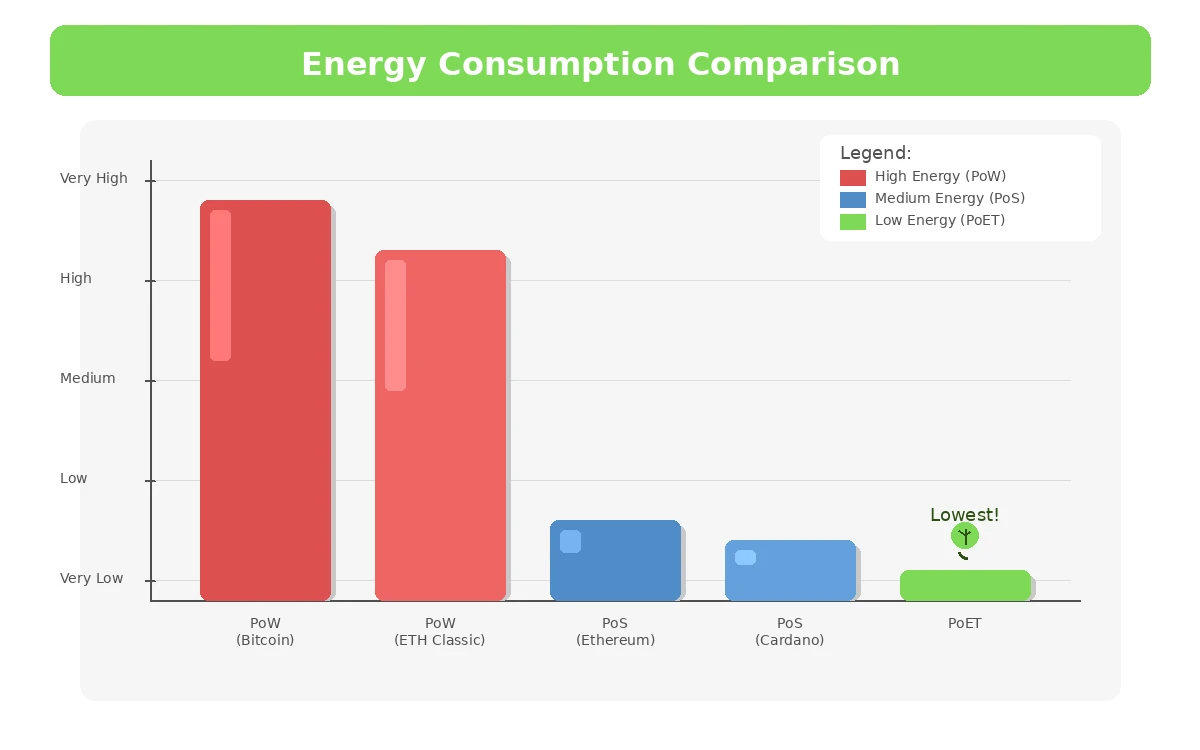
To understand why PoET stands out, it helps to compare it with the two most common consensus mechanisms in use today. Each has its strengths and weaknesses, and the best choice depends on your specific requirements.
| Feature | Proof of Work (PoW) | Proof of Stake (PoS) | Proof of Elapsed Time (PoET) |
|---|---|---|---|
| Energy Consumption | Very High | Low | Very Low |
| Hardware Requirements | Specialized mining equipment | Standard computers | TEE-enabled processors |
| Fairness | Favors those with more computing power | Favors those with more stake | Equal opportunity for all participants |
| Risk of Centralization | High (mining pools) | Medium to High | Low |
| Best For | Public blockchains | Public blockchains | Permissioned blockchains |
Proof of Work requires miners to solve complex mathematical puzzles, which demands enormous amounts of electricity. Bitcoin, the most famous PoW blockchain, consumes more energy than some countries. For businesses concerned about their environmental footprint or operating costs, this presents a serious problem.
Proof of Stake reduces energy consumption by selecting validators based on how much cryptocurrency they hold and are willing to lock up as collateral. While more efficient than PoW, this approach can lead to wealth concentration. Those who already have more tokens gain even more influence over the network.
PoET sidesteps both issues. It does not require intensive computations or large financial stakes. The random wait time mechanism treats every participant equally, regardless of their resources.
The Role of Trusted Execution Environments
The security of PoET depends heavily on Trusted Execution Environments. A TEE is a secure area within a processor that runs code in isolation from the rest of the system. Even the operating system cannot access or modify what happens inside the TEE.
In the context of PoET, the TEE performs two critical functions. First, it generates the random wait time for each participant. Second, it produces a certificate proving that the participant genuinely waited for the required period. This certificate can be verified by other network participants without revealing the inner workings of the TEE.
Intel Software Guard Extensions, commonly called SGX, is the most widely used TEE technology for PoET implementations. When you hear about Hyperledger Sawtooth using PoET, it typically relies on Intel SGX to handle the wait time generation and verification.
Primary Benefits That Make PoET Attractive
Several characteristics make PoET particularly well suited for enterprise and organizational use cases.
Energy Efficiency: Running a PoET node does not require specialized hardware running at full capacity around the clock. Participants simply wait, which means minimal power consumption. For organizations looking to reduce their carbon footprint while still benefiting from blockchain technology, this matters.
True Fairness: Every participant has an equal probability of being selected to propose the next block. Your chances do not improve by buying more equipment or accumulating more tokens. This creates a more democratic network where smaller players are not pushed out.
Scalability: As more participants join the network, PoET handles the growth without significant performance degradation. The wait time mechanism scales naturally because adding more participants does not increase the computational burden on individual nodes.
Reduced Attack Surface: Traditional consensus mechanisms face threats like 51% attacks, where an entity controlling the majority of mining power or stake can manipulate the blockchain. PoET makes such attacks impractical because control is not tied to resources you can accumulate.
Understanding the history of blockchain technology helps explain why these benefits matter. Early blockchains prioritized security and decentralization at the cost of efficiency. PoET represents the ongoing effort to find better tradeoffs.
How PoET Consensus Cycle Works
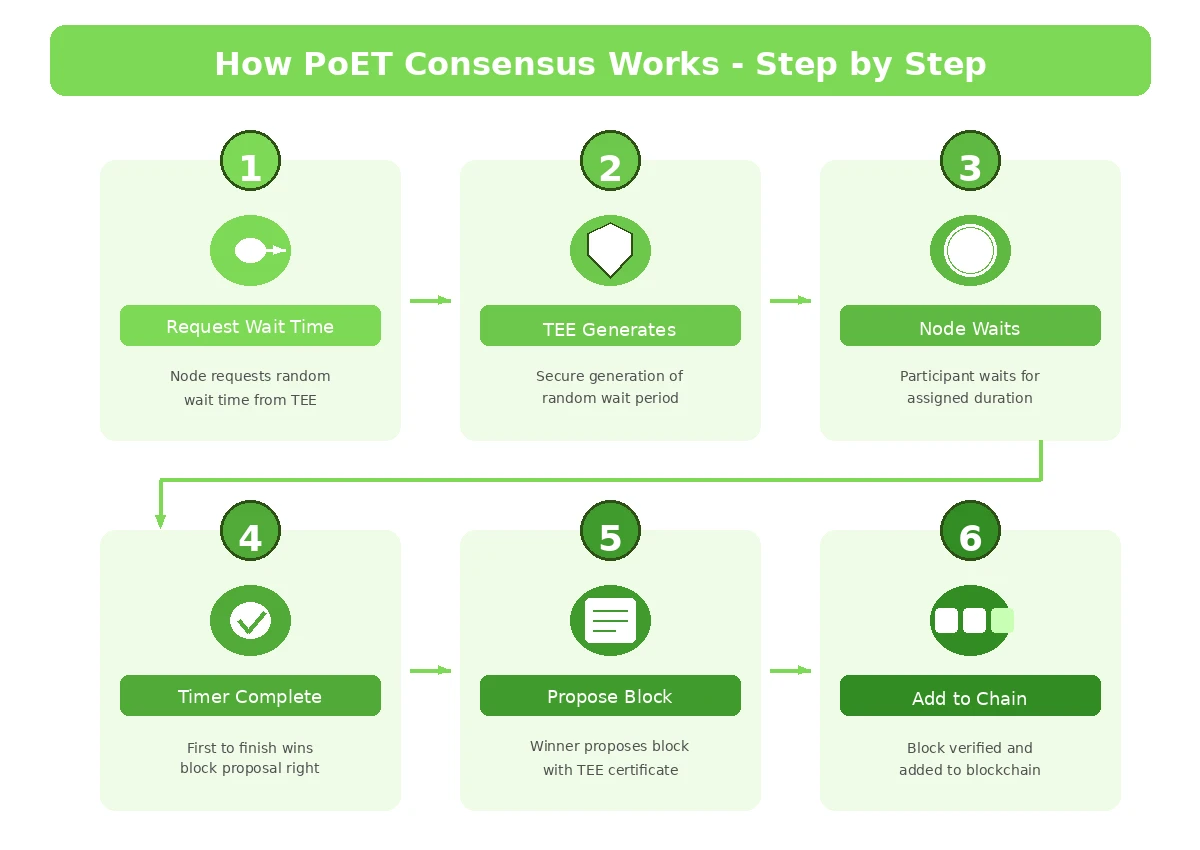
The PoET process follows a specific sequence that repeats for each new block added to the chain. Understanding this cycle helps clarify why the mechanism is both secure and efficient.
| Stage | Description |
|---|---|
| 1. Wait Time Request | Each participant requests a random wait time from their local TEE. |
| 2. Wait Period | Participants wait for their assigned duration while the system remains idle. |
| 3. Certificate Generation | Upon completion, the TEE generates a certificate proving the wait was legitimate. |
| 4. Block Proposal | The first participant to finish proposes a new block along with their certificate. |
| 5. Verification | Other participants verify the certificate and validate the proposed block. |
| 6. Block Addition | Once verified, the block is added to the chain and the cycle repeats. |
This cycle ensures that block creation follows a predictable pattern while maintaining randomness in who gets to propose each block. The TEE certificates prevent any participant from claiming they finished their wait before they actually did.
Industries Where PoET Makes Sense
PoET works best in scenarios where the network participants are known and have agreed to follow the rules. Several industries have found practical applications for this consensus mechanism.
Supply Chain Management: Tracking goods from manufacturer to consumer requires a system where multiple parties can record information without any single company controlling the data. PoET allows suppliers, shippers, retailers, and regulators to participate equally in maintaining the shared ledger.
Financial Services: Banks and financial institutions often need to share information while maintaining strict security standards. A PoET-based permissioned blockchain can facilitate interbank settlements, trade finance, and regulatory reporting without giving any single institution undue influence.
Healthcare: Patient records, clinical trial data, and insurance claims involve sensitive information that multiple parties need to access. PoET provides a way to maintain a shared record while ensuring that hospitals, insurers, and regulators all have equal standing in the network.
Government Services: From voting systems to land registries, government applications benefit from a consensus mechanism that is transparent and fair. PoET can help prevent any single agency or entity from dominating the system.
Learning what blockchain technology is and how it works provides the foundation for understanding these applications better.
Build Your PoET-Based Blockchain Solution
Ready to implement a fair, energy-efficient consensus mechanism for your permissioned blockchain network? Get expert guidance from professionals who understand PoET inside and out.
Potential Limitations to Consider
No consensus mechanism is perfect, and PoET has its own set of considerations that organizations should weigh before adoption.
The reliance on TEE technology means that your network depends on hardware security features. If vulnerabilities are discovered in the TEE implementation, they could potentially affect the entire network. Organizations must stay current with security patches and be prepared to update their infrastructure when needed.
PoET is specifically designed for permissioned networks. If you need a public blockchain where anyone can join without approval, PoET is not the right choice. The mechanism assumes that all participants have been vetted and can be trusted to run legitimate TEE-enabled nodes.
The random wait time approach introduces some latency compared to other consensus mechanisms. While this is acceptable for many enterprise applications, it may not suit use cases requiring extremely fast transaction finality.
Working with Nadcab Labs on PoET Implementation
Implementing a PoET-based blockchain requires deep technical knowledge and practical experience. Nadcab Labs brings more than 8 years of hands-on expertise in blockchain development, having worked across various consensus mechanisms and industry verticals.
Their team understands the nuances of setting up TEE environments, configuring Hyperledger Sawtooth for PoET consensus, and integrating blockchain solutions with existing enterprise systems. This experience means fewer surprises during implementation and faster time to deployment.
Beyond the initial setup, Nadcab Labs provides ongoing support to ensure your network runs smoothly. They can help with performance optimization, security audits, and scaling as your network grows. Having a partner with proven expertise reduces the risk associated with adopting new technology.
Their approach focuses on understanding your specific business requirements before recommending a solution. Not every organization needs the same configuration, and cookie-cutter implementations often lead to problems down the road. Working with a team that takes the time to understand your needs leads to better outcomes.
Quick Reference: Is PoET Right for Your Project?
| Your Requirement | PoET Suitability |
|---|---|
| Permissioned network with known participants | Excellent fit |
| Low energy consumption priority | Excellent fit |
| Fair participation regardless of resources | Excellent fit |
| Public blockchain with open participation | Not recommended |
| Ultra-low latency requirements | Consider alternatives |
| Enterprise supply chain or finance | Excellent fit |
Final Thoughts
Proof of Elapsed Time offers a compelling alternative to traditional consensus mechanisms for organizations building permissioned blockchain networks. Its combination of energy efficiency, fairness, and scalability addresses many of the concerns that have held back enterprise blockchain adoption.
The key is matching the consensus mechanism to your specific requirements. PoET shines in controlled environments where participants are known and energy efficiency matters. By understanding both its strengths and limitations, you can make an informed decision about whether it fits your project.
As blockchain technology continues to mature, consensus mechanisms like PoET demonstrate that there is no one-size-fits-all solution. The best choice depends on your network structure, performance requirements, and organizational priorities. Taking the time to evaluate these factors carefully will pay dividends in the long run.
Frequently Asked Questions
Q1.What is Proof of Elapsed Time and why is it used in permissioned blockchains?
Proof of Elapsed Time is a consensus mechanism that selects block validators based on random wait times generated within secure hardware environments called Trusted Execution Environments. It is specifically designed for permissioned blockchain networks where all participants have been verified and approved to join. The mechanism ensures fair block creation opportunities without requiring expensive mining equipment or large cryptocurrency holdings, making it ideal for enterprise applications.
Q2.How does PoET compare to Proof of Work in terms of energy consumption?
PoET consumes significantly less energy than Proof of Work because it does not require participants to solve complex mathematical puzzles. While PoW networks like Bitcoin consume electricity comparable to small countries due to continuous mining operations, PoET participants simply wait for their randomly assigned time to elapse. This passive approach means nodes can operate with minimal power usage, reducing both operational costs and environmental impact substantially.
Q3.What role do Trusted Execution Environments play in the PoET consensus mechanism?
Trusted Execution Environments serve as the security foundation for PoET by generating random wait times and producing verifiable certificates that prove participants genuinely completed their wait period. The TEE operates in isolation from the main system, preventing manipulation or tampering. Intel SGX is the most common TEE technology used for PoET implementations. Without this secure hardware component, the fairness and integrity of the consensus process could not be guaranteed.
Q4.Can PoET be used for public blockchains or is it limited to permissioned networks?
PoET is specifically designed for permissioned blockchain networks and is not suitable for public blockchains. The mechanism relies on verified participants running TEE-enabled hardware, which requires a controlled enrollment process. Public blockchains need consensus mechanisms that can handle anonymous participation without trust assumptions. For open networks where anyone can join freely, mechanisms like Proof of Work or Proof of Stake remain more appropriate choices.
Q5.What industries benefit most from implementing PoET-based blockchain solutions?
Industries with multiple known participants who need to share data securely benefit most from PoET. Supply chain management uses it for transparent goods tracking across manufacturers, shippers, and retailers. Financial services apply it for interbank settlements and trade finance. Healthcare organizations leverage it for secure patient record sharing among hospitals and insurers. Government agencies implement it for voting systems and public registries where fairness and transparency are essential requirements.
Q6.What are the main limitations or drawbacks of using PoET consensus mechanism?
PoET has several limitations organizations should consider. It depends on TEE hardware security, meaning vulnerabilities in the TEE could affect the entire network. The mechanism introduces some latency due to wait times, which may not suit applications requiring instant transaction finality. It only works for permissioned networks with vetted participants. Organizations must also ensure all nodes have compatible TEE-enabled processors, which adds hardware requirements to the deployment.
Explore Services
Related Services
Reviewed by

Aman Vaths
Founder of Nadcab Labs
Aman Vaths is the Founder & CTO of Nadcab Labs, a global digital engineering company delivering enterprise-grade solutions across AI, Web3, Blockchain, Big Data, Cloud, Cybersecurity, and Modern Application Development. With deep technical leadership and product innovation experience, Aman has positioned Nadcab Labs as one of the most advanced engineering companies driving the next era of intelligent, secure, and scalable software systems. Under his leadership, Nadcab Labs has built 2,000+ global projects across sectors including fintech, banking, healthcare, real estate, logistics, gaming, manufacturing, and next-generation DePIN networks. Aman’s strength lies in architecting high-performance systems, end-to-end platform engineering, and designing enterprise solutions that operate at global scale.