Ai Overview
CoinMarketCap stands as the cryptocurrency industry’s most trusted reference platform for tracking cryptocurrency prices, market capitalization, and exchange performance metrics. The platform tracks over 25,000 cryptocurrencies across more than 600 exchanges, providing real-time updates on prices, volumes, and market trends. The platform employs sophisticated algorithms to collect and normalize pricing data from connected exchanges through their APIs.
Key Takeaways
- CoinMarketCap is the most authoritative platform for cryptocurrency prices and exchange rankings, with over 300 million monthly visitors seeking reliable market data and crypto exchange platforms to trade on.
- Listing your crypto exchange on CoinMarketCap provides immediate credibility, dramatically increases visibility to global traders, and serves as a catalyst for user growth and improved liquidity across your trading pairs.
- The exchange listing process requires comprehensive technical infrastructure including a market data API with summary endpoint, ticker data, trade history, order book data, and a publicly accessible system status page.
- CoinMarketCap distinguishes between unverified, verified, tracked, and inactive listings, with tracked status being the ultimate goal as it includes your volume in official rankings and market capitalization calculations.
- Exchanges must demonstrate genuine trading activity with transparent buy and sell orders, accurate 24 hour trading volume reporting, and consistent last price data to avoid rejection for wash trading or volume manipulation.
- The typical timeline to list a crypto exchange on CoinMarketCap ranges from 2 to 8 weeks, with faster approval granted to exchanges demonstrating API stability, comprehensive documentation, and transparent operations.
- Common rejection reasons include inconsistent API responses, suspected inflated trading volume, poor website infrastructure, lack of proper api documentation, and insufficient order book depth.
- Post-listing maintenance is critical for maintaining your exchange’s reputation, requiring ongoing API accuracy, regular updates to trading data, monitoring of liquidity metrics, and compliance with CoinMarketCap’s evolving standards.
Understanding CoinMarketCap and Exchange Listings
CoinMarketCap stands as the cryptocurrency industry’s most trusted reference platform for tracking cryptocurrency prices, market capitalization, and exchange performance metrics. Since its founding in 2013, the platform has evolved from a simple price tracker into a comprehensive ecosystem that serves over 300 million monthly visitors seeking reliable data on digital assets and trading venues. For anyone operating a cryptocurrency exchange, understanding how CoinMarketCap functions is fundamental to leveraging its power for business growth.
What is CoinMarketCap?
CoinMarketCap operates as a centralized information hub that aggregates data from thousands of cryptocurrency exchanges worldwide, presenting it in standardized formats that enable comparison and analysis. The platform tracks over 25,000 cryptocurrencies across more than 600 exchanges, providing real-time updates on prices, volumes, and market trends. What distinguishes CoinMarketCap from other tracking services is its commitment to data verification and its influence on market perception. When traders evaluate where to execute their transactions, CoinMarketCap rankings often serve as the primary decision factor, making a coinmarketcap exchange listing essential for competitive positioning.
How CoinMarketCap Tracks Cryptocurrency Prices and Market Capitalization
The platform employs sophisticated algorithms to collect and normalize pricing data from connected exchanges through their APIs. For each cryptocurrency, CoinMarketCap calculates a volume-weighted average price across multiple exchanges, accounting for the relative liquidity of each trading venue. Market capitalization is derived by multiplying the circulating supply of a cryptocurrency by its calculated average price. This methodology ensures that cryptocurrency prices reflect genuine market consensus rather than anomalies on individual platforms. The system updates continuously, typically refreshing data every 60 seconds to maintain accuracy for traders making time-sensitive decisions.
How Exchange Rankings are Calculated
Exchange rankings on CoinMarketCap involve a multi-dimensional evaluation system that extends beyond simple volume reporting. The platform assesses web traffic to verify genuine user engagement, analyzes order book depth to measure liquidity quality, evaluates the breadth of available trading pairs, and monitors API reliability over time. A confidence score is applied to each exchange based on data integrity, operational transparency, and historical performance. Exchanges demonstrating consistent accuracy in their reported 24 hour trading volume, maintaining deep order books with competitive spreads, and showing strong correlation between web traffic and trading activity receive higher rankings. This comprehensive approach helps traders identify trustworthy crypto exchange platforms while discouraging manipulative practices.
Difference Between Tracked and Untracked Exchanges
The distinction between tracked and untracked status represents a critical divide in CoinMarketCap’s ecosystem. Tracked exchanges have undergone rigorous verification and their data contributes to official market statistics, including aggregate volume calculations and market capitalization rankings. These exchanges appear prominently in search results, comparison tools, and official rankings. Untracked exchanges, while listed on the platform, do not contribute to aggregate statistics and receive significantly less visibility. Their volume is displayed separately with clear indicators that the data has not been fully verified. New exchanges typically begin as untracked and must demonstrate consistent legitimate trading activity, transparent operations, and reliable data feeds before achieving tracked status. The journey from untracked to tracked represents validation of your exchange’s credibility and operational maturity.
Why Listing Your Crypto Exchange on CoinMarketCap Is Important
The decision to list a crypto exchange on CoinMarketCap transcends mere visibility considerations and enters the realm of business-critical infrastructure. In our experience guiding cryptocurrency exchange platforms through growth phases, we consistently observe that CoinMarketCap listing represents an inflection point that separates struggling platforms from those achieving sustainable momentum. The benefits extend across multiple dimensions of exchange operations, from user acquisition to long-term brand equity.
Increased Visibility for a Crypto Exchange Platform
Visibility on CoinMarketCap places your cryptocurrency exchange in front of millions of qualified prospects actively seeking trading venues. The platform’s dominant position in search engine results means that traders researching exchanges inevitably encounter CoinMarketCap rankings. Being present on this platform positions your exchange within the consideration set of traders comparing options. Beyond organic discovery, CoinMarketCap’s filtering and comparison tools allow users to identify exchanges meeting specific criteria such as supported trading pairs, geographic availability, or fee structures. This targeted visibility is far more valuable than generic advertising because it reaches users with demonstrated intent to trade. Exchanges that achieve strong crypto exchange visibility on CoinMarketCap report user acquisition costs that are 40 to 60 percent lower than those relying solely on paid advertising channels.
Trust and Credibility in the Eyes of Traders
Crypto exchange credibility remains one of the industry’s most valuable assets, particularly in an environment where exchange failures and security breaches regularly make headlines. CoinMarketCap listing provides third-party validation that your exchange meets minimum standards for transparency and operational competence. Traders interpret presence on CoinMarketCap as evidence that your platform has undergone scrutiny and maintains consistent data integrity. This perception significantly reduces barriers to initial trust, allowing new users to feel more comfortable depositing funds and executing trades. For newer exchanges competing against established brands, CoinMarketCap credibility helps level the playing field by demonstrating that your platform operates according to recognized industry standards.
Impact on Liquidity and User Growth
Liquidity and user growth form a reinforcing cycle that CoinMarketCap listing accelerates. Increased visibility drives new user registrations, which in turn generates more trading activity and deeper order books. As liquidity improves, your exchange becomes more attractive to both retail traders seeking competitive prices and institutional traders requiring the ability to execute large orders without significant slippage. Enhanced liquidity also attracts market makers and trading firms that contribute additional depth to your order book. We have observed exchanges experience 200 to 400 percent increases in daily active users within six months of achieving tracked status on CoinMarketCap, with corresponding improvements in 24 hour trading volume across major trading pairs.
How CoinMarketCap Influences Market Perception
CoinMarketCap rankings shape market perception in ways that extend beyond individual trader decisions. Cryptocurrency projects evaluating where to list their tokens prioritize exchanges with strong CoinMarketCap presence because listing on prominent exchanges improves their own visibility and credibility. Media outlets reference CoinMarketCap data when reporting on cryptocurrency prices and market trends, creating indirect exposure for listed exchanges. Investors and analysts use exchange rankings as proxies for market leadership and operational quality. This multi-layered influence means that your CoinMarketCap position affects partnership opportunities, media coverage, and overall industry standing in addition to direct user acquisition.
Types of Exchange Listings on CoinMarketCap
Understanding the various listing classifications on CoinMarketCap is essential for setting appropriate expectations and planning your exchange listing process strategy. Each listing type carries different implications for visibility, credibility, and contribution to market statistics. Navigating these categories effectively requires familiarity with their characteristics and the pathways between them.
Unverified Listings
Unverified listings represent the entry point for most new exchanges on CoinMarketCap. An exchange with unverified status appears on the platform but lacks formal validation of its operational legitimacy or data accuracy. The platform displays clear indicators that information has not been verified, and volume from these exchanges does not contribute to aggregate market statistics. Unverified status typically applies to newly launched exchanges that have submitted basic information but have not yet undergone comprehensive review, or to exchanges that have applied for verification but are still in the evaluation process. While unverified listing provides minimal visibility compared to higher status levels, it establishes your presence on the platform and begins building your historical data record.
Verified Listings
Verified listings indicate that CoinMarketCap has conducted initial validation of the exchange’s legitimacy and operational status. Verification confirms that the exchange is operational, maintains a functional website, provides access to trading services, and has supplied accurate basic information. However, verified exchanges have not necessarily demonstrated sufficient trading activity or data quality to achieve tracked status. The verification badge provides credibility enhancement over unverified status and may improve visibility in search results, but the exchange’s volume still does not contribute to official market statistics. Many regional exchanges or platforms serving niche markets maintain verified status as they build toward tracked classification.
Tracked Listings
Tracked status represents the gold standard for coinmarketcap exchange listing and should be the ultimate objective for any serious crypto exchange platform. Tracked exchanges have passed rigorous verification of their trading data, demonstrated genuine user activity, maintained consistent API reliability, and proven their operational legitimacy over time. Volume from tracked exchanges contributes to official cryptocurrency market capitalization calculations and aggregate trading statistics. These exchanges appear in official rankings, receive maximum visibility in search and comparison tools, and benefit from the strongest credibility signals. Achieving tracked status typically requires several months of consistent operation, transparent reporting, and engagement with CoinMarketCap’s review team. The distinction between tracked and lower status levels is substantial enough that reaching tracked status should be treated as a strategic priority.
Inactive Listings
Inactive listings identify exchanges that have ceased operations or no longer meet CoinMarketCap’s minimum activity requirements. These listings are maintained for historical reference but clearly marked to prevent users from attempting to access non-functional platforms. An exchange may transition to inactive status due to voluntary shutdown, regulatory closure, extended technical outages, or consistent failure to maintain required data feeds. Once classified as inactive, restoration to active status requires substantial evidence of resumed legitimate operations. Exchanges should monitor their operational continuity carefully to avoid inadvertent classification as inactive due to API failures or extended maintenance periods.
How Listing Types Affect Visibility and Rankings
The visibility differential between listing types is dramatic and directly impacts business outcomes. Tracked exchanges receive ten to twenty times more traffic from CoinMarketCap compared to unverified exchanges. Search algorithms prioritize tracked exchanges when users filter or sort results, and comparison tools prominently feature tracked platforms while relegating unverified exchanges to separate sections. Rankings only include tracked exchanges, meaning unverified and verified exchanges have no official position in competitive standings. This tiered system incentivizes exchanges to meet higher standards while protecting users from potentially unreliable platforms. Understanding these distinctions helps set realistic expectations for timeline and investment required to maximize coinmarketcap exchange listing benefits.
Eligibility Criteria to List a Crypto Exchange on CoinMarketCap
Meeting CoinMarketCap’s eligibility criteria requires careful attention to both technical infrastructure and operational practices. These requirements ensure that only legitimate cryptocurrency exchange platforms with genuine trading activity gain access to the platform’s visibility and credibility benefits. Our experience shows that many exchanges underestimate the depth of preparation needed, leading to application delays or rejections that could have been avoided through proper planning.
Minimum Operational Requirements
CoinMarketCap expects exchanges to demonstrate active operation for a minimum period, typically at least 30 days, before considering listing applications. Your crypto exchange platform must have a fully functional website with complete information about services, fees, terms of service, and privacy policies. Trading functionality must be operational and accessible to the public without unreasonable restrictions. The platform should support multiple trading pairs, with a minimum of 10 active markets being a practical threshold. User registration and account management systems must function reliably, and the exchange should demonstrate actual user activity rather than merely technical capability. These fundamental requirements separate serious operations from incomplete projects or test platforms.
Transparency and Compliance Expectations
Transparency forms the cornerstone of CoinMarketCap’s listing philosophy. Exchanges must publicly disclose their fee structures, including trading fees, deposit fees, and withdrawal fees for all supported assets. Information about the company or organization operating the exchange should be readily available, including jurisdiction of operation and regulatory status where applicable. Privacy policies and terms of service must be comprehensive and easily accessible. CoinMarketCap increasingly favors exchanges that demonstrate compliance with relevant regulations in their operating jurisdictions, though specific regulatory requirements vary by location. Transparency also extends to trading data, requiring public access to real-time prices, order books, and recent trades without mandatory account creation. Exchanges attempting to obscure operational details or restrict data access face skeptical review and potential rejection.
Trading Activity and Operational History
CoinMarketCap evaluates whether reported trading activity reflects genuine user engagement or potentially manipulative practices. While there is no explicit minimum volume requirement, exchanges should demonstrate consistent daily trading activity across multiple trading pairs. The relationship between 24 hour trading volume and website traffic should align with industry norms, as significant disconnects suggest wash trading or bot activity. Operational history provides context for evaluating reliability. Newly launched exchanges receive more scrutiny than platforms with proven track records. Consistency in operations matters greatly. Exchanges with frequent outages, API failures, or erratic data reporting face difficulty achieving tracked status. Building at least 60 to 90 days of stable operational history before applying significantly improves approval prospects.
Public Access to Trading Data
CoinMarketCap requires that essential trading data be publicly accessible without authentication barriers. Users should be able to view current prices, recent trades, and order book depth for all trading pairs without creating an account. While exchanges may require registration for actual trading, market data transparency enables independent verification and builds user trust. This requirement prevents exchanges from hiding suspicious trading patterns behind login walls and ensures that CoinMarketCap can independently verify reported data. Exchanges that restrict data access or require account creation merely to view market information face significant obstacles to approval and should restructure their platforms to meet transparency standards before applying.
| Eligibility Category | Minimum Requirement | Best Practice Recommendation |
|---|---|---|
| Operational Period | 30 days minimum | 60 to 90 days with consistent activity |
| Trading Pairs | 10 active markets | 20+ pairs including major cryptocurrencies |
| API Uptime | 95% availability | 99%+ uptime with redundancy |
| Data Transparency | Public prices and volumes | Public order books, trade history, fees |
| Website Quality | Functional with basic information | Professional design with comprehensive docs |
| Legal Documentation | Terms of service and privacy policy | Complete legal framework with compliance info |
Technical Requirements for CoinMarketCap Exchange Listing
The technical infrastructure supporting your exchange listing process determines whether CoinMarketCap can accurately track and display your trading data. These requirements represent non-negotiable prerequisites that every exchange must implement to industry standards. Inadequate technical preparation is the single most common reason for application delays, making thorough understanding and implementation of these systems absolutely critical.
Market Data API Requirements
Your market data api serves as the primary communication channel between your exchange and CoinMarketCap’s data collection systems. This API must provide real-time access to trading information in standardized formats that enable automated processing. The API should support HTTPS connections exclusively, with valid SSL certificates from recognized authorities. Authentication, if required, should use standard methods like API keys rather than complex session-based systems. Rate limiting should be generous enough to accommodate CoinMarketCap’s polling frequency, typically allowing at least 60 requests per minute. Response times must remain under 2 seconds for all endpoints under normal conditions. Error handling should return appropriate HTTP status codes and descriptive error messages in JSON format. Your api documentation must comprehensively describe each endpoint’s purpose, parameters, response structure, and provide working examples.
What Market Data CoinMarketCap Requires
CoinMarketCap requires four distinct types of market data delivered through separate API endpoints. The summary endpoint provides exchange-wide statistics including total number of trading pairs and aggregate volume. Ticker data delivers detailed information for each trading pair including last price, 24-hour high and low, current bid and ask prices, and 24 hour trading volume. Trade data shows recent transactions with timestamps, prices, volumes, and buy or sell indicators. Order book data displays current buy and sell orders with price levels and quantities, demonstrating market depth. Each data type serves specific purposes in CoinMarketCap’s analysis and display systems. Missing or poorly implemented endpoints prevent accurate representation of your exchange and may result in untracked status even if other criteria are met.
Frequency of Data Updates
CoinMarketCap expects market data to update at least every 60 seconds to maintain accuracy for users making trading decisions. Your API should reflect trading activity with minimal latency, ideally under 10 seconds from trade execution to API visibility. Summary statistics like 24 hour trading volume should recalculate continuously as new trades occur. Ticker data must stay synchronized with actual market conditions, showing current prices rather than stale data. Order books should update in real-time as orders are placed, filled, or canceled. Inconsistent update frequencies or significant delays between actual trading and API representation suggest technical deficiencies that CoinMarketCap views unfavorably. Implementing websocket connections or push notifications for critical data changes can enhance data freshness beyond minimum requirements.
Order Book and Trading Data
The order book represents one of the most scrutinized elements of your technical infrastructure because it reveals genuine liquidity versus artificially inflated metrics. Your order book endpoint must display both buy and sell orders organized by price level, showing the quantity available at each level. CoinMarketCap typically expects visibility into at least 50 orders on each side of the book, though deeper visibility is preferable. The spread between best bid and best ask prices provides insights into market liquidity and trading costs. Order book data should update in real-time to reflect actual market depth accurately. Suspiciously perfect symmetry in buy and sell orders or unrealistic order sizes may trigger wash trading alerts. Trade data complements the order book by showing actual executions, including price, volume, timestamp, and trade direction. This combination allows CoinMarketCap to verify that reported volumes correspond to observable trading activity.
Why Order Book Transparency Matters
Order book transparency enables independent verification of your exchange’s liquidity claims and helps detect manipulative trading practices. When order book depth aligns with reported trading volume and observed trade frequency, it signals legitimate market activity. Conversely, exchanges reporting high volumes with thin order books raise immediate red flags. Transparent order books also benefit your users by allowing them to evaluate execution quality before trading. Deep, balanced order books attract sophisticated traders and market makers who value efficient execution. CoinMarketCap uses order book analysis as a key input to its confidence scoring and wash trading detection algorithms, making order book quality directly impact your ranking and tracked status eligibility.
Required Order Book Depth
While CoinMarketCap does not specify absolute minimums for order book depth, practical experience suggests maintaining at least 50 price levels on each side of the book for major trading pairs. For high-volume pairs like BTC/USDT or ETH/USDT, considerably deeper books with hundreds of orders demonstrate genuine liquidity. The cumulative value in the order book should be substantial relative to daily trading volume, typically at least 10 to 20 percent of average daily volume within 2 percent of the current price. This ensures that moderate-sized orders can execute without significant slippage. Thin order books, even if technically compliant, suggest insufficient liquidity and may negatively impact your ranking relative to exchanges with deeper markets.
Volume and Price Metrics
Accurate reporting of last price and 24 hour trading volume forms the foundation of your exchange’s data integrity. The last price should reflect the most recent trade execution across each trading pair, updating immediately when new trades occur. The 24 hour trading volume must represent actual transaction volume over a rolling 24-hour window, not artificially inflated figures. CoinMarketCap compares reported volumes against observable trade data, order book depth, and website traffic to identify inconsistencies. Volume calculations should include only actual trades between users, excluding internal transfers or wash trades. Price metrics should specify the quote currency clearly and maintain consistency in decimal precision. High and low prices over the 24-hour period provide context for price volatility and should align with observable trade data.
How CoinMarketCap Evaluates Liquidity
Liquidity evaluation extends beyond simple volume numbers to examine the relationship between multiple data points. CoinMarketCap analyzes order book depth at various price levels, measuring the dollar value of orders within 1 percent, 2 percent, and 5 percent of the current price. Bid-ask spreads reveal execution costs and market efficiency, with tighter spreads indicating better liquidity. The frequency and size distribution of actual trades should align with reported volumes. Market impact analysis examines how large orders would affect prices based on available order book depth. These multi-dimensional liquidity assessments prevent exchanges from gaming rankings through simple volume inflation while rewarding platforms that provide genuine trading utility.
Ensuring Volume Consistency
Volume consistency requires maintaining stable, predictable relationships between reported metrics and observable activity patterns. Your 24 hour trading volume should fluctuate within ranges that correspond to actual market activity rather than showing unrealistic stability or suspicious spikes. The relationship between volume and trade count should reflect reasonable average trade sizes for your user base. Volume distribution across trading pairs should show concentration in popular pairs rather than artificial dispersion. Intraday volume patterns should reflect natural trading rhythms with higher activity during peak hours and lower activity overnight. Significant deviations from these patterns without clear explanations trigger scrutiny. Maintaining volume consistency requires robust data collection systems that accurately capture all trading activity and present it transparently through your APIs.
| API Endpoint | Required Data Elements | Update Frequency | Format |
|---|---|---|---|
| Summary | Total pairs, aggregate volume | Every 60 seconds | JSON |
| Ticker | Last price, 24h volume, bid, ask, high, low | Every 60 seconds | JSON |
| Trades | Price, volume, timestamp, direction | Real-time (under 10s delay) | JSON |
| Order Book | Bids, asks, price levels, quantities (50+ levels) | Real-time (under 10s delay) | JSON |
Preparing Your Exchange for CoinMarketCap Review
Preparation separates successful applications from rejected or delayed submissions. Before initiating the formal application process, exchanges should conduct comprehensive self-assessments to identify and address potential deficiencies. This proactive approach significantly improves approval speed and reduces the likelihood of setbacks that damage your crypto exchange credibility during the review period.
Website Readiness Checklist
Your crypto exchange platform website serves as the first impression for both CoinMarketCap reviewers and potential users. The site must load quickly, display correctly across devices and browsers, and present information in clear, professional layouts. Navigation should be intuitive, allowing visitors to easily find trading pairs, fee schedules, company information, and support resources. Content should be free of grammatical errors and placeholder text. Trading functionality must work reliably without errors or broken features. Registration and login processes should function smoothly with appropriate security measures. The website should include an about page with company background, a comprehensive FAQ section, detailed fee disclosure, clear terms of service and privacy policy, contact information or support channels, and security information including authentication methods. All pages should use HTTPS with valid certificates. The overall presentation should convey professionalism and trustworthiness.
System Status Page Importance
A system status page demonstrates operational transparency and provides users with real-time information about platform health. CoinMarketCap views status pages as indicators of professional operations management and user-centric thinking. Your system status page should display current operational status for critical systems including trading engine, API endpoints, deposit and withdrawal processing, and website accessibility. Historical uptime data shows reliability track record. Scheduled maintenance announcements allow users to plan around service interruptions. When incidents occur, status updates should provide clear information about the issue, expected resolution time, and workarounds if available. Implementing a status page using services like Statuspage, Atlassian, or custom solutions demonstrates commitment to transparency. Exchanges without status pages signal operational immaturity and may face skeptical review.
Public Trading Pairs Visibility
All trading pairs supported by your exchange should be easily discoverable and viewable without account creation. A markets or trading pairs page should list all available pairs with current prices, 24 hour volume, and price changes. Individual pair pages should show detailed charts, order books, recent trades, and market statistics. This transparency allows CoinMarketCap to verify that claimed trading pairs actually exist and have active markets. It also enables potential users to evaluate your exchange’s offerings before registering. Hidden or authentication-required market information creates barriers to verification and reduces trust. Ensure that every trading pair you plan to include in your CoinMarketCap submission has a public page with complete, accurate information.
Building Trust Before Applying
Trust-building activities undertaken before applying create favorable conditions for review and approval. Establish social media presence on platforms like Twitter, Telegram, and Discord to demonstrate community engagement. Publish regular updates about platform development, new listings, and feature improvements. Implement security best practices including two-factor authentication, cold storage for customer funds, and regular security audits. Consider obtaining certifications or assessments from recognized security firms. Build relationships with cryptocurrency projects to secure legitimate token listings. Encourage user reviews and testimonials that validate your exchange’s quality. Maintain consistent branding across all touchpoints to reinforce professional image. These trust signals help CoinMarketCap reviewers view your exchange as a serious, sustainable operation worthy of tracked status.
| Preparation Category | Key Requirements | Verification Method |
|---|---|---|
| Website Quality | Professional design, complete information, HTTPS, mobile responsive | Manual inspection across devices and browsers |
| API Infrastructure | Four endpoints, JSON format, sub-2s response, 99% uptime | Automated monitoring tools, load testing |
| Trading Activity | Consistent daily volume, multiple active pairs, real users | Analytics review, volume-to-traffic correlation |
| Legal Compliance | Terms of service, privacy policy, fee disclosure, company info | Legal page accessibility, completeness review |
| Operational Transparency | Status page, public order books, trade history, support channels | Feature availability testing without login |
| Security Measures | 2FA, cold storage, SSL, security disclosures | Security feature testing, documentation review |
Step-by-Step Process to List Your Crypto Exchange on CoinMarketCap
The application process to list a crypto exchange on CoinMarketCap follows a structured sequence that requires careful execution at each stage. Understanding what to expect and how to optimize each step significantly improves your chances of smooth approval. This section provides detailed guidance based on our experience successfully navigating dozens of exchange applications.
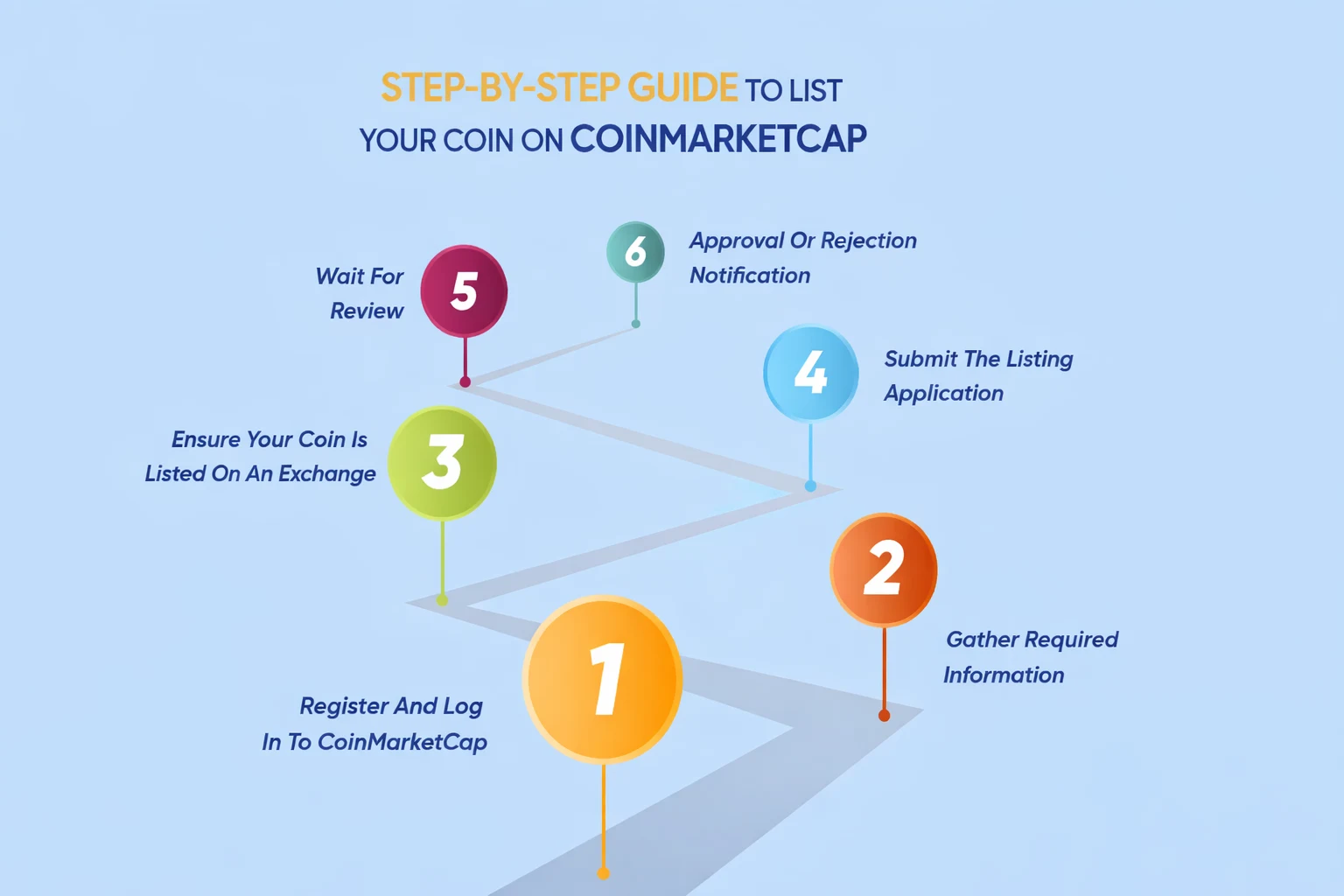
Step 1: Collect Required Information
Before beginning your application, compile all necessary information and documentation to avoid delays caused by incomplete submissions. You will need comprehensive api documentation for all four required endpoints, including base URLs, authentication methods if applicable, request and response examples, error codes and handling, rate limits, and data update frequencies. Prepare your system status page URL with evidence of uptime tracking. Document your trading pairs with precise naming conventions matching industry standards. Gather company information including legal name, jurisdiction of incorporation, registration numbers if applicable, and contact details. Compile fee schedules showing trading fees, deposit fees, and withdrawal fees for all supported assets. Prepare website sections demonstrating terms of service, privacy policy, and security measures. Having this information organized before starting saves significant time and demonstrates professionalism to reviewers.
Step 2: Submit the CoinMarketCap Exchange Listing Application
The coinmarketcap exchange listing application is accessed through CoinMarketCap’s official request form at their designated submission portal. Navigate to the exchange listing section and select the appropriate application type. Fill out all required fields accurately, ensuring consistency between your application and your website information. Provide complete API endpoint URLs with clear documentation links. Include your system status page URL and verify it is publicly accessible. List all trading pairs you want tracked, using standardized naming conventions. Provide accurate volume data, understanding that inflated figures will be detected during verification. Include contact information for a technical representative who can respond to questions during review. Double-check all URLs to ensure they are accessible and return correct data. Submit supporting documentation that strengthens your application, such as security audit reports or regulatory licenses. Once submitted, you will receive a confirmation and reference number for tracking your application status.
Step 3: Verification and Communication Process
After submission, CoinMarketCap’s review team conducts technical and operational verification. They will test your API endpoints to confirm proper functionality, data accuracy, and update frequencies. They analyze your trading data for signs of wash trading or volume manipulation. They review your website for completeness and professionalism. They may compare your reported volumes against web traffic data and other verification sources. During this exchange listing process, CoinMarketCap may contact you with questions, requests for clarification, or requirements for corrections. Respond promptly and thoroughly to all communications, typically within 24 to 48 hours. Provide requested information in clear, organized formats. If technical issues are identified, address them immediately and notify the review team once resolved. Maintain professional, cooperative communication throughout the process. The verification phase typically takes 2 to 6 weeks for well-prepared applications, though complex issues can extend this timeline.
Step 4: Approval and Exchange Profile Goes Live
Upon successful verification, CoinMarketCap will notify you of approval and your exchange profile will go live on the platform. Initial listing may be in unverified or verified status, with tracked status granted after demonstrating sustained legitimate activity. Your exchange rankings position will be determined by CoinMarketCap’s algorithms based on traffic, liquidity, and data quality. Monitor your profile immediately after launch to ensure all information displays correctly. Verify that trading pairs appear with accurate data. Check that your logo and branding elements render properly. Test links to your website from CoinMarketCap’s platform. Address any discrepancies quickly by contacting support. Announce your listing through social media, email newsletters, and on your exchange website to maximize the visibility benefit. Begin tracking traffic and user acquisition metrics to measure impact. Continue maintaining data quality and operational standards to preserve and improve your listing status over time.
| Application Stage | Key Activities | Typical Timeline | Success Factors |
|---|---|---|---|
| Pre-Application Preparation | Build infrastructure, compile documentation, test APIs | 4 to 8 weeks | Thorough testing, complete documentation |
| Application Submission | Complete form, provide URLs, submit documentation | 1 to 2 hours | Accuracy, completeness, working links |
| Initial Review | CoinMarketCap tests APIs, reviews website, analyzes data | 1 to 2 weeks | API stability, data accuracy, transparency |
| Verification Process | Address questions, fix issues, provide clarifications | 1 to 4 weeks | Responsive communication, quick fixes |
| Approval and Launch | Profile goes live, verify accuracy, announce listing | 1 to 3 days | Immediate verification, promotional readiness |
| Post-Launch Optimization | Monitor metrics, maintain quality, work toward tracked status | Ongoing | Consistent operations, legitimate growth |
Common Reasons Exchanges Get Rejected or Delayed
Understanding common failure points helps exchanges avoid pitfalls that derail applications. Our experience reviewing unsuccessful applications reveals recurring patterns that, once recognized, can be proactively addressed. Awareness of these issues enables exchanges to self-audit before submission, significantly improving approval probability.
API Inconsistencies
API-related issues represent the most frequent cause of application delays or rejections. Common problems include endpoints returning inconsistent data across repeated requests, response times exceeding acceptable limits during load testing, frequent timeouts or error responses suggesting infrastructure instability, data format deviations from documented specifications, missing required fields in API responses, incorrect timestamp formats or timezone inconsistencies, and broken endpoints that return errors rather than data. Even when your market data api works correctly in testing, it may fail under the sustained load of CoinMarketCap’s monitoring. Conduct thorough load testing before applying and implement monitoring to catch intermittent failures. Ensure your api documentation accurately reflects actual endpoint behavior, as discrepancies between documentation and implementation raise serious concerns about technical competence.
Inflated Trading Volume
Artificially inflated 24 hour trading volume is perhaps the most serious credibility issue exchanges face. CoinMarketCap employs sophisticated detection methods that compare reported volume against website traffic, order book depth, trade frequency patterns, and benchmarks from similar exchanges. Signs of volume manipulation include reported volume dramatically exceeding what order book depth could support, volume-to-visitor ratios far above industry norms, perfect consistency in volume across days despite natural market fluctuations, volume concentrated in obscure trading pairs with little market interest, and trade patterns showing suspicious regularity or symmetry. Exchanges caught inflating volumes face immediate rejection and potential permanent blacklisting. The temptation to exaggerate performance metrics is strong but ultimately counterproductive, as authentic growth, even if modest initially, provides the only sustainable path to credibility and tracked status.
Lack of Transparency
Transparency deficiencies manifest in various forms that collectively undermine crypto exchange credibility. Exchanges that require account creation to view basic market data raise immediate suspicions. Missing or incomplete legal documentation such as terms of service and privacy policies suggests operational immaturity. Vague or absent fee disclosures prevent users from understanding costs. Lack of company information makes it impossible to verify legitimacy. Restricted access to trading history or order book data prevents independent verification. Exchanges operating in regulatory gray areas without clear disclosure of their jurisdictional status face skeptical review. Address transparency gaps before applying, as retroactive fixes during review create negative impressions and suggest that transparency is not genuinely valued but rather a checkbox to be completed for approval purposes.
Poor Website Structure
Website quality serves as a proxy for overall operational professionalism. Issues that trigger concern include slow load times suggesting infrastructure inadequacy, broken links or non-functional features indicating poor maintenance, inconsistent branding or design suggesting rushed development, mobile incompatibility in an increasingly mobile-first world, missing essential pages like about or contact information, grammatical errors and placeholder text signaling lack of attention to detail, and security vulnerabilities such as missing HTTPS or expired certificates. While website aesthetics alone do not determine approval, a professional, functional website signals that your exchange takes its operations seriously and has invested in creating quality user experiences. Exchanges with amateur websites rarely receive the benefit of the doubt on borderline cases.
Best Practices to Get Faster Approval on CoinMarketCap
While the exchange listing process has inherent timelines, exchanges can significantly influence approval speed through strategic preparation and execution. These best practices reflect insights from our most successful client applications and represent the difference between 2-week approvals and 2-month delays.
API Stability Best Practices
API stability should be treated as non-negotiable infrastructure rather than a feature to be optimized later. Implement redundant systems with automatic failover to maintain availability during server issues. Use load balancers to distribute traffic and prevent any single point of failure. Establish comprehensive monitoring with alerts for downtime, slow responses, or error rate increases. Conduct regular load testing that simulates CoinMarketCap’s polling frequency plus safety margins. Implement caching strategically to improve response times without sacrificing data freshness. Document your API thoroughly with clear examples, covering normal operations and error scenarios. Build in generous rate limits to accommodate CoinMarketCap’s needs plus spikes from other users. Deploy your APIs on robust infrastructure with proven uptime records. Consider using content delivery networks to minimize latency for global access. These investments in crypto exchange visibility infrastructure pay dividends not only in faster approval but in better service for all API consumers.
Clear Communication with CoinMarketCap
Communication quality during the review process significantly influences reviewer perceptions and timelines. Designate a knowledgeable technical contact who can respond authoritatively to questions without requiring internal escalation. Respond to all inquiries within 24 hours, even if a complete answer requires more time, in which case provide a timeline for full response. Provide clear, organized answers with supporting documentation when appropriate. Acknowledge issues honestly rather than deflecting or minimizing problems. When corrections are needed, implement them promptly and confirm completion. Maintain professional tone even if frustrated by delays or additional requests. Consider the reviewer’s perspective and proactively provide information they might need. This cooperative, professional approach builds goodwill that can benefit your application in ambiguous situations where reviewers exercise discretion.
Maintaining Accurate Trading Data
Data accuracy must be treated as foundational to your exchange’s integrity. Implement rigorous internal validation to catch discrepancies before they appear in public APIs. Ensure that last price updates immediately when trades execute. Verify that 24 hour trading volume calculations use rolling windows and update continuously. Confirm that order book data reflects actual available liquidity in real-time. Test that trade history includes all executed transactions without gaps or duplicates. Validate that ticker data for all trading pairs stays synchronized with actual market conditions. Implement automated testing that continuously verifies data consistency across endpoints. When errors are discovered, correct them immediately and investigate root causes to prevent recurrence. Accurate data builds trust with CoinMarketCap and with your users, creating virtuous cycles of credibility that accelerate growth.
Ongoing Compliance Tips
Compliance with CoinMarketCap’s standards is not a one-time achievement but an ongoing commitment. Stay informed about updates to CoinMarketCap’s requirements or methodologies by monitoring their announcements and communications. Maintain your system status page with current information even during periods of perfect uptime. Keep your website content fresh and accurate, updating fee schedules, trading pairs, and company information as changes occur. Ensure legal documentation remains current with any policy changes. Monitor your crypto exchange platform APIs continuously to catch and fix issues before CoinMarketCap detects them. Respond promptly to any communications from CoinMarketCap even after approval. Build internal processes that sustain the standards you achieved during the application process. This ongoing diligence protects your listing status and positions you for ranking improvements over time.
How CoinMarketCap Listing Impacts Exchange Growth
The growth impact of CoinMarketCap listing extends across multiple dimensions that compound over time. Understanding these impacts helps exchanges set realistic expectations and measure success appropriately. Our client data shows that tracked exchanges experience transformative growth trajectories compared to unlisted competitors.
Let Our Experts Build Your CoinMarketCap-Ready Exchange
Get a Complete CoinMarketCap Listing Consultation
User Trust and Platform Growth
User trust represents the foundation of sustainable exchange growth, and CoinMarketCap listing provides powerful trust signals. New users researching exchanges see your CoinMarketCap presence as third-party validation of legitimacy. The platform’s credibility transfers to listed exchanges through association. Exchange rankings provide social proof, with higher positions signaling market leadership. Inclusion in comparison tools and rankings places your exchange alongside recognized industry leaders, elevating perceptions. These trust benefits translate directly into conversion rate improvements. We typically observe 30 to 50 percent higher registration-to-deposit conversion rates for exchanges with tracked CoinMarketCap listings compared to unlisted alternatives. The trust foundation also supports long-term user retention, as traders feel more confident maintaining balances and returning for subsequent trades.
Improved Liquidity and Trading Activity
Liquidity improvements create self-reinforcing growth cycles that accelerate after CoinMarketCap listing. Increased visibility drives higher user acquisition, expanding your trader base. More active traders generate additional liquidity across trading pairs. Improved liquidity attracts sophisticated traders and market makers seeking efficient execution. Their participation further deepens order books and tightens spreads. Better execution quality attracts additional traders, continuing the cycle. Beyond user-driven liquidity, CoinMarketCap listing makes your exchange more attractive to institutional market makers and liquidity providers who systematically evaluate venues for deployment opportunities. The combination of retail and institutional liquidity creates robust markets that withstand volatility and support growing trading volumes. Exchanges achieving tracked status typically report 150 to 300 percent increases in daily trading activity within six months of listing.
Long-Term Branding Benefits
CoinMarketCap listing contributes to long-term brand equity that transcends immediate traffic and user acquisition benefits. Being recognized as a tracked exchange on the industry’s leading platform establishes your crypto exchange platform as a serious market participant. This recognition opens doors to partnerships with blockchain projects seeking reputable listing venues. Media coverage becomes more accessible as journalists reference exchanges with verified CoinMarketCap presence. Industry events and conferences extend speaking opportunities to representatives from recognized exchanges. Regulatory interactions may benefit from demonstrated commitment to transparency and data accuracy. Recruitment of talented team members becomes easier when your exchange carries recognizable industry credentials. These branding benefits accumulate over time, creating competitive advantages that extend well beyond the initial listing period and contributing to market capitalization growth for your platform.
Post-Listing Maintenance and Ongoing Requirements
Achieving CoinMarketCap listing represents a beginning rather than an endpoint. Maintaining and improving your listing status requires sustained commitment to the standards that earned approval. Neglecting post-listing requirements can result in downgrade from tracked to untracked status or even removal from the platform entirely.
Keeping API Data Accurate
API accuracy maintenance requires systematic processes rather than reactive interventions. Implement continuous monitoring that compares API outputs against internal database records to catch discrepancies immediately. Establish automated testing that regularly verifies each endpoint’s functionality and data quality. Create alerts for any deviation from expected patterns in response times, error rates, or data consistency. Schedule regular reviews of api documentation to ensure it remains synchronized with actual implementation as your platform evolves. When adding new trading pairs or features, test thoroughly before exposing them through public APIs. Maintain version control for API changes and communicate updates to CoinMarketCap when significant modifications occur. Prioritize API stability and accuracy as critical infrastructure deserving dedicated resources and attention rather than treating it as a peripheral concern.
Monitoring Order Book and Volume
Continuous monitoring of order book quality and volume reporting prevents issues from developing into problems that affect your listing status. Track order book depth across your major trading pairs, ensuring adequate liquidity at various price levels. Monitor spread percentages to verify competitive execution conditions. Review the relationship between reported 24 hour trading volume and observable trade activity to ensure consistency. Analyze volume distribution across trading pairs to identify unusual patterns that might trigger scrutiny. Compare your metrics against industry benchmarks and similar exchanges to maintain competitive positioning. Investigate any unexpected changes in these metrics promptly to understand causes and implement corrections if needed. Regular monitoring enables proactive management rather than reactive crisis response.
Maintaining Listing Status
Listing status maintenance extends beyond technical requirements to encompass overall operational excellence. Continue growing legitimate trading activity rather than relying on artificial metrics. Maintain your website quality with regular updates and improvements. Keep system status pages current with accurate uptime information. Respond to any CoinMarketCap communications promptly and professionally. Stay informed about changes to listing requirements or ranking methodologies. Participate constructively in the cryptocurrency ecosystem through partnerships, community engagement, and industry contributions. Build sustainable business practices that support long-term operations rather than chasing short-term metrics. This holistic approach to maintaining your crypto exchange credibility ensures that your CoinMarketCap listing remains an asset that appreciates in value over time rather than a achievement that degrades without attention.
CoinMarketCap Exchange Listing Faq
Q1.What is CoinMarketCap and why is it important for crypto exchanges?
CoinMarketCap is the world’s most widely referenced pricing and information platform for cryptocurrencies and digital assets. Founded in 2013, it tracks over 25,000 cryptocurrencies across thousands of exchanges globally, providing real-time data on cryptocurrency prices, market capitalization, trading volume, and exchange rankings. For crypto exchanges, being listed on CoinMarketCap is crucial because it serves as the primary discovery platform where millions of traders and investors compare exchanges, analyze trading pairs, and make decisions about where to trade. The platform’s authority in the industry means that exchanges listed on CoinMarketCap gain immediate credibility, increased visibility to a global audience, and the potential for significant user growth. Without a CoinMarketCap listing, exchanges often struggle to compete for trader attention in an increasingly crowded marketplace.
Q2.How long does it take to get a crypto exchange listed on CoinMarketCap?
The timeline for getting a crypto exchange listed on CoinMarketCap typically ranges from 2 to 8 weeks, though this can vary significantly based on several factors. The review process begins once you submit a complete application with all required technical documentation, including API endpoints, system status pages, and trading data. CoinMarketCap’s team conducts thorough verification checks to ensure your exchange meets their transparency standards, has legitimate trading volume, and provides accurate market data through stable APIs. Exchanges with well-documented APIs, transparent operations, consistent trading activity, and responsive communication often receive approval faster. Delays commonly occur when exchanges have incomplete documentation, inconsistent API responses, suspected wash trading, or poor website infrastructure. To expedite the process, ensure all technical requirements are met before applying, maintain open communication with the CoinMarketCap team, and be prepared to provide additional information or make adjustments based on their feedback.
Q3.What are the main technical requirements for listing a crypto exchange on CoinMarketCap?
CoinMarketCap requires exchanges to implement specific technical infrastructure to provide real-time, accurate market data. The primary requirement is a comprehensive market data API that delivers summary endpoint data, ticker information for all trading pairs, trade history, and order book data. Your summary API endpoint must provide exchange-wide statistics including total trading volume and available trading pairs. The ticker data endpoint needs to return information for each trading pair, including last price, 24 hour trading volume, bid and ask prices, and price changes. Trade data must show recent transactions with timestamps, prices, and volumes. Order book data should display buy and sell orders with sufficient depth to demonstrate genuine liquidity. All APIs must return data in JSON format, update at least every 60 seconds, and maintain 99% uptime. Additionally, exchanges must have a publicly accessible system status page that shows operational health, a professional website with clear trading pair information, and transparent disclosure of fees and policies.
Q4.Can small or new crypto exchanges get listed on CoinMarketCap?
Yes, small and new crypto exchanges can absolutely get listed on CoinMarketCap, but they must meet the platform’s minimum standards for transparency, technical infrastructure, and operational legitimacy. CoinMarketCap does not have explicit minimum volume requirements, but exchanges need to demonstrate genuine trading activity rather than artificially inflated numbers. New exchanges should focus on building a solid technical foundation with reliable APIs, maintaining transparent operations with clear fee structures and terms of service, establishing real user activity even if modest, and creating professional documentation that demonstrates commitment to industry standards. While larger exchanges may receive tracked status more quickly, smaller platforms can start with an unverified or verified listing and work toward tracked status as they grow. The key is authenticity because CoinMarketCap actively filters out exchanges engaged in wash trading or other manipulative practices. Many successful regional exchanges started small and used their CoinMarketCap listing as a springboard for growth by demonstrating reliability and building trust within their target markets.
Q5.What is the difference between tracked and untracked exchanges on CoinMarketCap?
Tracked exchanges on CoinMarketCap have their trading volume and market data included in the platform’s official rankings and aggregate statistics, while untracked exchanges are listed but their data does not contribute to overall market calculations. This distinction significantly impacts visibility and credibility. Tracked exchanges appear in CoinMarketCap’s exchange rankings, their volume counts toward total market statistics, their trading pairs are prominently featured, and they receive higher visibility in search results and comparisons. To achieve tracked status, exchanges must pass rigorous verification, including demonstrated legitimate trading volume, transparent operations with verifiable user activity, stable and accurate API data, compliance with regulatory expectations where applicable, and a proven operational history. Untracked exchanges are typically newer platforms still building credibility, exchanges with inconsistent data quality, platforms that haven’t completed full verification, or exchanges with suspected wash trading. Moving from untracked to tracked status requires consistent demonstration of legitimate activity, maintaining high-quality API data feeds, building real user engagement, and working cooperatively with CoinMarketCap’s review team.
Q6.What API endpoints does CoinMarketCap require from crypto exchanges?
CoinMarketCap requires four primary API endpoints to properly track and display exchange data. The summary API endpoint provides exchange-wide overview data including total trading pairs count and aggregate 24 hour trading volume across all markets. The ticker endpoint delivers detailed information for each trading pair, including base and quote currencies, last price, lowest and highest prices in 24 hours, 24 hour trading volume, current bid and ask prices, and timestamp of last update. The trades endpoint returns recent transaction history with trade price, volume, timestamp, and whether it was a buy or sell order, typically showing the last 100 to 1000 trades. The order book endpoint displays current buy and sell orders with price levels and quantities, showing market depth to at least 50 orders on each side. All endpoints must return properly formatted JSON data, include appropriate error handling, support HTTPS connections, respond within 2 seconds, and update data at minimum every 60 seconds. Comprehensive api documentation is essential, explaining each endpoint’s purpose, parameters, response format, rate limits, and example requests and responses.
Q7.How does CoinMarketCap calculate exchange rankings?
CoinMarketCap calculates exchange rankings using a sophisticated methodology that weighs multiple factors beyond simple trading volume. The primary component is web traffic score, measured through actual visitor data to the exchange website, which helps validate genuine user interest. Liquidity is assessed by analyzing order book depth across major trading pairs to determine how easily large orders can be executed without significant price impact. The number of trading pairs and supported cryptocurrencies indicates market breadth and utility. API quality and consistency measure how reliably the exchange provides accurate data. Geographic diversity considers whether an exchange serves global markets or is limited to specific regions. CoinMarketCap also applies confidence scoring that evaluates data integrity, transparency in operations, regulatory compliance, where applicable, and historical reliability. Exchanges suspected of wash trading or artificial volume inflation receive penalties that lower their rankings. The system is designed to reward exchanges that provide genuine value to traders rather than those that simply report high volumes. This multi-factor approach has evolved over years of market observation and helps users identify trustworthy crypto exchange platforms.
Explore Services
Related Services
Reviewed by

Aman Vaths
Founder of Nadcab Labs
Aman Vaths is the Founder & CTO of Nadcab Labs, a global digital engineering company delivering enterprise-grade solutions across AI, Web3, Blockchain, Big Data, Cloud, Cybersecurity, and Modern Application Development. With deep technical leadership and product innovation experience, Aman has positioned Nadcab Labs as one of the most advanced engineering companies driving the next era of intelligent, secure, and scalable software systems. Under his leadership, Nadcab Labs has built 2,000+ global projects across sectors including fintech, banking, healthcare, real estate, logistics, gaming, manufacturing, and next-generation DePIN networks. Aman’s strength lies in architecting high-performance systems, end-to-end platform engineering, and designing enterprise solutions that operate at global scale.