Ai Overview
The multi level marketing industry has always evolved alongside technology. Each layer adds delay, cost, and the potential for error or fraud. International wire transfers can take 3 to 5 business days and add another 1% to 3% in conversion fees. The entire payout chain settles in under 5 seconds on BNB Chain at a cost of roughly $0.
Key Takeaways
- WalletConnect and MetaMask are the two most widely adopted Web3 wallet solutions for crypto MLM platforms, each serving different user types and devices.
- Integrating decentralized wallets removes payment intermediaries, cuts transaction costs, and gives network marketing distributors real-time access to their commissions.
- Smart contracts deployed on blockchains like Ethereum or BNB Chain automate multi-level commission payouts with zero manual processing.
- Proper security architecture including contract audits, phishing prevention, and wallet validation is non-negotiable before launching any multi level marketing platform on blockchain.
- Layer 2 solutions (Polygon, Arbitrum) directly address gas fee and scalability barriers that often slow adoption in high-volume MLM networks.
- The global reach of decentralized wallets enables any network marketing company to pay distributors across borders without dealing with banks, currency conversion, or regulatory bottlenecks in payments.
Introduction: The Web3 Shift in Network Marketing
The multi level marketing industry has always evolved alongside technology. In the 1990s it was the internet. In the 2000s it was mobile. Today, it is blockchain and decentralized finance. What used to take days through banks and payment processors now settles in seconds, directly from one wallet to another, with a permanent and tamper-proof record on the blockchain.
The emergence of crypto currency MLM companies has pushed the industry into a new phase. Distributors no longer want to wait for weekly payroll cycles. They want to see their commission land the moment a downline sale happens. They want to verify the payout on a public ledger. And they want to join from any country without being locked out by banking restrictions. This is exactly what blockchain-based platforms deliver.
At the center of this shift are two tools that have become almost universal in the Web3 world: WalletConnect and MetaMask. Together, they form the primary gateway through which users connect their crypto wallets to decentralized applications, including mlm marketing platforms built on smart contracts.
This guide draws on over eight years of hands-on experience building and deploying cryptocurrency MLM software for clients across Asia, Europe, and North America. What you will read here is not theory pulled from textbooks. It is a practical breakdown of how wallet integration actually works, why it matters, and how to do it right. Whether you are an operator at an existing mlm company, a developer building the next generation platform, or a business owner evaluating options, this article covers everything you need.
“Decentralized wallets are not just a payment tool. In the context of MLM, they are the infrastructure for trust. When a distributor can verify their own commission on a public blockchain, you no longer need them to trust the company. The ledger speaks for itself.”
— Senior Blockchain Architect, 8+ years in MLM platform development
Understanding WalletConnect & MetaMask
What is WalletConnect?
WalletConnect is an open-source communication protocol that creates an encrypted connection between a decentralized application (dApp) and a mobile or desktop crypto wallet. Instead of requiring a browser extension, it works through a QR code scan or a deep link. The user opens their wallet app on their phone, scans the QR code on the platform, and the session is established. No data is stored centrally. The connection is peer-to-peer and encrypted end to end.
For a multi level marketing company building on blockchain, WalletConnect is essential for mobile reach. A large portion of distributors in markets like Southeast Asia, Africa, and Latin America operate almost entirely on smartphones. WalletConnect makes sure they are not excluded.
What is MetaMask?
MetaMask is a browser-based crypto wallet, available as a Chrome, Firefox, and Brave extension, as well as a mobile app. It was created by ConsenSys and is one of the oldest and most trusted non-custodial wallets in the Ethereum ecosystem. When a user visits a dApp on a desktop browser with MetaMask installed, the wallet injects a web3 object into the browser. The platform detects it and can request transaction signatures directly.
For desktop-first users in network marketing such as team leaders and admin-level operators, MetaMask provides a seamless and familiar interface. It supports multiple networks including Ethereum, BNB Chain, Polygon, and any EVM-compatible chain, which matters a lot when you are running a crypto based mlm company that needs cross-chain flexibility.
Key Features and Differences: WalletConnect vs MetaMask
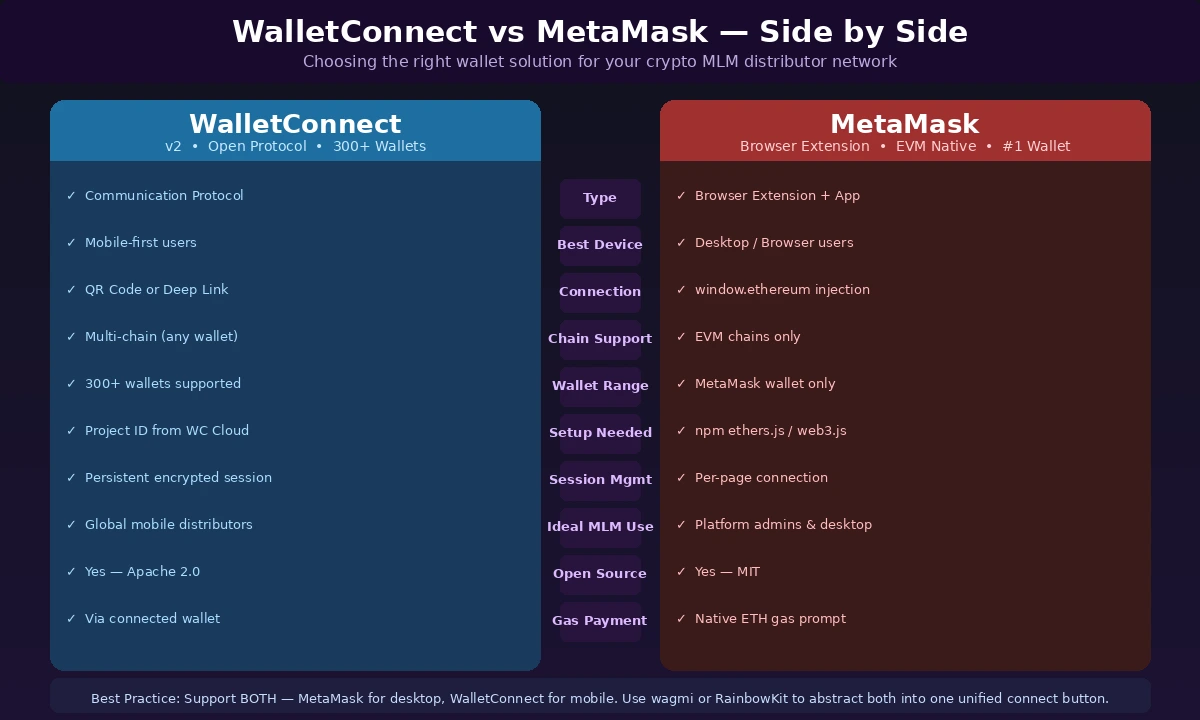
Both tools achieve the same goal (connecting a user’s wallet to your platform) but they serve different contexts. Here is a side-by-side comparison:
| Feature | WalletConnect | MetaMask |
|---|---|---|
| Type | Open protocol / bridge | Browser extension + mobile app |
| Primary Use Case | Mobile wallet users | Desktop / browser users |
| Connection Method | QR code or deep link | Browser extension injection |
| Network Support | Multi-chain (300+ wallets) | EVM chains (ETH, BNB, Polygon, etc.) |
| Custodial? | Non-custodial (protocol only) | Non-custodial |
| Best For MLM | Mobile distributors globally | Desktop operators and admins |
| Integration Complexity | Moderate (SDK required) | Low to moderate (web3.js / ethers.js) |
| Open Source | Yes | Yes |
Most mature network marketing companies building on blockchain support both. The general approach is to use MetaMask as the default for desktop users and WalletConnect as the bridge for all other wallet types, particularly on mobile. This dual-wallet architecture ensures you capture the widest possible user base without technical friction.
Also see: Ethereum vs BNB vs Solana for MLM Blockchain comparison for a deeper look at which chain to build your wallet integration on.
Why Wallet Integration Matters for MLM Platforms
When we look at traditional mlm marketing operations, a consistent pain point is the payments infrastructure. Companies rely on bank transfers, payment processors, and in many cases physical cheques. Each layer adds delay, cost, and the potential for error or fraud. Blockchain wallets solve this problem at the root.
Decentralization and Transparency
Every transaction on a public blockchain like Ethereum or BNB Chain is recorded on a distributed ledger that no single party controls. According to Wikipedia’s definition of decentralization, the removal of a central authority from a system distributes control and power across participants. In an MLM context, this means no one person at the company can secretly alter commission records. Distributors can independently verify their payouts with a block explorer like Etherscan.
Secure Peer-to-Peer Transactions
Crypto wallet transactions are signed with the user’s private key. Once signed and confirmed on-chain, they cannot be reversed or altered. For a distributor in an mlm company, this means no charge-backs, no frozen accounts, and no payment disputes. The transaction is the proof. This level of finality is something no traditional payment rail can offer.
Elimination of Intermediaries
Payment processors charge anywhere from 1.5% to 4.5% per transaction. International wire transfers can take 3 to 5 business days and add another 1% to 3% in conversion fees. Smart contracts settle in seconds and cost only the network’s gas fee, which on chains like BNB Chain or Polygon can be a fraction of a cent per transaction. For a crypto currency mlm operation moving millions in commissions monthly, this is a meaningful cost saving.
Global Accessibility and Borderless Payments
A distributor in Nigeria, the Philippines, or Brazil faces enormous friction receiving international payments through traditional banking. Crypto wallets have none of this friction. As long as the user has a wallet address and a stable internet connection, they can participate in any multi level marketing company‘s compensation plan regardless of geography. This opens markets that were previously closed to most network marketing operators.
For more on how blockchain is transforming the foundational rules of network marketing, check out our guide on blockchain MLM networks.
Core Benefits of Wallet Integration
Enhanced User Trust
Non-custodial wallets mean the platform never holds user funds. Distributors own their assets at all times, which builds real trust.
Fast Onboarding
Users connect their existing wallet in seconds. No KYC delays for basic participation. No lengthy bank account verification flows.
Smart Contract Automation
Commissions across all MLM levels are calculated and distributed automatically based on predefined rules coded into smart contracts.
Real-Time Tracking
Every on-chain transaction has a hash that users can check on any block explorer. No black box. No waiting for end-of-month statements.
Improved Scalability
Blockchain networks process thousands of transactions per second, especially on Layer 2 solutions. Your MLM can scale globally without backend bottlenecks.0
Lower Operational Cost
No payment processor fees. No manual reconciliation. No failed transfer disputes. The cost savings over 12 months are substantial for any mid-to-large MLM operation.
These benefits compound over time. An mlm company that launches with wallet integration from day one builds a reputation for transparency that traditionally structured competitors simply cannot match. This is an increasingly important differentiator as regulators and distributors alike demand more accountability from network marketing operators. See our overview of blockchain MLM regulation for the compliance angle.
Build Your Crypto MLM Platform With Proven Wallet Integration
We have deployed WalletConnect and MetaMask into over 50 blockchain MLM platforms. Our solutions are secure, audited, and built to scale from day one.
Technical Architecture Overview
Understanding the full technical picture helps both developers and business owners make informed decisions about platform design. Here is how the layers fit together in a production MLM platform that supports both WalletConnect and MetaMask.
Wallet Connection Lifecycle
MLM Platform
MetaMask / WC
Connection
Approves
Returned
Wallet connection lifecycle in a Web3 MLM application
Frontend Wallet Connection Flow
The frontend detects whether window.ethereum is available (indicating MetaMask is installed). If yes, it uses ethers.js or web3.js to request account access. If the user is on mobile or uses a different wallet, the platform falls back to the WalletConnect modal, which supports over 300 mobile wallets through a single QR code flow. Libraries like wagmi or RainbowKit abstract this into clean React hooks, making the frontend code much more maintainable.
Backend Smart Contract Integration
The backend does not touch user wallets. It listens to on-chain events emitted by the smart contracts, indexes transaction data, and updates the MLM platform’s database accordingly. This event-driven architecture means the backend is always in sync with the blockchain state without storing private keys or controlling funds. Tools like Alchemy or Infura provide reliable RPC endpoints to connect your backend to the blockchain node infrastructure.
Blockchain Network Compatibility
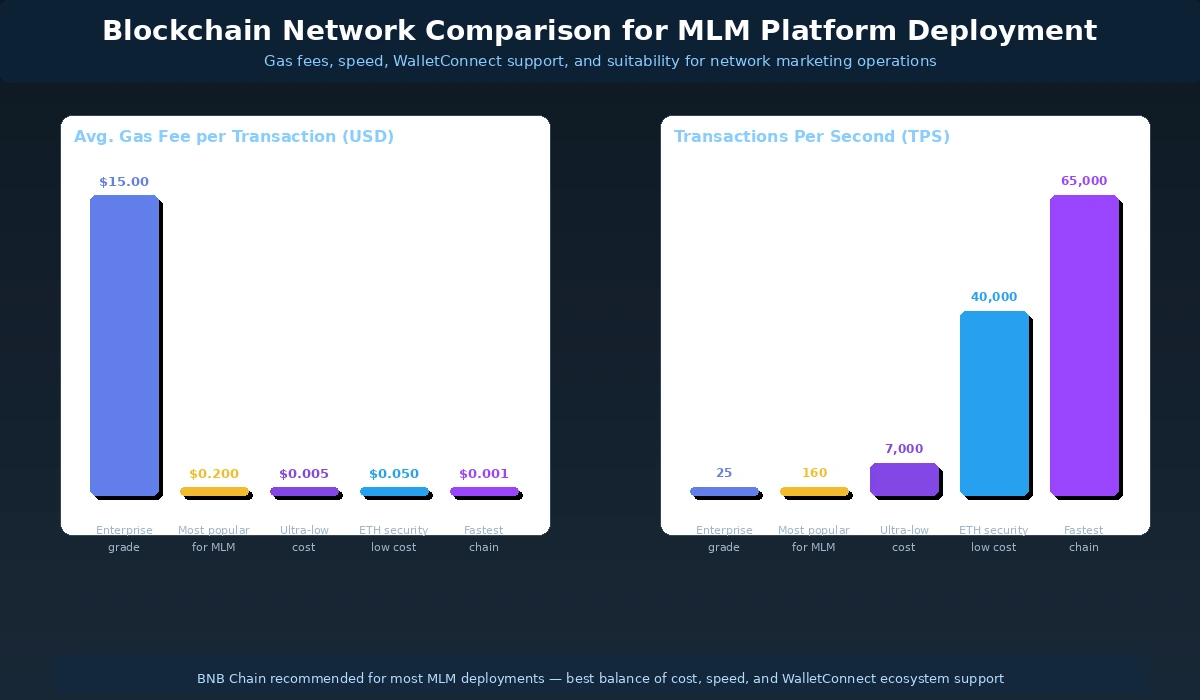
Choosing the right chain for your wallet integration affects costs, speed, and user familiarity. Here is how the major options compare for MLM platform deployment:
| Blockchain | Avg. Gas Fee | TPS | WalletConnect Support | MLM Suitability |
|---|---|---|---|---|
| Ethereum | $2 to $15 | 15 to 30 | Full | High-value / enterprise |
| BNB Chain | $0.05 to $0.30 | ~160 | Full | Most popular for MLM |
| Polygon | <$0.01 | ~7,000 | Full | Micro-commissions / high volume |
| Solana | <$0.001 | ~65,000 | Partial | Emerging / tech-forward MLM |
| Arbitrum (L2) | $0.01 to $0.10 | ~40,000 | Full | Ethereum-grade security, low cost |
BNB Chain dominates the crypto based mlm space primarily because of its low fees and the familiarity of its ecosystem to users in Asia and emerging markets. For a detailed chain-by-chain breakdown, see our analysis of Ethereum vs BNB vs Solana for MLM blockchain.
Step-by-Step Integration Process
The integration process below reflects the workflow we use in actual client deployments. It is not a simplified tutorial. It is the real sequence, with the gotchas included.
Setting Up the Development Environment
Install Node.js, Hardhat (for smart contract development), and the WalletConnect v2 SDK (@walletconnect/modal). For the frontend, set up a React or Next.js project and install ethers.js v6 and wagmi. Create a free project on WalletConnect Cloud to get your Project ID, which is mandatory for v2.
Integrating MetaMask into the Platform
Check for window.ethereum in the browser. If present, call eth_requestAccounts to prompt the user to connect. On confirmation, retrieve the wallet address and map it to the user’s MLM account. Handle network switching so users are always on the correct chain (BNB Chain or whichever you deploy on) before attempting any transactions.
Connecting WalletConnect for Mobile Users
Initialize the WalletConnect modal with your Project ID and target chain IDs. When MetaMask is not detected, automatically show the WalletConnect modal, which presents a QR code and a list of popular mobile wallets (Trust Wallet, Coinbase Wallet, Rainbow, etc.). On session establishment, retrieve the connected address identically to the MetaMask flow so downstream code is wallet-agnostic.
Smart Contract Deployment and Linking
Write Solidity contracts that encode your compensation plan. Deploy to testnet first (BNB Testnet or Sepolia for Ethereum). Include functions for user registration, referral tree updates, and automated commission distribution. Store the deployed contract address in your platform config and use it with ethers.js to call contract functions from the frontend after wallet connection is confirmed.
Testing Transactions and User Flows
Simulate the complete user journey: new distributor connects wallet, registers under a referrer, makes a purchase, and confirms that commissions propagate through all configured MLM levels. Use Hardhat’s local network for contract unit tests and then test on public testnet with real MetaMask and WalletConnect connections before any mainnet deployment.
Platform data security does not stop at the wallet layer. For distributors sharing sensitive data across the network, consider IPFS-based decentralized storage for MLM data as a complementary layer alongside your wallet integration.
Security Considerations
Security in blockchain MLM development is not optional and it is not a post-launch item. The combination of financial transactions and multi-level user structures creates a large attack surface. Here is what every network marketing company building on blockchain must address.
Protecting User Wallets and Private Keys
The platform never stores, requests, or has access to a user’s private key. That is the fundamental rule. MetaMask and WalletConnect are specifically designed to enforce this. Any platform that asks users to enter seed phrases or private keys anywhere on the website is fraudulent. Build user education around this point. Include visible warnings in the UI. Your distributors’ security is directly tied to your platform’s reputation.
Smart Contract Auditing
Before mainnet deployment, every smart contract must go through an independent security audit. Firms like CertiK, Trail of Bits, and ConsenSys Diligence specialize in Solidity audits. The audit should cover reentrancy attacks, integer overflow, access control vulnerabilities, and any logic flaws specific to your commission distribution model. In our eight-plus years of deploying MLM smart contracts, skipping the audit has been the single biggest mistake clients have regretted. One exploit can drain the entire contract.
Preventing Phishing and Fraud
Phishing is the most common attack vector in the crypto space. Attackers create fake versions of your platform domain to steal wallet connection signatures. Counter measures include registering all similar domain variations, implementing strict Content Security Policy (CSP) headers, using ENS (Ethereum Name Service) domains for verifiability, and educating users to always check the URL before connecting their wallet.
Secure Transaction Validation
All transaction parameters must be validated both on the frontend before submission and within the smart contract itself. Never rely solely on frontend checks. A user can bypass JavaScript validation and call your contract directly with manipulated inputs. Smart contracts must independently verify that the caller is registered, the amounts are within expected bounds, and the referral chain is valid before executing any state change.
Real Use Cases in MLM Platforms
Use Case Comparison: Traditional MLM vs Blockchain MLM
| Use Case | Traditional MLM | Blockchain MLM with Wallets |
|---|---|---|
| Commission Payout | Weekly / monthly, manual processing | Instant, automated via smart contract |
| Referral Tracking | Centralized database, proprietary | On-chain, publicly verifiable |
| User Identity | Email / username | Wallet address (self-sovereign) |
| Cross-Border Payments | Slow, expensive, restricted | Instant, borderless, same cost globally |
| Reward Programs | Points, gift cards, fiat bonuses | Tokens, NFTs, DeFi yield |
| Audit Trail | Internal only, not public | Immutable public blockchain record |
Example: Automated Commission Distribution in a 5-Level MLM
Here is a concrete example. A crypto currency mlm platform deploys a smart contract with the following commission rules:
- Level 1 (direct referrer): 10% of purchase value
- Level 2: 5%
- Level 3: 3%
- Level 4: 2%
- Level 5: 1%
When a new distributor connects their MetaMask wallet and makes a $500 purchase, the smart contract automatically sends $50 to the Level 1 address, $25 to Level 2, $15 to Level 3, $10 to Level 4, and $5 to Level 5, all in a single transaction. The entire payout chain settles in under 5 seconds on BNB Chain at a cost of roughly $0.15 in gas. No payroll department. No spreadsheet. No dispute resolution needed. The code is the agreement.
Token-Based Reward Systems
Beyond simple commission payouts, many crypto based mlm companies issue their own ERC-20 tokens as part of their reward ecosystem. Distributors earn tokens for hitting targets, recruiting members, or holding long-term. These tokens can be staked for DeFi yield, traded on decentralized exchanges, or redeemed for products. WalletConnect and MetaMask support all standard token interactions out of the box, which makes this kind of reward architecture practical to implement.
To understand how leading platforms are navigating compliance while building these systems, see our overview of MLM meaning, types, benefits, and global regulation.
Challenges and Practical Solutions
No integration is without friction. The following are the most common challenges we encounter with clients building mlm marketing platforms on blockchain, along with the solutions that actually work.
Future Trends: Where Blockchain MLM Is Headed
The pace of change in Web3 technology means the platforms being built today will look very different three years from now. Here are the developments that will most directly affect how multi level marketing platforms use wallet technology going forward.
Account Abstraction (ERC-4337)
Account abstraction is arguably the most important UX improvement coming to crypto wallets. It allows smart contract-based wallets to pay gas fees in any token (not just ETH), recover accounts without seed phrases, and batch multiple transactions. For MLM platforms, this means distributors could register and make a purchase in a single click, with gas paid in the platform’s native token. Adoption of ERC-4337 compatible wallets is already accelerating and will reshape onboarding for every crypto currency mlm platform.
DeFi Integration for Passive Income Layers
Several forward-looking crypto based mlm companies are building DeFi yield layers directly into the compensation plan. Distributors’ unclaimed commissions sit in a yield protocol like Aave or Compound and accrue interest until withdrawn. The connected wallet handles all of this automatically. This creates a compelling additional income stream that traditional mlm company models simply cannot replicate.
NFT-Based Membership and Rank Systems
NFTs are not just digital art. As non-fungible tokens that represent unique on-chain assets, they are an excellent fit for MLM membership tiers and rank certificates. A distributor who achieves “Diamond” rank receives a soul-bound NFT (non-transferable) that grants them access to higher commission tiers, exclusive product launches, and governance rights within the platform’s DAO. This membership and rank data lives permanently on the blockchain, in the user’s wallet, not in a company database.
AI-Powered Smart Contract Monitoring
AI tools are increasingly being used to monitor smart contract activity in real time, flagging unusual patterns that might indicate exploits or suspicious behavior before funds are drained. For a network marketing company managing millions in on-chain commissions, AI-driven contract monitoring adds an important security layer that complements traditional auditing.
For a broader picture of where the industry is heading from a regulatory perspective as these technologies converge, read our guide on blockchain MLM regulation.
Final Thoughts
Integrating WalletConnect and MetaMask into an MLM platform is not a feature addition. It is a foundational shift in how the platform operates. It changes the relationship between the company and its distributors from a trust-based one (trust us to pay you correctly) to a verification-based one (verify it yourself, on the blockchain, right now).
For any multi level marketing company serious about building for the next decade, this shift is not optional. Distributors are already comparing platforms. They already ask whether commissions are on-chain. They already know what MetaMask is. The platforms that meet them where they are will attract and retain the best networks. The ones that do not will lose them to competitors who did.
The technical implementation is absolutely achievable with the right team and the right architecture. The smart contract design, the security audit, the dual-wallet support, the gas optimization, all of it is solvable. What matters most is the decision to build it properly from the start rather than bolting crypto payments onto a platform that was not designed for it.
Our team has spent over eight years building precisely these systems for mlm marketing operators across every major market. The companies that integrate wallet-based infrastructure today are building a competitive moat that will be very difficult for late movers to close in the years ahead.
Frequently Asked Questions
Q1.Can I integrate both WalletConnect and MetaMask into the same MLM platform?
Yes, and this is the recommended approach. MetaMask handles desktop browser users while WalletConnect covers mobile users and those with other wallet preferences. Libraries like wagmi and RainbowKit make it straightforward to support both through a unified connection interface so your codebase stays clean and user experience stays consistent.
Q2.How long does it take to integrate WalletConnect and MetaMask into an existing MLM platform?
For a platform being rebuilt with blockchain from the ground up, the full wallet integration, smart contract development, and testing cycle typically takes 8 to 14 weeks depending on the complexity of the compensation plan. Adding wallet connectivity to an existing platform as a payment layer (without rebuilding the core logic) can be done in 3 to 5 weeks. The smart contract audit adds another 2 to 4 weeks and should never be skipped.
Q3.Which blockchain is best for a crypto MLM platform in 2026?
BNB Chain remains the most widely used blockchain for MLM platforms due to its low transaction fees (under $0.30), fast block times, and large user base in key MLM markets like Southeast Asia. Polygon is a strong alternative for very high-volume platforms needing near-zero gas costs. Ethereum is suitable for enterprise-grade platforms where security perception is paramount and the distributor base is more sophisticated. Our full comparison is available in the Ethereum vs BNB vs Solana guide.
Q4.Is it safe to run MLM commission payments through smart contracts?
Smart contracts are safe when they are properly designed and independently audited. The immutability that makes them powerful also makes vulnerabilities permanent once deployed. That is why code audits by specialized firms are essential before mainnet deployment. Contracts that handle significant funds should also implement time-locks and multi-signature admin controls as additional safeguards. The safety of the system is directly proportional to the rigor of the development and auditing process.
Q5.Do my distributors need to understand crypto to use a blockchain MLM platform?
Not necessarily, but some basic wallet literacy is required. At minimum, users need to install MetaMask or a mobile wallet, secure their seed phrase, and understand what it means to approve a transaction. Good UX design, in-app tutorials, and wallet abstractions like Web3Auth (which allows social login to create a wallet) can significantly lower the barrier. The goal is to make the crypto layer mostly invisible to casual users while keeping it accessible to those who want full control.
Q6.How does wallet integration help with MLM regulatory compliance?
Blockchain transaction records provide an immutable audit trail that regulators can independently verify. This transparency makes it much harder to run manipulative or fraudulent compensation structures, which is the primary regulatory concern with network marketing. Every payout, every referral, every registration is recorded on-chain. For platforms operating in regulated markets, this verifiability is a significant compliance advantage. See also our guide on blockchain MLM regulation for jurisdiction-specific considerations.
Explore Services
Related Services
Reviewed by

Aman Vaths
Founder of Nadcab Labs
Aman Vaths is the Founder & CTO of Nadcab Labs, a global digital engineering company delivering enterprise-grade solutions across AI, Web3, Blockchain, Big Data, Cloud, Cybersecurity, and Modern Application Development. With deep technical leadership and product innovation experience, Aman has positioned Nadcab Labs as one of the most advanced engineering companies driving the next era of intelligent, secure, and scalable software systems. Under his leadership, Nadcab Labs has built 2,000+ global projects across sectors including fintech, banking, healthcare, real estate, logistics, gaming, manufacturing, and next-generation DePIN networks. Aman’s strength lies in architecting high-performance systems, end-to-end platform engineering, and designing enterprise solutions that operate at global scale.