Ai Overview
A Layer 1 blockchain is a fully independent blockchain network with its own consensus mechanism, validators, native token, and execution layer. Bitcoin and Ethereum are foundational Layer 1 blockchains, enabling trustless value transfer and programmable smart contracts respectively. An inexperienced team might design requirements that are technically impossible (needing both 100,000 validators AND 100,000 transactions per second with finality in 1 second is not realistic).
Key Takeaways: Layer 1 Blockchain
- A Layer 1 blockchain is a fully independent blockchain network with its own consensus mechanism, validators, native token, and execution layer.
- Bitcoin and Ethereum are foundational Layer 1 blockchains, enabling trustless value transfer and programmable smart contracts respectively.
- Building a Layer 1 blockchain is justified only when existing Layer 1 or Layer 2 networks cannot meet technical or economic requirements.
- Consensus design is the most critical Layer 1 decision, directly controlling scalability, decentralization, security, and transaction finality.
- Proof of Stake BFT is the dominant Layer 1 consensus model in 2025, offering fast finality and strong security with efficient validator participation.
- EVM compatibility significantly accelerates adoption, allowing existing Ethereum smart contracts and developer tools to work with minimal changes.
- Most projects should choose Layer 2 solutions instead of building a new Layer 1, as Layer 1 development is costly, complex, and time-intensive.
When we talk about building a Layer 1 blockchain, we are talking about creating a completely independent financial system from the ground up. Imagine building your own country with its own government, currency, laws, courts, and economic system. A Layer 1 blockchain is similar in scope.
Bitcoin was the first Layer 1 blockchain. It solved the problem of how strangers could transfer value to each other without needing a bank or government to verify the transaction. Ethereum, built later, expanded this concept by allowing programmable agreements (smart contracts) to run on the blockchain. Today, if you want complete control over your protocol’s rules, economics, and technical design, you build a Layer 1.
Why Not Just Use Ethereum or Bitcoin?
You might wonder why anyone would build a new blockchain when Ethereum already exists and handles billions of dollars in transactions daily. The answer is that existing blockchains have trade-offs built into their design that cannot be changed.
Ethereum prioritizes security and decentralization, which limits how many transactions it can process per second. If your application needs to process millions of payments daily, Ethereum’s throughput might be insufficient. Bitcoin cannot run complex smart contracts because its design is intentionally simple. If you need custom logic that Bitcoin does not support, you cannot use Bitcoin.
A custom Layer 1 lets you make different choices. You could design a blockchain that prioritizes speed over decentralization. You could create a virtual machine optimized for AI computations. You could implement governance where your community votes on every major decision. You could design an economic system with specific inflation properties to incentivize certain behaviors.
The trade-off is that building a Layer 1 is extremely expensive and complex. It requires millions of dollars in funding, deep technical expertise, and several years of development before launch. Most projects that think they need a Layer 1 actually need a Layer 2 (which sits on top of Ethereum and inherits its security), or they should just launch on Ethereum directly.
This guide walks through exactly what building a Layer 1 entails, from the initial design decisions to the day your network goes live with real users and real money.
Part 1: Pre-Development Planning
Step 1: Understand What Problem You Are Solving
Before you write any code, before you hire any engineers, before you raise any money, you must answer one fundamental question: Why does your blockchain need to exist?
This is not a philosophical question. It is a business and technical question. What can your blockchain do that Ethereum, Solana, Polygon, or another existing blockchain cannot do?
Some legitimate answers include:
- You need fundamentally different economics. Ethereum charges transaction fees in ETH. If your application is a payments network for developing countries and you need fees to be near-zero permanently, you cannot use Ethereum. You would design your Layer 1 with different economics where transaction fees are nearly free through a different consensus model.
- You need a different technical architecture. Bitcoin uses a UTXO model (like cash, where you spend specific coins). Ethereum uses an account model (like a bank account with a balance). If your application requires the UTXO model for technical reasons, you cannot use Ethereum. You would build a Layer 1 with UTXO architecture.
- You need sovereign governance. Ethereum governance is controlled by its community and core developers. If you are a nation-state or large corporation and you need absolute control over your blockchain’s rules and require the ability to freeze accounts or reverse transactions, Ethereum will not work. You would build a private or semi-private Layer 1.
- You need custom virtual machines or execution models. Ethereum uses the EVM (Ethereum Virtual Machine) for smart contracts. If you want smart contracts written in a specific programming language that the EVM does not support well, or if you want to optimize execution for specific types of computations, you might build a Layer 1 with a custom execution engine.
- You need specific performance characteristics. Ethereum processes about 15 transactions per second on-chain (higher with Layer 2 solutions). If you need to process millions of transactions per second and cannot use a Layer 2, a custom Layer 1 designed for high throughput would be your solution.
- You need to build a specific financial primitive. Perhaps you are creating a decentralized exchange that needs atomic swaps between different assets, or a lending protocol that requires specific interactions between contracts that existing blockchains do not support well. A custom Layer 1 designed for your use case could provide better efficiency.
Ask yourself honestly: Could I achieve my goals using Polygon, Arbitrum, Optimism, Solana, or another existing Layer 1 or Layer 2? If the answer is yes, stop here. Do not build a Layer 1. Use an existing network and launch your application.
If the answer is genuinely no, then continue.
Step 2: Define Your Technical Requirements and Constraints
Once you know why you are building, you must define what you are building. This happens through detailed technical requirements that will guide every future decision.
- How many transactions per second must your network handle? This is critical because every other design decision flows from this. If you need 1,000 transactions per second, that is vastly different from needing 100,000. Higher throughput requires larger blocks, faster consensus, or more powerful validators.
- How long should users wait before they are certain a transaction cannot be reversed? A payment app might need finality in seconds (comparable to swiping a credit card). A settlement network might accept finality in minutes. This affects your consensus mechanism choice.
- How decentralized must the network be? Do you need 1,000 validators, 10,000, or 100,000? More validators improve decentralization and security, but increase network communication overhead and slow down consensus.
- What should be the average transaction cost? One penny? One dollar? This affects how much fees you can charge and influences validator economics.
- Should anyone with a laptop be able to run a validator? Or is it acceptable to require high-end servers costing thousands of dollars per year? This affects how decentralized your network can be.
- How much disk space must a full node use? Should a node operator be able to run your blockchain on a $500 computer? Or is terabytes of storage acceptable? This affects throughput and data availability.
- How critical is it that your blockchain is immutable? A financial settlement network might require extremely high security with thousands of validators. A gaming blockchain might accept slightly lower security with fewer validators for faster transactions.
Write these down explicitly. Show them to the technical advisors and ask if they are achievable. An inexperienced team might design requirements that are technically impossible (needing both 100,000 validators AND 100,000 transactions per second with finality in 1 second is not realistic).
Step 3: Choose Your Consensus Mechanism (The Decision That Controls Everything)
Consensus is how your blockchain reaches agreement on the canonical truth. It is the most critical design decision because it affects everything else: transaction throughput, finality time, validator count, hardware requirements, and security.
You have several options.
Option 1: Proof of Stake Byzantine Fault Tolerant (PoS BFT)
In Proof of Stake BFT consensus, validators are selected to propose blocks in rounds. For example, in Ethereum 2.0 and Cosmos, one validator is selected per block slot (e.g., every 12 seconds). That validator collects pending transactions and creates a new block. The validator broadcasts this block to the network.
Other validators receive the block and perform validation checks. Once two-thirds of validators attest (vote) that the block is valid, it reaches finality. Users and applications can treat the block as final and irreversible.
Advantages:
- Fast finality: blocks become final in seconds or minutes, not hours
- Predictable: you know exactly when finality happens
- Simple to understand: users see blocks appearing regularly
Disadvantages:
- Requires active validator participation: if more than one-third of validators go offline, consensus stops
- Requires a minimum stake: you need token capital to become a validator
- Validator count is typically limited: most PoS BFT systems have 100-1000 validators to keep consensus fast, not millions
- Complexity: Implementing BFT consensus correctly is difficult and requires careful testing
Hardware requirements: Moderate. A good server with 32GB RAM and fast SSD storage can run a validator.
Transaction throughput: Moderate. Most PoS BFT systems do 100-10,000 transactions per second, depending on design. Fast finality limits throughput.
Examples: Cosmos, Polkadot, and Ethereum 2.0’s beacon chain consensus.
Option 2: Nakamoto Consensus (Proof of Work or PoS Nakamoto)
Bitcoin uses Proof of Work (miners compete to solve hard puzzles). Some modern blockchains use Proof of Stake Nakamoto where validators are randomly selected to propose blocks, weighted by their stake.
In this model, there is no explicit voting. Miners/validators continuously produce blocks. The longest chain is considered canonical. Finality is probabilistic: after 6 blocks (about 1 hour for Bitcoin), the chance a transaction is reversed becomes negligible but not zero.
Advantages:
- Extremely decentralized: anyone can participate (for PoS version) or anyone can mine (for PoW version)
- Highly resilient: the network continues even if most participants go offline
- Simple: no complex voting logic required
- No minimum stake: anyone can participate
Disadvantages:
- Slow finality: users must wait hours to be certain transactions are final
- Energy-intensive (for PoW): miners use enormous amounts of electricity
- Potential for long chain reorganizations: under certain attack conditions, long stretches of blockchain history can be rewritten
- Lower throughput: blocks are relatively small to allow rapid propagation
Hardware requirements: Varies. PoW requires expensive mining equipment. PoS Nakamoto requires standard server hardware.
Transaction throughput: Low to moderate, typically 10-100 transactions per second, depending on block size.
Examples: Bitcoin (PoW), some newer chains experimenting with PoS Nakamoto.
Option 3: Delegated Proof of Stake (DPoS)
In DPoS, token holders vote for a small number of delegates (perhaps 20-100) who validate the blockchain on their behalf. This combines some benefits of PoS BFT (fast, final blocks from dedicated validators) with broader participation (anyone can vote).
Advantages:
- Participatory governance: token holders vote on validators
- Efficient: fewer active validators means simpler consensus
- Fair: anyone who buys tokens can participate in governance
- Moderate hardware requirements: delegates need good servers, but not extreme hardware
Disadvantages:
- Voter apathy: most token holders do not vote, so validation power concentrates in a few large holders
- Complexity: Implementing voting and delegation correctly is intricate
- Slashing risks: if a delegate misbehaves, delegators lose their stake
Hardware requirements: Moderate.
Transaction throughput: Moderate to high, 1,000-10,000 transactions per second.
Examples: EOS, Cosmos (with validators), Polkadot (with validators).
Recommendation for New Builders
If you are building a new Layer 1, Proof of Stake BFT is the industry standard in 2025. It provides excellent security, fast finality, and a reasonable balance of decentralization and performance. Cosmos SDK and Substrate are both frameworks that implement PoS BFT and dramatically accelerate development.
Only consider Nakamoto consensus if you need extreme decentralization and can accept slow finality. Only consider DPoS if you want explicit governance voting.
Step 4: Choose Your Execution Model (How Smart Contracts Run)
Your execution model determines how transactions are processed and how smart contracts are executed. This is the second most critical design decision.
Option 1: EVM Compatible (Ethereum Virtual Machine)
The EVM is the virtual machine Ethereum uses to execute smart contracts. If you build an EVM-compatible blockchain, any smart contract written for Ethereum will work on your blockchain (with minimal changes).
Advantages:
- Massive developer ecosystem: thousands of existing smart contracts can be deployed
- Familiar tools: developers already know how to code for the EVM
- Fast market entry: existing DeFi protocols can deploy on your chain immediately
- Security: the EVM is battle-tested with billions in value flowing through it
Disadvantages:
- Limited optimization: the EVM is a general-purpose machine, not optimized for specific use cases
- Performance ceiling: The EVM has inherent limitations on throughput and execution speed
- Gas model: You inherit Ethereum’s gas pricing model, which might not fit your design
Examples: Polygon, Avalanche, Arbitrum, Optimism, Binance Smart Chain.
Who should choose this: Most new Layer 1 builders should choose EVM compatibility. It gives you access to existing applications immediately.
Option 2: WASM (WebAssembly)
WebAssembly is a lower-level virtual machine that allows compilation from many programming languages (Rust, C, Python, etc.). It is more flexible than the EVM and generally executes faster.
Advantages:
- Better performance: WASM typically executes 5-10x faster than the EVM
- Multiple languages: developers can write contracts in Rust, C++, or other languages
- More expressive: WASM supports more complex operations
- Future-proof: WASM is a web standard likely to be supported for decades
Disadvantages:
- Smaller ecosystem: fewer existing contracts and tools compared to EVM
- Security complexity: WASM gives developers more power, which means more ways to write insecure code
- Learning curve: developers must learn WASM-specific tools
- Less battle-tested: WASM has less deployed capital in production
Examples: Cosmos SDK (using CosmWasm), Polkadot, Near Protocol, Solana (uses Solana’s custom runtime, but supports Rust-compiled WASM-like bytecode).
Who should choose this: Choose WASM if you prioritize performance and are willing to develop the ecosystem from scratch. Good for specialized applications (gaming, AI, high-frequency trading) where performance matters more than ecosystem size.
Option 3: Custom Virtual Machine
Build a completely custom execution engine optimized for your specific use case.
Advantages:
- Maximum optimization: your VM is perfect for your application
- Maximum control: you design exactly how execution works
- Differentiated: no direct competition from other chains with identical execution
Disadvantages:
- Enormous development effort: building a safe, efficient VM is harder than most people think
- Security risk: vulnerabilities in your custom code are unknown to the ecosystem
- No ecosystem: developers must learn your custom language and tooling
- Maintenance burden: You must maintain and upgrade your VM
Examples: Bitcoin (using Script), Cardano (using Plutus).
Who should choose this: Almost never. Only choose this if you have specific execution needs that neither EVM nor WASM can address, and you have a large team of experienced systems engineers.
Recommendation for New Builders
Choose EVM compatibility. This is the pragmatic choice that balances ecosystem access with reasonable performance. You can always optimize or add WASM support later if needed.
Step 5: Decide on Your State Model
Your state model is how your blockchain stores account information and balances.
Option 1: Account-Based Model
In an account-based model (used by Ethereum), each address is an account with a balance, nonce, and code. Transactions reference accounts by address.
Account:
    Address: 0x1234...
    Balance: 100 ETH
    Nonce: 42
    Code: [smart contract bytecode if it is a contract]
A transaction looks like: “Send 10 ETH from account A to account B.”
Advantages:
- Intuitive: it works like a bank account
- Smart contract-friendly: contracts can easily check balances and send funds
- Simpler consensus: less state bookkeeping needed
- More efficient for most applications
Disadvantages:
- Parallel execution is harder: if two transactions touch the same account, they cannot execute in parallel
- Privacy is harder: all balances are visible on-chain
- Requires nonce management: clients must track nonces to prevent replay attacks
Option 2: UTXO Model
In a UTXO model (used by Bitcoin), transactions reference specific previous transaction outputs. A user’s balance is the sum of all unspent outputs they own.
Transaction Output:
    Previous Transaction ID: abc123
    Output Index: 0
    Amount: 5 BTC
    Owner: address 0x5678...
A transaction looks like: “Spend output #0 from transaction abc123 (which contains 5 BTC) and send 3 BTC to Alice and 2 BTC to Bob.”
Advantages:
- Parallel execution: different UTXOs can be spent in parallel without conflicts
- Privacy: you can have multiple outputs to the same address
- Explicit lineage: you can trace the history of each coin
- Better for specialized applications: gaming, payments, privacy protocols
Disadvantages:
- More complex: developers must manage UTXOs explicitly
- Harder for smart contracts: contracts cannot easily check balances without scanning all outputs
- More storage: the state is larger because each unspent output must be stored
- Less intuitive: most users think in terms of account balances, not outputs
Recommendation for New Builders
Choose account-based unless you have a specific reason not to. It is simpler to implement and understand. Most applications work better with account-based models.
Part 2: Architecture Deep Dive
Step 6: Design Your Peer-to-Peer Network Architecture
A blockchain is a peer-to-peer network. The network layer allows nodes to discover each other, communicate, and share information. Without a robust network layer, your blockchain cannot function.
Node Discovery
When a new node starts up, it must find peers to connect to. It cannot hardcode the addresses of all validators because they might go offline or change. Instead, nodes use a discovery protocol.
The standard approach is Kademlia, a distributed hash table (DHT). Here is how it works:
- Bootstrap nodes: Your development team runs a few “bootstrap nodes” with well-known addresses. New nodes start by connecting to a bootstrap node.
- Peer sharing: When a new node connects to a bootstrap node, it asks, “Who else is on the network?” The bootstrap node responds with a list of other peers it knows.
- Continuous discovery: The new node connects to these peers and asks them for more peers. Over time, it discovers hundreds or thousands of peers.
- DHT lookup: Each node stores information about peers in a distributed hash table. When a node wants to find other peers, it uses the DHT to look them up.
This decentralized approach means your network does not depend on central servers. If all bootstrap nodes go offline, existing nodes continue to find each other.
Peer Connections
Nodes connect to each other using standard Internet protocols (TCP or UDP). Each node maintains about 20-100 active peer connections, depending on your design. Too few peers and nodes might not receive information quickly. Too many peers, and each node wastes bandwidth sending information to everyone.
Nodes authenticate each other using cryptographic signatures. When two nodes first connect, they exchange public keys and prove their identity. This prevents attackers from impersonating validators.
Transaction Gossip
When a user submits a transaction to a node, that node must share it with the rest of the network. This happens through a gossip protocol:
- Local submission: User submits a transaction to their local node via RPC
- Local validation: The node validates the transaction (checking the signature, sender’s balance, nonce)
- Adding to mempool: If valid, the node adds the transaction to its mempool (a local database of pending transactions)
- Gossiping: The node sends the transaction to all its peers
- Peer validation and regossip: Each peer validates the transaction and forwards it to their peers
- Network-wide propagation: Within seconds, the entire network knows about the transaction
This gossip process is critical because validators must know about transactions before they can include them in blocks. If transaction propagation is slow, users experience long waits.
Block Gossip
Blocks are gossiped similarly:
- Block production: A selected validator creates a block with transactions from the mempool
- Broadcasting: The validator sends the block to all its peers
- Validation: Peers validate the block (checking signatures, execution, state transitions)
- Regossiping: Peers forward the block to their peers
- Network-wide reception: Within seconds, all nodes have received the block
Block propagation speed is critical to consensus. If it takes a minute for a block to reach all validators, slow validators might miss the proposal of the next block. The consensus protocol relies on most validators seeing blocks quickly.
Spam Prevention
Without protection, attackers could flood your network with invalid transactions and blocks, consuming node bandwidth and CPU. Defenses include:
Rate limiting: Nodes reject excessive messages from any single peer. If a peer sends more than 100 transactions per second, the receiving node ignores them.
Signature validation: Nodes verify the cryptographic signature on transactions. Invalid signatures are rejected immediately without further processing.
Stake-based spam prevention: Only validators (nodes with significant token stakes) can propose blocks. Because validators have slashable stakes, they have a financial incentive not to propose invalid blocks. This is the strongest spam prevention.
Transaction cost: Every transaction has a fee. Users must spend money to submit transactions, so attacking the network is expensive.
Step 7: Design Your Mempool and Transaction Ordering
The mempool is a node’s local database of pending transactions waiting to be included in blocks. The mempool design is crucial to network health and fair transaction ordering.
Mempool Storage
Nodes store pending transactions in memory (RAM) to minimize latency. A typical node might store 10,000 to 100,000 pending transactions. If memory fills up, the node must decide which transactions to drop.
Transactions with higher fees are more valuable to validators, so nodes typically drop low-fee transactions first (this is called replacement). If a user wants to resend a transaction with a higher fee, they can replace the previous transaction with a new one.
Transaction Ordering and MEV
The mempool is an ordered list. Validators select transactions from the mempool to include in blocks. The order matters because it determines the order of execution. If Alice wants to buy 10 NFTs and Bob wants to sell 10 NFTs, the order determines who executes first.
In some cases, order is worth money. If Alice wants to swap Token A for Token B on a decentralized exchange, the execution price depends on how many other swaps execute before her. A validator could front-run Alice by inserting their own swap before hers, buying Token B at the price before Alice’s transaction, then selling it to Alice at a higher price.
This is called Maximal Extractable Value (MEV). It is a major issue in blockchain design.
Mempool privacy: One solution is a private mempool where transactions are encrypted until they are included in a block. Only the proposer knows the transaction order before the block is finalized. This prevents front-running but requires additional complexity.
Encrypted mempools: Threshold encryption allows transactions to be encrypted until a certain block height. Validators collectively decrypt transactions only after the block is finalized, so no validator can predict transaction order.
Randomized ordering: Instead of letting validators choose transaction order, the protocol randomly shuffles transactions. This removes MEV opportunities but adds complexity.
Builder separation: Validators propose blocks but do not choose transaction order. A separate “builder” component (operated by validators or third parties) chooses the order. This separates power and prevents validators from extracting MEV.
For a new Layer 1, start with a simple mempool without privacy. Add privacy features later if MEV becomes a problem. Most new chains do not prioritize MEV prevention initially.
Fee Market Design
Users attach fees to transactions to incentivize validators to include them. How fees are calculated and distributed significantly impacts the user experience.
Fixed fee: The blockchain requires a fixed fee per transaction type. Simple but inflexible. Works if transaction complexity is uniform.
First-price auction: Users bid any fee they want. Validators include the highest-fee transactions first. Simple but leads to fee volatility and users overpaying during congestion.
Base fee + priority fee (EIP-1559 model): The protocol sets a base fee that scales with congestion. Users add a priority fee on top. A portion of the base fee is burned (removed from circulation), creating deflationary pressure. This is Ethereum’s model and works well.
Auction-based fee market: Users bid for scarce block space in an auction. Complex but optimal for validators.
For a new Layer 1, EIP-1559 (base fee plus priority fee) is the proven standard. It provides predictable fees and deflationary dynamics.
Step 8: Design Your Consensus Algorithm in Detail
Now you must design the exact consensus mechanism your validators will use. This is the most critical technical design.
Using Proof of Stake BFT as an example (the recommended choice):
Slot and Epoch Structure
Divide time into discrete units:
Slot: A fixed time period (e.g., 12 seconds) during which one block is proposed.
Epoch: A collection of slots (e.g., 32 slots = 6.4 minutes). Validator set updates happen at epoch boundaries.
Epoch 1: Slot 0, Slot 1, Slot 2, ... Slot 31
Epoch 2: Slot 32, Slot 33, ... Slot 63
Validator Selection
At the beginning of each epoch, the protocol randomly selects which validator proposes each slot. The selection is weighted by stake. A validator with 10 times more stake is 10 times more likely to be selected.
The randomness is derived from the previous block hash, so all nodes calculate the same validator selection deterministically.
Block Proposal
The selected validator:
- Creates a new block with transactions from the mempool
- Orders transactions (deterministically or randomly, depending on your design)
- Computes the new state after executing all transactions
- Calculates the state root (a cryptographic hash of all account balances and contract state)
- Signs the block with their private key
- Broadcasts the block to the network
Block Attestation
After receiving a proposed block, other validators (called attesters) vote on whether the block is valid. They perform validation checks:
- Is the proposer correctly selected for this slot?
- Are all transaction signatures valid?
- Do all transactions have valid nonces?
- Does the execution produce the claimed state root?
- Are there any obvious attacks (double-spending, invalid state transitions)?
If the block passes these checks, the attester broadcasts an attestation (a vote) for the block.
Finality
The protocol tracks how many validators have attested to each block. Once two-thirds of validators attest to a block, it is finalized. Finalization is irreversible. Users and applications can treat finalized blocks as immutable.
Slashing Conditions
Validators who misbehave are punished:
- Double proposal: If a validator proposes two different blocks in the same slot, they are slashed
- Conflicting attestations: If a validator votes for two conflicting blocks, they are slashed
- Timing violations: If a validator proposes or attests at the wrong time, they are slashed
The penalty is typically losing 10-33% of the validator’s stake. Extreme punishment (losing 100%) is reserved for clear attacks.
Recovering from Offline Validators
If one-third or more of validators go offline, the network stops finalizing blocks (since two-thirds are needed for finality). The protocol should have mechanisms to recover:
- Inactivity leak: After a long time without finality, validators who did not attest gradually lose stake. This reduces the two-thirds threshold so the remaining online validators can finalize blocks again.
- Emergency restart: In extreme cases (more than two-thirds offline), the protocol requires manual intervention (community decision) to restart consensus.
Step 9: Design Your Execution Layer
The execution layer is where your blockchain actually does work. It processes transactions and executes smart contracts.
Transaction Execution
When a block is finalized, all nodes execute it the same way:
- Load the previous state: Read account balances and contract code from storage
- Execute each transaction in order: For each transaction in the block:
- Check the sender’s balance is sufficient
- Deduct the transaction fee
- If it is a simple transfer, update the receiver’s balance
- If it is a smart contract call, load the contract code and execute it
- Apply system transactions: The protocol generates system transactions (validator rewards, inflation minting) and executes them
- Compute the new state root: Calculate the cryptographic hash of all account state
Deterministic Execution
Critical rule: Every node must execute the same block identically. If two nodes execute differently, they will have different states and consensus will fail.
This means:
- No randomness: Smart contracts cannot use random numbers (different nodes would compute different random numbers). Use randomness from the blockchain itself (block hash as seed) or oracles.
- No external data: Smart contracts cannot access current time or external data. All input must come from the transaction or previous block data.
- No concurrency: Transactions execute sequentially, not in parallel (or if in parallel, must have deterministic results). This is a performance limitation but ensures correctness.
- Fixed gas costs: Every operation must cost a fixed amount of gas (computational units). Operations cannot take variable time.
Gas Metering
Transactions have a gas limit (maximum computation allowed). Gas is deducted for each operation:
PUSH1 (push a value): 3 gas
ADD (add two values): 3 gas
SSTORE (store to state): 20,000 gas
SLOAD (load from state): 2,100 gas
If a transaction uses more gas than allowed, execution stops, and the transaction is reverted (but the fee is still paid).
This prevents infinite loops and denial-of-service attacks.
System Transactions
The protocol generates system transactions for:
- Validator rewards: Each block, the protocol pays the block proposer transaction fees and new tokens
- Inflation: New tokens are minted and distributed to validators
- Governance: If token holders vote to change a parameter, the protocol executes a system transaction to update it
- State cleanup: Old data is pruned from the state
System transactions execute after all user transactions. They cannot be front-run or censored.
Step 10: Design Your State and Storage Layer
Your state is every account balance, contract code, and contract storage variable on your blockchain. This is all the information needed to process the next transaction. Efficient state storage is critical to performance.
State Structure: Merkle Trees
All state is organized into a cryptographic tree structure. The root of the tree (the state root) is a single hash that summarizes the entire state.
State Root: 0xabcd...
  Level 1:
    Left Hash: 0x1234...  |  Right Hash: 0x5678...

  Level 2:
    0x11.. 0x22.. | 0x33.. 0x44..

  Level 3 (Accounts):
    Alice: 100 ETH
    Bob: 50 ETH
    Charlie: 200 ETH
When a transaction changes Alice’s balance to 99 ETH, the state root changes. The new state root is computed by:
- Hashing Alice’s new state (99 ETH)
- Recomputing hashes up the tree
- Computing a new root hash
This is critical because it makes fraud detectable. If a dishonest node claims Alice has 1,000 ETH, we can verify the claim by asking for a Merkle proof (the minimal set of hashes from Alice to the root). If the proof does not match the canonical state root, the claim is fraudulent.
Account Storage
For each account, you store:
- Balance: How many tokens the account owns
- Nonce: A counter to prevent replay attacks (incremented with each transaction)
- Code: If it is a smart contract, the bytecode of the contract
- Storage: Smart contract variables and state
Alice's Account:
    Balance: 100 ETH
    Nonce: 42
    Code: null (not a contract)
    Storage: {}

SmartContract.sol's Account:
    Balance: 10 ETH
    Nonce: 1
    Code: 0x60604052... (EVM bytecode)
    Storage: {
        allowances: {Bob: 50},
        balances: {Alice: 100, Carol: 50},
        totalSupply: 1000000
    }
{
State Pruning
A full node storing every historical state would require petabytes of storage. Instead, nodes keep only the recent state. The old state that is no longer needed is pruned.
However, you must be able to prove historical facts. If someone asks “What was Alice’s balance at block 1000?”, even if you have pruned that state, you can answer using a Merkle proof from a historical block header.
State Snapshots and Fast Sync
A new node joining the network does not need to replay every transaction from genesis (which could take weeks). Instead, it downloads a state snapshot: a recent export of the entire state.
A state snapshot typically includes:
- All accounts and balances as of a recent block
- All smart contract code
- All storage variables
A new node downloads a snapshot, verifies it matches a recent block’s state root, then validates all blocks since the snapshot was created. This takes hours instead of weeks.
Storage Optimization
State storage is expensive because each node must store it. Optimizations include:
- Pruning old state: Delete accounts that have not been accessed for months
- Compression: Store state in compressed format
- Dedicated storage nodes: Not all nodes store the full state; some are lightweight nodes
- Rollup-style storage: For high-throughput chains, use Layer 2 rollups that post state to Layer 1, reducing Layer 1 storage burden
Step 11: Design Your Transaction Validation Rules
Before a transaction is included in a block, it must pass validation checks. These rules prevent invalid transactions from polluting your blockchain.
Signature Validation
Every transaction must be signed by the sender using their private key. Validators verify the signature using the sender’s public key. An invalid signature means the transaction is fraudulent (someone is spending tokens they do not own).
Transaction:
    From: Alice (address derived from her public key)
    To: Bob
    Amount: 10 ETH
    Nonce: 42
    Signature: 0x1234... (proving Alice authorized this transaction)
To verify: Does the signature prove Alice (the public key associated with the From address) authorized this transaction? If not, reject.
Nonce Validation
Each account has a nonce (a counter starting at 0). Every transaction increments the nonce. The purpose is to prevent replay attacks.
Without nonces, an attacker could copy a transaction “Send 10 ETH from Alice to Bob” and resubmit it multiple times. Alice would lose 10 ETH each time.
With nonces, the transaction is only valid if the sender’s nonce matches the expected nonce. After the first transaction executes, Alice’s nonce becomes 1. The attacker’s copy (with nonce 0) is now invalid.
Balance Validation
The sender must have enough balance to pay for the transaction (amount plus gas fees). If Alice has 5 ETH and tries to send 10 ETH, the transaction is invalid.
Required balance = Amount + (Gas Limit × Gas Price)
Available balance = Alice's account balance
If Available < Required, reject transaction
Replay Protection
Your blockchain might fork into two separate networks. You want transactions on one network to be invalid on the other (so users do not accidentally double-spend).
Solution: Include a chain ID in the transaction signature. The chain ID identifies which blockchain the transaction is for.
Transaction signature covers:
    From, To, Amount, Nonce, ChainID (crucial), Data
If attacker tries to replay a mainnet transaction on a testnet fork,
the signature does not verify because ChainID differs.
Gas Limit Validation
The transaction specifies a gas limit (maximum gas it can use). This prevents infinite loops. If a smart contract enters an infinite loop, the transaction will run out of gas and be reverted.
The gas limit must be reasonable. If someone submits a transaction with a gas limit of 10 billion, and your block gas limit is 100 million, reject it (it could never fit in a block).
Part 3: Building and Operating the System
Step 12: Design Your Validator Set and Staking Mechanism
Your blockchain is secured by validators who stake tokens and earn rewards. The staking mechanism determines who can validate and how much they earn.
Minimum Stake
Define the minimum amount of tokens required to run a validator. This is a critical parameter:
Too low (1 token): Anyone can spam the network by creating thousands of validators. Decentralization improves but the network is vulnerable to attacks.
Too high (100,000 tokens): Few wealthy people can become validators. The network is secure but not decentralized.
Optimal (32 tokens): A balance that allows thousands of validators while requiring enough capital to filter out casual attackers.
Ethereum uses 32 ETH (about $100,000 in 2025). Cosmos allows 1 token minimum. Choose based on your goals.
Validator Rewards
Validators earn rewards from two sources:
Transaction fees: Users pay fees on transactions. Validators who propose blocks earn these fees. This gives validators an incentive to accept as many transactions as possible.
Block rewards (inflation): The protocol creates new tokens and awards them to validators. This pays for network security even when transaction volume is low.
Block Reward Formula:
Annual inflation = 5% of total supply
Validators share inflation based on their stake
Transaction Fee Distribution:
Block proposer gets 100% of transaction fees
OR validators share fees equally
(depends on your design)
After the first few years, inflation typically decreases. Bitcoin halves inflation every four years. Ethereum has no fixed cap but declining inflation. Design an inflation schedule that incentivizes early participation but eventually stabilizes.
Validator Active Set
Only a subset of validators propose blocks and earn rewards. The active set typically includes top validators by stake (10-1,000 validators, depending on your consensus design).
New validators are added to the active set periodically. Departing validators are removed. This rotation happens at epoch boundaries.
Slashing Parameters
Define what behaviors are penalized and by how much:
Double proposal: Proposing two blocks in the same slot. Penalty: 3% of stake.
Conflicting votes: Voting for two different blocks. Penalty: 3% of stake.
Extreme slashing: In case of a coordinated attack that creates two conflicting finalized blocks (catastrophic failure), penalty: 100% of stake (loss of all staked tokens).
Slashing is severe enough to deter attacks but mild enough that honest mistakes during network outages do not devastate validators.
Delegation
Many token holders do not want to run validators themselves. They delegate tokens to validators who run the infrastructure.
A delegator loses a small percentage of rewards (the validator’s commission, typically 5-10%). In exchange, they earn staking rewards without running a node.
This is critical for decentralization because it lowers the barrier to participation.
Step 13: Design Your Fee and Inflation Economics
Economic design is as critical as technical design. Poor economics destroys blockchains.
Fee Market
Users pay fees based on network congestion:
Low demand: Fees are low (base fee)
High demand: Fees rise to ration scarce block space
The mechanism should balance:
- Low fees for users: Especially important for payments and financial inclusion
- Sustainable validator revenue: Validators must earn enough to justify running expensive infrastructure
- Protection against spam: Fees must be high enough that attacking the network is expensive
EIP-1559 style (base fee + priority fee) is the proven approach. The base fee scales automatically with block utilization:
If blocks are <50% full: decrease base fee
If blocks are >50% full: increase base fee
Priority fee is user-chosen (1 gwei to 1000 gwei typically)
Inflation Schedule
New tokens are minted according to a formula. Design your inflation to achieve specific goals:
Fast early growth: 10% annual inflation for years 1-3 to attract validators and users. Halves after year 3.
Stable final state: 2% annual inflation after year 10 to pay for network security.
Year 1: 10% inflation
Year 2: 10% inflation
Year 3: 7.5% inflation
Year 4: 5% inflation
Year 5-10: 2% inflation
Year 10+: 2% inflation (perpetual)
Total supply growth gradually slows down.
Fee Burning
Some blockchains burn a portion of transaction fees (remove tokens from circulation). This creates deflationary pressure, especially during high activity.
Burned tokens cannot be recovered. This is controversial because validators see no revenue from burned fees, but it makes the token potentially more valuable by reducing supply.
Fee: 1 ETH
Burned: 0.5 ETH (removed from circulation)
Validator gets: 0.5 ETH
This is Ethereum’s current approach.
MEV and Extraction
Transaction ordering is worth money. Validators can profit by ordering transactions strategically. Design your economics to account for MEV:
- Accept MEV: Do not try to prevent it. Validators earn additional rewards from MEV, which incentivizes participation.
- Minimize MEV: Use encrypted mempools or randomized ordering to reduce extractable value.
- Share MEV: Force validators to share MEV with users through mechanisms like MEV burning.
Most chains accept MEV as part of the system.
Step 14: Design Your Governance Model
Your blockchain will need upgrades and parameter changes. Governance determines how decisions are made.
Parameter Changes (On-Chain)
Some changes (inflation rate, block size, fee parameters) can be voted on and implemented automatically through smart contracts.
In token-based governance:
- Proposal: Someone stakes tokens and proposes a change
- Voting: Token holders vote for 7 days
- Quorum: At least 40% of tokens must vote
- Supermajority: 66% of votes must approve
- Activation: The change takes effect after a delay (1-4 weeks)
This is transparent and democratic but slow. Changing a parameter takes a month.
Protocol Upgrades (Off-Chain)
Consensual upgrades (adding new opcodes, changing consensus rules) cannot be implemented through smart contracts. They require all nodes to upgrade their software.
Typical process:
- Discussion: Core developers and community discuss the upgrade on forums
- RFC (Request for Comments): A formal proposal is published
- Testing: Code is tested on testnet for weeks or months
- Client Release: Each blockchain client (Rust, Go, Python, etc.) releases an update
- Adoption: Node operators voluntarily upgrade their software
- Activation: At a planned block height, the upgrade takes effect
Nodes that do not upgrade will continue following the old rules, creating a fork (two separate blockchains).
Governance Challenges
Governance is harder than it seems:
- Voter apathy: Most token holders do not vote; decisions are made by active minorities
- Token concentration: Large holders have disproportionate power
- Technical complexity: Most token holders cannot evaluate technical proposals
- Capture: Core developers or large holders might dominate decisions
Good governance requires:
- Clear processes: Everyone understands how decisions are made
- Transparent voting: All votes are public and verifiable
- Technical expertise: Some decisions should defer to technical experts
- Time delays: Upgrades take effect with delays so people can prepare
Step 15: Design Your Node and API Architecture
Users and applications interact with your blockchain through RPCs (Remote Procedure Calls). The RPC architecture determines the user experience.
RPC Methods
Provide standard methods for:
Reading state:
- getBalance(address): Get an account’s balance
- getCode(address): Get smart contract code
- call(transaction): Execute a contract function without modifying state
- getBlockByNumber(number): Get a block by height
- getTransactionReceipt(txHash): Get transaction result and status
Writing transactions:
- sendTransaction(signedTx): Submit a signed transaction to the network
- estimateGas(transaction): Estimate how much gas a transaction will use
- getFeeData(): Get current fee information
Subscribing to events:
- subscribe(“newBlocks”): Get notified when blocks are finalized
- subscribe(“logs”): Get notified when smart contracts emit events
Full Nodes vs Light Clients
Full nodes store the complete blockchain history and can verify all transactions independently. They are slow to sync (days or weeks) but fully trustless.
Light clients store only block headers and download specific data on-demand. They are fast to start but trust full nodes.
Most applications use full nodes for security. Light clients are used in mobile wallets and browsers.
Indexing Services
Raw blockchain data is inefficient to query. To find all transactions for an address, you would need to scan every block. Indexing services solve this:
The Graph protocol: Developers write indexing rules, data is indexed and made queryable.
Example query:

  GET /graphql
  {
    account(id: "0x123...") {
      transactions(first: 10)
      balanceHistory
    }
  }
This is much faster than raw blockchain queries.
API Rate Limiting
RPC endpoints are expensive to run. Prevent abuse through rate limiting:
- Free tier: 100 requests per day
- Paid tier: 1,000,000 requests per month for $100
This encourages applications to run their own nodes or use a service provider.
Step 16: Design Your Syncing and Bootstrapping Strategy
New nodes joining your network must synchronize to the current state. Efficient syncing is critical for adoption.
Full Sync from Genesis
The most secure method: replay every block from genesis (block 0), executing every transaction, verifying every signature.
Time: Weeks or months, depending on history length Storage: Terabytes Security: Complete; nodes independently verify everything
New chains use full sync because history is short (months or years). Established chains make this impractical.
Fast Sync (State Sync)
Download block headers and a recent state snapshot instead of replaying all history.
Process:
- Download all block headers (small; about 500 bytes each)
- Find a trusted checkpoint (a recent block with verified state root)
- Download state snapshot from peers
- Verify snapshot matches the checkpoint’s state root
- Start validating new blocks from the checkpoint forward
Time: Hours Storage: Gigabytes to terabytes Security: Less secure than full sync; depends on trusting the checkpoint
Light Client Sync
Only download block headers, not full state. Respond to queries about specific accounts by requesting Merkle proofs.
Time: Minutes Storage: Megabytes Security: Lightweight but requires trusting nodes for historical data
Genesis Configuration
Your blockchain starts with block 0 (genesis). Genesis must define:
- Initial balances: Who owns tokens at launch
- Validator set: Who are the first validators
- Parameters: Block size, gas limit, fee structure
- Timestamp: When the blockchain launched
Genesis is written to disk as a JSON or YAML file. The hash of genesis must match across all nodes, or they will not agree.
genesis.json:

{
    "chainID": "mychain-1",
    "blockTime": 12000,  // 12 seconds
    "validators": [
        {address: "0x111...", stake: 1000},
        {address: "0x222...", stake: 500},
    ],
    "accounts": [
        {address: "0x333...", balance: 1000000000},
    ],
    "gasLimit": 30000000,
    "baseGasPrice": 1000000000  // 1 gwei
}
Part 4: Security and Operations
Step 17: Security Architecture and Auditing
A blockchain with security bugs is worse than useless. Attackers have strong incentives to find vulnerabilities and exploit them for profit.
Security Audit Process
Before mainnet launch, conduct multiple professional security audits:
Phase 1: Code Review (Week 1-2)
External auditors read through all code systematically, checking for:
- Integer overflow/underflow bugs
- Reentrancy vulnerabilities (contract calls itself, causing double execution)
- Access control bugs (can unprivileged users do privileged actions?)
- State transition bugs (can the state machine reach invalid states?)
Phase 2: Fuzzing and Testing (Week 3-4)**
Automated tools generate random inputs and test your code:
- Fuzz transaction execution with random inputs
- Generate random blockchain states and test transitions
- Simulate validator misbehavior and check if slashing works
- Simulate network partitions and check recovery
Phase 3: Formal Verification (Week 5-6)**
For critical components (consensus, state machine), formal verification proves mathematical properties:
Prove: “If a block is finalized, it cannot be reverted.”
Prove: “If a validator is slashed, their stake decrease.s”
Prove: “If consensus has >2/3 honest validators, no fork occur.s”
These proofs provide high confidence in correctness.
Phase 4: Audit Report
The auditing firm publishes a detailed report:
- Found vulnerabilities (critical, high, medium, low severity)
- Recommendations for fixes
- Areas of high risk
- Overall security assessment
Typically, small blockchains find 50-200 vulnerabilities. Critical vulnerabilities must be fixed before launch. High and medium severity should be fixed. Low severity can be deferred.
Incentivized Bug Bounty
Before mainnet, run a bug bounty where security researchers compete to find bugs:
Bug Bounty Tiers:
Critical (network crash, total token loss): $100,000
High (single user fund loss): $50,000
Medium (gas estimation error): $5,000
Low (documentation issue): $500
This attracts talented hackers to test your code before real money is at stake.
Security Monitoring
After launch, continuously monitor for attacks:
- Unusual transaction patterns: Detect front-running or MEV extraction
- Validator misbehavior: Detect validators proposing invalid blocks
- Smart contract exploitation: Monitor for known attack patterns in contracts
- Network anomalies: Detect DDoS attacks or unusual peer behavior
Automated alerts notify operators when suspicious activity is detected.
Step 18: Disaster Recovery and Emergency Procedures
No matter how well you design, something will go wrong. Plan for emergencies.
Network Fork (Accidental)
Occasionally, the network temporarily splits into two branches due to network partitions or validator bugs.
Recovery procedure:
- Monitoring: Detect that consensus is not finalizing
- Analysis: Core team analyzes what went wrong
- Root cause: Identify the bug or network issue
- Fix: Deploy a patch to the code
- Coordination: Announce the fix and ask validators to upgrade
- Upgrade: Validators upgrade their software
- Restart: The network resumes with the new software
- Resolution: The minority fork is abandoned; everyone follows the majority
This requires communication channels (Discord, Twitter, forums) to coordinate community action.
Total Validator Consensus Failure
If more than two-thirds of validators go offline, consensus stops. The network cannot finalize new blocks.
Recovery options:
Option 1: Wait
If validators are just experiencing temporary outages, the network might recover.
Option 2: Inactivity Leak
Activate emergency mode where offline validators gradually lose stake,
reducing the supermajority requirement so remaining validators can finalize.
Option 3: Manual Restart
Core team announces a restart at a specific block height,
and the community decides to follow the restart or not.
Smart Contract Bug
If a deployed smart contract has a bug that drains user funds, you cannot easily fix it (immutability is a feature). Users must:
- Recognize the contract is buggy
- Migrate to a fixed version
- Accept the loss
Some blockchains implement circuit breakers (emergency stops) but this reduces decentralization.
Prevention is better than recovery: Auditing and testing prevent smart contract bugs.
Critical Protocol Bug
If your consensus code has a bug, it might be impossible to recover without a coordinated hard fork (changing all rules).
Example: Bitcoin’s value overflow bug (2010) allowed someone to create 184 billion bitcoins. The community responded by hard forking to reject the invalid blocks, losing some transactions but saving the network.
Emergency procedures:
- Detect: Identify the bug exploited in production
- Communicate: Announce the emergency widely
- Design fix: Core team designs a solution
- Test: Thoroughly test the fix
- Release: Publish updated client software
- Migrate: Validators upgrade and agree on a restart block
- Hard fork: The network upgrades to the new rules
This damages trust permanently. Prevention through extensive testing is critical.
Part 5: Implementation Roadmap
Building a Layer 1 is a 24-36 month project for a well-funded team. Here is the exact sequence:
| Phase | Timeline | Team | Budget | Deliverable |
|---|---|---|---|---|
| Design & Spec | Months 1-3 | 3-4 people | $150K | Whitepaper, technical specification |
| Consensus | Months 3-6 | 6 engineers | $750K | Working consensus algorithm |
| Execution & State | Months 6-9 | 5 engineers | $500K | Virtual machine, smart contracts |
| Networking | Months 8-11 | 4 engineers | $400K | P2P layer, transaction gossip |
| Node & Sync | Months 11-14 | 4 engineers | $400K | Client software, RPC, syncing |
| Testnet & Tools | Months 14-18 | 4-5 people | $500K | Public testnet, block explorer, wallet |
| Security Audits | Months 18-21 | 1-2 people managing | $500K | Professional audits, bug fixes |
| Mainnet Launch | Months 21-30 | Full team | $500K/month | Live network with validators |
Part 6: Final Assessment
Step 20: Do You Actually Need a Layer 1?
Before investing millions and spending 2 years of your team’s time, step back and ask: Is a Layer 1 really necessary?
Questions to Ask
Is your use case specific enough?
Build a better Ethereum” is not specific enough. “Build a blockchain optimized for AI inference with deterministic execution and on-chain ML models” is specific.
Can you achieve your goals on an existing L1?
Test your application on Ethereum first. If it works but is too expensive, you might need Layer 2, not Layer 1.
Can you achieve your goals on a Layer 2?
Layer 2 solutions like Arbitrum and Optimism inherit Ethereum’s security and can process 1,000+ TPS at low cost. Most teams should choose Layer 2.
Do you have the capital?
Building a Layer 1 costs $5-20 million for a competent team. Do you have venture funding or a token launch plan?
Do you have the talent?
You need 10-20 excellent engineers who have built production systems. Hiring is the bottleneck.
Is the timing right?
Layer 1 development is cyclical. Timing a mainnet launch during a bull market (easier fundraising) vs bear market (easier engineering) matters.
Alternatives to Consider
Use Ethereum: If your application works on Ethereum, use it. You benefit from the largest DeFi ecosystem and the most security.
Use a Layer 2: Deploy on Arbitrum, Optimism, Polygon, or Base. You get low costs and fast transactions while inheriting Ethereum’s security.
Use Cosmos SDK: If you want a custom blockchain but not a standalone L1, build a Cosmos zone. It is easier than building from scratch and connects to other Cosmos chains.
Use Polkadot: Similar to Cosmos SDK; you can build a parachain.
Use a Substrate chain: Deploy a specialized chain that connects to a larger ecosystem.
When to Actually Build a Layer 1
Valid reasons to build a Layer 1:
- You need radically different economics: You want transaction fees to be permanently free or negative. Traditional blockchains charge fees.
- You need a different consensus model: You want accountability (every transaction traceable to a validator) or more voting power for certain participants.
- You need a custom VM: You want smart contracts in Rust, or you want to optimize execution for video processing or scientific computing.
- You need specific governance: You are a government or large corporation that needs control over the blockchain rules and the ability to freeze accounts.
- You have substantial funding: You can afford $10 million and 24 months.
- You have exceptional talent: Your team includes people who have built Ethereum, Cosmos, or Polkadot.
Layer 1 is genuinely the right choice; partnering with an experienced blockchain development company ensures your consensus design, validator architecture, and tokenomics are production-ready from day one.
Final Thoughts
Building a Layer 1 blockchain is one of the most complex engineering challenges you can undertake. The roadmap above covers two years of constant engineering effort, security audits, community testing, and coordination.
If you decide to proceed, remember:
- Design matters more than code. Spend months on design; months on implementation.
- Security is non-negotiable. Budget millions for audits and testing.
- Community is essential. Your success depends on validators, developers, and users adopting your chain.
- Simplicity is strength. Do not add unnecessary features. Make one thing work extremely well.
- Long-term thinking. A blockchain you launch will exist for decades. Make decisions for the long term.
The blockchain space needs innovation. If you have a genuinely novel idea and the resources to execute it, building a Layer 1 might be the right choice. But for most projects and teams, launching on Ethereum, Solana, or a Layer 2 solution is the pragmatic path to success.
Frequently Asked Questions
Q1.How long does it take to build a Layer 1 blockchain?
24-36 months for a well-resourced team (10-20 experienced engineers). Smaller teams take 3-4 years. Time can be reduced by forking an existing blockchain and customizing it (12-18 months possible).
Q2.What are the main components of a Layer 1 blockchain?
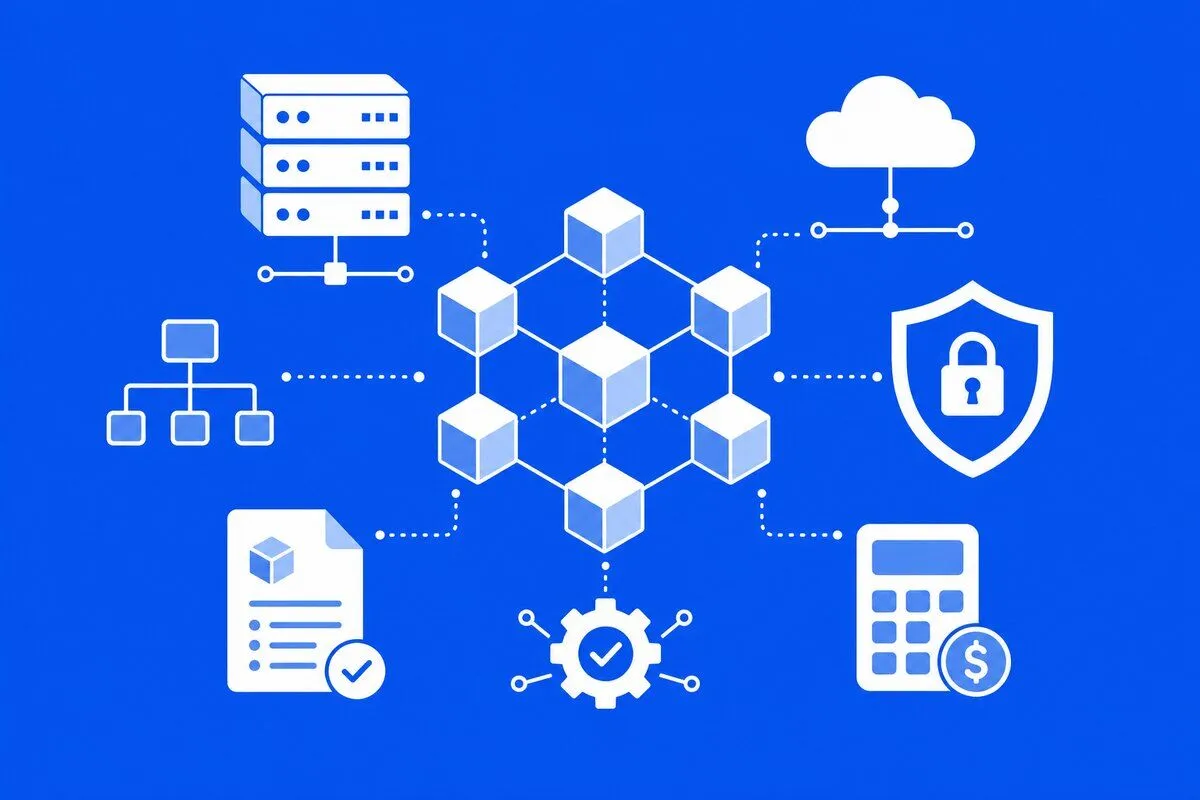
Networking (peer-to-peer communication), Consensus (agreement on blocks), Execution (smart contract processing), State (account storage), and APIs (user access via RPC). Each component must work perfectly.
Q3.Do you need to build a custom Layer 1 or can you use an existing one?
Use existing networks for 95% of projects. Build a Layer 1 only if you have specific needs (custom consensus, different economics, sovereign governance) and sufficient resources.
Q4.What is the difference between Layer 1 blockchain and blockchain technology?
Layer 1 blockchain is a specific network (Bitcoin, Ethereum). Blockchain technology is the broader category of distributed ledger systems. You can use blockchain technology on existing Layer 1s without building your own.
Q5.How much does it cost to build a Layer 1 blockchain?
$5-10 million for a professional team. This includes salaries (largest cost), security audits ($500K+), infrastructure, and operations. Some projects raise venture capital; others bootstrap with token sales.
Explore Services
Related Services
Reviewed by

Aman Vaths
Founder of Nadcab Labs
Aman Vaths is the Founder & CTO of Nadcab Labs, a global digital engineering company delivering enterprise-grade solutions across AI, Web3, Blockchain, Big Data, Cloud, Cybersecurity, and Modern Application Development. With deep technical leadership and product innovation experience, Aman has positioned Nadcab Labs as one of the most advanced engineering companies driving the next era of intelligent, secure, and scalable software systems. Under his leadership, Nadcab Labs has built 2,000+ global projects across sectors including fintech, banking, healthcare, real estate, logistics, gaming, manufacturing, and next-generation DePIN networks. Aman’s strength lies in architecting high-performance systems, end-to-end platform engineering, and designing enterprise solutions that operate at global scale.