Ai Overview
A security airdrop campaign is a planned token distribution that puts protection at the center of every decision. The a Priori airdrop saw approximately 80 percent of its BNB chain tokens claimed by 5,800 interconnected wallets. A deepfake of Binance CEO CZ was used to promote a fake BNB airdrop, which resulted in scamming $2 million in just a few hours. The development of audited smart contracts typically costs between $5,000 and $50,000, depending on complexity.
Key Takeaways
- The FBI’s Internet Crime Complaint Center received over 149,000 cryptocurrency-related complaints in a single recent year, with total losses reaching $9.3 billion, which is a 66 percent increase from the previous year, making airdrop security more important than ever.
[1] - Sybil farming remains one of the biggest threats to airdrop campaigns, with bots and fake wallets distorting distributions in 85 percent of campaigns, and in some major airdrops, single entities captured nearly 48 percent of distributed tokens through thousands of fake wallets.
[2] - Fake airdrop scams targeting projects like Hamster Kombat and Wall Street Pepe caused millions of dollars in user losses in recent years, with scammers using phishing links, cloned websites, and malicious smart contracts to drain wallets
- Smart contract audits are a critical part of any security airdrop campaign because exploited smart contract flaws led to losses exceeding $2.3 billion across DeFi protocols, and airdrop claim contracts must be verified before deployment.
[3] - Anti-Sybil systems are now implemented by more than 85 percent of projects running airdrops, using techniques like on-chain activity scoring, wallet behavior analysis, and AI-powered machine learning detection to filter out fake accounts.
[4] - LayerZero partnered with blockchain analytics firm Nansen to identify and disqualify linked wallet clusters and introduced a community bounty hunting program that incentivized users to report Sybil wallets, setting a new standard for airdrop fraud prevention.
[5] - Airdrop participants globally reached approximately 199 million recently, representing a 45 percent increase over 135.8 million two years prior, which means both the opportunity and the risk of running an airdrop campaign have grown significantly.
[6]
Crypto airdrops have become one of the most popular ways for blockchain projects to distribute tokens, build communities, and reward early supporters. But as airdrops have grown in popularity, so have the risks. Scammers create fake airdrop pages. Bots farm tokens with thousands of wallets. Hackers exploit weak smart contracts. And honest users end up losing money or getting cheated out of their fair share.
A secure airdrop campaign goes far beyond just sending tokens to a list of wallet addresses. It requires a well-rounded strategy that includes smart contract audits, anti-fraud systems, wallet verification processes, and strong Sybil resistance to guarantee both safety and fairness. For both emerging blockchain startups and established projects running multiple campaigns, integrating reliable crypto token development practices is crucial. In today’s evolving landscape, airdrop security is no longer optional, it is the defining factor that determines whether a token launch succeeds or turns into a costly mistake.
In this guide, we will walk through every step of building a secure crypto airdrop. You will learn how airdrop scams work, what makes a safe token airdrop, how to protect your project from Sybil attacks, and what real-world examples teach us about airdrop fraud prevention. By the end, you will know exactly how to secure an airdrop that builds trust instead of destroying it.
What Is a Security Airdrop Campaign and Why Does It Matter
A security airdrop campaign is a planned token distribution that puts protection at the center of every decision. Instead of simply dropping tokens into random wallets, a security-focused airdrop uses smart contract audits, anti-Sybil filters, identity verification, and community vetting to make sure tokens reach real users, and the process stays safe from start to finish.
The reason this matters is simple. The crypto space has seen massive losses from poorly managed airdrops and outright scams. According to the FBI’s IC3 report, Americans lost $9.3 billion to cryptocurrency fraud recently, a 66 percent increase from the year before. A large chunk of this comes from fake airdrops, phishing campaigns, and investment scams that trick people into connecting their wallets to malicious contracts. When projects skip security and rush their airdrop, they open the door for attackers to exploit every weakness.
On the other side, projects that invest in airdrop security build stronger communities. Users who feel safe are more likely to hold tokens, participate in governance, and stay active in the ecosystem. A well-protected airdrop sends a clear message that the team behind the project takes its responsibility seriously.
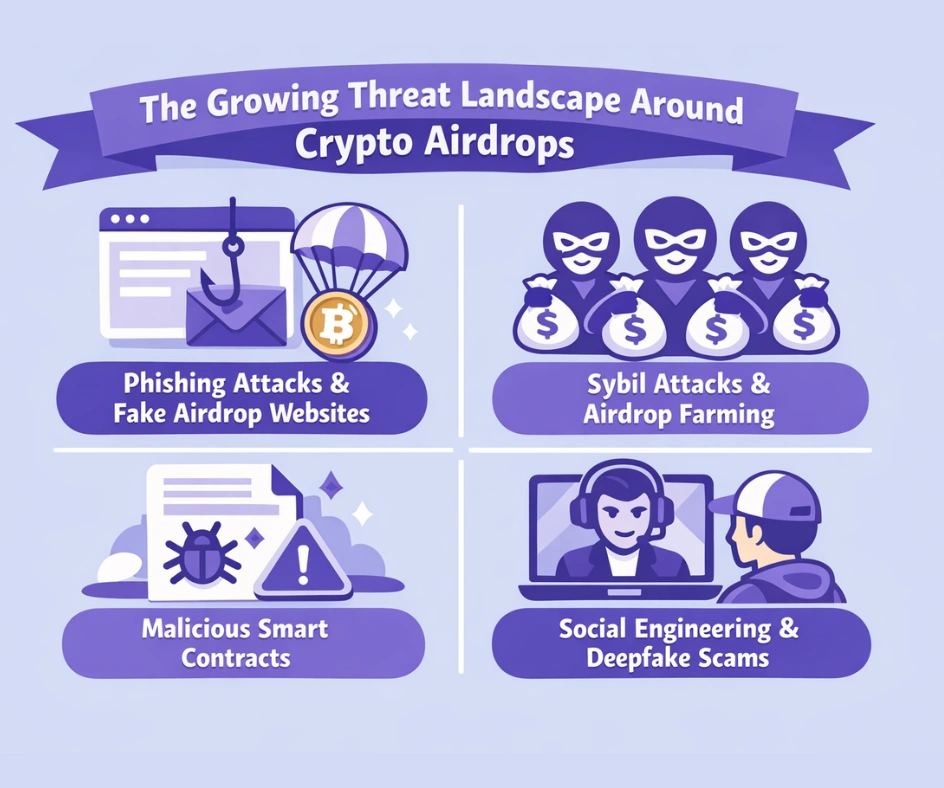
The Growing Threat Landscape Around Crypto Airdrops
Before we get into solutions, it helps to understand what you are up against. The threats facing airdrop campaigns have become more advanced over the past few years, and they continue to grow as more money enters the space.
1. Phishing Attacks and Fake Airdrop Websites
Phishing is the most common attack on airdrop participants. Scammers create websites that look exactly like a real project’s claim page. They copy logos, branding, and even social media handles. When users connect their wallets to these fake sites, they unknowingly sign transactions that give attackers full access to their funds and NFTs. The Kaspersky team warned about fake Hamster Kombat airdrops designed to steal wallet credentials from the game’s 250 million-plus users. Similar attacks hit Wall Street Pepe, HEX, Sui, and LayerZero.
2. Sybil Attacks and Airdrop Farming
Sybil attacks happen when one person or a small group creates hundreds or thousands of fake wallets to claim a larger share of the airdrop. This is sometimes called “airdrop farming.” These attackers use scripts and bots to simulate real user activity, fund wallets with small amounts of crypto, and qualify for rewards meant for genuine community members. In the Aptos airdrop, researchers found that Sybil addresses accounted for 40 percent of tokens deposited to exchanges. The a Priori airdrop saw approximately 80 percent of its BNB chain tokens claimed by 5,800 interconnected wallets.
3. Malicious Smart Contracts
Some attackers deploy smart contracts that look like airdrop claim contracts but are actually designed to drain wallets. When a user interacts with one of these contracts, it can request broad permissions that let the attacker move all tokens out of the wallet. Even experienced users can fall for this if they are not careful about reading transaction details before approving.
4. Social Engineering and Deepfake Scams
The use of AI deepfakes in crypto fraud surged approximately 700 percent in recent years. A deepfake of Binance CEO CZ was used to promote a fake BNB airdrop, which resulted in scamming $2 million in just a few hours. Scammers also impersonate project founders on Twitter Spaces, Discord servers, and Telegram groups to lure users into connecting to fake claim pages.
Recommended Reading:
How to Secure an Airdrop: Step-by-Step Framework
Now that you understand the threats, let us look at the practical steps every project should follow to run a safe token airdrop. This framework covers the development side (smart contracts, audits, technical infrastructure) and the community side (user verification, communication, fraud detection).
1. Start with a Smart Contract Audit
The smart contract that handles your airdrop claim process is the most important piece of your security airdrop campaign. If there is a bug or vulnerability in this contract, attackers can exploit it to steal tokens, manipulate distributions, or lock funds permanently. Before deploying any airdrop contract, you should have it audited by a reputable third-party firm. The development of audited smart contracts typically costs between $5,000 and $50,000, depending on complexity. Audit firms use tools like Slither, Securify, MythX, and Echidna to scan for vulnerabilities, reentrancy bugs, timestamp dependency issues, and logic errors. The audit should cover the full scope of the contract, including token distribution logic, Merkle proof verification, access controls, and emergency pause functions.
2. Use Merkle Tree-Based Distribution
Most modern airdrop contracts use a Merkle tree structure to manage eligible addresses and claim amounts. A Merkle proof allows the contract to verify that a specific wallet is on the eligible list without storing the entire list on chain, which saves gas fees and reduces attack surface. The project team compiles the list of eligible addresses, builds a Merkle tree, and publishes the Merkle root in the smart contract. When a user claims their tokens, they submit a Merkle proof that the contract verifies against the root. This approach is both cost-effective and hard to tamper with.
3. Implement Anti-Sybil Measures
Sybil resistance is one of the most important parts of airdrop security. More than 85 percent of projects launching airdrops now implement some form of anti-Sybil system. The development of Sybil-resistant distribution mechanisms, tying rewards to verifiable on-chain spending rather than simple task completion, is rapidly reshaping how projects approach airdrops. Here are the most common approaches used today:
On-chain activity scoring analyzes wallet behavior, transaction history, and interaction patterns to determine whether an address belongs to a real user or a bot. Wallets with very similar funding sources, transaction timing, and activity patterns are flagged as potential Sybils.
AI-powered machine learning detection uses algorithms to analyze large datasets of on-chain activity and identify suspicious clusters of wallets. Firms like Nansen and Trusta Labs have built frameworks specifically for this purpose. Trusta’s approach uses graph mining algorithms to detect coordinated communities and then refines results with behavior analysis to reduce false positives.
Community reporting programs incentivize community members to identify and report Sybil wallets. LayerZero introduced a Sybil bounty hunting program where addresses that self-reported as Sybil received 15 percent of their intended allocation, while undetected Sybil addresses that were later found received nothing.
KYC and identity verification can be effective, but may reduce participation because many Web3 users value privacy. Some projects use a lighter approach, such as requiring social media verification or task-based eligibility, to confirm that each participant is a real person without collecting sensitive personal data.
4. Set Up Wallet Whitelisting and Eligibility Snapshots
Take a snapshot of the blockchain at a specific block height to record all wallet balances and activity. Only wallets that meet your eligibility criteria at the time of the snapshot should be included in the airdrop. Publish the eligibility criteria clearly and in advance, so users understand what they need to do to qualify. Whitelisting approved wallets before the claim window opens adds another layer of protection against last-minute manipulation.
5. Secure Your Claim Portal and Communication Channels
Your airdrop claim website is a prime target for phishing attacks. Use strong SSL certificates, deploy the site on a verified domain, and publish the official URL through multiple confirmed channels (your project’s official website, verified social media accounts, and community forums). Monitor for look-alike domains that scammers might register to trick your users. Set up alerts for domain registrations that are similar to your project name. Communicate exclusively through official channels and warn your community about common scam patterns like fake support tickets, unsolicited DMs, and fake social media giveaways.
Real World Examples of Airdrop Security Failures and Successes
Looking at how other projects handled their airdrop offers the best lessons for building your own security airdrop campaign. Some projects got it right. Others made costly mistakes. Both kinds of examples are worth studying.
1. Aptos: What Happens When Anti-Sybil Measures Are Weak
When Aptos launched its airdrop, it lacked strong anti-Sybil rules. Airdrop hunters used multiple wallets to claim large amounts of APT tokens. After the exchange listing, these farming wallets dumped their tokens, crashing the price and hurting legitimate holders. Researchers found that Sybil addresses accounted for 40 percent of tokens deposited to exchanges. This example shows what happens when a project skips proper wallet verification and fraud detection.
2. LayerZero: Setting a New Standard for Airdrop Fraud Prevention
LayerZero took a very different approach. The team partnered with Nansen for blockchain analytics and launched a Sybil bounty hunting campaign. They gave Sybil wallets a chance to self-report and receive a reduced allocation, while undisclosed Sybils were completely disqualified. This approach, while controversial, helped filter out a large number of fake accounts and rewarded genuine users. LayerZero also used a proof of donation system for its ZRO token airdrop, requiring small donations to support developers as part of the claim process.
3. Optimism: Community Led Sybil Filtering
Optimism discovered during its airdrop that thousands of wallets had coordinated to farm their token distribution. The team filtered many of these wallets, but acknowledged that some Sybils still managed to claim tokens. Optimism’s Airdrop 5 later increased 30-day retention by 4.2 percentage points and 60-day retention by 2.8 points, showing that improved targeting leads to better long term results.
4. Jito: A Fair Distribution That Built Trust
Jito is widely respected for its airdrop approach. The project allocated a minimum of 4,941 JTO tokens to eligible wallet addresses, valued at around $9,000 at claim time. By setting a generous minimum threshold, Jito ensured that even small contributors received meaningful rewards. This built strong community loyalty and was praised by industry leaders, including Uniswap founder Hayden Adams.
Common Airdrop Security Threats and How to Counter Them
| Threat Type | How It Works | Prevention Strategy |
|---|---|---|
| Phishing Attacks | Fake websites clone the official claim page to steal wallet permissions and drain funds | Publish official claim URL on verified channels, monitor for look-alike domains, and warn the community about phishing |
| Sybil Attacks | One entity creates thousands of wallets to farm a larger share of the airdrop distribution | Use on chain analytics, AI detection, community bounties, and wallet behavior scoring |
| Smart Contract Exploits | Attackers find bugs in the airdrop claim contract to steal tokens or manipulate distributions | Conduct third-party smart contract audits, use battle-tested code libraries, and include emergency pause functions |
| Deepfake Impersonation | AI-generated videos or audio of project leaders promote fake airdrops to trick users | Never announce airdrops through informal channels, use signed messages, and educate the community about deepfakes |
| Token Dumping | Farming wallets immediately sell all airdropped tokens, crashing the price and harming real holders | Use vesting schedules, tiered distribution based on activity, and reward long-term holding |
| Malicious Token Airdrops | Unknown tokens appear in your wallet, and interacting with them triggers a drainer contract | Never interact with unknown tokens; use wallet guard tools like Pocket Universe or Revoke. cash |
| Social Engineering | Scammers impersonate support staff or project team members to trick users into sharing keys or approving transactions | Never share private keys, verify all support requests through official channels, and enable 2FA on all accounts |
Building a Fraud-Resistant Airdrop Distribution Model
The way you structure your airdrop distribution has a direct impact on how vulnerable it is to abuse. Projects that simply give equal amounts to every eligible wallet invite farming. Projects that design thoughtful, activity-based models attract and retain real users.
1. Activity-Based Eligibility
Instead of rewarding users just for holding tokens or completing a simple task, design your eligibility criteria around meaningful on-chain activity. This could include staking, providing liquidity, participating in governance votes, or actually using the protocol over an extended period. The more specific and effort-intensive your criteria, the harder it becomes for bots and farming wallets to qualify. Data from recent airdrops shows that task-based eligibility led to slightly higher retention compared to simpler distribution methods.
2. Tiered Reward Structures
A tiered system allocates different amounts based on the level of a user’s contribution. Early adopters who used the protocol for months and took on more risk (by depositing into newer, less audited contracts) should receive more than someone who made one small transaction right before the snapshot. EtherFi’s CEO, Mike Silgadaze, emphasized the importance of setting a minimum threshold for allocations, noting that their minimum of 175 ETHFI tokens created a meaningful reward that kept users engaged.
3. Vesting and Lockup Periods
Adding vesting schedules to your airdrop reduces the risk of immediate token dumps. When users know they will receive tokens over time rather than all at once, farming becomes less attractive because the profit timeline extends far beyond what most Sybil operators want to wait for. Vesting also signals to the market that the team is focused on long term value rather than short-term hype. Projects that distributed more than 10 percent of their total token supply via airdrop showed better price stability than those distributing less than 5 percent.
4. Multi-Chain and Cross-Chain Considerations
If your project operates across multiple blockchains, your security airdrop campaign needs to account for multi-chain complexity. Each chain has different gas costs, transaction speeds, and smart contract standards. Multi-chain airdrops display fragmented selloff patterns across networks, which means you need monitoring tools that track activity across all supported chains. Ensure that your airdrop contracts on each chain are individually audited and that eligibility criteria account for cross-chain activity.
Recommended Reading:
Smart Contract Security Best Practices for Airdrop Campaigns
The smart contract is the backbone of your airdrop distribution. Getting the development right means your campaign runs smoothly. Getting it wrong can mean lost funds, stolen tokens, or a broken distribution that cannot be fixed. Here are the practices that every project should follow when developing airdrop smart contracts.
1. Use Audited and Battle-Tested Code
Do not build your airdrop contract from scratch if you do not have to. Use well-known libraries like OpenZeppelin for core functionality such as ERC 20 token transfers, access controls, and pausable contracts. These libraries have been reviewed by thousands of developers and have gone through extensive testing. Build your custom logic on top of these foundations and then get the entire contract audited.
2. Include an Emergency Pause Function
If something goes wrong during the claim process, you need the ability to pause the contract immediately. An emergency pause (also called a circuit breaker) lets the contract owner stop all claims until the issue is resolved. This can prevent attackers from draining the contract if a vulnerability is discovered after deployment. Make sure the pause function itself is protected by multi-signature access so that no single wallet can control it alone.
3. Implement Claim Limits and Rate Controls
Set maximum claim amounts per wallet and consider adding time-based rate limits to prevent bulk claiming. If a single wallet or a group of wallets tries to claim an unusually large amount in a short time, the contract should flag or block the transactions. This adds a layer of protection against both exploits and coordinated farming operations.
4. Test Thoroughly on Testnets Before Mainnet Deployment
Before going live, deploy your airdrop contract on a testnet and simulate the entire claim process. The development team should test edge cases like double claiming, expired claim windows, gas limit issues, and what happens when ineligible wallets try to claim. Run automated fuzz testing using tools like Echidna to uncover unexpected behavior. Only move to mainnet once you are confident the contract handles all scenarios correctly.
5. Verify the Contract on Block Explorers
After deploying your airdrop contract, verify it on Etherscan, BscScan, or whichever block explorer corresponds to your chain. A verified contract lets anyone read the source code and confirm that it matches what was audited. This builds trust with your community and makes it harder for scammers to create convincing fakes, because users can compare the official verified contract with any suspicious ones.
Security Airdrop Campaign Checklist for Project Teams
| Phase | Action Items | Priority Level |
|---|---|---|
| Pre-Launch Planning | Define eligibility criteria, tokenomics, snapshot date, and anti-Sybil strategy | Critical |
| Smart Contract Development | Build an airdrop claim contract with Merkle proofs, access controls, pause functions, and claim limits | Critical |
| Security Audit | Hire a reputable third-party auditor to review the contract code for vulnerabilities | Critical |
| Sybil Filtering | Run on-chain analytics, AI detection, and community reporting to remove fake wallets from the eligible list | High |
| Testnet Deployment | Deploy on testnet, simulate claims, run fuzz tests, and fix any issues before mainnet launch | High |
| Claim Portal Setup | Build a verified claim website with SSL, and publish the official URL through confirmed channels | High |
| Community Communication | Warn users about phishing, publish FAQ, set up scam reporting channels | High |
| Post Distribution Monitoring | Track claim activity, monitor for anomalies, and respond quickly to any suspicious behavior | Medium |
How Users Can Protect Themselves During an Airdrop
Airdrop security is not just a responsibility for project teams. Users also need to take steps to protect their wallets and personal information. Here is what every airdrop participant should know.
1. Always Verify the Source Before Connecting Your Wallet
Never click on Airdrop links from DMs, emails, or unofficial social media posts. Always go to the project’s official website and look for the airdrop claim page there. Cross-check the URL carefully, since scammers often use slight misspellings or extra characters to create convincing fakes. If a project has not officially announced an airdrop on their verified channels, treat any claim of one as a potential scam.
2. Use a Separate Wallet for Airdrop Claims
Create a dedicated wallet just for claiming airdrops. Transfer only the tokens you need for gas fees into this wallet and keep your main holdings in a separate hardware wallet. If a malicious contract compromises your airdrop wallet, your primary funds remain protected. Hardware wallets like Ledger or Trezor provide the strongest protection because they keep private keys offline.
3. Never Share Your Private Key or Seed Phrase
No legitimate airdrop will ever ask for your private key or seed phrase. If any website, form, or person requests this information, it is a scam. Your seed phrase gives complete access to all funds in your wallet, and once shared, there is no way to recover stolen assets. This is the most basic rule of crypto security, but it continues to be the most common way that users lose funds.
4. Review Transaction Permissions Before Approving
When connecting your wallet to a claim page, pay attention to what permissions the transaction is requesting. The development of wallet protection tools like Pocket Universe, Fire, or Revoke.Cash makes it possible to scan transactions before approving them. If a transaction asks for unlimited spending approval or access to all tokens in your wallet, do not approve it. Legitimate airdrop claims will only request the minimum permissions needed to transfer tokens to your address.
5. Do Not Interact with Unknown Tokens in Your Wallet
Sometimes scammers send unsolicited tokens to random wallets. These tokens are designed so that when you try to swap or transfer them, you trigger a malicious smart contract that drains your other assets. If you see an unknown token in your wallet that you did not claim, do not touch it. Do not try to sell it, transfer it, or interact with it in any way.
Recommended Reading:
The Role of Blockchain Analytics in Airdrop Fraud Prevention
Blockchain analytics has become an important tool in the fight against airdrop fraud. The development of specialized tracking tools means that all transactions on public blockchains are visible, and analytics firms can trace wallet activity, identify patterns, and flag suspicious behavior at a scale that manual review cannot match.
Firms like Chainalysis, Nansen, Trusta Labs, and Arkham Intelligence offer tools specifically built for tracking illicit flows and identifying Sybil clusters. Nansen’s partnership with LayerZero showed how blockchain analytics can be used to identify and disqualify linked wallet clusters before token distribution. Trusta Labs developed an AI and machine learning framework that uses a two-phase approach: first, graph mining algorithms detect coordinated wallet communities, and then user behavior analysis refines the results to reduce false positives.
CoinList’s anti-Sybil system goes further by combining on-chain data with off-chain signals like IP addresses, device fingerprints, browser behavior, and email verification. This multi-layered approach catches farming operations that would be invisible to on-chain analysis alone, because experienced Sybil operators often use exchange addresses to obscure their on-chain tracks.
For projects running their own analytics, tools like Dune Analytics and Flipside Crypto allow teams to build custom dashboards that monitor airdrop claim patterns in real time. Sudden spikes in claims from wallets with similar characteristics, or clusters of wallets all claiming within seconds of each other, can be caught early and investigated before the damage spreads.
Regulatory Considerations for Security Airdrop Campaigns
Running a secure crypto airdrop also means staying on the right side of the law. The development of regulatory frameworks has accelerated, with scrutiny of token distributions increasing by 30 percent recently, and projects that ignore compliance risk face legal action that can shut down the entire operation.
1. Know Your Token Classification
Utility tokens, security tokens, and governance tokens all face different regulatory requirements. If your airdrop distributes security tokens, you may need to comply with securities laws in every jurisdiction where your recipients live. The SEC has taken the position that some airdropped tokens could constitute investment contracts, as discussed in the Dragonfly State of Airdrops Report submitted to the SEC. Understanding your token’s classification before launching your airdrop prevents costly legal problems down the road.
2. Geoblocking and Regional Restrictions
Many projects block users in certain countries from participating in their airdrop, often to comply with US securities regulations or sanctions laws. Between 920,000 and 5.2 million US persons were impacted by geoblocking policies across 11 analyzed airdrops from a recent study. Your security airdrop campaign should include clear geographic restrictions where required, with IP-based filtering and terms of service that explain who is eligible.
3. Data Protection and Privacy
If your airdrop requires any form of KYC or personal information collection, you must handle that data according to applicable privacy regulations (like GDPR in Europe). Minimize the data you collect, store it in encrypted form, and delete it once the airdrop is complete. Users trust you with their information, and a data breach during an airdrop would be devastating for both your community and your project’s reputation.
Real World Blockchain Security Implementations
The following projects show how blockchain security principles are already being applied in production environments. Each one demonstrates the same protective infrastructure discussed throughout this article, from audited smart contracts and token governance to community-driven participation and multi-layered fraud prevention systems.
🔒
Viper: Secure Token Distribution with Staking and Burns on Cardano
Built a Cardano-based memecoin with fair launch distribution (no presale), integrated staking rewards, and a deflationary token burn of 591 million VIPER tokens. The project uses Proof of Stake consensus for network security and decentralized exchange integration through Minswap, demonstrating how transparent distribution and community governance can protect both the project and its holders.
🛡️
Optopia: AI-Driven Layer 2 with Secure Governance and Airdrop Infrastructure
Developed an AI-driven Layer 2 blockchain network with built-in airdrop and staking infrastructure, wallet security integration, and decentralized governance through OPAI token distribution. The platform uses intent-based smart contracts, leaderboard-based reward tracking, and community-owned governance to ensure fair and protected token distribution across its ecosystem.
Build Your Secure Airdrop Campaign Today:
Our blockchain team specializes in building protected airdrop campaigns from start to finish. From smart contract development and security audits to anti-Sybil filtering and multi-chain distribution, we deliver solutions that keep your project and community safe. Whether you need a simple token drop or a full-scale campaign platform, we build airdrop systems that work.
Final Thoughts
A security airdrop campaign is not a luxury. It is a necessity for any blockchain project that wants to distribute tokens responsibly and build a community that actually trusts the team behind the project. The numbers speak for themselves. The FBI reported $9.3 billion in crypto fraud losses in a single recent year alone, with fake airdrops contributing heavily to those figures. Sybil farming operations captured nearly half of the distributed tokens in some major airdrops. And roughly 88 percent of airdropped tokens lose value within three months, often because the distribution reached bots instead of real users.
But the projects that invested in proper airdrop security, like Jito, LayerZero, and EtherFi, saw stronger retention, better price stability, and more engaged communities. The development of their security frameworks proved that when you take the time to audit your smart contracts, filter out Sybil wallets, protect your claim portal from phishing, and design distribution models that reward genuine participation, the results are worth the effort.
Whether you are launching your first airdrop or improving your next one, focus on the fundamentals. Get your smart contracts audited. Implement anti-Sybil detection. Educate your community about how to secure an airdrop and spot scams. Use vesting schedules to discourage dumping. And build your claim infrastructure with security at every layer. The crypto space rewards projects that take care of their users, and a well-executed safe token airdrop is one of the best ways to prove that your project is built to last.
Frequently Asked Questions
Q1.What is a security airdrop campaign?
A security airdrop campaign is a token distribution strategy that puts protection first. It includes smart contract audits, anti-Sybil filtering, wallet verification, and phishing prevention to ensure tokens reach real users and the process stays safe from fraud and exploitation.
Q2.How can I tell if an airdrop is fake?
Look for warning signs like no official announcement from the project, suspicious URLs that mimic the real website, requests for your private key or seed phrase, grammar errors on the claim page, unrealistic reward promises, and pressure to act quickly. Always verify airdrop details through the project’s official website and social channels.
Q3.What is a Sybil attack in airdrops?
A Sybil attack happens when one person or group creates hundreds or thousands of fake wallets to claim a larger share of the airdrop distribution. This hurts legitimate users by diluting their rewards and can crash token prices when the attacker sells all their claimed tokens at once.
Q4.Why are smart contract audits important for airdrops?
Smart contract audits identify vulnerabilities, bugs, and logic errors in your airdrop claim contract before deployment. Without an audit, attackers can exploit flaws to steal tokens, manipulate distributions, or lock funds permanently. An audit gives your community confidence that the process is protected.
Q5.How do projects prevent airdrop farming?
Projects use a combination of on-chain analytics, AI detection tools, community bounty programs, tiered reward structures, and vesting schedules. Some also require light identity verification, like social media accounts or task completion, to confirm each participant is a unique real person.
Q6.Should I use a separate wallet for airdrops?
Yes. Creating a dedicated wallet for airdrop claims protects your main funds if a malicious contract compromises the airdrop wallet. Keep only enough crypto for gas fees in your claim wallet and store your main holdings in a hardware wallet that stays offline and disconnected.
Explore Services
Related Services
Reviewed by

Aman Vaths
Founder of Nadcab Labs
Aman Vaths is the Founder & CTO of Nadcab Labs, a global digital engineering company delivering enterprise-grade solutions across AI, Web3, Blockchain, Big Data, Cloud, Cybersecurity, and Modern Application Development. With deep technical leadership and product innovation experience, Aman has positioned Nadcab Labs as one of the most advanced engineering companies driving the next era of intelligent, secure, and scalable software systems. Under his leadership, Nadcab Labs has built 2,000+ global projects across sectors including fintech, banking, healthcare, real estate, logistics, gaming, manufacturing, and next-generation DePIN networks. Aman’s strength lies in architecting high-performance systems, end-to-end platform engineering, and designing enterprise solutions that operate at global scale.