Ai Overview
Grant Cardone’s story is one of the most remarkable in American business. Think of it this way: a building worth $10 million could be divided into one million tokens each worth $10. For resident Indian investors, the Liberalised Remittance Scheme allows remittance of up to $250,000 per financial year for overseas investment purposes. The Grant Cardone real estate tokenization announcement carries implications that extend far beyond the $5 billion portfolio itself.
Key Takeaways
- 01. Grant Cardone controls a $5 billion real estate portfolio of over 12,000 US apartment units now being prepared for blockchain-based tokenization through Cardone Capital.
- 02. Tokenization converts physical property ownership rights into blockchain tokens, allowing fractional investment from global buyers including retail investors in India, UAE, and UK.
- 03. Smart contracts will automate monthly rental income distribution to token holders proportionally, eliminating bank intermediaries and reducing payment processing time significantly.
- 04. Cardone’s shift from crypto skepticism to blockchain adoption marks a pivotal cultural moment for institutional and retail real estate investor communities globally in 2026.
- 05. Unlike traditional REITs, Cardone tokens may offer 24/7 secondary market trading, asset-level transparency, and direct proportional ownership rather than pooled fund exposure.
- 06. Indian investors can use the Liberalised Remittance Scheme up to $250,000 annually for overseas investment, potentially covering token purchases once regulatory structure is confirmed.
- 07. The blockchain choice between Ethereum, Solana, Avalanche, and Polygon will determine transaction cost, speed, and the overall secondary liquidity of Cardone’s real estate tokens.
- 08. Dubai’s government-led tokenization program and Cardone’s private sector initiative represent two distinct but complementary paths toward global on-chain real estate ownership in 2026.
- 09. Regulatory classification of Cardone tokens as securities under the SEC will trigger investor protection requirements and may restrict non-accredited or non-US investor participation initially.
- 10. Investors globally should complete KYC documentation, understand token legal structure, and consult local tax advisors before committing capital to any tokenized real estate offering.
In eight years of working at the frontier of property investment and financial technology, our firm has tracked countless announcements about blockchain and real estate. But when Grant Cardone, arguably the world’s most recognizable real estate investor, declared he was moving his entire $5 billion portfolio onto blockchain, the industry stopped and paid attention. This is not a startup pitch or a whitepaper promise. This is a man who owns over 12,000 apartment units in the United States, built a nine-figure education and training business, and spent two decades publicly championing real estate as the single greatest wealth-building tool available to ordinary people. His decision to embrace real estate tokenization signals a fundamental shift in how global capital will flow into physical property assets in 2026 and beyond.
For investors in India, the UAE, and the UK who have long wanted access to US multifamily real estate without the barriers of currency transfers, minimum investment thresholds, and legal complexity, the Grant Cardone real estate tokenization announcement represents a potentially transformative opportunity. What follows is our most thorough analysis of what this deal means, how it works, and what investors across the world should know before the tokens become available.
Who Is Grant Cardone and How Did a Struggling Salesman Become a Billionaire With $5 Billion in Real Estate

Grant Cardone’s story is one of the most remarkable in American business. Born in Lake Charles, Louisiana, Cardone grew up in modest circumstances and by his own admission struggled with drug addiction through his early twenties. He turned his life around through obsessive focus on sales, a skill he eventually refined into a global training methodology taught to organizations across Fortune 500 companies. His early career was in car sales, and he used those commission earnings to purchase his first small apartment building in his early thirties.
What distinguishes Cardone from most property investors is his single-minded conviction: only multifamily residential real estate generates the kind of durable, scalable cash flow that builds lasting wealth. He has publicly rejected single-family homes as investments, dismissed stock market speculation, and until recently dismissed cryptocurrency entirely. His portfolio today includes properties in Miami, Nashville, Scottsdale, Jacksonville, and Houston. His brand, built through books like The 10X Rule and a massive social media following of over 10 million across platforms, has made him one of the most influential voices in global personal finance.
Understanding Grant Cardone real estate tokenization requires understanding this foundation. When a man who built a $5 billion empire on conventional real estate investment decides to move that empire onto a blockchain, the weight of that decision cannot be overstated. It signals that institutional-grade real estate and blockchain technology have reached a convergence point that even the most traditionally minded investors can no longer ignore.
Why Grant Cardone Has Always Said Real Estate Is the Only Investment That Makes You Rich While You Sleep
Long before the Grant Cardone real estate tokenization announcement, Cardone built his philosophy on one core principle: cash flow is king. He has consistently argued that the only asset class that generates income while you sleep, appreciates in value over time, provides tax advantages through depreciation, and can be leveraged using other people’s money is income-producing real estate. This is not mere motivational content. It is the operational framework behind Cardone Capital’s fund model.
Cardone’s preference for multifamily residential over commercial office, retail, or industrial is grounded in demographic reality. People always need housing. Even during economic downturns, apartment occupancy rates in well-selected US markets have remained stable. His portfolio’s geographic focus on Sun Belt states, regions like Florida, Tennessee, Texas, and Arizona with growing populations and favourable tax environments, reflects a deliberate market selection strategy rather than opportunistic buying.
This philosophy creates the ideal foundation for tokenization. Properties that generate reliable monthly rental income are far more suitable for blockchain-based income distribution than speculative or irregular cash flow assets. The predictability of apartment rental income is precisely what makes smart contract-based automatic distributions credible and attractive to global investors from India to the UAE looking for stable US dollar-denominated real estate income.
Grant Cardone Officially Announces Real Estate Tokenization on X and This Post Changed Everything
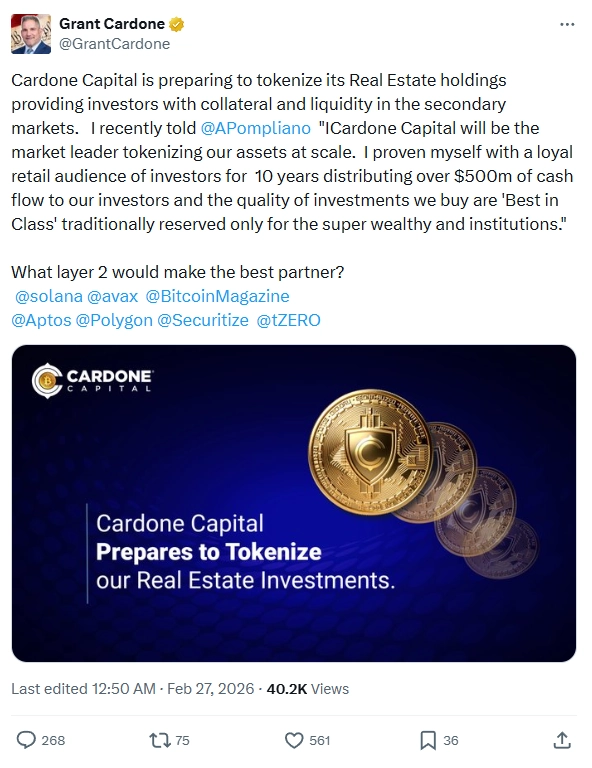
This is the post that started it all. On February 26, 2026 Grant Cardone took to X[1] and made a simple but historic announcement. He said Cardone Capital is preparing to tokenize its entire real estate portfolio so that everyday investors can finally get collateral and liquidity through secondary markets. He also referenced a conversation with famous crypto investor Anthony Pompliano where he boldly claimed Cardone Capital will be the market leader in real estate tokenization. He backed this claim by pointing to his 10 year track record of distributing over $500 million in cash flow to retail investors and his reputation for buying only the highest quality properties that were traditionally reserved for the super wealthy and big institutions. In short this one post put the entire real estate and crypto world on notice that the game is about to change.
What Is Cardone Capital and How Does It Allow Normal People to Invest Alongside a Billionaire in Real Estate
Cardone Capital is the private equity real estate fund business that Grant Cardone uses to pool investor money and deploy it into large multifamily apartment acquisitions. The firm was founded to solve a specific problem Cardone identified in the market: ordinary people cannot access institutional-grade real estate because entry costs for a meaningful stake in a large apartment complex can run into millions of dollars. Cardone Capital lowered that barrier by creating regulated fund structures where investors could participate starting at lower minimum amounts.
The fund operates by acquiring properties, managing them through a professional property management infrastructure, collecting rents, servicing debt, and distributing remaining cash flow to investors on a quarterly basis. Investors receive a share of both the income generated during holding and the profit realized when properties are sold. Cardone Capital has raised hundreds of millions of dollars from retail investors across the United States since its launch, making it one of the largest direct-to-consumer real estate fund operations in the country.
The tokenization initiative extends this model globally. Instead of being limited to US-based investors who can navigate Cardone Capital’s fund subscription process, tokenization would theoretically allow investors from Dubai, India, the UK, and beyond to acquire fractional digital ownership in the same portfolio through a blockchain platform with far fewer traditional banking and geographic barriers.
Grant Cardone Has 12,000 Apartment Units Across America and Here Is the Full List of Properties He Owns
The scale of the Grant Cardone real estate tokenization announcement becomes clearer when you look at the actual portfolio. Cardone Capital’s holdings span across some of the most economically active cities in the United States, with a clear concentration in Sun Belt markets that have experienced strong population inflows over the past decade. The following table provides a representative overview of the markets where Cardone has major property holdings.
| Market / City | State | Asset Type | Why This Market |
|---|---|---|---|
| Miami | Florida | Multifamily Apartments | No state income tax, population growth, HQ base |
| Nashville | Tennessee | Multifamily Apartments | Tech migration, strong rental demand, no income tax |
| Scottsdale | Arizona | Multifamily Apartments | Workforce housing demand, high occupancy rates |
| Houston | Texas | Multifamily Apartments | Energy sector employment, large renter base |
| Jacksonville | Florida | Multifamily Apartments | Affordable market, strong logistics employment growth |
Each of these markets has been deliberately selected based on Cardone’s core investment criteria: population growth, job creation, landlord-friendly state regulations, and strong workforce housing demand. When tokenized, these assets offer global investors exposure to the same US real estate dynamics that have driven strong rental income and appreciation for Cardone Capital fund investors over the past decade.
What Made Grant Cardone Suddenly Shift From Hating Crypto to Putting His Entire $5 Billion Portfolio on Blockchain
For years, Grant Cardone was one of the most vocal critics of cryptocurrency in the investment community. He called Bitcoin a distraction from real asset building, dismissed NFTs as digital nonsense, and consistently warned his followers to avoid speculative digital assets in favours of income-generating real property. This made his pivot toward blockchain technology all the more newsworthy when it came.
The distinction Cardone now draws is important and sophisticated. He is not endorsing cryptocurrency as a store of value or speculative instrument. He is embracing blockchain as an infrastructure layer for property ownership transfer and income distribution. This is the same distinction that financial regulators in Dubai, Singapore, and the UK have been carefully articulating in their policy frameworks: blockchain is not crypto speculation, it is a distributed ledger technology with profound applications in asset management, contract execution, and cross-border capital transfer.
What triggered the shift was the maturity of the tokenization infrastructure itself. By 2025, institutional-grade custody solutions, regulated security token platforms, and legally compliant smart contract frameworks had reached sufficient maturity for a real estate operator of Cardone’s scale to seriously consider them. The Grant Cardone real estate tokenization announcement is the direct result of infrastructure catching up to vision.
What Is Real Estate Tokenization in the Simplest Words Possible and Why Is Everyone Talking About It in 2026
Real estate tokenization is the process of converting the ownership rights of a physical property into digital tokens that live on a blockchain. Think of it this way: a building worth $10 million could be divided into one million tokens each worth $10. Anyone who buys a token owns a one-millionth share of that building and is entitled to a proportional share of its rental income and eventual sale proceeds. The token represents a legal claim to ownership, backed by the underlying physical asset, encoded in a digital format that can be transferred globally in seconds.
The reason everyone is talking about this in 2026 is the intersection of three converging forces. First, regulatory frameworks in major markets including the United States, UAE, Singapore, and the UK have matured enough to allow tokenized securities to operate under established legal standards. Second, blockchain infrastructure has become fast, cheap, and reliable enough for real-world asset management applications. Third, a generation of investors conditioned by fractional stock apps and digital asset trading is demanding the same fractional accessibility from real estate.
The Grant Cardone real estate tokenization announcement has accelerated mainstream awareness because Cardone is not a technologist or a blockchain startup founder. He is a property investor with a track record of generating cash flow. His entry signals that tokenization has crossed from early adopter territory into proven asset management practice.[2]
How Does Turning a Building Into Digital Tokens Actually Work and What Happens to the Physical Property
A question investors in India, Dubai, and the UK consistently ask is what actually happens to the building when it gets tokenized. The physical property does not change in any way. It continues to house tenants, be maintained by property managers, generate rental income, and potentially appreciate in value. What changes is the ownership record and the mechanism by which that ownership is transferred and income distributed.
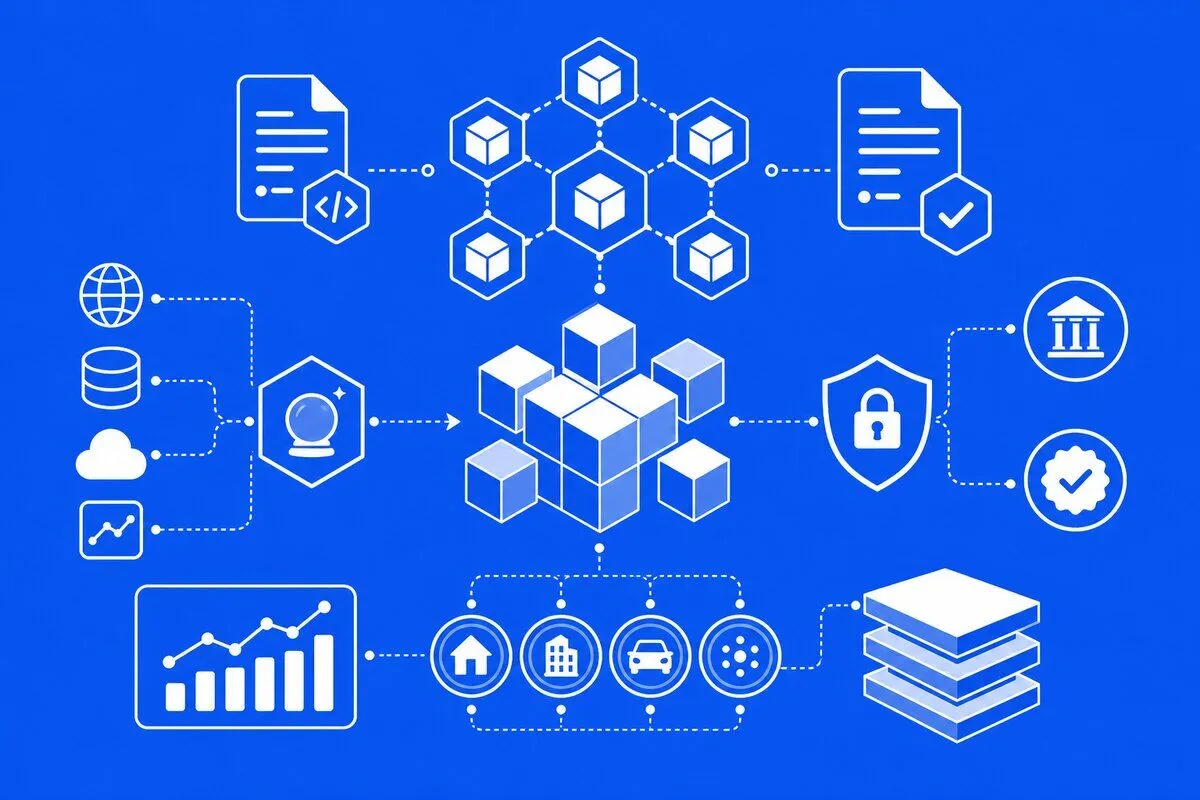
The technical process typically works through an SPV, or Special Purpose Vehicle. The property is held by the SPV, a legally registered entity. Ownership interests in the SPV are then tokenized and issued as digital security tokens on a blockchain. Each token represents a fractional beneficial interest in the SPV, which in turn holds the physical asset. The legal chain from token to building is clearly documented in the SPV’s articles, the token issuance agreement, and the smart contract terms.
When rental income arrives, it flows to the SPV. The smart contract then reads the ownership distribution from the blockchain, calculates each holder’s proportional share, and executes payment automatically. No bank wire. No fund administrator delay. No quarterly distribution schedule. The income flows in near-real time to token holders anywhere in the world, including investors in India using international wallets or UAE-based accounts connected to the platform.
Which Blockchain Will Grant Cardone Choose for His $5 Billion Portfolio and Why the Race Between Solana Ethereum Avalanche and Polygon Matters
Ethereum
Most institutional adoption, largest DeFi ecosystem, strong security track record. Higher transaction costs but unmatched credibility for regulated security token issuance.
Solana
Ultra-fast transaction speeds at very low cost. Growing institutional interest. Occasional network outages in past create concerns for high-stakes financial applications requiring constant uptime.
Avalanche
Purpose-built subnet architecture allows custom compliance rules on a dedicated chain. Increasingly used for real-world asset tokenization with strong institutional partnerships in 2025 and 2026.
Polygon
Ethereum-compatible layer 2 solution with low fees and fast finality. Already used by major asset managers for tokenization pilots. Strong developer ecosystem and enterprise client track record.
The blockchain selection for Grant Cardone real estate tokenization is a consequential technical and commercial decision. Each platform offers different trade-offs in speed, cost, security, and regulatory compatibility. Our assessment based on current industry trends is that Avalanche’s subnet model or Polygon’s enterprise-grade infrastructure represent the most likely choices for a project of this scale, scale and compliance requirements. The final choice will also influence which digital wallets, exchanges, and secondary markets can list and trade the tokens.
What Is a Smart Contract and How Will It Automatically Pay Rental Income Directly to Token Holders Every Month
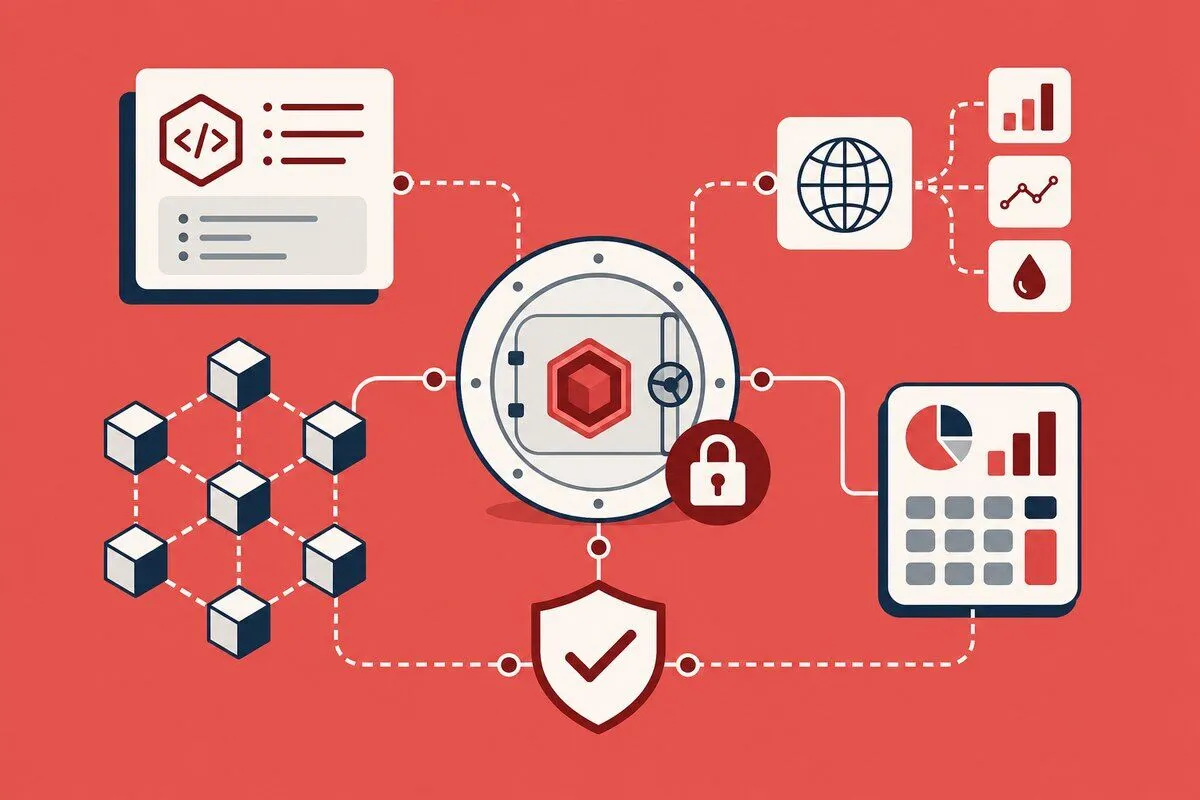
A smart contract is a self-executing computer program stored on a blockchain that automatically performs predefined actions when specific conditions are met. In the context of Grant Cardone real estate tokenization, the smart contract functions as the automated income distribution engine. When the property manager reports collected rent and transfers funds into the contract, it reads the current ownership registry, calculates every token holder’s proportional share, and executes payment to their wallet addresses automatically.
The critical advantage for global investors is that this process requires no human intermediary approval, no bank clearing house, and no cross-border wire transfer delay. An investor in Mumbai, Dubai, or London receives their share of a Miami apartment’s rental income with the same speed and certainty as an investor sitting in Miami itself. The smart contract is blind to geography. It only knows token ownership addresses and payment amounts.
The risk worth noting here is that smart contracts are code, and code can have vulnerabilities. A poorly audited smart contract could be exploited, resulting in misdirected funds or locked capital. Best practice in the industry requires multiple independent security audits by specialist blockchain audit firms before any smart contract managing real-world asset income is deployed. Investors should verify that Cardone Capital’s chosen platform has completed these audits before committing capital.
What Is the Difference Between Buying Grant Cardone Tokens and Buying a Traditional REIT or Mutual Fund
| Feature | Cardone Real Estate Token | Traditional REIT | Mutual Fund |
|---|---|---|---|
| Ownership Type | Direct fractional property | Pooled fund units | Pooled equity units |
| Trading Hours | 24/7 blockchain market | Exchange hours only | NAV once per day |
| Income Distribution | Automated smart contract | Quarterly distributions | Annual or semi-annual |
| Asset Transparency | Full on-chain visibility | Quarterly disclosures | Monthly portfolio disclosures |
| Global Access | Borderless by design | Exchange jurisdiction dependent | Country-specific distribution |
| Regulatory Framework | Security token regulation | SEC / SEBI regulated | Mutual fund regulations |
The fundamental distinction is ownership specificity and operational efficiency. With a REIT or mutual fund, a professional manager decides which assets to buy and sell. With Grant Cardone real estate tokenization, you own a digital representation of specific buildings you can identify, research, and track. The transparency is fundamentally different, and for investors who want to know exactly what their capital is financing, that matters enormously.
Can Indian Investors Buy Grant Cardone Real Estate Tokens and What Are the Legal and Tax Rules They Must Know
Indian investors represent one of the largest potential global markets for Grant Cardone real estate tokenization, given the strong cultural affinity for real estate investment and the large NRI population based in the UAE, UK, and the United States. However, Indian participation will depend heavily on how the tokens are legally classified and where they are issued. If classified as securities under US law, international investor onboarding will require compliance with both SEC regulations and India’s FEMA guidelines.
For resident Indian investors, the Liberalised Remittance Scheme allows remittance of up to $250,000 per financial year for overseas investment purposes. This amount is sufficient for meaningful entry-level positions in tokenized real estate. The tax treatment in India would classify income from foreign real estate tokens either as income from house property or income from other sources, taxed at the applicable slab rate. Capital gains on token sale would be classified as either short-term or long-term capital gains depending on holding period, subject to applicable Indian capital gains tax rates.
NRI investors based in Dubai and the UK face different regulatory landscapes. UAE-based investors benefit from zero personal income tax and are not subject to capital gains tax on foreign investments. UK-based NRIs must comply with HMRC guidance on digital asset and foreign property income. In all cases, investors should obtain specific legal and tax advice from qualified advisors in their country of residence before participating in any tokenized real estate offering.
What Are the Real Risks Nobody Is Talking About When It Comes to Investing in Tokenized Real Estate
Regulatory Reclassification Risk
If US regulators change how security tokens are classified or tighten cross-border investor rules, existing token holders could face forced redemption or restricted secondary market access with no prior warning.
Sponsor Concentration Risk
The entire investment thesis is tied to Grant Cardone’s personal brand, management decisions, and operational competency. If the Cardone Capital management structure changes, investor outcomes could be significantly affected beyond property fundamentals.
Smart Contract Vulnerability
Code errors in smart contracts managing rental income distribution could result in lost funds or incorrect allocations. Without independent audit and insurance coverage, investors have limited recourse against technical failures.
Secondary Market Illiquidity
In early stages, the secondary token market may have insufficient buyer depth. Investors needing to exit before natural property disposition events may struggle to find buyers at fair value, creating effective illiquidity.
These risks do not make Grant Cardone real estate tokenization a bad investment. They make it a risk-aware investment that requires due diligence proportional to the opportunity. Our eight years of experience in this space has taught us that the investors who perform best in emerging asset classes are those who understand the downside scenarios as clearly as the upside potential.
How Is Grant Cardone Deal Different From Dubai Real Estate Tokenization and Which One Is Better for Investors
Dubai’s real estate tokenization program, now in Phase 2 under the Dubai Land Department, represents the most advanced government-led tokenization initiative in the world. The DLD program integrates blockchain directly with the official property registry, meaning that a tokenized property transaction is simultaneously recorded as a legal ownership transfer in the government’s land records system. This creates a level of legal certainty that no private sector tokenization initiative has yet matched anywhere globally.
Grant Cardone’s approach is private sector-led, operating under US securities law through the security token framework rather than a government property registry integration. The strength of Cardone’s model is the portfolio quality, the brand trust, and the US market’s historical return profile for multifamily assets. The weakness is that the legal infrastructure backing the tokens depends on SPV law and securities regulation rather than a government-backed registry system.
For investors choosing between the two, the decision depends on geographic exposure preference, currency preference, and risk tolerance. Dubai tokens offer UAE dirham and US dollar-denominated assets in one of the world’s fastest-growing luxury real estate markets with government registry backing. Cardone tokens offer US dollar-denominated Sun Belt multifamily assets with the backing of a proven operator’s track record. The smartest investors in India and the UK are evaluating both as complementary exposures rather than competing choices.
Model Selection Criteria: 6-Step Framework for Evaluating Tokenized Real Estate Investments
What Does This $5 Billion Tokenization Deal Mean for the Future of Real Estate Buying and Selling Around the World
The Grant Cardone real estate tokenization announcement carries implications that extend far beyond the $5 billion portfolio itself. It represents a cultural inflection point in how the global real estate investment community perceives blockchain as an operational tool. When a personality of Cardone’s standing, who built his career on the most traditional version of real estate investment possible, pivots to tokenization, every other major real estate operator in the world is forced to evaluate whether they should follow.
The broader implication is for the global property transaction model. Currently, buying real estate in any country involves lawyers, agents, banks, notaries, title companies, and weeks or months of administrative processing. Tokenized property transfers happen in seconds on a blockchain. The counterparty is not a bank in one country clearing through a correspondent bank in another. It is a smart contract executing a verified ownership transfer based on payment receipt. For cross-border real estate investment from India to the US, UAE to the UK, or Singapore to Australia, this is a transformational efficiency gain.
Industry projections from multiple asset management research firms suggest that tokenized real estate assets under management could reach $4 trillion globally by 2030. If Cardone’s deal performs as intended, it will accelerate that timeline by demonstrating at scale that a proven real estate operator can successfully integrate blockchain infrastructure without sacrificing investment quality or investor confidence.[3]
Authoritative Principles: 8 Industry Standards Every Tokenized Real Estate Investor Must Follow
01. Demand Full Legal Documentation
Never invest in tokenized real estate without receiving and reviewing the complete legal chain from token to asset, including SPV registration, title documents, and investor rights agreement from qualified legal counsel.
02. Verify Independent Custody
Underlying assets must be held by an independent qualified custodian separate from the platform operator. Commingled custody where the platform holds both tokens and assets represents an unacceptable concentration of risk for investors.
03. Require Smart Contract Audits
All smart contracts governing income distribution and token transfers must have publicly available audit reports from minimum two independent blockchain security audit firms before any capital commitment from investors.
04. Understand the Exit Mechanism
Every tokenized real estate investment must have a documented exit pathway, whether through secondary market trading, platform buyback facility, or natural property disposition at end of hold period. Never invest without clarity on how you get your capital back.
05. Monitor Regulatory Changes Actively
Security token regulations in the US, India, UAE, and UK are actively evolving in 2026. Investors must maintain ongoing awareness of regulatory changes that could affect token trading rights, income distribution mechanisms, or cross-border holding legality.
06. Diversify Across Platforms and Geographies
Concentration in a single tokenization platform or a single operator’s portfolio carries amplified platform-specific risk. Diversifying across multiple platforms, operators, and geographies reduces exposure to any single point of failure in the emerging tokenization ecosystem.
07. Secure Your Digital Wallet Infrastructure
Investors must use hardware wallets or institutional-grade custody solutions for storing real estate tokens. Hot wallets connected to the internet expose token holdings to hacking and theft risk that is entirely avoidable with proper digital security infrastructure.
08. Document All Transactions for Tax Compliance
Every token purchase, income receipt, and transfer must be documented with timestamps and values in both local currency and USD equivalent. Tax authorities in India, UAE, and the UK are increasing scrutiny of digital asset and foreign property income disclosures in 2026.
When Will Grant Cardone Real Estate Tokens Be Available to Buy and What Should Investors Do Right Now to Prepare
As of early 2026, Cardone Capital has not announced a public token sale date. The project is reported to be in the structuring, legal review, and regulatory filing phase. Based on comparable security token offerings of this scale, the timeline from announcement to public availability typically runs between 12 and 24 months. Investors who want to position themselves for early access should take specific preparatory steps now rather than waiting for a formal launch announcement.
The most important preparation steps for investors in India, UAE, and the UK are: registering on Cardone Capital’s official platform and completing initial interest forms, setting up a compliant international investment account that can receive USD-denominated digital asset distributions, consulting a local tax advisor about the reporting requirements for foreign tokenized real estate income, and establishing a secure digital wallet infrastructure through a reputable hardware wallet provider.
The Grant Cardone real estate tokenization initiative, whatever its final structure, has already accomplished something significant. It has made a category of investment, fractional blockchain-based ownership of institutional US real estate, feel credible and accessible to a global investor base that would never have considered it before. For investors willing to prepare now and invest with appropriate risk sizing, this could represent one of the defining real estate investment opportunities of the decade.
Start Your Tokenized Real Estate Journey Today
Our specialists help investors in India, UAE, and UK navigate global tokenized real estate opportunities with full legal and tax compliance support.
Frequently Asked Questions
Q1.1. Is Grant Cardone actually putting his real estate portfolio on blockchain?
Yes, Grant Cardone has announced plans to tokenize his $5 billion real estate portfolio through Cardone Capital, converting apartment units into blockchain-based digital tokens to allow global fractional ownership. The initiative represents one of the largest private real estate tokenization announcements in history, targeting retail investors previously locked out of large-scale multifamily assets across the United States.
Q2.2. How much is Grant Cardone's real estate portfolio worth?
Grant Cardone’s portfolio is valued at approximately $5 billion, comprising over 12,000 apartment units across major US markets including Miami, Nashville, Scottsdale, and Houston. His company Cardone Capital manages this portfolio on behalf of both accredited and non-accredited investors, making multifamily real estate accessible to regular people through structured fund offerings before tokenization was even announced.
Q3.3. What changed Grant Cardone's mind about cryptocurrency and blockchain?
Grant Cardone was publicly skeptical of cryptocurrency for years, calling it speculative and unproductive. His shift came when he recognized that blockchain technology, specifically tokenization infrastructure, could solve the liquidity and accessibility problems he faced with his real estate fund model. The utility of tokenization as a distribution mechanism, not crypto speculation, changed his perspective entirely.
Q4.4. Can investors from India participate in Grant Cardone's tokenized real estate?
Indian investors may potentially participate depending on the final regulatory structure of the token offering. If tokens are structured as securities, Indian investors must comply with FEMA regulations and RBI guidelines on overseas investments. The Liberalised Remittance Scheme allows up to $250,000 per year for overseas investments, which may cover entry-level token purchases once the platform launches publicly.
Q5.5. What blockchain will Grant Cardone use for tokenizing his properties?
The specific blockchain network for Grant Cardone’s tokenization has not been officially confirmed as of early 2026. Industry analysts expect the project to gravitate toward Ethereum, Solana, Avalanche, or Polygon, each offering different advantages in transaction speed, cost, and institutional adoption. The choice of chain will significantly influence investor onboarding, secondary market liquidity, and smart contract reliability for rental income distribution.
Q6.6. How is this different from a traditional REIT?
A traditional REIT pools property into a managed fund traded on stock exchanges. Cardone’s tokenized approach gives investors fractional direct ownership in specific properties through blockchain tokens, enabling 24/7 secondary market trading, near-instant smart contract rental distributions, and borderless access. Unlike a REIT, token holders may have clearer asset-level transparency without being subject to fund-level management decisions and traditional exchange trading hours.
Q7.7. When will Grant Cardone's real estate tokens be available to buy?
No confirmed public launch date has been announced as of early 2026. Cardone Capital is currently reported to be in the structuring and regulatory filing phase. Investors interested in early access should follow official Cardone Capital announcements, register on their platform, and ensure their international investment accounts and KYC documentation are prepared in advance for a smooth onboarding process.
Q8.8. How does real estate tokenization pay investors rental income?
Rental income from tokenized properties is collected by the property manager and fed into a smart contract on the blockchain. The smart contract automatically calculates each token holder’s proportional share and distributes income in stablecoin or digital currency directly to their wallet. This eliminates intermediaries, reduces processing delays from weeks to minutes, and gives global investors in India, Dubai, or the UK instant access to US rental cash flows.
Q9.9. How does Cardone's tokenization compare to Dubai's real estate tokenization program?
Dubai’s real estate tokenization program is government-led and regulated by the Dubai Land Department, covering a verified property registry integrated with blockchain. Cardone’s initiative is private sector-led and targets US multifamily residential assets. Both approaches are complementary but different in scope. Dubai’s program has stronger regulatory backing, while Cardone’s carries the power of a globally recognised personal brand to attract retail capital.
Q10.10. What are the real risks of investing in Grant Cardone's tokenized real estate?
Key risks include regulatory uncertainty around security token classification in the US and internationally, platform and smart contract vulnerabilities, secondary market illiquidity in early stages, concentration in US multifamily assets subject to vacancy and interest rate risk, and the reputational and operational risks tied to a single sponsor personality. Investors should allocate only what they can afford to hold for a minimum of three to five years.
Explore Services
Related Services
Reviewed by

Aman Vaths
Founder of Nadcab Labs
Aman Vaths is the Founder & CTO of Nadcab Labs, a global digital engineering company delivering enterprise-grade solutions across AI, Web3, Blockchain, Big Data, Cloud, Cybersecurity, and Modern Application Development. With deep technical leadership and product innovation experience, Aman has positioned Nadcab Labs as one of the most advanced engineering companies driving the next era of intelligent, secure, and scalable software systems. Under his leadership, Nadcab Labs has built 2,000+ global projects across sectors including fintech, banking, healthcare, real estate, logistics, gaming, manufacturing, and next-generation DePIN networks. Aman’s strength lies in architecting high-performance systems, end-to-end platform engineering, and designing enterprise solutions that operate at global scale.