The 2026 Transformation of Real Estate in Capital Markets
Eight years of cross-border capital markets experience, distilled into the most comprehensive guide on how tokenized real estate is transforming institutional and retail investment globally.
Key Takeaways
10 critical insights on capital markets and real estate tokenization
-
01
Capital markets globally manage over $120 trillion in assets, yet real estate, representing 65% of global wealth, remains largely inaccessible through standard market mechanisms for retail investors.
-
02
Blockchain-based tokenization is converting illiquid property assets into capital markets instruments with real-time secondary trading, 3-5 second settlement, and proportional income distribution.
-
03
Dubai’s Land Department launched Phase 2 tokenization in 2026, placing 10 properties on the XRP Ledger, marking the first government-backed real estate entry into regulated capital markets via blockchain.
-
04
Regulatory frameworks across the USA (SEC), UK (FCA), UAE (VARA), Canada (OSC), and India (SEBI) are each building distinct compliance architectures for digital real estate capital markets participation.
-
05
Mortgage-backed securities and REITs were the original bridge between real estate and capital markets, but tokenization is delivering the next generation: specific-asset exposure with daily liquidity.
-
06
Indian NRI investors represent the largest foreign buyer group in Dubai real estate, and tokenization reduces their minimum entry from $200,000 to under $1,000 through fractional capital markets access.
-
07
Smart contract infrastructure eliminates settlement intermediaries, reducing capital markets transaction costs for real estate by 60-80% compared to traditional cross-border property acquisition processes.
-
08
Institutional capital markets participants, including sovereign wealth funds and pension funds from Canada and the UK, are actively allocating to tokenized real estate as a portfolio diversification instrument.
-
09
The global tokenized real estate market is projected to reach $1.4 trillion by 2030, reshaping how capital markets allocate, price, and trade property assets at a scale previously impossible.
-
10
Key capital markets risks in tokenized real estate include thin secondary market liquidity, cross-border tax uncertainty, and platform-level operational risks that require careful due diligence before allocating capital.
Capital markets serve as the connective tissue of the global economy, channeling long-term investment capital from providers to users through regulated exchanges, over-the-counter platforms, and increasingly, blockchain-based protocols. Real estate, the largest single asset class by value on earth, has historically maintained an uncomfortable relationship with these markets. Its illiquidity, high entry cost, and complex ownership transfer mechanics have prevented it from integrating fully into the liquid, transparent, and accessible infrastructure that capital markets represent. Real estate tokenization is fundamentally changing this relationship. By converting property ownership rights into blockchain-based digital tokens, tokenization creates a capital markets interface for real estate that did not exist before, one with real-time pricing, fractional ownership, global accessibility, and automated compliance. This guide examines every layer of that transformation, from the foundational role of capital markets in property finance to the cutting edge of institutional blockchain adoption.
Over eight years of working with investors across the USA, UK, UAE, Canada, and India, we have observed a consistent pattern: the investors who most want exposure to high-quality real estate are frequently the same investors who are most excluded from it by capital requirements, geographic barriers, and liquidity constraints. An IT professional in Bangalore wanting exposure to Dubai commercial property, a retail investor in Toronto wanting to hold a stake in a London residential building, or a young professional in New York wanting yield from Abu Dhabi infrastructure assets, all face the same fundamental barrier. Capital markets in their traditional form were not built for these use cases. The infrastructure being built around blockchain and tokenized securities is built for exactly these cases, and understanding how it intersects with existing capital markets architecture is essential for any investor engaging with the global property market in 2026 and beyond.
Understanding the Structural Role of Capital Markets in Real Estate Finance
Capital markets fulfill three essential functions for real estate: they provide long-term financing to property owners and builders, they offer investors a mechanism to deploy capital into property assets, and they create a pricing mechanism that reflects the market’s collective valuation of those assets. In the USA, this has historically taken the form of commercial mortgage-backed securities, agency bonds, and publicly traded REITs. In the UK, listed property companies on the London Stock Exchange serve a similar function. In Canada, pension funds like CPP Investments allocate billions annually to real estate through capital markets vehicles. In Dubai and the UAE, the DIFC has served as the institutional capital markets gateway for sovereign and private investment into Emirates real estate. The common thread is that all of these mechanisms require significant capital, professional intermediaries, and market access that is unavailable to most individual investors. The structural role of capital markets in real estate has always been to serve sophisticated institutional money, and that constraint is precisely what tokenization is now disrupting at every level.
The primary and secondary capital markets play distinct roles in real estate financing. Primary capital markets raise new funds, the developer bond issuance in India financing a Mumbai commercial tower, or the initial public offering of a Canadian property REIT raising capital for acquisitions. Secondary capital markets provide the trading infrastructure that gives primary investors confidence to commit, knowing they can exit their position when needed. Without secondary markets, capital markets investors demand higher returns as compensation for illiquidity, directly raising the cost of capital for real estate projects. This relationship is fundamental to understanding why tokenization matters so deeply. By creating a functional secondary market for individual property assets through blockchain, tokenization reduces the illiquidity premium built into real estate pricing, theoretically lowering the cost of property capital and making more projects economically viable across the USA, UK, UAE, and India alike.
How Capital Markets Drive Liquidity, Valuation, and Risk Allocation in Property Assets
The three core functions and how they shape real estate finance
Liquidity, valuation accuracy, and risk allocation are the three outputs that capital markets generate for any asset class they absorb. For real estate, the absence of deep capital markets integration has historically meant poor liquidity, opaque valuation, and inefficient risk allocation. Capital markets address each of these through different mechanisms. Liquidity is provided by the trading infrastructure of secondary markets, where willing buyers and sellers continuously transact, enabling position entry and exit. Valuation accuracy emerges from price discovery, the continuous aggregation of market participants’ views on an asset’s worth through real transactions. Risk allocation is achieved through the ability to create different security tranches with different risk-return profiles from the same underlying asset, from senior secured debt instruments to high-yield junior equity, each distributed to the capital markets investors best equipped to hold those risk levels.
Continuous buyer-seller matching through secondary markets enables position entry and exit without asset disposal.
Real-time price discovery aggregates market views, reducing valuation opacity in cross-border property transactions.
Tranching separates debt and equity risk, distributing each to capital markets investors best suited to carry it.
The Evolution of Real Estate Financing: From Traditional Capital Markets to Digital Assets
The history of real estate in capital markets is a story of progressive securitization. Before the 1960s, property finance was entirely local and relationship-based. A developer in Chicago needed a Chicago bank. A landlord in London needed a London building society. Capital was geographically constrained, and real estate investment was limited to those with direct local access. The creation of mortgage-backed securities in the late 1960s in the USA was the first major capital markets innovation for real estate. By pooling individual mortgages and selling claims on that pool to investors, this structure allowed global capital to fund American housing for the first time. REITs, introduced in the USA in 1960 and subsequently adopted in the UK, Canada, India, and UAE, created the second major capital markets bridge, allowing equity-like investment in property portfolios through public stock exchanges. Each innovation expanded the capital markets interface for real estate, but each also maintained fundamental limits: REITs are portfolios, not individual assets. MBS are debt instruments, not equity ownership. No structure before tokenization gave investors specific property equity with liquid secondary trading.
The digital transformation of capital markets began with electronic trading in the 1980s and accelerated through algorithmic trading in the 2000s, high-frequency trading in the 2010s, and blockchain protocols in the 2020s. Each phase shifted power from intermediaries to technology, reducing friction, cost, and exclusivity. For real estate, the digital transition has lagged by approximately one decade compared to financial securities, primarily because property ownership requires government land registry involvement, which resisted digitization far longer than private financial institutions. The convergence of digitized land registries, VARA-regulated blockchain platforms in the UAE, SEC guidance on digital securities in the USA, and DLT-friendly regulation in Singapore and Switzerland has created the conditions for the first genuine digital capital markets layer for real estate. This is not incremental. It is the same structural shift that electronic trading represented for equities in the 1980s, applied to the largest asset class on earth, and it is happening now across every major investment market from London to Mumbai.
Institutional Real Estate Investment and the Expansion of Global Capital Markets
Institutional investors, including pension funds, sovereign wealth funds, insurance companies, and endowments, collectively manage over $80 trillion globally and allocate approximately 10-15% of their portfolios to real estate. In absolute terms, this represents $8-12 trillion in institutional real estate capital deployed through various capital markets vehicles. The Canada Pension Plan Investment Board, one of the world’s largest pension funds, maintains a real estate portfolio exceeding $50 billion across office, industrial, retail, and residential assets in the USA, UK, Europe, and Asia-Pacific. Abu Dhabi Investment Authority, among the largest sovereign wealth funds globally, has similarly built a multi-billion dollar real estate portfolio with holdings across London, New York, and Asian gateway cities. These institutions access real estate through capital markets structures that the average investor cannot touch: unlisted property funds with $5 million minimum subscriptions, club deals requiring industry relationships, and direct acquisitions requiring hundreds of millions in capital. Understanding how tokenization intersects with institutional capital markets is therefore not academic. It determines how the largest pools of investable capital on earth will engage with digital property markets over the coming decade.
The institutional capital markets landscape for real estate is shifting visibly toward digital infrastructure. BlackRock, the world’s largest asset manager, filed for a blockchain-based tokenized real estate fund structure in 2024. Franklin Templeton launched an on-chain fund accessible to a broader investor base. In the UAE, multiple ADGM-registered funds have begun exploring tokenized real estate as a feeder mechanism to attract capital from markets that traditional fund structures could not efficiently reach, particularly India’s growing HNI investor class. The strategic logic is clear: tokenized capital markets access allows institutional managers to reduce their minimum investment thresholds dramatically, expanding their investor base from hundreds of family offices and pension funds to potentially millions of verified retail investors. For the institutional capital markets ecosystem, tokenization is not disintermediation. It is a customer acquisition and capital efficiency tool that expands the market without undermining existing structures.
Private Equity, REITs, and Securitization: Bridging Real Estate with Capital Markets Infrastructure
The three pillars that built modern real estate capital markets
Three vehicles have historically served as the primary bridges between real estate and capital markets: private equity real estate funds, public REITs, and mortgage securitization. Private equity real estate, exemplified by firms like Blackstone, Brookfield, and CBRE Investment Management, raises blind pool capital from institutional investors, deploys it into value-add or opportunistic property strategies, and harvests returns over 7-10 year fund lives. This capital markets vehicle delivers the highest potential returns but demands the longest lock-up periods and highest minimum investments, typically $5-25 million for institutional access. REITs occupy the middle ground: publicly traded, highly liquid, low minimum investment, with mandatory dividend distributions of at least 90% of taxable income in most jurisdictions including the USA, UK, Canada, and Australia. India introduced its REIT framework in 2014, and the UAE established REIT regulations through ESCA in 2010, both expanding capital markets participation in their respective property sectors. Mortgage securitization sits at the debt end of the capital structure, converting mortgage pools into rated bonds that insurance companies, pension funds, and bond fund managers can hold.
Limitations of Traditional Capital Markets in Real Estate Asset Accessibility
Despite decades of capital markets innovation in real estate, the fundamental problem of accessibility remains largely unsolved. The limitations are structural and interconnected. High minimum investment thresholds eliminate most of the world’s investable population from direct capital markets participation in real estate. A $250,000 minimum for a private real estate fund excludes 99% of retail investors globally, including the vast majority of high-income professionals in India and Southeast Asia. Geographic concentration means that capital markets instruments available to investors in the UK or Canada give exposure to local markets, not the Dubai office tower or Singapore industrial estate that might offer superior risk-adjusted returns. Opacity in underlying asset performance, a persistent problem in unlisted real estate funds, means that capital markets investors cannot independently verify what they own, relying entirely on manager reporting. Slow redemption mechanisms in closed-end vehicles force investors into lock-up periods of 5-10 years with no secondary market, creating significant illiquidity risk. Each of these limitations represents a gap that digital capital markets infrastructure, built on blockchain and tokenization, is specifically designed to close, not partially but completely.
The gap between available capital and accessible real estate capital markets opportunity is enormous. In India alone, SEBI reports indicate that over 50 million individuals hold investable assets above $10,000 but below $100,000, putting them above the threshold of meaningful financial market participation but below the threshold of traditional real estate capital markets access. In Canada, millions of TFSA and RRSP account holders seek higher-yield alternatives to bonds and equities but find real estate capital markets instruments either unavailable in their account type or inaccessible due to minimum investment requirements. In the UK, post-Brexit capital flows have shifted, creating both opportunity and challenge for retail investors seeking diversified real estate exposure beyond domestic REITs. These populations represent the exact users that digital real estate capital markets, built on transparent blockchain infrastructure, are designed to serve. The question is no longer whether the market exists. It demonstrably does. The question is which jurisdictions and platforms will build the regulatory and technical infrastructure to capture it first.
Regulatory Frameworks Governing Real Estate Participation in Capital Markets
How USA, UK, UAE, Canada and India regulate digital real estate securities
The regulatory architecture governing real estate’s participation in capital markets varies significantly across the target jurisdictions, and understanding these differences is essential for any investor or platform operator building a cross-border tokenized real estate strategy. In the USA, the SEC treats tokenized real estate as a security subject to the Investment Company Act and Securities Act. Platforms must operate under Regulation D, Regulation A+, or Regulation CF depending on investor type and offering size. The SEC’s enforcement actions against non-compliant token offerings have established clear precedent: property tokens that confer ownership rights and income entitlement are securities, and they must be registered or exempt. The UK’s Financial Conduct Authority has published consultation papers on digital asset securities that signal a principles-based approach rather than prescriptive rules, allowing tokenized real estate platforms to operate under existing authorized investment firm frameworks with additional digital asset permissions.[1]
Regulatory Framework Comparison: Capital Markets Access for Tokenized Real Estate
| Jurisdiction | Regulator | Framework | Investor Access | Status 2026 |
|---|---|---|---|---|
| USA | SEC / FINRA | Reg D / Reg A+ / Reg CF | Accredited and Retail | Active |
| UAE (Dubai) | VARA / DLD | VASP License + DLD Oversight | Global Retail (KYC) | Phase 2 Live |
| UK | FCA | Digital Securities Sandbox | Qualified Investors | Sandbox |
| Canada | OSC / CSA | National Instrument 45-106 | Accredited Investors | Evolving |
| India | SEBI / RBI | LRS + FEMA + VDA Rules | NRI / Outward Remittance | In Review |
Digital Transformation of Capital Markets and the Rise of Asset Tokenization
The digital transformation of capital markets is not a single event but a multi-decade process that is now accelerating sharply in the asset tokenization layer. When NASDAQ introduced electronic trading in 1971, it digitized price discovery but not settlement. When T+2 settlement replaced T+3 in the USA and UK, it shortened the settlement window but did not eliminate intermediaries. When central securities depositories adopted digital records, they digitized ownership tracking but maintained centralized, single-point control. Each step reduced friction partially. Blockchain-based tokenization, applied to capital markets instruments including real estate, completes the digitization by addressing settlement, ownership tracking, compliance, and distribution simultaneously within a single programmable layer. The Boston Consulting Group projects that the global market for tokenized assets across capital markets will reach $16 trillion by 2030, representing approximately 10% of global GDP. For real estate, which represents the single largest slice of that projected market, the implication is that the fundamental infrastructure of property capital markets is being rebuilt from scratch on blockchain rails, with every major financial institution from Citigroup to JP Morgan to HSBC actively building or piloting tokenization capabilities.
The platform landscape for digital real estate capital markets is segmenting into three distinct tiers. The first tier comprises government-backed infrastructure platforms like Dubai’s DLD-linked tokenization program, Singapore’s Project Guardian, and the UK’s FCA Digital Securities Sandbox, which establish the regulatory legitimacy and operational standards for the broader market. The second tier includes institutional-grade technology providers and custodians, companies like Securitize, tZERO, and Tokeny Solutions, which build the technical and compliance infrastructure that licensed platforms rely on. The third tier consists of investor-facing platforms that integrate the infrastructure from the first two tiers and provide the user experience through which retail and institutional investors in India, Canada, the USA, and the UK access tokenized real estate capital markets. Each tier is maturing at a different pace, and the bottleneck in 2026 remains regulatory certainty at the national level, which determines how quickly the investor-facing platforms in each jurisdiction can scale their user bases and asset offerings.
Blockchain Infrastructure as the Next Layer of Capital Markets Innovation
The technical foundation that makes digital real estate capital markets possible
Blockchain infrastructure provides capital markets with capabilities that no prior technology could offer simultaneously: immutable ownership records that cannot be altered post-settlement, programmable compliance logic through smart contracts that execute automatically without human intervention, real-time settlement that eliminates counterparty risk windows, and global accessibility without geographic restrictions on participation. For real estate capital markets specifically, the implications of each of these properties are transformative. Immutable ownership records mean that a fractional property token purchase is permanently and verifiably recorded without requiring a centralized database that could be altered or corrupted. Dubai’s XRP Ledger integration with the DLD registry demonstrates this in practice: every token ownership change is simultaneously recorded on the blockchain and referenced in the official government land registry, creating dual-layer permanence. Smart contract compliance means that transfer restrictions, investor accreditation requirements, and income distribution calculations execute automatically, reducing the operational cost of running a regulated capital markets platform from hundreds of employees to a fraction of that.
3-5 second settlement, 1,500 TPS, fractions of a cent in fees. Used by Dubai DLD for property tokenization.
ERC-1400 security token standard supports compliance logic, transfer restrictions, and income distribution automation.
High throughput Layer-2 enabling mass-market tokenized real estate platforms at low cost for retail investors.
Used for cross-border stablecoin settlement in real estate token transactions across India, UAE, and USA corridors.

From Illiquid Assets to Fractional Ownership: The Financial Engineering Behind Real Estate Tokenization
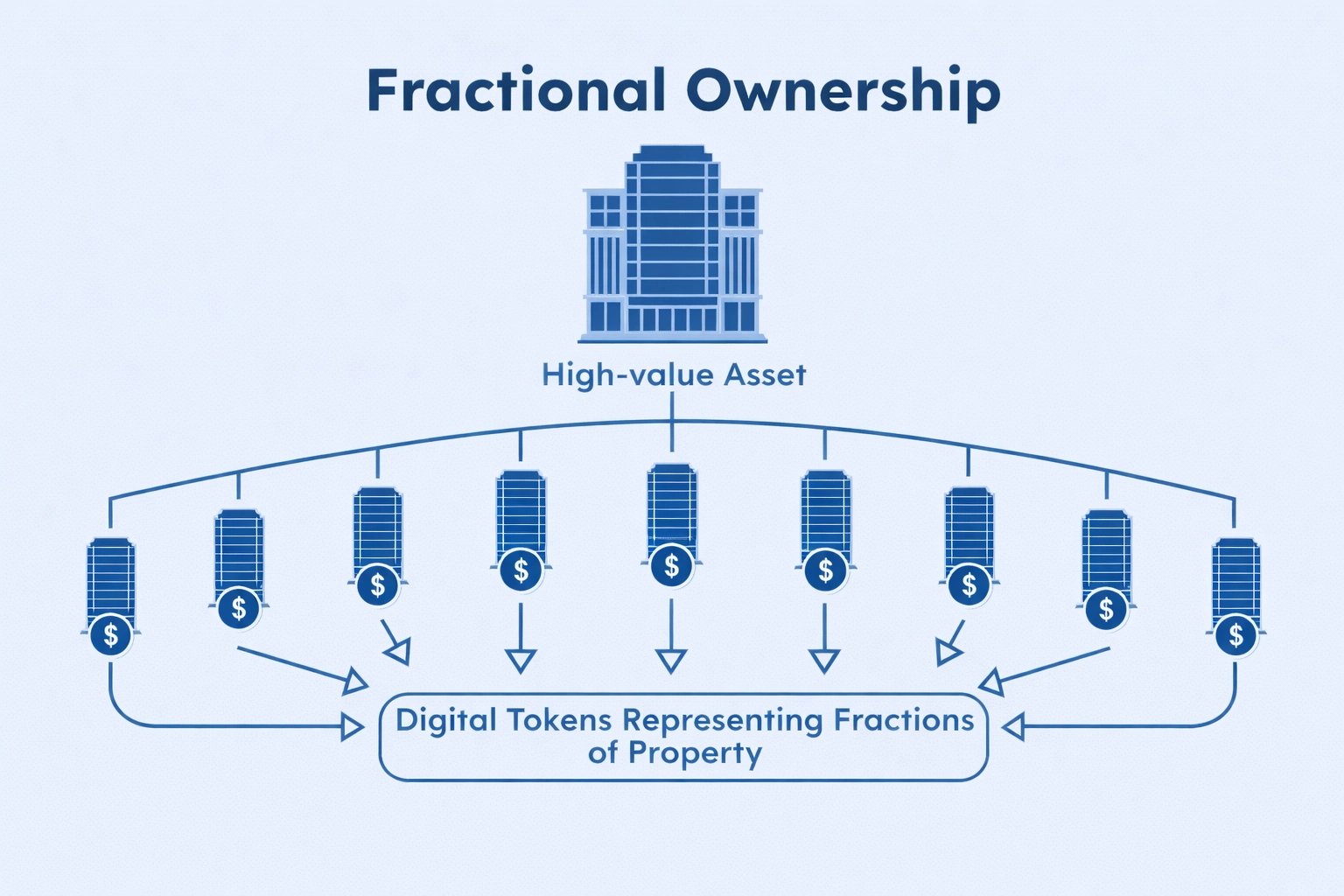
The financial engineering behind real estate tokenization is more sophisticated than it appears on the surface. The process begins with property valuation and legal structuring. A special purpose vehicle, typically a limited liability company or trust, acquires legal title to the property. This SPV then issues tokens against the value of its equity, with each token representing a defined proportional ownership stake in the SPV and through it, the underlying property. The token supply is calculated to produce a per-token price accessible to the target investor base, whether that is $500 per token for retail capital markets access or $50,000 per token for institutional placement. The smart contract governing the token specifies the income distribution logic, calculating each holder’s proportional share of rental income received by the SPV and distributing it at defined intervals. It also specifies transfer restrictions: which investor types are permitted to hold tokens under applicable capital markets regulations, which jurisdiction restrictions apply, and what happens to tokens in the event of property sale or SPV dissolution. The entire legal and financial structure is encoded into the on-chain contract, creating a self-executing capital markets instrument that requires no ongoing manual administration beyond property management operations.
The secondary market pricing mechanism for property tokens introduces a layer of capital markets valuation dynamics that traditional real estate does not experience. Because tokens trade continuously, their price reflects not just the underlying property value but also market sentiment, liquidity premium or discount, and the broader capital markets environment. During periods of general capital markets stress, tokenized real estate may trade at a discount to net asset value, similar to how closed-end funds trade at discounts during market downturns. During periods of high investor demand, they may trade at premiums to NAV. Understanding this dynamic is essential for investors approaching tokenized real estate as a capital markets instrument rather than a buy-and-hold property asset. Platforms operating in the UAE, USA, and Singapore are building NAV reporting mechanisms that allow investors to see both the real-time token market price and the independently calculated underlying property value, giving capital markets participants the transparency they need to make informed relative value judgments across their portfolio of tokenized real estate positions.
6-Step Model for Selecting a Tokenized Real Estate Capital Markets Platform
Selection criteria for investors entering digital capital markets
Verify Regulatory Authorization
Confirm the platform holds a current license from the relevant capital markets regulator in its operating jurisdiction: VARA for UAE platforms, SEC registration for USA-facing platforms, FCA authorization for UK access. Unlicensed platforms carry existential legal risk for investor positions.
Audit Smart Contract Security
Request third-party smart contract audit reports from firms like CertiK, Trail of Bits, or OpenZeppelin. Smart contract vulnerabilities in capital markets infrastructure can expose investor assets to irreversible loss. All credible platforms publish their audit results publicly.
Assess Secondary Market Liquidity
Request order book depth data and historical trading volume for listed tokens. A platform with fewer than 500 active traders per property token carries meaningful bid-ask spread risk. Compare liquidity metrics across platforms before committing capital to any tokenized real estate capital markets position.
Evaluate Custody Architecture
Determine whether the platform uses a qualified independent custodian for both the physical title documentation and fiat reserves. Platforms that self-custody these assets create concentration risk. Institutional-grade capital markets participants require segregated custody as a non-negotiable operational standard.
Analyze Fee Structure
Total platform fees including annual management fees (0.5-2%), secondary market trading commissions (0.1-0.5% per transaction), and income distribution processing fees can materially reduce net returns. On a 7% gross rental yield, a 2% total fee load reduces net income by nearly 30%. Model fees carefully before selecting a capital markets platform.
Confirm Cross-Border Settlement Path
For investors in India, Canada, UK, and USA, verify the platform supports fiat on-ramp and off-ramp in your local currency without excessive conversion friction. Platforms with stablecoin-only settlement create currency risk that may not be appropriate for all capital markets participants. Confirm settlement mechanics before investing.
How Tokenized Real Estate Expands Capital Markets Access to Global Investors
The expansion of capital markets access that tokenized real estate enables is genuinely historic in scope. Consider the investor journeys that become possible for the first time. An IT professional in Hyderabad earning INR 25 lakh annually, with savings in Indian mutual funds, can now allocate a small portion of their Liberalized Remittance Scheme allowance into fractional ownership of a Dubai Marina apartment generating 7.5% annual rental yield, receiving monthly distributions in USDC directly to their verified digital wallet without any intermediary processing. A young professional in Toronto contributing to a self-directed RRSP can hold tokenized positions in three different markets, London residential, Dubai commercial, and Singapore industrial, diversifying their capital markets real estate exposure globally for the first time through a single regulated platform. A retired investor in Arizona seeking income above bond yields can access UAE property tokens generating 6-8% annual income while maintaining daily liquidity that traditional direct property ownership or private fund vehicles cannot offer. These are not theoretical scenarios. The infrastructure to execute each of these investment journeys existed by early 2026, and the regulatory frameworks to make them compliant are in active implementation across each target jurisdiction.
The democratization of real estate capital markets through tokenization has measurable economic implications. When more investors can participate in property markets, capital allocation becomes more efficient: properties that generate the best risk-adjusted returns attract capital regardless of investor geography, while underperforming properties face price discipline from a larger, more analytical investor base. This price efficiency benefits not just investors but the broader economy, as property values better reflect fundamental income-generating capacity rather than proximity to local wealthy buyers. For markets like India and Southeast Asia, where domestic real estate markets are often opaque and dominated by insider relationships, the ability to access transparent, blockchain-recorded real estate capital markets in the UAE or Singapore introduces a benchmark standard that competitive pressure will eventually force domestic markets to match. The long-term trajectory is a globally integrated real estate capital markets ecosystem where a property in Dubai competes for the same investor capital as one in London, New York, or Mumbai, with technology making the comparison transparent and the investment process frictionless regardless of where the investor is located.
Risk Management, Compliance, and Custodial Architecture in Tokenized Capital Markets
Operational standards every investor must understand
Risk management in tokenized real estate capital markets operates across three distinct dimensions: asset-level risk, platform-level risk, and regulatory-level risk. Asset-level risk includes standard real estate factors: vacancy rates, property maintenance costs, local market price volatility, and macroeconomic headwinds affecting specific property types or geographies. Platform-level risk encompasses smart contract vulnerabilities, custodial arrangement failures, platform operator insolvency, and cybersecurity incidents affecting the token infrastructure. Regulatory-level risk includes jurisdiction-specific changes to digital asset classification, cross-border capital movement restrictions, tax treatment updates from authorities in India, USA, Canada, or UK, and potential enforcement actions against platforms whose compliance frameworks are found inadequate by evolving regulatory standards. Professional investors accessing real estate capital markets through tokenized instruments should apply a risk management framework that separately assesses each of these three dimensions, rather than treating tokenized real estate as either pure real estate or pure digital asset risk.
Capital Markets Compliance Governance Checklist
| Governance Area | What to Verify | Applicable Jurisdictions | Priority |
|---|---|---|---|
| Platform License | Verify active VARA/SEC/FCA registration on regulator public databases | All | Critical |
| Title Deed Linkage | Confirm token references verifiable DLD or equivalent land registry record | UAE, USA, UK | Critical |
| KYC / AML Process | Platform conducts full identity, address, and source of funds verification | All | Required |
| Smart Contract Audit | Third-party security audit report from recognized cybersecurity firm | All | Required |
| Cross-Border Tax | Confirm FEMA / IRS / HMRC / CRA treatment with licensed tax advisor | India, USA, UK, Canada | Verify |
| Custody Arrangement | Confirm qualified independent custodian for title deeds and fiat reserves | All Institutional | Required |
| Liquidity Risk Disclosure | Platform provides clear disclosure of secondary market depth and lock-up conditions | All | Monitor |
Institutional Adoption of Real Estate Tokenization within Modern Capital Markets
Institutional adoption of tokenized real estate within capital markets has accelerated visibly since 2024. The most significant development was BlackRock’s BUIDL fund, a tokenized money market fund that reached $2 billion in assets under management within months of launch, demonstrating institutional-scale capital markets appetite for blockchain-native investment products. While BUIDL is not a real estate fund, it proved the operational infrastructure required: qualified custody, SEC compliance, secondary market trading, and institutional investor comfort with on-chain asset management. For real estate specifically, JPMorgan’s Onyx platform has processed over $700 billion in repo transactions using blockchain infrastructure, establishing the bank’s operational confidence in blockchain settlement at capital markets scale. HSBC and Standard Chartered have both launched tokenized product platforms in Singapore and Hong Kong, with real estate among the asset classes on the roadmap. In the UAE, multiple ADGM-regulated asset managers have begun raising capital for tokenized real estate funds that will use DLD-registered properties as underlying assets and token distribution for investor access, directly integrating with Dubai’s government-backed tokenization infrastructure.
Three institutional drivers are accelerating tokenized real estate adoption within capital markets. First, portfolio efficiency: institutions holding illiquid real estate positions benefit from on-chain secondary market access that allows partial rebalancing without the 12-18 month disposal process required for direct property sales. Second, client demand: institutional managers are receiving growing inquiries from their high-net-worth clients in India, the Middle East, and Southeast Asia seeking direct property exposure in specific high-yield markets, demand that tokenization uniquely satisfies at scale. Third, operational cost reduction: the infrastructure cost of administering a real estate fund through traditional capital markets processes, involving lawyers, administrators, transfer agents, registrars, and auditors, can consume 2-3% of fund NAV annually. Smart contract automation reduces this operational overhead dramatically, directly improving investor net returns. These three drivers align institutional incentives with retail investor demand in a way that creates powerful momentum for further capital markets adoption of tokenized real estate across every major investment center.
The Convergence of Real Estate, Blockchain, and Capital Markets: A New Financial Paradigm
The convergence of real estate, blockchain, and capital markets represents a financial paradigm shift comparable in scale to the introduction of mortgage securitization in the 1970s or the global adoption of REIT structures in the 1990s and 2000s. Each of those earlier innovations expanded the investor base for real estate capital markets by orders of magnitude. MBS opened American housing finance to global bond market investors. REITs opened commercial real estate to public equity investors in the USA, UK, Canada, Australia, Japan, Singapore, India, and the UAE. Tokenization opens every individual property, anywhere in the world, to every verified investor, anywhere in the world, with no minimum capital requirement beyond a few hundred dollars and no institutional intermediary required to execute the investment. This is not an incremental extension of existing capital markets. It is a structural redesign of how the largest asset class on earth connects with investable capital. The implications extend beyond investment returns: more efficient capital allocation to real estate means better-priced financing for property owners, higher-quality price signals for city planners and policymakers, and broader wealth-building participation for populations that have historically been excluded from property markets by capital barriers.
The road ahead for real estate capital markets convergence with blockchain is mapped in the strategies of every major financial institution currently investing in digital asset infrastructure. The trajectory leads toward a world where every significant property asset carries a digital twin on a blockchain, where that digital twin is tradeable 24 hours a day across global capital markets, where income from that property flows automatically to token holders within seconds of receipt, and where the cost of investing in international real estate becomes comparable to the cost of buying an international ETF. We are not there yet. The infrastructure exists, the regulatory frameworks are in active construction, and the early adopter institutions are placing their positions. For investors with capital to deploy in the capital markets of 2026, the question is whether to engage with this transition now, while valuations reflect early-market uncertainty, or to wait until the market has matured and the opportunity cost of missed early participation has compounded into a permanent performance gap. Based on eight years of watching similar transitions unfold in digital capital markets, the window for foundational positioning in tokenized real estate is open and will not remain open indefinitely.
Ready to Enter Tokenized Real Estate Capital Markets?
Our team has guided investors across the USA, UK, UAE, Canada, and India through real estate capital markets for over 8 years. Get expert guidance tailored to your jurisdiction.
People Also Ask
Capital markets are platforms where long-term financial instruments like stocks, bonds, and securities are bought and sold. Real estate connects to capital markets through REITs, mortgage-backed securities, and increasingly through tokenized property assets that allow fractional ownership and secondary trading.
Tokenization converts property ownership into blockchain-based digital tokens, enabling fractional investment from as little as a few hundred dollars. This opens capital markets participation to retail investors in India, Canada, and UAE who previously lacked sufficient capital for direct real estate investment.
Yes. In the USA, the SEC governs tokenized securities under existing frameworks. The UK’s FCA is developing specific digital asset guidance. Both regulators require KYC, AML compliance, and investor accreditation checks, making regulated tokenized real estate a legitimate capital markets instrument.
REITs give exposure to diversified property portfolios traded on stock exchanges. Tokenized real estate allows investment in specific individual properties with on-chain transparency, direct rental income distribution, and 24/7 secondary market trading, offering more granular capital markets participation.
Blockchain enables real-time settlement, eliminates intermediary friction, automates compliance through smart contracts, and creates an immutable ownership record. This reduces capital markets transaction costs by up to 80% compared to traditional property purchase and transfer processes.
Indian investors can participate through the Liberalized Remittance Scheme, investing up to $250,000 annually in foreign tokenized real estate. FEMA compliance and tax reporting remain mandatory. Platforms operating in Dubai and Singapore offer compliant access points for Indian capital markets participants.
Private equity firms aggregate institutional capital, acquire large real estate portfolios, and generate returns through value-add strategies and eventual asset sales. They represent the largest single allocation source in real estate capital markets across the USA, UK, Canada, and UAE.
Mortgage-backed securities pool thousands of individual home loans into a tradeable instrument sold to capital markets investors. They convert illiquid mortgage debt into liquid securities, providing banks with fresh capital to issue new loans while giving investors regular interest income.
UAE capital markets, particularly Dubai, offer zero annual property tax, high rental yields of 6-8%, and a VARA-regulated digital asset environment. Western markets offer deeper liquidity and longer track records but face higher transaction costs, heavier taxation, and stricter investment restrictions.
Key risks include thin secondary market liquidity in early-stage platforms, evolving cross-border tax treatment, smart contract vulnerabilities, platform operator insolvency, and currency exchange exposure. Regulatory frameworks across the USA, UK, Canada, and India are still maturing for digital real estate securities.
Reviewed & Edited By

Aman Vaths
Founder of Nadcab Labs
Aman Vaths is the Founder & CTO of Nadcab Labs, a global digital engineering company delivering enterprise-grade solutions across AI, Web3, Blockchain, Big Data, Cloud, Cybersecurity, and Modern Application Development. With deep technical leadership and product innovation experience, Aman has positioned Nadcab Labs as one of the most advanced engineering companies driving the next era of intelligent, secure, and scalable software systems. Under his leadership, Nadcab Labs has built 2,000+ global projects across sectors including fintech, banking, healthcare, real estate, logistics, gaming, manufacturing, and next-generation DePIN networks. Aman’s strength lies in architecting high-performance systems, end-to-end platform engineering, and designing enterprise solutions that operate at global scale.