Ai Overview
The story of Generative Artificial Intelligence did not start with ChatGPT. It started decades earlier with simple rule-based programs that could produce text following fixed templates. In the 1960s, ELIZA was one of the earliest programs designed to simulate conversation. In the UAE, the country’s vision for AI contributing 14 percent of GDP by 2031 is driving massive infrastructure investment across Dubai and Abu Dhabi, creating career opportunities that simply did not exist three years ago.
Key Takeaways
-
01generative artificial intelligence creates entirely new content like text, images, music, and code rather than simply analysing or classifying existing data like traditional AI systems.
-
02The technology powering generative artificial intelligence includes Large Language Models, Diffusion Models, and GANs, each specialised for different types of creative content output and tasks.
-
03India is one of the world’s fastest-growing markets for generative artificial intelligence adoption, with millions of users across education, healthcare, content creation, and enterprise software already using Gen AI daily.
-
04Dubai and the UAE are investing billions in Generative AI infrastructure and have a national AI strategy targeting becoming a top AI hub with a significant portion of GDP powered by AI by 2031.
-
05Learning Generative AI does not require a computer science degree. Beginners with basic digital literacy can start using GenAI tools productively within days of their first introduction to the technology.
-
06The main ethical concerns around Generative Artificial Intelligence include misinformation, intellectual property questions, potential bias in outputs, and the environmental cost of training large AI models on massive datasets.
-
07Businesses using Generative AI report average productivity gains of 20 to 40 percent on content-intensive tasks like marketing copy, code writing, customer support, and data analysis workflows.
-
08The introduction to Generative AI landscape is broad, spanning text models, image generators, video creators, audio synthesisers, and code assistants, each with different strengths and ideal use cases.
-
09Prompt engineering is the most practical skill for anyone starting with Generative AI. The better you are at writing clear instructions, the better the outputs you receive from any Generative AI system.
-
10The future scope of Generative Artificial Intelligence includes personalised medicine, autonomous creative industries, AI-native applications, and deeply intelligent assistants that reshape how humans work entirely.
History and Evolution of Generative AI
The story of Generative Artificial Intelligence did not start with ChatGPT. It started decades earlier with simple rule-based programs that could produce text following fixed templates. In the 1960s, ELIZA was one of the earliest programs designed to simulate conversation. It was basic and brittle, but it planted a seed: what if computers could generate language that felt human?
The real leap came with the introduction of neural networks in the 1980s and 1990s, which gave computers a way to learn from data rather than just follow explicit instructions. By 2014, a breakthrough called Generative Adversarial Networks (GANs) made it possible to generate realistic images. Then in 2017, Google researchers published the Transformer architecture, which became the foundation of every major language model that followed.
OpenAI’s GPT-3 in 2020 was the first model that genuinely surprised people with the quality of its text generation. Then ChatGPT launched in November 2022 and reached 100 million users in just two months, making it the fastest-growing consumer application in history. In India and the UAE, adoption was immediate and enthusiastic, with millions of users exploring the technology within weeks of its global release.
Key Milestones in Generative AI History
ELIZA created at MIT, the first conversational AI simulating human responses using pattern matching rules.
GANs (Generative Adversarial Networks) invented by Ian Goodfellow, enabling realistic image generation for the first time.
Google published “Attention Is All You Need” introducing the Transformer architecture that powers all modern language models.
GPT-3 released by OpenAI with 175 billion parameters, producing surprisingly human-like text for the first time at scale.
ChatGPT launched reaching 100 million users in 2 months. Both India and UAE see explosive early adoption across sectors.
Multimodal Generative AI models process text, images, audio and video simultaneously. Enterprise adoption reaches mainstream scale.
What Does Generative Artificial Intelligence Mean
The word “generative” simply means something that creates or produces. So Generative Artificial Intelligence is AI that generates, meaning it creates new things. The things it creates can be text, images, audio, video, code, or even three-dimensional designs, powering tools such as an AI Video Generator that can create visual content from simple prompts. This is fundamentally different from a calculator that computes a fixed answer, or a search engine that finds existing content. Generative artificial intelligence makes something that did not exist before. An image AI generator is one type of generative system focused on producing visual content from input descriptions, using learned patterns rather than retrieving pre-existing material.
When you type a question to ChatGPT, it does not retrieve a pre-written answer from a database. It generates a new response on the spot, word by word, based on its training on billions of text examples. Every response is unique. When you ask an image generator to create a picture of a sunset over the Dubai skyline, it does not find an existing photo. It generates a brand new image that has never existed.
A simple way to understand Generative AI is to think of it as a very sophisticated completion machine. It has studied so much human-created content that it has developed an intuitive sense of what should come next in any given context. This is how it generates paragraphs, paintings, melodies, and lines of code that feel remarkably human and purposeful despite being created by software.
Why Generative AI Is Becoming Popular
The popularity of Generative Artificial Intelligence has grown because it finally delivers on a very old promise: useful, accessible AI that non-experts can actually benefit from. Previous AI required technical skills or was limited to narrow tasks behind the scenes. Today, with the rise of structured learning resources like generative AI courses, understanding and applying this technology has become even more approachable for a wider audience. Generative AI is conversational, visual, and creative, making it genuinely useful to teachers in Bangalore, entrepreneurs in Mumbai, marketers in Dubai, and architects in Abu Dhabi equally.
Accessible to Everyone
No coding needed. Any person with an internet connection can use Generative AI tools from day one without training.
Saves Real Time
Tasks that took hours now complete in minutes. A 1000-word blog draft, a logo concept, a Python function all generated instantly.
Dramatically Cheaper
Hiring a copywriter, illustrator, and translator was expensive. Generative AI handles all three for a few dollars per month.
How Generative Artificial Intelligence Works
At its core, generative artificial intelligence explained comes down to pattern recognition at massive scale. During training, a model is shown billions of examples: books, articles, code repositories, images, conversations. From all this data, the model learns statistical patterns about what typically follows what. It learns that the word “sunrise” is often followed by “golden”, that a question typically ends with a question mark, that a legal document has a certain structure and vocabulary.
When you give the model a prompt (a starting instruction or question), it uses these learned patterns to predict what should come next, one token at a time. A token is roughly one word or part of a word. The model predicts the most appropriate next token, then uses that prediction to predict the one after it, and so on, until a complete response is generated. This is called autoregressive generation.
For images, the process is slightly different. Diffusion models learn by starting with a noisy image and gradually learning to remove noise while preserving meaningful visual patterns. When generating a new image, they start with pure random noise and progressively “clean” it according to the text description you provide, like sculpting order from chaos using language as a guide.Once you understand how these systems work, the next step is applying them in real-world use cases. This is where a custom AI agent builder becomes useful, allowing you to create custom AI assistants, automate workflows, and build intelligent applications without starting from scratch.
How a Text Generation Model Works Step by Step
Training: The model reads billions of text documents and learns statistical patterns about language, facts, and reasoning over months of computing time.
You give a prompt: You type a question, instruction, or starting sentence that tells the model what you want it to create or respond to.
Token by token generation: The model predicts the most appropriate next word, then uses that word to predict the following word, building the response piece by piece.
You receive output: A complete, coherent response is delivered to you, looking and reading as if a knowledgeable human wrote it specifically for your question.
Technologies Behind Generative AI
Several different technical architectures power different types of Generative Artificial Intelligence. You do not need to understand the mathematics to use these tools, but knowing what they are helps you understand why different tools are better at different tasks.
Difference Between Generative AI and Traditional AI
The easiest way to learn Generative AI concepts is to understand how it differs from the AI most people already interact with. Traditional AI, which has been powering spam filters, recommendation algorithms, and fraud detection for decades, is designed to classify or predict. Generative AI is designed to create. This is a fundamental difference in purpose that leads to very different capabilities.[1]
Generative AI vs Traditional AI: Key Differences
| Feature | Generative AI | Traditional AI |
|---|---|---|
| Primary Function | Creates new content | Classifies or predicts |
| Output Type | Text, images, audio, video | Labels, scores, decisions |
| User Interaction | Conversational, open-ended | Structured input/output |
| Common Example | ChatGPT, Midjourney | Spam filter, credit scoring |
| Requires Technical Skill | No (use via chat) | Usually yes (to build) |
| Creativity Capability | High (generates novel content) | Low (works within fixed rules) |
Types of Generative Artificial Intelligence Models
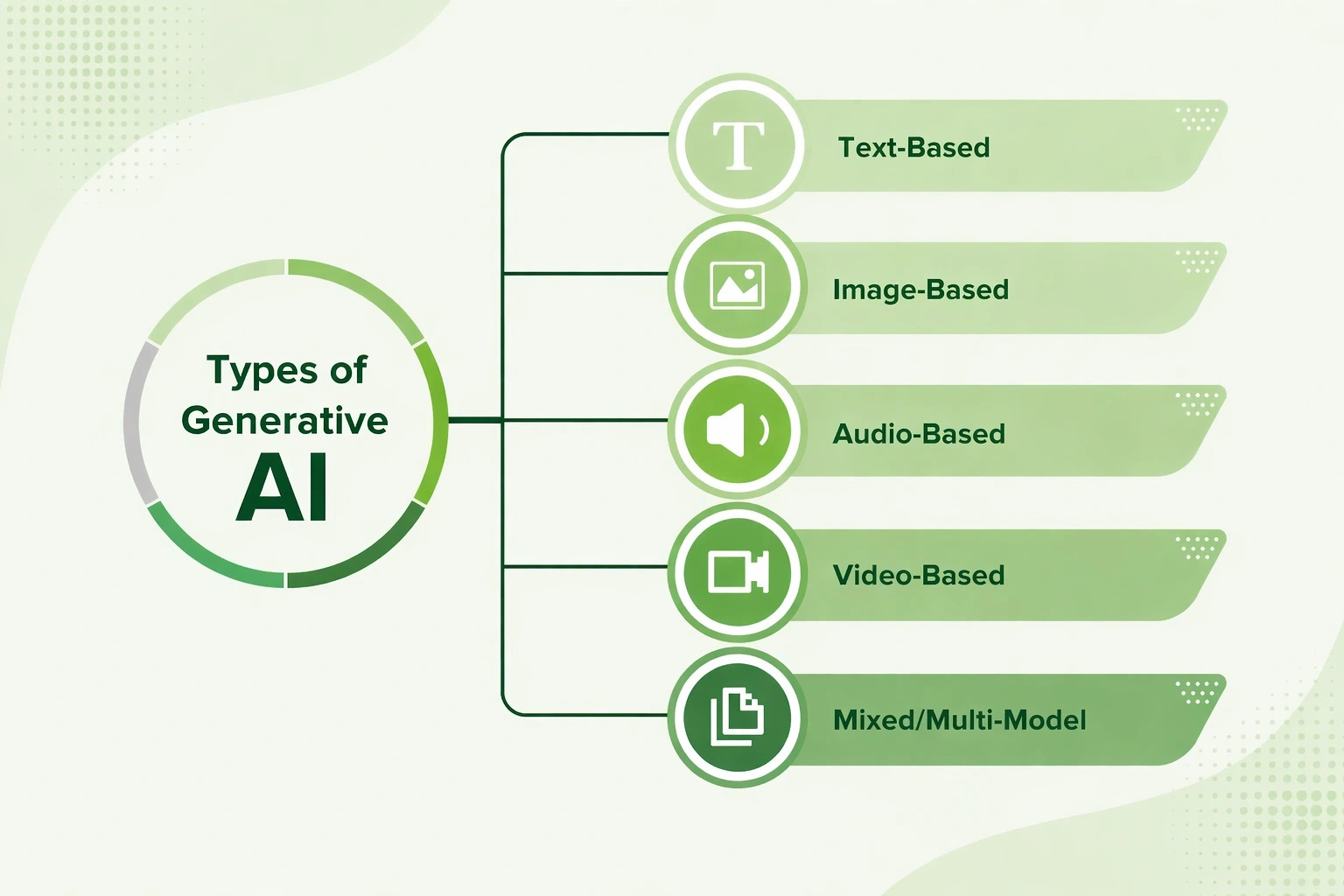
As part of your introduction to Generative AI, it helps to know that the field is not one single thing. Different types of Generative AI models are specialised for different types of content. Choosing the right type for your use case is the first practical decision anyone building with or using Generative AI needs to make.
Types of Generative AI and Their Maturity Level in 2026
Common Examples of Generative AI in Daily Life
You may already be using Generative Artificial Intelligence without realising it. Here are real examples that people in India and the UAE encounter regularly as part of their everyday digital lives in 2026.
Gmail Smart Compose
When Gmail suggests how to finish your sentence as you type, that is Generative AI completing text based on your writing style and context.
Swiggy and Zomato Descriptions
Many food delivery platforms in India use Generative AI to write enticing dish descriptions from basic ingredient lists provided by restaurants automatically.
Dubai Property Listings
Real estate agencies in Dubai use Generative AI to write property descriptions, create virtual tour scripts, and translate listings into Arabic automatically.
Customer Service Chatbots
When you chat with a bank, telecom, or e-commerce support system and receive coherent, contextual answers, Generative AI is powering that conversation.
Social Media Captions
Instagram, LinkedIn, and creator tools in India now offer AI-generated caption suggestions based on the photo or topic you are sharing with your audience.
Exam Preparation Tools
Platforms like BYJU’s and Unacademy in India now use Generative AI to create personalised practice questions and explanations tailored to each student’s learning level.
How Businesses Use Generative AI Today
Businesses in India and the UAE are using generative artificial intelligence across every function. Marketing teams generate campaign copy, social posts, and email sequences in minutes instead of days. Software teams use AI coding assistants that write and debug code, cutting project timelines significantly. HR departments use it to write job descriptions, screen resumes, and draft offer letters.
Finance teams in Dubai banks use generative artificial intelligence to summarise lengthy regulatory documents and flag compliance issues. Indian startups use it to translate their products into regional languages instantly. The businesses seeing the best results are those using Generative AI as a productivity multiplier rather than a replacement for human expertise and creative direction.
Generative AI in Content Creation and Design
Content creation is where most people first encounter generative artificial intelligence explained in their own workflow. Writers use tools like ChatGPT to draft articles, overcome writer’s block, and polish prose. Graphic designers use Midjourney and Adobe Firefly to generate visual concepts that they then refine. Video creators use AI to generate scripts, voiceovers, and even basic animations automatically.
In India’s booming digital content ecosystem, YouTube creators, Instagram influencers, and digital marketing agencies are among the most enthusiastic early adopters. In Dubai, hospitality and tourism brands are using Generative AI to create personalised marketing content in English and Arabic simultaneously, dramatically reducing translation costs while maintaining quality across both language markets.
Ethical Concerns Around Generative AI
No honest introduction to Generative AI is complete without addressing its challenges. The same capability that makes Generative Artificial Intelligence so useful also creates real risks that individuals, businesses, and governments need to think about carefully before deploying it widely.
Misinformation and Deepfakes
To counter AI-generated deepfakes on ephemeral platforms, researchers and everyday users often rely on archiving tools like a [Snapchat Story Downloader] to securely save and verify temporary video content before it permanently disappears.
Intellectual Property Questions
AI models are trained on human-created content, raising legal questions about ownership of AI outputs and fair compensation for original creators whose work was used in training data.
Bias in Outputs
Models trained on historical data inherit historical biases. AI outputs can reflect gender stereotypes, cultural biases, and discrimination if not carefully monitored and corrected by teams responsible for oversight.
Both India and the UAE have begun drafting AI ethics guidelines to address these concerns as adoption accelerates across sectors. [1]
Skills Needed to Learn Generative AI
One of the most common questions we hear from beginners in India and Dubai is: what do I actually need to know to start using and working with generative artificial intelligence? The answer is more accessible than most people expect, especially for learners who start with a gen ai course to understand the basics in a structured way. Different levels of involvement require different skill sets, and most people can start at the user level within days.
Future Scope of Generative Artificial Intelligence
The future scope of generative artificial intelligence is genuinely enormous, even beyond what current tools suggest. We are in the earliest chapter of this technology’s story. The models that will exist in 5 years will likely make today’s most capable AI feel like early mobile phones in retrospect. The core trajectory is clear: more capable, more personalised, more integrated into everything.
In India, the government’s IndiaAI Mission is investing billions to ensure India is a net contributor to AI rather than just a consumer. IIT campuses are training the next generation of AI researchers. In the UAE, the country’s vision for AI contributing 14 percent of GDP by 2031 is driving massive infrastructure investment across Dubai and Abu Dhabi, creating career opportunities that simply did not exist three years ago.
At Nadcab Labs, we help businesses harness generative artificial intelligence to create smarter, faster, and more efficient digital solutions. With our Generative AI development services, we build systems for content creation, automation, customer support, and data insights, helping organizations reduce manual work, improve productivity, and deliver better user experiences.
People Also Ask
Q1.What is Generative Artificial Intelligence in simple words?
Generative artificial intelligence refers to AI systems that can create new content like text, images, audio, and code by learning patterns from existing data. It does not just analyse; it actually produces original outputs.
Q2.How is Generative AI different from normal AI?
Normal AI typically classifies or predicts based on existing data, while Generative AI creates entirely new content. For example, traditional AI can detect spam, but generative AI can write a full email draft from scratch.
Q3.What are the most popular examples of Generative AI tools?
Popular tools include ChatGPT for text generation, DALL·E and Midjourney for images, GitHub Copilot for code, and Suno for music. These tools are used widely across businesses in India, Dubai, and globally every day.
Q4.Is Generative AI safe to use for businesses?
Generative artificial intelligence is generally safe when used responsibly with proper data governance. Businesses in UAE and India should implement clear usage policies, avoid feeding sensitive data into public models, and stay updated on regulatory guidelines.
Q5.Can a beginner learn Generative Artificial Intelligence easily?
Yes, beginners can start learning generative artificial intelligence through free online courses, tutorials, and hands-on tools. Basic understanding of Python and machine learning concepts gives a strong head start without requiring a computer science degree.
Q6.What industries are using Generative AI the most right now?
Healthcare, marketing, e-commerce, finance, and media are leading adopters. In Dubai and India, sectors like real estate, fintech, and education are rapidly integrating generative AI solutions to improve efficiency and personalise user experiences.
Q7.What are the risks of using Generative Artificial Intelligence?
Key risks include generating inaccurate information (hallucinations), copyright concerns, misuse for misinformation, and data privacy issues. Organisations must put ethical frameworks and human oversight in place before deploying generative AI at scale.
Q8.How does Generative AI help in content creation?
Generative artificial intelligence speeds up content creation by drafting articles, social media posts, product descriptions, and marketing copy in minutes. It helps creators in India and UAE scale their output without compromising on quality or creativity.
Q9.What skills do I need to work with Generative AI?
Essential skills include prompt engineering, basic Python coding, understanding of large language models, data literacy, and critical thinking. Soft skills like creativity and ethical judgment are equally important when building or managing generative AI systems.
Q10.What is the future of Generative Artificial Intelligence?
The future of generative artificial intelligence points toward multimodal systems, autonomous AI agents, personalised healthcare tools, and deeply integrated enterprise platforms. Markets like India and the UAE are expected to be key growth hubs for generative AI adoption through 2030.
Explore Services
Related Services
Reviewed by

Aman Vaths
Founder of Nadcab Labs
Aman Vaths is the Founder & CTO of Nadcab Labs, a global digital engineering company delivering enterprise-grade solutions across AI, Web3, Blockchain, Big Data, Cloud, Cybersecurity, and Modern Application Development. With deep technical leadership and product innovation experience, Aman has positioned Nadcab Labs as one of the most advanced engineering companies driving the next era of intelligent, secure, and scalable software systems. Under his leadership, Nadcab Labs has built 2,000+ global projects across sectors including fintech, banking, healthcare, real estate, logistics, gaming, manufacturing, and next-generation DePIN networks. Aman’s strength lies in architecting high-performance systems, end-to-end platform engineering, and designing enterprise solutions that operate at global scale.