Ai Overview
Generative AI for Business refers to the use of artificial intelligence systems capable of producing original content, code, data summaries, images, and automated decisions to enhance business operations. Businesses no longer see AI as a futuristic investment. The business case for Generative AI for Business goes well beyond cost cutting. Audit current workflows, identify the highest-value AI use cases, and prioritise based on effort and ROI potential.
Key Takeaways
- Generative AI for Business is reshaping how companies in India and UAE automate content, decisions, and customer interactions at enterprise scale.
- A clear Generative AI Strategy aligned to measurable KPIs is the single most critical factor determining whether AI projects succeed or stall.
- Generative AI Implementation typically follows a 6 to 20 week phased process involving discovery, piloting, integration, and team training stages.
- Businesses in Dubai are deploying Generative AI Applications across real estate, banking, healthcare, and logistics sectors with measurable ROI results.
- Generative AI Integration into existing workflows reduces manual task loads by up to 60 percent, freeing teams to focus on strategic and creative work.
- Data security must be prioritised from day one with private model deployments, data masking, and governance policies before Generative AI Integration begins.
- Small and medium businesses in India can access affordable Generative AI Applications through cloud APIs without needing large upfront infrastructure investment.
- Measuring success requires establishing baseline KPIs before launch and reviewing productivity, cost, and quality metrics on a defined quarterly schedule.
- Team training and change management are as important as the technology itself when executing a successful long-term Generative AI Strategy.
- Organisations that build a structured Generative AI Implementation roadmap outperform unplanned adopters by 3x in speed to value within the first year.
Over the past eight years, our team has helped hundreds of enterprises across India and the UAE build intelligent, scalable operations using Generative AI. What once felt like a futuristic experiment is now a proven driver of business productivity, revenue, and competitive advantage.
Whether you run a startup in Bengaluru or a multinational firm headquartered in Dubai, understanding Generative AI for Business is no longer optional. It is the foundation of modern business resilience. This guide covers everything from building a solid Generative AI for business Strategy to planning a structured Generative AI Implementation, selecting the right Generative AI Applications, and managing a smooth Generative AI Integration across your teams and systems.
1. What Is Generative AI for Business
Generative AI for Business refers to the use of artificial intelligence systems capable of producing original content, code, data summaries, images, and automated decisions to enhance business operations. Unlike traditional automation, which follows rigid scripts, generative models learn from data and produce contextually relevant outputs at scale.
These systems are built on large language models (LLMs) and diffusion architectures trained on vast corporate and public datasets. When deployed correctly, they function as intelligent co-workers that can draft proposals, answer customer queries, analyse financial reports, and generate marketing material with minimal human intervention.
For businesses in India and the UAE, this represents a transformational shift. Indian enterprises, especially in BFSI, IT services, and e-commerce, are using generative AI for business to manage the enormous volume of customer interactions in multiple languages. Meanwhile, UAE-based conglomerates in Dubai are using it to personalise services in Arabic and English simultaneously, achieving efficiency at a scale previously impossible.
Content Generation
Create blogs, emails, reports, and product descriptions automatically at enterprise scale.
Conversational AI
Deploy intelligent chatbots that handle complex customer queries in multiple languages.
Data Insights
Transform raw business data into actionable summaries and strategic recommendations.
2. Why Businesses Are Using Generative AI Today
The adoption curve for Generative AI for Business has accelerated dramatically since 2023. Businesses no longer see AI as a futuristic investment. They see it as a present-day operational necessity. Rising labour costs, increasing customer expectations, and intensifying global competition are the three primary forces pushing organisations to act now.[1]
In India, where the technology services sector employs millions, businesses are using Generative AI Applications to reduce the time spent on documentation, coding, testing, and client communication by automating first drafts and repetitive outputs. This directly translates to faster delivery and higher margins.
In Dubai, the UAE government’s National AI Strategy 2031 has created a policy environment that actively encourages enterprise AI adoption. Businesses that invest now benefit from early-mover advantages, including government incentives, talent access, and a growing local AI ecosystem that supports rapid Generative AI Implementation.
Why Businesses Cannot Wait
3. Benefits of Generative AI for Business Growth
The business case for Generative AI for Business goes well beyond cost cutting. When implemented as part of a thoughtful Generative AI Strategy, AI becomes a growth engine that opens new revenue streams, accelerates time to market, and dramatically improves customer satisfaction scores.
Faster Time to Market
AI-generated product descriptions, landing pages, and campaign briefs cut launch timelines from weeks to days.
Personalisation at Scale
Serve millions of customers with hyper-personalised emails, offers, and support responses without growing your team.
Reduced Operational Cost
Automating repetitive documentation, reporting, and communication tasks can reduce department costs by 25 to 40 percent.
Better Decision Making
AI analyses large datasets in real time, giving leadership cleaner signals and faster insights for strategic decisions.
Employee Productivity
Staff spend less time on low-value tasks and more time on high-impact creative and strategic work that drives growth.
Competitive Advantage
Early adopters of Generative AI Applications consistently outperform competitors in speed, quality, and customer experience ratings.
4. Common Problems Solved by Generative AI Applications
Before businesses can appreciate the full value of Generative AI Applications, they need to see how AI maps to their specific pain points. In our eight years working with enterprises in India and the UAE, we have identified the most common problems that AI solves consistently across industries.
Common Business Problems vs Generative AI Solutions
| Business Problem | Generative AI Solution | Estimated Impact |
|---|---|---|
| Slow content creation pipeline | AI-generated first drafts for blogs, emails, ads | 60% faster output |
| High customer support costs | Intelligent chatbots handling Tier 1 queries | 40% cost reduction |
| Manual reporting and data summaries | Automated insight generation from raw data | 5x faster reports |
| Inconsistent brand communication | Brand-trained AI writing assistance for all teams | 95% brand consistency |
| Slow HR onboarding and documentation | AI-generated onboarding docs, FAQs, and training | 50% time saved |
| Low multilingual content coverage | AI translation and localisation for regional markets | 10x language reach |
5. How to Create a Strong Generative AI Strategy
A powerful Generative AI Strategy does not begin with technology. It begins with clarity of purpose. The businesses we have worked with across Mumbai, Bengaluru, Dubai, and Abu Dhabi that achieved the best outcomes always started by asking a simple question: what specific business outcomes do we want generative AI for business to deliver in the next 12 months?
Once that clarity exists, strategy construction becomes a structured exercise. You define the use cases that support those outcomes, identify the data you already have that can train or fine-tune your models, map existing workflows that AI will touch, and assign ownership to cross-functional AI champions inside your organisation.
The most common mistake we see is businesses jumping straight to tool selection without this foundation. No tool can fix a strategy gap. The best Generative AI for Business programs are always strategy-first, technology-second.
6. Setting Business Goals for Generative AI Implementation
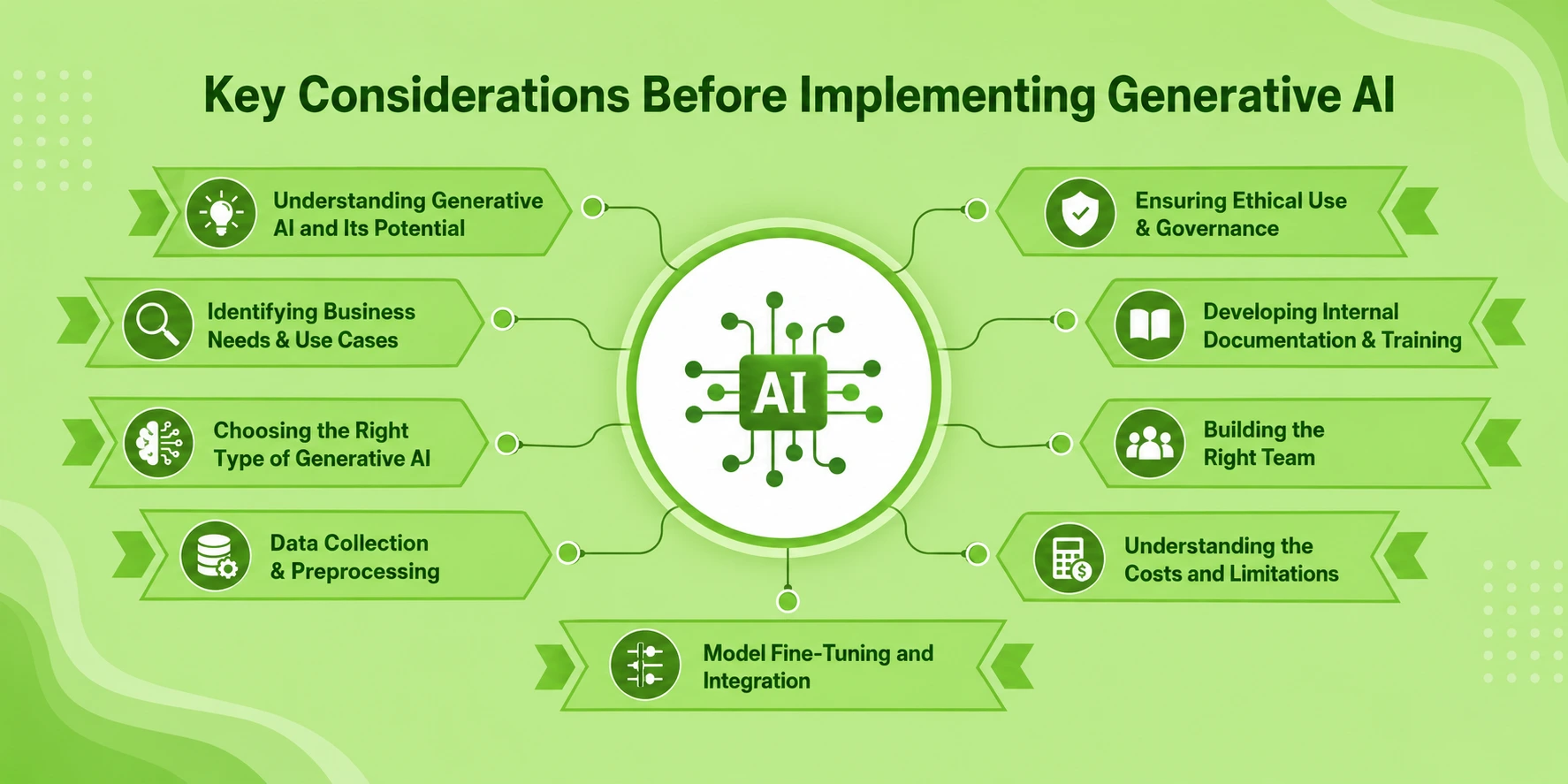
Goal setting for Generative AI Implementation must be specific, measurable, and time-bound. Vague goals like “use AI to improve efficiency” produce vague results. Concrete goals like “reduce first-response time in customer support from 6 hours to 30 minutes by Q3 2026” create clear accountability and success benchmarks.
We advise clients to categorise goals into three tiers. The first tier covers quick wins achievable in 30 to 60 days, such as deploying a content generation tool for the marketing team. The second tier covers medium-term transformation goals achievable in 6 months, such as AI-assisted customer support workflows. The third tier covers long-term structural changes, such as fully autonomous business reporting systems that run without human intervention.
Tier 1: Quick Wins (0 to 60 Days)
Deploy content AI tools, launch internal chatbots, automate meeting summaries and email drafting for key departments.
Tier 2: Core Transformation (3 to 6 Months)
Integrate AI into customer support, sales prospecting, HR onboarding, and product documentation workflows.
Tier 3: Structural AI Infrastructure (6 to 18 Months)
Build proprietary AI models, autonomous reporting systems, and organisation-wide AI governance frameworks.
7. Choosing the Right Tools for Generative AI Applications
Selecting the right tools is a critical step in any Generative AI for business Strategy. The market is now saturated with options, and not every tool is appropriate for every business context. The criteria we use with clients include scalability, data privacy controls, integration flexibility, language support (especially for Hindi, Arabic, and regional languages), and vendor track record.
Generative AI Tool Categories for Business Use
| Category | Examples | Best For |
|---|---|---|
| LLM Platforms | GPT-4, Claude, Gemini | Content generation, summarisation, code assistance |
| AI Chatbot Builders | Botpress, Voiceflow, Intercom AI | Customer support, lead qualification, FAQ automation |
| Image and Design AI | Midjourney, DALL-E, Adobe Firefly | Marketing visuals, product imagery, ad creative |
| Code Generation AI | GitHub Copilot, Cursor, Replit AI | Software teams, QA automation, API building |
| Enterprise AI Suites | Microsoft Copilot 365, Salesforce Einstein | Large enterprises needing integrated AI across all tools |
8. Step by Step Generative AI Implementation
Successful Generative AI Implementation is a structured process, not a single event. Based on deployments we have managed across verticals including fintech, healthcare, retail, and real estate in India and the UAE, we have refined a reliable eight-step framework.[2]
Business Discovery
Audit current workflows, identify the highest-value AI use cases, and prioritise based on effort and ROI potential.
Data Readiness Assessment
Evaluate the quality, quantity, and accessibility of your business data that will power AI model performance.
Tool and Vendor Selection
Choose AI platforms and work with an experienced AI agent development company that aligns with your technical stack, data privacy requirements, and language needs.
Pilot Program Launch
Deploy AI in one department or workflow, measure results tightly, and gather user feedback before expanding.
Integration with Systems
Connect AI tools to your CRM, ERP, CMS, and communication platforms through APIs and middleware solutions.
Team Training
Equip staff with the skills and confidence to use AI tools effectively through structured learning programs.
Full Rollout
Scale the AI across all target departments with governance protocols, feedback loops, and escalation paths active.
Continuous Optimisation
Monitor KPIs monthly, retrain models on new data, and update use cases as business needs evolve over time.
9. Planning a Successful Generative AI Implementation Process
Planning is where most Generative AI for business Implementation projects either win or lose. Businesses that dedicate four to six weeks exclusively to planning before any tool is deployed consistently achieve faster results and fewer costly rollbacks. This planning phase covers stakeholder alignment, risk mapping, budget forecasting, and technical architecture design.
Key planning deliverables include a use case priority matrix, a data governance policy, a vendor evaluation scorecard, a 90-day implementation timeline, and a stakeholder communication plan. In markets like Dubai, where regulatory compliance in AI is increasingly governed by the UAE AI Office, this planning phase must also include a compliance review.
Indian enterprises must additionally account for data localisation laws under DPDP (Digital Personal Data Protection) Act requirements, which affect how personal data can be used in AI training pipelines. Building these legal constraints into the planning phase prevents expensive project delays later.
10. Training Teams for Better AI Adoption
Technology alone cannot drive Generative AI for Business success. People are the final variable. In every engagement we have delivered across India and the UAE, team training and change management have been the most underestimated aspects of any AI program.
Effective AI training is not about making everyone a data scientist. It is about making every employee an informed, confident user of generative AI for business tools relevant to their role. A copywriter needs to learn how to prompt effectively. A finance analyst needs to understand how to validate AI-generated summaries. A customer service agent needs to know when to hand off from AI to human.
We recommend a tiered training model: foundational AI literacy for all staff, intermediate tool usage training for departmental users, and advanced AI management skills for team leads and IT. This ensures everyone grows in AI capability at a pace that matches their role and responsibility.
11. Best Practices for Generative AI Integration
Effective Generative AI for business Integration follows a set of proven best practices that separate high-performing generative AI for business programs from costly, chaotic rollouts. After eight years of enterprise AI deployments, these are the principles we stand by without exception.
- Start narrow, scale wide. Begin with one clearly defined use case and prove it before expanding to multiple departments.
- Human in the loop always. Never fully remove human oversight from AI outputs, especially in customer-facing or regulated contexts.
- Document everything. Maintain a living record of prompts, model versions, output quality scores, and user feedback for continuous improvement.
- Measure before and after. Establish clear baseline metrics before integration and compare rigorously at 30, 60, and 90-day intervals.
- Update your governance policies. As AI capabilities evolve, your internal policies on data use, output review, and ethical use must evolve alongside them.
- Celebrate early wins publicly. Share successful AI outcomes internally to build enthusiasm and reduce adoption resistance across teams.
12. How Generative AI Integration Improves Daily Work
The most tangible impact of Generative AI Integration is felt in the day-to-day workflows of individual employees. Rather than abstract efficiency gains, AI delivers practical time savings that compound across an entire organisation every single day.
Daily Work Improvements by Department
| Department | Daily AI Task | Time Saved Per Day |
|---|---|---|
| Marketing | AI drafts campaign copy, social posts, and ad headlines | 2 to 3 hours |
| Customer Support | AI resolves Tier 1 queries and drafts Tier 2 responses | 3 to 5 hours |
| Legal and Compliance | AI summarises contracts and flags clause anomalies | 1.5 to 2.5 hours |
| Finance | AI generates financial narrative summaries from raw spreadsheets | 1 to 2 hours |
| HR | AI drafts job descriptions, onboarding guides, and training content | 2 to 4 hours |
13. Keeping Business Data Safe During Generative AI Integration
Data security is the number one concern we hear from enterprise clients in both Dubai and India when they begin their Generative AI Integration journey. The concern is valid. When business data is sent to third-party AI platforms, it can be exposed to training pipelines, retained by vendors, or accessed without adequate controls if the integration is not configured correctly.
The solution is a layered security architecture. This begins with choosing vendors that offer enterprise-grade data agreements with no-training clauses, meaning your data cannot be used to train shared public models. It extends to deploying private model instances on your own cloud infrastructure, implementing role-based access controls so only authorised users interact with sensitive AI tools, and anonymising personal or confidential data before it is processed by any generative AI for business system.
Data Security Checklist for AI Integration
-
- Use vendors with no-data-training enterprise agreements
- Deploy private or dedicated model instances where possible
- Implement role-based access control across all AI tools
- Anonymise personal data before passing it to AI systems
- Maintain full audit logs of all AI-generated outputs
- Review and update AI governance policies every six months
- Comply with DPDP Act (India) and UAE AI Office guidelines
14. Popular Generative AI Applications for Businesses
The ecosystem of Generative AI Applications has matured rapidly. Businesses no longer need to build from scratch. There are production-ready applications across every functional area that can be deployed within days with the right configuration and integration support.
AI Content Platforms
Tools like Jasper, Copy.ai, and Writesonic generate SEO-optimised content for marketing teams at a fraction of traditional cost and time.
AI Sales Assistants
Platforms like Outreach, Salesloft AI, and Gong use generative AI to draft personalised outreach, analyse call recordings, and coach reps in real time.
AI Coding Tools
GitHub Copilot, Cursor, and Tabnine accelerate software teams in India and UAE by suggesting code completions, catching bugs, and writing test cases automatically.
AI Customer Service
Intercom, Zendesk AI, and Freshdesk Freddy handle customer queries intelligently, escalating only the complex cases that require human empathy and judgement.
AI Business Intelligence
Microsoft Copilot in Power BI and ThoughtSpot Sage allow business analysts to query data in natural language and receive instant visualisations and narratives.
AI Creative Tools
Adobe Firefly, Canva AI, and Runway ML empower creative teams to produce brand-consistent visuals, videos, and design assets faster than any traditional workflow allows.
15. Measuring Results From Your Generative AI Strategy
No Generative AI Strategy is complete without a rigorous measurement framework. AI programs that cannot demonstrate clear ROI are quickly defunded, regardless of their technical quality. Measurement must begin before the first AI tool is deployed and must continue on a regular cadence throughout the program lifecycle.
We organise AI measurement into four categories: productivity metrics (time saved per task, output volume), quality metrics (error rate reduction, output accuracy scores), financial metrics (cost per unit of output, total savings generated), and experience metrics (customer satisfaction, employee adoption rate).
Generative AI KPI Framework
| KPI Category | Key Metric | Review Cadence |
|---|---|---|
| Productivity | Hours saved per team per week, output volume per employee | Weekly |
| Quality | Error rate reduction, output accuracy score, revision frequency | Biweekly |
| Financial | Cost per AI-generated output, total departmental savings | Monthly |
| Customer Experience | CSAT score, first response time, resolution rate | Monthly |
| Adoption | Active AI users per department, daily usage rate, NPS from employees | Quarterly |
Businesses in India and the UAE that implement this four-category KPI framework consistently report a faster path to ROI justification, enabling them to secure additional AI investment budgets with confidence. The key is discipline in measurement from week one, not retrofitting metrics after the fact.
As your Generative AI Strategy matures, you will also want to introduce more advanced outcome metrics tied directly to business revenue: AI-influenced pipeline value, customer lifetime value improvements, and market share gains attributable to AI-powered speed and personalisation. These senior-level metrics are what ultimately cement AI as a permanent strategic pillar rather than a departmental experiment.
Final Thoughts
Generative AI for Business is not a trend. It is a structural shift in how modern organisations compete, create, and serve customers. With the right Generative AI Strategy, a disciplined Generative AI Implementation process, thoughtful Generative AI Integration into daily workflows, and the selection of appropriate Generative AI Applications, businesses in India and the UAE are well-positioned to outperform competitors and build lasting operational advantage. The question is no longer whether to adopt AI. It is how quickly and intelligently you act.
Start Your AI Transformation Today
Partner with our team to design, build, and scale a Generative AI program that delivers real business results across your entire organisation.
People Also Ask
Q1.What is Generative AI for Business and how does it work?
Generative AI for Business refers to AI systems that create text, images, code, or data to automate and enhance business operations. It uses large language models trained on vast datasets to generate human-like, context-aware outputs that support real business decisions.
Q2.How can small businesses in India use Generative AI?
Small businesses in India can use Generative AI for Business to automate customer support, create marketing content, generate financial summaries, and streamline HR workflows. Even with limited budgets, cloud-based AI tools make adoption affordable and fast for growing Indian businesses.
Q3.Is Generative AI safe to use for business data?
Yes, when implemented with proper governance, Generative AI for Business can be very safe. Businesses should use role-based access controls, data masking, and private model deployments to ensure sensitive business data is never exposed to third-party training pipelines.
Q4.What are the most common Generative AI Applications for businesses in Dubai?
Businesses in Dubai commonly use Generative AI Applications for automated Arabic and English content creation, customer experience personalization, legal document drafting, real estate listing generation, and smart contract analysis in the fintech and property sectors.
Q5.How long does Generative AI Implementation take for a mid-size company?
A typical Generative AI Implementation for a mid-size company takes between 6 to 20 weeks depending on complexity. This includes discovery, tool selection, pilot testing, team training, and phased rollout across business departments.
Q6.What is a Generative AI Strategy and why does my business need one?
A Generative AI Strategy is a structured roadmap that defines how AI will align with your business goals, which tools will be used, how ROI will be measured, and how risks will be managed. Without a clear strategy, most AI projects fail to deliver lasting business value.
Q7.What are the top benefits of Generative AI Integration in daily business operations?
Generative AI Integration boosts productivity by automating repetitive tasks, improves content quality, accelerates decision-making with generative AI for business insights, reduces operational costs, and enables teams to focus on high-value creative and strategic work every day.
Q8.Which industries in UAE are adopting Generative AI for Business fastest?
In the UAE, industries including real estate, banking, healthcare, retail, and logistics are among the fastest adopters of Generative AI for Business. Dubai’s Smart City initiatives and government-backed AI programs are significantly accelerating enterprise adoption across all major sectors.
Q9.How do I measure the ROI of my Generative AI Strategy?
Measuring ROI from your Generative AI for business Strategy involves tracking metrics like time saved per task, content output volume, customer satisfaction scores, error reduction rates, and cost savings per department. Set baseline KPIs before launch and review them quarterly for accurate measurement.
Q10.Can Generative AI Applications replace human employees?
Generative AI for business Applications are designed to augment, not replace, human employees. They handle repetitive, data-heavy, or content-generation tasks so human teams can focus on creativity, relationships, and complex judgement calls that AI cannot yet replicate effectively.
Explore Services
Related Services
Reviewed by

Aman Vaths
Founder of Nadcab Labs
Aman Vaths is the Founder & CTO of Nadcab Labs, a global digital engineering company delivering enterprise-grade solutions across AI, Web3, Blockchain, Big Data, Cloud, Cybersecurity, and Modern Application Development. With deep technical leadership and product innovation experience, Aman has positioned Nadcab Labs as one of the most advanced engineering companies driving the next era of intelligent, secure, and scalable software systems. Under his leadership, Nadcab Labs has built 2,000+ global projects across sectors including fintech, banking, healthcare, real estate, logistics, gaming, manufacturing, and next-generation DePIN networks. Aman’s strength lies in architecting high-performance systems, end-to-end platform engineering, and designing enterprise solutions that operate at global scale.