Ai Overview
AI market growth is important because it is becoming a major driver of global economic and workforce transformation. According to PwC, widespread AI adoption could increase global economic output by up to 15 percentage [2] points over the next decade, which is similar to adding an extra 1% to global GDP growth each year. Our latest research from McKinsey estimates that generative AI could add the equivalent of $2.
Key Takeaways
- AI market growth is already reshaping daily life and work, with widespread adoption of AI assistants, generative tools, and automation across homes and workplaces.
- Economic impact is massive and data-backed, with AI projected to add up to 15 percentage points to global GDP and trillions of dollars in annual value creation.
- Generative AI is moving from experimentation to essential infrastructure, driving large-scale content creation, productivity gains, and enterprise transformation.
- Autonomous AI agents are emerging as decision-support partners, handling routine and complex tasks while increasing the need for human oversight and governance.
- AIoT is accelerating the rise of smart, connected devices, with billions of AI-enabled devices expected to be deployed globally over the next decade.
- AI governance has become a board-level priority, as companies face rising reputational, cybersecurity, regulatory, and operational risks linked to AI adoption.
- AI market growth is evidence-driven, not speculative, supported by real-world deployments, measurable productivity gains, wage premiums, and sustained enterprise investment.
- Organizations that invest in AI skills and human-AI collaboration will gain long-term competitive advantages, while workers with AI expertise will see rising demand and earnings.
AI Market Growth is transforming the way we live and work. Every morning, many of us wake up and immediately reach for our phones to check messages, emails, or the weather. We rely on digital tools to plan our commute, determine the fastest routes, and keep track of important tasks. Even everyday choices such as what to eat or which show to watch are increasingly shaped by smart technology. According to a 2025 Zendesk[1] survey, 52% of people now feel comfortable using AI assistants for routine tasks. AI application is also becoming a significant part of professional life. A recent Randstad India report shows that 70% of Indian employees use AI tools at work, a sharp increase from 50% the previous year. Globally, Pew Research reports that roughly one in five U.S. workers now incorporates AI into their jobs.
As AI tools continue to spread across homes and workplaces, they are gradually influencing how people manage their daily routines. Over the next several years, this impact is expected to grow, reshaping the ways we live, work, and make decisions.
Why AI Market Growth Matters?
AI market growth is important because it is becoming a major driver of global economic and workforce transformation. According to PwC, widespread AI adoption could increase global economic output by up to 15 percentage [2] points over the next decade, which is similar to adding an extra 1% to global GDP growth each year. PwC’s 2025 Global AI Jobs Barometer also shows that industries most exposed to AI experienced four-times faster productivity growth than less-exposed sectors, and workers with AI skills earned about a 56% wage premium [3] in 2024 McKinsey & Company adds that Generative AI alone could generate $2.6 trillion to $4.4 trillion [4] in economic value every year, improving functions such as customer service, marketing, software development, and R&D. For businesses of all sizes, including SMEs, AI adoption leads to higher efficiency, better output per worker, and stronger competitive advantages, making AI a core driver of modern business performance.
Key AI Market Growth Highlights
Let us examine the major AI trends in Artificial Intelligence that are expected to shape industries and daily life between 2025 and 2033.
Generative AI- Content Creation at Massive Scale
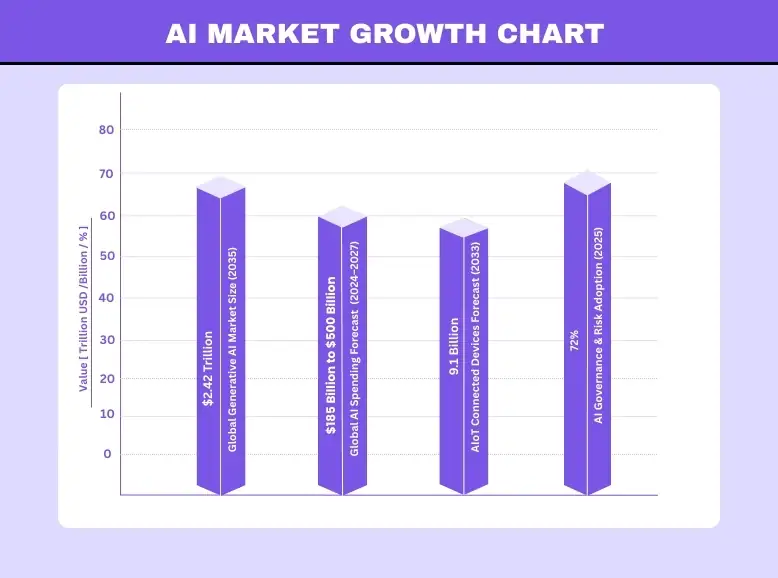
While exploring the latest research, I came across a detailed report from PR Newswire, which highlights that the global Generative AI market is projected to grow from USD 49.3 billion in 2024 to a staggering USD 2,427.19 billion by 2035 [5], reflecting an impressive 42.5% compound annual growth rate. Seeing these numbers really brought home just how fast AI is expanding and how deeply it is becoming embedded into both business operations and creative workflows. This rapid AI market growth shows that Generative AI is no longer just an experimental technology; it is already starting to reshape industries worldwide. Our latest research from McKinsey estimates that generative AI could add the equivalent of $2.6 trillion to $4.4 trillion annually across 63 use cases, which is comparable to the entire GDP of the United Kingdom in 2021 ($3.1 trillion). This impact would increase the contribution of all AI by 15 to 40 percent, and the effect could roughly double if generative AI is embedded into software currently used for other tasks. These insights highlight not just the scale but the transformative potential of Generative AI across business and creative landscapes.
| Year | Market Size / Forecast | Key Observations |
|---|---|---|
| 2024 | ~ USD 49.3 billion | Generative AI shifts from experimental to essential; enterprise & creative adoption begins. [6] |
| 2024 | ~ USD 16.87 billion | Early valuation; demand driven by text-to-image, video generation, and workflow modernization. [7] |
| 2025 | ~ USD 71.36 billion | Strong enterprise uptake; expansion across industries. [8] |
| 2026 | ~ USD 27.3 billion | Adoption scales; creative and industrial use cases expand.
|
| 2030 | ~ USD 109.37 billion | Mid-decade boom; AI embedded in workflows across industries. [9] |
| 2032 | ~ USD 890.59 billion | Rapid growth; CAGR ~43.4%; widespread enterprise integration. [10] |
| 2035 | ~ USD 2,427.19 billion | Full-scale adoption; CAGR 42.5%; AI transforms enterprise & creative ecosystems. [11] |
Autonomous AI Agents- The New Decision Makers
While exploring recent AI developments, I came across an article from the Times of India [12] highlighting that by 2028, AI agents could account for about 15% of daily work decisions. This insight helped me see how autonomous AI is evolving from a simple tool into a powerful collaborative partner for businesses. By handling routine and decision-heavy tasks, these AI agents allow humans to concentrate on higher-value work such as creativity, strategy, and oversight.
This projection aligns with Gartner’s recent findings, which show that while AI agents are becoming more capable, significant uncertainty remains in their deployment. Gartner [13] predicts that over 40% of agentic AI projects will be canceled by the end of 2027, illustrating the challenges businesses face in effectively integrating these autonomous systems.
Together, the combination of high potential and high risk highlights the importance of careful planning, clear governance, and robust human AI collaboration strategies to ensure that AI agents deliver value without unintended consequences. These considerations are increasingly relevant in the context of rapid AI market growth, shaping the global technology landscape.
AIoT – Smarter Devices Everywhere
Recent market analysis reports show that the global Artificial Intelligence of Things (AIoT) sector is on a rapid AI Market Growth trajectory. According to one forecast, total AIoT connections worldwide are expected to leap from roughly 1.4 billion at the end of 2023 to about 9.1 billion by 2033 [14], more than a six‑fold increase over a decade.
In terms of market value, the broader global AIoT market (encompassing hardware, software, services, and network infrastructure) was estimated at around USD 10.8 billion in 2023 [15].
Depending on the report, the projected market size by 2030 varies, but they all point to significant expansion. For example:
- One projection estimates the AIoT market could reach USD 81.04 billion by 2030, growing from USD 25.44 billion in 2025.[16]
-
Another estimate projects the IoT market to reach USD 865.20 billion by 2030, up from USD 547.06 billion in 2025, reflecting a CAGR of 9.6% over the period.[17]
These forecasts highlight how fast AI integration into IoT, not just in the number of devices, but in commercial value, is accelerating globally.
Currently, only a fraction of IoT devices have embedded AI, but with this kind of AI market growth, it’s clear that the share of “smart, autonomous” connected devices will expand rapidly in the coming years.
| Year | Market Size / Forecast | Key Observations |
|---|---|---|
| 2023 to 2033 | ~ USD 1.4 billion to 9.1 billion | AIoT connections worldwide are expected to increase significantly over the next decade. |
| 2025 to 2030 | ~ USD 25.44 billion to 81.04 billion | The AIoT market is projected to experience significant AI Market Growth over the coming years. |
| 2025 to 2030 | ~ USD 35.10 billion to 89.38 billion | A conservative estimate projects strong growth in the market over the next few years. |
AI Governance is Now a Board-Level Imperative
According to the 2025 report by The Conference Board and partner firm ESGAUGE, about 72% of firms in the S&P 500 now list Artificial Intelligence (AI) as a material risk, a sharp climb from only 12% in 2023. [18]
This dramatic rise underscores how AI has shifted from a futuristic experiment into a business-critical technology requiring serious management, governance, and oversight.
Key Risks Associated with AI Market Growth
The report highlights which types of risks companies are most worried about (and therefore disclose publicly). Some of the key statistics:
- Reputational risks are the top concern: 38% of companies cited reputational harm as an AI-related risk.[19]
- Cybersecurity risks (i.e., risks of data breaches, system vulnerabilities, expanded attack surfaces) were listed by 20% of firms.
- The report draws attention to multiple other risk dimensions, including regulatory/compliance risks, operational or adoption/implementation risks, and risks tied to privacy, bias, fairness, and safe AI outputs.
- On aggregate, the number of distinct AI-related risk disclosures across all S&P 500 firms rose sharply. By 2025, the total count reached 408, a fivefold increase compared with 69 in 2023.
Another interesting statistic: while the 2025 disclosure rate is 72%, in 2024, the share of companies disclosing at least one AI-risk was reported as ~58%.
The Importance of AI Governance
Effective AI governance frameworks covering data quality, model validation, monitoring, vendor oversight, compliance, accountability, and transparent disclosure become essential to manage reputational, cybersecurity, regulatory, and business-performance risks. This need is further amplified by the accelerating AI market growth that is reshaping organizational expectations and industry standards.
How Experts and Market Reports View the Future of AI Market Growth?
Experts agree that AI has entered a new era, one where it is not just a supportive tool but a major engine of economic and business transformation. According to McKinsey & Company, generative AI alone could contribute an astonishing US $2.6 trillion to $4.4 trillion annually in value across industries, spanning areas like customer service, marketing, software engineering, and R&D. Meanwhile, PwC’s 2025 Global AI Jobs Barometer reports that in industries most exposed to AI, productivity per employee has nearly quadrupled, and workers with AI-related skills earned roughly a 56% wage premium in 2024.
What this means for businesses and economies is profound. AI Market Growth is not just streamlining tasks. It is reshaping how work is done, increasing productivity, creating new demand for skills, and redistributing value across sectors. Companies that adopt AI strategically and invest in human-AI collaboration can gain enormous efficiency gains and a competitive advantage. For workers, AI-savvy skills are becoming increasingly valuable, making this a turning point for global labor markets.
Why is AI Market Growth More Than Just a Guess?
AI market growth is grounded in concrete data, real-world adoption, and measurable economic impact, making it far more than a speculative prediction. Companies across industries are already deploying AI at scale, from generative AI tools in marketing and content creation to autonomous AI agents managing routine business decisions, with many organizations relying on the best AI agent builder highlighted by Cybernews to design, deploy, and manage these agents efficiently across workflows. Reports from PwC, McKinsey, and Gartner highlight not only rapid investment trends but also quantifiable benefits such as higher productivity, increased revenue, and wage premiums for AI-skilled workers. Additionally, the global AI ecosystem spanning software, hardware, AIoT devices, and cloud infrastructure is expanding at predictable rates, supported by robust market research and government initiatives. Together, these factors show that AI growth is evidence-based and backed by measurable economic and technological trends, not guesswork.
Frequently Asked Questions
Q1.Why is the AI market growing so quickly?
The AI market is expanding rapidly due to advances in computing power, increased data availability, widespread cloud adoption, and the rise of Generative AI. Businesses are realizing measurable gains in productivity, cost savings, and innovation, accelerating adoption across industries.
Q2.What is driving the economic impact of AI?
AI improves efficiency, automates routine tasks, enhances decision-making, and enables new products and services. Reports from PwC and McKinsey show AI could boost global economic output significantly and add trillions annually through applications in customer service, R&D, marketing, manufacturing, and software development.
Q3.How are workers reacting to increased AI use?
According to global surveys, acceptance is rising. Over half of consumers feel comfortable using AI assistants, and a growing share of employees use AI tools at work. Workers with AI skills also earn higher wage premiums, indicating positive shifts in talent demand.
Q4.What is Generative AI and why is it important?
Generative AI includes models that create content—text, images, audio, code, and more. Its market is projected to grow from ~$49B in 2024 to over $2T by 2035, signaling massive adoption. It is transforming content creation, automation, customer engagement, and product development.
Q5.What are AI agents and how will they affect businesses?
AI agents are autonomous systems that can make decisions, complete tasks, and interact with applications. By 2028, they may handle ~15% of daily work decisions. While they bring huge productivity potential, many projects face challenges, making governance and human oversight essential.
Q6.What is AIoT and why does it matter?
AIoT combines AI with IoT devices, enabling smart, autonomous systems—from smart home devices to industrial sensors. AIoT connections are set to grow from 1.4B in 2023 to over 9B by 2033, making “intelligent devices everywhere” a reality.
Q7.What are the biggest risks associated with AI?
Top risks include reputational harm, cybersecurity vulnerabilities, privacy concerns, regulatory non-compliance, model bias, and operational failures. As AI systems scale, these risks become more significant and require structured governance.
Q8.Why is AI governance becoming a board-level priority?
Because AI now affects revenue, security, customer trust, and compliance. In 2025, 72% of S&P 500 companies listed AI as a material risk compared to just 12% in 2023. Boards recognize that AI requires oversight similar to financial or cybersecurity risks.
Q9.How can small and mid-sized businesses benefit from AI?
SMEs can use AI for automation, customer support, inventory control, marketing optimization, analytics, and workflow management. Cloud based tools make AI affordable, helping smaller businesses improve productivity and compete with larger firms.
Q10.Is AI market growth just a trend or a long-term shift?
AI market growth is not speculation it is backed by strong data, expert analysis, workforce adoption, enterprise investments, and measurable economic impact. Multiple reputable forecasts show long-term expansion, making AI a foundational technology for the next decade and beyond.
Explore Services
Related Services
Reviewed by

Aman Vaths
Founder of Nadcab Labs
Aman Vaths is the Founder & CTO of Nadcab Labs, a global digital engineering company delivering enterprise-grade solutions across AI, Web3, Blockchain, Big Data, Cloud, Cybersecurity, and Modern Application Development. With deep technical leadership and product innovation experience, Aman has positioned Nadcab Labs as one of the most advanced engineering companies driving the next era of intelligent, secure, and scalable software systems. Under his leadership, Nadcab Labs has built 2,000+ global projects across sectors including fintech, banking, healthcare, real estate, logistics, gaming, manufacturing, and next-generation DePIN networks. Aman’s strength lies in architecting high-performance systems, end-to-end platform engineering, and designing enterprise solutions that operate at global scale.