Ai Overview
AI Application and AI Platforms are no longer optional tools but essential pillars of competitive business strategy in every sector. Artificial intelligence is projected to add over $15. AI driven data analysis enables faster, more accurate decision-making that reduces costs and boosts operational efficiency by up to 40%. Netflix and Amazon attribute over 35% of their revenue directly to their AI recommendation systems.
★ Key Takeaways
- AI Application and AI Platforms are no longer optional tools but essential pillars of competitive business strategy in every sector.
- Artificial intelligence is projected to add over $15.7 trillion to the global economy by 2030, reshaping how businesses create and deliver value.[1]
- Machine learning, natural language processing, and computer vision form the core technologies powering modern AI Application ecosystems.
- Healthcare, finance, retail, and education are experiencing unprecedented transformation through intelligent AI Platforms and automated systems.
- AI driven data analysis enables faster, more accurate decision-making that reduces costs and boosts operational efficiency by up to 40%.
- Smart city initiatives worldwide are leveraging AI Application technology to optimize traffic, energy, public safety, and urban planning.
- Ethical AI governance and transparent algorithmic design are critical factors in ensuring responsible and sustainable AI deployment.
- Businesses that invest in AI Platforms and upskill their workforce achieve higher ROI and superior customer experience outcomes.
- The future workforce will be augmented by AI, requiring a shift toward creative, strategic, and empathy driven roles rather than routine tasks.
- Partnering with experienced AI specialists like Nadcab Labs ensures businesses navigate the complexities of AI adoption with confidence and measurable results.
1. Introduction to Artificial Intelligence
We are living in one of the most transformative eras in human history. Artificial intelligence, once confined to science fiction, now sits at the very heart of how businesses operate, compete, and grow. From intelligent chatbots that handle millions of customer queries to AI Platforms that predict equipment failures before they occur, the technology has permeated every corner of commerce and industry.
At its core, artificial intelligence refers to the simulation of human cognitive functions by machines. This encompasses learning, reasoning, problem solving, perception, and language understanding. Today, an AI Application can diagnose disease, write software code, compose music, drive vehicles, and negotiate contracts. The breadth of capability is simply staggering.
What makes this moment particularly pivotal is that AI is no longer the exclusive domain of tech giants. Small and medium enterprises, government bodies, healthcare providers, and educational institutions are all deploying AI Platforms to gain competitive advantage. The democratization of intelligent technology is accelerating at a pace that demands every business leader pay close attention.
2. The Evolution of AI Technology
The journey of artificial intelligence spans more than seven decades. What began as rule based programs and expert systems in the 1950s has evolved into sophisticated neural networks, large language models, and autonomous AI Platforms that operate at superhuman speeds. Understanding this progression helps contextualize why the current wave of AI Application is so transformative.
AI Technology Evolution Lifecycle
1950s to 1970s — Rule-Based Systems and Early Expert Systems. Alan Turing introduced the concept of machine thinking.
1980s to 1990s — Machine Learning emergence, neural network research, and pattern recognition breakthroughs.
2000s to 2010s — Deep learning revolution. GPU acceleration makes training large AI models commercially viable.
2015 to 2020 — AI Platforms become cloud accessible. Natural language processing matures. AI Application reaches consumer markets.
2021 to Present — Generative AI, multimodal models, autonomous agents, and enterprise grade AI Platforms redefine business operations globally.
3. Why AI is Transforming the Modern World
The reason AI Application is reshaping the world so profoundly comes down to three forces converging simultaneously: exponentially growing data, dramatically falling compute costs, and algorithmic breakthroughs that allow machines to learn from that data at unprecedented scale.
Consider this powerful statement from McKinsey Global Institute: AI could deliver up to $4.4 trillion of additional global corporate value annually. This figure is not aspirational; it is grounded in documented productivity gains, cost reductions, and revenue expansions already observed across industries deploying AI Platforms at scale.
4. Key Technologies Powering Artificial Intelligence
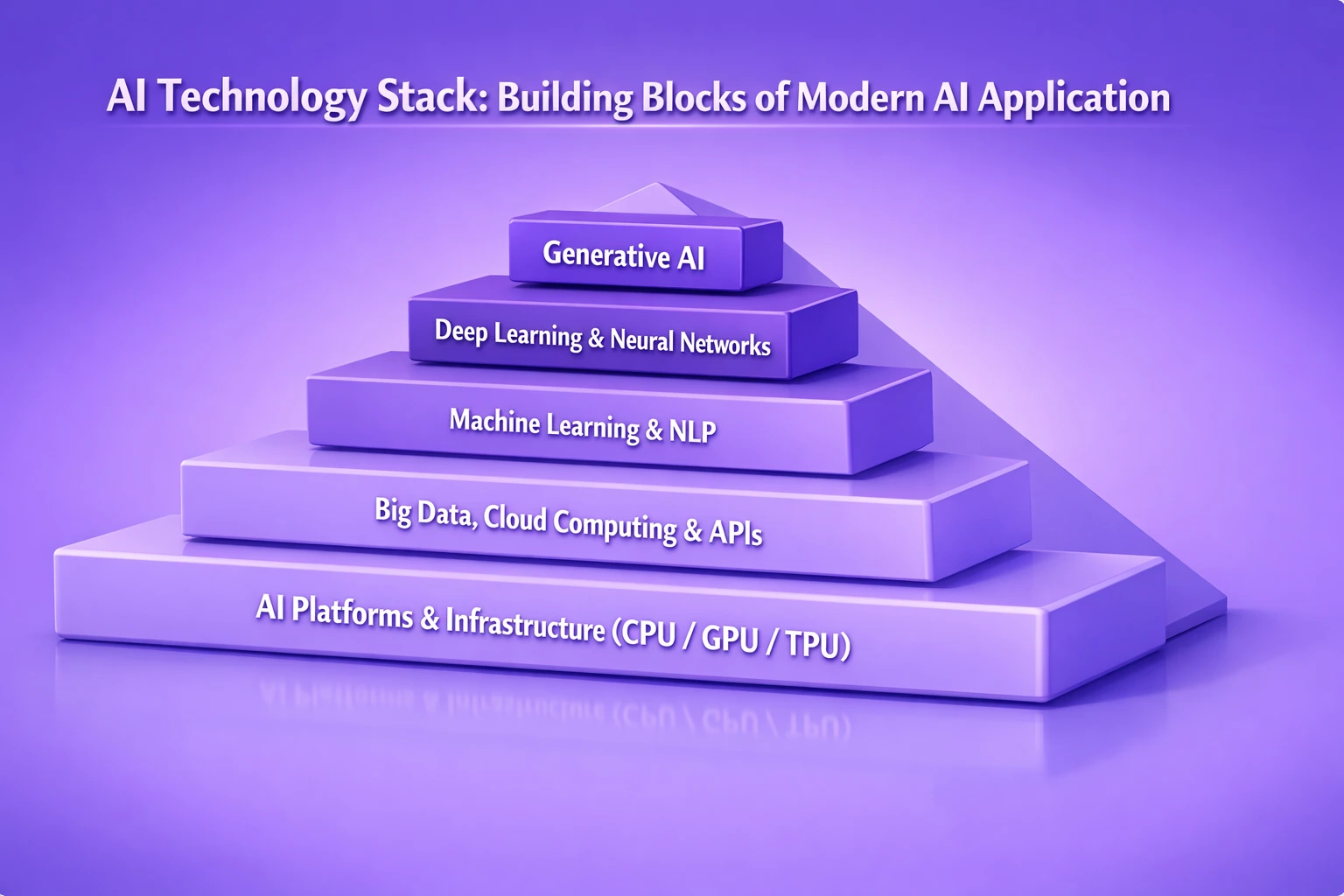
Modern AI applications and platforms are built on a stack of interlocking technologies that support artificial intelligence development. Understanding these building blocks reveals why AI is so versatile and why its applications span from healthcare diagnostics to financial fraud detection. The primary technology pillars include machine learning, deep learning, natural language processing, computer vision, and reinforcement learning.
| Technology | Core Function | AI Application Example | Business Impact |
|---|---|---|---|
| Machine Learning | Learns patterns from data | Predictive analytics, recommendation engines | Revenue uplift up to 20% |
| Deep Learning | Multilayer neural network inference | Image recognition, speech processing | 95%+ accuracy in classification tasks |
| Natural Language Processing | Understands and generates human language | Chatbots, sentiment analysis, contracts | 50% support cost reduction |
| Computer Vision | Interprets visual data from images and video | Quality inspection, autonomous vehicles | 30% defect reduction in manufacturing |
| Reinforcement Learning | Learns via reward and penalty signals | Supply chain optimization, robotics | 25% logistics cost savings |
5. AI in Business and Industry Automation
Industry automation powered by AI solutions is reshaping manufacturing, logistics, customer service, and supply chain management. Modern AI Platforms can monitor production lines in real time, predict failures, automate reordering, and optimize routing, all simultaneously and without human intervention.
A compelling example is Amazon’s warehouse automation network. Using a combination of computer vision, robotic AI, and predictive inventory AI Platforms, Amazon reduced order fulfillment time from 60 minutes to just 15 minutes while cutting operational costs by 20%. This model is now being replicated across retail, pharmaceutical, and automotive sectors.
Key Areas Where AI Application is Automating Business Operations
- Robotic Process Automation (RPA) for repetitive data entry and document processing tasks
- Intelligent scheduling and workforce management through AI Platforms
- Real time supply chain visibility and predictive restocking powered by ML algorithms
- AI driven quality assurance using computer vision in manufacturing lines
- Smart contract automation in procurement and vendor management
- Automated financial reporting and compliance monitoring
6. How AI is Revolutionising Healthcare
Healthcare stands as perhaps the most profound domain where AI Application is saving lives. From early cancer detection to drug discovery acceleration, AI Platforms are delivering outcomes that were considered impossible just a decade ago. IBM Watson Health pioneered the concept of AI driven clinical decision support, while newer platforms like Google DeepMind have achieved ophthalmologist level accuracy in diagnosing eye diseases from retinal scans.
AI Application in drug discovery deserves special mention. Traditional drug discovery takes 10 to 15 years and costs over $2 billion per successful drug. AI Platforms compress this timeline dramatically by modeling protein structures, simulating molecular interactions, and identifying candidate compounds with exponentially greater speed. AlphaFold by DeepMind solved the 50 year protein folding problem, unlocking a new era of precision medicine.
7. AI Transformations in the Financial Sector
The financial sector was among the earliest adopters of AI Application and continues to lead in deployment maturity. AI Platforms now process billions of transactions daily, detecting fraud in milliseconds, optimizing investment portfolios, assessing credit risk, and providing personalized wealth management at scale.
JPMorgan Chase deployed an AI Application called COiN (Contract Intelligence) that reviews 12,000 commercial credit agreements in seconds, a task that previously required 360,000 hours of lawyer time annually. This single AI deployment saved the bank an estimated $150 million in operational costs within its first year.
| AI Use Case in Finance | Traditional Approach | AI Platform Approach | Improvement |
|---|---|---|---|
| Fraud Detection | Rule based filters, 24hr review | Real time ML anomaly detection | 80% fewer false positives |
| Credit Scoring | FICO score, 2 to 3 day process | AI with 1,000+ variables, instant | 40% better default prediction |
| Algorithmic Trading | Manual analysis and execution | AI executes millions of trades/second | 70% of US equity volume is AI driven |
| Customer Service | Call center agents, long wait times | AI chatbots with NLP, instant response | 65% cost reduction |
8. Artificial Intelligence in Education and Learning
Education is experiencing a paradigm shift driven by AI Application. Adaptive learning AI Platforms analyze student performance in real time, adjusting content difficulty, pacing, and teaching style to individual needs. Platforms like Khan Academy’s Khanmigo and Duolingo’s AI tutor demonstrate how personalized instruction at scale is now achievable.
Beyond personalization, AI Platforms are transforming administrative functions in education. Automated grading, plagiarism detection, enrollment analytics, and intelligent scheduling free educators from routine tasks, allowing them to focus on mentorship and creative instruction. Early intervention systems powered by AI identify at risk students weeks before traditional methods would detect a problem. With AI-generated content becoming widespread in classrooms, the role of an online plagiarism checker has expanded far beyond catching copied text. Modern tools now detect AI-written submissions, paraphrased content, and citation manipulation with near forensic accuracy, helping institutions preserve academic integrity at scale.
“AI Application in education is not about replacing teachers. It is about amplifying their impact so every student receives the individual attention they deserve, regardless of class size or geography.”
9. AI in Retail and Customer Experience
The retail industry has been transformed beyond recognition by AI Application and AI Platforms. Personalization engines powered by collaborative filtering and deep learning analyze browsing history, purchase patterns, and real time behavior to serve hyper relevant product recommendations. Netflix and Amazon attribute over 35% of their revenue directly to their AI recommendation systems.
Inventory management is another area where AI Platforms deliver measurable ROI. Predictive demand forecasting reduces overstock by 20 to 30% while simultaneously minimizing stockouts. The same logic applies to order of operations. AI eCommerce order management through MyEcomClaw works exactly this way, validating and routing every incoming order automatically while flagging the exceptions that genuinely need a human to look at them. Walmart uses an AI Application system that processes over 40 petabytes of transaction data daily to optimize inventory across its global network.
Retail AI Application Touchpoints Across the Customer Journey
10. The Role of AI in Data Analysis and Decision Making
Data is the fuel that powers AI Application. The global datasphere is expected to reach 175 zettabytes by 2025, a volume no human team could ever process or interpret. AI Platforms equipped with advanced analytics capabilities transform this raw data into actionable intelligence, enabling executives to make informed decisions with confidence and speed.
Augmented analytics, a key feature of modern AI Platforms, automates data preparation, insight discovery, and explanation in natural language. Business intelligence tools like Tableau with Einstein Analytics and Microsoft Power BI with Copilot allow non technical users to query vast datasets conversationally, democratizing data driven decision making across entire organizations.
AI Data Analysis: From Raw Data to Strategic Decision
11. AI and Smart Cities Development
Smart cities represent the most ambitious application of AI Platforms at a societal scale. Singapore, Dubai, and Barcelona have deployed comprehensive AI Application ecosystems that manage traffic signals, predict energy demand, optimize waste collection, monitor air quality, and respond to public safety incidents in real time.
Traffic management AI Platforms alone demonstrate the potential. Columbus, Ohio reduced traffic congestion by 40% and emergency response times by 35% after implementing an integrated AI traffic optimization system. The economic value created through reduced commute times, fuel savings, and productivity gains exceeded $100 million annually for the city.
12. Benefits of Artificial Intelligence for Businesses
The business case for adopting AI Application and AI Platforms is compelling across every industry. Beyond the headline metrics, organizations that embrace AI develop structural competitive advantages that compound over time.
| Benefit Category | AI Application Impact | Measurable Outcome |
|---|---|---|
| Cost Efficiency | Automates repetitive high volume tasks | 20 to 30% operational cost savings |
| Revenue Growth | Hyper personalization and upselling | 15 to 25% revenue increase |
| Speed and Agility | Real time analytics and instant response | 3x faster time to market |
| Customer Experience | 24/7 personalized AI interactions | 40% higher customer satisfaction scores |
| Risk Management | Predictive risk modeling and fraud prevention | 80% reduction in fraud losses |
13. Challenges and Risks of AI Implementation
Despite its transformative potential, deploying AI Application in business comes with significant challenges. Data quality remains the most persistent barrier. AI Platforms are only as good as the data they are trained on. Biased, incomplete, or poorly labeled training data produces unreliable, unfair, and sometimes harmful outputs.
Poor data governance leads to biased models and unreliable predictions in AI Platforms.
Demand for AI engineers, data scientists, and ML specialists far exceeds available talent globally.
Connecting AI Application with legacy systems requires significant architectural investment.
AI systems can be exploited through adversarial attacks and data poisoning techniques.
14. Ethical Considerations in Artificial Intelligence
Ethical AI is not a constraint on innovation; it is a precondition for sustainable innovation. As AI Application becomes embedded in decisions affecting hiring, lending, healthcare, and criminal justice, the stakes for getting ethics right are enormous. Algorithmic bias, lack of transparency in model decision making (the “black box” problem), and privacy erosion are the most pressing ethical challenges facing AI Platforms today.
Leading organizations are responding by establishing AI ethics boards, publishing algorithmic impact assessments, and committing to explainable AI (XAI) standards. The EU AI Act, which came into force in 2024, represents the world’s most comprehensive regulatory framework for AI Application, requiring high risk systems to meet strict transparency, accuracy, and human oversight standards.
Core Pillars of Ethical AI Application
- Fairness: AI models must be audited for discriminatory bias across protected demographic groups.
- Transparency: Decision making processes in AI Platforms must be explainable to affected individuals.
- Accountability: Clear human responsibility must exist for every AI Application deployment.
- Privacy: Data minimization and consent must be embedded into AI system design from the outset.
- Robustness: AI Platforms must be tested against adversarial conditions and edge cases before deployment.
15. Future Trends in Artificial Intelligence
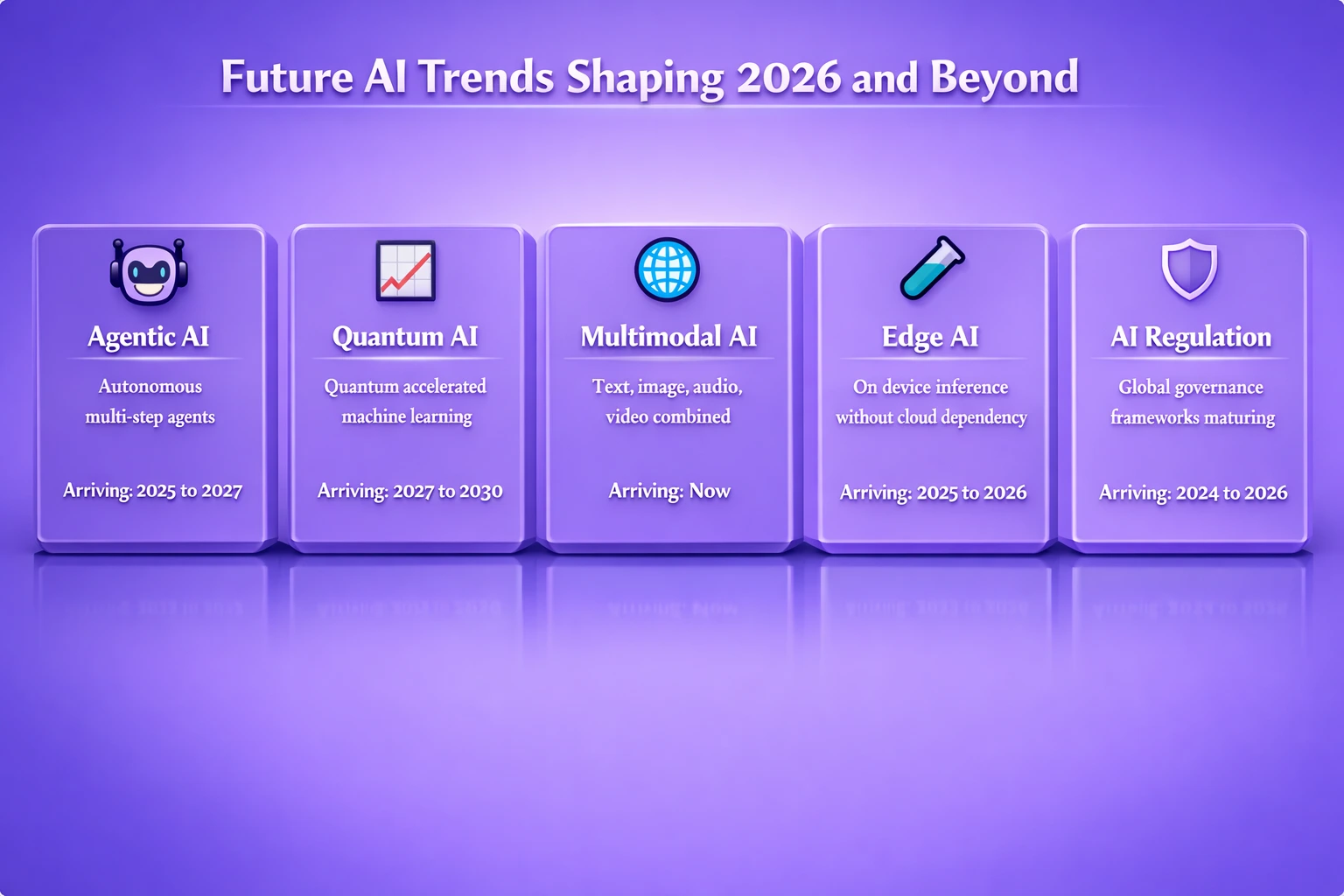
The next decade of AI applications will be defined by several powerful trends converging. Agentic AI, systems capable of autonomously planning and executing multi-step tasks with minimal human oversight, is moving from research labs into enterprise AI Platforms. These agents will handle everything from market research and competitor analysis to budget optimization and vendor negotiation.
Multimodal AI Platforms that simultaneously process text, images, audio, and video are enabling richer, more contextual applications. Quantum AI, the fusion of quantum computing with machine learning, promises to solve optimization problems that are computationally intractable for classical systems, with implications for drug discovery, logistics, and financial modeling that are almost difficult to overstate.
16. The Impact of AI on Jobs and Workforce
The labor market impact of AI Application is nuanced. While AI Platforms will automate approximately 85 million jobs by 2025 according to the World Economic Forum, the same report projects creation of 97 million new roles that are better adapted to the division of labor between humans, machines, and algorithms. The net effect is positive, but the transition demands proactive workforce reskilling.
The most resilient careers in an AI driven economy are those requiring creative problem solving, emotional intelligence, ethical judgment, and cross disciplinary collaboration. Roles in AI Application engineering, prompt design, AI ethics compliance, human-AI collaboration facilitation, and AI model auditing are all experiencing explosive demand.
17. How Businesses Can Adopt AI Solutions
Successful AI adoption is not about deploying the most sophisticated technology. It is about matching the right AI Application to the right business problem with the right organizational readiness. For small businesses without in-house operations expertise, engaging a business operations consultant for small businesses can help evaluate readiness, map existing workflows, and build the operational foundation needed before committing to AI platform investments. A structured adoption framework dramatically improves the probability of success and measurable ROI from AI Platforms.
Organizations that follow this phased approach, often coordinating their implementation phases via AI project management tools, consistently outperform those that attempt wholesale AI transformation. Starting with high impact, lower complexity AI Applications builds organizational confidence, generates quick wins, and creates the data and learning foundations necessary for scaling more sophisticated AI Platforms across the enterprise. Whether optimizing operations, automating workflows, or enhancing brand development with tools like Kittl , a phased implementation strategy helps maximize long-term business value.
Ready to Transform Your Business with AI?
Partner with Nadcab Labs to build, deploy, and scale powerful AI Application and AI Platform solutions tailored to your unique business goals.
Conclusion: The Future of an AI-Driven World
We stand at the threshold of an era where AI Application is not a competitive advantage but a competitive necessity. Organizations that embrace AI Platforms with strategic clarity, ethical commitment, and organizational agility will define the industries of tomorrow. Those that hesitate will find themselves outpaced by competitors who have made intelligence the foundation of everything they do.
The promise of AI is ultimately a human promise: more time for creativity, deeper insights for better decisions, greater capacity to solve problems that have plagued humanity for generations. From curing diseases to building smarter cities, from personalizing education to eliminating financial fraud, AI Application is the most powerful tool we have ever created, and we are only beginning to understand its full potential.
The businesses that will thrive are those that do not merely use AI but make AI thinking central to their culture, strategy, and vision of the future. That future is already here. The only question is whether your organization is ready to lead it.
Frequently Asked Questions
Q1.How much does it cost to build an AI Application for a small business?
The cost of building an AI Application varies considerably based on complexity, data requirements, and integration scope. Simple AI chatbots or recommendation systems can be built using off the shelf AI Platforms for a few thousand dollars per month. Custom machine learning models for specific business use cases typically range from $25,000 to $150,000 for initial development. Enterprise grade AI Platforms with full integration, ongoing training, and compliance features can require investments from $250,000 upward. Working with an experienced partner like Nadcab Labs helps ensure your investment is sized appropriately to the actual business value being created.
Q2.What is the difference between AI Application and traditional software?
Traditional software follows explicit, programmer defined rules to produce outputs. An AI Application learns patterns from data and improves its performance over time without being explicitly reprogrammed. The fundamental difference is adaptability: traditional software behaves identically regardless of changing conditions, while AI Platforms continuously learn, adjust, and optimize based on new data and feedback. This makes AI Application far more capable in domains characterized by complexity, variability, and high data volumes.
Q3.Can AI Application be implemented without a large IT team?
Yes, modern AI Platforms such as Google Vertex AI, Microsoft Azure AI, and AWS SageMaker offer no code and low code tools that allow non technical users to deploy AI models. However, achieving meaningful business results still requires strategic planning, data governance, and integration expertise. Organizations without internal AI capabilities benefit most from partnering with specialist firms who provide both the technical implementation and the ongoing optimization services needed to extract sustained value from AI Application investments.
Q4.How long does it take to see ROI from an AI Platform implementation?
Timeline to ROI from AI Application varies by use case. Customer service chatbots and basic automation show returns within 3 to 6 months. Predictive analytics and recommendation engines typically demonstrate measurable ROI within 6 to 12 months. More complex AI Platforms involving custom model training and deep system integration may require 12 to 24 months for full ROI realization, but often deliver significantly larger long term returns. Setting clear baseline metrics before deployment is essential for accurately measuring AI Platform impact.
Q5.Is my business data safe when using AI Platforms?
Data security in AI Platform deployments depends on the architecture chosen and the security practices implemented. Enterprise AI Platforms from major cloud providers offer robust encryption, access control, and compliance certifications including SOC 2, ISO 27001, and GDPR readiness. Organizations handling sensitive data should implement data anonymization before model training, maintain strict access controls, conduct regular security audits of AI Application systems, and ensure contractual data processing agreements are in place with all AI Platform providers.
Q6.What industries benefit most from AI Application right now?
Healthcare, financial services, retail, and manufacturing are currently the leading industries extracting measurable value from AI Application at scale. Healthcare benefits from diagnostic AI and drug discovery acceleration. Financial services leverage AI Platforms for fraud detection and algorithmic trading. Retail uses AI for hyper personalization and demand forecasting. Manufacturing deploys AI Application for predictive maintenance and quality control. However, virtually every industry from legal and real estate to agriculture and education is now finding high value AI use cases that deliver tangible competitive advantage.
Q7.How do AI Platforms handle languages other than English?
Modern multilingual AI Platforms support dozens to hundreds of languages through transformer based architectures that share semantic representations across language families. Google’s Gemini, Meta’s LLaMA, and Anthropic’s Claude all offer strong multilingual capabilities. However, performance typically remains strongest in languages with abundant training data. For AI Application deployments targeting specific regional languages, it is often advisable to supplement general purpose AI Platforms with language specific fine tuning using domain relevant local language data.
Q8.What is the environmental impact of training large AI models?
Training large AI models is computationally intensive and has a significant carbon footprint. Training GPT-3 reportedly consumed approximately 1,300 megawatt hours of electricity and generated roughly 550 tonnes of CO2. The AI industry is actively addressing this through more efficient training methods, model distillation, and routing inference to data centers powered by renewable energy. Organizations deploying AI Platforms should inquire about the sustainability credentials of their cloud providers and consider carbon offset programs for their AI Application workloads.
Q9.How do you prevent AI hallucinations in business critical applications?
AI hallucinations, where a model generates plausible sounding but factually incorrect outputs, represent a serious risk in business critical AI Application deployments. Mitigation strategies include Retrieval Augmented Generation (RAG), which grounds AI outputs in verified knowledge bases; output validation layers that cross check AI responses against authoritative sources; human in the loop review workflows for high stakes decisions; and careful prompt engineering that explicitly instructs AI Platforms to acknowledge uncertainty rather than confabulate. Fine tuning models on domain specific verified data also significantly reduces hallucination rates in specialized applications.
Q10.What should I look for when choosing an AI Platform provider?
Evaluating AI Platform providers requires assessing seven key parameters: scalability to handle your peak data and inference volumes; security and compliance certifications relevant to your industry; model quality and benchmark performance on tasks representative of your use case; total cost of ownership including training, inference, and API costs; integration flexibility with your existing technology stack; vendor support quality and response time commitments; and the provider’s AI ethics and bias mitigation practices. Requesting a proof of concept trial on a representative subset of your actual use case is the single most reliable way to evaluate AI Platform fit before making a major investment commitment.
Explore Services
Related Services
Reviewed by

Aman Vaths
Founder of Nadcab Labs
Aman Vaths is the Founder & CTO of Nadcab Labs, a global digital engineering company delivering enterprise-grade solutions across AI, Web3, Blockchain, Big Data, Cloud, Cybersecurity, and Modern Application Development. With deep technical leadership and product innovation experience, Aman has positioned Nadcab Labs as one of the most advanced engineering companies driving the next era of intelligent, secure, and scalable software systems. Under his leadership, Nadcab Labs has built 2,000+ global projects across sectors including fintech, banking, healthcare, real estate, logistics, gaming, manufacturing, and next-generation DePIN networks. Aman’s strength lies in architecting high-performance systems, end-to-end platform engineering, and designing enterprise solutions that operate at global scale.