Ai Overview
User onboarding is one of the foundational components of a crypto exchange architecture, as it defines how users enter and interact with the platform. In a well-designed cryptocurrency exchange, onboarding is smooth and easy to understand. These global liquidity providers and market makers supply continuous buy and sell orders, helping maintain tight spreads, deep order books, and stable pricing across trading pairs. This flexibility is essential for maintaining performance and cost efficiency.
Key Takeaways
- A strong cryptocurrency exchange architecture is the foundation of any reliable trading platform, determining how smoothly users trade, how fast orders execute, and how safely funds are stored across all system components.
- The wallet system includes four types: Hot Wallets for instant withdrawals and daily transactions, Cold Wallets for offline majority asset storage, MPC Wallets that split private key control across multiple parties, and Warm Wallets that balance liquidity between hot and cold storage.
- The Trading Engine is the central component controlling order execution logic, price matching rules, and real-time processing, built with in-memory processing, event-driven architecture, and microservices design to support high-frequency trading (HFT).
- Redis caching stores active order books and frequently accessed trading data for reduced latency, while TimescaleDB or time-series databases handle historical trade data and market activity for analysis without affecting live operations.
- The Order Matching Engine matches buy and sell orders using price priority and time priority rules, supporting market orders, limit orders, stop-loss orders, and trailing stop orders with ultra-fast in-memory execution.
- Liquidity is managed through A-Book model (trades routed to external providers for transparent pricing), B-Book model (trades matched internally for faster execution), or hybrid approach, integrating providers like Binance, Coinbase Prime, Kraken, Wintermute, and Jump Trading.
- The Compliance Module ensures regulatory adherence through KYC verification, AML checks, geo-blocking for unsupported countries, and cross-border compliance to protect both users and the exchange from legal risks.
- Market Data Services deliver real-time price updates, order book depth, trade history, and OHLCV data (open, high, low, close, volume) optimized to handle thousands of updates per second without lag.
- The Risk Management Module continuously monitors trading behavior, open positions, and transaction patterns to identify manipulation, wash trading, and abnormal orders while controlling exposure during high volatility periods.
- Infrastructure includes cloud-based deployment for automatic scaling, multi-environment distribution for disaster recovery, DDoS protection against malicious attacks, and auto-scaling to adjust resources based on trading volume fluctuations.
A strong cryptocurrency exchange architecture is the base of any reliable trading platform. It decides how smoothly users can trade, how fast orders are executed, and how safely funds are stored. When an exchange handles thousands of users at the same time, even a small design mistake can cause delays or security risks. That is why a well-planned exchange architecture focuses on performance, stability, and protection of user assets.
Modern trading platforms depend on real-time data, fast order execution, and seamless blockchain communication. A scalable crypto exchange architecture connects all system components in a way that trading remains stable even during high market activity. From account creation to order execution, every step depends on how well the architecture is designed.
User Onboarding
User onboarding is one of the foundational components of a crypto exchange architecture, as it defines how users enter and interact with the platform. In a well-designed cryptocurrency exchange, onboarding is smooth and easy to understand. Users should be able to register, secure their accounts, and access basic features without confusion.
The onboarding flow connects directly with identity verification and wallet setup. A clean onboarding experience improves trust and reduces drop-offs. In a scalable architecture for cryptocurrency exchanges, onboarding systems are designed to accommodate a large number of user sign-ups without compromising performance.
Compliance Module
The compliance module is a critical layer of a secure exchange architecture. It ensures that every user follows legal and regulatory rules before accessing trading features. This module mainly covers KYC verification, AML checks, geo-blocking, and cross-border compliance, which help the exchange operate safely across different regions.
KYC and AML processes verify user identity and track suspicious activities to prevent fraud, money laundering, and illegal transactions. Geo-blocking restricts access from unsupported countries, while cross-border compliance ensures the platform follows local laws in every operating region. These checks protect both users and the exchange from regulatory risks.Wallet System (Hot, Cold, MPC, and Warm Wallets)
The wallet system manages user funds and ensures secure storage, fast withdrawals, and accurate balance updates within a cryptocurrency exchange.
Hot Wallets
Hot wallets handle instant withdrawals and daily transactions. They remain connected to the trading engine to support fast execution while holding limited funds to reduce risk.
Cold Wallets
Cold wallets store the majority of assets offline and protect funds from online threats. Controlled transfers from cold storage maintain liquidity without exposing long-term holdings.
MPC Wallets
MPC wallets split private key control across multiple parties, preventing single-point compromise and strengthening operational security.
Warm Wallets
Warm wallets balance liquidity between hot and cold storage, allowing smoother fund movement during high trading activity.
Blockchain Node Connection
Blockchain nodes detect deposits and confirmations, after which Wallet balances update automatically and users can trade without delay, keeping balances aligned across the exchange architecture.
Wallet Security Controls
Withdrawal limits, approval rules, address monitoring, and real-time alerts protect funds and maintain trust during high-volume usage.
Deposit and Withdrawal System
The deposit and withdrawal system allows users to move funds in and out of the platform. This system must be fast, accurate, and secure so deposits reflect on time and withdrawals are processed without delays.
Every crypto transaction requires on-chain verification to ensure funds are real and confirmed on the blockchain. During deposits, users select the correct network to avoid fund loss, and the system verifies address accuracy before accepting the transaction. Once sent, the transaction goes through multiple block confirmations, after which the balance is credited.
Each transaction is tracked using a transaction hash, which acts as a unique proof on the blockchain and allows users and the system to verify status at any time. Withdrawals follow the same process in reverse, ensuring funds are broadcast correctly and confirmed on-chain.
This system works closely with wallet integration and blockchain confirmations. A weak setup can create trust issues, while a well-designed crypto exchange architecture ensures smooth fund movement even during high transaction volumes.
Trading Interface
The trading interface is where users place orders and track the market. A clear interface shows order books, price charts, and completed trades in real time. A user-focused trading interface is responsive and easy to use.
The interface connects directly with the trading engine and market data systems. A smooth interface improves user confidence and trading activity. A well-built exchange platform ensures that the interface remains stable even during peak trading hours.
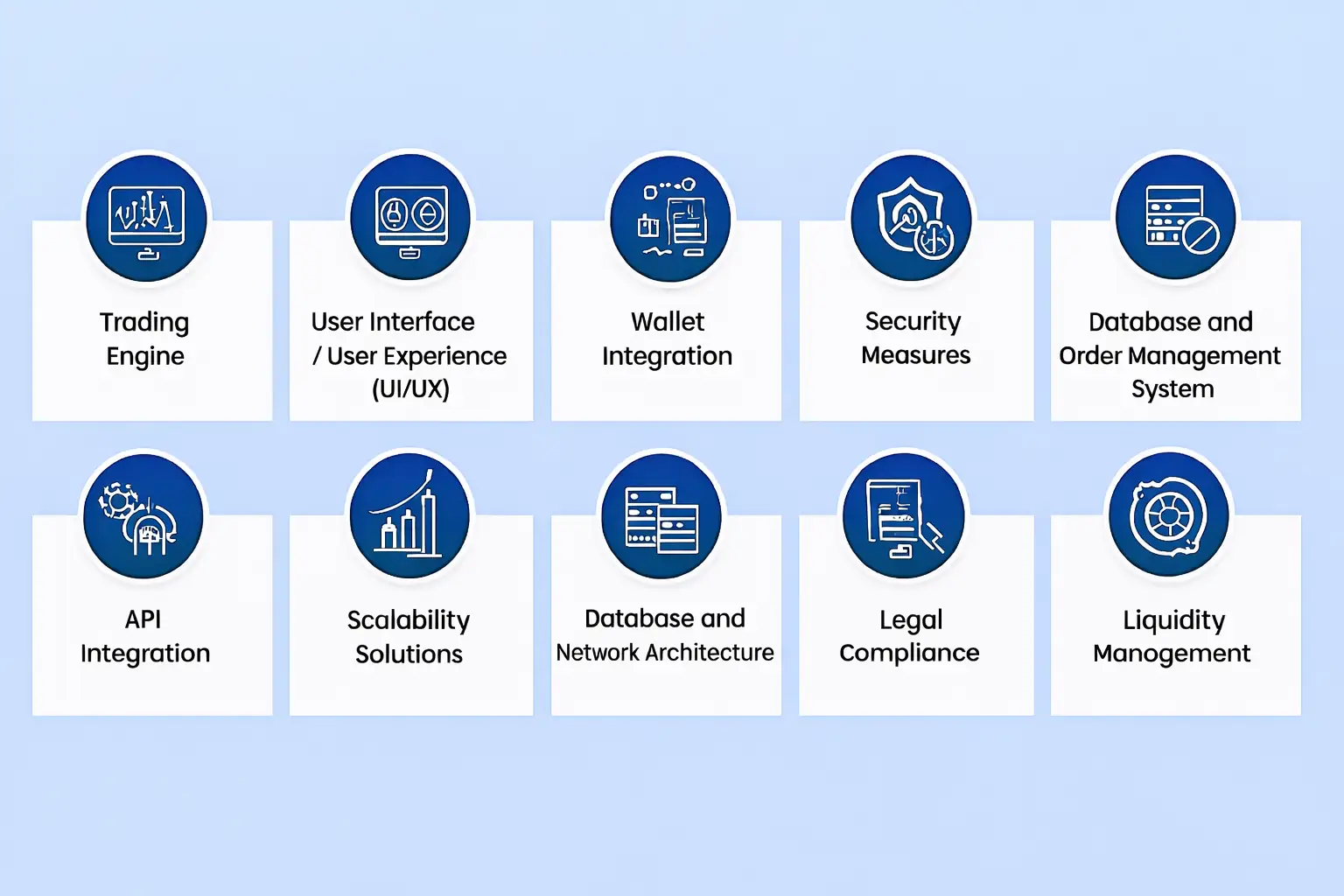
Market Data Service
Market data services deliver real-time price updates, order book depth, and trade history. This component is essential in a high-performance exchange because accurate data helps traders make informed decisions.
Along with live prices, the system also provides OHLCV data open, high, low, close, and volume which represents market movement over specific time intervals. Historical OHLCV data allows traders to analyze past price behavior, identify trends, and compare volume changes over time. This data is continuously updated and synchronized so charts and indicators remain accurate during active trading.
The market data service sends live updates to the trading interface using fast data streams. In a scalable crypto exchange, this service is optimized to handle thousands of updates per second without lag.
Trading Engine
The trading engine is the central component of a cryptocurrency exchange architecture and plays a direct role in how fast and accurately trades are executed. It controls order execution logic, applies price matching rules, and processes every buy and sell order in real time. A well-designed trading engine ensures fair trade execution, low latency, and stable performance even during heavy market activity.
In modern crypto exchange architecture, the trading engine is built to support high-frequency trading (HFT) and high transaction throughput. To achieve this speed, the system uses in-memory processing, event-driven architecture, and microservices-based design. These elements allow the trading engine to scale independently and continue operating smoothly when user volume increases.
For real-time performance, Redis caching is used to store active order books, open orders, and frequently accessed trading data. This reduces database load and improves response time. TimescaleDB or other time-series databases store historical trade data, market activity, and price movements, making it easier to analyze trading patterns and generate reports without affecting live trading operations.
A strong caching and messaging layer is tightly integrated with the trading engine. Messaging systems like RabbitMQ handle real-time communication between services such as the order matching engine, order management system, and wallet services. This ensures instant trade updates, balance synchronization, and smooth order flow across the entire crypto exchange platform.
By combining low-latency trading infrastructure, real-time data processing, and scalable system architecture, the trading engine becomes the backbone of a reliable crypto exchange. The overall performance of a cryptocurrency exchange architecture depends heavily on how efficiently the trading engine is designed and how well it integrates with supporting components.
Build Your Crypto Exchange Today
Launch a High-Performance Cryptocurrency Exchange with Advanced Architecture
Order Matching Engine
The order matching engine is the core system that matches buy and sell orders on a crypto exchange. It works on clear rules such as price priority and time priority, so every trade is executed fairly. In a high-performance cryptocurrency exchange setup, the order matching engine runs in memory to deliver ultra-fast execution with minimum delay.
This engine supports all common order types used by traders. A market order is executed instantly at the best available price, while a limit order allows users to buy or sell only at a chosen price. Advanced options like stop-loss orders help reduce risk by automatically selling when prices fall, and trailing stop orders move with the market to lock in profits as prices rise.
A fast and reliable order matching engine ensures smooth trading, low slippage, and real-time execution even during high market activity. If this system is slow or unstable, users face delays and poor trade results, which directly affects trust and platform performance.
Order Management System
The order management system acts as a control component of a crypto exchange architecture, validating and managing orders before execution. It checks balances, locks funds, and sends valid orders to the matching engine. In a structured cryptocurrency exchange architecture, this system prevents invalid trades and balance issues.
The order management system also keeps records of open and completed orders. It acts as a control layer between the user interface and the core trading logic. A stable exchange relies on this system for accuracy and consistency.
Liquidity and API Module
Liquidity ensures that users can trade without delays or sudden price gaps. In a scalable crypto trading platform, liquidity modules connect with internal liquidity pools and external liquidity providers to keep the order book active at all times, even during low-volume market conditions.
Along with BitGo, exchanges often integrate liquidity from well-known providers such as Binance Liquidity, Coinbase Prime, Kraken, OKX, Bitstamp, Huobi, Cumberland DRW, Jump Trading, GSR Markets, and Wintermute. These global liquidity providers and market makers supply continuous buy and sell orders, helping maintain tight spreads, deep order books, and stable pricing across trading pairs.
Liquidity is commonly managed through A-Book and B-Book models. In the A-Book model, user trades are routed directly to external liquidity providers or the open market, which minimizes exchange risk and ensures transparent price discovery. In the B-Book model, trades are matched internally within the platform, enabling faster execution and better liquidity control during low-volume periods. Many exchanges follow a hybrid A-Book and B-Book approach to balance performance, risk management, and profitability.
A well-structured liquidity system ensures smooth execution, reduced slippage, and consistent pricing, which directly improves trader confidence and platform reliability.
Admin Panel
The admin panel allows the exchange owner to control and monitor the entire platform from one place. Through the admin panel, administrators can manage users, approve or reject accounts, control trading pairs, adjust fees, and monitor system activity. It acts as the operational control center of the crypto exchange architecture.
The admin panel is directly connected to the trading engine and order matching engine. This allows admins to pause trading during abnormal market conditions, manage liquidity sources, and take quick action in case of suspicious activity. Without a strong admin panel, maintaining platform stability and user trust becomes difficult as the exchange grows.
Risk Management Module
Risk management is a core layer of any secure cryptocurrency exchange architecture. This module continuously monitors user activity, trading behavior, open positions, and transaction patterns to identify potential risks. It helps protect the platform from market manipulation, wash trading, and abnormal order placement that could impact the trading engine performance.
The risk management module works closely with the order matching engine to control exposure during high volatility. It can apply limits on order size, control leverage, and block risky accounts in real time. This ensures that the trading engine remains stable even during sudden market spikes or heavy trading volumes.
Security Module
Security is not a single feature but a complete system within a cryptocurrency exchange architecture. The security module protects user accounts, wallets, and transactions at every level. It includes measures such as multi-factor authentication, withdrawal approvals, anti-phishing protection, and strict access control for sensitive operations.
Wallet integration plays a major role here. A secure exchange separates hot wallets and cold wallets to reduce exposure. Most funds are stored offline, while only a small amount remains online for daily withdrawals. The security module ensures that wallet integration follows strict rules so user assets stay protected even if one part of the system is attacked.
Infrastructure and Deployment Environment
A strong infrastructure is required to support a growing crypto exchange. Cloud-based deployment allows the platform to scale automatically during peak trading hours and reduce resources when activity is low. This flexibility is essential for maintaining performance and cost efficiency.
The crypto exchange architecture is usually deployed across multiple environments to ensure uptime and disaster recovery. The trading engine and order matching engine are placed in high-performance environments, while user-facing services are distributed globally. This approach improves speed, stability, and overall user experience.
DDoS Protection and Auto Scaling
Traffic spikes are common in crypto markets, especially during major price movements. A secure cryptocurrency exchange architecture includes DDoS protection to defend against malicious attacks and traffic floods. This ensures that real users can continue trading without interruption.
Auto scaling allows the crypto exchange architecture to adjust resources automatically based on load. When trading volume increases, additional resources support the trading engine and wallet integration services. When activity drops, resources scale down to maintain efficiency. This balance keeps the platform stable under all conditions.
Frequently Asked Questions
Q1.What is cryptocurrency exchange architecture?
Cryptocurrency exchange architecture is the complete system design that defines how trading, wallets, order execution, security, and infrastructure work together to run a crypto exchange smoothly.
Q2.Why is exchange architecture important for a crypto trading platform?
A strong exchange architecture ensures fast order execution, secure fund storage, real-time data accuracy, and platform stability during high trading volumes.
Q3.What are hot, cold, MPC, and warm wallets in a crypto exchange?
Hot wallets handle instant withdrawals, cold wallets store assets offline, MPC wallets split private key control, and warm wallets balance liquidity between hot and cold storage.
Q4.How does the trading engine work in a cryptocurrency exchange?
The trading engine processes buy and sell orders in real time using in-memory execution, microservices, and event-driven architecture to support high-frequency trading.
Q5.What is the role of the order matching engine?
The order matching engine matches buy and sell orders based on price and time priority, supporting market, limit, stop-loss, and trailing stop orders.
Q6.How does liquidity management work in a crypto exchange?
Liquidity is managed using A-Book, B-Book, or hybrid models by combining internal liquidity pools with external providers to ensure tight spreads and smooth execution.
Q7.What is the compliance module in crypto exchange architecture?
The compliance module handles KYC verification, AML checks, geo-blocking, and cross-border regulations to protect the exchange from legal and regulatory risks.
Q8.How are deposits and withdrawals processed on a crypto exchange?
Deposits and withdrawals are verified through blockchain confirmations, tracked via transaction hashes, and synced with wallet systems for accurate balance updates.
Q9.How does the risk management module protect the exchange?
The risk management module monitors trading behavior, detects manipulation, controls exposure during volatility, and prevents abnormal or harmful trading activity.
Q10.What infrastructure is required to run a scalable crypto exchange?
A scalable crypto exchange uses cloud-based deployment, auto-scaling, DDoS protection, disaster recovery setups, and high-performance environments for core services.
Explore Services
Related Services
Reviewed by

Aman Vaths
Founder of Nadcab Labs
Aman Vaths is the Founder & CTO of Nadcab Labs, a global digital engineering company delivering enterprise-grade solutions across AI, Web3, Blockchain, Big Data, Cloud, Cybersecurity, and Modern Application Development. With deep technical leadership and product innovation experience, Aman has positioned Nadcab Labs as one of the most advanced engineering companies driving the next era of intelligent, secure, and scalable software systems. Under his leadership, Nadcab Labs has built 2,000+ global projects across sectors including fintech, banking, healthcare, real estate, logistics, gaming, manufacturing, and next-generation DePIN networks. Aman’s strength lies in architecting high-performance systems, end-to-end platform engineering, and designing enterprise solutions that operate at global scale.