Ai Overview
It needs a clear and structured plan that guides the team from the initial idea to the final product and even after launch. This structured process is known as the Software Development Life Cycle, or SDLC. According to a KPMG study, 70% of software projects fail to meet their original goals. According to IBM’s Cost of a Data Breach Report, the average cost of a data breach in 2025 was $4.
When a software company plans to build a new application, it cannot just start writing code. It needs a clear and structured plan that guides the team from the initial idea to the final product and even after launch. This structured process is known as the Software Development Life Cycle, or SDLC.
Whether you are a student studying software engineering, a project manager leading a development team, or a business owner working with a software company, understanding SDLC is very important. It helps you understand what is being built, why each phase is necessary, and how to deliver software that works properly and meets user needs.
Key Takeaways
- The software development life cycle (SDLC) is a structured framework used to plan, design, develop, test, deploy, and maintain software systems efficiently.
- The meaning of the software development life cycle is a step-by-step process that guides a software project from initial idea to final maintenance.
- SDLC is important in software engineering because it ensures better planning, higher quality, reduced risks, and controlled project costs.
- The 7 phases of SDLC are Planning, Requirements Analysis, System Design, Development, Testing, Deployment, and Maintenance.
- The planning phase in SDLC evaluates project feasibility, defines scope, estimates costs, and identifies potential risks.
- The requirements analysis phase gathers and documents functional and non-functional requirements in an SRS document.
- In modern software development, testing is integrated throughout the SDLC using approaches like Shift-Left Testing.
- SDLC models define how development phases are organized, including Waterfall, Agile, V-Model, Spiral, Iterative, and RAD.
- SDLC methodology refers to the structured framework, such as Scrum, Kanban, DevOps, or Lean, used to execute software development processes.
- L1 to L4 levels in software development define engineer seniority from entry-level support to principal technical leadership roles.
- SDLC is the overall software development framework, while Agile is one specific methodology used to implement it.
In this guide, we explain the Software Development Life Cycle (SDLC) in a simple and detailed way, including its meaning, phases, and different models. We also discuss how it is used in real-world software engineering and testing. In addition, we answer common questions about SDLC, including the difference between various SDLC models and how to choose the right one for your project.
What is Software Development Life Cycle (SDLC)?
The Software Development Life Cycle, or SDLC, is a structured process that software development teams use to plan, design, build, test, deploy, and maintain software. It provides a clear framework that defines every step involved in creating software in a systematic way.
In simple terms, SDLC works like a roadmap for building software, whether you are developing system software, application software, or other types of software used in modern computer systems. Just as you plan a journey before you begin, SDLC helps a team plan the complete software journey from the initial idea to the final product and its future improvements.
In software engineering, the term Software Development Life Cycle refers to the entire process that starts when a project is first proposed and continues even after the software is delivered to users. It includes all activities required to ensure the software is reliable, efficient, and meets business and user requirements.
💡 Key Stat
According to a KPMG study, 70% of software projects fail to meet their original goals. SDLC directly addresses the top causes: poor planning, unclear requirements, and lack of testing structure.
Software Development Life Cycle Meaning in Simple Words
The Software Development Life Cycle SDLC is a structured process that enables the production of high-quality and cost-effective software within a defined time frame. The goal of the Software Development Life Cycle SDLC is to deliver reliable software that meets and exceeds customer expectations and business requirements. which is why every professional software development company follows this framework to manage projects efficiently. It provides a clear framework that guides development teams through every stage of software creation in a systematic and organized way.
SDLC works in the same way, but instead of building a house, you are building software. It provides structure, clear steps, and proper direction to ensure the entire software development process runs smoothly and successfully.
Why is SDLC Important in Software Engineering?
Without a proper software development life cycle in software engineering, development teams often face problems like unclear requirements, missed deadlines, cost overruns, and poor software quality. Using knowledge base software alongside SDLC helps teams manage documentation, track processes, and maintain consistency. SDLC solves these problems by bringing discipline and clarity to every stage.
Here is why SDLC is important:
- Clear Direction: Every team member knows what to do, when to do it, and what the expected output is.
- Better Quality: Testing is built into the process, not done as an afterthought.
- Accurate Cost Estimation: Planning phases help teams predict costs and timelines more accurately.
- Risk Reduction: Risks are identified early, during the planning and design phases, before they become expensive problems.
- Stakeholder Confidence: Clients and business owners can track progress through defined deliverables at each stage.
- Team Collaboration: SDLC creates a common language between developers, testers, managers, and clients.
What Are the Phases of SDLC? 6 Phase vs 7 Phase Explained
One of the most common questions in the software development life cycle process is whether SDLC has 6 phases or 7 phases.
The correct answer is simple. Both models are valid.
The difference is not about adding or removing work. It is about how the early stages are structured.
The 6 Phase SDLC Model
In the 6 phase model, Planning and Requirement Analysis are combined into one broader stage often called Discovery.
This approach is common in smaller projects, startups, and Agile driven environments where speed and collaboration are prioritized.
The 7 Phase SDLC Model
In the 7 phase model, Planning and Requirement Analysis are treated as two separate phases.
Planning focuses on feasibility, cost estimation, resource allocation, and risk assessment.
Requirement Analysis focuses on gathering detailed business and technical needs.
This structured separation is widely followed in enterprise software projects where financial and operational risks must be evaluated before moving forward.
What Stays the Same
Whether you follow 6 phases or 7 phases, the core software development life cycle workflow remains the same:
You plan, analyze, design, develop, test, deploy, and maintain.
The structure may vary, but the objective does not.
What Are the 7 Phases of SDLC?
This is one of the most searched questions about SDLC. The Software Development Life Cycle process consists of 7 key phases. Each phase has specific activities, goals, and deliverables.
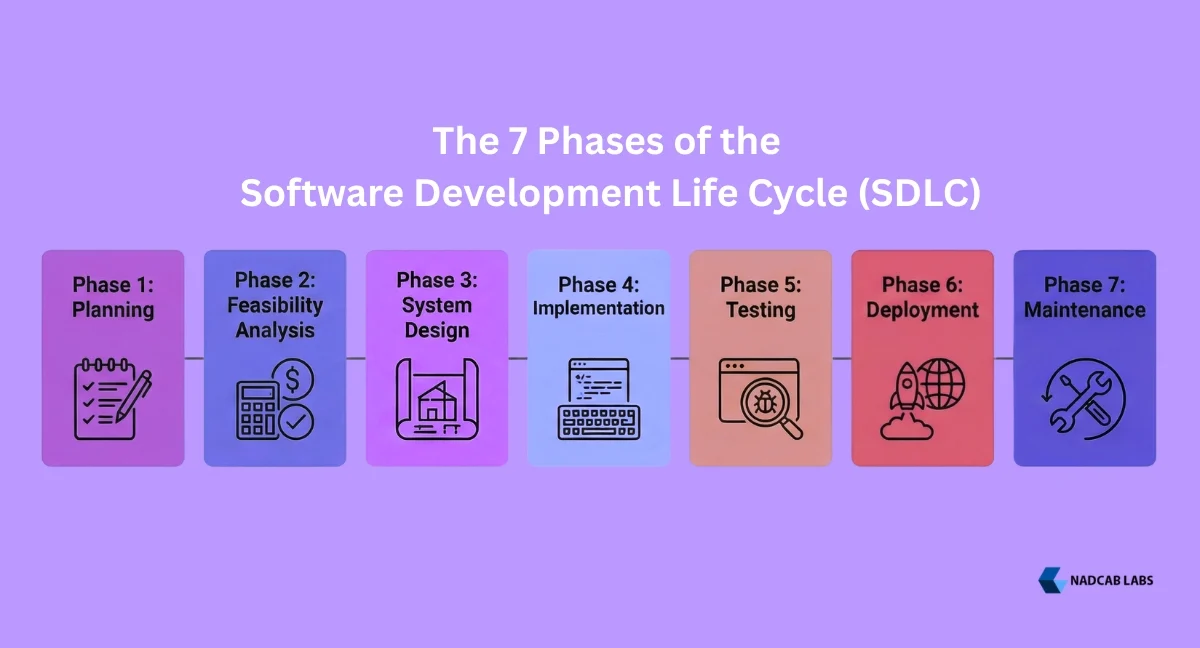
Here are the 7 phases of SDLC:
-
Planning
-
Requirement Analysis
-
System Design
-
Development
-
Testing
-
Deployment
-
Maintenance
Here is a clear explanation of each phase:
| Phase | Key Activities | Deliverables | Key Players |
|---|---|---|---|
| 1. Planning | Project scope, feasibility, cost estimation | Project Plan, Feasibility Report | Project Manager, Stakeholders |
| 2. Requirements Analysis | Gathering functional and non functional requirements | SRS Document | Business Analysts, Product Owner |
| 3. System Design | Architecture, database, UI design | Design Document (DDS or SDD) | System Architects, Lead Developer |
| 4. Development | Writing and reviewing code | Source Code, Executables | Frontend and Backend Developers |
| 5. Testing | Unit, Integration, UAT, System testing | Bug Reports, Quality Report | QA Engineers, Testers |
| 6. Deployment | Release to production environment | Live Application | DevOps, Release Managers |
| 7. Maintenance | Bug fixes, updates, performance tuning | Patches, New Versions | Support Engineers |
Let us now understand each phase in detail.
Phase 1: Planning
This is the starting point of the software development life cycle process. In this phase, the team answers one critical question: Should we build this software?
The planning phase involves a feasibility study to check if the project is technically possible, financially viable, and operationally realistic. The team also estimates the project cost, timeline, and required resources.
- Feasibility analysis (technical, financial, operational)
- Resource planning and team allocation
- Timeline and milestone definition
- Risk identification at a high level
Output: A Project Plan document and a Feasibility Report that tells the stakeholders whether to proceed.
Phase 2: Requirements Analysis
Once the project is approved, the team collects detailed requirements from all stakeholders — clients, end users, business teams, and technical experts. This phase produces the Software Requirement Specification (SRS) document, which acts as the official contract between the client and the development team.
- Functional requirements: What the software should do
- Non-functional requirements: Performance, security, scalability
- User stories and use case documentation
- Business and regulatory requirements
Output: SRS (Software Requirement Specification) Document — the most critical document in the SDLC.
💡 Important Note
A poorly written SRS is one of the top reasons software projects fail. According to IBM research, fixing a bug in production costs 30 times more than fixing it during the requirements phase.
Phase 3: System Design
Using the SRS as input, the design team creates the technical blueprint of the system. This phase has two sub-phases:
- High-Level Design (HLD): Covers the overall system architecture, technology stack, database schema, and how different modules connect with each other.
- Low-Level Design (LLD): Covers the internal logic of each module, API interfaces, class diagrams, and detailed database table design.
During this phase, the team also starts addressing security concerns using threat modeling — identifying potential vulnerabilities before any code is written. This is a practice strongly recommended in modern software engineering.
Output: Design Document Specification (DDS) / Software Design Document (SDD).
Phase 4: Development (Coding)
This is the phase most people think of when they hear “software development.” Developers write the actual code based on the design documents. This is typically the longest phase of the software development life cycle.
- Developers write code in selected programming languages (Java, Python, PHP, etc.)
- Code is broken into smaller tasks and assigned to individual developers
- Version control tools like Git are used to manage code changes
- Code reviews and unit testing are performed during this phase
- APIs, databases, and third-party integrations are built and connected
If you are looking to hire a development team for your next project, explore a professional software development company that follows structured SDLC practices to deliver high-quality software.
Output: Executable source code and functional software prototype.
Phase 5: Testing
After development, the software enters the testing phase. Quality Assurance (QA) engineers test the software to find and fix bugs before it reaches end users, including issues related to data integrity such as what is checksum error, which occurs when stored or transmitted data does not match its original verification value. This is where the software development life cycle in software testing plays a critical role, which we will cover in a dedicated section below.
- Unit Testing: Each small function or module is tested individually.
- Integration Testing: Different modules are combined and tested together.
- System Testing: The complete application is tested end-to-end.
- User Acceptance Testing (UAT): End users test the software to confirm it meets their real-world needs.
- Regression Testing: Ensures that new changes have not broken existing features.
- Performance Testing: Tests the application under high load to ensure it can handle real user traffic.
Output: Bug reports, test case documentation, and a final quality report.
Phase 6: Deployment
Once the software passes all tests, it is deployed to the production environment where real users can access it. In modern DevOps practices, deployment is often automated using CI/CD (Continuous Integration/Continuous Delivery) pipelines.
- Code is packaged and moved to the production server
- Environment configuration is set up (database connections, API keys, etc.)
- Smoke testing is done on the live environment to confirm nothing is broken
- Rollback plans are in place in case the deployment fails
Deployment strategies include Blue-Green Deployment, Canary Releases, and Rolling Updates — each designed to minimize downtime and user disruption.
Output: Live application accessible to end users.
Phase 7: Maintenance
The software development life cycle does not end after deployment. The maintenance phase is ongoing and includes fixing bugs reported by users, releasing software updates, improving performance, and adding new features based on user feedback.
- Corrective Maintenance: Fixing bugs and errors found after release.
- Adaptive Maintenance: Updating the software to work with new operating systems, devices, or regulations.
- Perfective Maintenance: Improving performance, usability, or adding new features.
- Preventive Maintenance: Refactoring code and updating libraries to prevent future issues.
Output: Software patches, version updates, and improved releases.
Software Development Life Cycle in Software Testing
The role of testing in the SDLC is often underestimated. Many people think testing only happens in the “Testing Phase,” but in modern software engineering, testing is integrated throughout the entire SDLC. This approach is called Shift-Left Testing.
Here is how the software development life cycle in software testing works at each stage:
- Planning Phase: Test managers review the project plan and create a high-level test strategy. They estimate testing effort, select tools, and identify risks.
- Requirements Phase: QA teams review requirements for completeness and testability. Any ambiguous requirement is flagged early — preventing expensive rework later.
- Design Phase: Test cases are written based on the design documents. This is called Test-Driven Development (TDD) when taken further — where tests are written before the code itself.
- Development Phase: Developers write unit tests alongside their code. Automated testing frameworks (like JUnit, Selenium, Pytest) are set up.
- Testing Phase: Full testing cycle — functional, regression, performance, security, and UAT.
- Deployment Phase: Smoke testing and sanity checks are run on the live environment.
- Maintenance Phase: Regression testing is done with every update or bug fix to ensure no new issues are introduced.
💡 Why Shift-Left Testing Matters
Testing early in the SDLC reduces defect fixing costs by up to 100 times compared to fixing them in production. The earlier a bug is found, the cheaper it is to fix.
Software Development Life Cycle Model Types
The Software Development Life Cycle model types define how the phases of SDLC are structured and carried out in a project. Different projects require different SDLC models based on their size, complexity, timeline, budget, and clarity of requirements.
Here are the most widely used Software Development Life Cycle model types:
-
Waterfall Model
-
Agile Model
-
V Model
-
Spiral Model
-
Iterative Model
-
Rapid Application Development RAD Model
Below is a clear explanation of each model along with its approach and best use cases:
| Model | Approach | Best For | Real World Use |
|---|---|---|---|
| Waterfall | Sequential process | Stable and clearly defined requirements | Government and banking systems |
| Agile | Iterative development in short cycles | Frequently changing requirements | Startups and web or mobile applications |
| V Model | Testing runs parallel with development | High-quality and critical applications | Medical and aerospace software |
| Spiral | Risk driven development cycles | Large and complex projects | Defense and research systems |
| Iterative | Incremental builds with repeated improvements | When partial requirements are known | E-commerce platforms |
| RAD | Rapid prototyping and quick releases | Time-sensitive delivery | Marketing tools and demo applications |
1. Waterfall Model
The Waterfall model is the oldest and most straightforward SDLC model. In this model, the development process flows sequentially — like a waterfall — from one phase to the next. Each phase must be completed before the next one begins.
- Simple and easy to understand
- Best when requirements are clear and unlikely to change
- Not suitable for projects where requirements may evolve
Example: Developing a government portal where all requirements are defined upfront by regulation.
2. Agile Model
Agile is the most popular SDLC methodology in the modern software industry. It divides the development process into small, repeatable cycles called sprints (usually 2–4 weeks). After each sprint, a working piece of software is delivered and reviewed by stakeholders.
- Highly flexible — requirements can change between sprints
- Continuous delivery and customer feedback
- Requires close collaboration between teams
- Frameworks: Scrum, Kanban, SAFe
Agile is the preferred approach for building modern software types like mobile apps, SaaS platforms, and e-commerce solutions.
3. V-Model (Verification and Validation Model)
The V-Model extends the Waterfall model by making testing parallel to development. For every development phase on the left side of the V, there is a corresponding testing phase on the right side.
- Testing is planned early and runs in parallel with development
- Best for projects where quality is the highest priority
- Used in medical devices, automotive software, and aerospace systems
4. Spiral Model
The Spiral model combines Waterfall and iterative development. It arranges SDLC phases in a spiral, with each loop representing a complete development cycle. Risk analysis is done at every loop, making it ideal for large, complex, high-risk projects.
- Strong emphasis on risk management
- Suitable for very large and complex systems
- Can be expensive for small projects
5. Iterative Model
In the Iterative model, the software is developed in multiple iterations. Each iteration produces a working software version with a subset of features. New features are added in each subsequent iteration until the full product is complete.
- Good when requirements are partially known
- Allows early delivery of core functionality
- Changes are easy to accommodate between iterations
6. RAD Model (Rapid Application Development)
The RAD model focuses on speed and rapid delivery using prototypes. It minimizes planning and maximizes prototyping and user feedback.
- Best when quick delivery is the priority
- Requires highly skilled developers
- Works well for time-sensitive projects with flexible requirements
How to Choose the Right SDLC Model for Your Project?
Choosing the right SDLC model is a critical decision. The wrong model can lead to project failure, budget overruns, and dissatisfied clients. Here is a simple guide to help you choose:
- Are requirements clearly defined? → Use Waterfall or V-Model.
- Are requirements likely to change? → Use Agile or Iterative Model.
- Is this a large, complex, high-risk project? → Use Spiral Model.
- Is speed of delivery the top priority? → Use RAD Model.
- Is this a high-quality, safety-critical product? → Use V-Model.
- Is customer involvement and feedback important? → Use Agile (Scrum or Kanban).
What is SDLC Methodology?
The term “SDLC methodology” refers to the specific framework or approach a team uses to implement the software development life cycle. It defines how teams collaborate, communicate, plan, and deliver work.
Common SDLC methodologies include:
- Scrum: An Agile framework using sprints, daily standups, sprint reviews, and retrospectives. Best for dynamic, fast-changing projects.
- Kanban: A visual workflow management system using a board with cards. Best for continuous delivery without fixed sprint cycles.
- Lean: Focuses on eliminating waste, improving efficiency, and delivering value faster. Inspired by Toyota’s manufacturing process.
- DevOps: Combines Development and Operations into one continuous pipeline, enabling faster deployments and more reliable releases.
- DevSecOps: Extends DevOps by integrating security at every stage of the SDLC, rather than treating it as a final step.
How Does SDLC Address Security? (DevSecOps)
One of the most common mistakes in software development is treating security as a final step — something to check just before deployment. This approach leads to expensive security vulnerabilities discovered late in the process.
Modern SDLC addresses security through DevSecOps — a methodology that integrates security into every phase of the development lifecycle:
- Planning: Define security requirements alongside functional requirements
- Design: Use threat modeling to identify security risks in the architecture
- Development: Follow secure coding standards; use static code analysis tools (SonarQube, Checkmarx)
- Testing: Include security testing — penetration testing, OWASP testing, vulnerability scanning
- Deployment: Ensure secure configuration of servers, databases, and APIs
- Maintenance: Monitor for new threats; apply security patches promptly
💡 Industry Fact
According to IBM’s Cost of a Data Breach Report, the average cost of a data breach in 2025 was $4.4 million. Integrating security into the SDLC from the start is far less expensive than dealing with breaches after deployment.
What is L1, L2, L3, and L4 in Software Development?
In software development teams, especially in large IT companies and service organizations, developers and engineers are classified into different seniority or support levels — commonly referred to as L1, L2, L3, and L4. These levels define the complexity of tasks a professional handles and their level of expertise.
| Level | Role | Responsibilities | Typical Experience |
|---|---|---|---|
| L1 (Level 1) | Entry-level support engineer | Basic bug fixes, known error resolution, routine tasks | 0–1 years experience |
| L2 (Level 2) | Mid-level developer or analyst | Complex bugs, code changes, and module-level development | 2–4 years of experience |
| L3 (Level 3) | Senior developer or architect | Deep architectural issues, performance optimization, and design | 5–8 years of experience |
| L4 (Level 4) | Principal engineer or tech lead | System-wide decisions, cross-team architecture, innovation | 8+ years of experience |
In practice, an L1 engineer will handle routine tasks and known issues, escalating complex problems to L2. L2 engineers handle module-level development and complex debugging. L3 engineers work on architecture and deep system issues. L4 engineers lead technical direction at an organizational level.
Understanding these levels helps companies build the right team structure for their SDLC — ensuring the right people handle the right tasks at each phase.
Real-World SDLC Example: Building a Tournament Management System
To understand how the software development life cycle works in practice, let us look at the development of a tournament management system — software used by sports organizations to manage registrations, brackets, scores, and results.
- Planning: The team identifies the key features needed — player registration, bracket generation, score tracking, and results publishing. A feasibility study is done, and the project is approved.
- Requirements Analysis: Detailed requirements are gathered from sports administrators, coaches, and players. The SRS is created.
- Design: The system architecture is designed — a web application with a mobile-friendly interface, a PostgreSQL database for tournament data, and a REST API layer.
- Development: Developers build the registration module, bracket generation algorithm, score tracking dashboard, and results export feature.
- Testing: QA engineers test player registration flow, bracket accuracy with various tournament sizes, and performance under high concurrent usage.
- Deployment: The system is deployed to a cloud server, tested in the live environment, and handed over to the client.
- Maintenance: After the first tournament, feedback is collected and new features (like livestream integration) are planned for the next version.
Learn more about what goes into building such systems: Tournament Software — What It Is and Key Features.
Final Thoughts
The Software Development Life Cycle (SDLC) is not just a process — it is the backbone of successful software delivery. Whether you are building a simple mobile app or a complex enterprise system, following a structured SDLC helps you deliver software that is high-quality, on time, and within budget.
Understanding the 7 phases of SDLC — from planning to maintenance — ensures that no critical step is skipped. Choosing the right SDLC model — whether Waterfall, Agile, V-Model, or Spiral — ensures your development process fits your project’s unique requirements. And integrating security and testing throughout the SDLC, rather than treating them as afterthoughts, is what separates great software teams from average ones.
If you are planning to build software for your business, working with a team that understands and follows proper SDLC practices is essential. Nadcab Technology is a professional software development company that brings structured, proven SDLC practices to every project — ensuring your software is built right the first time.
Frequently Asked Questions (FAQ)
Q1.What is software development life cycle in software engineering?
In software engineering, the software development life cycle (SDLC) is a formal methodology that structures the entire software creation process into defined phases. It provides a disciplined, repeatable framework that engineering teams use to plan, design, build, test, and maintain software systems. Software engineering treats SDLC as the foundation of all development practices.
Q2.: What is the difference between SDLC and Agile?
SDLC is the overall framework for software development. Agile is a specific SDLC model (or methodology) within that framework. Think of it this way: SDLC is the concept, and Agile is one way to implement it. Other SDLC models include Waterfall, Spiral, V-Model, and RAD.
Q3.What is the most popular SDLC model today?
Agile is currently the most widely used SDLC model in the software industry. According to the 2023 State of Agile Report, over 71% of organizations use Agile as their primary development methodology. Scrum is the most popular Agile framework.
Q4.Can SDLC be used for small projects?
Yes. While SDLC is commonly associated with large enterprise projects, its principles apply to projects of all sizes. For small projects, a lightweight version of SDLC or the Agile model works well. The key is to ensure clear requirements, structured development, and proper testing — regardless of project size.
Q5.Is SDLC only for software companies?
No. SDLC principles are used by any organization that develops or manages software — including banks, hospitals, government bodies, educational institutions, and startups. Any team building software benefits from the structure and discipline that SDLC provides.
Explore Services
Related Services
Reviewed by

Aman Vaths
Founder of Nadcab Labs
Aman Vaths is the Founder & CTO of Nadcab Labs, a global digital engineering company delivering enterprise-grade solutions across AI, Web3, Blockchain, Big Data, Cloud, Cybersecurity, and Modern Application Development. With deep technical leadership and product innovation experience, Aman has positioned Nadcab Labs as one of the most advanced engineering companies driving the next era of intelligent, secure, and scalable software systems. Under his leadership, Nadcab Labs has built 2,000+ global projects across sectors including fintech, banking, healthcare, real estate, logistics, gaming, manufacturing, and next-generation DePIN networks. Aman’s strength lies in architecting high-performance systems, end-to-end platform engineering, and designing enterprise solutions that operate at global scale.