Ai Overview
The architecture of a Web3 application differs drastically from a traditional Web2 application. While both share a visible user interface rendered in the browser, the way data flows, where logic executes, and how state is managed follow entirely different paradigms. For DeFi platforms popular in the USA and UAE markets, displaying accurate pricing and slippage information is equally critical. The frontend estimates gas using the provider’s estimateGas method, then presents the cost to the user.
Key Takeaways
- ✓ The frontend in Web3 apps manages wallet connections, transaction signing, and rendering on-chain data through the browser interface.
- ✓ Smart contracts serve as the primary on-chain backend, executing immutable business logic and managing token transfers securely.
- ✓ Web3 frontends rely on Ethers.js, Wagmi, and Viem to communicate with blockchain networks through RPC providers efficiently.
- ✓ Off-chain backends handle indexing, caching, and session management that smart contracts alone cannot provide for production apps.
- ✓ Frontend security focuses on phishing prevention and wallet protection, while backend security targets smart contract vulnerabilities and exploits.
- ✓ Hybrid architectures combining decentralized on-chain logic with off-chain services are the current industry standard for scalable dApps.
- ✓ Node providers like Infura and Alchemy bridge the gap between frontend interfaces and blockchain networks for reliable data access.
- ✓ Wallet-based authentication replaces traditional login systems, using cryptographic signatures as the primary identity verification mechanism in Web3.
- ✓ The Graph and subgraphs power efficient data queries, preventing frontends from making expensive and slow direct blockchain reads.
- ✓ Multi-chain support, gasless transactions, and optimized RPC calls are essential best practices for enterprise Web3 apps in 2025 and beyond.
The Web3 ecosystem has fundamentally changed how software teams think about the relationship between frontend and backend. In traditional web applications, the frontend sends HTTP requests to a centralized server, which processes the logic and returns responses. In Web3, that backend layer splits across smart contracts, decentralized storage, indexing protocols, and optional off-chain servers, creating a web3 application architecture unlike anything seen in the Web2 era. For teams across the USA, UK, UAE, and Canada investing in Web3 solutions, understanding the clear boundary between frontend and backend in Web3 apps is no longer optional. It is the foundation of every architectural decision, from choosing libraries to designing security models. This guide breaks down the frontend vs backend divide in Web3 apps with practical insight drawn from 8+ years of building decentralized products across global markets.
Web3 App Architecture Overview
The architecture of a Web3 application differs drastically from a traditional Web2 application. While both share a visible user interface rendered in the browser, the way data flows, where logic executes, and how state is managed follow entirely different paradigms. A Web3 app typically consists of three primary layers: the frontend (user interface and wallet interaction), the on-chain layer (smart contracts and blockchain state), and the off-chain layer (indexers, APIs, decentralized storage). Each layer has distinct responsibilities, and understanding how they interconnect is critical for building reliable, high-performance dApps. Teams in the USA and UK have been at the forefront of defining best practices in this space, while Canada and the UAE are rapidly growing their Web3 engineering capabilities.
Web2 vs Web3 Architecture
| Aspect | Web2 Architecture | Web3 Architecture |
|---|---|---|
| Backend Logic | Centralized servers (Node.js, Django) | Smart contracts + off-chain services |
| Data Storage | SQL/NoSQL databases | Blockchain state + IPFS/Arweave |
| Authentication | Email/password, OAuth | Wallet signatures (SIWE) |
| API Layer | REST/GraphQL APIs | RPC calls + Subgraph queries |
| Trust Model | Trust the server operator | Trustless, verifiable on-chain |
What Makes a Web3 App Different from a Traditional App?
A Web3 app is fundamentally different because its core business logic does not live on a private server controlled by one entity. Instead, the logic resides on a public blockchain as a smart contract, visible and verifiable by anyone. State mutations require cryptographic signatures from the user’s wallet, and data finality depends on blockchain consensus rather than database writes. This creates a paradigm where the frontend becomes the primary orchestrator of user interactions, managing wallet states, transaction lifecycles, and on-chain data rendering. For businesses across the UAE and Canada building top web3 applications, this shift means rethinking how teams are structured, how QA is done, and how updates are rolled out.
Core Layers in a Web3 Application (UI, Blockchain, Off-chain)
Three Core Layers of Web3 Architecture
UI Layer (Frontend)
- Renders the user interface in the browser
- Manages wallet connection and state
- Sends transaction requests to blockchain
- Displays on-chain data to users
Blockchain Layer (On-Chain)
- Executes smart contract logic
- Stores permanent on-chain state
- Handles token transfers and approvals
- Emits events for indexers to consume
Off-Chain Layer (Backend)
- Indexes blockchain events for queries
- Caches data to speed up UI loading
- Manages sessions and user preferences
- Stores large files on IPFS or Arweave
Every layer in a Web3 app has clear ownership. The UI layer is maintained by frontend engineers. The on-chain layer is owned by smart contract engineers. The off-chain layer is managed by backend and infrastructure teams. When building top web3 applications for markets like the UK or Canada, clearly defining these boundaries from day one prevents costly rework and security blind spots later in the product lifecycle.
What Is Frontend in Web3 Apps?
The frontend in Web3 apps goes far beyond rendering pages. It is the layer that connects a user’s wallet to blockchain networks, constructs and submits transactions, and presents on-chain state in a human-readable format. Unlike traditional frontends that simply consume API responses, Web3 frontends must handle asynchronous blockchain confirmations, gas estimation, network switching, and error states like reverted transactions. The frontend in web3 apps is the user’s gateway to decentralized logic, and every design choice directly impacts trust, usability, and security.
Web3 Frontend Meaning (UI + Wallet Interaction)
The Web3 frontend is the browser-rendered interface that combines visual UI elements with blockchain wallet interaction. When a user connects their MetaMask or WalletConnect wallet, the frontend reads the wallet address, checks the connected network, and enables the user to interact with smart contracts. Every button click that triggers an on-chain action (swapping tokens, minting NFTs, casting votes) flows through the frontend before reaching the blockchain. This makes the frontend in web3 apps the most critical touchpoint for user experience.
Main Responsibilities of Web3 Frontend
Web3 frontend responsibilities include rendering UI components, managing wallet connection lifecycles, displaying real-time blockchain data, handling transaction construction and submission, managing network switching, and providing clear error feedback for blockchain-specific failures. Additionally, frontends must handle token approval flows, display gas estimates, manage pending transaction states, and ensure that users understand what they are signing before confirming any action. For DeFi platforms popular in the USA and UAE markets, displaying accurate pricing and slippage information is equally critical.
Common Web3 Frontend Tech Stack
The dominant web3 app stack for frontends centers on React and Next.js, with Vue gaining traction in specific communities. React’s component model aligns naturally with the modular nature of Web3 interfaces, where wallet status, transaction history, and contract data each have isolated state management needs. Next.js adds server-side rendering benefits crucial for SEO and performance. TypeScript is nearly universal for type safety when interacting with complex contract ABIs. Tailwind CSS has become the preferred styling approach for rapid iteration across teams in the UK and Canada.
Web3 Libraries Used in Frontend (Ethers.js, Web3.js, Wagmi)
Key Frontend Libraries for Web3
Ethers.js: Lightweight library for interacting with Ethereum. Handles provider connections, contract calls, and transaction building with clean abstractions.
Web3.js: The original Ethereum JavaScript library. Offers comprehensive API coverage but is heavier than Ethers.js. Still widely used in legacy projects.
Wagmi: React hooks library for Ethereum. Provides type-safe hooks for wallet connection, contract reads/writes, and ENS resolution.
Viem: Modern TypeScript library optimized for performance. Serves as the underlying transport layer for Wagmi with minimal bundle size.
What Is Backend in Web3 Apps?
The backend in Web3 apps is not a single monolithic server. It is a distributed set of services that includes on-chain smart contracts, off-chain indexing and data services, decentralized storage protocols, and optional centralized API layers. Understanding the backend in web3 apps means recognizing that business logic is split between immutable on-chain code and flexible off-chain infrastructure. This duality creates unique challenges around consistency, latency, and fault tolerance that teams must address when building robust dApps.
Is Smart Contract the Backend in Web3?
Smart contracts are the on-chain backend. They store state, execute logic, and enforce rules in a trustless manner. However, calling smart contracts “the backend” is an oversimplification. Smart contracts cannot initiate actions on their own, cannot access external data without oracles, and have significant gas and storage limitations. For any production dApp serving users in the USA, UK, or UAE, the backend extends well beyond contracts to include indexers, notification services, analytics pipelines, and metadata storage systems that collectively form the full backend infrastructure.
On-Chain Backend vs Off-Chain Backend (Clear Difference)
| Feature | On-Chain Backend | Off-Chain Backend |
|---|---|---|
| Execution | Smart contracts on blockchain | Servers, serverless functions |
| Mutability | Immutable after deploy | Easily updatable |
| Cost | Gas fees per transaction | Infrastructure hosting costs |
| Speed | Block time dependent (seconds) | Millisecond response times |
| Trust | Trustless, verifiable | Requires trust in operator |
Backend Responsibilities in Web3 Applications
Backend responsibilities in Web3 applications span contract execution, event indexing, metadata management, oracle integration, and off-chain computation for tasks that are too expensive or complex for on-chain execution. The backend also handles notification systems, analytics, transaction monitoring, and relayer services. In enterprise contexts across the USA and UK, the backend in web3 apps additionally manages compliance workflows, rate limiting, and API key management to satisfy regulatory requirements.
When Web3 Apps Still Need Traditional Backend Servers?
Traditional backend servers remain essential for tasks like user session management, push notifications, email integration, webhook processing, and serving content behind access controls. Many top web3 applications use centralized databases to store user preferences, transaction history caches, and off-chain metadata that would be prohibitively expensive to store on-chain. Understanding how to build a web3 game, for instance, requires off-chain servers for matchmaking, leaderboards, and real-time game state synchronization alongside on-chain asset ownership.
Frontend vs Backend in Web3 Apps
Role Difference (UI vs Logic Execution)
The frontend vs backend role distinction in Web3 is sharper than in Web2. The frontend exclusively handles user-facing presentation and wallet interaction. It cannot execute business logic independently. The backend (smart contracts) owns all state-changing logic, and the result of every transaction is deterministic based on the contract code. This clear separation means frontend bugs affect UX while backend bugs can cause permanent financial loss, a critical distinction for teams building in regulated markets like the UAE and Canada.
Data Flow Difference
Data flows in Web3 apps are fundamentally different from REST API patterns. Read operations go through RPC calls to node providers. Write operations require wallet signatures and gas payment. Historical data is fetched through indexing protocols like The Graph rather than database queries. This multi-layered data flow in the web3 application architecture means the frontend must manage multiple async data sources simultaneously, combining on-chain reads, subgraph queries, and off-chain API calls into a cohesive user experience.
Security Difference
Frontend security in Web3 focuses on preventing phishing, UI spoofing, and supply chain attacks where malicious packages compromise wallet interactions. Backend security centers on smart contract auditing for vulnerabilities like reentrancy, integer overflow, and access control flaws. A compromised frontend can trick users into signing malicious transactions, while a compromised smart contract can drain all locked funds. Both layers require dedicated security practices, and the frontend vs backend security gap in Web3 remains one of the most under-addressed risks in the industry.
Performance Difference
Frontend performance in Web3 is limited by RPC response times and rendering complexity. Backend (on-chain) performance is constrained by block times and gas limits. A typical Ethereum transaction takes 12 to 15 seconds to confirm, while a Layer 2 transaction on Optimism or Arbitrum may finalize in under 2 seconds. Frontends must provide optimistic UI updates, loading indicators, and transaction status tracking to bridge this latency gap and maintain a responsive user experience across the web3 app stack.
How Frontend Communicates with Blockchain?
Wallet Connection Flow (MetaMask, WalletConnect)
The wallet connection flow begins when a user clicks “Connect Wallet” on the frontend. The app requests access to the wallet provider (MetaMask, WalletConnect, Coinbase Wallet). Once approved, the frontend receives the user’s public address and can read the connected chain ID. This establishes the communication bridge between the UI and the blockchain. For mobile users common in UAE and UK markets, WalletConnect provides deep-link connections, while browser extension wallets like MetaMask serve desktop users. The frontend must handle all wallet states: disconnected, connecting, connected, and wrong network.
Transaction Signing and Sending Process
When a user initiates a write action, the frontend constructs a transaction object containing the target contract address, function selector, encoded parameters, and gas settings. This transaction is sent to the wallet for signing. The user reviews the transaction details in their wallet interface and either approves or rejects it. Once signed, the transaction is broadcast to the network through an RPC provider. The frontend then monitors the transaction hash until it is either confirmed in a block or fails, updating the UI accordingly throughout this lifecycle.
Reading Blockchain Data (RPC Calls)
Reading data from the blockchain is free and does not require gas. The frontend calls view or pure functions on smart contracts through RPC providers like Infura or Alchemy. These calls return current state data such as token balances, contract configuration, or allowance amounts. For performance, smart teams batch multiple read calls using multicall contracts, reducing the number of RPC requests. This is a critical optimization in the web3 app stack, especially for data-heavy dashboards serving users in the USA and Canada.
Writing Blockchain Data
Writing to the blockchain requires a signed transaction and gas payment. The frontend estimates gas using the provider’s estimateGas method, then presents the cost to the user. After confirmation in the wallet, the transaction is submitted. Writing data in Web3 is fundamentally different from a POST request in Web2. There is no instant response. The frontend must wait for block inclusion, handle pending states, and deal with potential reverts. Real-world example: Uniswap’s swap interface shows estimated gas, slippage tolerance, and price impact before the user confirms the trade.
Web3 Backend Components
Node Providers and RPC Infrastructure
Node providers are the backbone of Web3 backend infrastructure. They run full blockchain nodes and expose RPC endpoints that frontends and backend services use to read data and submit transactions. Infura and Alchemy are the most widely adopted, offering multi-chain support, rate limiting, webhook services, and enhanced APIs for NFT and token data. QuickNode and Ankr provide alternatives with global distribution. For enterprise projects in the UK and UAE, selecting a node provider with SLA guarantees and compliance certifications is a critical architectural decision.
Indexing Layer
The indexing layer transforms raw blockchain data into queryable, structured formats. The Graph is the leading protocol, using subgraphs that define how to process and store blockchain events. Instead of scanning the entire blockchain for a user’s transaction history, the frontend queries a subgraph endpoint that returns pre-indexed data in milliseconds. This layer is essential for any production frontend vs backend architecture in Web3, as direct blockchain reads are too slow and expensive for complex queries that power dashboards, analytics, and history views.
Off-chain Databases in Web3 Apps
Off-chain databases store data that does not need blockchain guarantees. User preferences, notification settings, cached token prices, and app configuration are commonly stored in PostgreSQL, MongoDB, or Redis. These databases provide the sub-millisecond read performance that on-chain queries cannot match. In a well-designed web3 application architecture, the off-chain database complements the blockchain layer without replacing it, ensuring that trust-critical data remains on-chain while convenience data stays off-chain for speed.
Decentralized Storage Backend
Decentralized storage protocols handle large files that are impractical to store on-chain. IPFS uses content-addressing to store and retrieve files across a distributed network. Arweave provides permanent storage with a one-time fee. Filecoin offers decentralized storage with economic incentives. NFT metadata, game assets, and media files are typically stored on these networks with content hashes referenced on-chain. This pattern ensures that even if one storage provider fails, the content remains accessible and verifiable.
Authentication and Identity in Web3 Apps
Wallet-Based Authentication vs Traditional Login
Wallet-based authentication eliminates passwords entirely. Instead of storing credentials, the backend generates a challenge message, the user signs it with their private key, and the backend verifies the signature against the wallet address. This is trustless, server-light, and directly tied to the user’s on-chain identity. For enterprise dApps in the USA, UK, and UAE, wallet-based auth simplifies identity management while introducing new UX challenges around wallet onboarding for non-crypto-native users.
Sign-In with Ethereum (SIWE) Explained
Sign-In with Ethereum (SIWE) is the standardized protocol (EIP-4361) for authenticating users via their Ethereum wallet. The frontend displays a structured message containing the domain, wallet address, nonce, and expiration time. The user signs this message, and the backend verifies the signature to create an authenticated session. SIWE provides a consistent, interoperable authentication standard that works across all dApps, making it the preferred approach for production Web3 applications in Canada and across global markets.
Role-Based Access Control in Web3 Apps
Role-Based Access Control (RBAC) in Web3 apps can be implemented both on-chain and off-chain. Smart contracts use modifier functions and role mappings to restrict function access (OpenZeppelin’s AccessControl is the standard). Off-chain RBAC uses JWT tokens issued after wallet authentication to gate API endpoints. A combined approach ensures that sensitive on-chain operations are protected at the contract level while off-chain features have proper authorization checks.
Session Handling and Security for dApps
Session handling in dApps is more nuanced than in traditional apps because the wallet connection itself is not a persistent session. Frontends must detect wallet disconnections, account changes, and network switches in real time. Backend sessions (via JWT or cookies) must be tied to the wallet address and include proper expiration and refresh logic. Real-world dApps like Aave and OpenSea combine wallet connections with short-lived session tokens to balance convenience with security across both the frontend and backend layers.
Real Workflow of a Web3 App
Web3 Transaction Lifecycle
User Action – Frontend Trigger
User clicks a button (e.g., “Swap Tokens”). Frontend validates input, estimates gas, and constructs the transaction object.
Wallet Prompt – Signature / Approval
Wallet popup shows transaction details. User reviews and approves. Private key signs the transaction locally.
Smart Contract Execution – On-Chain Update
Transaction is broadcast, included in a block, and the smart contract executes the logic. State is permanently updated on-chain.
UI Refresh Using Events / Indexing
Frontend listens for transaction receipt, updates UI optimistically. Indexers process the event for historical query access.
Common Tools Used in Web3 Frontend
Wallet Integrations (RainbowKit, Web3Modal)
RainbowKit and Web3Modal are the two leading wallet connection libraries for React-based Web3 frontends. RainbowKit, built by the Rainbow team, provides a polished, customizable connect modal that supports dozens of wallets out of the box. Web3Modal (by WalletConnect) offers similar functionality with broader protocol support. Both handle wallet detection, chain switching, and ENS resolution automatically, dramatically reducing the engineering effort needed to build a professional wallet connection flow for the frontend in web3 apps.
Contract Interaction Tools (Ethers, Viem)
Ethers.js and Viem are the primary libraries for interacting with smart contracts from the frontend. Ethers.js provides a mature, well-documented API for connecting to providers, reading contract state, and sending transactions. Viem, the newer alternative, offers a more modular architecture with tree-shaking support and TypeScript-first design. Teams building modern top web3 applications are increasingly adopting Viem alongside Wagmi for type-safe, performant contract interactions that reduce bundle size and improve reliability.
UI + Web3 UX Best Practices
Web3 UX best practices include providing clear transaction status indicators (pending, confirming, confirmed, failed), showing human-readable error messages instead of raw contract revert codes, displaying gas costs prominently before confirmation, and supporting network auto-switching when users are on the wrong chain. Progressive disclosure is key: show simplified views by default with advanced options behind toggles. For global audiences across the USA, UAE, and Canada, multi-language support and regional currency displays also improve adoption.
Error Handling in Web3 Frontend (Reverts, Gas, Network)
Error handling in Web3 frontends is more complex than in Web2 because errors can originate from the wallet, the RPC provider, the blockchain itself, or the smart contract. Common error types include user rejection (user declined in wallet), insufficient funds for gas, contract reverts with custom error codes, network congestion timeouts, and RPC rate limits. A robust frontend maps each error type to a clear, actionable message, helping users understand what went wrong and how to fix it.
Common Tools Used in Web3 Backend
Event Listening and Transaction Monitoring
Backend services subscribe to smart contract events using WebSocket connections or polling mechanisms through RPC providers. When a contract emits an event (e.g., Transfer, Swap, Mint), the backend listener captures it, processes the data, and triggers downstream actions like updating databases, sending notifications, or refreshing caches. Alchemy Webhooks and Infura subscriptions are popular managed solutions. Self-hosted event listeners using Ethers.js or Viem provide more control for custom implementations in the backend in web3 apps.
Oracles for Off-chain Data (Chainlink)
Oracles bridge the gap between off-chain data and on-chain smart contracts. Chainlink is the dominant oracle network, providing price feeds, verifiable randomness (VRF), and cross-chain communication. Smart contracts cannot access external APIs directly, so oracles act as trusted data relays. For DeFi applications, accurate and tamper-resistant price feeds are non-negotiable. Understanding how to build a web3 game also requires oracles for random number generation and real-world event verification, making them a cornerstone of the web3 app stack.
Relayers and Gasless Transactions
Relayers enable gasless transactions where the application pays the gas fee on behalf of the user. The user signs a message (meta-transaction), and the relayer submits the actual on-chain transaction. OpenZeppelin Defender, Gelato Network, and Biconomy are leading relayer services. This pattern is essential for onboarding users who do not hold native tokens for gas, a common scenario in gaming and social dApps targeting mainstream audiences. For teams learning how to build a web3 game, gasless transactions can eliminate the biggest friction point for new players.[1]
Analytics and Logging for Web3 Apps
Analytics in Web3 apps combine on-chain data analysis with traditional web analytics. Dune Analytics and Flipside provide SQL-based interfaces for querying blockchain data. Tenderly offers real-time transaction monitoring and debugging. On the frontend side, standard tools like PostHog and Amplitude track user behavior. The combination of on-chain and off-chain analytics provides a complete picture of user engagement, contract utilization, and application performance across the entire frontend vs backend stack.
Security Risks in Web3 Frontend vs Backend
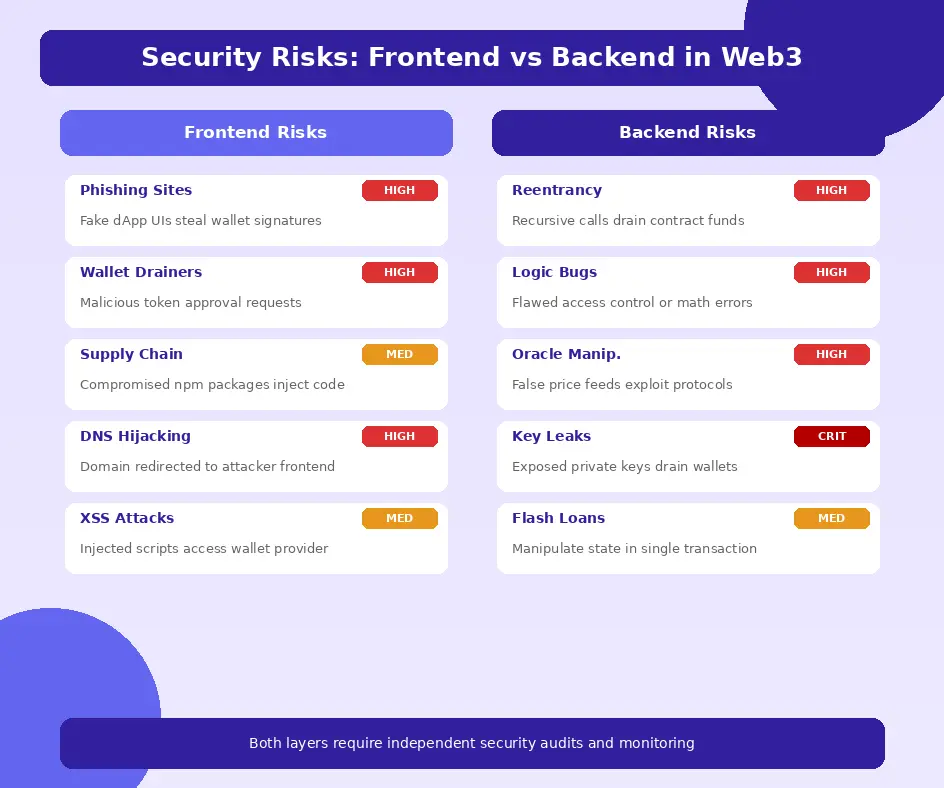
Frontend Security Issues (Phishing, Fake UI, Wallet Drainers)
Frontend attacks in Web3 target the user’s wallet through deceptive interfaces. Phishing sites replicate legitimate dApp UIs to trick users into signing malicious transactions. Wallet drainer scripts exploit unlimited token approvals. Supply chain attacks compromise npm packages to inject malicious code. DNS hijacking redirects users from legitimate domains to attacker-controlled frontends. These threats make frontend security in Web3 uniquely high-stakes because a single malicious signature can drain a wallet entirely.
Smart Contract Security Issues (Reentrancy, Logic Bugs)
Smart contract vulnerabilities are the most financially devastating in Web3. Reentrancy attacks allow malicious contracts to recursively call vulnerable functions before state is updated. Logic bugs in access control can grant unauthorized permissions. Oracle manipulation can feed false prices to exploit lending protocols. Integer overflows, flash loan attacks, and storage collision bugs round out the most common threat vectors. The irreversible nature of blockchain transactions means contract exploits cannot be “rolled back,” making auditing and formal verification essential for any serious Web3 project.
API & Backend Security Issues (Rate limits, key leaks)
Off-chain backend security issues include exposed API keys (especially RPC provider keys hardcoded in frontend code), insufficient rate limiting on indexer endpoints, and unauthorized access to admin functions. Private key management for relayer wallets and contract deployer accounts is another critical concern. Leaked private keys have caused some of the largest losses in Web3 history. Proper key management using hardware security modules (HSMs) and secrets management solutions is mandatory for production backends.
Best Practices to Secure Both Layers
Authoritative Security Standards for Web3 Frontend and Backend
Standard 1: Conduct independent smart contract audits with at least two separate audit firms before mainnet deployment.
Standard 2: Implement Content Security Policy (CSP) headers on all frontend deployments to prevent XSS and injection attacks.
Standard 3: Use environment variables and server-side proxies for all RPC keys. Never expose API keys in client-side code.
Standard 4: Implement rate limiting and bot protection on all off-chain API endpoints to prevent abuse and DDoS attacks.
Standard 5: Deploy monitoring and alerting systems for unusual contract activity, large transfers, and governance changes.
Standard 6: Store private keys in hardware security modules (HSMs) and implement multi-signature requirements for all admin functions.
Standard 7: Run automated dependency scanning and lockfile audits in CI pipelines to detect supply chain vulnerabilities early.
Standard 8: Establish a bug bounty program with clear scope and rewards to incentivize responsible vulnerability disclosure from the community.
When to Use Centralized Backend in Web3 Apps?
Use Cases Where Off-chain Backend Is Required
Off-chain backends are required for real-time features (chat, notifications, live feeds), complex computations too expensive for gas (ML scoring, recommendation engines), regulatory compliance (KYC/AML processing), fiat payment integration, and user experience enhancements like email notifications and order matching. For NFT marketplaces, off-chain backends handle image processing, search indexing, and auction mechanics. For DeFi dashboards, they aggregate multi-chain data and compute portfolio analytics.
Hybrid Web3 Architecture (Best of Both Worlds)
Architecture Model Selection Criteria
Step 1: Fully On-Chain
- Best for simple token swaps, DAOs
- Maximum decentralization
- Limited by gas costs and speed
- Ideal for trust-critical operations
Step 2: Hybrid Model
- On-chain for ownership and transfers
- Off-chain for speed-sensitive tasks
- Best for marketplaces and gaming
- Balanced cost and performance
Step 3: Off-Chain Heavy
- Centralized server with chain anchoring
- Best for real-time gaming, social apps
- Requires trust in the operator
- Highest speed and flexibility
Tradeoffs: Decentralization vs Performance
The tradeoff between decentralization and performance is the defining tension in web3 application architecture. Full decentralization provides censorship resistance and trustlessness but introduces latency, gas costs, and data limitations. Centralized components offer speed and flexibility but introduce trust assumptions and single points of failure. The best teams in the USA, UK, Canada, and UAE evaluate each feature independently, placing trust-critical operations on-chain while keeping performance-sensitive features off-chain. This pragmatic approach delivers the best outcomes for end users.
How to Keep Backend Minimal but Secure?
Keeping the off-chain backend minimal means using managed services where possible (The Graph for indexing, Alchemy for RPC, IPFS pinning services for storage), implementing serverless functions for lightweight API needs, and avoiding storing sensitive data off-chain. The principle is: if data can live on-chain or in decentralized storage, it should. The off-chain backend should only handle what is genuinely impossible or impractical to do on-chain, keeping the attack surface small and the trust footprint minimal.
Compliance & Governance Checklist
| Requirement | Frontend | Backend | Notes |
|---|---|---|---|
| KYC/AML Verification | ✓ | ✓ | Required in USA, UK, UAE |
| Smart Contract Audit | – | ✓ | Mandatory before mainnet |
| Data Privacy (GDPR) | ✓ | ✓ | UK, Canada compliance |
| Access Logging | ✓ | ✓ | Required for audit trails |
| Multi-sig Admin Control | – | ✓ | Gnosis Safe standard |
| Bug Bounty Program | ✓ | ✓ | Immunefi for contracts |
Best Practices for Building Web3 Frontend + Backend
Designing a Clean Contract-to-UI Interaction Layer
A clean contract-to-UI interaction layer starts with auto-generated TypeScript types from contract ABIs using tools like TypeChain or Wagmi CLI. This ensures type safety across the entire frontend vs backend boundary. Contract hooks should be abstracted into reusable modules that handle loading states, error parsing, and optimistic updates. The frontend should never contain hardcoded contract addresses; instead, use configuration files or on-chain registries for contract discovery.
Optimizing RPC Calls and Reducing Load Time
RPC optimization strategies include using multicall contracts to batch multiple read calls into a single request, implementing client-side caching with React Query or SWR, using WebSocket subscriptions for real-time data instead of polling, and leveraging subgraphs for historical data instead of scanning blocks. Rate limiting awareness is also critical because exceeding provider limits causes failures. For high-traffic dApps, using multiple RPC providers with failover logic ensures reliability across the web3 app stack.
Handling Multi-chain Support Smoothly
Multi-chain support requires both frontend and backend considerations. The frontend must detect the user’s current chain, prompt switching when needed, and maintain separate contract instances per chain. Backend services must index events across multiple chains and normalize data into a unified format. Configuration management using chain registries that map chain IDs to RPC URLs, contract addresses, and explorer links keeps the codebase maintainable as new chains are added, a growing requirement for top web3 applications targeting global audiences.
Testing Strategy for Frontend + Smart Contracts
Web3 App Integration Testing Lifecycle
Unit Testing
Test individual contract functions in isolation using Hardhat or Foundry to verify basic logic and state changes.
Integration Testing
Verify multiple contracts interact properly and external system connections like oracles function as designed.
End-to-End Testing
Validate complete user workflows from frontend wallet connection through smart contract execution to UI updates.
Load & Security Auditing
Stress test RPC endpoints under load and conduct formal security reviews of all contract and API integration points.
Final Checklist
Frontend Checklist (UI, Wallet, UX, Security)
Your frontend checklist should cover: wallet connection with multiple provider support, network detection and auto-switching, transaction status tracking with clear UI feedback, gas estimation and display, error handling for all blockchain-specific failure modes, responsive design for mobile wallets, CSP headers and subresource integrity for security, loading states for all async blockchain operations, and accessibility compliance. Test on both desktop (MetaMask) and mobile (WalletConnect) before any release targeting the USA, UK, or UAE markets.
Backend Checklist (Contracts, Indexing, Storage, Monitoring)
Your backend checklist should include: smart contract audit completion (minimum two independent audits), proper access control with multi-sig admin roles, subgraph deployment and validation for all indexed events, IPFS pinning service configuration with redundancy, RPC provider setup with failover, event listener deployment and monitoring, off-chain database schema with migration tooling, API rate limiting and authentication, private key management via HSMs, and continuous monitoring with alerting for anomalous contract activity. This comprehensive approach ensures production readiness.
Recommended Stack for Beginners vs Enterprises
| Layer | Beginner Stack | Enterprise Stack |
|---|---|---|
| Frontend | React + Wagmi + RainbowKit | Next.js + Viem + Custom Wallet Adapter |
| Contracts | Hardhat + OpenZeppelin | Foundry + Custom Libraries + Formal Verification |
| RPC | Alchemy (Free Tier) | Multi-provider with Failover (Infura + QuickNode) |
| Indexing | The Graph (Hosted) | Self-hosted Subgraphs + Custom Indexer |
| Storage | Pinata (IPFS) | Arweave + Redundant IPFS Pinning |
Ready to Architect Your Next Web3 Product?
Our team brings 8+ years of expertise in crafting secure, scalable Web3 frontend and backend systems for global clients. Let us help you ship with confidence.
Frequently Asked Questions
Q1.Do Web3 apps need a traditional backend?
Yes, most production-grade Web3 apps still rely on some form of traditional backend infrastructure. While smart contracts handle core on-chain logic, off-chain backends manage tasks like indexing blockchain events, caching data for faster UI rendering, handling user sessions, and storing metadata. Services like The Graph, Alchemy, and Infura serve as middleware. Hybrid architectures combining decentralized on-chain logic with efficient off-chain services are the standard for top web3 applications in markets like the USA, UK, and UAE today.
Q2.What is the role of smart contracts in Web3 backend?
Smart contracts serve as the primary on-chain backend for Web3 applications. They execute business logic, enforce rules, manage token transfers, and handle state changes on the blockchain. Once deployed, smart contracts are immutable and trustless, meaning no single party can alter their logic. However, smart contracts alone cannot cover all backend needs. Off-chain indexing, event listening, oracle integration, and API services supplement them to create a full-featured web3 application architecture suitable for enterprise-grade platforms.
Q3.How does frontend communicate with the blockchain?
The frontend communicates with the blockchain through Remote Procedure Calls (RPCs) provided by node providers like Infura or Alchemy. When a user initiates an action, the frontend constructs a transaction object and prompts the connected wallet (MetaMask, WalletConnect) for approval. For read operations, the frontend calls view functions on smart contracts. For write operations, it sends signed transactions that consume gas. Libraries like Ethers.js and Viem abstract the complexity, providing clean APIs for both reading and writing blockchain data efficiently.
Q4.What security risks exist in Web3 frontend vs backend?
Frontend security risks in Web3 include phishing attacks, fake UI spoofing, malicious wallet drainers, and supply chain attacks on JavaScript dependencies. Backend (smart contract) risks include reentrancy exploits, logic bugs, oracle manipulation, and access control failures. API and off-chain backend risks include key leaks, rate limit abuse, and unauthorized data access. A comprehensive security approach covers both layers with audits, penetration testing, and ongoing monitoring, which is critical for any serious Web3 project in regulated markets like the UK, Canada, or UAE.
Q5.How to build a Web3 game with proper frontend and backend?
Building a Web3 game requires a well-structured frontend for gameplay rendering, wallet integration, and real-time blockchain interaction, combined with a robust backend for smart contract logic, asset management, and off-chain game state. The frontend uses engines like Unity with Web3 SDKs or React-based interfaces with Ethers.js. Backend components include smart contracts for asset ownership, indexing layers for tracking game events, and decentralized storage for game metadata. Understanding how to build a web3 game starts with clearly separating on-chain and off-chain responsibilities.
Explore Services
Related Services
Reviewed by

Aman Vaths
Founder of Nadcab Labs
Aman Vaths is the Founder & CTO of Nadcab Labs, a global digital engineering company delivering enterprise-grade solutions across AI, Web3, Blockchain, Big Data, Cloud, Cybersecurity, and Modern Application Development. With deep technical leadership and product innovation experience, Aman has positioned Nadcab Labs as one of the most advanced engineering companies driving the next era of intelligent, secure, and scalable software systems. Under his leadership, Nadcab Labs has built 2,000+ global projects across sectors including fintech, banking, healthcare, real estate, logistics, gaming, manufacturing, and next-generation DePIN networks. Aman’s strength lies in architecting high-performance systems, end-to-end platform engineering, and designing enterprise solutions that operate at global scale.