Ai Overview
Before we explore how DeFi is transforming this space, let’s understand the basic challenge. Think of a small electronics manufacturer who produces 10,000 units monthly. The exporter ships 5,000 garments worth $50,000 and uploads the invoice and shipping documents to a DeFi supply chain platform. A business that paid $8,000 in fees on a $100,000 transaction through traditional factoring now pays $1,000 to $2,000 through DeFi platforms.
Key Takeaways
- DeFi in supply chain financing uses blockchain to enable instant liquidity without traditional banks acting as intermediaries.
- Smart contracts automate invoice verification and payment execution, reducing processing time from days to minutes.
- Supply chain financing through DeFi significantly reduces costs by cutting out middlemen and lowering interest rates.
- Tokenized assets allow suppliers to sell their payment rights immediately, freeing working capital.
- DeFi platforms provide transparent, verifiable records that increase trust between trading partners across borders.
- Small and medium enterprises gain access to affordable financing that traditional banks often deny them.
- Blockchain in supply chain finance eliminates geographical barriers, enabling seamless global trade.
- Real world DeFi use cases include invoice factoring, purchase order financing, and inventory-backed loans.
- DeFi supply chain solutions reduce fraud through immutable transaction records and cryptographic verification.
- The future of supply chain financing is decentralized, faster, cheaper, and accessible to businesses of all sizes globally.
- Imagine a clothing manufacturer in India who needs money today to buy fabric and pay workers, but their retailer won’t pay for 60 days. This is where DeFi in supply chain financing comes in. Instead of waiting months for payments or borrowing at high interest rates from banks, businesses can now use blockchain and decentralized finance to unlock cash instantly. DeFi in supply chain financing is revolutionizing how companies access liquidity, manage payments, and build trust across global trade networks without relying on traditional financial intermediaries.
Understanding Supply Chain Financing: The Traditional Problem
Before we explore how DeFi is transforming this space, let’s understand the basic challenge. Think of a small electronics manufacturer who produces 10,000 units monthly. They need to pay their workers and raw material suppliers upfront, but their major clients won’t pay for 45 to 90 days. This gap between paying suppliers and receiving customer payments is called the “working capital gap.”
In the traditional system, this manufacturer must either:
- Wait for customer payment while struggling to keep operations running
- Take expensive bank loans with high interest rates and lengthy approval processes
- Use invoice factoring through intermediaries who charge significant fees (2 to 8 percent of invoice value)
- Ask suppliers for extended payment terms which damages relationships and limits growth
This system is slow, expensive, and excludes millions of small businesses globally, especially in developing economies. The average global supply chain payment takes 30 to 60 days to process, tying up billions of dollars in working capital that could fuel business growth.
What is DeFi in Supply Chain Financing?
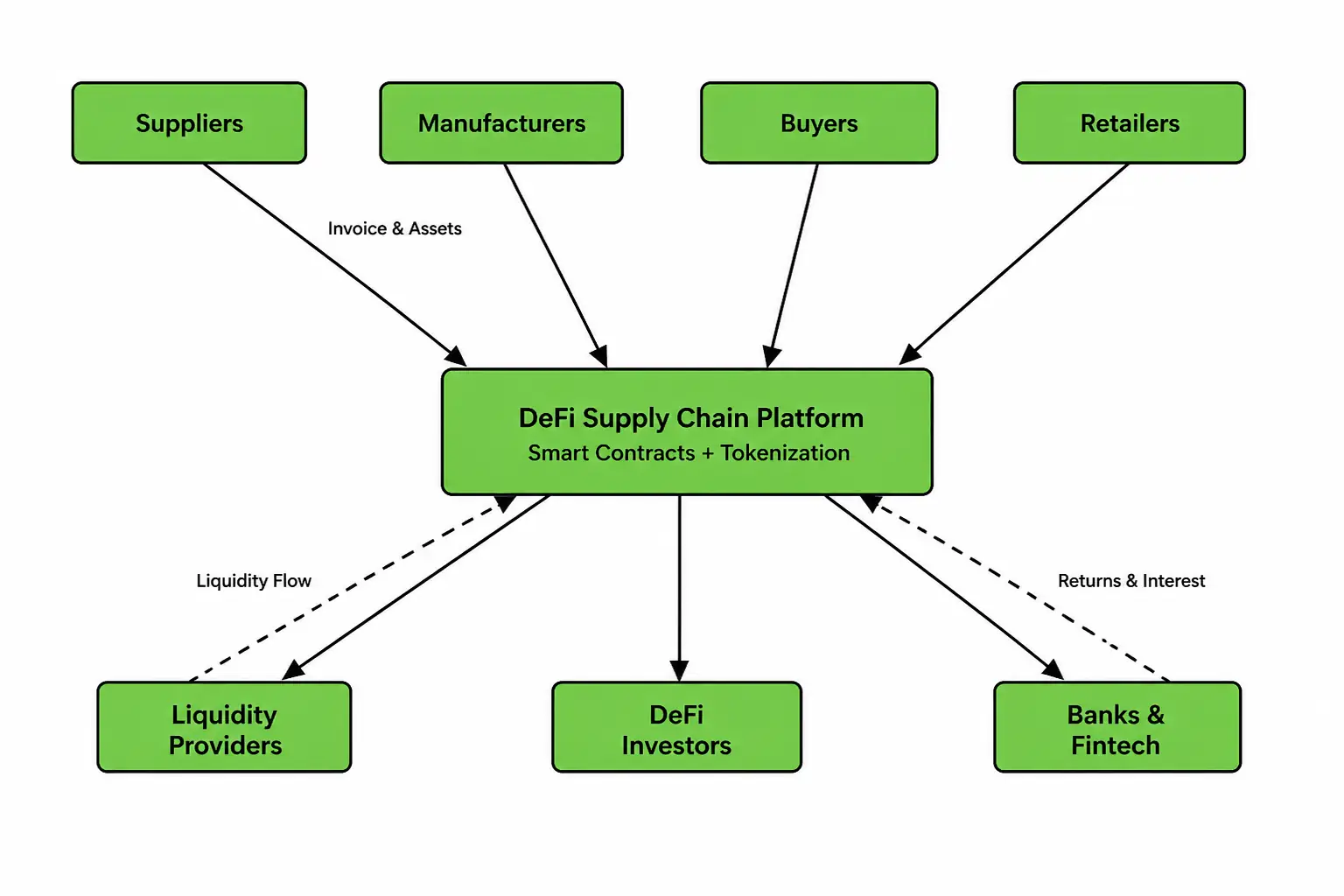
DeFi in supply chain financing refers to using blockchain technology and decentralized finance protocols to create instant, transparent, and low cost financing solutions for businesses in trade and logistics. Instead of going through banks or traditional finance companies, suppliers and manufacturers connect directly through smart contracts on blockchain networks.
Think of it like this: In traditional finance, when you want to borrow money, you visit a bank. The bank verifies you, charges fees, processes the loan, and takes weeks to approve it. In DeFi supply chain finance, the verification happens automatically through smart contracts using verifiable data from the blockchain. Lenders can see the entire transaction history and payment track record in seconds. This means faster approvals, lower costs, and no geographical restrictions.
Key components of DeFi in supply chain financing include:
- Smart contracts in logistics finance: Self executing agreements that trigger payments when conditions are met (goods delivered, invoice verified, etc.)
- Tokenized supply chain assets: Invoices, purchase orders, or inventory converted into digital tokens that can be bought, sold, or used as collateral instantly
- Decentralized trade finance: Peer to peer lending networks where investors fund businesses directly without bank involvement
- Real world assets on blockchain: Physical goods represented digitally so their ownership and movement can be tracked transparently
How DeFi Supply Chain Solutions Work: A Step by Step Guide
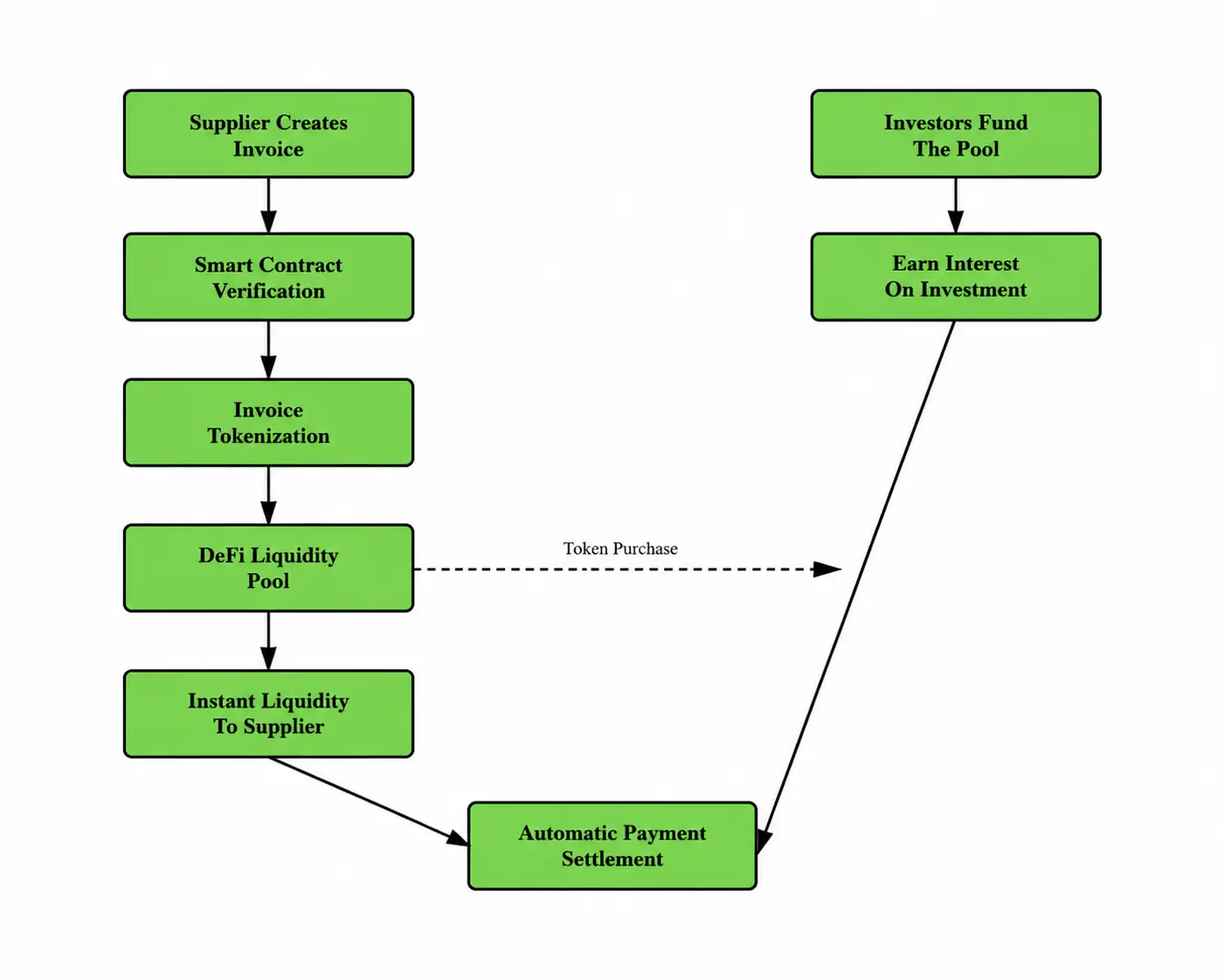
Let’s walk through a real scenario to understand DeFi invoice financing in action. Imagine an apparel exporter in Bangladesh supplies clothing to a major European retailer.
Step 1: Invoice Creation and Verification
The exporter ships 5,000 garments worth $50,000 and uploads the invoice and shipping documents to a DeFi supply chain platform. Smart contracts automatically verify the shipment using IoT data from logistics providers and confirm the retailer’s creditworthiness through blockchain records.
Step 2: Tokenization of Assets
The invoice is converted into a digital token worth $50,000. This token represents the right to receive payment in 60 days. The exporter now owns a tokenized supply chain asset that can be traded or used as collateral.
Step 3: Immediate Liquidity Access
Instead of waiting 60 days, the exporter can sell this token on the DeFi platform for $48,000 immediately (a small discount for immediate liquidity). Investors funding the platform earn interest on their contribution while the exporter gets cash within hours to pay workers and restock inventory.
Step 4: Automated Payment Settlement
After 60 days, when the European retailer pays, the smart contract automatically distributes funds. The investor who purchased the token receives their $48,000 plus interest. The exporter’s transaction is complete without any bank involvement, paperwork, or intermediary fees.
DeFi Supply Chain Financing Process
Real World Examples: DeFi Supply Chain Finance in Action
Example 1: Manufacturing Export Trade Finance
A leather goods manufacturer in India produces premium wallets for a large US retailer. Historically, they waited 90 days for payment while struggling to buy raw materials. Using a DeFi supply chain platform, they now:
- Upload their invoice and shipping proof within hours of shipment
- Tokenize the receivable as a digital asset
- Receive 98 percent of invoice value instantly
- Complete the process in less than one hour instead of weeks with traditional banks
Example 2: E-commerce Supply Chain Liquidity
An electronics e-commerce platform in Southeast Asia needs to purchase inventory from manufacturers in China. Instead of taking a 6-month bank loan at 12 percent interest, they use DeFi supply chain solutions to:
- Access purchase order financing at 4 to 6 percent annual rate
- Receive funds immediately when the order is confirmed
- Repay from sales revenue without fixed payment schedules
- Scale inventory rapidly without straining cash flow
Example 3: Logistics and Warehouse Finance
A third-party logistics provider in Africa holds inventory worth $500,000 in a warehouse. They need working capital to expand but don’t have enough collateral for traditional bank loans. Through tokenized supply chain assets, they:
- Tokenize their warehouse inventory as collateral on a DeFi platform
- Receive up to 70 percent of inventory value as immediate financing
- Expand operations and add more customers
- Repay the loan from operational profits without intermediary pressure
Traditional Supply Chain Finance vs DeFi Based Solutions
| Feature | Traditional Supply Chain Finance | DeFi Based Supply Chain Finance |
|---|---|---|
| Processing Time | 5 to 15 business days | Minutes to hours |
| Interest Rates | 8 to 15 percent annually | 3 to 7 percent annually |
| Intermediary Fees | 2 to 8 percent of transactions | 0.5 to 2 percent of transaction |
| Accessibility | Limited to creditworthy firms with collateral | Open to all verified businesses globally |
| Geographical Reach | Limited by banking infrastructure | Global, 24/7 availability |
| Documentation | Manual verification, extensive paperwork | Automated smart contract verification |
| Transparency | Limited visibility into transaction flow | Complete blockchain transparency |
| Fraud Risk | Higher due to manual processes | Minimized through cryptographic verification |
Key Benefits of DeFi Supply Chain Solutions
1. Dramatically Faster Payments
What took weeks now takes hours. Suppliers no longer suffer from payment delays that damage cash flow and growth prospects. A textile exporter can now finance their weekly production instead of waiting months between shipments.
2. Significantly Lower Costs
By cutting out banks, brokers, and intermediaries, DeFi supply chain financing reduces total costs by 50 to 75 percent. A business that paid $8,000 in fees on a $100,000 transaction through traditional factoring now pays $1,000 to $2,000 through DeFi platforms.
3. Access for Everyone
Small and medium enterprises that banks reject due to lack of collateral or credit history can now access financing. A startup manufacturing company with only six months of transaction history can secure supply chain liquidity through DeFi by proving their legitimacy through blockchain records.
4. Transparent and Trustworthy
Every transaction is recorded on the blockchain and visible to all parties. This builds trust in international trade where parties have never met. A supplier in Vietnam and a buyer in Germany can transact with confidence knowing smart contracts enforce the agreement automatically.
5. Global Reach Without Geographic Limitations
DeFi supply chain solutions work 24/7 across all time zones and countries. No more waiting for banking hours in specific regions or dealing with international transfer delays. Businesses in Africa, Asia, and Latin America now have equal access to financing opportunities.
6. Reduced Fraud and Risk
Immutable blockchain records make it nearly impossible to fake invoices or manipulate documents. The $1.5 trillion in annual supply chain fraud losses could be significantly reduced through blockchain in supply chain finance solutions that verify every transaction cryptographically.
Challenges and Limitations of DeFi in Supply Chain Financing
While DeFi supply chain solutions offer tremendous potential, they’re not without challenges that both users and providers must understand.
Regulatory Uncertainty
Governments globally are still establishing clear regulations for DeFi in supply chain financing. A business operating legally today might face compliance changes tomorrow as regulators catch up with blockchain technology. Staying informed about regulatory developments in your jurisdiction is essential.
Technology Adoption Barriers
Many traditional businesses lack the technical knowledge to use DeFi platforms. A manufacturing business owner comfortable with spreadsheets and bank transfers might find blockchain interfaces intimidating. However, many DeFi platforms now offer simplified user interfaces similar to traditional banking apps.
Smart Contract Risks
While smart contracts are powerful, they’re only as good as their code. Bugs or vulnerabilities in poorly audited contracts can lead to financial loss. Always verify that DeFi platforms you use have undergone professional security audits by reputable firms.
Volatility in Cryptocurrency Markets
Some DeFi platforms operate with cryptocurrency tokens that can be volatile. If the platform’s native token drops in value suddenly, investors can experience losses. Platforms using stablecoins (tokens pegged to real currency) reduce this risk but may offer lower returns.
Limited Integration with Traditional Finance
Moving money between traditional bank accounts and DeFi platforms can still involve friction. However, this is improving rapidly as fintech companies build bridges between traditional and decentralized finance systems.
Credit Risk Assessment
While blockchain provides transaction transparency, assessing whether a buyer will actually pay their invoice is more complex. DeFi platforms are developing better credit scoring mechanisms using on-chain data, but this remains an evolving challenge.
How DeFi Supply Chain Finance Impacts Different Industries
Manufacturing and Export
Manufacturers in Asia, Africa, and Latin America can now scale production without being limited by cash flow constraints. They can fulfill larger orders from international buyers and expand their customer base knowing they can access immediate financing.
Retail and E-Commerce
E-commerce businesses can maintain optimal inventory levels without excessive borrowing costs. DeFi supply chain financing allows retailers to stock multiple warehouses and expand rapidly during peak seasons.
Logistics and Freight
Shipping companies and logistics providers can tokenize their accounts receivable, turning invoices from shippers into immediate working capital. This enables them to expand fleets and service more routes.
Agriculture and Food Supply Chains
Farmers and agricultural suppliers historically struggle with seasonal cash flow challenges. DeFi in supply chain financing enables them to access pre season funding without high interest rates from traditional lenders.
Automotive Supply Chains
Component suppliers to major automotive manufacturers can now finance their production through decentralized trade finance instead of being squeezed by payment delays from large OEMs.
DeFi Supply Chain Ecosystem
Building DeFi Supply Chain Solutions: Implementation Guide
If your business is considering DeFi supply chain solutions, here’s how to get started:
Step 1: Evaluate Your Supply Chain Needs
Assess where your business faces working capital challenges. Do you wait 60 days for customer payments? Do you struggle to fund inventory expansion? Are you paying high fees to traditional factoring companies? Understanding your specific pain points helps you select the right DeFi solution.
Step 2: Research DeFi Platforms and Solutions
Multiple blockchain platforms now offer real world DeFi use cases in supply chain financing. Look for platforms that are audited, have transparent fee structures, and offer user interfaces suitable for non-technical users. Check their transaction volumes and customer reviews.
Step 3: Prepare Your Documentation
DeFi platforms require digitized versions of invoices, purchase orders, shipping documents, and company information. Ensure these documents are accurate, complete, and stored digitally so they can be uploaded quickly to smart contracts.
Step 4: Start with a Small Pilot
Don’t commit your entire supply chain financing to DeFi immediately. Process a few transactions through a DeFi platform to understand the workflow, verify it works for your business model, and build confidence before scaling up.
Step 5: Integrate with Your Existing Systems
Modern DeFi supply chain platforms offer API integrations that connect with your accounting software, ERP systems, and banking platforms. This automation reduces manual work and errors.
Step 6: Train Your Team
Ensure your finance and operations teams understand how DeFi in supply chain financing works. Most platforms offer training resources, webinars, and customer support to help teams get up to speed.
The Future of DeFi in Supply Chain Financing
The evolution of DeFi in supply chain financing is still in early stages, but the trajectory is clear. Industry experts predict several major developments:
Greater Mainstream Adoption
As user interfaces improve and regulatory frameworks solidify, DeFi supply chain solutions will move from niche fintech to mainstream business practice. Within five years, accessing supply chain liquidity through blockchain might be as common as using online banking.
Interoperability Between Blockchains
Currently, different blockchain platforms operate separately. The future will bring greater interoperability, allowing decentralized trade finance to work seamlessly across multiple blockchains. This eliminates friction and expands the available liquidity pools.
AI and Machine Learning Integration
Artificial intelligence will improve credit scoring and fraud detection in supply chain financing. Smart contracts will become smarter, automatically adjusting terms based on market conditions and counterparty behavior.
Integration with IoT and Supply Chain Tech
IoT devices tracking goods movement, temperature, and conditions will feed real time data to smart contracts. This creates a fully automated supply chain where financing is triggered based on actual shipment status rather than documents.
Central Bank Digital Currencies (CBDCs)
As governments launch their own digital currencies, DeFi in supply chain financing will operate on more stable foundations. CBDC backed smart contracts will provide the reliability and legitimacy that businesses require for large scale adoption.
Regulatory Clarity and Compliance
As regulators worldwide establish clearer frameworks for blockchain and DeFi, businesses will have greater confidence deploying supply chain financing solutions. This regulatory clarity will accelerate institutional participation and scale.
Ready to Transform Your Supply Chain Financing
Whether you are a startup scaling rapidly, a manufacturer seeking working capital solutions, or a logistics company optimizing cash flow, DeFi in supply chain financing offers powerful alternatives to traditional banking.
Final Thoughts
DeFi in supply chain financing represents a fundamental shift in how global trade operates. Instead of suppliers waiting months for payment while struggling to fund operations, they now access liquidity instantly. Instead of paying expensive intermediaries, businesses keep more of their revenue. Instead of being excluded from financing due to lack of collateral or credit history, even startups can prove their creditworthiness through transparent blockchain records.
The supply chain financing problems that have plagued businesses for centuries are being solved by blockchain technology and decentralized finance. Smart contracts in logistics finance automate what previously required armies of accountants and brokers. Tokenized supply chain assets create liquidity where none existed before. Decentralized trade finance opens opportunities to billions of people previously excluded from global commerce.
While challenges remain around regulation, technology adoption, and smart contract risks, these are temporary friction points in the march toward a more efficient supply chain ecosystem. The world’s trade finance infrastructure, largely unchanged for decades, is being revolutionized by DeFi.
Whether you’re a business seeking to optimize your working capital, an investor looking to participate in supply chain financing returns, or a fintech company building the next generation of tools, the opportunities in DeFi in supply chain financing are immense. The time to understand and adopt these technologies is now, as early movers will gain significant competitive advantages.
The future of supply chain financing is decentralized, transparent, efficient, and accessible to all. DeFi in supply chain financing is not coming—it’s already here, transforming global trade one smart contract at a time.
Frequently Asked Questions
Q1.How does DeFi invoice financing work for businesses without cryptocurrency experience?
Modern DeFi platforms simplify the experience with user-friendly interfaces similar to traditional banking apps. You upload invoices like you would to an email, smart contracts handle verification automatically, and you receive funds in stablecoins or your local currency. Many platforms offer customer support teams to guide first-time users through the process. No cryptocurrency knowledge required.
Q2.What documents are needed to use supply chain financing through DeFi platforms?
Typically you’ll need: commercial invoices, proof of shipment (bill of lading or tracking), purchase orders showing buyer authorization, company registration documents, and identification of authorized signatories. Some platforms may request additional documents depending on transaction size and your jurisdiction. Digital versions of all documents are required for faster processing.
Q3.What happens if the buyer doesn't pay the invoice on DeFi platforms?
If a buyer defaults, the platform’s smart contracts can execute recovery processes defined in the loan agreement. Some platforms hold buyer collateral or require buyer insurance. Others pool default risk across many transactions. Advanced platforms integrate buyer creditworthiness data to minimize default risk upfront. This is why platform selection and due diligence matter significantly.
Q4.Are there tax implications for using DeFi supply chain financing?
Tax treatment varies by jurisdiction. In most countries, interest or fees paid for financing are tax-deductible business expenses. However, regulations around blockchain transactions, token conversions, and international transfers continue evolving. Consult with your accountant or tax advisor familiar with DeFi regulations in your specific location to ensure compliance.
Q5.Can small businesses with limited transaction volume use DeFi supply chain solutions?
Yes, many DeFi platforms welcome small businesses. Some have minimum transaction sizes of just $5,000 to $10,000. The cost advantage actually increases for smaller businesses since fees are charged as a percentage of the loan amount rather than fixed fees. A small business processing $50,000 in annual financing saves more proportionally than a large business processing millions.
Q6.How are supply chain assets tokenized on blockchain platforms?
Tokenization converts real world assets (invoices, purchase orders, inventory) into digital tokens representing ownership rights. Smart contracts verify the underlying asset’s authenticity, then create a token representing the right to receive payment. These tokens can be held, sold, or transferred instantly on the blockchain. The entire process is auditable and transparent for all parties involved.
Q7.What's the difference between supply chain financing and regular loans from banks?
Supply chain financing is secured by specific invoices or assets, not just your business creditworthiness. Banks lend based on your credit history and collateral. DeFi platforms lend based on the quality of underlying invoices and buyer creditworthiness. This makes supply chain financing faster to obtain and cheaper because it’s lower risk for lenders. The specific assets secure the loan, not your personal assets.
Q8.How do blockchain platforms ensure data privacy in supply chain transactions?
Blockchain transactions are transparent but can be pseudonymous (identified by wallet addresses rather than real names). Many enterprise DeFi platforms use private blockchains where only authorized parties see transaction details. Others use encryption and zero knowledge proofs to verify transactions without revealing sensitive data. Privacy levels vary by platform, so check specific security features before using.
Q9.What blockchain networks support DeFi supply chain financing solutions?
Ethereum remains the leading blockchain for DeFi applications including supply chain financing. However, platforms also operate on Polygon, Avalanche, Binance Smart Chain, and other networks. Each blockchain offers different trade-offs between cost, speed, and ecosystem maturity. Enterprise platforms often use private blockchains like Hyperledger Fabric for greater control and customization.
Q10.How quickly can a business start using DeFi supply chain financing?
Onboarding typically takes 3 to 7 days for most platforms. This includes account creation, document verification, and buyer approval confirmation. After setup, funding for individual invoices can be received within 24 to 48 hours from document submission. Some platforms offering pre-approved credit lines can fund transactions within hours. Speed varies based on platform technology and verification complexity.
Explore Services
Related Services
Reviewed by

Aman Vaths
Founder of Nadcab Labs
Aman Vaths is the Founder & CTO of Nadcab Labs, a global digital engineering company delivering enterprise-grade solutions across AI, Web3, Blockchain, Big Data, Cloud, Cybersecurity, and Modern Application Development. With deep technical leadership and product innovation experience, Aman has positioned Nadcab Labs as one of the most advanced engineering companies driving the next era of intelligent, secure, and scalable software systems. Under his leadership, Nadcab Labs has built 2,000+ global projects across sectors including fintech, banking, healthcare, real estate, logistics, gaming, manufacturing, and next-generation DePIN networks. Aman’s strength lies in architecting high-performance systems, end-to-end platform engineering, and designing enterprise solutions that operate at global scale.