Ai Overview
DeFi architecture is the technical foundation that makes decentralized financial applications possible. It defines how different system components, blockchain networks, smart contracts, off-chain services, and user interfaces work together to deliver financial services without relying on intermediaries like banks or brokers. In simple terms, DeFi architecture is not just about writing smart contracts.
Key Takeaways
- DeFi architecture follows a layered system design where blockchain networks, smart contracts, data services, applications, and governance have clearly defined roles.
- Decentralized infrastructure powered by nodes, validators, and distributed services ensures availability, security, and trustless execution without centralized control.
- Modular DeFi protocol stacks separate execution, data, access, and interface layers, making systems easier to upgrade, integrate, and scale.
- Secure data flow between on-chain and off-chain components is essential, making oracle networks and indexing layers a critical part of DeFi design.
- Scalability in DeFi is achieved through efficient smart contract design, layered execution models, and optimized data indexing solutions.
- Security is enforced across every layer through audits, access controls, fail-safe mechanisms, and governance oversight to reduce systemic risk.
Most DeFi platforms don’t fail because of bad ideas, they fail because of weak architecture.
In decentralized finance, how a system is designed matters just as much as what it does.
Decentralized Finance (DeFi) is transforming the way financial systems are built, deployed, and governed. Unlike traditional finance, DeFi platforms run on open blockchain networks where code replaces intermediaries and financial logic is executed by smart contracts instead of centralized institutions. Every transaction, rule, and asset movement is handled by distributed components working together in a trustless environment.
To truly understand how DeFi works at scale, it’s important to look beyond individual applications like lending protocols or decentralized exchanges. The real foundation of DeFi lies in its architecture the layers that separate responsibilities, the nodes that secure and validate the network, and the protocol stacks that enable different systems to connect and compose with each other.
This guide explains DeFi architecture from a system design and developer perspective. It breaks down layers, nodes, and protocol stacks in a clear and practical way, focusing on how modern DeFi platforms are structured for security, scalability, and composability. Whether you are a blockchain developer, architect, or technical decision-maker, this article will help you understand how real-world DeFi systems are designed and why those design choices matter.
What Is DeFi Architecture?
DeFi architecture is the technical foundation that makes decentralized financial applications possible. It defines how different system components, blockchain networks, smart contracts, off-chain services, and user interfaces work together to deliver financial services without relying on intermediaries like banks or brokers.
In simple terms, DeFi architecture is not just about writing smart contracts. It is about designing a complete, reliable system where financial logic runs on-chain, data flows securely between components, and users can interact with protocols in a transparent and trustless way. Every design decision, from contract structure to node interaction, directly affects security, scalability, and user experience.
A well-designed DeFi architecture ensures:
- Trustless execution of financial logic, where rules are enforced by smart contracts, not human intervention
- High availability and fault tolerance, supported by decentralized nodes and distributed infrastructure
- Secure asset custody, with funds controlled by audited smart contracts instead of centralized wallets
- Protocol composability, allowing DeFi applications to integrate and build on top of other protocols
- Scalability across users and transactions, through efficient contract design and supporting infrastructure
Understanding DeFi architecture is essential for developers and architects who want to build systems that are not only innovative but also secure, scalable, and production-ready. Strong architecture is what separates experimental DeFi projects from platforms that can operate reliably in real-world financial environments.
Layered Architecture of DeFi Systems
Most DeFi platforms follow a layered architectural model. Each layer has a distinct responsibility, making the system modular, upgrade-friendly, and easier to audit.
1. Blockchain Layer (Settlement Layer)
The blockchain layer is the base layer of every DeFi system. It provides the shared infrastructure where transactions are recorded, validated, and finalized. Everything else in the DeFi stack ultimately depends on the security and reliability of this layer.
Key responsibilities include:
- Maintaining a distributed ledger
- Executing transactions through consensus mechanisms
- Providing final settlement and security guarantees
Common characteristics:
- Decentralized validator or miner networks
- Cryptographic security
- Global state replication
This layer ensures that all DeFi operations are verifiable and tamper-resistant.
The blockchain layer provides final settlement and security for DeFi protocols, and Ethereum’s[1] blockchain architecture explains how decentralized consensus and global state replication enable trustless execution.
2. Smart Contract Layer (Protocol Logic)
The smart contract layer contains the core business logic of DeFi protocols. Financial rules such as lending conditions, swaps, collateral ratios, and reward distribution are encoded directly into smart contracts.
Core functions:
- Autonomous execution of financial agreements
- Asset custody and transfer
- Enforcement of protocol rules without intermediaries
Design considerations:
- Security-first development
- Gas optimization
- Upgrade and governance mechanisms
This layer is where most protocol-level innovation happens.
3. Data & Indexing Layer
DeFi protocols generate large volumes of on-chain data that are difficult to query directly from blockchains. The data and indexing layer bridges this gap by organizing blockchain data into usable formats.
Key roles:
- Indexing historical transactions
- Providing fast read access for analytics
- Supporting dashboards and monitoring tools
This layer improves performance and usability without compromising decentralization principles.
4. Application Layer
The application layer connects end users with DeFi protocols. It includes dashboards, web apps, and integrations that allow users to interact with smart contracts.
Responsibilities:
- Transaction creation and signing
- Wallet integration
- Displaying balances, yields, and protocol states
This layer focuses on usability, accessibility, and user experience while relying on lower layers for trust and security.
5. Governance Layer
Many DeFi systems include a governance layer that allows protocol stakeholders to influence upgrades and parameter changes.
Core elements:
- Governance tokens
- Proposal and voting mechanisms
- On-chain execution of approved changes
This layer ensures decentralized decision-making and long-term protocol sustainability.
Role of Nodes in DeFi Architecture
Nodes are the operational backbone of any DeFi system. They keep the blockchain running, validate transactions, and make data available to applications and users. Without nodes, smart contracts cannot execute, transactions cannot be confirmed, and DeFi protocols simply do not function.
From a system design perspective, nodes are what make DeFi decentralized, reliable, and always available. Different types of nodes exist because a single node cannot efficiently handle every responsibility at scale.
Types of Nodes in DeFi Systems
- Validator or Miner Nodes
These nodes secure the network by validating and ordering transactions. They participate in the consensus process and are responsible for producing new blocks, making them critical to network security and finality. - Full Nodes
Full nodes store a complete copy of the blockchain and independently verify transactions and blocks. They help preserve decentralization by allowing anyone to verify the network without relying on third parties. - RPC Nodes
RPC (Remote Procedure Call) nodes act as the bridge between DeFi applications and the blockchain. They allow wallets, dashboards, and backend services to read blockchain data and submit transactions. - Archive Nodes
Archive nodes store the entire history of blockchain states, not just the latest one. They are essential for analytics, historical queries, audits, and advanced DeFi data analysis.
Each node type plays a specific role in maintaining reliability and decentralization.
Protocol Stacks in DeFi
In DeFi, no single technology works in isolation. A protocol stack describes how multiple layers of technology come together to form a complete, usable DeFi system from blockchain infrastructure to the interfaces users interact with every day.
Thinking in terms of protocol stacks helps developers understand where each component fits, how responsibilities are separated, and how systems can remain modular while still working seamlessly together.
Typical DeFi Protocol Stack
- Base Layer – Blockchain NetworkThis layer provides the core infrastructure for the entire system. It handles consensus, transaction finality, and immutable state storage. All higher layers ultimately rely on the security and availability of the underlying blockchain.
- Execution Layer – Smart ContractsThe execution layer contains the protocol’s business logic. Smart contracts define how assets move, how rules are enforced, and how financial actions like swaps, lending, or staking are executed.
- Data Layer – Indexers and OraclesThis layer supplies external and structured data. Indexers make on-chain data easy to query, while oracles feed real-world information such as asset prices into smart contracts.
- Access Layer – APIs and SDKs APIs and SDKs act as the bridge between DeFi protocols and applications. They allow developers to interact with smart contracts without directly managing low-level blockchain communication.
- Interface Layer – Web and Mobile ApplicationsThis is the user-facing layer. Wallet-connected web apps and mobile interfaces allow users to interact with DeFi protocols in a simple and accessible way.
This stacked approach allows developers to build complex financial systems while keeping each part of the system modular, upgradeable, and interoperable. When designed well, protocol stacks make DeFi platforms easier to scale, integrate, and evolve over time.
Interoperability and Composability
One of the most powerful ideas behind DeFi architecture is composability. DeFi protocols are designed to work together, not in isolation. Each protocol acts like a building block that other developers can plug into, extend, or combine with new systems.
From a practical perspective, this means a DeFi application does not need to rebuild everything from scratch. A lending protocol can use an existing price oracle, a DEX can share liquidity with other platforms, and a yield strategy can combine multiple protocols into a single workflow.
This architectural approach offers several clear benefits:
- Faster innovation, because teams can build on proven protocols
- Reduced development time, by reusing existing infrastructure
- Shared liquidity and network effects, which strengthen the entire ecosystem
However, composability also introduces architectural responsibility. Developers must carefully manage cross-protocol dependencies, handle failure scenarios, and design systems that remain secure even when external protocols change behavior.
When done right, interoperability and composability turn DeFi into a connected financial system, not a collection of isolated applications. This is what allows DeFi platforms to scale rapidly while remaining open, flexible, and permissionless.
Security Considerations in DeFi Architecture
Security is not a single feature in DeFi it is a design responsibility that spans every architectural layer. From the blockchain and smart contracts to oracles and user access, each component can become a point of failure if not designed carefully.
In real-world DeFi systems, most major losses happen not because the idea was flawed, but because security was treated as an afterthought. Strong architecture reduces these risks by building safeguards directly into the system.
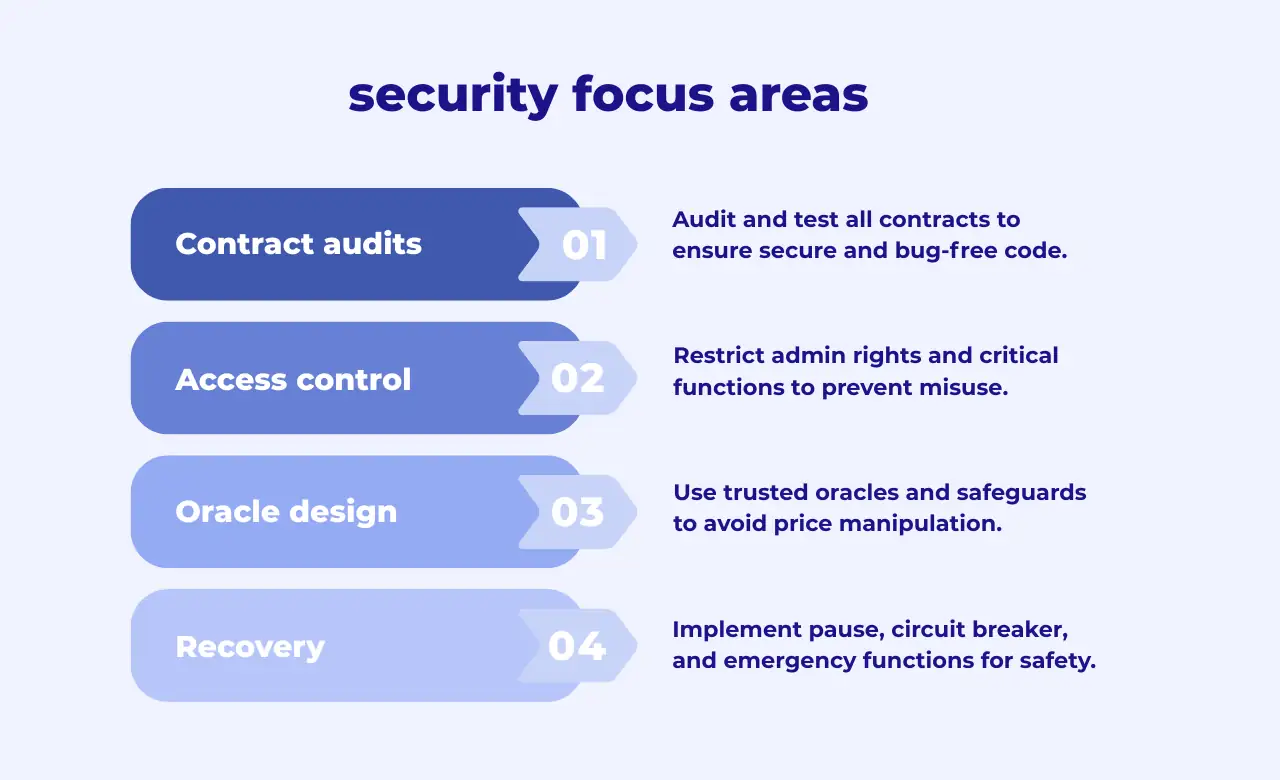
Key security focus areas include:
- Smart contract auditsEvery contract should be reviewed, tested, and audited before deployment. Clear logic, minimal complexity, and well-tested code reduce the risk of exploitable bugs.
- Access control and permissionsAdmin roles, upgrade rights, and emergency functions must be tightly controlled. Poor permission design can turn a decentralized system into a centralized risk.
- Oracle manipulation resistanceSince many DeFi protocols rely on external price data, oracle design is critical. Using reliable data sources and safeguards helps prevent price manipulation attacks.
- Fail-safe and recovery mechanismsCircuit breakers, pause functions, and emergency exits allow protocols to respond to unexpected behavior without putting user funds at immediate risk.
A secure DeFi architecture does not eliminate risk entirely, but it limits the blast radius when something goes wrong. Thoughtful security design is what protects user funds, preserves trust, and allows DeFi platforms to operate safely at scale.
Scalability and Performance Design
As defi platform development attracts more users, scalability becomes a real architectural challenge, not just a theoretical concern. Higher transaction volume, complex smart contract logic, and increased data reads can quickly expose performance bottlenecks if the system is not designed to scale from the start.
From an architectural point of view, scalability is about more than handling more transactions. It’s about making sure the system remains usable, secure, and decentralized even as demand increases.
Common scalability and performance strategies include:
- Layered execution models Separating execution, settlement, and data access helps reduce load on the base blockchain while preserving security guarantees.
- Optimized smart contract design Efficient storage usage, minimal external calls, and gas-aware logic reduce costs and improve execution speed without sacrificing safety.
- Efficient data retrieval systems Indexers and caching layers allow applications to access blockchain data quickly without overwhelming on-chain resources.
Performance optimization in DeFi always involves trade-offs. Every decision must carefully balance decentralization, security, and user experience. Well-designed architecture ensures that as the system scales, it remains reliable and trustworthy rather than fragile under pressure.
Need Help Designing the Right DeFi Architecture?
Every successful DeFi protocol starts with a strong architectural foundation.
If you’re unsure about protocol layers, scalability, security, or composability,
our blockchain experts can guide you from concept to deployment.
Use DeFi Architecture to Build Better Protocols
DeFi architecture is not just about deploying smart contracts. It is about designing a complete, layered system where blockchain infrastructure, protocol logic, data services, nodes, and governance work together as a single financial stack.
Understanding how layers, nodes, and protocol stacks fit together gives developers and architects a practical foundation for building DeFi platforms that are secure, scalable, and composable. These architectural principles help teams avoid common pitfalls and design systems that can operate reliably in real-world conditions.
As decentralized finance continues to evolve, protocols will grow more complex and interconnected. In that environment, architectural clarity becomes a competitive advantage. Teams that invest in strong system design today are far more likely to build DeFi platforms that remain reliable, adaptable, and future-ready.
Frequently Asked Questions
Q1.What are the five core layers of DeFi architecture?
DeFi architecture has five main layers: the blockchain layer for settlement and security, protocol layer for smart contract logic, data/indexing layer for querying and analytics, application layer for user interfaces, and governance layer for decision-making. Together, they ensure modular, secure, and scalable DeFi systems.
Q2.How do oracles bring off-chain data to DeFi protocols securely?
Oracles bridge blockchains and external data by delivering off-chain information like prices or events to smart contracts. Security comes from decentralized sources, cryptographic signatures, and aggregation methods, ensuring data integrity and minimizing manipulation risks while maintaining trustless interactions within DeFi protocols.
Q3.What security vulnerabilities exist in smart contracts at the protocol layer?
Smart contracts can be exploited through reentrancy attacks, logic bugs, unchecked external calls, or poor access controls. These vulnerabilities can compromise funds and protocol operations. Proper auditing, testing, and secure coding practices reduce risks and protect users, ensuring robust protocol layer security in DeFi systems.
Q4.What are the key differences between DeFi Layer 1 and Layer 2 solutions?
Layer 1 (e.g., Ethereum) provides base blockchain security, consensus, and transaction finality but can be slow and costly. Layer 2 solutions (e.g., Optimism) process transactions off-chain or in sidechains to improve speed and reduce fees while inheriting security from Layer 1, enhancing scalability.
Q5.What role do validator nodes play in consensus mechanisms like Proof of Stake?
Validator nodes in PoS networks validate and confirm transactions, propose blocks, and vote on consensus. They maintain network security, ensure transaction finality, and earn rewards or penalties for their behavior. Validators are critical to decentralization and reliability in DeFi networks.
Q6.How does the blockchain settlement layer ensure transaction finality and security?
The settlement layer records all transactions on a distributed ledger. Consensus mechanisms like PoS or PoW prevent tampering, while global replication ensures all nodes verify data. Once confirmed, transactions are immutable, giving DeFi protocols a trustless, secure foundation for executing financial operations.
Q7.What is a blockchain node, and why are nodes essential for decentralized finance?
A blockchain node stores, validates, and propagates data across the network. Nodes maintain decentralization, verify transactions, and keep the ledger synchronized. Without nodes, DeFi systems would rely on central points, losing trust, security, and availability essential for a reliable decentralized financial ecosystem.
Q8.How do Automated Market Makers (AMMs) replace traditional finance infrastructure?
AMMs like Uniswap replace order books with smart contract liquidity pools, enabling automated token swaps without intermediaries. Prices are algorithmically determined, and users can provide liquidity to earn fees. This decentralized mechanism recreates exchange functions permissionlessly and efficiently, removing the need for centralized infrastructure.
Q9.What is the difference between the protocol layer and the application layer in a DeFi dApp?
The protocol layer contains smart contracts and financial logic, executing transactions automatically. The application layer is the user-facing interface, like web apps or dashboards, enabling users to interact with protocols easily. Together, they separate backend logic from user interaction for usability and security.
Q10.What is protocol composability, or “money legos,” and how do Aave and Uniswap use it?
Protocol composability allows DeFi protocols to integrate and build on each other. Aave’s lending pools can serve as collateral in other protocols, while Uniswap provides liquidity for swaps. This modular design enables developers to create complex financial products by combining existing protocols efficiently and securely.
Explore Services
Related Services
Reviewed by

Aman Vaths
Founder of Nadcab Labs
Aman Vaths is the Founder & CTO of Nadcab Labs, a global digital engineering company delivering enterprise-grade solutions across AI, Web3, Blockchain, Big Data, Cloud, Cybersecurity, and Modern Application Development. With deep technical leadership and product innovation experience, Aman has positioned Nadcab Labs as one of the most advanced engineering companies driving the next era of intelligent, secure, and scalable software systems. Under his leadership, Nadcab Labs has built 2,000+ global projects across sectors including fintech, banking, healthcare, real estate, logistics, gaming, manufacturing, and next-generation DePIN networks. Aman’s strength lies in architecting high-performance systems, end-to-end platform engineering, and designing enterprise solutions that operate at global scale.