Ai Overview
Decentralized applications represent a fundamental shift in how we build and interact with software systems. Effective state management balances data availability, security, and cost efficiency. Event logs provide an efficient mechanism for tracking state changes without the high cost of on-chain storage. State management optimization directly impacts dApp performance, cost, and scalability.
Key Takeaways
- dApp data flow involves complex interactions between users, nodes, smart contracts, and blockchain state, requiring careful architecture design for optimal performance.
- Transactions serve as the fundamental unit of state change, validated by nodes through consensus mechanisms before being permanently recorded on-chain.
- State management determines how data persists across the network, balancing on-chain storage costs against off-chain efficiency for scalable application development.
- Nodes perform critical validation, propagation, and synchronization roles, maintaining network integrity through distributed consensus and cryptographic verification methods.
- Event logs provide cost-effective tracking mechanisms, enabling frontend applications to monitor state changes without expensive on-chain storage requirements or complex queries.
- dApp security depends on proper transaction validation, state management patterns, and protection against common vulnerabilities like reentrancy and front-running attacks.
- Hybrid architectures combining on-chain and off-chain storage optimize performance while maintaining necessary security guarantees for sensitive operations and data integrity.
- Understanding data flow patterns enables developers to build efficient, secure, and user-friendly decentralized applications that scale effectively under real-world conditions.
Introduction to dApp Data Flow
Decentralized applications represent a fundamental shift in how we build and interact with software systems. Unlike traditional applications where data flows through centralized servers, dApps distribute data processing across a network of nodes, creating transparency, immutability, and trustless execution. Understanding data flow in these systems is essential for developers, architects, and stakeholders who want to build robust blockchain solutions.
The data flow in a dApp involves multiple layers of interaction. When a user initiates an action, it triggers a transaction that propagates through the network, gets validated by nodes, executes smart contract logic, and ultimately updates the blockchain state. This process involves cryptographic verification, consensus mechanisms, and state management techniques that ensure data integrity and security across the distributed network.
Why Data Flow Matters?
Proper data flow architecture directly impacts application performance, user experience, transaction costs, and overall dApp security. A well-designed data flow minimizes gas consumption, reduces latency, prevents common vulnerabilities, and ensures scalability as the application grows. Organizations with eight years of blockchain development experience understand that data flow decisions made early in development have long-term implications for maintenance, upgrades, and user adoption rates.
Key Components of a dApp
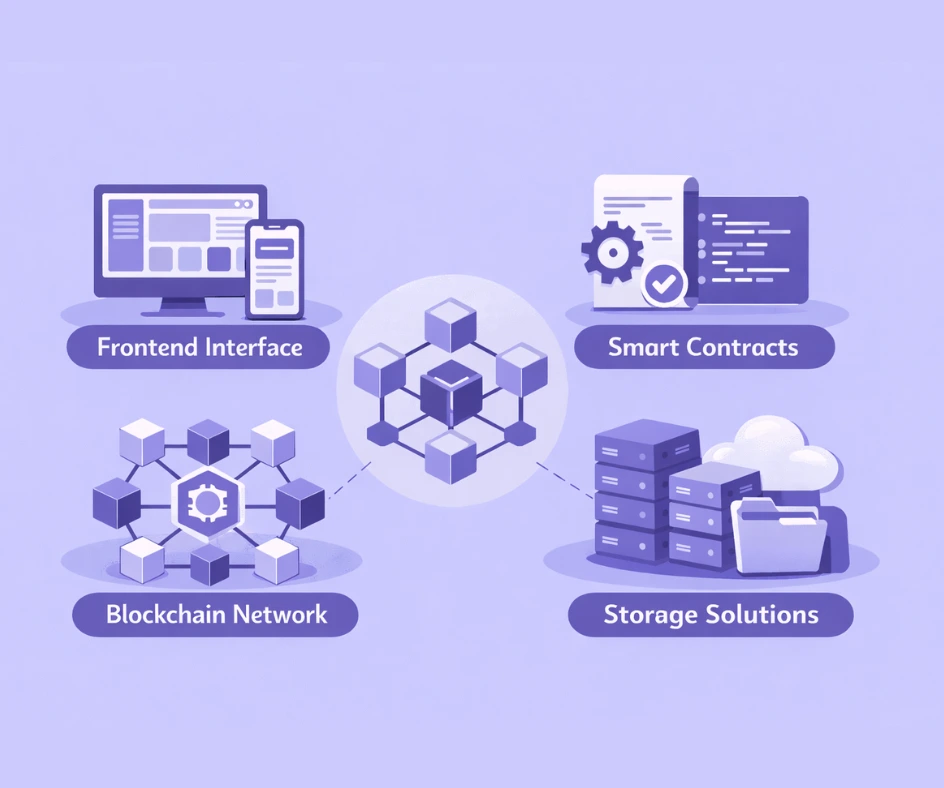
Every decentralized application consists of several interconnected components that work together to process data, maintain state, and deliver functionality to users. Understanding these components provides the foundation for comprehending how data flows through the entire system.
Frontend Interface
The user-facing layer built with web technologies that interacts with blockchain through Web3 libraries, wallet connections, and API endpoints.
Smart Contracts
Self-executing code deployed on the blockchain that defines business logic, stores state, and processes transactions automatically without intermediaries.
Blockchain Network
The distributed ledger layer where nodes validate transactions, maintain consensus, and store the permanent record of all state changes.
Storage Solutions
Hybrid storage combining on-chain data for critical information and off-chain solutions like IPFS for larger datasets and media files.
These components interact continuously as users perform actions. The frontend captures user input and creates transaction requests. Smart contracts execute the business logic and emit events. The blockchain network validates and records state changes. Storage solutions maintain data accessibility. Each component plays a specific role in ensuring the dApp functions correctly, securely, and efficiently.
What is a Transaction in a dApp?
Transactions represent the fundamental unit of interaction in decentralized applications. Every state change, data update, or function execution requires a transaction that gets validated and recorded on the blockchain. Understanding transaction structure and lifecycle is crucial for effective dApp development.
A blockchain transaction contains several key elements: the sender’s address, recipient address or contract address, value being transferred, gas limit, gas price, nonce, and transaction data. The transaction data field contains encoded function calls and parameters when interacting with smart contracts. This structure ensures that every transaction can be uniquely identified, properly ordered, and correctly executed by the network.
| Transaction Element | Purpose | Impact on Data Flow |
|---|---|---|
| Nonce | Ensures transaction ordering and prevents replay attacks | Maintains sequential execution from each address |
| Gas Price | Determines transaction priority and miner incentive | Affects confirmation speed and network throughput |
| Gas Limit | Sets maximum computational resources for execution | Prevents infinite loops and limits state modifications |
| Data Payload | Contains function calls and parameters for contracts | Determines which state changes will occur |
Transaction lifecycle begins when a user signs a transaction with their private key. The signed transaction enters the mempool, a waiting area for unconfirmed transactions. Validators or miners select transactions based on gas price, include them in blocks, and execute the contained operations. Once confirmed, the transaction becomes part of the permanent blockchain record. This process ensures data integrity while maintaining decentralized consensus.
Nodes and Their Role in Processing Transactions
Nodes form the backbone of blockchain networks, performing critical validation and data propagation functions. Different node types serve distinct purposes, each contributing to the overall security and functionality of the decentralized system.
Full nodes maintain a complete copy of the blockchain, validating every transaction against protocol rules. They verify signatures, check balances, ensure transactions follow consensus rules, and propagate valid transactions to peers. Archive nodes store not just current state but historical states, enabling applications to query past data. Light nodes maintain only block headers and request specific data from full nodes, reducing storage requirements while still enabling transaction verification.
Node Processing Workflow
Transaction Reception
Node receives transaction from peer or directly from user wallet through RPC connection.
Validation Process
Verifies signature authenticity, checks nonce sequence, validates sufficient balance, and ensures gas limits.
Mempool Addition
Valid transactions enter the mempool, sorted by gas price for prioritized block inclusion.
Network Propagation
Node broadcasts valid transactions to connected peers, spreading information across the network rapidly.
Validator nodes have additional responsibilities in Proof-of-Stake networks. They propose new blocks, vote on block validity, and participate in consensus. These nodes must stake cryptocurrency as collateral, creating economic incentives for honest behavior. The combination of different node types creates a resilient network that maintains dApp security through distributed validation and data redundancy.
State Management in dApps
State management determines how dApps store, update, and access data across the blockchain network. The state represents all current information including account balances, contract storage variables, and application data. Effective state management balances data availability, security, and cost efficiency.
Blockchain state consists of two primary components: account state and contract state. Account state tracks balances and nonces for externally owned accounts. Contract state stores smart contract variables and their current values. Every transaction that modifies state creates a new state root, a cryptographic hash representing the entire current state, enabling efficient verification of state consistency across nodes.
On-Chain State
Stored directly in smart contracts with guaranteed immutability and transparency. Ideal for critical data requiring consensus validation.
Use for: Ownership records, financial balances, governance votes, access control
Off-Chain State
Maintained in external databases with on-chain references or hashes. Reduces costs and improves query performance significantly.
Use for: User profiles, historical data, media files, analytics, metadata
State management patterns significantly impact gas costs and performance. Storage operations on Ethereum, for example, are among the most expensive computations. Developers optimize by using memory variables for temporary data, events for historical tracking, and off-chain storage for large datasets. Advanced patterns like state channels and rollups move state modifications off-chain while maintaining security through periodic settlement on the main blockchain.
Role of Smart Contracts in Data Flow
Smart contracts serve as the programmable core of decentralized applications, defining how data flows through the system. They execute automatically when specific conditions are met, eliminating the need for trusted intermediaries and enabling complex multi-party agreements.
When a transaction calls a smart contract function, the blockchain virtual machine executes the code in a deterministic environment. The contract reads its current state from storage, performs computations, and writes new state values. Throughout this process, the contract can interact with other contracts, emit events, and transfer assets. All execution occurs atomically, meaning either all operations succeed or all revert, preventing partial state changes that could compromise data integrity.
Smart Contract Data Flow Best Practices
- Minimize storage writes by using events for historical data and memory for temporary computations
- Implement proper access control to prevent unauthorized state modifications and protect sensitive operations
- Use checks-effects-interactions pattern to prevent reentrancy attacks and maintain contract security
- Batch operations when possible to reduce transaction costs and improve user experience
- Validate all inputs thoroughly before processing to prevent unexpected behavior and vulnerabilities
- Design upgradeable contracts carefully, balancing flexibility against immutability guarantees
Smart contracts also define the interface through which external applications interact with blockchain data. Application Binary Interface specifications allow frontend applications to encode function calls correctly and decode return values. This standardization enables seamless integration between user interfaces and blockchain logic, creating smooth data flow from user actions to permanent state changes.
Consensus Mechanisms and Transaction Validation
Consensus mechanisms enable distributed nodes to agree on the current state without central authority. They determine how transactions are validated, ordered, and added to the blockchain, directly impacting dApp performance, security, and decentralization characteristics.
Proof-of-Work requires miners to solve complex mathematical puzzles to propose new blocks. This process provides strong security through computational work but results in slower finality and higher energy consumption. Proof-of-Stake selects validators based on their staked tokens, offering faster block times and lower energy requirements while maintaining robust security through economic incentives and slashing penalties for malicious behavior.
| Consensus Type | Transaction Speed | Finality | Best Use Case |
|---|---|---|---|
| Proof-of-Work | 10-15 minutes | Probabilistic (6+ blocks) | High security applications with less concern for speed |
| Proof-of-Stake | 12-15 seconds | Near-instant (2 epochs) | DeFi platforms requiring fast confirmations |
| Byzantine Fault Tolerance | 1-3 seconds | Instant (single block) | Enterprise solutions and private blockchains |
| Delegated Proof-of-Stake | 3-5 seconds | Fast (few blocks) | High-throughput dApps like gaming and social |
Byzantine Fault Tolerant algorithms like Practical Byzantine Fault Tolerance and Tendermint provide instant finality, making them ideal for applications requiring immediate confirmation. However, they typically support fewer validators, which may reduce decentralization. These consensus models play a crucial role in shaping scalable dApp solutions, influencing user experience, security models, and long-term economic sustainability.
The Flow of Data from User to Blockchain
Understanding the complete data flow from user action to blockchain confirmation reveals the complexity and elegance of decentralized systems. Each step in this process serves a specific purpose in maintaining security, consistency, and trustlessness across the network.
Complete Data Flow Lifecycle
User Action
User interacts with dApp frontend, triggering wallet to create transaction
Transaction Signing
Wallet signs transaction with private key, creating cryptographic proof
Network Broadcast
Signed transaction broadcasts to network nodes via RPC endpoints
Mempool Entry
Validated transaction enters mempool, awaiting block inclusion
Block Inclusion
Validator selects transaction for block based on priority and gas price
Execution
Smart contract code executes, modifying blockchain state atomically
Event Emission
Contract emits events logging state changes for off-chain tracking
Confirmation
Block propagates through network, achieving consensus and finality
This flow ensures that every state change is validated, ordered correctly, and permanently recorded. The cryptographic signatures prevent unauthorized modifications. The mempool mechanism manages network capacity. The consensus process ensures all nodes agree on the state. Together, these elements create a robust system where data flows securely from user intent to immutable storage.
Event Logs: Tracking Changes in dApp State
Event logs provide an efficient mechanism for tracking state changes without the high cost of on-chain storage. Smart contracts emit events during execution, creating a searchable record of important occurrences that applications can monitor and respond to in real-time. The behavior of events at the contract level is defined in the solidity events specification.
Events consist of indexed and non-indexed parameters. Indexed parameters become part of the log topics, enabling efficient filtering and searching. Non-indexed parameters are stored in the log data, accessible but not directly searchable. This structure allows developers to optimize for specific query patterns, balancing between searchability and gas costs.
Frontend Integration
Web3 libraries subscribe to events, updating user interfaces immediately when transactions confirm. This creates responsive applications without constant blockchain polling.
Indexer Services
Services like The Graph listen to events, building queryable databases that enable complex queries impossible directly on blockchain.
Historical Analysis
Event logs create an audit trail of all contract interactions, enabling analytics, compliance reporting, and historical state reconstruction.
Effective event design significantly impacts dApp functionality. Developers should emit events for all significant state changes, include relevant context in parameters, and design event structures that support anticipated queries. Well-designed events enable rich user experiences while maintaining the cost efficiency essential for scalable decentralized applications.
How Nodes Communicate and Synchronize Data?
Node communication forms the foundation of blockchain decentralization. Through peer-to-peer protocols, nodes discover each other, exchange information, and maintain synchronized state across the entire network without central coordination.
When a node joins the network, it connects to known peers, exchanges version information, and begins synchronizing blockchain data. The node downloads historical blocks, validates each transaction, and builds its local state. During normal operation, nodes continuously exchange new transactions and blocks, ensuring rapid propagation of information across the network.
Synchronization Protocols
Gossip Protocol
Nodes randomly select peers to share information with, creating exponential propagation that quickly spreads data across the entire network.
Block Synchronization
New nodes download blocks in batches, verify transactions, and execute smart contracts to build local state matching the network.
State Snapshots
Some networks support snapshot synchronization, allowing nodes to download recent state directly rather than replaying all history.
Network topology affects synchronization efficiency and resilience. Highly connected networks propagate information faster but require more bandwidth. Sparse networks reduce resource requirements but risk partitioning. Modern blockchain protocols dynamically manage connections, balancing performance against resource constraints while maintaining network security and preventing eclipse attacks where malicious peers isolate honest nodes.
Handling Transaction Failures and Reverts
Transaction failures are an inherent part of blockchain systems. Understanding why transactions fail and how to handle them properly is essential for building reliable dApps that provide good user experiences even when operations don’t succeed.
Transactions can fail for multiple reasons: insufficient gas, failed require statements, arithmetic errors, or external contract calls that revert. When a transaction fails, all state changes revert to the pre-execution state, but the user still pays gas for computation performed up to the failure point. This mechanism prevents partial execution while maintaining incentives for validators.
| Failure Type | Cause | Prevention Strategy |
|---|---|---|
| Out of Gas | Gas limit too low for operation | Estimate gas accurately, add buffer for safety |
| Require Failure | Validation condition not met | Validate inputs client-side before submission |
| Reentrancy | External call allows recursive execution | Use checks-effects-interactions pattern, reentrancy guards |
| Integer Overflow | Arithmetic operation exceeds type limits | Use safe math libraries, validate ranges |
Developers should implement comprehensive error handling in both smart contracts and frontend applications. Contracts should use descriptive error messages that help diagnose failures. Frontend applications should catch transaction errors, present user-friendly messages, and provide retry mechanisms where appropriate. Proper error handling transforms frustrating failures into manageable situations that maintain user trust.
Optimizing State Management for Performance
State management optimization directly impacts dApp performance, cost, and scalability. Effective optimization requires understanding storage costs, access patterns, and the tradeoffs between different architectural approaches.
Storage operations on blockchains like Ethereum are expensive because every node must maintain the data permanently. Writing a single storage slot can cost thousands of gas, while reading costs significantly less. This economic model encourages developers to minimize storage usage, use efficient data structures, and move non-critical data off-chain.
- Pack variables into single storage slots
- Delete unused storage to receive gas refunds
- Use mappings instead of arrays for sparse data
- Implement lazy loading for complex structures
- Cache frequently accessed values in memory
- Batch operations to reduce transaction overhead
- Use view functions for read-only operations
- Optimize loop iterations and conditionals
- Use layer 2 solutions for high-frequency operations
- Implement state channels for interactive use cases
- Store large data off-chain with on-chain hashes
- Design upgradeable proxies for future optimizations
Advanced optimization techniques include using merkle trees for efficient verification of large datasets, implementing bitmap patterns for flags and permissions, and designing contracts that minimize cross-contract calls. Organizations with extensive blockchain experience develop optimization frameworks that balance gas costs, user experience, and development complexity, creating dApps that remain economically viable even as network usage grows.
Off-Chain Data Storage and Indexing
Off-chain storage solutions enable dApps to handle large datasets and complex queries that would be prohibitively expensive on-chain. These systems maintain data externally while preserving verifiability through cryptographic references stored on the blockchain.
IPFS provides decentralized file storage where content is addressed by its cryptographic hash. Smart contracts store these hashes on-chain, creating immutable references to off-chain data. Arweave offers permanent storage with one-time payment. Centralized databases provide query flexibility and performance for data that doesn’t require decentralization guarantees. The choice depends on data sensitivity, access patterns, and cost constraints.
On-Chain vs Off-Chain Decision Matrix
Store On-Chain When:
- Data requires consensus validation
- Immutability is critical
- Size is small and manageable
- Data affects contract logic directly
- Transparency is essential
Store Off-Chain When:
- Data size is large or growing
- Frequent updates are needed
- Complex queries are required
- Cost optimization is priority
- Performance matters more than trust
Indexing services bridge on-chain and off-chain data, creating queryable databases from blockchain events. The Graph protocol allows developers to define subgraphs that specify which events to index and how to structure the resulting data. These indexed databases enable complex queries like filtering, sorting, and aggregation that would be impossible to perform directly on the blockchain, dramatically improving dApp responsiveness.
Visualizing dApp Data Flow for Better Understanding
Visual representations of data flow help developers, stakeholders, and users understand complex blockchain interactions. Effective visualization clarifies system behavior, identifies bottlenecks, and communicates architectural decisions to both technical and non-technical audiences. High-fidelity diagrams often require polished visual assets, which can be refined using professional clipping path services to ensure clarity and impact.
Data flow diagrams should illustrate the movement of information between components, showing how user actions trigger transactions, how smart contracts process data, and how state changes propagate through the network. Sequence diagrams capture the temporal ordering of operations, revealing potential race conditions or timing dependencies.
Real-World Example: DeFi Lending Protocol
Step 1: User deposits collateral through frontend interface, wallet creates and signs transaction
Step 2: Transaction broadcasts to network, enters mempool, gets included in block by validator
Step 3: Lending contract executes, transfers tokens, updates user position, calculates interest rates
Step 4: Contract emits events logging deposit amount, new position value, and updated protocol metrics
Step 5: Indexer catches events, updates database, frontend receives notification and refreshes user dashboard
Effective visualization tools range from simple flowcharts to interactive diagrams that allow stakeholders to explore different paths through the system. Development teams should maintain up-to-date visual documentation that evolves with the architecture, serving as both design tool and communication medium that bridges technical and business perspectives.
Security Considerations in Data Flow
dApp security requires comprehensive attention to how data flows through the system. Vulnerabilities often arise from unexpected interactions between components, making security analysis of data flow patterns essential for protecting user assets and maintaining system integrity.
Common attack vectors target data flow weaknesses. Reentrancy attacks exploit external calls that allow malicious contracts to recursively call back before state updates complete. Front-running occurs when attackers observe pending transactions and submit competing transactions with higher gas prices. Integer overflow and underflow can corrupt state through arithmetic operations that exceed variable limits. Each vulnerability represents a failure in data flow security that proper design can prevent.
dApp Security Checklist
Transaction Security
- Validate all inputs before processing
- Implement proper access controls
- Use secure random number generation
- Check return values from external calls
State Protection
- Use checks-effects-interactions pattern
- Implement reentrancy guards
- Avoid delegatecall with untrusted contracts
- Protect against integer overflow
Data Integrity
- Verify off-chain data with on-chain hashes
- Use oracle solutions for external data
- Implement timelock for sensitive operations
- Maintain audit logs through events
Network Security
- Monitor for unusual transaction patterns
- Implement rate limiting where appropriate
- Use multisig for administrative functions
- Plan incident response procedures
Organizations prioritizing dApp security conduct thorough code reviews, engage professional auditors, implement comprehensive testing including fuzzing and formal verification, and maintain bug bounty programs. Security must be considered at every stage of data flow design, from initial user input validation through final state commitment. A security-first approach to data flow architecture prevents costly vulnerabilities and builds user confidence essential for widespread adoption.
Industry Best Practice: Leading blockchain development teams with extensive experience implement defense-in-depth strategies, combining multiple security layers including smart contract safeguards, frontend validation, monitoring systems, and incident response protocols to create resilient dApps that protect users even when individual components face attacks.
Future Trends in dApp Data Flow and Management
The blockchain ecosystem continues evolving rapidly, with innovations in data flow and state management promising to unlock new capabilities and improve existing applications. Understanding emerging trends helps developers prepare for the next generation of decentralized systems.
Layer 2 scaling solutions are transforming dApp architecture by moving computation and state management off the main chain while preserving security guarantees. Optimistic rollups assume transactions are valid and only compute fraud proofs when challenged. Zero-knowledge rollups use cryptographic proofs to validate batched transactions. These technologies enable thousands of transactions per second at fraction of current costs, fundamentally changing what’s possible in decentralized applications.
Cross-Chain Communication
Interoperability protocols enabling data and asset transfer between blockchains will create unified experiences spanning multiple networks seamlessly.
Modular Blockchains
Separation of execution, consensus, and data availability into specialized layers optimizes each function independently for better overall performance.
Account Abstraction
Smart contract wallets with programmable transaction logic improve user experience through features like gas sponsorship and batch operations.
AI Integration
Machine learning models analyzing blockchain data provide predictive analytics, automated optimization, and enhanced security monitoring capabilities.
Privacy-preserving technologies are maturing, enabling confidential transactions and private state management. Zero-knowledge proofs allow verification without revealing underlying data. Secure multi-party computation enables collaborative processing without exposing individual inputs. These technologies will unlock sensitive use cases in healthcare, finance, and identity management that require both transparency and privacy.
Data availability solutions address the challenge of making transaction data accessible to all network participants without requiring every node to store everything. Data availability sampling allows light clients to verify data availability with minimal bandwidth. This enables more decentralized networks where participation doesn’t require expensive hardware, democratizing access while maintaining security.
Ready to Upgrade Your dApp Infrastructure?
Collaborate with our team to create efficient data flows, optimized transaction paths, and a strong, scalable node-state framework.
Preparing for the Future
Development teams should design architectures that accommodate emerging technologies while remaining functional with current infrastructure. Modular designs enable gradual migration to new solutions. Standards-based interfaces facilitate integration with evolving protocols.
Organizations with deep blockchain expertise understand that successful dApps balance innovation with stability, adopting proven technologies while maintaining flexibility to leverage breakthroughs that enhance performance, reduce costs, or enable new capabilities that create value for users.
The future of dApp data flow points toward systems that are faster, cheaper, more private, and more interoperable than current implementations. Developers who understand fundamental principles while staying informed about innovations will build applications that take advantage of these advances, creating user experiences that rival or exceed centralized alternatives while maintaining decentralization’s core benefits of transparency, security, and user sovereignty.
Final Thoughts
Understanding dApp data flow from transactions through nodes to state management is fundamental for building robust, secure, and efficient decentralized applications. The intricate interactions between users, smart contracts, nodes, and blockchain state create systems that are transparent, trustless, and resistant to censorship while requiring careful architectural decisions to optimize performance and cost.
Organizations with years of blockchain development experience recognize that mastering data flow patterns, implementing proper dApp security measures, and staying informed about emerging technologies enables creation of applications that deliver real value while maintaining the decentralization principles that make blockchain transformative. As the ecosystem matures, those who deeply understand these fundamentals will lead the next wave of innovation in decentralized technology.
Frequently Asked Questions
Q1.What is the basic data flow in a dApp?
dApp Data Flow refers to the movement of information and transactions within a decentralized application. It describes how user inputs, smart contracts, and blockchain nodes interact to update the application’s state, ensuring transparency, security, and immutability in the decentralized ecosystem.
Q2.How do transactions work in a dApp?
In a dApp, transactions start when a user interacts with the frontend. These transactions are sent to smart contracts on the blockchain. Nodes validate and execute the transaction, updating the state accordingly. Once confirmed, the transaction becomes immutable, ensuring trustless execution.
Q3.Why is state management important in dApps?
State management is crucial for tracking changes in a dApp’s data. It ensures the frontend reflects the latest blockchain updates. Proper state handling improves user experience, prevents inconsistencies, and is a key part of efficient dApp Data Flow across multiple nodes and transactions.
Q4.What role do nodes play in a dApp?
Nodes are the backbone of a dApp, validating transactions and storing the blockchain’s data. They ensure consensus, maintain integrity, and propagate state updates across the network, allowing decentralized applications to function securely and reliably without relying on a single central server.
Q5.How does a dApp ensure data consistency?
Data consistency is maintained through consensus mechanisms. Nodes independently verify transactions, and smart contracts execute logic deterministically. State updates are synchronized across all nodes, ensuring every user sees the same information, preserving trust in the decentralized application.
Q6.Can dApp Data Flow handle high transaction volumes?
Yes, but scalability depends on the underlying blockchain and architecture. Layer-2 solutions, sidechains, or optimized state management techniques can improve throughput. Properly designed dApps efficiently manage transactions without compromising performance or security.
Q7.How is dApp Data Flow monitored and tracked?
dApp Data Flow can be monitored using blockchain explorers, node logs, and analytics tools. Tracking transactions, state changes, and node activity helps developers identify bottlenecks, optimize performance, and ensure transparency. Proper monitoring ensures that all components of a dApp remain synchronized and operate efficiently.
Q8.How do smart contracts influence dApp functionality?
Smart contracts automate transaction processing and state changes. They define rules of interaction, ensuring consistent and secure execution. Any user-triggered changes pass through these contracts, forming the backbone of decentralized applications without relying on centralized servers.
Q9.What are common challenges in managing dApp transactions and state?
Common challenges in dApp operations include network congestion, delayed transaction confirmations, and inconsistent state updates across nodes. To maintain smooth functionality, developers use efficient node management, caching strategies, and Layer-2 scaling solutions. These measures help ensure reliable transaction processing, synchronized state management, and a seamless user experience in decentralized applications.
Q10.How can developers optimize dApp performance?
Developers can optimize dApps by using efficient state management, minimizing on-chain computations, implementing caching strategies, and adopting scalable blockchain infrastructure. Regular monitoring and testing ensure nodes and transactions operate efficiently, improving reliability and user experience.
Explore Services
Related Services
Reviewed by

Aman Vaths
Founder of Nadcab Labs
Aman Vaths is the Founder & CTO of Nadcab Labs, a global digital engineering company delivering enterprise-grade solutions across AI, Web3, Blockchain, Big Data, Cloud, Cybersecurity, and Modern Application Development. With deep technical leadership and product innovation experience, Aman has positioned Nadcab Labs as one of the most advanced engineering companies driving the next era of intelligent, secure, and scalable software systems. Under his leadership, Nadcab Labs has built 2,000+ global projects across sectors including fintech, banking, healthcare, real estate, logistics, gaming, manufacturing, and next-generation DePIN networks. Aman’s strength lies in architecting high-performance systems, end-to-end platform engineering, and designing enterprise solutions that operate at global scale.