Ai Overview
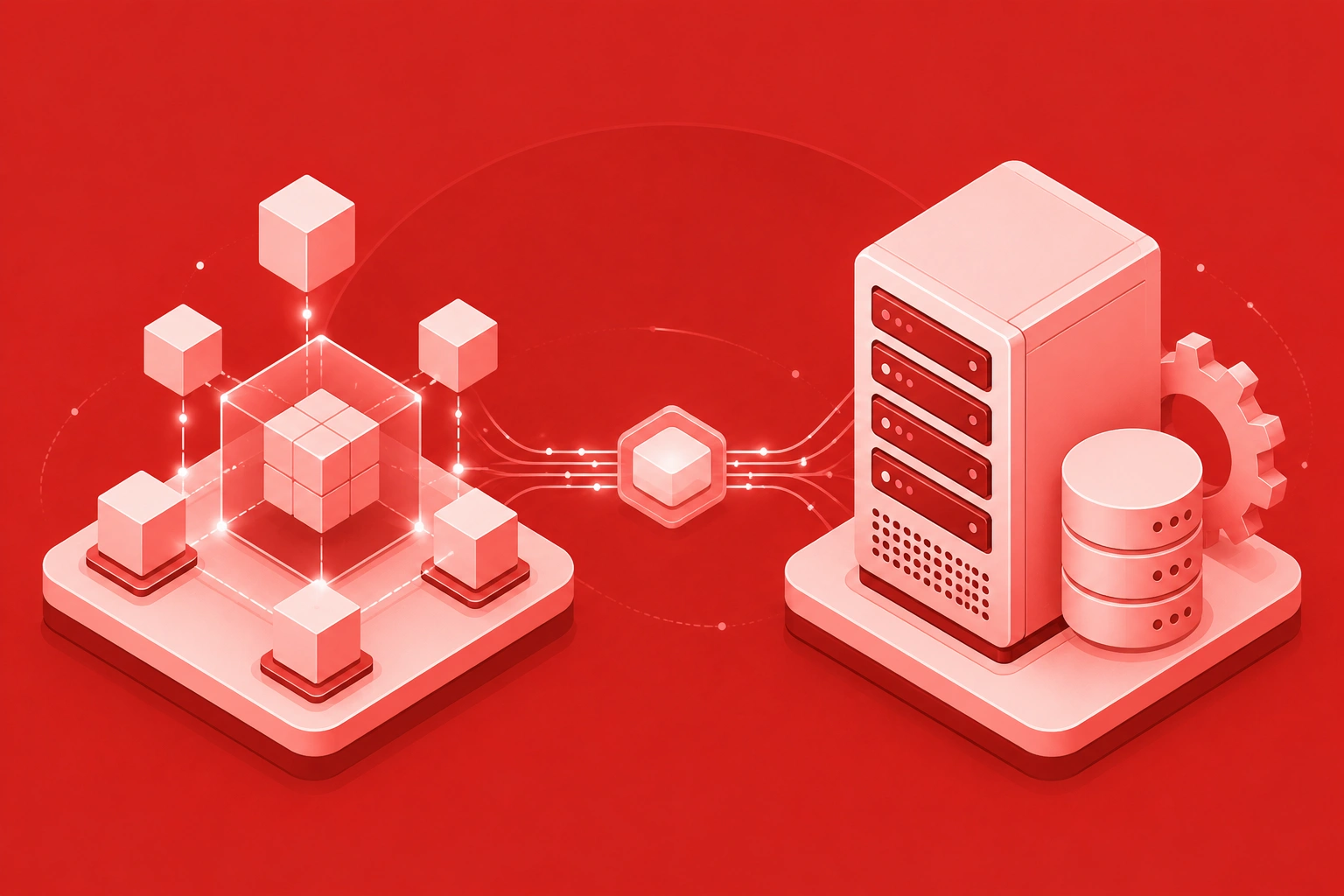
Decentralized applications operate across two fundamental architectural layers that work in concert to deliver blockchain-powered functionality. Storing one megabyte on Ethereum costs thousands of dollars while off-chain solutions like IPFS provide decentralized storage at fraction of the cost. Storing a single 32-byte word in contract storage can cost several dollars worth of gas during high network congestion periods.
Key Takeaways
- Decentralized applications strategically combine on-chain security with off-chain scalability to deliver performant, cost-efficient user experiences while maintaining blockchain guarantees.
- On-chain components including smart contracts and consensus-validated transactions provide immutability, transparency, and trustless execution but incur higher costs and limited throughput.
- Off-chain infrastructure handles data storage, complex computations, and real-time interactions through services like IPFS, oracles, and traditional databases to overcome blockchain limitations.
- Gas fees represent the primary economic constraint driving architectural decisions, making developers prioritize which operations warrant expensive on-chain execution versus off-chain alternatives.
- Middleware solutions including The Graph, event listeners, and indexing services bridge both layers by synchronizing state changes and enabling efficient data queries.
- Oracle networks serve as critical infrastructure connecting smart contracts to external data sources, enabling dApps to respond to real-world events and information.
- Layer 2 solutions and rollup technologies process transactions off-chain while maintaining cryptographic security proofs, dramatically improving scalability without sacrificing decentralization principles.
- Successful hybrid architectures require careful consideration of security models, data consistency mechanisms, and user experience trade-offs when distributing logic across both layers.
What Are On-Chain and Off-Chain Layers in a dApp?
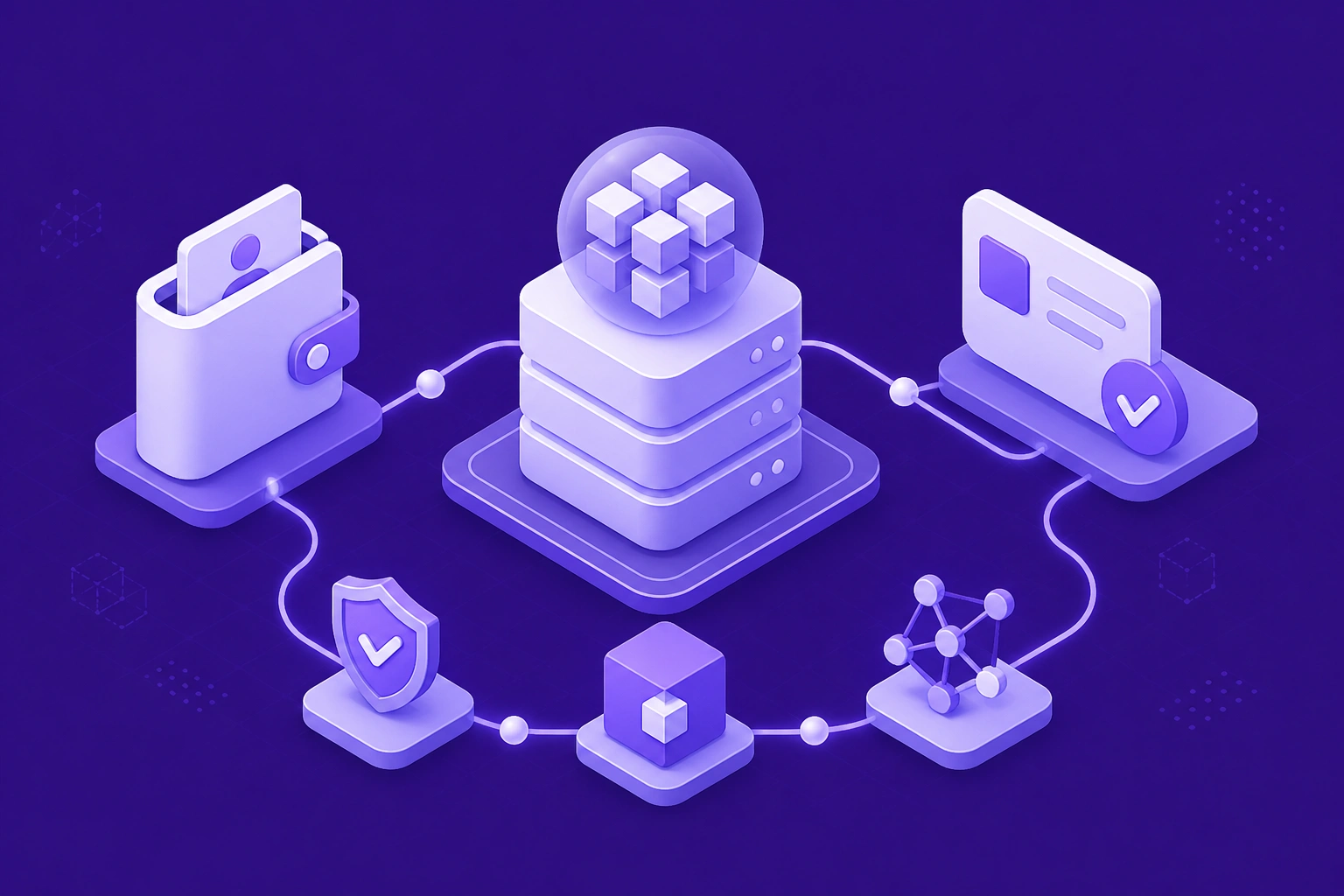
Decentralized applications operate across two fundamental architectural layers that work in concert to deliver blockchain-powered functionality. The on-chain layer encompasses all operations executed directly on the blockchain network, where every transaction undergoes consensus validation, gets permanently recorded in distributed ledgers, and becomes immutably part of the network’s shared state. This layer includes smart contract execution, token transfers, state modifications, and any logic requiring trustless verification and censorship resistance.
The off-chain layer comprises all computational processes, data storage, and application logic occurring outside the blockchain while remaining connected through cryptographic proofs, hash references, or oracle services. This includes user interface rendering, database queries, API integrations, file storage systems, complex calculations, and real-time communication channels. Off-chain components provide the performance characteristics users expect from modern applications while the on-chain layer ensures security and decentralization guarantees.
Understanding the distinction between these layers proves essential for blockchain developers and architects. On-chain operations inherit the blockchain’s properties including immutability, transparency, and distributed consensus, but face constraints of limited throughput, high latency, and computational costs measured in gas fees. Off-chain processes leverage traditional computing infrastructure offering superior speed, storage capacity, and cost efficiency while requiring different trust assumptions and security models compared to blockchain-native operations.
Why dApps Use Both On-Chain and Off-Chain Layers?
Performance Optimization
Blockchain networks process 15-30 transactions per second while off-chain systems handle thousands, enabling responsive user experiences without network congestion.
Cost Reduction
Gas fees for on-chain storage and computation can reach hundreds of dollars during peak usage, making off-chain alternatives economically necessary for viable applications.
Storage Scalability
Storing one megabyte on Ethereum costs thousands of dollars while off-chain solutions like IPFS provide decentralized storage at fraction of the cost.
Functional Flexibility
Smart contracts cannot natively access external data or execute complex algorithms efficiently, requiring off-chain oracles and computation services for advanced functionality.
The hybrid architecture addresses fundamental blockchain limitations while preserving its core value propositions. Blockchains excel at providing trustless environments where participants can transact without intermediaries, verify application state independently, and rely on cryptographic guarantees rather than institutional trust. However, these properties come with inherent trade-offs including limited computational resources, expensive storage, and consensus-driven latency that make pure on-chain applications impractical for most use cases.
Off-chain infrastructure enables developers to build feature-rich applications comparable to traditional software while strategically leveraging blockchain for critical operations requiring decentralization. A decentralized exchange might process order matching and price calculations off-chain for speed while settling final trades on-chain for security. Social media dApps store posts and media files off-chain while recording content hashes and ownership proofs on-chain. Gaming applications execute complex game logic off-chain while tokenizing assets and recording ownership transfers on-chain.
This architectural approach allows dApps to compete with centralized alternatives on user experience metrics while maintaining blockchain advantages. Users benefit from instant feedback, rich interfaces, and affordable interactions for routine operations while critical state changes, asset transfers, and governance decisions receive blockchain security guarantees. The challenge lies in designing systems where off-chain components enhance rather than undermine decentralization goals, requiring careful consideration of trust boundaries and security models.
Understanding On-Chain Components in a dApp
On-chain components form the trustless foundation of decentralized applications, comprising all logic and data stored directly on the blockchain network. These elements undergo consensus validation by network validators or miners, ensuring every state change achieves distributed agreement before permanent recording. On-chain architecture includes deployed smart contracts containing application logic, transaction records documenting all state modifications, token balances tracked in contract storage, and governance parameters defining protocol rules.
Smart contracts represent the executable code running on blockchain virtual machines, defining the rules and logic governing dApp behavior. These self-executing programs process transactions according to predetermined conditions without requiring trusted intermediaries. Once deployed, smart contracts become immutable programs that anyone can interact with, verify, or audit. The transparency ensures users understand exactly how their assets will be handled and what outcomes specific transactions will produce.
State storage maintains the current condition of all smart contract variables, user balances, and application parameters. Each blockchain node maintains complete copies of this state, enabling independent verification and eliminating single points of failure. State changes occur exclusively through validated transactions, creating an auditable history of every modification. This distributed state management ensures data consistency across the network while preventing unauthorized alterations or rollbacks.
Transaction logs provide permanent records of all interactions with smart contracts, including function calls, parameter values, and execution results. These logs enable event-driven architectures where off-chain services monitor blockchain activity and respond to specific occurrences. Events emitted by smart contracts serve as the primary communication mechanism between on-chain operations and off-chain infrastructure, triggering updates to user interfaces, database records, or external systems when significant state changes occur.
Smart Contracts: The Core of On-Chain Logic Processing
Smart contracts function as the programmable backbone of decentralized applications, executing predefined logic in response to user transactions and external triggers. Written in blockchain-specific languages like Solidity for Ethereum or Rust for Solana, these contracts compile into bytecode that runs on distributed virtual machines across thousands of network nodes. Every contract execution produces identical results across all validating nodes, ensuring deterministic behavior and trustless operation without central authorities.
| Smart Contract Function | Purpose | Gas Intensity | Example Use Case |
|---|---|---|---|
| State Modification | Update contract variables and balances | High | Token transfers, NFT minting |
| Read Operations | Query current state without changes | Free | Balance checks, metadata retrieval |
| Event Emission | Log transaction details for indexing | Low | Activity tracking, notifications |
| Access Control | Verify permissions and ownership | Low-Medium | Admin functions, gated content |
| External Calls | Interact with other contracts | Variable | DeFi composability, protocol integration |
Contract architecture directly impacts gas efficiency and application scalability. Optimized contracts minimize storage operations, batch related state changes, and use efficient data structures to reduce computational overhead. Design patterns like proxy contracts enable upgradeability while maintaining immutable deployment addresses, allowing developers to fix bugs or add features without migrating user assets. Security considerations dominate smart contract development, as vulnerabilities can result in irreversible loss of funds with no recourse for recovery.
The execution model follows atomic transaction semantics where operations either complete entirely or revert completely, preventing partial state changes that could corrupt application logic. This property enables complex multi-step operations like token swaps involving multiple transfers and calculations to execute as single indivisible units. Failed transactions still consume gas for computation performed before reverting, incentivizing thorough testing and validation before deployment to production networks.
How On-Chain Data Storage Works?
On-chain data storage operates fundamentally differently from traditional databases, with every byte of stored information replicated across thousands of network nodes and permanently embedded in the blockchain’s historical record. This distributed storage model ensures data permanence and resistance to censorship but creates significant economic and technical constraints that shape how dApps structure their data architecture.
| Storage Type | Description | Use Cases | Cost Factor |
|---|---|---|---|
| Contract Storage | Persistent key-value pairs maintained in smart contract state variables accessible across transactions. | Token balances, ownership records, configuration parameters, critical application state. | Very High |
| Transaction Data | Information passed as function parameters during contract invocations, stored in transaction history. | Transfer amounts, recipient addresses, function arguments, metadata hashes. | High |
| Event Logs | Indexed records emitted during execution, stored separately from contract state but accessible to external systems. | Activity notifications, state change signals, audit trails, off-chain synchronization triggers. | Medium |
| Memory Variables | Temporary data existing only during function execution, discarded after transaction completes. | Intermediate calculations, temporary arrays, processing variables within single operations. | Low |
The economic reality of on-chain storage dictates architectural patterns. Storing a single 32-byte word in contract storage can cost several dollars worth of gas during high network congestion periods. This makes storing large datasets, user profiles, or media files directly on-chain economically prohibitive. Instead, dApps typically store only cryptographic hashes or content identifiers on-chain, serving as verifiable pointers to actual data stored in off-chain systems.
Storage optimization becomes a critical concern in smart contract development. Techniques include packing multiple values into single storage slots, using events instead of storage for historical records, implementing lazy deletion patterns that free storage to receive gas refunds, and carefully structuring data to minimize storage operations. These optimizations can reduce gas costs by orders of magnitude while maintaining necessary functionality.
The permanence of on-chain storage presents both advantages and challenges. Data cannot be deleted or modified except through explicit contract logic, providing strong guarantees for critical records like ownership or financial transactions. However, this also means mistakes are permanent, privacy is limited since all data is publicly readable, and regulatory requirements for data deletion cannot be easily satisfied for information stored on-chain.
Gas Fees and Execution Costs: Why On-Chain Logic Is Expensive
Gas fees represent the fundamental cost mechanism that makes blockchain networks sustainable while simultaneously creating economic pressure to minimize on-chain operations. Every computational operation, storage modification, and data transmission consumes gas, which users must pay in the network’s native cryptocurrency. This fee structure compensates validators for processing transactions and prevents network abuse through spam or infinite loops.
Gas Cost Factors
Complex calculations, loops, and algorithmic operations consume more gas proportional to their computational intensity and execution time.
Writing to contract storage is the most expensive operation, costing significantly more than computation or memory usage due to permanent replication across nodes.
Gas prices fluctuate based on network demand, with costs multiplying during periods of high transaction volume or popular application launches.
Larger transaction payloads with extensive parameters or data consume more gas, making data compression and efficient encoding important optimization strategies.
The gas pricing mechanism creates a natural economic pressure toward hybrid architectures. When a simple database query costs fractions of a cent using traditional infrastructure but might cost several dollars on-chain during peak times, the economic incentive to move operations off-chain becomes overwhelming. This economic reality drives architectural decisions more than technical limitations in many cases.
Gas optimization is both an art and a science in smart contract development. Developers employ numerous techniques to reduce costs, including batch processing multiple operations in single transactions, using events instead of storage for non-critical data, implementing efficient data structures that minimize storage slots, and carefully ordering operations to take advantage of gas refunds for freeing storage. These optimizations can reduce operational costs by 50 to 90 percent while maintaining identical functionality.
Understanding gas costs is essential for dApp economics and user experience design. Applications must either absorb gas costs, pass them to users, or find alternative architectures that minimize on-chain operations. Many successful dApps implement gas abstraction layers, subsidize user transactions through meta-transaction patterns, or migrate high-frequency operations to Layer 2 solutions where costs are orders of magnitude lower while maintaining security through periodic on-chain settlements.
Understanding Off-Chain Components in a dApp
Off-chain components handle the majority of computational work and data management in modern decentralized applications, operating outside blockchain constraints to deliver performance and functionality comparable to traditional web applications. These components include frontend interfaces built with React or Vue, backend servers processing API requests, databases storing indexed blockchain data, content delivery networks hosting media files, and computation engines performing complex analytics or machine learning operations.
Off-Chain Architecture Lifecycle
Frontend receives notification and updates UI
Off-Chain Servers, APIs, and Oracles Explained
Off-chain servers and APIs form the traditional computing backbone that complements blockchain networks in hybrid dApp architectures. These systems handle high-frequency operations, complex computations, and integration with external services that would be impractical or impossible to execute on-chain. Application servers process user requests, coordinate multi-step workflows, aggregate data from multiple sources, and present unified interfaces that abstract blockchain complexity from end users.
Oracle Systems: Bridging On-Chain and Off-Chain Worlds
Oracles solve the fundamental problem that smart contracts cannot directly access external data or interact with off-chain systems. These specialized services fetch data from APIs, databases, IoT devices, or other external sources, verify and authenticate the information, and deliver it on-chain in formats that smart contracts can consume. Oracles effectively extend blockchain capabilities beyond their isolated computational environments.
Price Feed Oracles
Aggregate cryptocurrency and asset prices from multiple exchanges, providing reliable market data for DeFi protocols, derivatives, and automated trading systems.
Event Oracles
Monitor real-world events like weather conditions, sports results, or flight status, enabling smart contracts that execute based on verifiable external occurrences.
Computational Oracles
Perform complex calculations off-chain and return verified results, enabling resource-intensive operations like machine learning inference or statistical analysis.
Randomness Oracles
Generate verifiable random numbers using cryptographic techniques, essential for gaming, lotteries, and fair distribution mechanisms that require unpredictable outcomes.
Oracle security represents a critical consideration in dApp architecture, often called the oracle problem. Since smart contracts trust oracle-provided data implicitly, compromised or malicious oracles can cause contracts to execute incorrectly despite being perfectly secure themselves. This creates a trust bottleneck where decentralized smart contracts depend on potentially centralized data sources.
Decentralized oracle networks address this challenge by aggregating data from multiple independent node operators, using consensus mechanisms to validate information before delivering it on-chain, and implementing economic incentives that punish nodes providing incorrect data. Leading oracle solutions like Chainlink, Band Protocol, and API3 employ various approaches to create trustworthy data feeds while maintaining the decentralization properties that make blockchain valuable.
From our extensive experience building production dApps, we strongly recommend implementing multiple oracle sources for critical data feeds, establishing thresholds for acceptable variance between sources, designing fallback mechanisms for oracle failures, and carefully evaluating the trust assumptions introduced by each external data dependency. The oracle layer often represents the weakest link in otherwise secure dApp architectures.
Off-Chain Data Storage Options: IPFS, Filecoin & Traditional Databases
Off-chain data storage solutions enable dApps to handle large files, user-generated content, and extensive datasets without incurring prohibitive on-chain storage costs. These systems range from fully decentralized networks that maintain censorship resistance properties to traditional centralized databases that prioritize performance and cost efficiency. The choice between storage options depends on data permanence requirements, access patterns, trust assumptions, and budget constraints.
| Storage Solution | Architecture | Advantages | Best Use Cases |
|---|---|---|---|
| IPFS | Peer-to-peer distributed file system using content addressing, where files are identified by cryptographic hashes rather than locations. | Decentralized, censorship-resistant, content deduplication, verifiable integrity through content IDs. | NFT metadata, documents, static website hosting, immutable content distribution. |
| Filecoin | Blockchain-based storage network with economic incentives, providing persistent storage through cryptographic proofs and market mechanisms. | Permanent storage guarantees, decentralized redundancy, cryptographic proof of storage, competitive pricing. | Long-term archival, large datasets, enterprise backups, media libraries requiring permanence. |
| Arweave | Permanent storage blockchain using novel economic model where single upfront payment guarantees perpetual storage availability. | Truly permanent storage, no recurring costs, censorship resistance, historical preservation. | Historical records, permanent publications, cultural preservation, regulatory compliance archives. |
| Traditional Databases | Centralized SQL or NoSQL databases managed by application operators, providing standard database capabilities and query performance. | High performance, complex queries, easy updates, mature tooling, low operational costs. | User profiles, application cache, analytics, frequently updated data, private information. |
| Cloud Storage | Managed services from providers like AWS S3, Google Cloud Storage, or Azure, offering scalable object storage with global distribution. | Scalability, reliability, CDN integration, cost efficiency, enterprise features. | User uploads, media streaming, backups, temporary files, high-bandwidth content delivery. |
The relationship between on-chain and off-chain storage typically involves storing only content identifiers or cryptographic hashes on-chain while hosting actual data in off-chain systems. Smart contracts can verify data integrity by comparing provided content against stored hashes, enabling trustless verification without requiring full on-chain storage. This pattern appears extensively in NFT implementations, where token metadata and artwork live on IPFS or Arweave while the blockchain stores only content identifiers.
Hybrid storage strategies combine multiple solutions to balance different requirements. Critical, immutable content might reside on permanent storage networks like Arweave, while frequently accessed data lives in IPFS with pinning services ensuring availability, and dynamic user data exists in traditional databases with periodic snapshots anchored on-chain. This layered approach optimizes for different data characteristics and access patterns.
Storage strategy significantly impacts dApp longevity and user trust. Applications relying entirely on centralized storage face questions about data persistence if operators shut down, while purely decentralized storage may struggle with performance and cost for high-frequency access patterns. We recommend carefully documenting storage choices, implementing data redundancy across multiple systems for critical content, and designing migration paths that enable moving data between storage solutions as requirements or technology evolves.

How Off-Chain Computation Helps Improve dApp Scalability
Off-chain computation represents one of the most effective strategies for scaling decentralized applications beyond blockchain networks’ inherent throughput limitations. By moving complex calculations, data processing, and resource-intensive operations to traditional computing environments, dApps achieve orders of magnitude better performance while maintaining security through cryptographic verification and periodic on-chain settlement of results.
Layer 2 scaling solutions exemplify sophisticated off-chain computation strategies. These systems process hundreds or thousands of transactions off the main blockchain, batch them into compact proofs, and submit only cryptographic commitments on-chain. Technologies like optimistic rollups and zero-knowledge rollups achieve blockchain security guarantees while operating at speeds and costs comparable to traditional databases.
State channels represent another off-chain computation approach where participants conduct unlimited interactions privately off-chain, recording only opening and closing states on-chain. This pattern works excellently for applications like payment channels, gaming, or any scenario involving repeated interactions between known parties. The Lightning Network for Bitcoin and Raiden for Ethereum demonstrate state channel effectiveness for payment use cases.
Trusted execution environments and secure enclaves provide hardware-based solutions for off-chain computation with cryptographic assurances. These specialized processors execute code in isolated environments, generating attestations that prove correct execution without revealing private inputs. This enables privacy-preserving computation and confidential smart contracts while maintaining verifiable guarantees about computational integrity.
The key challenge in off-chain computation lies in maintaining verifiability and security guarantees. Techniques include cryptographic proofs that can be efficiently verified on-chain, economic incentives through stake and slashing mechanisms, dispute resolution systems that allow challenging incorrect computations, and multi-party computation protocols that distribute trust across multiple independent operators. Successfully implementing these mechanisms enables dApps to scale effectively while preserving the security properties that make blockchain technology valuable.
Take Your dApp to the Next Level
Master how on-chain and off-chain layers work together and enhance your Web3 project success today.
On-Chain vs Off-Chain: Key Differences in Security, Speed & Cost
Understanding the fundamental trade-offs between on-chain and off-chain layers is essential for effective dApp architecture. Each layer offers distinct advantages and limitations across multiple dimensions including security guarantees, performance characteristics, operational costs, and trust requirements. Successful applications strategically distribute functionality to leverage each layer’s strengths while mitigating its weaknesses.
On-Chain Characteristics
Off-Chain Characteristics
The security versus performance trade-off represents the primary consideration when distributing functionality across layers. On-chain operations provide mathematical guarantees that code executes exactly as written and that results cannot be altered retroactively. Off-chain systems can process operations instantly but require users to trust infrastructure operators, security implementations, or additional cryptographic mechanisms that verify correct execution.
Cost considerations often drive architectural decisions more than technical limitations. When identical functionality can be implemented either on-chain at significant gas cost or off-chain for fractions of a cent, economic pressure naturally pushes operations off-chain unless they genuinely require blockchain properties. This creates tension between decentralization ideals and practical business requirements for sustainable economics.
The optimal architecture strikes a balance based on specific application requirements. Financial operations handling significant value justify on-chain costs for security guarantees, while social features, analytics, and UI interactions belong off-chain for performance. Critical governance actions merit on-chain transparency, while routine administrative functions can operate off-chain with periodic on-chain checkpoints. Understanding these trade-offs enables architects to design systems that are both secure and practical.
How dApps Process User Requests Across Both Layers?
User interactions with dApps involve sophisticated coordination between on-chain and off-chain components, with requests flowing through multiple systems before completing. Understanding this request processing lifecycle reveals how hybrid architectures maintain usability while preserving blockchain security properties. The complexity remains invisible to users, who experience applications through familiar web or mobile interfaces.
Complete User Request Processing Flow
User Interface Interaction
User interacts with frontend application through web browser or mobile app, initiating actions like token transfers, NFT purchases, or governance votes through intuitive graphical interfaces.
Frontend Validation & Processing
Application validates inputs, fetches necessary data from off-chain databases or APIs, constructs transaction parameters, and prepares blockchain interaction through web3 libraries.
Wallet Connection & Signing
Browser wallet extension or mobile wallet app prompts user to review and cryptographically sign the transaction, providing authorization without revealing private keys to application.
Transaction Broadcast
Signed transaction is broadcast to blockchain network through RPC nodes, entering mempool where it awaits validation and inclusion in next block by network validators.
On-Chain Execution
Validators execute smart contract code, validate state transitions, update blockchain state, and emit events recording the operation’s outcome and relevant data.
Event Monitoring & Indexing
Off-chain services monitor blockchain events, extract relevant data, update application databases, trigger webhooks or notifications, and maintain synchronized state with on-chain records.
UI Update & Confirmation
Frontend receives confirmation, updates user interface to reflect new state, displays transaction success, and provides links to blockchain explorers for verification.
This multi-step process typically completes in 15 to 30 seconds from user action to final confirmation, though complex operations may take longer during network congestion. The coordination between layers happens seamlessly from the user’s perspective, with progress indicators and intermediate states providing feedback during blockchain confirmation periods.
Error handling across layers requires careful design. On-chain transactions can fail for numerous reasons including insufficient gas, failed validation checks, or contract logic errors. Off-chain systems must detect these failures, provide meaningful error messages to users, and maintain consistency between on-chain state and off-chain records even when operations partially succeed or fail at different stages.
Role of Middleware & Indexing Tools
Middleware and indexing infrastructure form the connective tissue between on-chain and off-chain layers, enabling efficient data access, query capabilities, and real-time synchronization that blockchain networks alone cannot provide. These tools abstract the complexity of blockchain interaction, provide developer-friendly APIs, and maintain queryable databases of blockchain history that would be impractical to construct through direct node queries.
Essential Middleware Components
RPC Node Providers
Services like Infura, Alchemy, and QuickNode provide reliable access to blockchain networks without requiring applications to run their own nodes. They handle the infrastructure complexity of maintaining synchronized nodes, providing load-balanced endpoints, and ensuring high availability for critical blockchain interactions.
Blockchain Indexers
The Graph, Covalent, and similar protocols continuously scan blockchain data, extract relevant information based on subgraph definitions, and organize it into queryable databases. This transforms blockchain’s append-only log into a structured data source supporting complex queries, filtering, and aggregation operations.
Wallet Connection Libraries
Web3Modal, RainbowKit, and ConnectKit provide standardized interfaces for connecting various wallet types, managing sessions, and signing transactions. These libraries abstract wallet-specific implementation details, enabling applications to support multiple wallet providers through unified interfaces.
Development Frameworks
Hardhat, Foundry, and Truffle provide comprehensive environments for smart contract development, testing, deployment, and verification. These frameworks include local blockchain simulators, testing utilities, deployment scripts, and integration with development tools that accelerate the development lifecycle.
Indexing becomes particularly critical for applications requiring historical analysis, search functionality, or aggregated views of blockchain data. Querying blockchain nodes directly for historical information is slow, resource-intensive, and often requires scanning millions of blocks. Indexers maintain pre-processed databases optimized for specific query patterns, enabling responsive user interfaces and complex analytics that would be impractical through direct blockchain queries.
The dependency on middleware creates both benefits and risks. While these services dramatically simplify development and reduce operational complexity, they also introduce centralization points and potential failure modes. Applications relying on single providers face downtime risks if those services experience outages. Best practices include implementing fallback providers, caching critical data locally, and designing graceful degradation when middleware services become unavailable.
From our extensive dApp experience, we emphasize the importance of selecting reliable middleware providers, implementing monitoring for service health, establishing clear SLAs with providers, and maintaining contingency plans for provider migrations. The middleware layer significantly impacts application reliability, performance, and user experience, making provider selection a critical architectural decision rather than just an implementation detail.
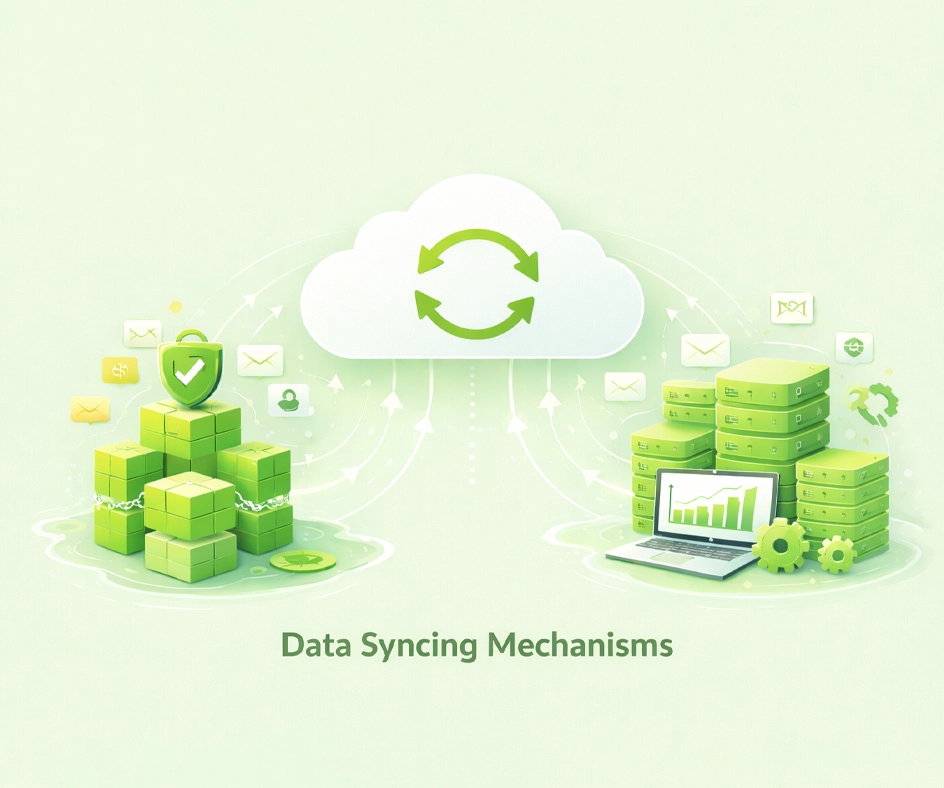
Bridging On-Chain and Off-Chain Logic: Data Syncing Mechanisms
Maintaining consistency between on-chain and off-chain state represents a critical challenge in hybrid dApp architecture. While blockchain provides authoritative records through consensus, off-chain systems must stay synchronized with this canonical state to provide accurate information and responsive user experiences. Various synchronization mechanisms enable this coordination while managing the inherent latency and complexity of cross-layer communication.
Applications subscribe to smart contract events through WebSocket connections or polling mechanisms, receiving notifications whenever relevant on-chain activities occur. Event data triggers off-chain processing, database updates, and user notifications.
Background workers periodically query blockchain state, compare current values against cached data, and update off-chain systems when changes are detected. This approach works reliably even when event mechanisms are unavailable or unreliable.
Cryptographic proofs enable verifying that specific data exists in on-chain structures without requiring full blockchain access. Off-chain systems can prove data authenticity by providing compact proofs verifiable against on-chain root hashes.
Dedicated services monitor blockchain activity and trigger HTTP callbacks to application endpoints when specific conditions occur. This decouples blockchain monitoring from application logic, enabling specialized infrastructure for reliable event delivery.
Synchronization mechanisms must handle various edge cases including blockchain reorganizations where recent blocks are replaced with alternative histories, delayed confirmations during network congestion, missed events due to connection failures, and the eventual consistency nature of distributed systems. Robust implementations include confirmation tracking that waits for multiple blocks before considering transactions final, reconciliation processes that periodically verify off-chain state against authoritative on-chain records, and retry logic for failed synchronization attempts.
The choice of synchronization strategy impacts application architecture significantly. Real-time event-driven approaches provide immediate responsiveness but require careful handling of connection failures and event ordering. Polling-based systems offer simplicity and reliability but introduce latency and resource consumption. Hybrid approaches combining multiple mechanisms often provide the best balance of responsiveness, reliability, and efficiency.
Critical applications implement multiple layers of synchronization verification. Primary event listeners provide real-time updates, backup polling services ensure nothing is missed, periodic full reconciliation processes verify overall consistency, and cryptographic proofs validate critical operations. This defense-in-depth approach ensures data integrity even when individual synchronization mechanisms experience failures or attacks.
Real-World Examples: How Popular dApps Use Hybrid Architecture
Examining successful dApps reveals practical implementations of on-chain and off-chain layer coordination. These applications demonstrate how theoretical architectural principles translate into production systems serving millions of users and handling billions in transaction volume. Each example showcases different strategies for balancing decentralization, performance, and cost efficiency.
These examples illustrate common patterns in hybrid architecture design. Core value propositions (trading, ownership, lending) remain on-chain where security and trustlessness matter most. User experience enhancements, data aggregation, search functionality, and performance optimizations operate off-chain where they can be implemented efficiently. The boundary between layers aligns with the distinction between what must be trustless versus what benefits from flexibility and performance.
Successful dApps continuously refine their layer distribution as technology evolves. Features initially implemented on-chain might migrate to Layer 2 solutions as those technologies mature. Off-chain services might be progressively decentralized through oracle networks or peer-to-peer systems. The architecture remains fluid, adapting to changing requirements, technological capabilities, and user expectations while preserving core security properties that define decentralized applications.
Final Thoughts
Designing effective hybrid dApp architectures requires balancing competing concerns of security, performance, cost, and decentralization. Success depends not on maximizing any single dimension but on finding optimal trade-offs that serve specific application requirements and user needs. The architectural decisions made during development fundamentally shape application capabilities, operational costs, and long-term sustainability.
Architecture Decision Framework
Asset ownership and transfers, financial transactions, governance decisions, audit trails requiring immutability, operations needing trustless execution, consensus-critical business logic.
User interfaces, large file storage, complex computations, high-frequency operations, private user data, search and filtering, analytics and reporting, external system integration.
Store cryptographic hashes on-chain with full data off-chain, execute critical logic on-chain with supporting operations off-chain, use Layer 2 for high-frequency operations with periodic on-chain settlement.
As blockchain technology matures, the distinction between on-chain and off-chain layers becomes more nuanced with innovations like rollups, validiums, and other hybrid solutions. These technologies blur traditional boundaries by providing varying degrees of security guarantees, decentralization properties, and performance characteristics. Architects must stay informed about emerging technologies and evaluate how new solutions might better serve their application requirements.
Critical Best Practices for Hybrid dApp Development
Conduct comprehensive smart contract audits, implement multi-signature controls, use established patterns, test thoroughly, and design fail-safe mechanisms protecting user assets.
Minimize on-chain storage, batch operations when possible, optimize gas consumption, consider Layer 2 solutions, and design economically sustainable operations.
Provide clear transaction feedback, implement optimistic UI updates, abstract complexity, offer multiple wallet options, and maintain responsive interfaces throughout blockchain operations.
Implement comprehensive logging, monitor synchronization health, establish alerting systems, maintain fallback mechanisms, and plan for infrastructure evolution.
The future of dApp architecture continues evolving as layer technologies advance, scaling solutions mature, and developer tooling improves. However, the fundamental principles remain constant: understand trade-offs between security and performance, minimize trust assumptions for critical operations, optimize costs through intelligent layer distribution, and maintain user experience standards that enable mainstream adoption.
Drawing from eight years of blockchain development experience across dozens of production applications, we emphasize that successful dApp architecture stems from clear understanding of requirements, honest assessment of trade-offs, and disciplined execution of best practices. The technology enables unprecedented possibilities for trustless coordination and value exchange, but realizing this potential requires thoughtful architecture that respects both blockchain capabilities and limitations.
Building effective hybrid dApp architectures is both technical challenge and strategic opportunity. By thoughtfully distributing functionality across on-chain and off-chain layers, developers create applications that deliver blockchain benefits without sacrificing usability, enabling the next generation of decentralized services that serve millions of users with security, efficiency, and practical utility.
Frequently Asked Questions
Q1.What is the difference between on-chain and off-chain in blockchain?
On-chain refers to data and transactions recorded directly on the blockchain network, validated by consensus mechanisms and permanently stored across distributed nodes. Off-chain encompasses processes, computations, and storage happening outside the blockchain but connected to it through cryptographic proofs or oracle services. On-chain ensures immutability and decentralization while off-chain provides scalability and cost efficiency for dApp operations.
Q2.Why do dApps need both on-chain and off-chain components?
dApps combine both layers to balance decentralization with performance. On-chain components provide security, transparency, and trustless execution through smart contracts, while off-chain handles resource-intensive tasks like data storage, complex computations, and real-time interactions. This hybrid architecture enables dApps to deliver user experiences comparable to traditional applications while maintaining blockchain benefits like censorship resistance and verifiable state transitions.
Q3.What are examples of on-chain operations in a dApp?
On-chain operations include token transfers, NFT minting, governance voting, staking deposits, liquidity pool interactions, and smart contract state changes. These transactions are validated by network validators, permanently recorded on the blockchain, and require gas fees. Every on-chain operation creates an immutable audit trail accessible to anyone, ensuring transparency and enabling trustless verification of all application logic and asset movements.
Q4.How do smart contracts interact with off-chain data?
Smart contracts access off-chain data through oracle networks like Chainlink, which fetch external information and deliver it on-chain through cryptographically signed transactions. Oracles bridge the gap between blockchain and real-world data sources, enabling smart contracts to respond to price feeds, weather data, sports scores, or API results. This mechanism maintains security while expanding smart contract functionality beyond purely on-chain information.
Q5.What is stored off-chain in decentralized applications?
Off-chain storage typically includes user profile data, multimedia content, application metadata, historical analytics, cached transaction data, and large datasets. Services like IPFS and Filecoin provide decentralized off-chain storage, while traditional databases offer faster query performance. dApps store content-addressed hashes on-chain as references to off-chain data, ensuring verifiability while avoiding expensive blockchain storage for large files.
Q6.How do gas fees affect on-chain and off-chain architecture decisions?
Gas fees directly influence architectural choices by making on-chain operations expensive, especially during network congestion. Developers minimize on-chain transactions by moving computations, storage, and non-critical logic off-chain. Layer 2 solutions, state channels, and optimistic rollups reduce costs while maintaining security. Strategic architecture balances decentralization requirements with user experience, determining which operations justify on-chain execution costs versus off-chain alternatives.
Q7.What are oracles and why are they important for dApps?
Oracles are intermediary services that provide external data to blockchain smart contracts, acting as bridges between on-chain and off-chain worlds. They enable dApps to access real-time information like asset prices, weather conditions, or event outcomes that don’t exist natively on-chain. Decentralized oracle networks use multiple data sources and cryptographic validation to ensure data integrity, making them critical infrastructure for DeFi, gaming, and prediction market applications.
Q8.How does IPFS work with blockchain applications?
IPFS provides content-addressed, distributed file storage where files are identified by cryptographic hashes rather than locations. dApps store large files on IPFS and record the content hash on-chain, creating verifiable links to off-chain data. This approach combines blockchain immutability with efficient storage, enabling applications to host images, videos, and documents without bloating the blockchain while maintaining proof of data integrity and availability.
Q9.What are Layer 2 solutions and how do they relate to off-chain processing?
Layer 2 solutions process transactions off the main blockchain while inheriting its security through periodic settlement. Technologies like optimistic rollups, zk-rollups, and state channels batch multiple transactions off-chain before submitting compressed proofs to the base layer. This dramatically increases throughput and reduces costs while maintaining cryptographic security guarantees, enabling dApps to scale without compromising decentralization or requiring users to trust intermediaries.
Q10.How do dApps ensure data consistency between on-chain and off-chain layers?
dApps maintain consistency through event listeners, indexing services like The Graph, and cryptographic commitments. Smart contracts emit events when state changes occur, which off-chain services monitor and process. Merkle proofs and state commitments enable verification that off-chain data matches on-chain records. Middleware solutions synchronize data bidirectionally, while caching strategies ensure off-chain systems reflect the authoritative on-chain state without constant blockchain queries.
Explore Services
Related Services
Reviewed by

Aman Vaths
Founder of Nadcab Labs
Aman Vaths is the Founder & CTO of Nadcab Labs, a global digital engineering company delivering enterprise-grade solutions across AI, Web3, Blockchain, Big Data, Cloud, Cybersecurity, and Modern Application Development. With deep technical leadership and product innovation experience, Aman has positioned Nadcab Labs as one of the most advanced engineering companies driving the next era of intelligent, secure, and scalable software systems. Under his leadership, Nadcab Labs has built 2,000+ global projects across sectors including fintech, banking, healthcare, real estate, logistics, gaming, manufacturing, and next-generation DePIN networks. Aman’s strength lies in architecting high-performance systems, end-to-end platform engineering, and designing enterprise solutions that operate at global scale.