Ai Overview
Cloud infrastructure for cryptocurrency exchange encompasses the computing, storage, networking, and security services that power modern trading platforms. Cloud platforms deliver these capabilities while enabling rapid innovation and cost optimization. This approach enables targeted scaling of high-demand components like order matching while maintaining cost efficiency for lower-demand services. 99%+ uptime targets that traders and regulators expect from modern exchanges.
Key Takeaways
- Cloud infrastructure for cryptocurrency exchange provides the scalability, security, and reliability essential for modern trading platforms operating in global markets.
- Scalable cloud infrastructure for crypto exchange enables automatic resource adjustment during market volatility, ensuring consistent performance during trading surges.
- Secure cloud infrastructure for cryptocurrency exchange delivers enterprise-grade protection including DDoS protection cloud crypto exchange capabilities and multi-layered security.
- High availability cloud infrastructure ensures 99.99%+ uptime through geographic redundancy, automated failover, and fault-tolerant architecture design.
- Cloud architecture for crypto exchange reduces operational costs by 40-60% compared to equivalent on-premises infrastructure through pay-as-you-go models.
- Disaster recovery for crypto exchange through cloud replication ensures business continuity with recovery time objectives measured in minutes rather than hours.
- Data protection in cloud crypto exchanges meets regulatory requirements through encryption, access controls, and compliance certifications from major providers.
- Cloud computing for crypto exchanges accelerates market entry by eliminating months of data center planning, procurement, and setup processes.
The cryptocurrency exchange landscape demands infrastructure capable of handling extreme volatility, global accessibility, and uncompromising security. Cloud infrastructure has emerged as the foundation enabling modern exchanges to meet these challenges while maintaining operational efficiency and cost effectiveness that would be impossible with traditional approaches.
Cloud Infrastructure for Cryptocurrency Exchange – An Overview
Cloud infrastructure for cryptocurrency exchange encompasses the computing, storage, networking, and security services that power modern trading platforms. Unlike traditional data center approaches, cloud infrastructure provides on-demand resources that scale automatically with demand, geographic distribution for global reach, and sophisticated security services that protect billions in digital assets.
Why Cloud Infrastructure Is Essential for Cryptocurrency Exchange
Cloud infrastructure in crypto exchange operations addresses fundamental challenges that make traditional infrastructure inadequate. Cryptocurrency markets operate 24/7 across global time zones, experience unpredictable traffic spikes during market events, and face constant security threats that require enterprise-grade protection. Cloud platforms deliver these capabilities while enabling rapid innovation and cost optimization.
The essential nature of cloud extends beyond technical capabilities to business sustainability. Building crypto exchanges successfully requires infrastructure that can scale from startup to enterprise volumes without costly migrations. Cloud infrastructure provides this growth path while offering the reliability that traders and regulators expect from financial platforms.
Role of Cloud Computing in Crypto Trading Platforms
Cloud computing for crypto exchanges serves multiple critical roles including compute resources for order matching, storage for transaction data, networking for global connectivity, and security services for asset protection. These components integrate into cohesive platforms that deliver the performance, reliability, and security that modern exchanges require.
Beyond infrastructure, cloud platforms provide managed services that accelerate feature delivery. Database services, analytics tools, and machine learning capabilities enable sophisticated trading features without requiring specialized in-house expertise for every technology component. Working with experienced exchange specialists helps optimize cloud architecture for trading requirements.
Infrastructure Principle: Cloud infrastructure transforms capital expenditure into operational expenditure while providing capabilities that would require massive investment to replicate independently. This economic model enables exchanges to focus resources on trading features rather than infrastructure management.
Cloud-Based Crypto Exchange Architecture
A cloud-based crypto exchange architecture leverages cloud-native services organized into layers that handle different platform functions. This architecture provides the separation of concerns that enables independent scaling, security boundaries, and failure isolation while maintaining the integration necessary for cohesive platform operation.
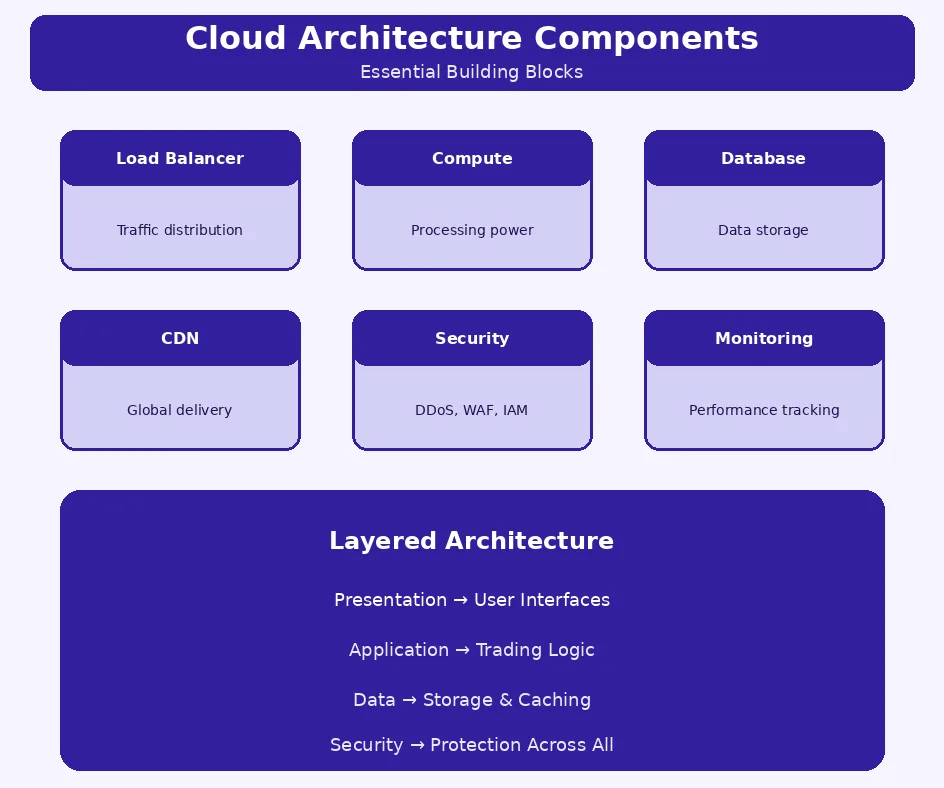
Cloud Architecture for Crypto Exchange Platforms
Cloud architecture for crypto exchange platforms typically includes presentation layers for user interfaces, application layers for trading logic, data layers for storage, and security layers spanning all components, often supported by scalable cloud VPS solutions for enhanced performance and reliability. Each layer utilizes appropriate cloud services optimized for its specific requirements while communicating through well-defined interfaces.
Modern exchange architectures employ microservices patterns where individual functions operate as independent services. This approach enables targeted scaling of high-demand components like order matching while maintaining cost efficiency for lower-demand services. Understanding exchange architecture patterns helps design effective cloud deployments.
Core Components of a Cloud Crypto Exchange Environment
Core components of a crypto exchange cloud environment include load balancers distributing traffic, auto-scaling compute clusters, managed database services, caching layers for performance, message queues for asynchronous processing, and security services protecting all components. Container orchestration platforms like Kubernetes often manage service deployment and scaling.
Cloud Infrastructure vs Traditional Servers for Crypto Exchange
Cloud infrastructure for crypto trading platforms offers fundamental advantages over traditional servers in flexibility, time-to-market, and operational efficiency. While traditional infrastructure requires capacity planning months in advance, cloud resources provision in minutes and scale automatically with demand.
Flexibility, Cost Efficiency, and Performance Comparison
Flexibility comparisons favor cloud infrastructure with instant provisioning versus weeks for physical servers. Cost efficiency through pay-per-use models eliminates payment for idle capacity. Performance parity or advantage comes from cloud providers’ continuous hardware upgrades and optimization investments that exceed what individual organizations can achieve.
Cloud vs Traditional Infrastructure Comparison
| Factor | Cloud Infrastructure | Traditional Servers |
|---|---|---|
| Provisioning Time | Minutes | Weeks to months |
| Scaling | Automatic, instant | Manual, slow |
| Cost Model | Pay per use | Fixed capital expense |
| Global Reach | Built-in multi-region | Requires separate facilities |
| Security Investment | Shared with provider | Entirely on operator |
Scalability Benefits of Cloud Infrastructure in Crypto Exchanges
Scalability represents perhaps the most critical advantage of cloud infrastructure for cryptocurrency exchanges. Market volatility creates unpredictable demand patterns where trading volumes can spike 10x or more within minutes. Cloud infrastructure absorbs these spikes automatically while maintaining performance standards.
Scalable Cloud Infrastructure for Cryptocurrency Exchange
Scalable cloud infrastructure for crypto exchange operations implements horizontal scaling where additional server instances join the cluster as demand increases. This approach provides virtually unlimited scaling capacity while maintaining consistent per-request performance regardless of total system load.
Auto Scaling and High Traffic Handling in Crypto Trading
Auto scaling configurations define rules that trigger resource adjustments based on metrics like CPU utilization, request queue depth, or custom trading-specific indicators. When thresholds exceed, new instances launch automatically within seconds. When demand subsides, excess capacity terminates to optimize costs. This automation ensures consistent user experience during market events.
High Performance Cloud Infrastructure
High performance cloud infrastructure utilizes premium compute instances, high-speed networking, and optimized storage configurations to minimize latency and maximize throughput. Modern cloud providers offer instance types specifically optimized for financial workloads with consistent, predictable performance.
Low Latency Cloud Infrastructure for Crypto Exchanges
Low latency cloud infrastructure for crypto exchanges employs placement groups that co-locate related instances, premium network tiers with dedicated bandwidth, and strategic region selection near major financial hubs. These optimizations achieve sub-millisecond internal latency comparable to traditional co-located infrastructure while maintaining cloud flexibility.
Security and Reliability of Cloud Infrastructure for Crypto Exchanges
Security and reliability form the foundation upon which successful exchanges operate. Cloud security for crypto exchanges leverages billions of dollars in security investment from major providers while enabling exchange-specific security measures that protect user assets and data.
Secure Cloud Infrastructure for Cryptocurrency Exchange
Secure cloud infrastructure for cryptocurrency exchange operations implements defense-in-depth strategies with multiple security layers. Network security, application security, data security, and identity security each provide protection that complements other layers. This comprehensive approach ensures that breaching one layer does not compromise the entire system.
Cloud Security for Crypto Exchanges and User Asset Protection
Cloud security for crypto exchanges includes DDoS protection cloud crypto exchange services that absorb volumetric attacks, web application firewalls that block exploitation attempts, and network isolation that restricts lateral movement. User asset protection extends to encrypted storage, secure key management services, and audit logging that tracks all sensitive operations.
High Availability Cloud Infrastructure
High availability cloud infrastructure distributes workloads across multiple availability zones and regions to eliminate single points of failure. Even complete zone failures do not interrupt service when properly architected. This geographic redundancy provides resilience that would require enormous investment to replicate independently.
Fault Tolerance and Uptime for Crypto Trading Platforms
Fault tolerance mechanisms include automated health checks that detect failures within seconds, automatic replacement of unhealthy instances, and database replication that maintains data availability during failures. These mechanisms enable 99.99%+ uptime targets that traders and regulators expect from modern exchanges.
Cloud Infrastructure Implementation Lifecycle
| Phase | Stage | Activities | Outcomes |
|---|---|---|---|
| 1 | Architecture Design | Plan components, select services | Cloud architecture blueprint |
| 2 | Security Setup | Configure networks, IAM, encryption | Secure foundation |
| 3 | Infrastructure Deploy | Provision resources via IaC | Running infrastructure |
| 4 | Application Deploy | Deploy exchange platform | Operational exchange |
| 5 | Monitoring Setup | Configure alerts, dashboards | Operational visibility |
| 6 | Optimization | Tune performance, reduce costs | Efficient operations |
Data Protection and Disaster Recovery in Cloud Crypto Exchanges
Data protection in cloud crypto exchanges and disaster recovery capabilities ensure business continuity and regulatory compliance. These capabilities distinguish enterprise-grade exchanges from platforms that could lose user data or extended availability during adverse events.
Disaster Recovery for Crypto Exchange Platforms
Disaster recovery for crypto exchange platforms involves maintaining replicated infrastructure in geographically separate regions. If the primary region experiences catastrophic failure, operations failover to the secondary region with minimal data loss and downtime. Cloud platforms make this geographic redundancy achievable at costs that would be prohibitive with traditional infrastructure.
Cloud Backup and Recovery Strategies
Cloud backup strategies include continuous database replication, point-in-time recovery capabilities, and immutable backup storage that protects against ransomware. Recovery time objectives (RTO) of minutes and recovery point objectives (RPO) of seconds are achievable with proper architecture. Exploring cloud computing innovations reveals emerging approaches to resilience.
Data Protection in Cloud Crypto Exchanges
Data protection in cloud crypto exchanges encompasses encryption, access controls, and compliance measures that safeguard user information and trading data. Major cloud providers offer compliance certifications (SOC 2, ISO 27001, PCI DSS) that provide assurance and simplify exchange compliance efforts.
Encryption, Access Control, and Compliance Standards
Encryption protects data at rest and in transit using industry-standard algorithms. Access controls implement least-privilege principles where users and services receive only necessary permissions. Audit logging tracks all data access for compliance reporting. These measures combine to create comprehensive data protection that meets regulatory expectations.
Critical Warning: Cloud infrastructure does not automatically guarantee security. Misconfiguration remains the leading cause of cloud security incidents. Proper architecture, ongoing security reviews, and operational procedures are essential complements to cloud platform capabilities.
Operational Efficiency with Cloud Infrastructure
Operational efficiency through cloud infrastructure reduces the overhead of managing exchange platforms while improving reliability and enabling faster feature delivery. This efficiency translates directly to competitive advantage and improved margins.
Cloud Monitoring for Cryptocurrency Exchanges
Cloud monitoring for cryptocurrency exchanges provides comprehensive visibility into platform health, performance, and security. Native cloud monitoring services integrate with exchange components to track metrics, aggregate logs, and correlate events across the entire infrastructure stack.
Real-Time Performance Tracking and Issue Detection
Real-time performance tracking captures latency, throughput, error rates, and resource utilization continuously. Anomaly detection identifies unusual patterns that may indicate problems before users are affected. Alerting systems notify operators immediately when issues arise, enabling rapid response. Cloud hosting for crypto exchange operations benefits from these built-in capabilities.
Cloud Maintenance for Crypto Exchanges
Cloud maintenance for crypto exchanges shifts responsibility for underlying infrastructure to the cloud provider while enabling automated management of exchange-specific components. This division of responsibility reduces operational burden while maintaining control over critical platform elements.
Automated Updates and Infrastructure Management
Automated updates through managed services keep databases, operating systems, and security patches current without manual intervention. Infrastructure as Code (IaC) enables version-controlled infrastructure changes that can be tested, reviewed, and rolled back like application code. This automation reduces human error while improving consistency.
Cloud Provider Selection Criteria
When selecting cloud providers for exchange infrastructure, consider:
- Security Certifications: SOC 2, ISO 27001, PCI DSS compliance
- Geographic Coverage: Regions near target users and liquidity sources
- Performance: Network quality, instance performance, latency
- Financial Services: Experience with trading platforms and compliance
- Support Quality: Response times and technical expertise
- Pricing Model: Total cost including networking, storage, and support
Cloud Infrastructure Supporting Crypto Exchange Growth
Cloud infrastructure supports crypto exchange growth by removing infrastructure constraints that traditionally limit expansion. Exchanges can scale globally, add features rapidly, and respond to market opportunities without infrastructure becoming a bottleneck.
Cloud Infrastructure Benefits for Crypto Exchanges
Cloud infrastructure benefits for crypto exchanges extend beyond technical capabilities to business agility. Reduced time-to-market for new features, ability to experiment with minimal commitment, and operational simplicity that enables smaller teams to manage sophisticated platforms all contribute to competitive advantage.
Faster Expansion and Global Accessibility
Faster expansion through cloud infrastructure enables exchanges to launch in new regions within days rather than months. Global accessibility through content delivery networks ensures low latency for users worldwide. This geographic flexibility supports business growth without corresponding infrastructure complexity. Reviewing platform building strategies helps align cloud decisions with business goals.
Future of Cloud Infrastructure in Crypto Exchanges
The future of cloud infrastructure in crypto exchanges involves continued innovation in specialized services, edge computing for lower latency, and enhanced security capabilities. Cloud providers increasingly recognize cryptocurrency as a significant vertical, building services specifically for exchange requirements.
Cloud Adoption Trends in Crypto Trading Platforms
Cloud adoption trends show increasing sophistication in how exchanges utilize cloud services. Multi-cloud strategies reduce vendor dependency, serverless computing reduces operational overhead, and specialized blockchain services simplify node management. For those exploring hosting options, reviewing VPS hosting solutions provides additional perspective on infrastructure options.
Cloud Services for Crypto Exchanges
| Service Type | Purpose | Key Benefits |
|---|---|---|
| Compute (EC2, GCE) | Processing power | Scalable, diverse instance types |
| Managed Databases | Data storage | Automated backups, replication |
| Load Balancers | Traffic distribution | High availability, SSL termination |
| CDN Services | Global delivery | Low latency, DDoS protection |
| Security Services | Threat protection | WAF, DDoS, encryption |
Final Thoughts on Cloud Infrastructure for Cryptocurrency Exchanges
Cloud infrastructure has become essential for cryptocurrency exchanges seeking to compete in global markets. The combination of scalability, security, reliability, and cost efficiency that cloud platforms provide would require massive investment to replicate independently, making cloud adoption a strategic necessity rather than merely a technical choice.
Build a Cloud-Powered Cryptocurrency Exchange with Confidence
Our team helps crypto exchanges leverage cloud computing for better scalability, performance, and security across global markets.
Launch Your Exchange Now
Why Crypto Exchanges Rely on Cloud Infrastructure
Crypto exchanges rely on cloud infrastructure because it enables them to focus resources on trading features and user experience rather than infrastructure management. The shared responsibility model lets exchanges leverage billions in provider investment while maintaining control over their specific requirements.
Building a Secure, Scalable, and Reliable Trading Ecosystem
Building a secure, scalable, and reliable trading ecosystem requires thoughtful cloud architecture that leverages appropriate services for each requirement. Success depends on understanding cloud capabilities, implementing proper security measures, and maintaining operational excellence as the platform grows. Working with experienced specialists helps navigate these decisions effectively.
Frequently Asked Questions
Q1.Why is cloud infrastructure essential for modern cryptocurrency exchange platforms?
Cloud infrastructure is essential for cryptocurrency exchange platforms because it provides on-demand scalability, high availability, and reliable performance. Exchanges must process thousands of transactions simultaneously, especially during high market volatility. Cloud computing enables automatic resource allocation, ensuring that trading engines, APIs, and databases continue to operate smoothly without downtime or latency issues.
Q2.How does cloud scalability support high trading volumes on crypto exchanges?
Cloud scalability allows cryptocurrency exchanges to dynamically increase or decrease computing resources based on real-time demand. During sudden traffic spikes, cloud servers automatically scale to handle increased workloads. This prevents system crashes, order execution delays, and poor user experience, making cloud scalability a critical feature for high-volume trading environments.
Q3.Is cloud computing secure enough for cryptocurrency exchange infrastructure?
Yes, cloud computing offers enterprise-grade security for cryptocurrency exchange infrastructure. Cloud security includes data encryption, identity and access management, firewall protection, DDoS mitigation, and continuous threat monitoring. Reputable cloud providers follow global security and compliance standards, ensuring the protection of sensitive exchange data and user information.
Q4.What does high availability mean in cloud-based cryptocurrency exchanges?
High availability in cloud-based exchanges refers to the ability of the platform to remain operational even during hardware failures or system issues. Cloud architecture uses redundant servers, load balancing, and multi-region deployments to ensure uninterrupted service. This minimizes downtime and ensures continuous trading operations.
Q5.How does cloud disaster recovery protect cryptocurrency exchange data?
Cloud disaster recovery ensures that exchange data is continuously backed up and replicated across multiple locations. In case of system failure, cyberattack, or data loss, cloud recovery mechanisms allow rapid restoration of data and services. This guarantees business continuity and reduces operational risk for exchange platforms.
Q6.What is a hybrid cloud architecture and why is it useful for crypto exchanges?
Hybrid cloud architecture combines private cloud security with public cloud scalability. Cryptocurrency exchanges use private cloud environments for sensitive operations while leveraging public cloud resources for scalable workloads. This approach improves performance, enhances security, and optimizes infrastructure costs.
Q7.How does cloud infrastructure help reduce operational costs for exchanges?
Cloud infrastructure operates on a pay-as-you-use model, allowing exchanges to pay only for consumed resources. This eliminates large upfront hardware investments and reduces maintenance costs. Cloud cost optimization enables efficient resource usage while maintaining enterprise-level performance and reliability.
Q8.Why is cloud monitoring important for cryptocurrency exchange performance?
Cloud monitoring tracks system performance, resource usage, security events, and application health in real time. Continuous cloud monitoring helps detect issues early, optimize workloads, and prevent downtime. This ensures consistent platform performance and enhances user experience.
Explore Services
Related Services
Reviewed by

Aman Vaths
Founder of Nadcab Labs
Aman Vaths is the Founder & CTO of Nadcab Labs, a global digital engineering company delivering enterprise-grade solutions across AI, Web3, Blockchain, Big Data, Cloud, Cybersecurity, and Modern Application Development. With deep technical leadership and product innovation experience, Aman has positioned Nadcab Labs as one of the most advanced engineering companies driving the next era of intelligent, secure, and scalable software systems. Under his leadership, Nadcab Labs has built 2,000+ global projects across sectors including fintech, banking, healthcare, real estate, logistics, gaming, manufacturing, and next-generation DePIN networks. Aman’s strength lies in architecting high-performance systems, end-to-end platform engineering, and designing enterprise solutions that operate at global scale.