Ai Overview
Crypto apps have changed how millions of people interact with money. For apps requiring extremely fast and cheap transactions, Solana offers sub-second finality and fees under $0. Travel Rule compliance requires sharing sender and recipient information for transfers above certain thresholds (typically $3,000 in the US). Standard 1: Implement two-factor authentication as mandatory for all users, with hardware key support (FIDO2/WebAuthn) for accounts holding over $10,000 in assets.
Introduction to Crypto Currency Apps
Crypto apps have changed how millions of people interact with money. What started as a niche hobby for tech enthusiasts has grown into a massive global industry. Today, over 420 million people worldwide use cryptocurrency, and nearly all of them access their digital assets through crypto apps on their phones and computers. Whether it is buying Bitcoin during a lunch break, sending USDC to a friend across the world in seconds, or staking Ethereum to earn passive income, crypto apps are the gateway that makes all of this possible for everyday users around the globe.
The demand for well-built crypto apps is growing faster than ever. Coinbase has over 110 million verified users. Trust Wallet serves more than 60 million users globally. MetaMask reaches over 30 million monthly active users. These numbers show that people want simple, secure, and reliable ways to manage their digital currencies. And as the crypto market matures, users expect better design, faster transactions, stronger security, and features that go beyond basic buying and selling from their crypto apps.
Our agency has been building crypto apps for over eight years. We have helped startups launch their first wallet apps, helped exchanges scale to millions of users, and helped financial institutions integrate cryptocurrency into their existing platforms. This guide walks you through every step of building a crypto banking app, from choosing features and selecting a blockchain to designing interfaces, implementing security, and launching to the public. Whether you are a startup founder, a product manager, or a business owner, this is your practical roadmap for building crypto apps that people actually want to use.
What Is a Digital Currency App
A digital currency app is any software application that allows users to interact with cryptocurrencies and blockchain networks. At its simplest, it is a wallet that stores your private keys and lets you send and receive tokens. At its most complex, it is a full-featured platform that combines wallet functionality with trading, staking, lending, borrowing, NFT management, and integration with hundreds of decentralized protocols across multiple blockchain networks at the same time.
Think of crypto apps as the banking apps of the Web3 world. Just like your Chase or Bank of America app lets you check your balance, transfer money, pay bills, and invest in stocks, a crypto app lets you check your token balances, send crypto to other wallets, pay for goods and services, and invest in DeFi protocols. The key difference is that crypto apps connect to decentralized blockchain networks instead of centralized bank databases, giving users direct ownership and full control over their funds without any middleman.
Real-world example: Trust Wallet is one of the best examples of a well-built crypto app. It supports over 70 blockchains and millions of tokens. Users can store, send, receive, stake, and swap tokens all within a single app. It integrates a built-in DApp browser for accessing DeFi protocols directly from mobile. Trust Wallet is non-custodial, meaning users control their own private keys and no company can freeze or access their funds. This combination of simplicity, security, and broad functionality is exactly what modern crypto apps should aspire to deliver to every user.
Planning Features for Your Crypto App
03
Feature planning is the most important step in building successful crypto apps. You need to know exactly what your app will do before writing a single line of code. Start by defining your target audience. Are you building for crypto beginners who need a simple wallet? Experienced traders who want advanced charting and order types? Businesses that need payment processing? Each audience requires a fundamentally different feature set, and trying to build everything for everyone at once is the fastest way to fail in this competitive space.
For a minimum viable product, focus on core features that solve one problem really well. A wallet-focused crypto app needs secure key generation, multi-currency support, send and receive functionality, transaction history, and basic price display. A trading-focused app needs order books, limit and market orders, candlestick charts, and liquidity integration. A payment-focused app needs merchant tools, QR code generation, invoice creation, and fiat conversion. The best crypto apps launched with a tight and focused feature set and expanded over time based on actual user feedback and demand.
| Feature Category | MVP (Launch) | Phase 2 (Growth) |
|---|---|---|
| Wallet | Create, import, backup wallet | Multi-chain, hardware wallet link |
| Transactions | Send, receive, history view | Batch sends, scheduled transfers |
| Market Data | Live prices, basic charts | Advanced charting, alerts, news feed |
| Security | PIN, biometrics, 2FA | Address whitelisting, fraud detection |
| Payments | QR code, basic fiat ramp | Merchant tools, invoices, recurring pay |
Choosing the Right Blockchain Network
The blockchain network you choose will define everything about your crypto app including its speed, costs, security, and the ecosystem of tools and users available to you. This is not a decision you can easily change later because switching blockchains after launch means rebuilding significant portions of your app. Take time to evaluate each option against your specific requirements before committing to a particular network for your crypto app project.
Ethereum remains the most popular choice for crypto apps because of its massive ecosystem, battle-tested security, and the largest pool of smart contract tooling available. However, gas fees can be expensive during high-traffic periods. Most modern crypto apps solve this by building on Ethereum Layer 2 networks like Arbitrum, Optimism, or Base, which offer Ethereum security guarantees with much lower transaction costs. For apps requiring extremely fast and cheap transactions, Solana offers sub-second finality and fees under $0.01.
| Blockchain | Speed | Avg Fee | Best For |
|---|---|---|---|
| Ethereum | 12 sec blocks | $1 to $15 | DeFi, high-value transfers |
| Solana | 400ms finality | Under $0.01 | Trading, gaming, payments |
| Polygon | 2 sec blocks | Under $0.01 | Budget apps, enterprise use |
| Arbitrum | Sub-second | $0.01 to $0.10 | Ethereum L2 DeFi apps |
| BNB Chain | 3 sec blocks | Under $0.05 | Low-cost trading, Asia market |
Setting Up Wallet Integration
The wallet is the heart of every crypto app. It is where users store their private keys, manage their tokens, and initiate every single transaction. There are two main approaches: custodial wallets where your app holds the private keys on behalf of users, and non-custodial wallets where users control their own keys directly. Each approach has significant implications for security, user experience, regulatory requirements, and the level of trust users must place in your platform going forward.
Custodial wallets are easier for beginners because users do not need to worry about seed phrases or private key management. If they forget their password, you can reset it. This is the model used by Coinbase, Kraken, and most centralized exchanges. The downside is that you become responsible for securing potentially billions in user assets, which requires enterprise-grade security infrastructure, regulatory licenses, and proper insurance coverage. Non-custodial wallets like MetaMask put users in full control but require more education since lost keys mean permanently lost funds.
Real-world example: Coinbase solved the custodial vs. non-custodial debate by offering both options. According to SDK Finance Blogs, Their main Coinbase app is custodial, making it beginner-friendly. Their separate Coinbase Wallet app is non-custodial, giving experienced users full key control. This dual approach lets Coinbase serve both audiences without compromising either experience. For your crypto app, consider which model fits your target audience best, or plan to support both from the start with clear communication about the tradeoffs each approach involves for the user.
Designing a Secure User Authentication System
06
Authentication is where security meets user experience in crypto apps. You need to make it easy enough that users do not abandon the app during onboarding, but strong enough that hackers cannot access accounts even if they steal passwords. The standard approach is layered authentication using something the user knows (password), something the user has (phone for 2FA), and something the user is (fingerprint). Modern crypto apps use all three layers for maximum protection of user assets.
For the onboarding flow, keep registration simple. Email or phone number plus a strong password is enough for account creation. Add biometric authentication during setup so users can log in quickly afterwards. Require two-factor authentication through an authenticator app like Google Authenticator rather than SMS, because SMS-based 2FA is vulnerable to SIM swapping attacks that have cost crypto users millions in stolen funds. This one security decision alone can prevent the majority of account takeover attacks.
Real-world example: Binance implements one of the most comprehensive authentication systems among crypto apps. They require email verification, phone verification, Google Authenticator 2FA, and biometric login on mobile. For withdrawals, they add email confirmation, SMS confirmation, and anti-phishing codes. High-value withdrawals trigger manual review with a 24-hour delay. This multi-layered approach has helped Binance protect billions in user funds despite being one of the largest hacking targets in the entire cryptocurrency industry.
Transactions are the core action that users perform inside crypto apps. Every transaction involves creating a message, signing it with the user’s private key, broadcasting it to the blockchain network, and waiting for confirmation. Your app needs to abstract all this complexity into a simple experience: the user taps a button, confirms the amount, and the transaction completes. Behind the scenes, your backend handles gas estimation, nonce management, transaction queuing, and confirmation tracking.
Fiat-to-crypto on-ramps are essential for any crypto app targeting mainstream users. Most new users want to buy crypto with their credit card, bank transfer, or Apple Pay. Integrating on-ramp providers like MoonPay, Transak, or Wyre lets users purchase crypto directly inside your app without leaving the experience. These providers handle payment processing, fraud detection, and regulatory compliance on the fiat side. You pay a revenue share (typically 0.5% to 1.5% of each transaction) for this service.
| Transaction Type | User Action | Backend Process | Typical Speed |
|---|---|---|---|
| Token Transfer | Enter address and amount | Sign, broadcast, confirm | 5 sec to 10 min |
| Token Swap | Select pair, confirm rate | Route through DEX, execute | 10 sec to 3 min |
| Fiat Purchase | Pay with card or bank | On-ramp provider handles | 1 to 30 minutes |
| DeFi Interaction | Stake, lend, or provide LP | Smart contract call + sign | 10 sec to 5 min |
Adding Real-Time Price and Market Data
Real-time price data is what keeps users coming back to crypto apps multiple times per day. Unlike traditional stock markets that close at 4 PM, cryptocurrency markets run 24 hours a day, 7 days a week. Prices can move 5% to 10% in a single hour. Users need accurate, fast, and reliable price feeds to make informed decisions about buying, selling, or holding their assets. A price feed that lags by even a few seconds can result in poor trade execution and frustrated users who will switch to a competitor.
The most popular price data APIs for crypto apps include CoinGecko (free tier with 30 calls per minute, comprehensive coverage of 13,000+ coins), CoinMarketCap (owned by Binance, strong institutional data), and CryptoCompare (excellent WebSocket support for real-time streaming). For trading-focused crypto apps, you should also integrate order book data from major exchanges via their APIs. Binance, Coinbase, and Kraken all offer public WebSocket feeds that stream order book updates in real time.
Real-world example: CoinStats, a popular portfolio tracking crypto app, aggregates price data from over 100 exchanges and 20,000+ token sources. They use a multi-source approach where prices from different exchanges are weighted by trading volume to produce a fair market price. If one exchange reports an outlier price (common during flash crashes or thin liquidity), the aggregation algorithm automatically reduces its weight. This approach gives users reliable pricing even during volatile market conditions, which is critical for building user trust in any crypto app.
Three Technology Pillars of Modern Crypto Apps
Blockchain Connectivity Layer
- RPC nodes via Alchemy or QuickNode
- Multi-chain support across EVM and non-EVM
- Transaction broadcasting and confirmation
- Smart contract interaction libraries
Security and Key Management
- MPC or Secure Enclave key storage
- 2FA plus biometric authentication
- Hardware Security Module integration
- Real-time fraud detection systems
Data and Market Intelligence
- Real-time WebSocket price streaming
- Multi-source aggregated price feeds
- On-chain analytics and token metadata
- Push notifications for alerts and events
Building a User-Friendly Interface
User interface design makes or breaks crypto apps. The blockchain world is full of complex terminology and confusing processes that scare away mainstream users. Gas fees, seed phrases, private keys, block confirmations, and smart contract approvals are all concepts that most people have never encountered. The best crypto apps hide this complexity behind simple, familiar interfaces. Instead of asking users to “broadcast a signed transaction,” you show them a button that says “Send” with a progress indicator showing “Confirming your payment.”
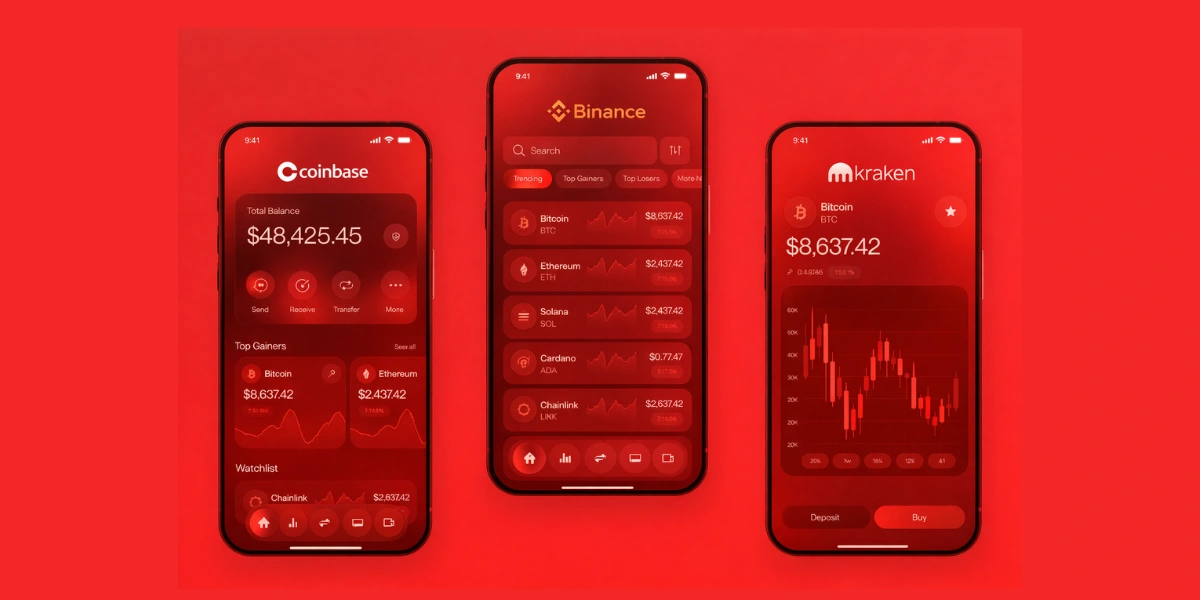
The user interface of successful crypto apps follows a clear pattern: a home screen showing total portfolio value with price change percentages, a simple send/receive flow with QR code support, a clean transaction history with status indicators (pending, confirmed, failed), a token list with search functionality, and settings for security preferences. Navigation should use a bottom tab bar on mobile with no more than five primary actions. Every screen should be reachable within three taps from the home screen at most.
Real-world example: Trust Wallet (now backed by Binance) grew to over 60 million downloads by prioritizing simplicity above all else. Their onboarding flow takes under 60 seconds: create wallet, write down seed phrase, verify seed phrase, done. The home screen immediately shows token balances with a prominent “Buy” button for users who want to purchase crypto right away. Trust Wallet supports over 70 blockchains, but users never have to think about which chain they are on because the interface handles chain switching automatically based on the token being used.
Security is the single most important consideration when building crypto apps. Unlike traditional fintech apps where a breach exposes data that can be recovered, a crypto security breach means direct, irreversible financial loss. If an attacker gains access to private keys, funds are gone forever. There is no bank to call, no chargeback to file, and no insurance to claim in most cases. This reality means security must be designed into every layer of your crypto app from the very beginning, not bolted on after the fact.
Regulatory compliance varies dramatically by jurisdiction but follows common themes. Know Your Customer (KYC) verification requires users to submit identity documents before accessing certain features. Anti-Money Laundering (AML) monitoring tracks transaction patterns for suspicious activity. Travel Rule compliance requires sharing sender and recipient information for transfers above certain thresholds (typically $3,000 in the US). In the United States, any crypto app handling fiat currency needs Money Services Business registration and potentially individual state money transmitter licenses across all 50 states.
| Region | Key Regulation | Requirements | Enforcement Body |
|---|---|---|---|
| United States | MSB + State Licenses | KYC, AML, SAR filing | FinCEN, SEC, CFTC |
| European Union | MiCA Framework | CASP license, reserves | National regulators |
| United Kingdom | FCA Registration | AML, consumer warnings | FCA |
| Singapore | MAS License | KYC, risk assessment | MAS |
| UAE / Dubai | VARA License | AML, custody standards | VARA |
Testing and Launching the App
Testing crypto apps requires more rigor than testing standard mobile apps because bugs can result in permanent financial loss. Your testing strategy should cover unit tests for all business logic, integration tests for blockchain interactions, end-to-end tests for complete user workflows, security penetration testing, and load testing to ensure the app handles traffic spikes during volatile market conditions when everyone is trying to trade at once.
Always test on blockchain testnets first. Ethereum has Sepolia and Holesky testnets. Solana has Devnet. Polygon has Mumbai testnet. These environments let you test every transaction flow with fake tokens that cost nothing. After testnet validation, move to a limited mainnet beta with real assets but controlled access. Invite a small group of trusted testers to use the app with small amounts, monitoring every transaction for issues before opening access to the general public.
Real-world example: When Uniswap launched version 3, they ran a months-long audit and testing process that included three independent security audits (Trail of Bits, ABDK, samczsun), a $500,000 bug bounty program, and extensive testnet deployment. Despite this thorough approach, minor issues were still discovered after mainnet launch that required quick patches. This illustrates why crypto apps need both comprehensive pre-launch testing and a rapid response capability for post-launch issues, because no amount of testing catches everything in complex blockchain systems.
Industry Standards for Secure Crypto Apps
Standard 1: Implement two-factor authentication as mandatory for all users, with hardware key support (FIDO2/WebAuthn) for accounts holding over $10,000 in assets.
Standard 2: Store 95% or more of user funds in cold storage with multi-signature requirements, keeping only operating liquidity in hot wallets for daily processing needs.
Standard 3: Conduct at least two independent security audits per year, plus continuous penetration testing and a bug bounty program with minimum $100K maximum payout.
Standard 4: Encrypt all private keys at rest and in transit using AES-256 encryption with Hardware Security Module (HSM) integration for production signing operations.
Standard 5: Complete KYC verification for all users before enabling fiat transactions, with ongoing AML transaction monitoring and automated Suspicious Activity Report filing.
Standard 6: Maintain proof of reserves with quarterly third-party attestations and real-time dashboards showing user fund coverage ratios above 100% at all times.
KYC identity verification system integrated with automated document checking and liveness detection
AML transaction monitoring active with configurable rules for flagging suspicious transfer patterns
Money Services Business registration completed with FinCEN plus state licenses for US-facing operations
Data privacy policy compliant with GDPR, CCPA, and local regulations for every target jurisdiction
Travel Rule compliance system for sharing sender/receiver info on transfers above threshold amounts
Security audit completed by at least two independent firms with all critical findings resolved before launch
Terms of service and risk disclosures reviewed by legal counsel covering crypto-specific liability protections
Sanctions screening integrated with OFAC and EU sanctions lists checked against every wallet address
Future Improvements and Scaling
Launching your crypto app is just the beginning. The most successful crypto apps treat their initial release as a foundation to build upon based on real user behavior and feedback. Your post-launch roadmap should prioritize three areas: multi-chain expansion to reach more users, feature additions that increase engagement and retention, and infrastructure scaling to handle growth. Coinbase started with Bitcoin only, then added Ethereum, then dozens more chains and tokens based on user demand over several years of steady iteration.
Multi-chain support is the most impactful scaling move for crypto apps today. Users increasingly hold assets across multiple blockchains and want a single app to manage everything. Adding Layer 2 networks like Arbitrum, Optimism, and Base gives users access to cheaper transactions. Adding Solana captures the growing trading and DeFi community on that chain. Each new chain increases your addressable market, but also adds engineering complexity for transaction handling, token display, and cross-chain balance aggregation.
Advanced features that drive engagement include staking (users earn yield on held tokens), DeFi aggregation (one-tap access to lending and liquidity protocols across chains), social features (follow wallets, share portfolios), and AI-powered insights (price predictions, portfolio optimization suggestions, risk alerts). The crypto apps that will dominate the next five years are those that evolve from simple transaction tools into comprehensive financial platforms where users manage their entire digital financial life.
Real-world example: Phantom wallet started as a single-chain Solana wallet in 2021. By 2024, they expanded to Ethereum, Polygon, Base, and Bitcoin, growing from 2 million to over 7 million monthly active users. Their in-app token swap feature (aggregating quotes from multiple DEXs) became a massive revenue driver, generating millions in swap fees. Phantom’s evolution from simple wallet to multi-chain super app shows the trajectory that the best crypto apps follow: launch simple, listen to users, and expand strategically based on real data and market opportunity.
Building crypto apps is one of the most rewarding challenges in software engineering today. You are creating tools that give people direct control over their financial lives, without banks, without borders, and without permission. From choosing the right blockchain and integrating secure wallets to handling real-time market data and meeting regulatory requirements, every decision shapes the experience your users will have and the trust they will place in your platform.
The crypto apps that succeed are not necessarily the ones with the most features. They are the ones that solve a specific problem extremely well, wrap it in an interface that anyone can understand, and protect user funds with enterprise-grade security. Coinbase, MetaMask, Phantom, and Trust Wallet all became industry leaders by mastering simplicity first and expanding strategically over time. Focus on your core use case, invest heavily in security, and let user feedback guide your roadmap after launch.
Whether you are building a wallet, an exchange, a payment app, or a DeFi platform, the principles in this guide will help you navigate the technical, regulatory, and design challenges of creating crypto apps that users love and trust. The market is still early, the opportunity is massive, and the teams that build the best crypto apps today will define how hundreds of millions of people interact with digital currency for decades to come.
Frequently Asked Questions
Q1.What are crypto apps used for?
Crypto apps allow users to buy, sell, store, and manage digital currencies directly from their smartphones or desktops. They serve as gateways to the blockchain ecosystem. Users can track prices, send payments, swap tokens, participate in DeFi protocols, and manage NFT collections. Popular crypto apps like Coinbase, MetaMask, and Trust Wallet handle millions of transactions daily. The best crypto apps combine easy-to-use interfaces with strong security features and real-time market data.
Q2.How much does it cost to build a crypto app?
Building a crypto app typically costs between $50,000 and $500,000 depending on complexity. A basic wallet app with send and receive functionality may cost $50,000 to $100,000. A full-featured exchange platform with trading, staking, and DeFi integration can reach $300,000 to $500,000. Key cost factors include blockchain integration complexity, security audit requirements, regulatory compliance features, number of supported cryptocurrencies, real-time data feeds, and the platform choice between iOS, Android, or cross-platform solutions.
Q3.Which blockchain is best for building crypto apps?
The best blockchain depends on your app’s requirements. Ethereum offers the largest ecosystem and most mature tooling but has higher gas fees. Solana provides ultra-fast transactions at low cost but has faced occasional network issues. Polygon delivers Ethereum compatibility with lower fees. BNB Chain is popular for DeFi apps in Asian markets. For most new crypto apps, starting with Ethereum or Polygon gives you access to the widest user base, best documentation, and strongest community support available today.
Q4.Do crypto apps need to comply with regulations?
Yes, crypto apps must comply with regulations in every jurisdiction where they operate. Most countries require Know Your Customer (KYC) and Anti-Money Laundering (AML) procedures. In the United States, crypto apps handling fiat-to-crypto conversions need Money Services Business (MSB) registration with FinCEN plus state money transmitter licenses. The European Union requires compliance with MiCA regulations. Failing to meet regulatory requirements can result in heavy fines, forced shutdowns, and legal action against founders.
Q5.How long does it take to build a crypto app?
A basic crypto wallet app takes 3 to 6 months to build from planning through launch. A full crypto exchange with trading, portfolio tracking, and multi-chain support requires 8 to 14 months. Complex platforms with DeFi integration, staking, lending, and governance features may take 12 to 18 months. Timeline factors include regulatory compliance setup, security audits (which alone take 4 to 8 weeks), blockchain integration complexity, and whether you build native mobile or cross-platform using frameworks like React Native.
Q6.What security features do crypto apps need?
Essential security features for crypto apps include two-factor authentication (2FA), biometric login (fingerprint or face ID), encrypted private key storage, secure enclave integration on mobile devices, withdrawal whitelisting, session timeouts, and real-time fraud detection. Cold storage for the majority of user funds is critical for exchange-type apps. Hardware Security Module (HSM) integration protects signing keys. Regular penetration testing and smart contract audits should be conducted at least quarterly.
Q7.Can I build a crypto app without coding?
While no-code platforms exist for simple token-related tools, building a production-quality crypto app requires proper engineering. No-code solutions cannot handle the security requirements, blockchain integrations, real-time data processing, and regulatory compliance features that users expect. White-label solutions like AlphaPoint or Modulus offer pre-built exchange platforms that reduce the engineering burden. However, customization is limited. For serious crypto apps handling real user funds, hiring experienced blockchain engineers is essential for safety.
Q8.What APIs are needed for crypto apps?
Crypto apps rely on several key APIs. Blockchain node APIs (Alchemy, Infura, QuickNode) connect your app to blockchain networks. Price data APIs (CoinGecko, CoinMarketCap, CryptoCompare) provide real-time market information. Payment APIs (MoonPay, Transak, Wyre) handle fiat-to-crypto on-ramps. KYC/AML APIs (Jumio, Onfido, Chainalysis) manage identity verification and compliance. Wallet APIs (Web3.js, Ethers.js) enable transaction signing. Choose APIs with high uptime guarantees and good documentation.
Explore Services
Related Services
Reviewed by

Aman Vaths
Founder of Nadcab Labs
Aman Vaths is the Founder & CTO of Nadcab Labs, a global digital engineering company delivering enterprise-grade solutions across AI, Web3, Blockchain, Big Data, Cloud, Cybersecurity, and Modern Application Development. With deep technical leadership and product innovation experience, Aman has positioned Nadcab Labs as one of the most advanced engineering companies driving the next era of intelligent, secure, and scalable software systems. Under his leadership, Nadcab Labs has built 2,000+ global projects across sectors including fintech, banking, healthcare, real estate, logistics, gaming, manufacturing, and next-generation DePIN networks. Aman’s strength lies in architecting high-performance systems, end-to-end platform engineering, and designing enterprise solutions that operate at global scale.