Ai Overview
The fundamental difference between these roles lies in decision ownership. It is about who makes what type of decisions and the consequences of those decisions. A blockchain solution architect makes system-level decisions. These include choosing which blockchain platform to use, defining how smart contracts interact with each other, determining what data goes on the chain versus off the chain, and establishing governance mechanisms.
Key Takeaways
- Blockchain solution architects own system-level decisions that are often irreversible, while developers implement those decisions through code.
- Architects define what should be built and how the system should work; developers build what has been decided.
- Projects involving financial value, multiple smart contracts, or compliance requirements need dedicated architectural ownership.
- Blockchain architect salaries in 2026 range from $120,000 for entry-level to over $250,000 for senior positions.
- Poor architectural decisions cause more project failures than weak development work.
- Both roles are necessary, but their importance varies based on project complexity and stage.
The blockchain industry has grown beyond experimental technology into a mature field that powers financial systems, supply chains, gaming platforms, and decentralized applications worldwide. With this growth comes a clear need to understand the different roles that make blockchain projects successful.
Two roles often get mixed up in conversations about blockchain teams: the blockchain solution architect and the blockchain developer. While both work within the same ecosystem, their responsibilities, decision-making authority, and impact on project outcomes differ significantly.
This article breaks down these two roles from an execution and development perspective. We will examine what each role does, when you need one versus the other, how they work together, and what you should consider when building your blockchain team.
At Nadcab Labs, we have spent over 8 years building blockchain systems across various industries. This experience has taught us that understanding these role distinctions early prevents costly mistakes later in the development process.
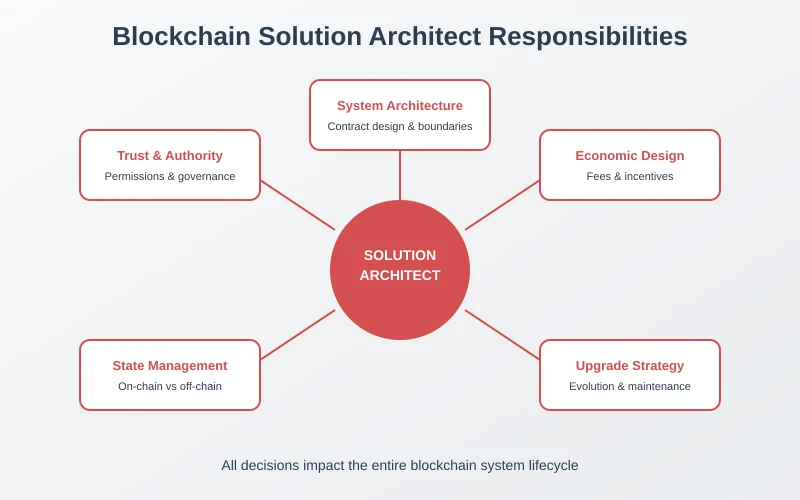
Understanding the Core Distinction from an Execution Standpoint
The fundamental difference between these roles lies in decision ownership. This is not about seniority or years of experience. It is about who makes what type of decisions and the consequences of those decisions.
A blockchain solution architect makes system-level decisions. These include choosing which blockchain platform to use, defining how smart contracts interact with each other, determining what data goes on the chain versus off the chain, and establishing governance mechanisms. These decisions are often difficult or impossible to reverse once implemented.
A blockchain developer, on the other hand, makes implementation-level decisions. These include how to structure code within a smart contract, which libraries to use, how to optimize gas consumption, and how to handle edge cases within the defined architecture. These decisions can typically be changed through updates or refactoring.
Consider a real-world parallel. An architect who designs a building decides where the load-bearing walls go, how the foundation should be built, and where the plumbing and electrical systems run. A construction worker builds according to these plans. Moving a load-bearing wall after construction is expensive and dangerous. Painting a room a different color is straightforward.
Blockchain systems work similarly. Changing the fundamental structure of how your smart contracts manage state or how your system handles permissions can require complete redeployment and migration of user funds. Fixing a bug in calculation logic or improving a user interface function is comparatively simple.
Detailed Role Comparison: Architect vs Developer
The following table outlines the primary differences between blockchain solution architects and blockchain developers across several dimensions that matter for project execution.
| Dimension | Blockchain Solution Architect | Blockchain Developer |
|---|---|---|
| Decision Type | System-level, often irreversible | Module-level, typically reversible |
| Scope of Work | Entire protocol or product system | Specific contracts or modules |
| Primary Output | Architecture documents, system diagrams, decision frameworks | Working code, smart contracts, integrations |
| Failure Impact | Network-wide or product-wide consequences | Application-level issues |
| Security Focus | Structural and systemic vulnerabilities | Code-level security and functional testing |
| Timeline Focus | Long-term evolution and upgrade paths | Current sprint and feature delivery |
This distinction becomes clearer when we look at how each role handles specific aspects of blockchain development.
The Development Lifecycle Perspective
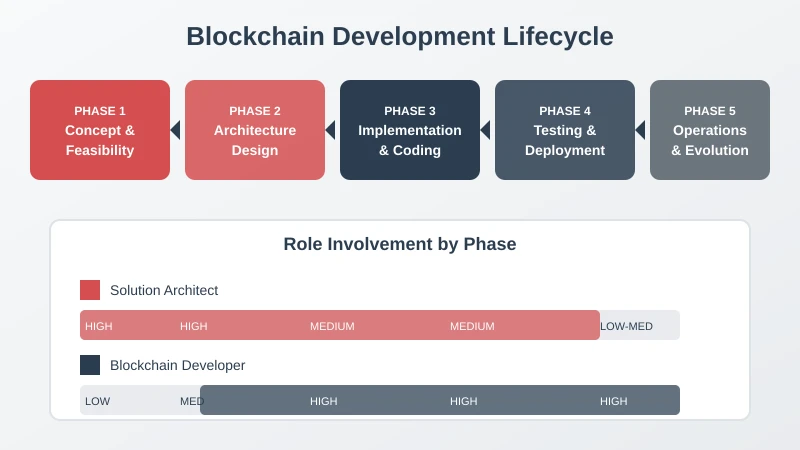
Understanding when each role contributes most heavily helps teams plan their hiring and resource allocation. The blockchain development lifecycle has distinct phases where architectural and development work overlap but remain separate.
Phase 1: Concept and Feasibility
During this phase, the solution architect dominates. They assess whether blockchain is the right solution for the problem, which blockchain platform fits the requirements, and what the high-level system structure should look like. Developers may provide input on technical feasibility, but architects make the strategic calls.
This is also when architects decide what belongs on the blockchain and what should remain off the chain. These boundaries affect everything from transaction costs to regulatory compliance. For example, storing personal data on a public blockchain creates GDPR compliance issues that cannot be fixed through better code.
Phase 2: Architecture Design
The architect creates detailed system designs during this phase. This includes smart contract boundaries, interaction patterns between contracts, integration points with external systems, governance mechanisms, and upgrade strategies.
Developers review these designs for implementation feasibility. They may raise concerns about gas costs, complexity, or technical limitations. Good architects incorporate this feedback, but they retain decision authority over the overall structure.
Our team at Nadcab Labs has found that involving developers in architecture reviews catches practical issues early. However, allowing developers to make architectural decisions often leads to short-term thinking that creates long-term problems.
Phase 3: Implementation
Developers take the lead during implementation. They write smart contracts, build backend services, create APIs, and integrate wallets. Architects shift to an oversight role, ensuring implementation matches the designed architecture.
This phase is where the quality of architectural decisions becomes apparent. Well-designed architectures make implementation straightforward. Poorly designed architectures force developers to create workarounds that introduce technical debt and security risks.
Projects building decentralized applications face particular challenges during implementation. The interaction between on-chain and off-chain components must match the architectural design precisely, or the entire system behaves unpredictably.
Phase 4: Testing and Deployment
Both roles contribute heavily to testing. Developers write unit tests, integration tests, and handle testnet deployments. Architects verify that the implemented system matches the design and that security assumptions hold under realistic conditions.
Mainnet deployment is often a point of significant architectural concern. The architect ensures deployment sequences are correct, upgrade mechanisms work as designed, and emergency procedures are in place. Developers execute the deployment following established procedures.
Phase 5: Operations and Evolution
After deployment, both roles remain active but with different focuses. Developers handle bug fixes, feature additions within existing boundaries, and day-to-day operational issues. Architects plan system evolution, design upgrades, and address structural issues that emerge under real-world use.
This ongoing work is where many projects struggle. Without clear architectural ownership, incremental changes accumulate into structural problems. Without skilled developers, even good architectures degrade through poor implementation choices.
Build Your Blockchain System Right
Get expert architectural guidance and development support from a team with 8+ years of blockchain experience. We help you make the right decisions before they become expensive mistakes.
What Blockchain Solution Architects Actually Do
The solution architect role encompasses several responsibility areas that shape blockchain systems before development begins and guide them throughout their operational life.
System Architecture Design
This is the most visible part of the architect role. They define how many smart contracts exist, how contracts interact, which responsibilities belong on the chain versus off the chain, and how external systems integrate.
Architecture decisions directly affect gas costs, audit complexity, upgrade safety, and operational overhead. A system with too many small contracts creates excessive inter-contract calls and higher gas costs. A system with too few large contracts becomes difficult to upgrade and audit.
Consider a project building a blockchain gaming platform. The architect must decide how game assets are represented on the chain, how game logic executes, how player progression is tracked, and how the gaming system integrates with marketplaces and other ecosystem components.
Trust and Authority Model Design
Despite common misconceptions, blockchain systems are not automatically trustless. They are designed with specific trust assumptions that the architect must define explicitly.
Who controls upgrade authority? How are permissions granted and revoked? How does governance work? What happens during emergencies? How are private keys managed across the system? These questions require architectural answers that developers then enforce through code.
Getting trust models wrong has caused some of the most expensive failures in blockchain history. Projects that gave upgrade authority to a single address lost user funds when that address was compromised. Projects without emergency controls could not respond to discovered vulnerabilities.
State and Execution Management
Architects decide what data gets stored on the chain, how state growth is controlled over time, and how deterministic execution is preserved across all nodes.
These decisions prevent problems like excessive storage costs, legal exposure from permanently stored data, and consistency issues between different blockchain clients. Developers implement logic within these constraints, but they cannot change the fundamental state model without architectural approval.
Understanding how on-chain trading works illustrates why state management matters. Every trade creates new state on the blockchain. Without careful architectural planning, state growth can make the system economically unsustainable over time.
Economic and Risk Design
Every blockchain system operates under economic incentives. Architects design fee models, incentive structures, and protections against economic attacks like front-running, MEV exploitation, and spam attacks.
This work requires understanding both blockchain mechanics and game theory. Developers may implement the mechanisms, but architects must understand how rational actors will interact with the system and exploit any weaknesses.
Projects built on Layer 1 blockchains face particular economic design challenges. The base layer economic model constrains what applications can do, and architects must work within these constraints while designing their own incentive systems.
Governance and Upgrade Strategy
Architects define how systems evolve over time. This includes upgrade mechanisms, governance processes, and emergency controls. Without clear upgrade strategies, blockchain systems either become rigid and unable to adapt or dangerously centralized through ad-hoc upgrade processes.
The choice between upgradeable and immutable contracts is fundamentally architectural. Upgradeable contracts provide flexibility but introduce trust assumptions. Immutable contracts provide stronger guarantees but cannot be fixed if problems emerge.
What Blockchain Developers Actually Do
Blockchain developers transform architectural designs into working systems. Their work is technical, detailed, and focused on implementation quality within the boundaries established by architects.
Smart Contract Development
The core work of blockchain developers is writing smart contracts. This includes implementing business logic in languages like Solidity, Rust, or Move; handling data structures and storage patterns; managing gas optimization; and ensuring code follows security best practices.
Smart contract development requires different skills than traditional software development. The immutable nature of deployed contracts means bugs cannot be patched directly. The public execution environment means anyone can see exactly how contracts work and attempt to exploit weaknesses.
Good developers write clean, well-documented code that auditors can review effectively. They understand common vulnerability patterns and avoid them through established coding practices. They also write comprehensive tests that cover edge cases and potential attack vectors.
Integration and Backend Development
Blockchain applications need more than smart contracts. They require backend services that interact with the blockchain, APIs that frontend applications can consume, and integration with external data sources and services.
Developers build these components while following the integration patterns defined by architects. This includes handling blockchain events, managing transaction submission and confirmation, caching data for performance, and synchronizing off-chain state with on-chain state.
The blockchain development services that companies provide typically include this full stack of work, not just smart contract coding.
Wallet and Frontend Integration
User-facing applications must connect with blockchain wallets to sign transactions. Developers implement these integrations, handle different wallet types and connection methods, manage transaction state, and provide users with appropriate feedback about their blockchain interactions.
This work requires understanding both frontend development and blockchain-specific concerns like transaction signing flows, gas estimation, and error handling for failed transactions.
Testing and Security
Blockchain developers spend significant time on testing. They write unit tests for individual functions, integration tests for contract interactions, and end-to-end tests for complete user flows. They also conduct security reviews and work with external auditors to identify and fix vulnerabilities.
Testing blockchain applications is more complex than testing traditional software. The deterministic but distributed nature of blockchain execution creates edge cases that do not exist in centralized systems. Developers must think about how malicious actors might interact with their code and test accordingly.
Skills Required: Architect vs Developer
While there is overlap in technical knowledge, architects and developers need different skill sets to perform their roles effectively.
| Skill Category | Blockchain Solution Architect | Blockchain Developer |
|---|---|---|
| Technical Depth | Broad understanding of multiple blockchain platforms, consensus mechanisms, and architectural patterns | Deep expertise in specific languages, frameworks, and development tools |
| System Thinking | Essential: must see how components interact and anticipate emergent behavior | Helpful but focused on component-level interactions |
| Security Knowledge | Structural security: trust models, attack surfaces, systemic risks | Code security: vulnerability patterns, secure coding practices, audit preparation |
| Business Understanding | Critical: must align technical decisions with business requirements and constraints | Important for understanding feature requirements and priorities |
| Communication | Must communicate with executives, product managers, legal, and technical teams | Primarily communicates with other developers and technical stakeholders |
| Regulatory Awareness | Must understand how architectural choices affect compliance | Should be aware but typically implements compliance features as specified |
Notice that architects need broader but not necessarily deeper technical knowledge. They must understand enough about multiple areas to make informed decisions but do not need to implement complex systems themselves. Developers need deeper knowledge in specific areas to write production-quality code.
When Your Project Needs Each Role
Not every project needs a dedicated solution architect. Not every project can succeed with developers alone. Understanding when each role is necessary helps teams allocate resources appropriately.
Projects That Need Solution Architects
You need dedicated architectural ownership when your project involves financial value or custody, where mistakes can result in permanent loss of user funds.
Multiple interacting smart contracts create architectural complexity that developers alone struggle to manage. Each contract interaction is a potential failure point, and understanding how they combine requires system-level thinking.
Hybrid systems with both on-chain and off-chain components need clear boundaries and integration patterns. Architects define these boundaries; developers implement within them.
Strict security or compliance requirements demand architectural attention. Regulatory compliance cannot be retrofitted through better code. It must be designed into the system from the beginning.
Long-term projects that will evolve over years need upgrade strategies and governance mechanisms that only architects can properly design, a key consideration when you hire dedicated software development team members who will maintain the system.
Our work with blockchain-based education platforms, documented in our Open Campus case study, demonstrates how architectural decisions early in a project enable sustainable growth over time.
Projects That May Not Need Dedicated Architects
If your project uses a well-established architecture pattern and your team has built similar systems before, developers may be sufficient to execute the implementation.
Simple or isolated systems without complex integrations can often proceed with experienced developers making architectural decisions as needed.
Proofs of concept designed to validate ideas rather than serve production users can move faster with developers alone. However, successful proofs of concept that graduate to production systems will eventually need architectural review.
Projects with minimal risk exposure, where failure has limited consequences, can operate with less architectural oversight.
Even in these cases, some architectural thinking is required. The question is whether it needs dedicated focus or can be handled as part of development work.
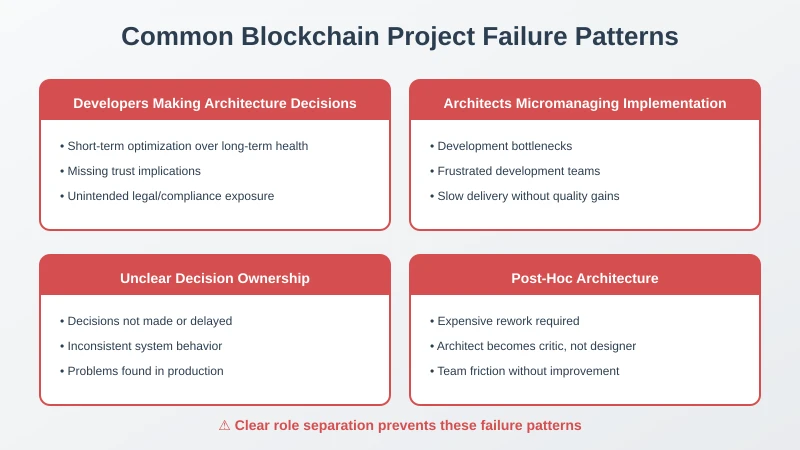
Common Failure Patterns from Role Confusion
Many blockchain projects fail not because of weak development but because of architectural problems. Understanding common failure patterns helps teams avoid them.
Developers Making Architectural Decisions
When no architect is present, developers make architectural decisions by default. These decisions often optimize for short-term development convenience rather than long-term system health.
A developer might choose an upgradeable contract pattern because it makes testing easier, without fully considering the trust implications. They might store data on the chain for convenience, creating legal exposure that only becomes apparent later.
These decisions are not wrong per se. They are made without the system-level context that architects provide.
Architects Making Implementation Decisions
The opposite problem also occurs. Architects who involve themselves too deeply in implementation details slow down development without improving outcomes.
Implementation decisions should be made by people writing the code. They have the detailed context needed to make good choices. Architects who second-guess every implementation decision create bottlenecks and frustrate developers.
Unclear Decision Ownership
When decision ownership is unclear, neither role takes responsibility for critical choices. Decisions either do not get made, delaying the project, or get made inconsistently by different team members.
This often happens in teams that grow organically without defining roles clearly. Everyone assumes someone else is handling architectural concerns until problems emerge in production.
Post-Hoc Architecture
Some teams hire architects after development is substantially complete, expecting them to fix structural problems. This rarely works well.
By the time the code is written, architectural decisions are embedded in the implementation. Changing them requires significant rework, often equivalent to starting over. The architect becomes a critic rather than a designer, creating friction without improving outcomes.
Salary Expectations and Market Trends in 2026
Compensation for both roles reflects the specialized skills required and the market demand for blockchain expertise. Understanding salary ranges helps with both hiring budgets and career planning.
| Experience Level | Solution Architect (USD) | Developer (USD) |
|---|---|---|
| Entry Level | $120,000 – $140,000 | $80,000 – $100,000 |
| Mid Level | $145,000 – $180,000 | $100,000 – $140,000 |
| Senior Level | $185,000 – $250,000+ | $140,000 – $200,000 |
| Global Average | $85,000 | $65,000 |
The salary premium for architects reflects the broader impact of their decisions and the relative scarcity of qualified candidates. Finding developers who can write solid smart contracts is difficult but possible. Finding architects who can design secure, scalable blockchain systems is substantially harder.
Several factors affect individual compensation beyond experience level. Protocol design experience, where the candidate has designed systems that operated successfully under real-world conditions, commands significant premiums. Multi-chain proficiency across Ethereum, Solana, Cosmos, and other platforms increases value. Industry specialization in finance, gaming, supply chain, or other verticals also affects compensation.
Remote work has standardized salaries somewhat. A developer working remotely for a US company often earns US-level compensation regardless of their physical location. This has increased competition for positions while also expanding the talent pool available to companies.
Building Effective Blockchain Teams
Hiring for blockchain roles requires understanding what makes candidates effective in each position. Technical skills matter, but they are not the only consideration.
Evaluating Solution Architects
Technical interviews for architects should focus on decision-making, not just knowledge. Present candidates with realistic scenarios and evaluate how they think through tradeoffs.
Ask about systems they have designed and what happened when those systems encountered real-world stress. Good architects have stories about decisions that worked well and decisions they would make differently with hindsight. Candidates who only tell success stories either lack experience or lack self-awareness.
Evaluate communication skills directly. Architects who cannot explain their reasoning to non-technical stakeholders will struggle in the role. Have them present a past project to a mixed audience and observe how they adjust their communication.
Check references specifically on architectural judgment. Did their designs prove sound over time? Did they collaborate effectively with development teams? Were they able to adapt when requirements changed?
Evaluating Developers
Developer evaluation should include practical coding assessments in the languages and frameworks your project uses. Review their approach to testing, documentation, and security.
Ask about bugs they have found in production and how they handled them. This reveals both technical debugging skills and the ability to work under pressure. Ask about code they have written that they would now write differently. This shows growth and self-reflection.
Evaluate their understanding of blockchain-specific concerns like gas optimization, reentrancy, and front-running. These topics separate developers who have worked on production blockchain systems from those who have only completed tutorials.
Team Composition
Effective blockchain teams need both roles in appropriate ratios. A common pattern is one architect supporting multiple development teams, with the architect setting direction and developers executing within that direction.
For smaller projects, a single senior person might combine both roles, but this requires exceptional breadth and depth of skills. More commonly, smaller projects use external architectural consultation combined with in-house development.
Our experience at Nadcab Labs shows that projects benefit from architectural engagement throughout their lifecycle, not just at the beginning. Even after the initial design is complete, having architectural oversight for major changes prevents drift away from sound design principles.
Real-World Example: Blockchain in Property Markets
To illustrate how these roles work together, consider a project using blockchain in property markets for fractional ownership of real estate.
The solution architect would make decisions like:
- Which blockchain platform supports the required transaction throughput and compliance features
- How property ownership is represented on the chain, whether through NFTs, fungible tokens, or custom structures
- How the system integrates with existing property registries and legal frameworks
- What governance mechanisms allow property owners to make collective decisions
- How the system handles jurisdictional differences in property law
Developers would then implement these decisions:
- Writing smart contracts for token creation, transfer, and governance
- Building integration services that connect blockchain events to traditional databases
- Creating user interfaces for property browsing, purchase, and management
- Implementing compliance checks and reporting features
If developers made architectural decisions in this scenario, they might choose structures that are easy to code but create legal complications. If architects tried to implement the code themselves, development would be slow and the code quality would likely suffer.
Making the Right Choice for Your Project
Whether you need a solution architect, developers, or both depends on your specific situation. Consider these factors when making your decision.
Project complexity is the primary driver. Simple integrations with existing blockchain infrastructure need less architectural oversight than novel systems with custom mechanics.
Financial risk matters significantly. The more value flows through your system, the more important architectural decisions become. A bug in a social feature creates bad user experience. A bug in a financial feature can cause permanent loss of funds.
Team experience affects requirements. If your development team has built similar systems successfully, they bring implicit architectural knowledge. If the project type is new to your team, external architectural guidance becomes more valuable.
Timeline and budget constraints are practical considerations. Architectural work front-loads costs and extends initial timelines but typically reduces total project cost by avoiding expensive mistakes. Projects with tight deadlines and limited budgets may need to accept higher risk.
Regulatory environment shapes needs. Projects in regulated industries like finance or healthcare face compliance requirements that demand architectural attention. Projects in less regulated spaces have more flexibility.
Conclusion: Both Roles Are Essential
The blockchain solution architect and blockchain developer roles are equally important but fundamentally different. Architects make system-level decisions that shape what gets built and how it works. Developers implement those decisions through quality code that brings designs to life.
Neither role can substitute for the other. Developers without architectural guidance make short-term decisions that create long-term problems. Architects without skilled developers cannot translate designs into working systems.
The key is matching role allocation to project needs. Simple projects may succeed with experienced developers handling architectural decisions as part of their work. Complex projects involving financial value, multiple smart contracts, or compliance requirements need dedicated architectural ownership.
At Nadcab Labs, we have seen both success patterns and failure patterns across hundreds of blockchain projects over our 8+ years in this industry. The projects that succeed almost always have clear separation between architectural and development responsibilities, with each role empowered to do their best work within their domain.
If you are starting a blockchain project and uncertain about team composition, err on the side of architectural consultation early. The cost of architectural advice is small compared to the cost of rebuilding a system that was designed incorrectly from the start.
FAQ : Blockchain Solution Architect vs Blockchain Developer
Q1.Can a senior blockchain developer replace a blockchain solution architect?
No, because experience does not equal architectural authority. A senior blockchain developer may write excellent contracts and systems, but an architect is responsible for system-level assumptions, trust models, upgrade boundaries, economic risk, and long-term survivability. These decisions exist outside code quality and cannot be corrected by refactoring after deployment.
Q2.At what stage of a blockchain project should a solution architect be involved?
A solution architect must be involved before any technical commitment is made, ideally at the idea or feasibility stage. Once smart contract boundaries, custody models, or governance assumptions are implemented, changing them often requires redeployments, migrations, or even protocol resets. Early architectural decisions define the project’s ceiling.
Q3.Why do many blockchain projects fail even with technically strong developers?
Because technical execution does not compensate for poor system design.
Projects commonly fail due to incorrect on-chain/off-chain separation, unsafe upgrade authority, flawed incentive structures, or regulatory blind spots. These are architectural failures, not coding mistakes, and they usually surface only after real users and adversarial actors interact with the system.
Q4.Does every blockchain project need a full-time solution architect?
Not always, but every serious blockchain project needs architectural ownership.
For small or well-defined systems, this role may be part-time or advisory. However, when financial value, multiple contracts, governance, or external integrations are involved, the absence of a clear architectural owner creates long-term fragility and operational risk.
Q5.Who is responsible when a blockchain system design turns out to be unsafe?
Responsibility lies at the architectural decision layer, not the implementation layer.
If developers implement the defined design correctly, but the system fails due to trust, economic, or governance flaws, the failure originates from architecture—not execution. This is why mature teams separate design authority from development delivery.
Q6.How should companies evaluate a blockchain solution architect during hiring?
Companies should evaluate decision history, not just technical knowledge.
Strong signals include experience designing systems that survived production stress, handling upgrades without breaking trust, responding to incidents, and making trade-offs between decentralization, cost, security, and usability. Architectural competence is demonstrated through judgment under constraint, not tool familiarity.
Q7.How does a blockchain solution architect support blockchain development services?
A blockchain solution architect designs the system architecture that powers blockchain development services. This includes defining on-chain and off-chain components, trust and governance models, security assumptions, and scalability plans.
Explore Services
Related Services
Reviewed by

Aman Vaths
Founder of Nadcab Labs
Aman Vaths is the Founder & CTO of Nadcab Labs, a global digital engineering company delivering enterprise-grade solutions across AI, Web3, Blockchain, Big Data, Cloud, Cybersecurity, and Modern Application Development. With deep technical leadership and product innovation experience, Aman has positioned Nadcab Labs as one of the most advanced engineering companies driving the next era of intelligent, secure, and scalable software systems. Under his leadership, Nadcab Labs has built 2,000+ global projects across sectors including fintech, banking, healthcare, real estate, logistics, gaming, manufacturing, and next-generation DePIN networks. Aman’s strength lies in architecting high-performance systems, end-to-end platform engineering, and designing enterprise solutions that operate at global scale.