Ai Overview
The transformation sweeping through modern medicine isn’t just about new treatments or advanced surgical techniques. North America dominates the global market, capturing 33% of total market share in 2023, driven by widespread adoption of advanced healthcare technologies and significant investments in IT infrastructure. Nearly 20% of all Medicare discharges nationwide lead to readmission within 30 days, creating both financial burdens and negative patient outcomes.
Key Takeaways
- The global big data analytics in healthcare market grew from 42.2 billion USD in 2023 and is projected to reach 145.8 billion USD by 2033, representing a compound annual growth rate of 13.2%. North America leads with 33% of global market share, driven by advanced IT infrastructure and government support programs.
[1] - By 2024, 95% of U.S. office-based physicians had adopted electronic health record systems, with 83.6% using certified EHR systems. Hospital adoption reached 96% by 2021, up dramatically from just 28% in 2011, creating massive datasets for analytics applications.[2]
- Machine learning models predicting 30-day hospital readmissions achieved an area under the curve of 0.83 using combined features from 429,000 patients over seven years. Real-world implementation at Kaiser Permanente showed 2.5% absolute risk reduction in readmissions among high-risk patients, while Allina Health calculated 3.7 million USD in cost savings.[3]
- Big data analytics-enabled healthcare fraud detection systems demonstrate accuracy levels exceeding 95%, enabling faster investigations and improved financial loss prevention. Implementation of data-driven insurance plans resulted in an average reduction of nearly 5% in healthcare claim expenditures, with 3% to 10% of total healthcare spending lost to fraudulent activities.
- Patients receiving genomically-matched treatments experienced 85% better outcomes compared to standard care. In oncology, patients with treatments matched to actionable tumor genomic alterations showed higher objective response rates (16.4% versus 5.4%) and longer progression-free survival (4.0 versus 2.8 months).
- Big data storage in healthcare was projected to reach 175 zettabytes by 2025, up from 33 zettabytes in 2018, representing a compound annual growth of 61%. By 2025, 49% of this data was expected to be stored in public cloud environments, with 30% of generated data consumable in real time.[4]
- The financial analytics segment within healthcare is forecast to reach approximately 167 billion USD by 2030, registering a CAGR of 21.1% from 2024 onward. This reflects growing recognition that data-driven operational decisions dramatically improve efficiency and reduce costs across healthcare systems.
- Implementation of electronic health record systems led to an average reduction of 70% in medication errors across healthcare facilities. Healthcare institutions using EHR data analytics report a 40% decrease in diagnostic errors compared to traditional paper-based record systems.[5]
- Nearly 20% of all Medicare discharges nationwide lead to readmission within 30 days. Preventing just 10% of these readmissions could save Medicare 1 billion USD annually, demonstrating the massive financial and clinical impact of predictive analytics in readmission prevention.[6]
- 41% of healthcare professionals have implemented big data for operational analytics, with 81% anticipating significant improvements in healthcare delivery. The Internet of Medical Things market experienced accelerated growth, supported by increasing adoption of connected medical devices generating continuous data streams.[7]
A New Era in Medical Intelligence
The transformation sweeping through modern medicine isn’t just about new treatments or advanced surgical techniques. It represents a fundamental shift in how we understand, diagnose, and treat patients. Big Data Analytics in Healthcare has emerged as one of the most powerful tools reshaping the medical landscape, turning massive volumes of information into actionable insights that save lives and optimize resources.
The Scale of Healthcare Data Growth
Healthcare generates data at an unprecedented pace. According to recent market analysis, the global big data in healthcare market reached 42.2 billion USD in 2023 and is projected to grow to 145.8 billion USD by 2033, representing a compound annual growth rate of 13.2%. This explosive growth reflects not just financial investment but the sheer volume of information being created every second across hospitals, clinics, and research facilities worldwide.
The United States alone saw its healthcare big data analytics market valued at 22.2 billion USD in 2024, with projections indicating growth to 58.40 billion USD by 2033 at an 11.3% CAGR. North America dominates the global market, capturing 33% of total market share in 2023, driven by widespread adoption of advanced healthcare technologies and significant investments in IT infrastructure.
Storage requirements tell an even more striking story. Big data storage in healthcare was expected to reach 175 zettabytes by 2025, up from 33 zettabytes in 2018. To put this in perspective, if you could stack one zettabyte worth of standard books, they would reach far beyond the moon. This exponential data growth stems from multiple sources: electronic health records, medical imaging, genomic sequencing, wearable devices, and insurance claims, all contributing to the deluge.
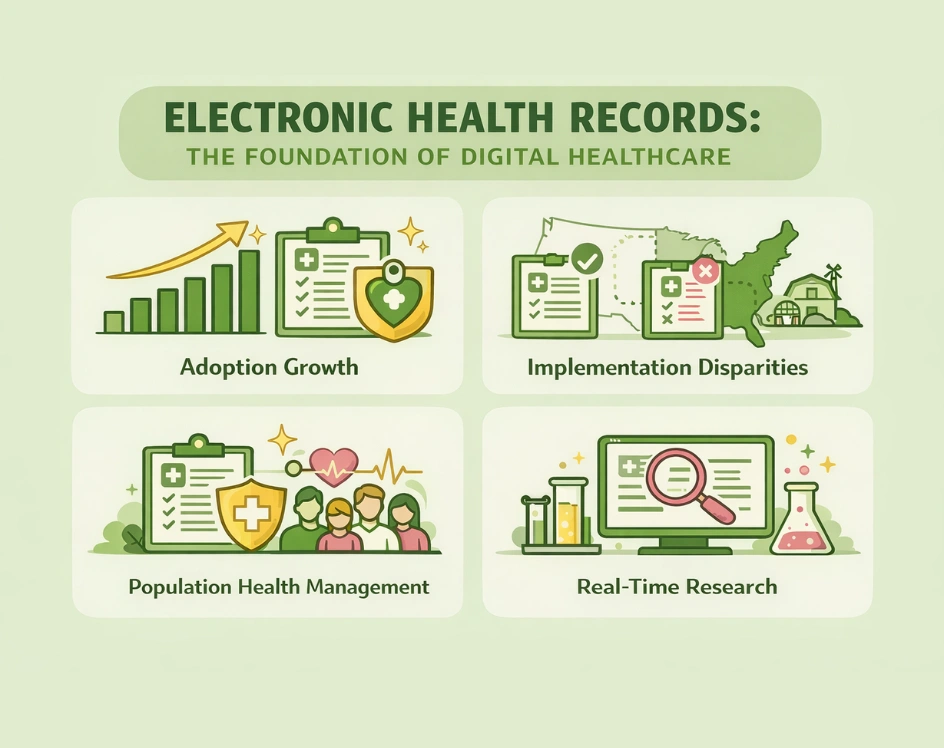
Electronic Health Records: The Foundation of Digital Healthcare
- Adoption Growth- The adoption of Electronic Health Records has fundamentally changed how patient information flows through healthcare systems. By 2021, nearly 96% of non-federal acute care hospitals had adopted certified EHR systems, a dramatic increase from just 28% in 2011. Among office-based physicians, adoption reached 78% by 2021, compared to only 34% a decade earlier. More recent data from the 2024 National Electronic Health Records Survey reveal that 95% of U.S. office-based physicians had adopted EHR systems, with 83.6% using certified systems. This near-universal adoption creates an enormous reservoir of structured and unstructured patient data that analytics can transform into clinical insights.
- Implementation Disparities- Adoption alone doesn’t guarantee optimal use across all healthcare settings. Rural hospitals, while achieving 83% basic EHR adoption rates similar to urban hospitals, lag significantly in comprehensive EHR adoption at 53% compared to 65% in urban areas. System-affiliated hospitals show higher adoption rates (84% basic, 69% comprehensive) than independent hospitals (76% basic, 47% comprehensive), highlighting disparities that analytics must address to ensure equitable healthcare delivery.
- Population Health Management- The real power of EHRs emerges through their analytical applications. Over 90% of healthcare organizations now leverage EHR data for population health management and research purposes. This widespread utilization enables healthcare systems to identify disease patterns, track health trends across communities, and develop targeted interventions for at-risk populations.
- Real-Time Research- EHRs contribute to a 30% increase in the availability of real-time patient data for clinical research and analysis. This enhanced data accessibility enables faster medical discoveries, more responsive care delivery, and the ability to make evidence-based decisions at the point of care, ultimately improving patient outcomes and advancing medical knowledge.
Predictive Analytics: Preventing Problems Before They Occur
One of the most transformative applications of big data analytics in healthcare lies in its ability to predict future events. Nowhere is this more evident than in hospital readmission prevention. Nearly 20% of all Medicare discharges nationwide lead to readmission within 30 days, creating both financial burdens and negative patient outcomes. Preventing just 10% of these readmissions could save Medicare 1 billion USD.
Healthcare organizations have developed sophisticated predictive models that identify patients at high risk for readmission. Mission Health, for instance, developed a predictive model achieving an area under the curve (AUC) of 0.784, outperforming the commonly used LACE index. This improvement translated into a readmission rate 1.2 percentage points lower than top hospital peers.
More advanced machine learning approaches have pushed these capabilities further. A study using seven years of data from 429,000 patients demonstrated that combining manually-engineered features with automatically generated features achieved an AUC of 0.83 in predicting 30-day readmissions. Even using only automated features showed good performance, with logistic regression achieving AUC 0.76 and gradient boosting machines reaching 0.77.
The real-world impact of these predictive models extends beyond statistics. Kaiser Permanente Northern California implemented a Transitions Program using predictive analytics to target high-risk patients after discharge. The program demonstrated statistically significant reductions in 30-day readmission odds (adjusted odds ratio 0.91), corresponding to an absolute risk reduction of 2.5% among patients with predicted risk above 25%. For a healthcare system handling over 1.5 million admissions during the study period, this represents thousands of prevented readmissions and millions in cost savings.
Allina Health provides another compelling example. Their predictive model assigns readmission scores based on medical history, demographic information, current clinical data, and prior emergency department utilization. High-risk patients identified by their algorithm have a 20% or greater chance of 30-day readmission. Implementation of their program, combining predictive analytics with care process redesign, resulted in a calculated 3.7 million USD reduction in variable costs by comparing actual versus expected readmissions.
Fighting Fraud Through Intelligent Detection
Healthcare fraud represents a massive drain on resources, with estimates suggesting 3% to 10% of total healthcare expenditures are lost to fraudulent activities. Big data analytics has emerged as a powerful weapon in this fight. According to recent market data, fraud detection systems enabled by big data have demonstrated accuracy levels exceeding 95%, enabling faster investigations and improved financial loss prevention.
Machine learning approaches to fraud detection have shown remarkable success across multiple studies. One healthcare fraud detection model achieved 92% accuracy using logistic regression and 88% using random forest algorithms. Another study developing a real-time artificial neural network model for detecting fraudulent health insurance claims reported approximately 100% model accuracy in their supervised model.
The systematic application of machine learning to healthcare fraud spans multiple approaches. A comprehensive review of 137 studies on health insurance fraud detection found widespread use of supervised methods (94 studies), unsupervised methods (41 studies), and hybrid approaches (12 studies). While traditional machine learning approaches remain dominant, the adoption of advanced deep learning techniques continues to rise.
The financial impact of improved fraud detection extends beyond catching criminals. Implementation of customized, big data-driven insurance plans has resulted in an average reduction of nearly 5% in healthcare claim expenditures. For a healthcare system processing billions in claims annually, this percentage translates to hundreds of millions in savings that can be redirected to patient care.
Precision Medicine and Genomic Analytics
- Superior Treatment Outcomes:
Perhaps no area demonstrates the power of big data analytics in healthcare more dramatically than precision medicine. By 2024, studies showed that patients receiving genomically-matched treatments experienced 85% better outcomes compared to standard care. In oncology specifically, patients receiving treatments matched to actionable tumor genomic alterations showed higher objective response rates (16.4% versus 5.4%), longer progression-free survival (4.0 versus 2.8 months), and higher 10-year overall survival rates (6% versus 1%) compared with unmatched therapy. - Cancer-Specific Improvements:
The statistics become even more impressive when examining specific cancer types. Solid tumors showed response rates of 24.5% with personalized approaches compared to 4.5% with standard treatments, while blood cancers exhibited a 24.5% response rate versus 13.5%. When analyzing biomarker-based approaches specifically, targeting genomic alterations resulted in a 42% response rate compared to 22.4% when targeting protein overexpression. - Breakthrough Therapies:
CAR-T cell therapy, made possible through advanced genomic analytics, has achieved 76% response rates in treatment-resistant cancers. For rare diseases, genomic approaches have led to a 60% reduction in diagnostic odysseys, the often years-long journey patients undertake to find answers. In cardiovascular prevention, personalized strategies informed by genomic data have demonstrated a 30% decrease in cardiovascular events. - Molecular Classification Revolution:
The Cancer Genome Atlas initiative exemplifies the power of big data in genomic research. Through comprehensive analysis of tumor samples, researchers identified 33 distinct tumor types, revolutionizing cancer classification and treatment approaches. This level of detailed molecular understanding would be impossible without the ability to process and analyze massive genomic datasets.
Operational Excellence Through Analytics
Beyond clinical applications, big data analytics drives significant improvements in healthcare operations. Financial analytics within healthcare is forecast to reach approximately 167 billion USD by 2030, registering a CAGR of 21.1% from 2024 onward. This dramatic growth reflects recognition that data-driven operational decisions can dramatically improve efficiency and reduce costs.
Beyond clinical and operational improvements, healthcare organizations are increasingly using analytics to strengthen their financial performance. Advanced data insights help identify claim denials, coding inefficiencies, reimbursement delays, and revenue leakage across specialty practices. Healthcare providers looking to optimize their revenue cycle often partner with experienced ENT billing services providers such as AnnexMed, which leverages data-driven billing strategies, accurate coding workflows, and denial management processes to improve collections and streamline practice operations.
The Internet of Medical Things (IoMT) represents another frontier where big data analytics optimizes performance. The IoMT market experienced accelerated growth and reached significant scale by 2025, supported by increasing adoption of connected medical devices. These devices generate continuous streams of data about patient vital signs, equipment status, and environmental conditions. Analytics transform this raw data into actionable insights that improve both clinical care and operational efficiency.
Healthcare Big Data Analytics Market Growth by Region
| Region | 2024 Market Value (USD Billion) | 2033 Projected Value (USD Billion) | CAGR (%) | Key Characteristics |
|---|---|---|---|---|
| North America | 24.63 | 58.40+ | 11.3 | Leads with 33% global market share, driven by advanced IT infrastructure and government support |
| Global Market | 50.74 | 145.8 | 13.2 | Widespread EHR adoption, AI and ML integration, rising demand for personalized medicine |
| Asia Pacific | Data growing | Fastest growth expected | 19.2+ | Emerging as fastest growing region, increasing digital health investments |
| Europe | Significant share | Growing steadily | 11-13 | Strong regulatory frameworks, emphasis on data protection and interoperability |
Challenges and Implementation Barriers
Despite remarkable progress, healthcare big data analytics faces significant challenges. Data quality remains a persistent concern, with inconsistent formatting, missing values, and errors compromising analytical accuracy. Healthcare data comes from diverse sources using different standards, making integration complex and time-consuming.
Privacy and security present constant challenges. With 53% of healthcare data breaches attributed to EHR incidents in 2020, organizations must balance data accessibility for analytics with robust protection measures. Regulatory compliance with frameworks like HIPAA adds complexity to data sharing and analysis.
The imbalanced nature of healthcare data creates technical difficulties. Fraudulent claims represent a tiny fraction of total claims, readmissions affect only a minority of patients, and rare diseases by definition have limited data. These imbalances can cause machine learning algorithms to become biased toward majority classes, missing the very patterns analysts seek to identify.
Healthcare organizations also face resource constraints. Advanced analytics systems require substantial computational power, specialized expertise in data science and machine learning, and ongoing financial investment. Smaller organizations often lack these resources, potentially widening the gap between well-funded health systems and resource-limited facilities.
The workforce shortage in quantitative sciences and mathematical applications to healthcare represents another critical barrier. Organizations need professionals who understand both healthcare domain knowledge and advanced analytics techniques, but such expertise remains scarce.
Clinical Applications of Big Data Analytics and Their Impact
| Application Area | Key Metric | Impact/Outcome | Data Source |
|---|---|---|---|
| Hospital Readmission Prediction | AUC Score | 0.83 with combined features; 2.5% absolute risk reduction | Kaiser Permanente study, 1.5M+ admissions |
| Healthcare Fraud Detection | Accuracy Rate | 95%+ detection accuracy; 5% reduction in claim costs | Market analysis, multiple ML studies |
| Precision Oncology | Response Rate Improvement | 16.4% vs 5.4%; 85% better outcomes with genomic matching | Clinical trials data, genomic studies |
| Medication Error Reduction | Error Decrease | 70% average reduction in medication errors | EHR implementation studies |
| Population Health Management | Data Utilization | 90%+ organizations use EHR data for population health | National surveys, 2021-2024 |
| Diagnostic Accuracy | Error Reduction | 40% decrease in diagnostic errors vs paper-based systems | Healthcare analytics comparison studies |
| Hospital-Acquired Infections | Infection Reduction | 20% reduction through predictive analytics | EHR data analysis studies |
| Rare Disease Diagnosis | Time to Diagnosis | 60% reduction in diagnostic odysseys | Genomic sequencing programs |
The Role of Artificial Intelligence and Machine Learning
Artificial intelligence and machine learning have evolved from experimental technologies to essential components of healthcare big data analytics. Machine learning usage in hospitals and clinics is expected to grow by 10.6% as healthcare systems recognize the technology’s potential to extract insights from complex datasets.
The applications span multiple domains. In imaging analysis, AI algorithms achieve accuracy rates of 95% in predicting patient disease progression when integrated with EHR data. Natural language processing enables the extraction of valuable information from unstructured clinical notes, expanding the usable data universe beyond structured fields.
Deep learning approaches show particular promise in handling high-dimensional healthcare data. Convolutional neural networks excel at medical image analysis, identifying patterns invisible to human observers. Recurrent neural networks process sequential data like vital sign monitoring or disease progression over time. Transformer architectures, originally developed for natural language processing, now analyze clinical notes and research literature at scale.
The adoption of explainable AI techniques like SHAP (Shapley Additive Explanations) and LIME (Local Interpretable Model-agnostic Explanations) addresses a critical challenge: making AI-driven insights understandable to clinicians. These techniques quantify each feature’s contribution to predictions, building trust and enabling clinical validation of model outputs.
Future Directions and Emerging Trends
- Digital Integration Acceleration: The future of healthcare big data analytics points toward even more sophisticated applications. Digital transformation and Industry 4.0 concepts are accelerating integration with other technologies, including IoT and natural language processing. The COVID-19 pandemic demonstrated the critical role of big data management and analysis technologies in infectious disease monitoring and control, providing a template for future public health responses.
- Federated Learning Models: Federated learning represents an emerging approach that allows machine learning models to train across multiple healthcare organizations without sharing raw patient data. This technology could unlock insights from larger, more diverse datasets while preserving privacy and complying with regulations.
- Multiomics Data Integration: The integration of multiomics data (genomics, transcriptomics, proteomics, metabolomics, microbiomics) with clinical information promises more comprehensive patient profiles. Analyzing these diverse data types together requires sophisticated analytics capable of identifying patterns across biological layers, but the potential for understanding disease mechanisms and treatment responses is immense.
- Real-Time Decision Support: Real-time analytics increasingly enable immediate clinical decision support. Rather than batch processing that analyzes data hours or days after collection, streaming analytics can alert clinicians to deteriorating patient conditions within minutes. By 2025, 30% of generated data was expected to be consumable in real-time, enabling faster interventions.
- Patient Experience Analytics: Sentiment analysis and patient-reported outcomes are gaining prominence in healthcare analytics. Understanding patient experiences, concerns, and satisfaction through natural language processing of social media, surveys, and patient portal messages provides insights that complement traditional clinical metrics.
Building the Infrastructure for Success
Successful implementation of healthcare big data analytics requires a robust infrastructure. Cloud-based deployment has become the dominant model, accounting for 52% of the overall market in 2023. Cloud platforms offer the scalability needed to handle growing data volumes, the computational power required for complex analytics, and the flexibility to adopt new technologies as they emerge.
Data governance frameworks ensure quality, security, and appropriate use. Organizations must establish clear policies for data ownership, access controls, retention periods, and ethical use. Blockchain development is increasingly being explored to create immutable audit trails and enhance data integrity across healthcare networks. These frameworks balance competing demands, maximizing data utility for analytics while protecting patient privacy and maintaining regulatory compliance.
Interoperability standards enable data exchange across systems and organizations. Despite progress, only approximately 30% of healthcare providers have achieved full EHR interoperability, highlighting ongoing challenges in seamless data exchange across different systems. Standards like HL7 FHIR (Fast Healthcare Interoperability Resources) show promise, with adoption in outpatient settings climbing from 49% in 2021 to 64% in 2024.
The shift toward value-based care models creates additional impetus for analytics adoption. As reimbursement increasingly ties to outcomes rather than service volume, healthcare organizations need analytics to demonstrate quality improvements, identify high-risk populations, and optimize resource allocation.
Final Thoughts
Big data analytics in healthcare has moved from experimental applications to essential infrastructure supporting modern medicine. The numbers tell a compelling story: billions in market growth, near-universal EHR adoption, significant improvements in clinical outcomes, and substantial cost savings. These achievements represent only the beginning of what becomes possible as data volumes grow, analytical techniques advance, and healthcare systems mature in their use of information.
The challenges remain significant. Data quality issues, integration complexity, privacy concerns, workforce shortages, and resource constraints all limit progress. Health disparities in technology adoption risk creating a two-tier system where well-resourced organizations leverage analytics for superior outcomes while others lag behind.
Yet the trajectory is clear. Healthcare generates more data every year, analytical capabilities continue advancing, and evidence accumulates demonstrating real-world impact. Organizations that invest in data infrastructure, develop analytical capability, and embed data-driven decision making into clinical workflows position themselves to deliver better care at lower cost. Those that delay face competitive disadvantages as the gap between leaders and followers widens.
The fundamental promise of big data analytics in healthcare remains unchanged: transform information into insight, insight into action, and action into improved health. Achievement of this promise requires sustained effort across technical, organizational, and policy domains. The investments made today in infrastructure, workforce, and governance will determine how fully healthcare realizes the potential of its most abundant and underutilized resource, data.
Frequently Asked Questions
Q1.What is Big Data Analytics in Healthcare?
Big Data Analytics in Healthcare refers to the process of examining large volumes of structured and unstructured health data from sources like electronic health records, medical imaging, wearable devices, genomic sequencing, and insurance claims to extract meaningful insights that improve patient care, reduce costs, and optimize healthcare operations.
Q2.How much is the healthcare big data market worth?
The global big data in healthcare market reached 42.2 billion USD in 2023 and is projected to grow to 145.8 billion USD by 2033, with a compound annual growth rate of 13.2%. The United States alone had a market value of 22.2 billion USD in 2024, expected to reach 58.40 billion USD by 2033.
Q3.How does predictive analytics reduce hospital readmissions?
Predictive analytics uses machine learning models to analyze patient data including medical history, demographics, and clinical information to identify patients at high risk for readmission. These models have achieved accuracy rates with AUC scores of 0.83, helping healthcare systems reduce readmissions by 2.5% and save millions in costs through targeted interventions.
Q4.What percentage of hospitals have adopted Electronic Health Records?
By 2024, 95% of U.S. office-based physicians had adopted EHR systems, with 83.6% using certified systems. Hospital adoption reached 96% by 2021, representing a dramatic increase from just 28% in 2011. This near-universal adoption creates the foundation for healthcare analytics applications.
Q5.How accurate is big data in detecting healthcare fraud?
Big data analytics-enabled fraud detection systems demonstrate accuracy levels exceeding 95%. Machine learning models using techniques like logistic regression have achieved 92% accuracy, while some artificial neural network models report approximately 100% accuracy in supervised fraud detection applications.
Q6.What is precision medicine and how does big data support it?
Precision medicine uses a patient’s genomic data, lifestyle, and environmental factors to deliver personalized treatment. Big data analytics processes massive genomic datasets to match patients with optimal therapies. Studies show patients receiving genomically-matched treatments experience 85% better outcomes, with cancer patients showing 16.4% versus 5.4% objective response rates compared to unmatched therapy.
Q7.How much healthcare spending is lost to fraud?
Between 3% and 10% of total healthcare expenditures are lost to fraudulent activities. This represents billions of dollars annually that could be redirected to patient care. Implementation of big data-driven insurance plans has resulted in an average reduction of nearly 5% in healthcare claim expenditures.
Q8.What are the main challenges in implementing healthcare big data analytics?
Key challenges include data quality issues with inconsistent formatting and missing values, privacy and security concerns (53% of healthcare data breaches are attributed to EHR incidents), integration complexity across diverse systems, workforce shortages in data science expertise, resource constraints for computational infrastructure, and the imbalanced nature of healthcare data, where critical events are rare.
Q9.How much data does healthcare generate?
Healthcare data storage was projected to reach 175 zettabytes by 2025, up from 33 zettabytes in 2018, representing compound annual growth of 61%. By 2025, 30% of generated data will be consumable in real-time, enabling immediate clinical decision support and faster interventions.
Q10.What cost savings can hospitals achieve through big data analytics?
Hospitals achieve significant savings across multiple areas. Preventing 10% of Medicare readmissions could save 1 billion USD annually. Individual health systems like Allina Health calculated 3.7 million USD in cost reductions through readmission prevention programs. EHR adoption can save healthcare facilities up to 5 billion USD annually, while fraud detection reduces claim costs by 5% on average. Medication error reduction of 70% also translates to substantial financial and patient safety benefits.
Reviewed by

Aman Vaths
Founder of Nadcab Labs
Aman Vaths is the Founder & CTO of Nadcab Labs, a global digital engineering company delivering enterprise-grade solutions across AI, Web3, Blockchain, Big Data, Cloud, Cybersecurity, and Modern Application Development. With deep technical leadership and product innovation experience, Aman has positioned Nadcab Labs as one of the most advanced engineering companies driving the next era of intelligent, secure, and scalable software systems. Under his leadership, Nadcab Labs has built 2,000+ global projects across sectors including fintech, banking, healthcare, real estate, logistics, gaming, manufacturing, and next-generation DePIN networks. Aman’s strength lies in architecting high-performance systems, end-to-end platform engineering, and designing enterprise solutions that operate at global scale.